Experience Categories
Categories help you organize your experiences into logical groups. They make it easier for customers to browse your offerings in the booking widget and help you keep things tidy as your catalog grows.
How Categories Work
Each experience can be assigned to one or more categories. Categories are displayed in the booking widget as filters, letting customers quickly narrow down to the type of activity they are looking for. An experience placed in several categories appears under each of them.
Example categories:
- Water Sports
- Land Tours
- Family Activities
- Private Tours
- Workshops
- Seasonal Specials
Viewing Your Categories
Navigate to Experiences > Categories in the sidebar to see all your experience categories.
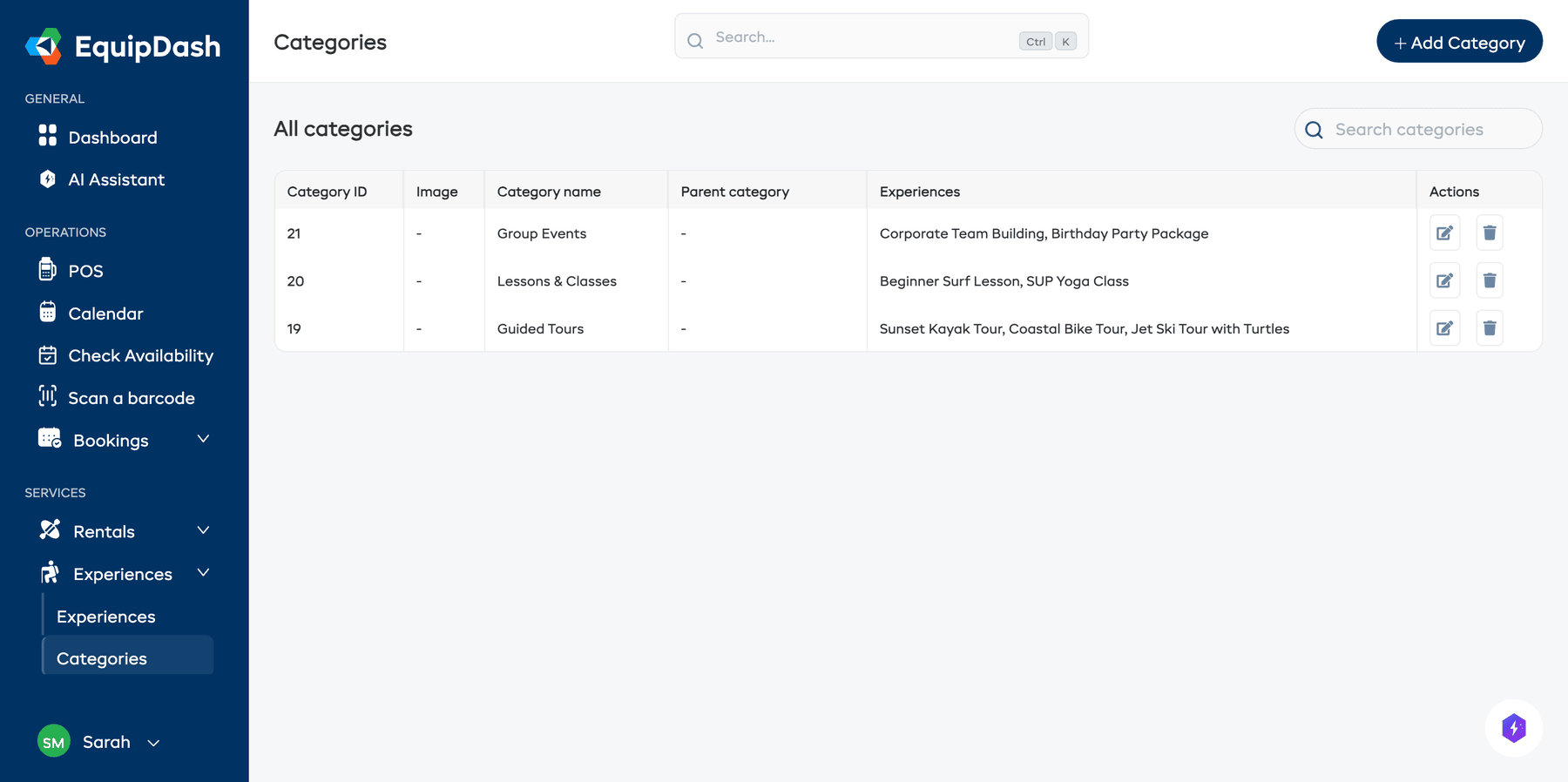
The table shows:
- Category ID — The internal ID of the category.
- Image — The category image (shown in the booking widget).
- Category Name — The display name of the category.
- Parent Category — The parent category, if this is a subcategory.
- Experiences — The names of experiences that belong to this category.
- Actions — Edit or delete the category.
Creating a Category
- Go to Experiences > Categories.
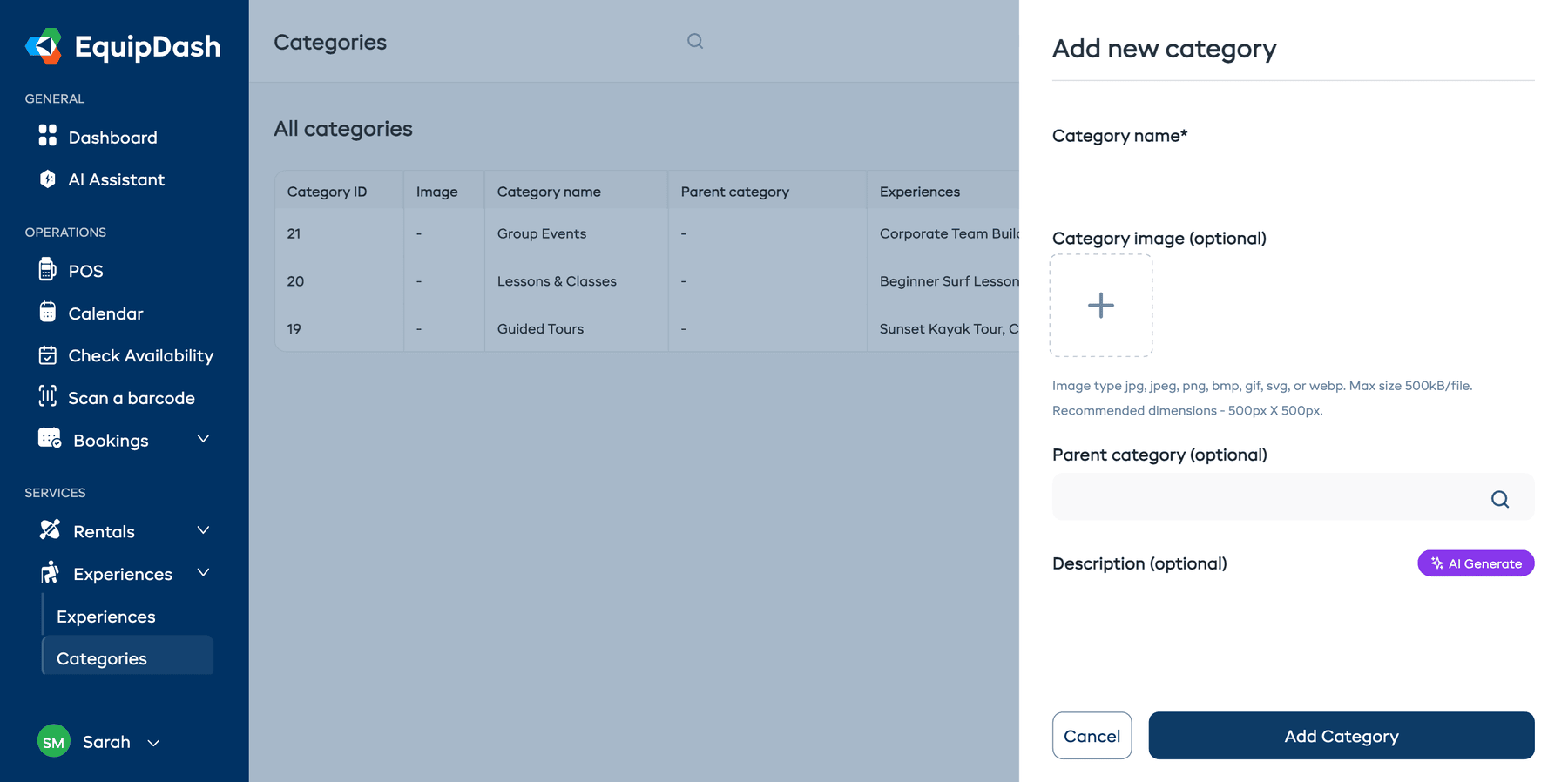
- Click the + Add Category button.
- In the panel that opens, enter a Category name.
- (Optional) Upload a Category image. This is displayed in the booking widget alongside the category name.
- (Optional) Select a Parent category if this is a subcategory.
- (Optional) Add a Description — a short summary visible to customers. You can use the AI Generate button to have EquipDash draft one for you.
- Click Add Category.
Use One Category Across Experiences, Rentals, and Store
If you offer more than one booking type — say experiences and rentals, or experiences and a store — you often want the same category in each. A "Water Sports" group that covers your guided paddle tours, your kayak rentals, and your store accessories should be one category, not three separate ones you keep in sync by hand.
When you add or edit a category, look for the Also use this category for row near the bottom of the panel. It shows a checkbox for each other booking type you have turned on:
- On an experience category, you'll see checkboxes for Rentals and Store (whichever you have enabled).
- Tick a box and the same category is created in that booking type and linked to this one.
Change it once, it updates everywhere
Linked categories share their name, image, and description. Rename "Water Sports" to "On the Water" on the experiences side and the rentals and store versions rename themselves automatically. Swap the image once and every linked copy updates. You manage the category in one place, and it stays consistent across your whole widget.
Each booking type keeps its own list of items, though — a linked "Water Sports" category holds your paddle tours under Experiences, your kayak rentals under Rentals, and your accessories under Store. The shared bit is the label (name, image, description), not the contents.
Already have a matching category? It links instead of duplicating
If a category with the same name already exists in the other booking type and isn't linked yet, ticking the box links to that existing category rather than creating a duplicate.
Unticking the link later
If you edit a linked category and untick one of the boxes, the link is removed. What happens to the other category depends on whether anything still uses it:
- Nothing else uses it (no experiences, products, or sub-categories) — the other category is deleted.
- Something still uses it — it's kept as a standalone category in that booking type, just no longer linked.
The save confirmation tells you which of these will happen before you commit.
Deleting a linked category only removes that category. The linked copies in the other booking types are left exactly as they were.
Assigning Experiences to a Category
You assign an experience to categories when you create or edit it:
- In Step 1 of the experience wizard, type in the Categories search box.
- Select a category from the dropdown — it appears as a pill.
- Add more categories the same way; click the × on a pill to remove one.
- Continue through the wizard and save.
An experience can belong to several categories at once, appearing under each. There's no single "primary" category to set — just add every group the experience belongs in.
Editing a Category
- Go to Experiences > Categories.
- Click the Edit icon on the category row.
- Update the name, description, or image.
- Click Save.
Changes to the category name or image will be reflected everywhere the category is displayed, including the booking widget.
Viewing Category Details
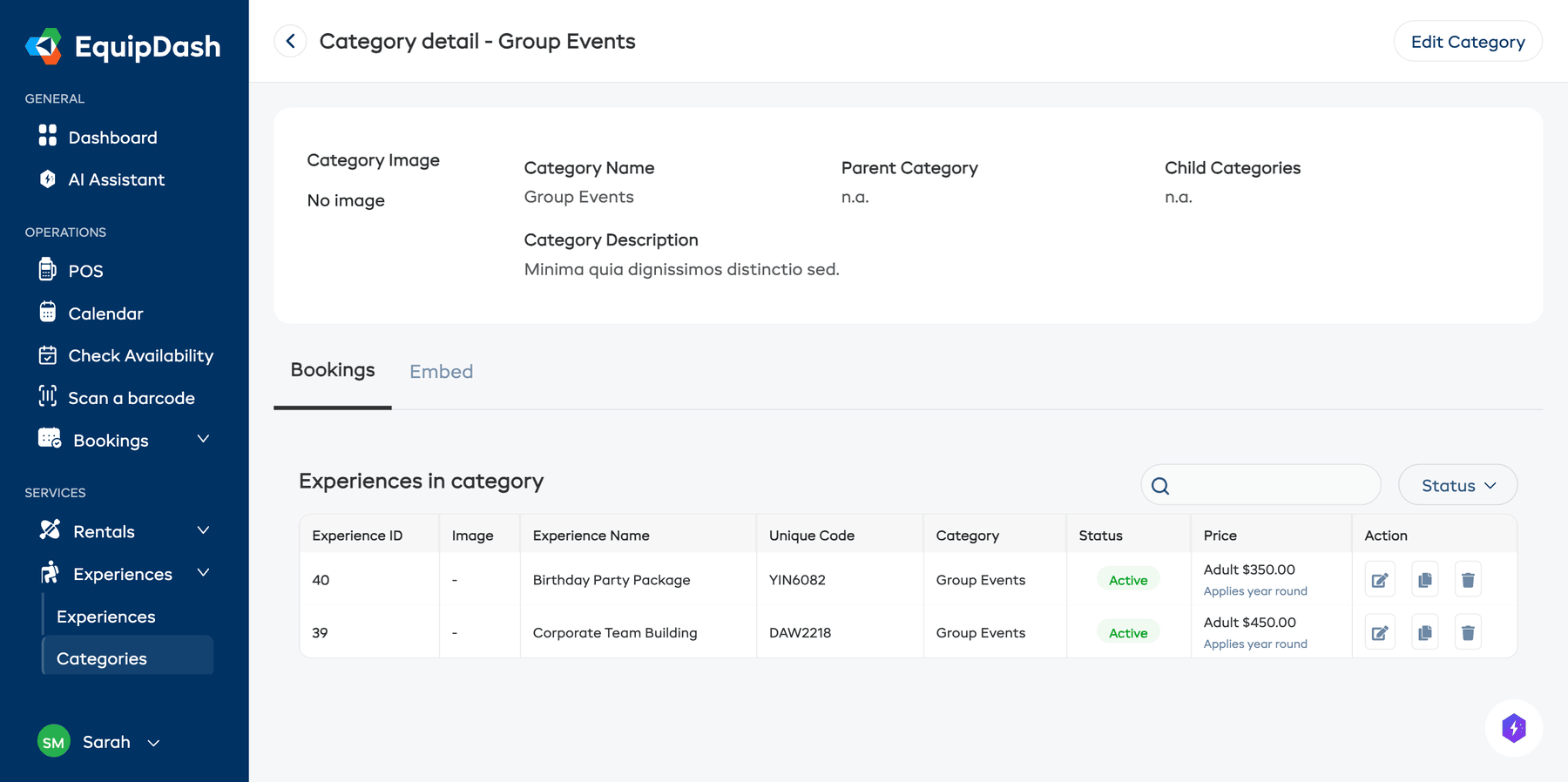
Click a category name in the table to open its detail page. The category detail page shows:
- The category image, name, parent category, and child categories.
- The category description.
- A table of all experiences assigned to this category.
Deleting a Category
- Go to Experiences > Categories.
- Click the Delete icon on the category row.
- Confirm the deletion.
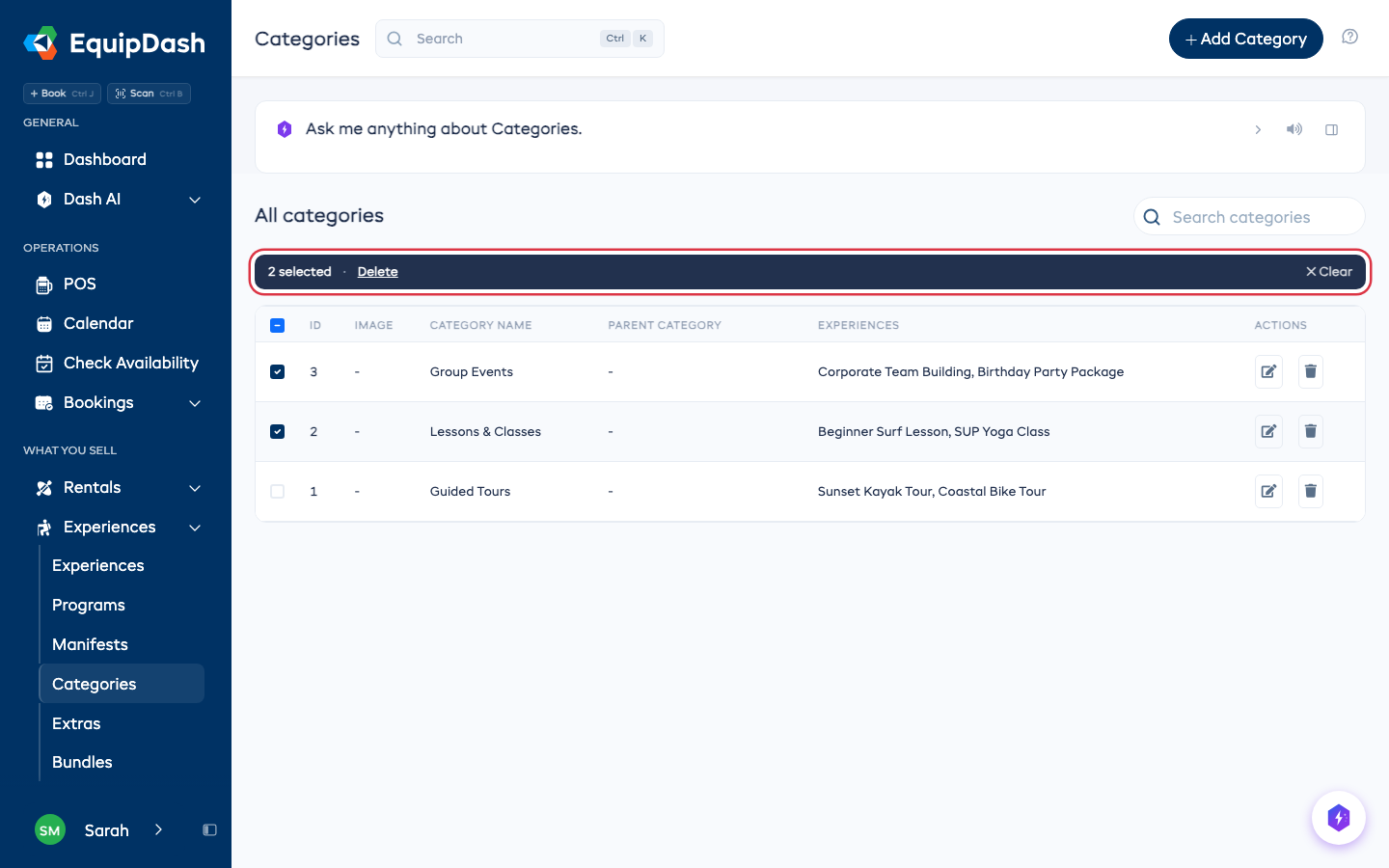
To delete several at once, tick them and click Delete in the bar above the table. Sub-categories are deleted before their parent, so you can tick a parent together with its sub-categories.
A category that still has experiences in it, or a sub-category you are not deleting with it, is kept. Move its experiences to another category first. The confirm tells you how many will stay.
How Categories Appear in the Booking Widget
In the booking widget, categories are shown as filters or tabs that customers can use to browse your experiences.
Customers can click a category to see only the experiences in that group, making it quicker to find what they are looking for.
Tips
- Keep category names short and clear. Customers see these in the widget, so names like "Water Sports" work better than "Water-Based Activities and Tours".
- Use images. A good category image helps customers visually identify the type of activity.
- Do not create too many categories. A handful of well-chosen categories is easier to browse than a long list. Aim for 3 to 8 categories.
- Review periodically. As you add and remove experiences, check that your categories still make sense.