Best FareHarbor Alternatives & Competitors (2026)
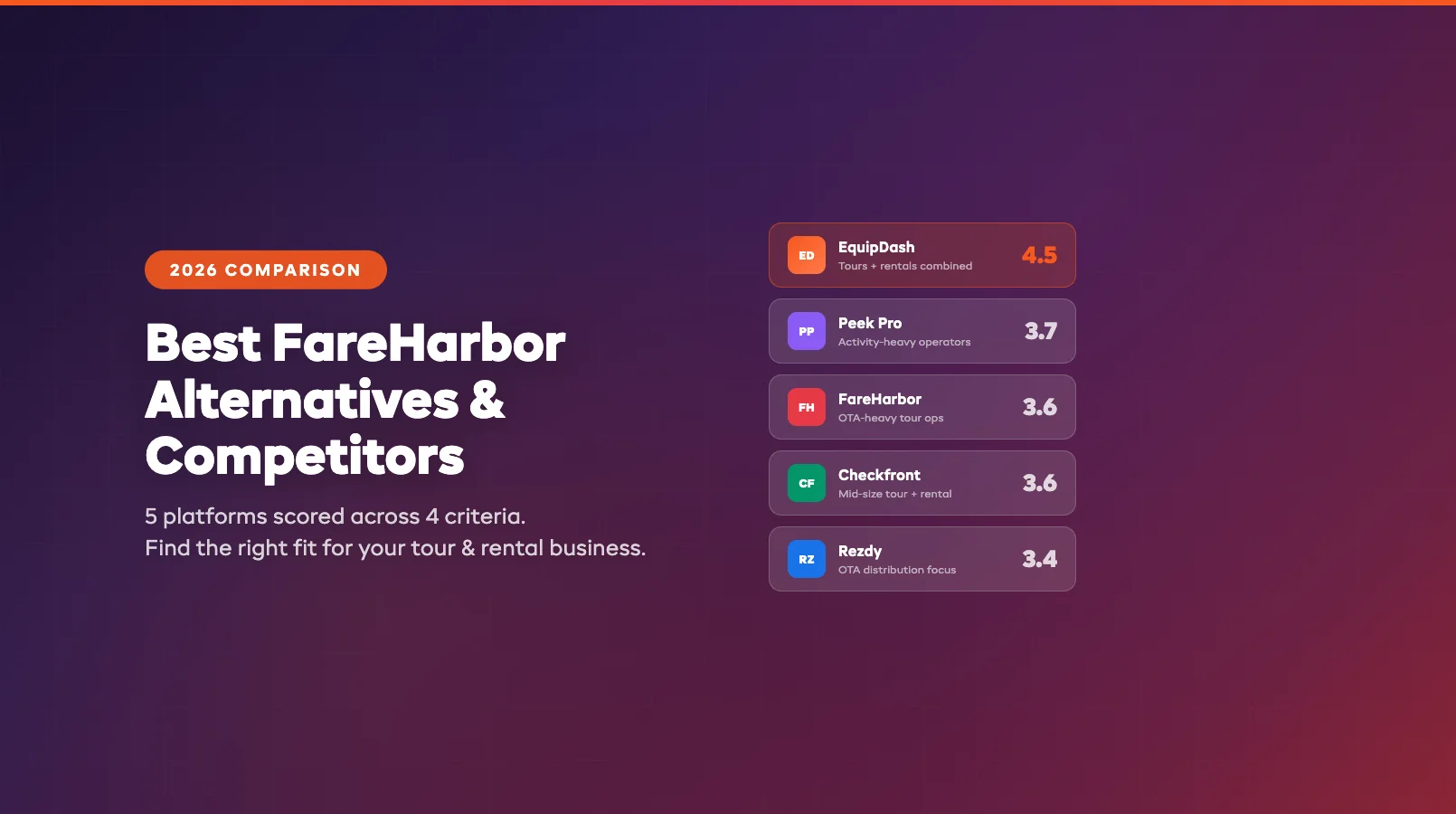
Prefer a direct head-to-head? See our EquipDash vs FareHarbor comparison. Already switching? Skip to the migration guide.
FareHarbor is one of the most widely used booking platforms in the tour and activity industry. It powers thousands of operators, from kayak tours to zipline parks, and its distribution through Booking Holdings gives it serious reach.
But reach comes with trade-offs. FareHarbor's commission-based pricing, limited equipment rental features, and tight integration with Booking Holdings' ecosystem aren't ideal for every operator. If you're a tour business that also rents gear, or you want transparent flat-rate pricing, it's worth looking at what else is out there.
This guide covers what FareHarbor does well, why operators switch, and the best alternatives worth evaluating in 2026. Also comparing Booqable? See our Booqable alternatives guide. For tour-focused platforms, check our Peek Pro alternatives, Rezdy alternatives, TripWorks alternatives, and Xola alternatives guides.
In this guide:
- What FareHarbor Does Well
- Common Reasons Operators Switch
- Top FareHarbor Alternatives Compared
- Alternative-by-Alternative Reviews
- Keeping Your Distribution Network
- FAQ
What FareHarbor Does Well
Before evaluating alternatives, understand what makes FareHarbor work for the operators who stay. If your operation fits these strengths, switching may not be worth the effort.
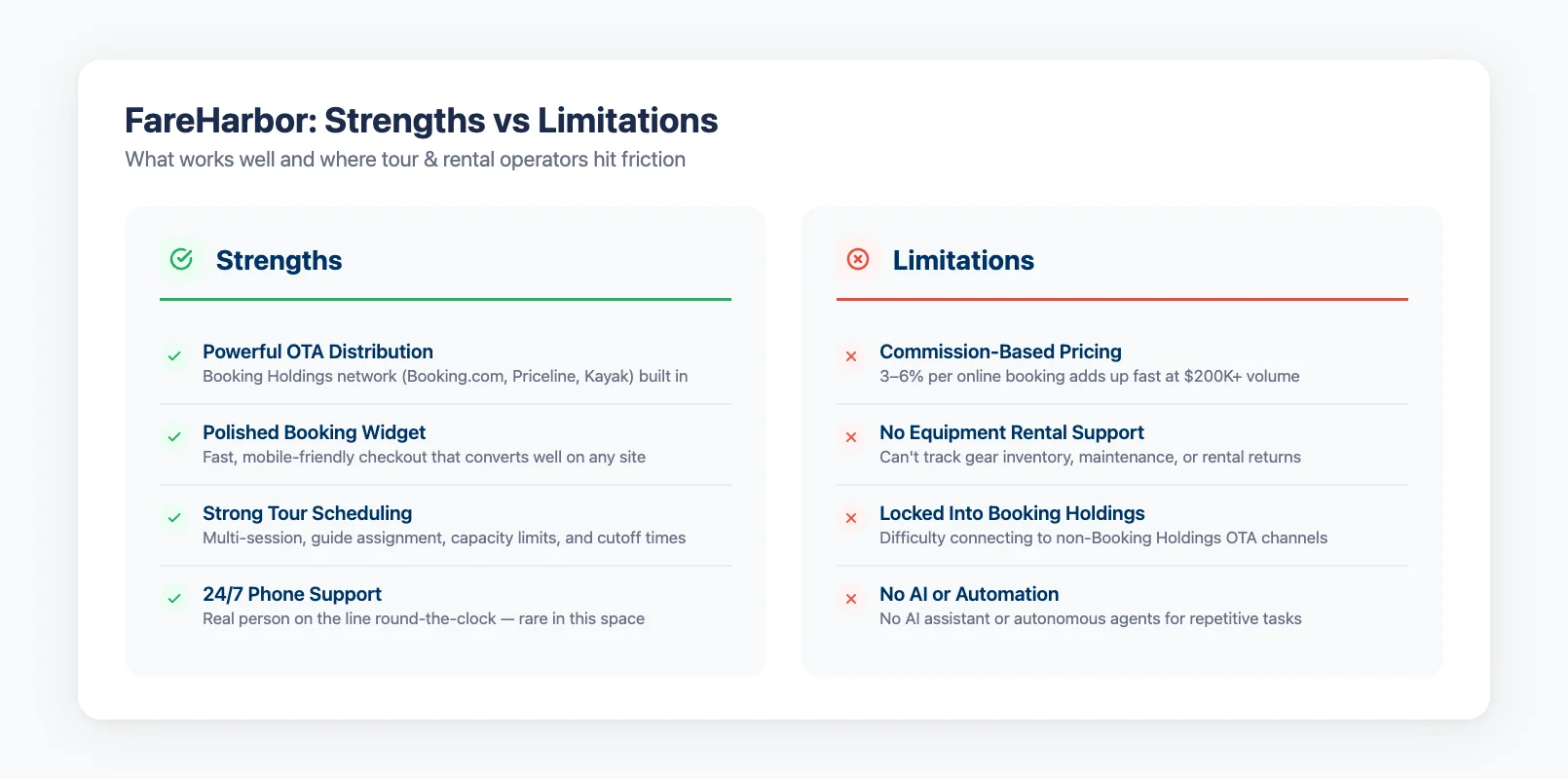
Powerful distribution network. FareHarbor is owned by Booking Holdings (parent company of Booking.com, Priceline, and Kayak). This gives operators access to a massive distribution pipeline. If most of your bookings come through OTAs, FareHarbor's network is hard to beat.
Polished booking widget. The embeddable booking widget is fast, mobile-friendly, and converts well. Customers can browse availability, pick a time slot, and pay, all without leaving your site. It's one of the best booking widgets in the industry.
Strong tour scheduling. Multi-session scheduling, guide assignment, capacity limits, and cutoff times work smoothly. For operators running 10+ tours per day, FareHarbor handles the scheduling complexity reliably.
24/7 phone support. FareHarbor offers round-the-clock phone support, a rarity in this space. When something breaks during a busy Saturday morning, having a real person on the line matters.
Common Reasons Operators Switch
The friction points tend to surface around pricing, flexibility, and the growing need for equipment rental alongside tours.
Commission-based pricing. FareHarbor charges a percentage on every online booking. The exact rate varies by operator and isn't publicly listed, but it typically ranges from 3% to 6%. At $200K+ annual booking volume, that adds up fast: $6,000 to $12,000 in commissions alone. Flat-rate alternatives can save thousands per year.
No equipment rental management. If you rent kayaks, bikes, or snorkel gear alongside guided tours, FareHarbor can't track that inventory. You'll need a separate system for availability, maintenance, and returns — creating double work and risking double bookings.
Locked into Booking Holdings' ecosystem. While the OTA distribution is a strength, it also creates dependency. Operators report difficulty connecting to non-Booking Holdings channels. If you want to list on Viator (TripAdvisor) or GetYourGuide while also using FareHarbor, the integrations can feel one-sided.
Limited customization. The booking flow looks professional, but customizing it beyond basic branding is restricted. Operators wanting unique checkout experiences, custom fields per product, or conditional logic in their booking forms often hit walls.
No AI or automation tools. FareHarbor doesn't include an AI assistant or autonomous agents. Customer follow-ups, review requests, demand forecasting, and late-return alerts are all manual processes. As booking volume grows, this becomes a significant operational burden.
Top FareHarbor Alternatives Compared
We evaluated each platform using the same six weighted criteria from our equipment rental software comparison: core rental features (25%), tour support (15%), ease of use (20%), pricing transparency (15%), integrations (10%), and customer support (15%).
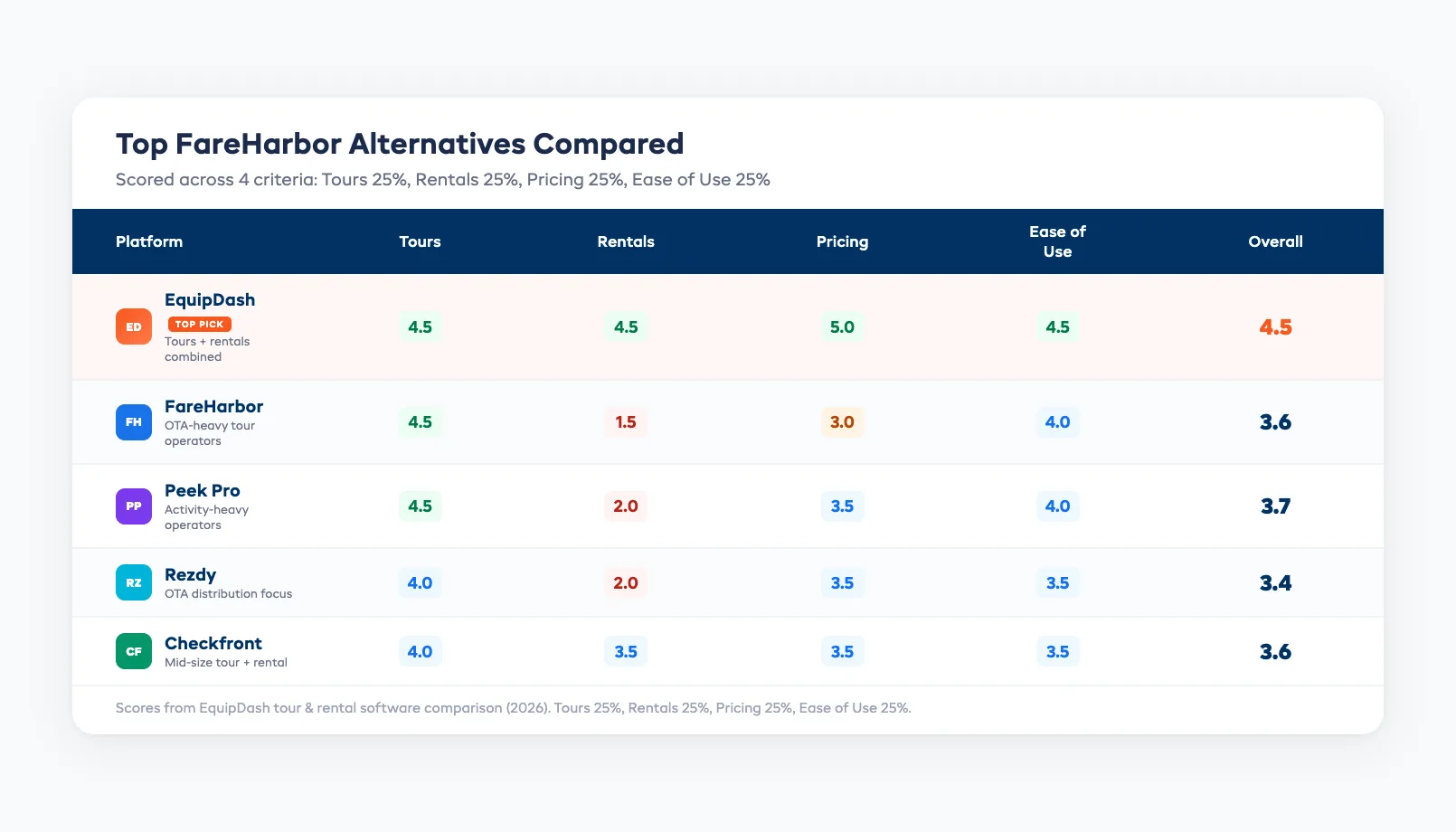
| Platform | Best for | Tours | Rentals | Pricing | Ease of use | Overall |
|---|---|---|---|---|---|---|
| EquipDash | Tours + rentals combined | 4.5 | 4.5 | 5.0 | 4.5 | 4.5 |
| FareHarbor | OTA-heavy tour operators | 4.5 | 1.5 | 3.0 | 4.0 | 3.6 |
| Peek Pro | Activity-heavy operators | 4.5 | 2.0 | 3.5 | 4.0 | 3.7 |
| Rezdy | OTA distribution focus | 4.0 | 2.0 | 3.5 | 3.5 | 3.4 |
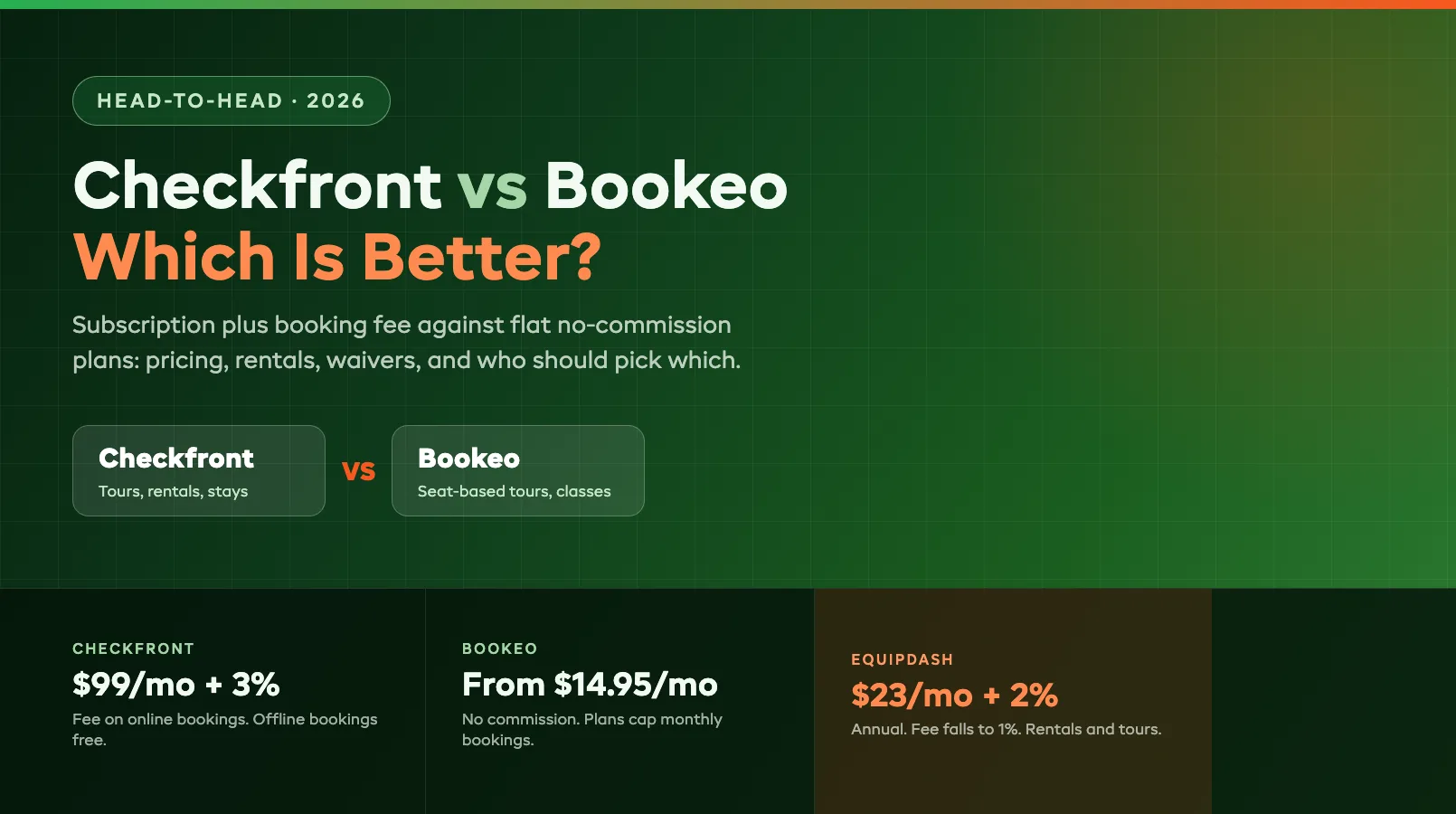
| Checkfront | Mid-size tour + rental | 4.0 | 3.5 | 3.5 | 3.5 | 3.6 |
Key takeaway: FareHarbor leads for OTA-dependent tour operators. But if you need equipment rentals, flat-rate pricing, or AI automation, alternatives like EquipDash deliver more value at a lower total cost.
Alternative-by-Alternative Reviews
EquipDash: Best for Tours + Rentals in One Platform
EquipDash is built for operators who run tours and rent equipment from the same business. Guided kayak trips with gear rental, bike tours with helmet and lock packages, snorkel excursions with equipment hire — one dashboard handles both sides without stitching together separate tools.
The AI assistant (Dash AI) is the biggest differentiator. Ask it to check tomorrow's availability, pull a revenue report, or look up a customer's booking history. Dash Agents run tasks autonomously: sending waiver reminders, alerting you to late returns, and following up on unsigned waivers.
Where it beats FareHarbor:
- Handles both tours and equipment rentals natively, no second system
- Flat-rate pricing starting at $23/mo (annual), no per-booking commissions
- Built-in AI assistant and autonomous agents
- Native POS for walk-in customers
- Multi-location support out of the box
Pricing: Starter $23/mo, Growth $55/mo, Pro $119/mo (annual billing). Platform fee: 2% / 1.5% / 1%. At $100K annual booking volume, total cost ranges from $2,160 to $2,428/yr: versus $3,000–$6,000+ in FareHarbor commissions at the same volume.
Best fit: Operators who run tours and rent gear from the same business, or who want transparent pricing without per-booking commissions.
Peek Pro: Best for Activity-Heavy Tour Operators
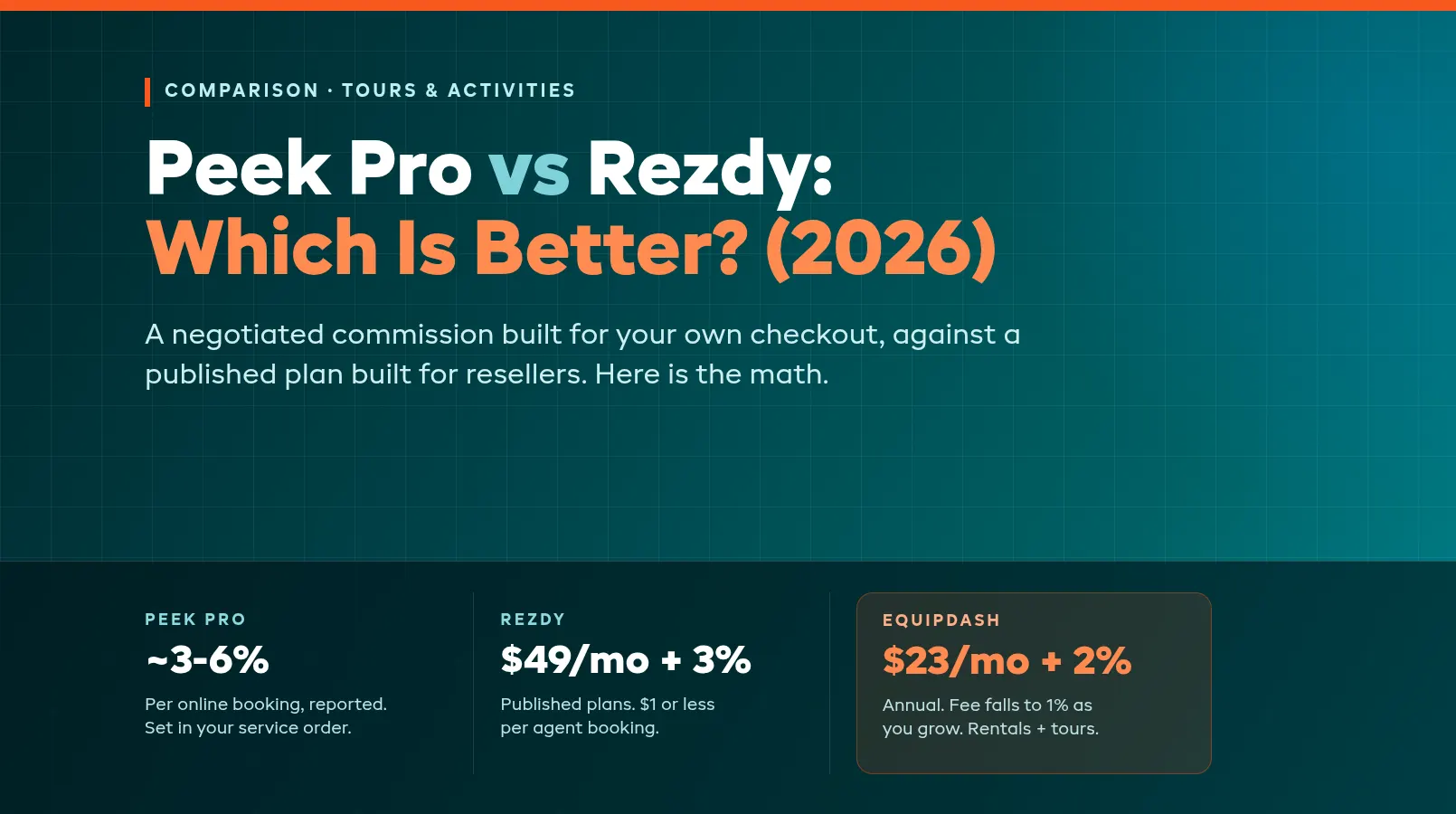
Peek Pro is FareHarbor's closest direct competitor. It targets tour and activity operators with a similar commission-based model but adds more operational tools: staff scheduling, digital waivers, and smart pricing that adjusts rates based on demand.
Where it beats FareHarbor:
- Built-in dynamic pricing (adjusts rates automatically)
- Better staff scheduling and assignment tools
- Stronger digital waiver integration
- More flexible booking flow customization
Where it falls short:
- Also uses commission-based pricing — same fundamental cost issue
- Limited equipment rental features
- Smaller OTA distribution network than FareHarbor
Best fit: Tour operators who want FareHarbor-style booking with better operational tools and don't mind commission pricing.
Rezdy: Best for OTA Distribution Focus
Rezdy specializes in connecting tour operators to the widest possible OTA network. If maximizing distribution across Viator, GetYourGuide, Expedia, and dozens of smaller channels is your top priority, Rezdy's channel manager is best-in-class.
Where it beats FareHarbor:
- Wider OTA distribution (not limited to Booking Holdings channels)
- Agent-friendly booking portal for resellers
- Per-connection pricing gives more control over channel costs
Where it falls short:
- Interface feels dated compared to FareHarbor
- Limited equipment rental support
- Steeper learning curve for the channel manager
Best fit: Tour operators whose revenue depends heavily on OTA bookings and want maximum distribution reach.
Checkfront: Best for Mid-Size Tour and Rental Operations
Checkfront bridges the gap between tour-only and rental-only platforms. It handles bookings for both equipment and experiences, with decent OTA distribution and flexible pricing rules.
Where it beats FareHarbor:
- Supports both rentals and tours in one platform
- Flat-rate pricing (no per-booking commissions)
- More flexible pricing rules and discount structures
Where it falls short:
- Interface feels less polished than FareHarbor
- Steeper learning curve
- Smaller distribution network
Best fit: Mid-size operators (10–50 employees) who run both tours and rentals and want to avoid commission pricing.
Keeping Your Distribution Network
The biggest concern when switching from FareHarbor is losing OTA bookings. Here's how to protect your distribution:
1. Audit your booking sources. Before switching, check what percentage of bookings come through FareHarbor's OTA network versus direct bookings. If direct bookings account for 60%+ of revenue, the OTA dependency is lower than you think.
2. Connect OTAs directly. Most major OTAs (Viator, GetYourGuide, Expedia) offer direct API connections. You don't need FareHarbor as a middleman — your new platform can connect to the same channels.
3. Ramp up direct bookings. Use Google Business Profile, your website's booking widget, and email marketing to shift more customers to direct bookings. Direct bookings have zero commission regardless of platform.
4. Overlap for 30 days. Run both systems in parallel for a month. Keep FareHarbor active for OTA bookings while your new platform handles direct bookings. Once you've confirmed OTA connections work on the new platform, cut over completely.
Timeline: Most operators complete the full transition in 2–4 weeks with minimal revenue disruption.
Frequently Asked Questions
Why are tour operators switching from FareHarbor? The top reasons are commission-based pricing (3–6% per booking adds up at volume), limited equipment rental support, and dependency on Booking Holdings' distribution network. Operators who rent gear alongside tours or want flat-rate pricing find better options elsewhere.
Which FareHarbor alternatives don't charge commissions? EquipDash and Checkfront both use flat-rate monthly pricing instead of per-booking commissions. EquipDash starts at $23/mo (annual) with a 2% platform fee — significantly lower than FareHarbor's typical 3–6% commission at most booking volumes.
Can I keep my OTA connections if I leave FareHarbor? Yes. Major OTAs like Viator, GetYourGuide, and Expedia offer direct API connections independent of FareHarbor. Your new platform connects to the same channels. Run both systems in parallel for 30 days to ensure a smooth transition.
Is FareHarbor good for equipment rental businesses? No. FareHarbor is designed for tours and activities, not equipment rentals. It lacks inventory tracking, maintenance scheduling, and rental-specific availability management. If you rent gear alongside tours, you'll need a second system, or a platform like EquipDash that handles both natively.
in one place