AI for Tour Operators: The Complete Guide to Smarter Operations (2026)
Every tech company selling to tour operators now leads with the same word: AI. The pitch is always grand and always vague. Then you look at your own operation (a sea kayak fleet, three guides, a wall calendar covered in sticky notes, an inbox that never empties) and wonder what any of it has to do with filling tomorrow's 9 AM departure.
Here's the honest version. AI isn't a robot guide or a dashboard that runs your business while you sleep. For a tour operator, it's a set of tools that quietly handle the repetitive work happening between bookings: nudging a half-full tour to capacity, answering the same five questions at midnight, adjusting prices when demand spikes, and warning you which week next month will be slammed.
This guide walks through the specific ways AI applies to tour and activity operations in 2026. No theory, no buzzwords. What works, what doesn't, and how a small operator gets started without a tech team or a big budget.
How AI Is Changing Tour Operations
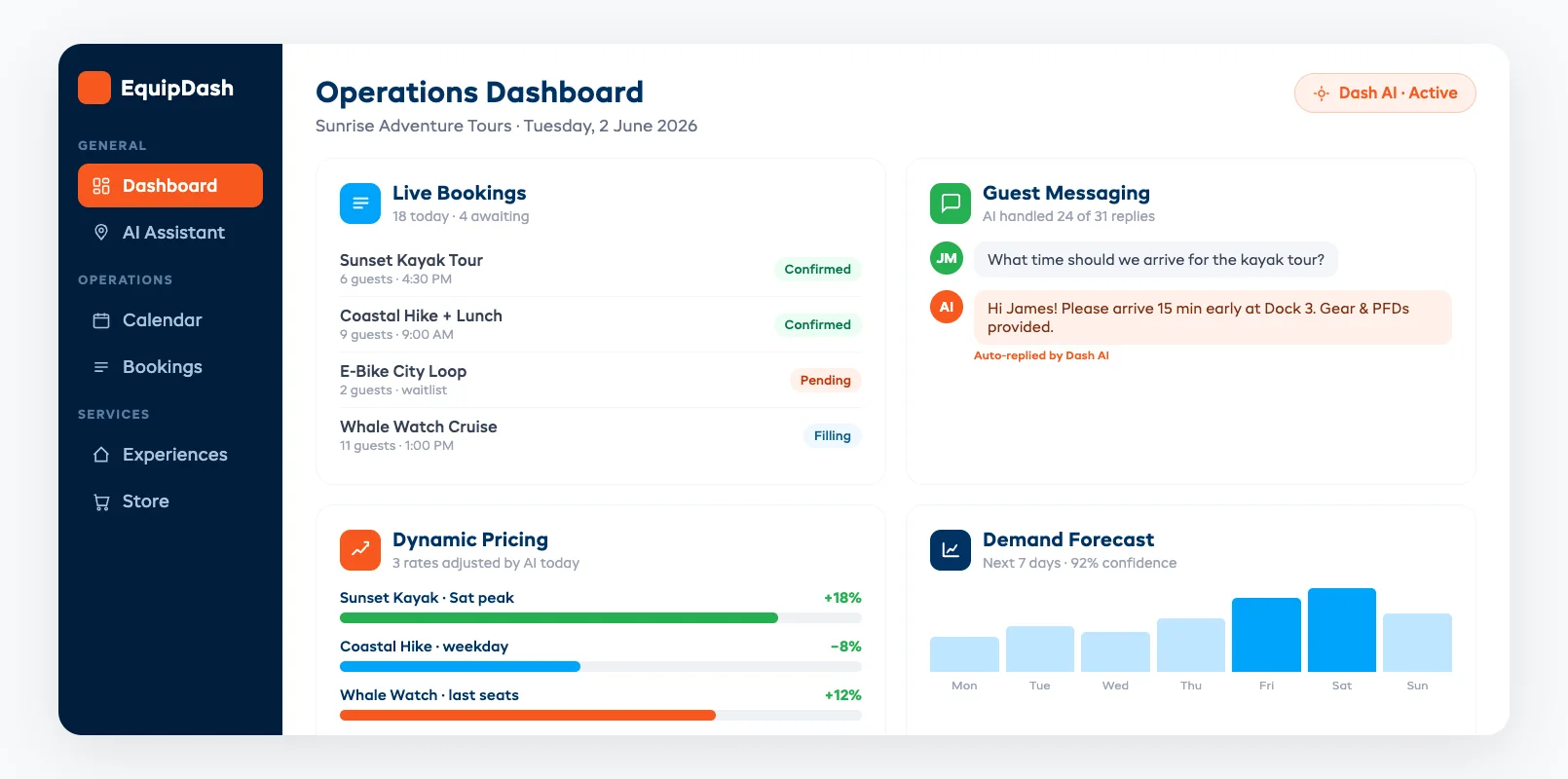
Strip away the marketing and AI does three concrete things for a tour operator.
First, it watches patterns no human can hold in their head. You can track maybe a dozen things at once. This weekend's bookings, tomorrow's forecast, which guide is off Thursday. A trained system processes thousands of signals together: years of booking history, weather, local events, cancellation rates, the hour of day each guest tends to book. It spots the pattern that a Tuesday-morning sunset paddle always sells out by Sunday night, and tells you before you'd have noticed.
Second, it makes the routine decisions faster than you can. Should the 2 PM zip-line tour drop its price to fill the last four seats? The system already checked the forecast, compared it to the same date last year, and saw the tour is tracking 30% behind. It can suggest, or quietly make, the adjustment hours before you'd open the calendar.
Third, it handles the communication you keep meaning to send. The booking confirmation at 11 PM. The "bring a windbreaker" note the morning of. The review request the day after. None of these are hard. They're just the tasks that slide when you're guiding a trip or fixing a trailer.
The distinction that matters: this technology doesn't replace what makes you good at running tours. You still design the experiences, train the guides, read the group, and make the safety calls. It clears the administrative weight off your shoulders so you spend your hours on the parts of the job that actually need a human.
For operators choosing the platform underneath all this, our tour operator software guide breaks down what to look for. And if you also rent equipment, the same patterns apply on the gear side. See our companion guide to AI for equipment rental businesses.
Booking Optimization: Fill More Seats Automatically
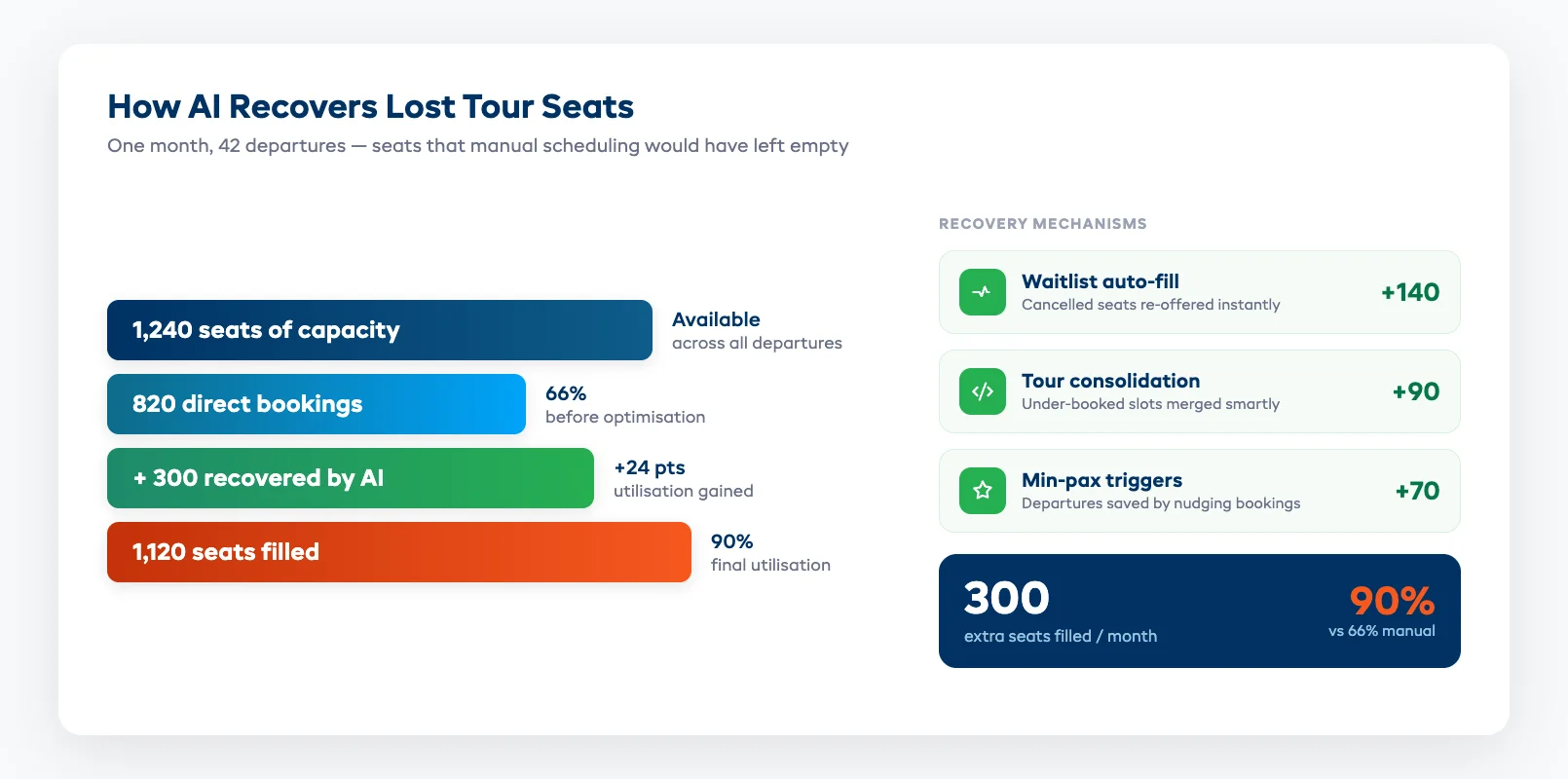
Most tours run below capacity. A boat licensed for 12 leaves with 8. A walking tour built for 15 goes out with 9. That empty space is pure lost margin — the guide costs the same, the fuel costs the same, the permit costs the same whether the trip is full or half-empty.
Booking optimization is the work of closing that gap, and it's where automation pays back fastest. A few mechanisms do the heavy lifting:
- Smart waitlists. When a popular departure fills, the next interested guest joins a managed waitlist instead of bouncing to a competitor. The moment a cancellation hits, the seat is offered automatically, in order, with a time-limited hold.
- Group consolidation. Two half-full departures an hour apart are a scheduling problem. The system can flag them, prompt a merge, and message both sets of guests with the new time, turning two unprofitable trips into one full one.
- Minimum-pax triggers. Set the threshold a tour needs to run. When a departure is short with 48 hours to go, the system can nudge nearby time slots, open a discount, or alert you to combine or cancel before you've committed a guide.
- Overbooking guardrails. If your no-show rate is a predictable 8%, a system can let you sell slightly past capacity with rules that protect you from the bad day when everyone shows.
The foundation under all of this is real-time availability that every channel reads from: website, walk-ins, phone, OTA partners. If your inventory lives in one connected place, optimization is automatic. If it's spread across a spreadsheet and three booking sites, you're back to manual reconciliation. Our online booking system guide covers how that live availability layer works.
AI Chatbots: Handle Guest Questions 24/7
Look at your inbox and message threads for a week. Strip out the genuinely unusual requests and you're left with the same handful of questions, asked over and over: Is Saturday available? What's your cancellation policy? Where do we meet? Is it suitable for kids? What happens if it rains?
These questions arrive at every hour, and a large share land after you've closed. A guest browsing at 10 PM who can't get an answer often books the operator who could. An AI chatbot exists to close that gap, not to sound clever, but to answer accurately and instantly so the booking doesn't slip away overnight.
A well-built assistant handles availability checks against your live calendar, quotes prices and packages, explains cancellation and weather policies, shares meeting-point details and what to bring, and confirms suitability for age, fitness, or experience level. When it hits something it genuinely can't resolve (a custom private charter, a medical question, a complaint) it hands off cleanly to you with the full conversation attached, so the guest never repeats themselves.
The line to hold is judgment. A chatbot should answer questions and take bookings; it should not make safety determinations or override a guide's call on conditions. Used that way, it covers the after-hours and overflow volume that would otherwise need a person on the phone, and frees your team to handle the conversations that actually need them. For a deeper look at this one tool, we cover AI chatbots for tour operators in the wider software guide.
Dynamic Pricing for Tours and Activities
Most operators set a price per tour and leave it there all season. Maybe there's a peak rate and an off-peak rate. That's two price points for a business with dozens of variables moving every week: weather, day of the week, how far ahead the booking is, how full the trip already is, what's happening in town.
Dynamic pricing means letting those variables move the price within limits you set. You're not handing the keys to an algorithm and hoping. You define the floor (never sell below this), the ceiling (never gouge past this), and the rules, then let the system adjust inside that box.
The patterns that work for tours:
- Peak-time premiums. A sunset sail on a clear Saturday in July is worth more than the same trip on a gray Wednesday in May. Pricing that recognizes the difference captures revenue you're currently leaving on the table.
- Early-bird and last-minute rates. Reward guests who commit early with a lower price, and recover empty same-day seats with a modest discount rather than running half-full.
- Demand-responsive adjustment. When a departure is selling far faster than usual, nudge the price up. When it's lagging, ease it down to fill. The system makes the small, frequent calls you'd never have time to make by hand.
- Group and package rates. Automate the math on group discounts and bundled experiences so the quote is instant and consistent.
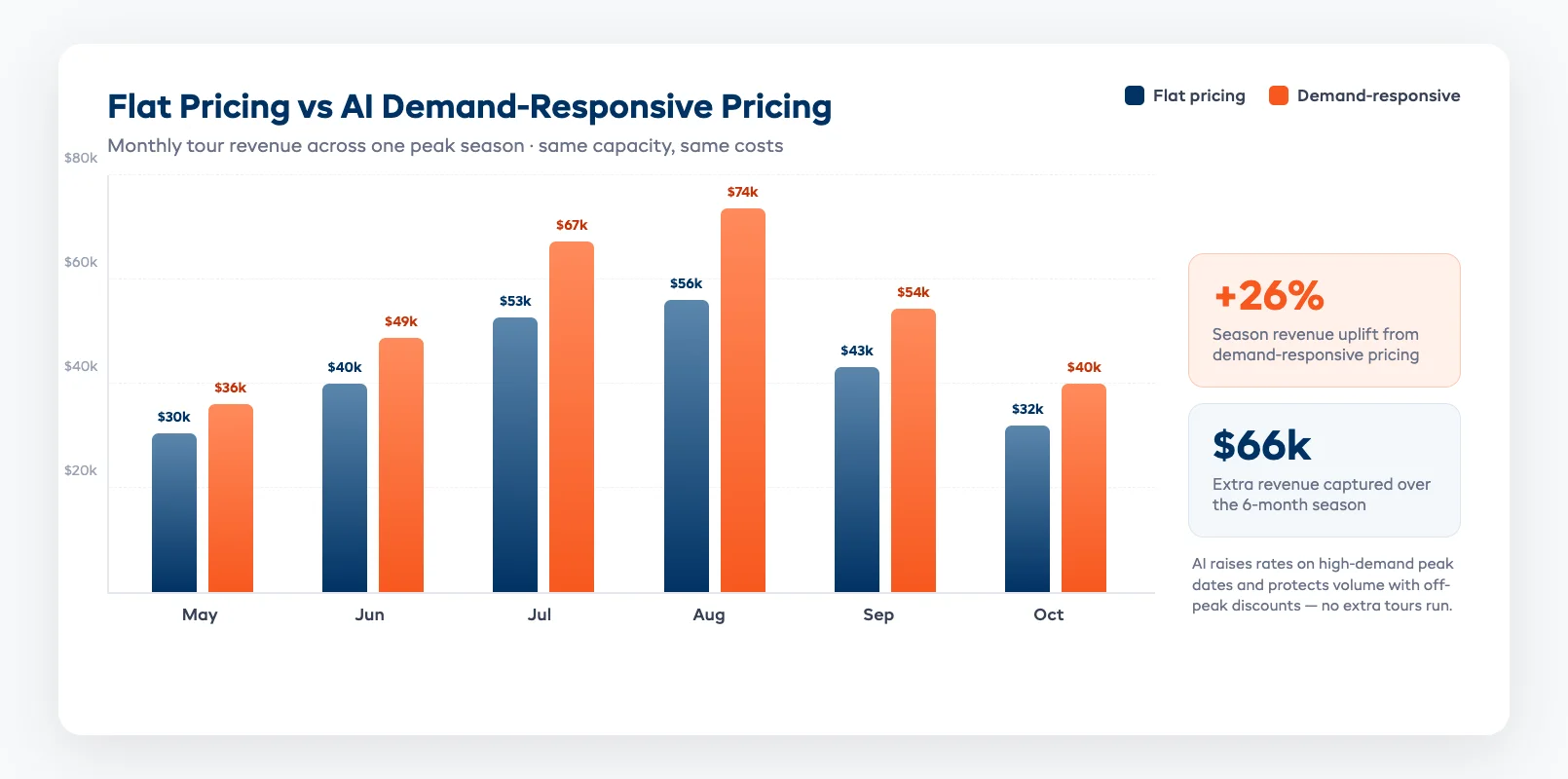
The guardrails are what make this safe for a small operator. Set your price floor so you're never undercutting your own brand, cap the upside so regulars don't feel punished on a hot weekend, and review the results monthly. The goal isn't airline-style surge pricing that annoys people. It's catching the obvious revenue you give away every time a high-demand slot sells at the same price as a slow one. For the full playbook on surge rules, early-bird and last-minute rates, and the price floors that keep it safe, see our guide to AI dynamic pricing for tours and activities.
Demand Forecasting for Seasonal Operators
The hardest part of running a seasonal tour business is committing resources before you know what's coming. Hire too many guides and you pay them to stand around in a quiet week. Hire too few and you turn away a sold-out Saturday because no one's free to run the second boat. Order too much gear and it sits; order too little and you cap your own revenue.
Demand forecasting turns last year's hindsight into next month's foresight. A forecasting model reads your historical bookings, layers in weather trends, local event calendars, school holidays, and even booking pace (how fast reservations are coming in compared to the same point last year) and projects the weeks ahead.
That projection changes three decisions:
- Staffing. Schedule guides against predicted demand instead of gut feel. Roster up for the week the system flags as 40% above normal; trim hours for the lull before it.
- Gear and prep. Know which weekends will run every boat or bike so maintenance happens in the quiet windows, not the morning of a sold-out trip.
- Marketing spend. Pour promotion into the soft weeks the forecast surfaces, and stop spending to fill departures that are already going to sell out.
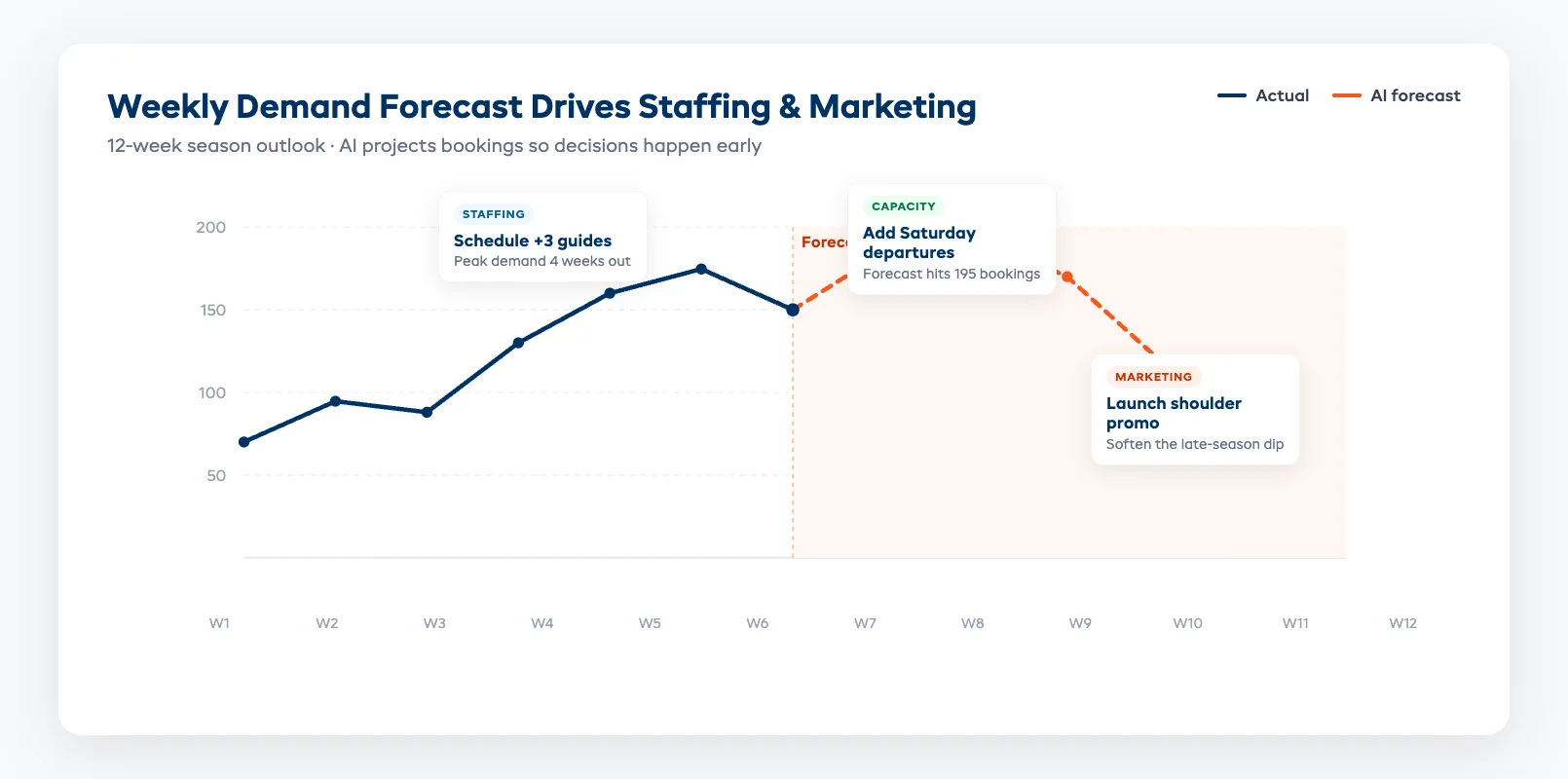
No forecast is perfect, and a freak storm or a viral post will still surprise you. But a model that's even 80% right beats a calendar of guesses. Operators who plan a season against real projections stop the two most expensive mistakes in the business — overstaffing dead weeks and getting caught flat-footed when the rush lands.
Guest Communication on Autopilot
There's a chain of messages every good tour operator sends, and almost everyone drops links in it when they get busy. The booking confirmation. The pre-trip prep email three days out. The weather-and-meeting-point note the morning of. The thank-you and review request the day after. Each one is simple. Together they're the difference between a guest who feels looked after and one who shows up confused or never leaves the review that would've won you the next ten bookings.
Automating that chain means it runs whether you remember it or not:
- Confirmation goes out the instant a booking lands, with everything the guest needs in one place.
- Pre-trip preparation lands a few days before, covering what to wear, what to bring, and where to be.
- Day-of details confirm the meeting point, the conditions, and any last change — exactly when guests are checking their phones.
- Post-trip follow-up thanks the guest and asks for a review while the experience is fresh, which is when people actually leave them.
The quiet upgrade is personalization without the manual work. A message can pull the guest's name, their specific tour, the gear they reserved, and the right meeting point automatically, so a templated email reads like you wrote it for them. Tools like Dash AI can even draft the wording in your voice, leaving you to approve rather than compose. The result is communication that's consistent on your busiest day, which is exactly when it usually falls apart. For the full message-by-message playbook (confirmation, pre-trip prep, day-of weather and meeting-point alerts, and the post-trip review request) see our guide to automated guest communication for tour operators.
AI Personalization: The Right Tour for the Right Guest
Personalization sounds like a big-tech word, but for a tour operator it's plain common sense applied at scale. A guest who booked a beginner kayak tour and loved it is a strong candidate for the half-day coastal trip, not the advanced whitewater run. A family who came for the easy nature walk wants the gentle wildlife cruise next, not the via ferrata.
You already make these matches by instinct when you talk to someone at the dock. The value of software is doing it for the hundreds of guests you never get a face-to-face minute with.
Practical personalization for tours looks like:
- Recommendation prompts. After a booking or a completed trip, suggest the next experience that fits what this guest actually chose — based on their history, not a generic blast.
- Upsells that don't feel pushy. Offer the photo package, the gear upgrade, or the longer version at the moment it's relevant, framed as an option rather than a hard sell.
- Repeat-guest recognition. Greet returning guests as returning guests. Knowing someone's third trip with you, and saying so, turns a transaction into a relationship.
The fuel for all of this is data you already have: booking history, tour types, group sizes, the time of year people come. You're sitting on it; most operators just never put it to work. The one rule to hold is trust. Use the data to be genuinely helpful, be transparent about it, and never trade guest privacy for a marginal upsell. Done right, personalization makes guests feel known, and guests who feel known come back.
Getting Started: Practical AI for Small Operators
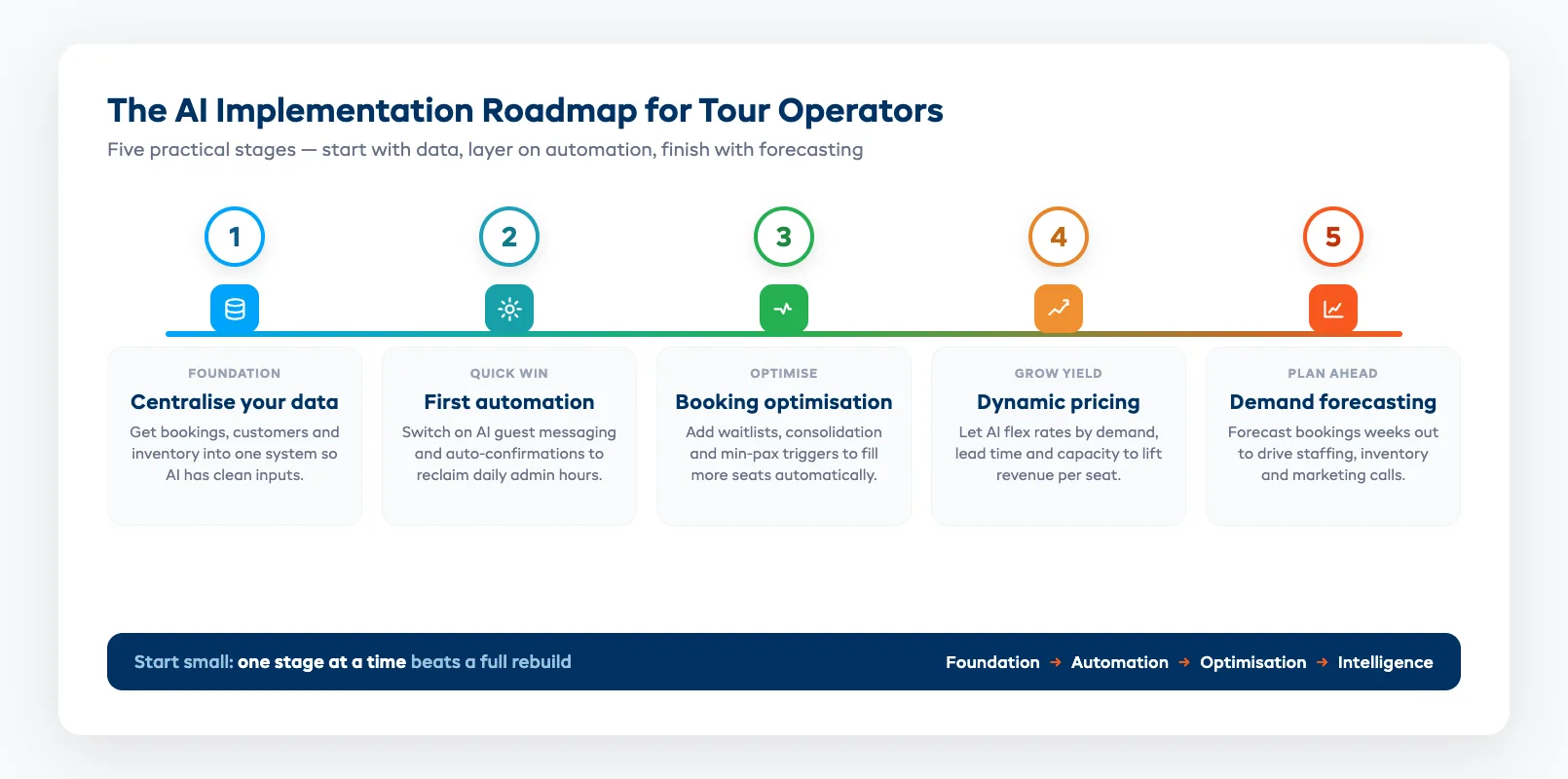
You don't roll out everything above at once, and you don't need a developer or a five-figure budget to begin. The operators who succeed with this start small, prove the value, and expand. Here's the path.
- Get your data in one place. None of this works on top of a spreadsheet and three disconnected booking sites. Before anything else, move bookings, availability, guests, and gear into one connected system. This single step makes every later feature possible.
- Start with one automation that hurts. Pick the task that costs you the most time or revenue today, usually after-hours inquiries or the guest communication chain. Automate that one thing and live with it for a few weeks before adding more.
- Turn on booking optimization. Once availability is centralized, enable waitlists and minimum-pax rules. Recovering even a few seats a week pays for most platforms outright.
- Add dynamic pricing with tight guardrails. Set a firm floor and ceiling, switch on peak-time and last-minute rules, and review the numbers monthly before loosening anything.
- Layer in forecasting before your next season. With a season of clean data in one system, let demand projections drive your staffing and marketing instead of last year's memory.
The mistake to avoid is buying a pile of single-purpose tools that don't talk to each other: a chatbot here, a pricing app there, an email tool somewhere else. The whole advantage of this technology comes from one connected system where booking, communication, pricing, and forecasting share the same live data. An all-in-one platform like EquipDash, with Dash AI built in, gives a small operator those capabilities without a tech team — starting at $23/month on an annual plan. Pick one feature, prove it earns its keep, and grow from there.
FAQ
Do I need to be technical to use AI for my tour business?
No. Modern AI tools for tour operators are built for people who run trips, not write code. You set rules in plain language ("offer the last seats at 10% off when a tour is under half full 24 hours out") and the system handles the rest. If you can manage a booking calendar on your phone, you can run these tools.
How much does AI tour operator software cost?
Most platforms with built-in AI features run roughly $25–$150 per month depending on your volume and the plan. EquipDash starts at $23/month on an annual plan, with AI capabilities included rather than sold as add-ons. The revenue recovered from filling a few extra seats or catching peak-day pricing usually covers the cost within the first month.
Will AI replace my guides or staff?
No. AI handles the repetitive work between bookings: confirmations, after-hours questions, price adjustments, review requests. Your guides still run the experience, read the group, and make the safety calls, and you still design the tours and build the relationships. Operators typically report it frees up 10–15 hours a week that goes back into guest-facing work.
What's the first thing I should automate?
Start with whatever costs you the most time or lost bookings today. For most operators that's either after-hours guest questions, handled by a chatbot, or the guest communication chain of confirmations, prep emails, and review requests. Automate one thing, run it for a few weeks, then add the next.
How much booking data do I need before AI is useful?
For communication and chatbot features, you can start day one. For pricing and demand forecasting, one full season of digital booking history is enough to produce meaningful results, and the projections sharpen as more data accumulates. The key requirement is that the data lives in one connected system rather than scattered across tools.
Is dynamic pricing going to annoy my regular customers?
Only if you let it run without limits. Set a firm price floor and ceiling, keep adjustments modest, and the changes feel like normal early-bird and peak-season pricing, which guests already expect. The goal is catching obvious revenue, like a sold-out summer Saturday priced the same as a slow weekday, not airline-style surge pricing.
Can one system handle bookings, pricing, communication, and forecasting together?
Yes, and that's the setup worth aiming for. The advantage of AI comes from one connected platform where bookings, guest messaging, pricing, and forecasting share the same live data. All-in-one tools like EquipDash bundle these capabilities so a small operator gets them without stitching together separate apps that don't talk to each other.
in one place