Captained Charter vs Bareboat Rental: Operator Economics
You own a 26-foot pontoon. You can rent it bareboat for $350/day or hire a captain and charge $650. The $650 looks better on paper — until you factor in the captain's wages, the USCG license requirements, the higher P&I premium, and the fact that your captain called in sick on the busiest Saturday of the season.
Captained charters and bareboat rentals aren't better or worse. They're different businesses sharing the same dock. The revenue models, risk profiles, staffing needs, and customer expectations diverge in ways that affect every line of your P&L. This guide breaks down the operator economics of each model — with real numbers — so you can decide which fits your fleet, your market, and your appetite for complexity.
For the full boat rental operator playbook covering licensing, insurance, fleet composition, and tech stack, see our complete boat rental business guide.
Revenue Per Day
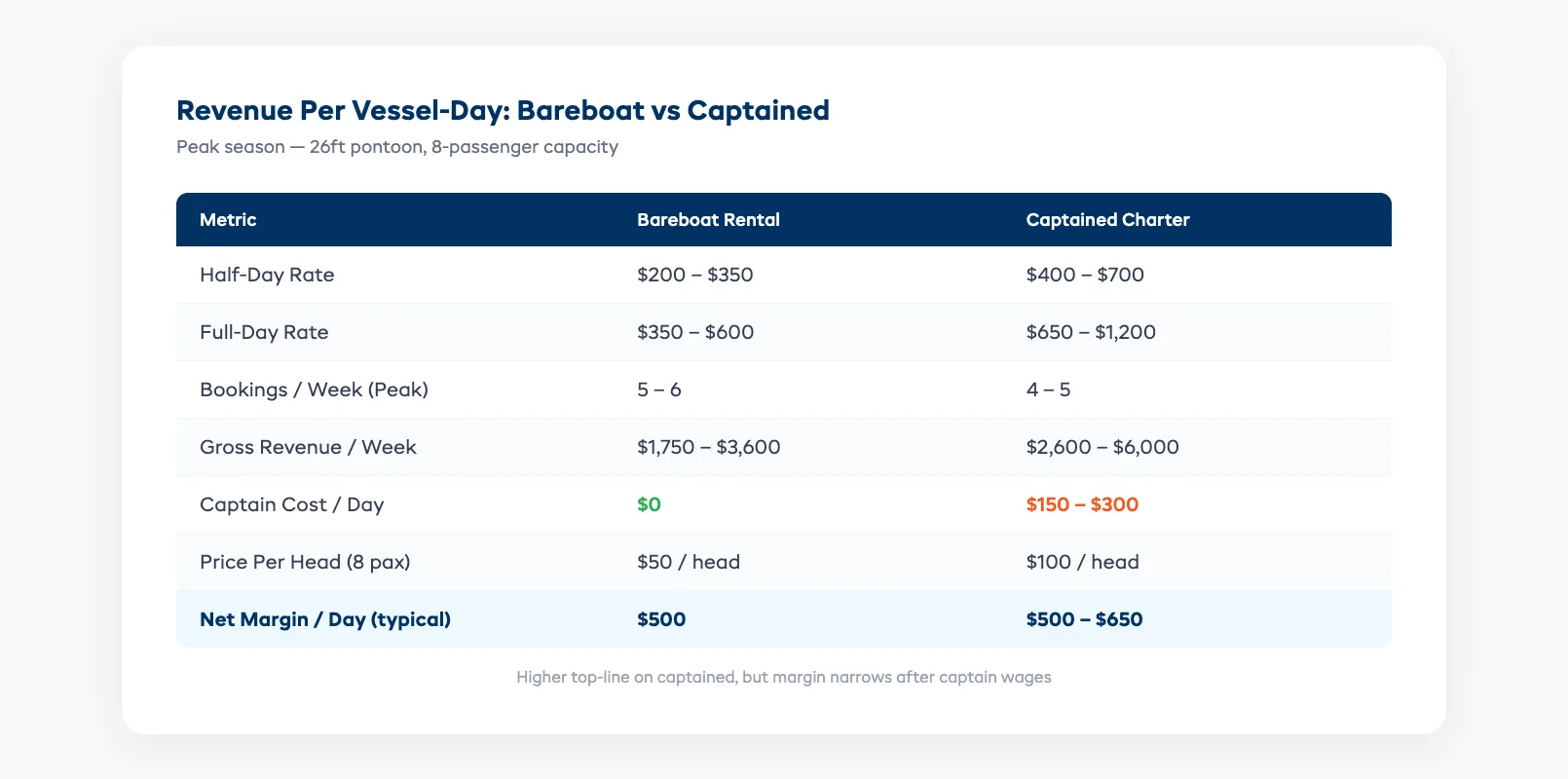
The headline number is misleading. A captained charter charges more per booking, but revenue per vessel-day tells the real story.
Bareboat rental:
- Half-day rate: $200–$350
- Full-day rate: $350–$600
- Average bookings per vessel per week (peak): 5–6
- Gross revenue per vessel per week: $1,750–$3,600
- Direct labor cost per vessel-day: $0 (customer drives)
Captained charter:
- Half-day rate: $400–$700
- Full-day rate: $650–$1,200
- Average bookings per vessel per week (peak): 4–5 (scheduling around captain availability)
- Gross revenue per vessel per week: $2,600–$6,000
- Direct labor cost per vessel-day: $150–$300 (captain wages)
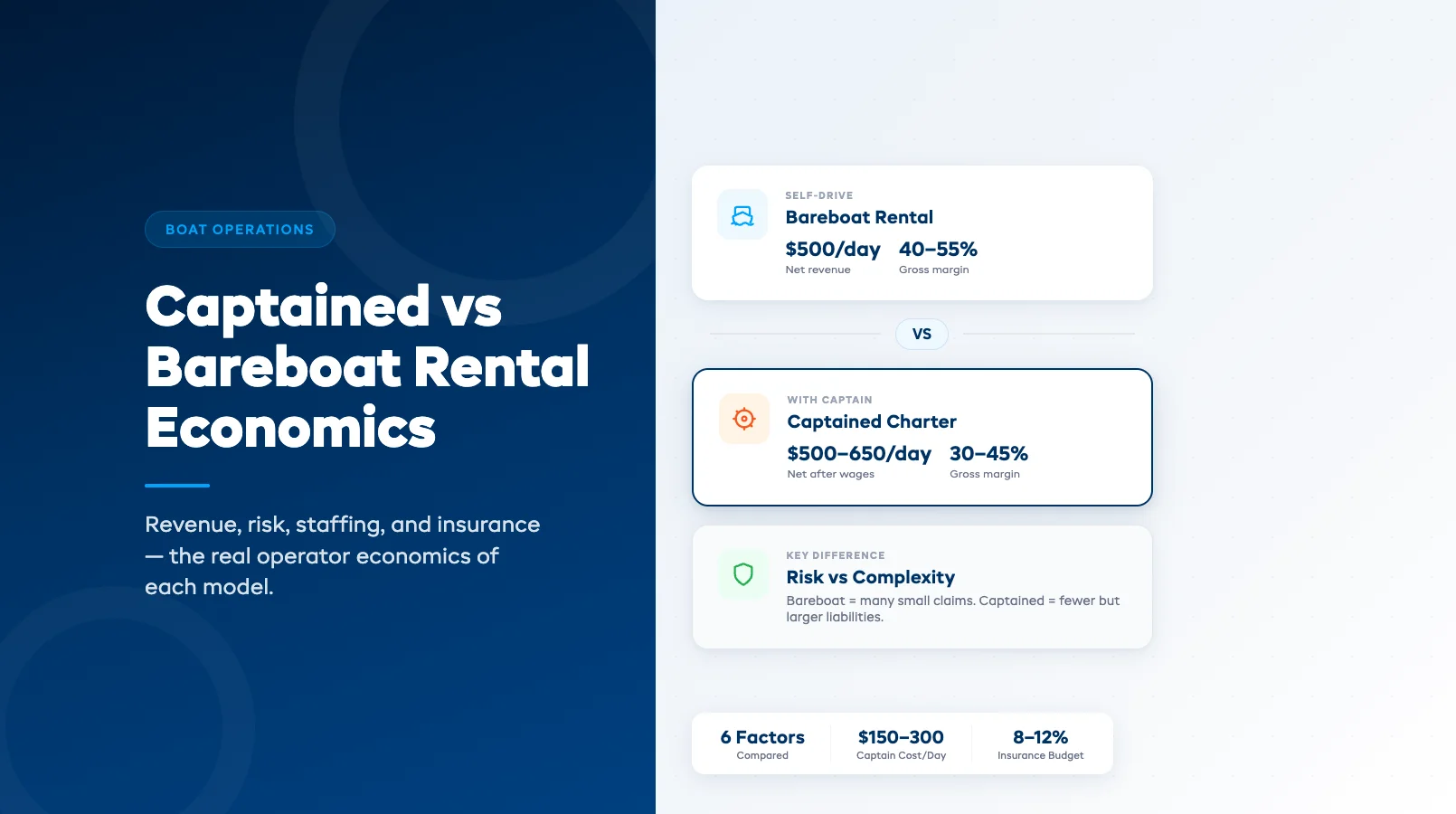
The gap narrows when you subtract captain wages. A bareboat pontoon generating $500/day keeps $500. A captained charter generating $800/day keeps $500–$650 after the captain is paid. Your top line is 60% higher but your margin is only 0–30% higher.
Where captained charters pull ahead is ticket price per customer. A bareboat rental for 8 people at $400 is $50/head. A captained sunset cruise for 8 at $800 is $100/head. If your market has tourists willing to pay for the experience rather than just the boat, that per-head premium compounds into real margin.
The utilization factor. Bareboat rentals can turn a vessel 2–3 times per day for short rentals (2-hour jet ski sessions, 4-hour pontoon half-days). Captained charters typically run once per half-day because the captain needs to prep, brief, operate, and debrief. Higher daily turns on bareboat offset the lower ticket price.
Risk Exposure
Risk sits in different places depending on the model. Neither is inherently safer — they just break in different ways.
Bareboat risk profile:
- Hull damage is your biggest cost. Inexperienced renters hit docks, run aground, and ding props. Budget $3,000–$8,000/year in damage repair per vessel on a pontoon fleet.
- Liability from customer operation. The renter is driving. Your waivers, safety briefings, and pre-departure checklists are your defense. If they're weak, you're exposed.
- Fuel and engine abuse. Renters run engines at full throttle for hours, miss depth warnings, and forget to check oil. Accelerated wear is a real cost.
Captained charter risk profile:
- Lower hull damage. Your captain knows the waterway. Prop strikes and groundings drop by 60–80% compared to bareboat.
- Higher liability exposure. You're providing a paid service with a professional operator. If something goes wrong, the customer's lawyer argues your employee was negligent — not some untrained renter.
- Employee injury and workers' comp. Captains work on water in sun, wind, and weather. Marine workers' comp rates are $5–$8 per $100 of payroll. A captain earning $40,000/season costs $2,000–$3,200 in workers' comp alone.
- Captain misconduct. Alcohol, passengers who bring alcohol, off-color behavior. One incident can cost your business's reputation and invite regulatory scrutiny.
The net risk calculation: Bareboat costs you more in small, frequent claims (dings, props, minor damage). Captained costs less often but bigger when it hits (liability suits, workers' comp claims, regulatory penalties). Choose based on whether you'd rather manage many small fires or prepare for occasional large ones.
Staffing Requirements
This is where the models diverge most sharply.
Bareboat staffing:
- Dock staff for check-in, safety briefing, and return inspection: 1 per 4–6 vessels
- No captain needed
- Seasonal part-time workers can handle it
- Training: 2–3 days on safety briefings, inspection process, basic troubleshooting
Captained charter staffing:
- 1 captain per vessel per shift — non-negotiable
- Each captain needs a USCG OUPV ("Six-Pack") license minimum
- Peak weekend coverage requires backup captains (illness, double bookings)
- A 6-boat captained fleet needs 8–10 licensed captains to cover peak season reliably
- Captain pay: $150–$300/day or $20–$40/hour, depending on market and vessel size
The hiring problem. Licensed captains are scarce. In popular boating markets (Florida Keys, Lake of the Ozarks, Lake Tahoe), you're competing with fishing charters, yacht delivery, and private captains for the same talent pool. Expect to start recruiting 3–4 months before season and lose 10–15% of your roster to better offers before opening day.
Bareboat operations scale with dock staff — you can train a college student in a week. Captained operations scale with licensed professionals — and you can't train a USCG license in a week. Your growth ceiling is your ability to recruit and retain captains.
Use a captain daily briefing checklist to standardize handoffs and keep every captain operating to the same standard. A captain daily briefing agent can auto-generate each captain's daily brief — weather conditions, vessel status, booking details, and safety notes — so your captains arrive informed instead of scrambling.
Customer Type
Bareboat and captained attract fundamentally different customers. Your marketing, pricing, and service design need to reflect that.
Bareboat customers:
- Local or repeat visitors who know the water
- Families and friend groups who want autonomy
- Price-sensitive — comparing your rates to the marina down the road
- Booking lead time: 1–7 days, often last-minute
- Loyalty potential: high — they come back every summer
Captained charter customers:
- Tourists, corporate groups, special occasions (birthdays, proposals, team outings)
- Willing to pay for a curated experience
- Less price-sensitive — comparing you to a dinner cruise or resort excursion, not another boat rental
- Booking lead time: 2–6 weeks, sometimes months for events
- Loyalty potential: moderate — they may not return, but they'll refer friends and leave reviews
The revenue mix implication. Bareboat revenue is predictable and seasonal — it follows weather and weekends. Captained charter revenue can extend your season by 4–6 weeks because you can market sunset cruises, fall foliage tours, and holiday events. If your current season runs May through September, captained charters might push you into April and October.
Marketing differences. Bareboat customers find you on Google Maps, marina signage, and "boat rental near me" searches. Captained charter customers find you on TripAdvisor, Instagram, wedding vendor lists, and corporate event searches. Your ad spend, photography style, and booking funnel should be different for each.
Insurance Differences
Your insurance carrier sees these as completely different risk classes. Don't assume your existing policy covers both.
Bareboat insurance (livery):
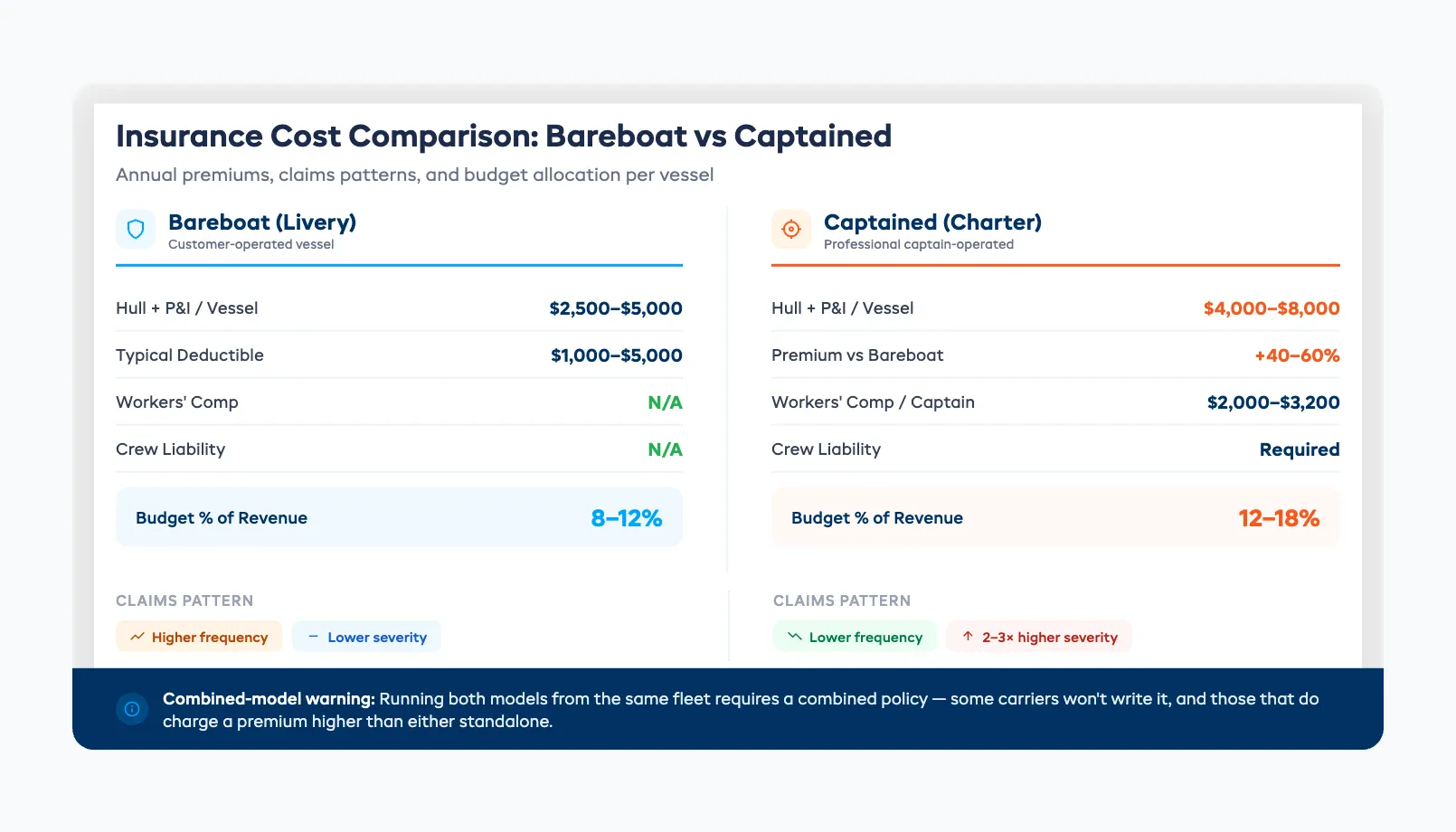
- Hull + P&I per vessel: $2,500–$5,000/year
- Customer damage waivers offset deductible exposure
- Claims frequency: higher (more minor claims from renter damage)
- Typical deductible: $1,000–$5,000 per incident
Captained charter insurance (charter):
- Hull + P&I per vessel: $4,000–$8,000/year (40–60% more than bareboat)
- Requires proof of captain licensing (USCG OUPV minimum)
- Additional crew liability coverage needed
- Workers' comp for captains: $2,000–$3,200/year per captain
- Claims frequency: lower, but average claim value is 2–3x higher
The combined-model trap. If you run both bareboat and captained from the same fleet, you need a policy that covers both uses. Some carriers won't write this. Others will, at a premium that's higher than either standalone policy. Get quotes for combined coverage before you commit to a hybrid model.
Budget 8–12% of gross revenue for insurance on a bareboat operation. Budget 12–18% on a captained charter operation. If either number surprises you, go back to your pricing model before you sign the policy.
Which Model When
There's no universal answer. The right model depends on your market, your capital, and what you're willing to manage.
Choose bareboat when:
- Your waterway is well-marked, low-hazard, and forgiving for inexperienced boaters
- Your market is families and locals who want to drive themselves
- You want to scale fleet size without scaling headcount proportionally
- Captain availability in your area is limited
- You're starting out and want lower operational complexity
Choose captained when:
- Your market has tourist traffic willing to pay premium prices
- The waterway is complex, high-traffic, or has navigational hazards
- You want to offer curated experiences (sunset cruises, fishing charters, island tours)
- You have access to a reliable pool of licensed captains
- You want to extend your operating season beyond peak summer months
Choose both when:
- You have 8+ vessels and can dedicate some to each model
- Your market has both price-sensitive locals and experience-seeking tourists
- You can staff and insure both models without cannibalising margin
- You've operated one model successfully for at least 2 seasons and want to diversify revenue
Most operators start bareboat and add captained charters in year 2 or 3 once they understand their market. Starting captained-only is harder because the staffing and insurance overhead is front-loaded — you're paying captains and premiums before your first booking.
Track which model drives more revenue per vessel-day with your booking system's reporting dashboard. Knowing your actual utilization and margin per model — not your assumptions — tells you where to invest next season's fleet budget. If your bareboat fleet is growing past 10 vessels, our guide to scaling a pontoon rental business covers the staffing ratios and operational breakpoints you'll hit.
FAQ
What does "bareboat" actually mean in a rental context? Bareboat means the customer rents the vessel without a captain or crew. They operate the boat themselves. The term comes from maritime law — a "bareboat charter" transfers operational control to the charterer. In rental operations, it means you hand over the keys and the customer drives.
Do I need a special license to offer captained charters? Your captains need a USCG Operator of Uninspected Passenger Vessels (OUPV) license at minimum — commonly called a "Six-Pack" license because it covers up to 6 passengers. For larger vessels or more passengers, you need captains with a Master license. The business itself may need a charter vessel permit depending on your state.
Can I switch a vessel between bareboat and captained use? Yes, but your insurance policy must cover both use cases. Some carriers require separate endorsements or policies for each. Check with your marine insurance broker before mixing models on the same vessel.
Which model has higher profit margins? It depends on your market and execution. Bareboat operations typically run 40–55% gross margin. Captained charters run 30–45% gross margin because of captain wages, but the higher ticket price can produce more absolute profit per booking. A bareboat pontoon netting $500/day vs a captained charter netting $550/day — the margin difference is small, but the captained model requires more management overhead.
How do I price a captained charter competitively? Research fishing charters, sunset cruises, and boat tour operators in your market — not other rental companies. Your captained charter competes with experiences, not hourly boat rentals. Price based on what a group of 6 would pay for a comparable 4-hour activity in your area.
What happens if my captain calls in sick on a fully booked day? You need backup captains. Most charter operations keep 1 backup captain for every 4–5 active captains during peak season. Without backup, you're canceling bookings and issuing refunds — which costs more than the captain's wages. Build the backup cost into your pricing model.
Can I offer both models simultaneously? Yes, and many established operators do. The key is keeping the insurance, marketing, and staffing separate enough that one model doesn't cannibalise the other. Dedicate specific vessels to each model rather than switching boats back and forth daily — it simplifies insurance and scheduling.
Running either model well starts with knowing your numbers — per-vessel revenue, margin, utilization, and claims cost. If you're tracking that in your head or on a spreadsheet, you're guessing. A booking system that separates captained and bareboat revenue by vessel gives you the data to make next season's fleet decisions with confidence.
More in the boats series: Maintenance logs · Damage deposits · Marina operations · Scaling past 10 vessels · Fuel policies & provisioning
For the full boats vertical — fleet management, captained vs bareboat economics, marina logistics, and more — visit our boats resource hub. Browse key terms in our boat rental glossary.
in one place