How to Run a Boat Rental Business: The Complete Operator's Guide (2026)
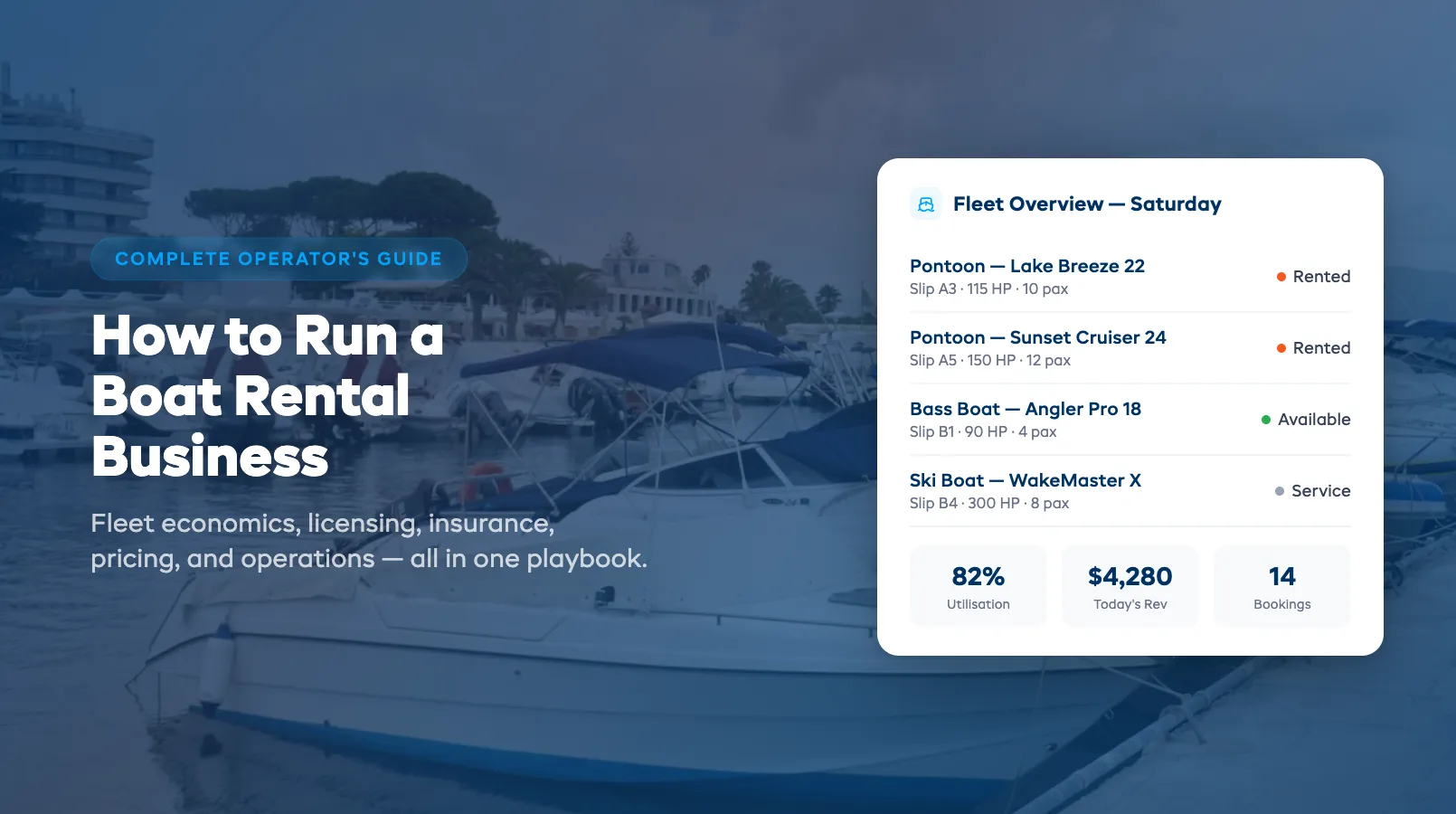
Running a boat rental business looks straightforward from the outside. Buy some pontoons, find a dock, rent them out. Then you're three weeks into your first season with a cracked prop, an expired fire extinguisher, a customer who ran aground in a no-wake zone, and your marina landlord calling about slip fees you didn't budget for. The distance between "I like boats" and "I run a profitable boat rental operation" is measured in hull repairs and insurance claims.
This guide is the operator playbook — covering every major decision from vessel type to pricing to tech stack. Whether you're launching a pontoon rental business on a lake, running a marina rental business on the coast, or scaling a mixed fleet of ski boats and fishing boats, the fundamentals are here.
Types of Boat Rental Businesses
Not every boat rental operation looks the same. Before you spend a dollar on hulls or slips, you need to know which model fits your market, your capital, and your risk tolerance.
Pontoon rentals — the bread and butter of inland boat rental. Pontoons are forgiving for inexperienced drivers, hold 8–12 passengers, and work on lakes and slow rivers. Lower damage rates than performance boats. Average unit cost: $25,000–$60,000 new, $12,000–$30,000 used.
Ski and wakeboard boats — higher revenue per hour but higher risk. Customers need more experience. Prop and gel-coat damage is common. Average unit cost: $40,000–$90,000 new.
Fishing boats — aluminum bass boats and center consoles. Popular on lakes and inshore coastal areas. Lower ticket price per rental, but reliable repeat customers (fishing guides, weekend anglers). Average unit cost: $15,000–$45,000 new.
Jet ski / PWC rentals — high turnover, high damage, high insurance. You can rent a jet ski 6–8 times per day versus 1–2 for a pontoon. But every rental is a liability event. Average unit cost: $8,000–$18,000 new.
Captained charters — you provide the boat and the captain. Higher revenue per trip ($500–$2,000+), but you need licensed captains on payroll. See your local USCG requirements for charter vessel inspection and captain licensing.
Bareboat rentals — customer drives. Lower labor cost, higher damage risk. Most pontoon and fishing boat operations run this model.
Houseboats — multi-day rentals on lakes. High revenue per booking ($1,500–$5,000+ per week), but massive capital outlay ($150,000–$500,000 per vessel) and complex maintenance.
The model you choose dictates everything downstream — insurance costs, staffing needs, marina requirements, and pricing. Most first-time operators start with pontoons or fishing boats. They're the most forgiving on all four dimensions.
Licensing and Registration
Every boat in your fleet needs to be legal before it touches water. The requirements vary by state and vessel type, but here's the baseline:
State vessel registration. Every motorised vessel must be registered with your state's boating authority (usually the Department of Natural Resources or Department of Motor Vehicles). Fees range from $25 to $150 per vessel per year. Registration must be renewed annually.
USCG documentation. Vessels over 5 net tons used in commercial activity (which includes rentals) may need federal documentation through the US Coast Guard. This applies to most boats over 26 feet. Documentation costs ~$100 and is valid for one year.
Commercial use endorsement. Many states require a separate commercial use permit or livery license for rental vessels. This is different from personal registration. Check your state's specific requirements — some states (Florida, Michigan, Minnesota) have explicit livery boat laws with additional inspection requirements.
Captain's license. If you offer captained charters, your captains need a USCG Operator of Uninspected Passenger Vessels (OUPV or "Six-Pack") license at minimum. For vessels carrying more than 6 passengers, you need a Master license. Testing through USCG-approved courses runs $800–$1,500.
Business licenses and permits. Standard business registration (LLC, insurance certificates, sales tax permits). If operating from a public waterway, you likely need permits from your local parks department, port authority, or Army Corps of Engineers.
Required safety equipment per vessel:
- USCG-approved life jackets (one per passenger capacity, plus children's sizes)
- Fire extinguisher (Type B-I minimum for vessels under 26 feet, B-II for larger)
- Visual distress signals (flares or electronic for vessels over 16 feet on coastal waters)
- Sound-producing device (horn or whistle)
- Navigation lights (if operating after sunset — and customers will push past sunset)
- Throwable flotation device (Type IV, required on vessels 16 feet and over)
Budget $500–$1,200 per vessel per year for registration, documentation, and safety equipment compliance. Multiply by fleet size and add it to your fixed cost model before you buy your first boat.
Insurance
Insurance is the single biggest variable cost that new boat rental operators underestimate. This isn't personal boat insurance. Commercial marine insurance for rental fleets is a specialized product and it's expensive.
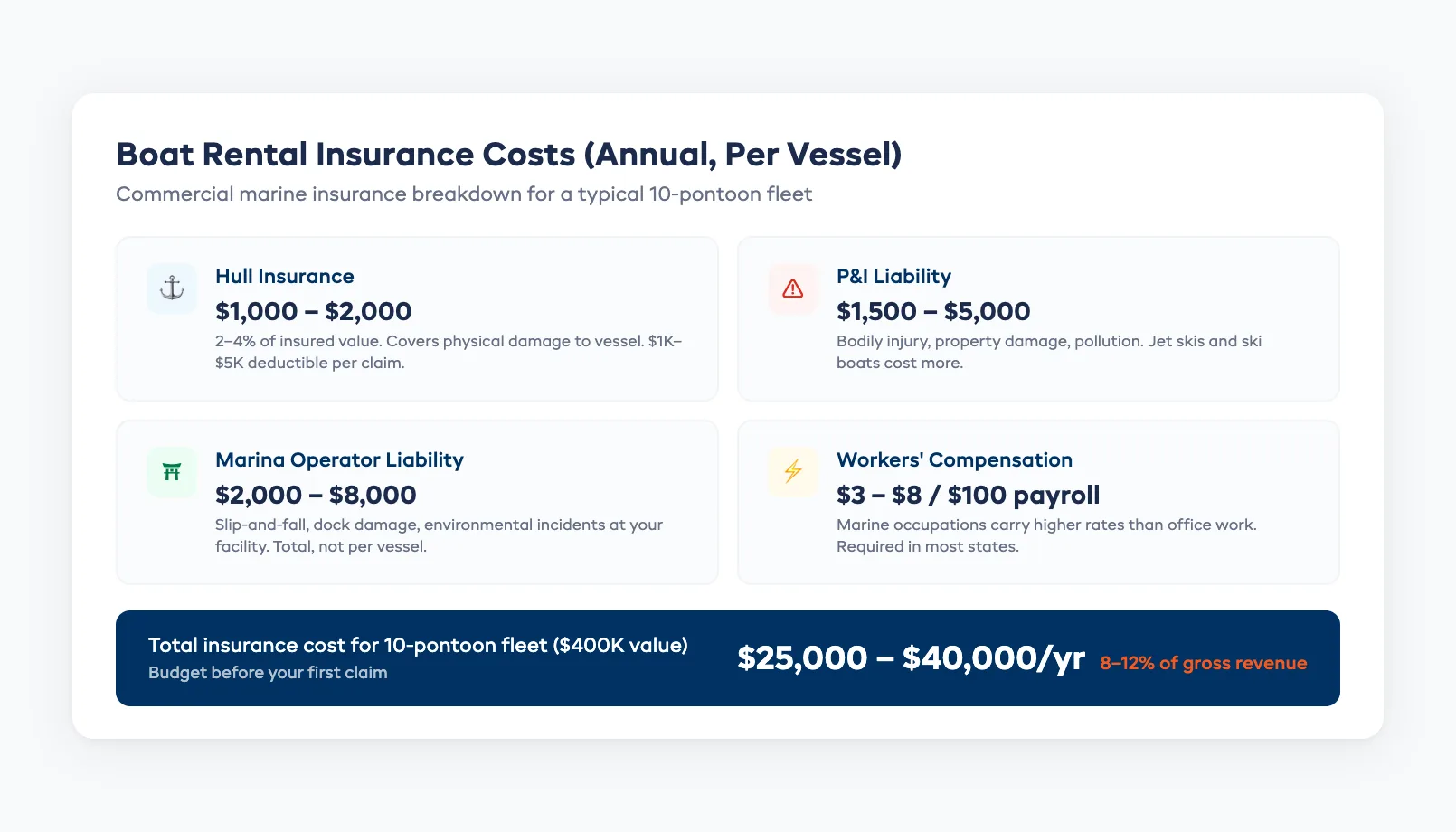
Hull insurance covers physical damage to your vessels. Expect to pay 2–4% of the vessel's insured value annually. A $50,000 pontoon costs $1,000–$2,000/year to insure for hull damage. Deductibles typically run $1,000–$5,000 per claim.
Protection and Indemnity (P&I) insurance covers liability — bodily injury, property damage, pollution. This is the big one. Premiums range from $1,500–$5,000 per vessel per year depending on vessel type, fleet size, and claims history. Jet skis and ski boats cost more to insure than pontoons.
Marina operator liability (if you own or lease dock space) covers slip-and-fall injuries, dock damage, and environmental incidents at your facility. $2,000–$8,000/year depending on size.
Workers' compensation for your staff. Required in most states. Rates for marine occupations are higher than office work — expect $3–$8 per $100 of payroll.
The math that matters: For a 10-pontoon fleet valued at $400,000 total, budget $25,000–$40,000/year in total insurance costs. That's $2,500–$4,000 per vessel. If your average vessel generates $30,000–$50,000 in seasonal revenue, insurance eats 8–12% of gross revenue. That's before a single claim.
Damage waivers and customer deposits offset some risk. Charge a $500–$2,000 security deposit hold (authorization, not charge) per rental. Offer an optional damage waiver ($25–$75 per rental) that reduces the customer's liability from the full deductible to a lower amount ($250–$500). Damage waivers can generate $15,000–$30,000/year on a 10-boat fleet — enough to cover 1–2 claims' worth of deductibles.
Document everything. Pre-departure photos, post-return inspection, GPS logs, incident reports. Your insurer will ask for it, and your defense against frivolous claims depends on it. Use your boat damage assessment checklist as the standard process for every return. A boat damage report drafter can turn your inspection photos and notes into a formatted damage letter with cost estimates — saving 20-30 minutes per incident and producing consistent documentation your insurer will accept without follow-up questions.
Fleet Composition
Your fleet is your product. Get the mix wrong and you'll have boats sitting idle while customers ask for the type you don't have.
Start-up fleet (year one):
- 4–6 pontoons (22–24 foot, 115–150 HP outboard). This is your base revenue.
- 1–2 fishing boats if your lake or waterway has an angling market.
- 0 jet skis in year one unless you have prior PWC rental experience. The insurance and damage costs will surprise you.
Growth fleet (year two and beyond):
- Add 2–3 pontoons per year based on utilization data. If your existing fleet runs above 80% utilization on weekends, you're leaving money on the dock.
- Consider 1–2 specialty vessels (tritoon, ski boat, deck boat) to capture the higher-spend customer.
- Jet skis if your insurance carrier will write the policy and your location allows it.
Fleet economics:
| Vessel Type | Avg. Purchase | Annual Insurance | Annual Maintenance | Revenue/Season | ROI Timeline |
|---|---|---|---|---|---|
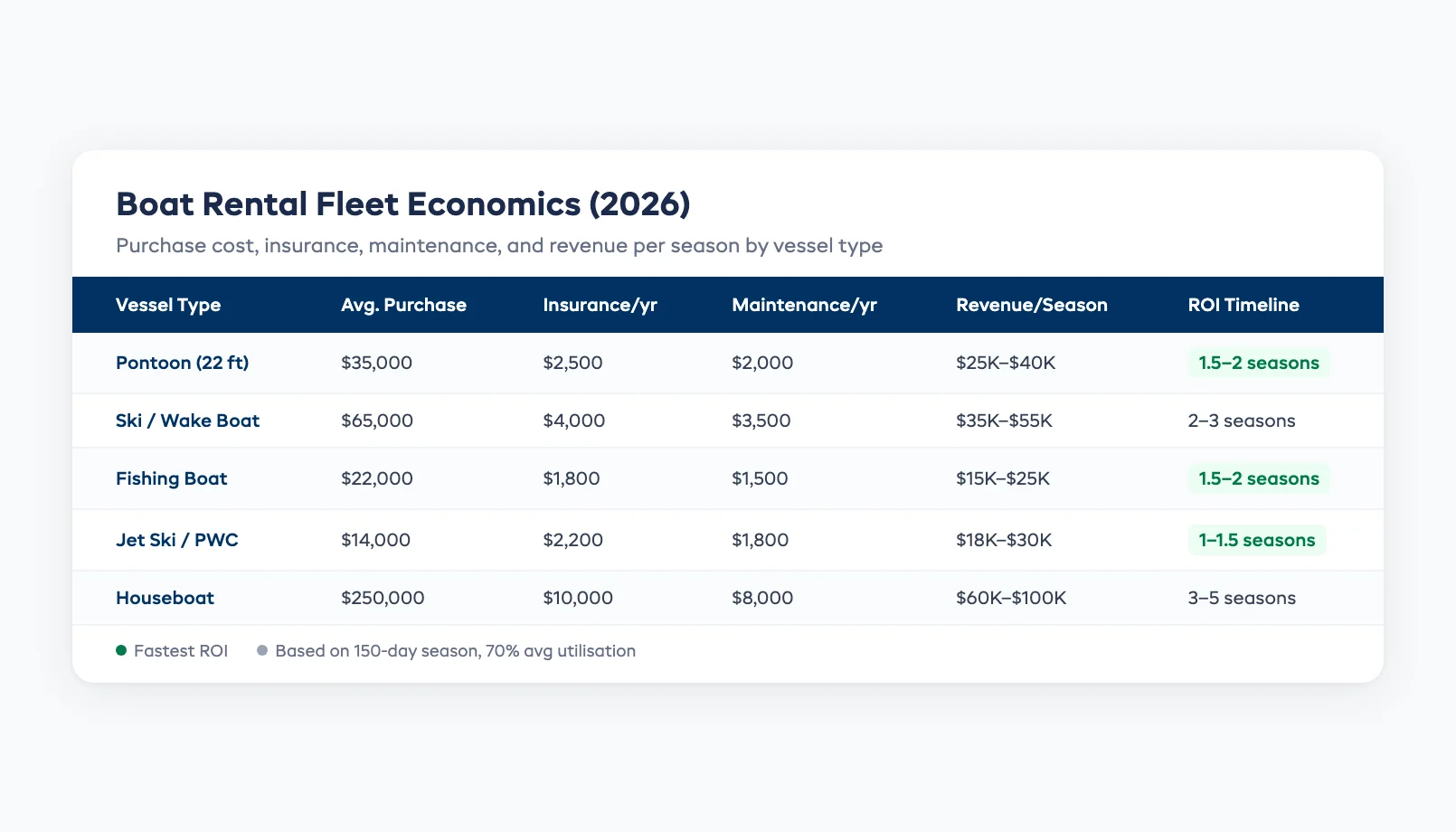
| Pontoon (22 ft) | $35,000 | $2,500 | $2,000 | $25,000–$40,000 | 1.5–2 seasons |
| Ski boat | $65,000 | $4,000 | $3,500 | $35,000–$55,000 | 2–3 seasons |
| Fishing boat | $22,000 | $1,800 | $1,500 | $15,000–$25,000 | 1.5–2 seasons |
| Jet ski | $14,000 | $2,200 | $1,800 | $18,000–$30,000 | 1–1.5 seasons |
| Houseboat | $250,000 | $10,000 | $8,000 | $60,000–$100,000 | 3–5 seasons |
Maintenance cadence: Engine oil and filter every 100 hours. Impeller every 200–300 hours or annually. Lower unit service annually. Upholstery inspection weekly during season. Hull cleaning monthly (more in saltwater). Track engine hours religiously — it's the only honest metric for when service is due. Your boat engine service log should be as non-negotiable as your pre-departure check.
Depreciation reality: Boats depreciate 10–15% per year for the first five years, then slow to 5–8%. Budget to replace vessels every 5–8 seasons for a rental fleet. Rental boats take 3–5x the abuse of privately owned vessels. A "ten-year boat" in personal use is a five-year boat in a rental fleet.
Marina vs Trailer Operations
Where and how you store your fleet is a strategic decision that affects every aspect of your operation.
Marina-based operations
Pros:
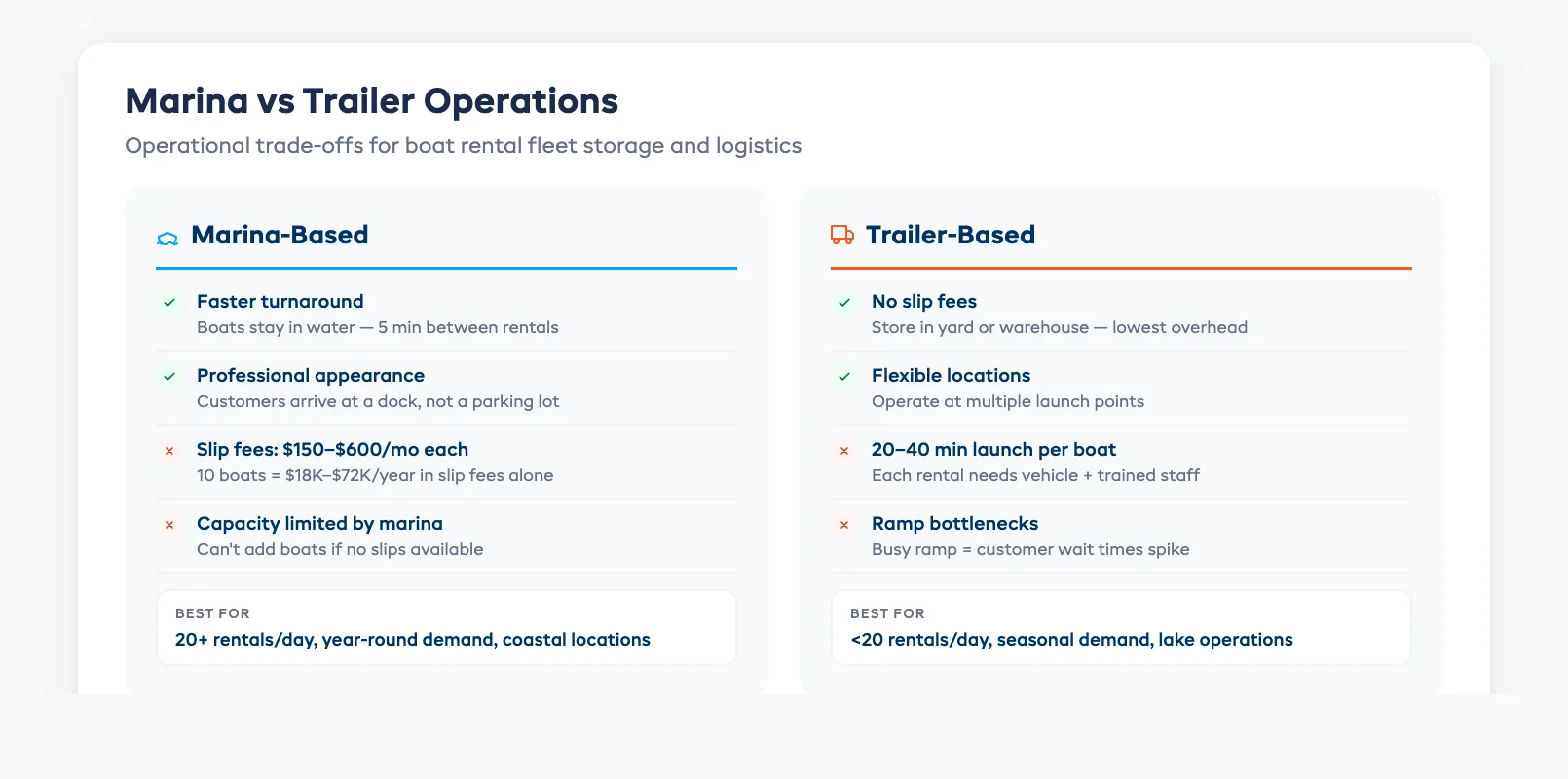
- Boats stay in the water — faster turnaround between rentals.
- Professional appearance. Customers pull up to a dock, not a parking lot.
- Access to fuel, pumpout, and sometimes on-site mechanics.
- Walk-in traffic from marina visitors.
Cons:
- Slip fees. $150–$600/month per slip depending on location, length, and whether it's covered. A 10-boat fleet at $300/slip = $36,000/year in slip fees alone.
- You're a tenant — marina owners set rules about signage, hours, and operations.
- Limited expansion. If the marina has 10 slips for you and all 10 are full, you can't just add boats.
- Dock damage liability. Your boats (or your customers) can damage neighboring vessels.
Trailer-based operations
Pros:
- No slip fees. Store boats on trailers in a yard or warehouse.
- Flexibility — you can operate at different launch points.
- Lower overhead during off-season (boats on trailers in storage).
- You control your own property.
Cons:
- Every rental requires a launch and retrieval. That's 20–40 minutes per boat per rental.
- You need a vehicle (truck) and trained staff for launching.
- Launches are bottlenecks — if your ramp is busy, customers wait.
- Less professional appearance compared to marina operations.
The hybrid model: Some operators keep their most popular boats in slips for quick turnover, with overflow inventory on trailers for peak days. This balances cost and capacity.
Decision framework: If you're on a lake with a public boat ramp and seasonal demand under 20 rentals/day, trailer operations keep your overhead low. If you're at a busy marina or coastal location with year-round demand and 20+ rentals/day, slips pay for themselves in turnaround efficiency.
Staffing
A boat rental business is a people business. The person handing keys to a customer on a Saturday morning is the face of your operation — and the last safety check before a $50,000 asset leaves your control.
Core roles:
- Dock staff / rental agents. Handle check-in, safety briefings, vessel walkarounds, and returns. This is your most important hire. A bad dock person causes damage, loses customers, and creates liability. Ratio: 1 dock staff per 4–6 active vessels during peak hours.
- Captains (if offering captained charters). Must hold USCG OUPV or Master license. Pay range: $200–$500/day depending on market and vessel size.
- Mechanics / maintenance. 1 part-time mechanic per 8–12 vessels. Outboard motor certification (Mercury, Yamaha, etc.) preferred. If you can't justify a dedicated mechanic, establish a relationship with a local marine service shop and schedule regular service.
- Operations manager. Once you pass 8 vessels, you need someone who isn't you managing the daily schedule, staff, and maintenance coordination. You should be growing the business, not untying dock lines.
Seasonal staffing math:
For a 10-pontoon marina operation running May–September (150 days):
- 3 dock staff × $16/hour × 10 hours/day × 150 days = $72,000
- 1 operations manager × $22/hour × 10 hours/day × 150 days = $33,000
- 1 part-time mechanic × $25/hour × 20 hours/week × 22 weeks = $11,000
- Total seasonal labor: ~$116,000
If your 10-pontoon fleet generates $300,000–$400,000 in seasonal revenue, labor runs 29–39% of gross. Target under 35%.
Training non-negotiables:
- Safety briefing delivery — every dock staff member must be able to deliver a consistent, complete safety briefing in under 5 minutes. Script it. Drill it. Mystery-shop it.
- Pre-departure inspection — use your daily boat pre-departure check every time, no exceptions. A checklist catches the engine issue that a glance misses.
- Damage documentation — before and after every rental. Photos of hull, prop, upholstery, electronics. Timestamped. Stored.
- Emergency procedures — man overboard, engine failure, fire, grounding, weather emergency. Run drills monthly during season.
Standardize the morning routine with your boat shop opening-day checklist so new seasonal hires can get productive in their first week, not their third. Automate your morning dock assignments with a captain daily briefing agent that pulls today's bookings, assigns vessels, and flags any maintenance-blocked boats before your team arrives at the dock.
Pricing
Boat rental pricing is more complex than most outdoor rental categories because of the wide range of vessel types, the high cost per unit, and the fuel variable.
2026 market benchmarks:
| Vessel Type | 2 Hours | Half-Day (4h) | Full Day (8h) | Avg. Revenue/Unit/Day |
|---|---|---|---|---|
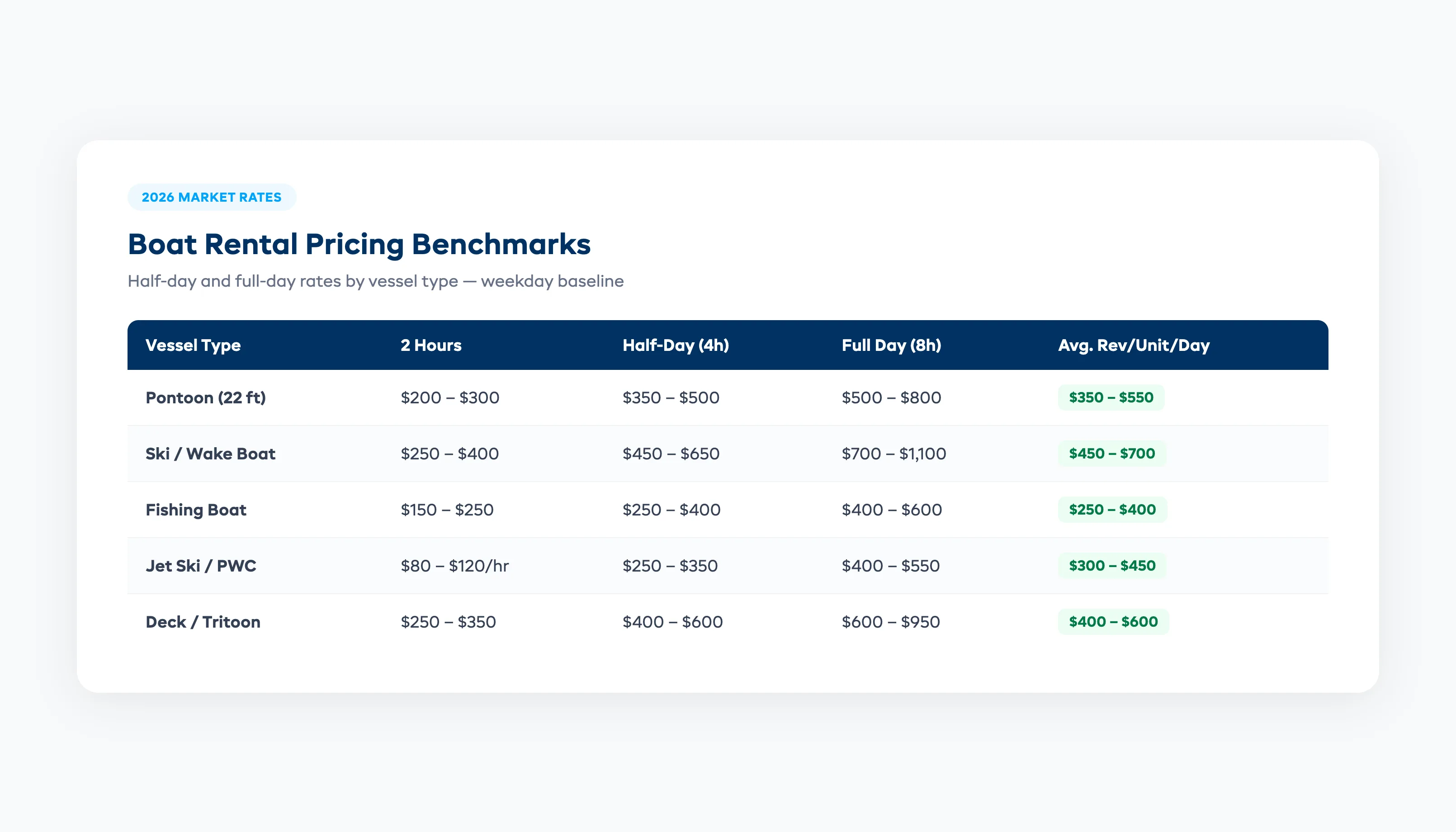
| Pontoon (22 ft) | $200–$300 | $350–$500 | $500–$800 | $350–$550 |
| Ski / Wake boat | $250–$400 | $450–$650 | $700–$1,100 | $450–$700 |
| Fishing boat | $150–$250 | $250–$400 | $400–$600 | $250–$400 |
| Jet ski | $80–$120/hr | $250–$350 | $400–$550 | $300–$450 |
| Deck / Tritoon | $250–$350 | $400–$600 | $600–$950 | $400–$600 |
Pricing strategies that work:
- Half-day anchoring. Set your half-day at 1.8× your two-hour rate. Customers who see "$250 for 2 hours vs $450 for 4 hours" consistently upgrade. The two-hour rate exists to make the half-day look like a bargain.
- Weekend premium of 20–30%. Don't hide it — publish both weekday and weekend rates clearly. Customers expect it and you need it. Saturday generates 2–3× the revenue of Tuesday.
- Fuel policy. Three common approaches: (a) Full-to-full — customer returns with a full tank or pays a per-gallon surcharge. (b) Fuel included — bake estimated fuel cost into the rental price (simpler, but you absorb price spikes). (c) Fuel metered — charge actual consumption at pump price + handling fee. Full-to-full is the cleanest for operations.
- Damage waiver. $35–$75 per rental, reduces customer liability to $250–$500. Conversion rates of 40–60% are typical. This is pure margin and an insurance buffer.
- Captain add-on. If you offer both bareboat and captained options, the captain add-on ($150–$350 for a half-day) converts 15–25% of bareboat bookings.
- Multi-day discounts. 15–25% off for 2+ day rentals. Vacation markets thrive on 3-day and weekly packages.
The number that matters: Revenue per fleet unit per season day. Divide total seasonal revenue by (fleet size × operating days). If you're below $250/unit/day on pontoons, you have a pricing or utilization problem. Above $400, your fleet is working hard.
Tech Stack: The Systems That Run Your Operation
Boat rental operations have more moving parts than most rental businesses — fuel, captains, vessel inspections, weather cancellations, dock logistics. Your tech stack needs to handle all of it without creating more work than it saves.
What you need from day one:
- Online booking with real-time availability. Customers expect to see available boats and book instantly. If they have to call, 30–40% will book with whoever has an online option instead. Your booking system needs to handle different vessel types, time slots, and capacity limits.
- Digital waivers. Pre-arrival waiver signing saves 5–10 minutes per check-in. For a Saturday with 20 rentals, that's nearly two hours of dock time recovered. Waivers should auto-attach to the booking record.
- Maintenance tracking. Engine hours, service intervals, inspection history per vessel. This isn't optional — it's your warranty protection, your insurance documentation, and your fleet reliability. Log every service event in your boat engine service log.
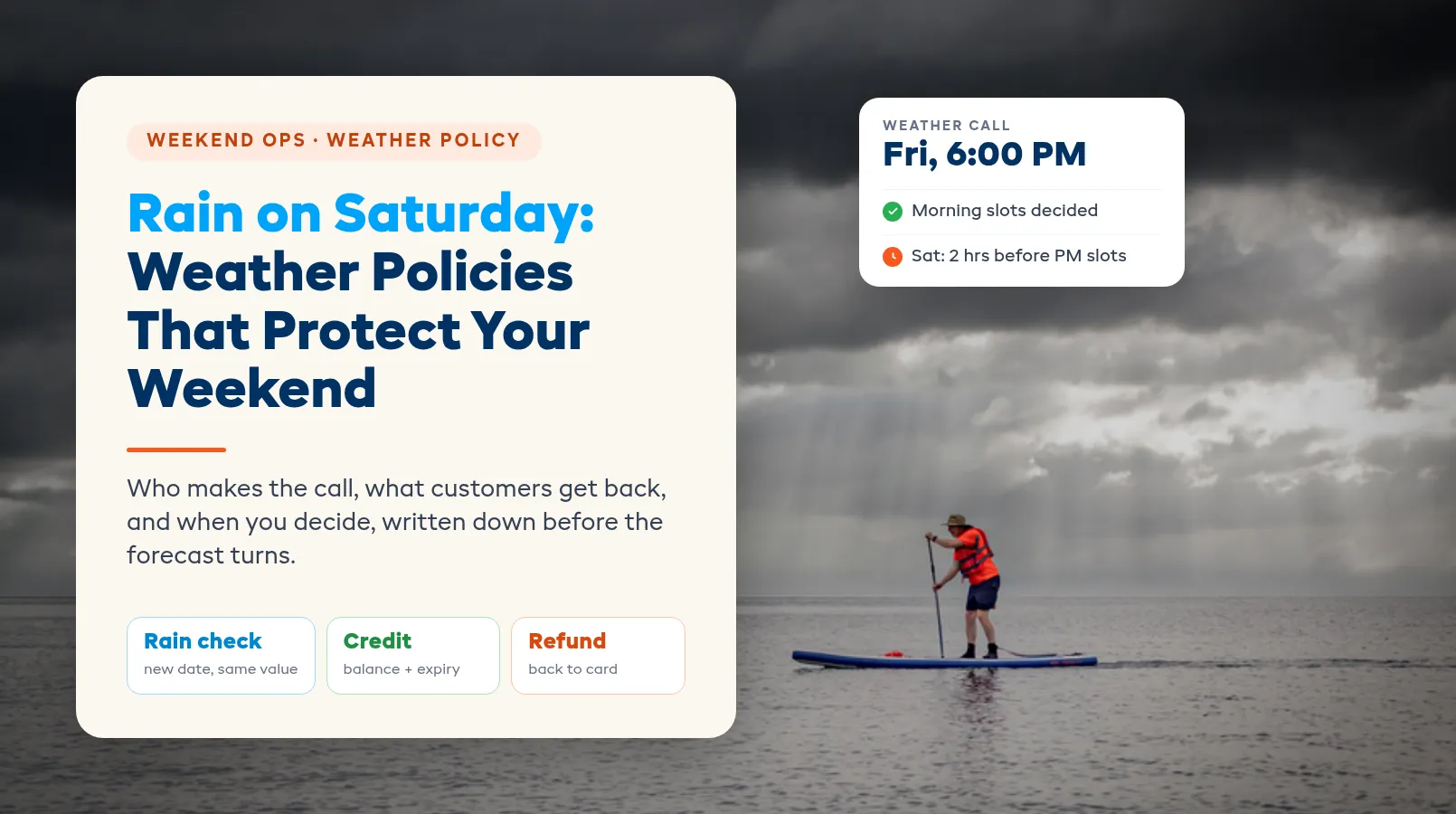
- Customer communication. Automated confirmation emails, pre-arrival instructions (dock location, what to bring, cancellation policy), weather alerts, and post-rental review requests. Manual texts at 6am on a Saturday morning don't scale. A weather cancellation agent can monitor marine forecasts and automatically send reschedule offers to affected bookings before you even check the weather.
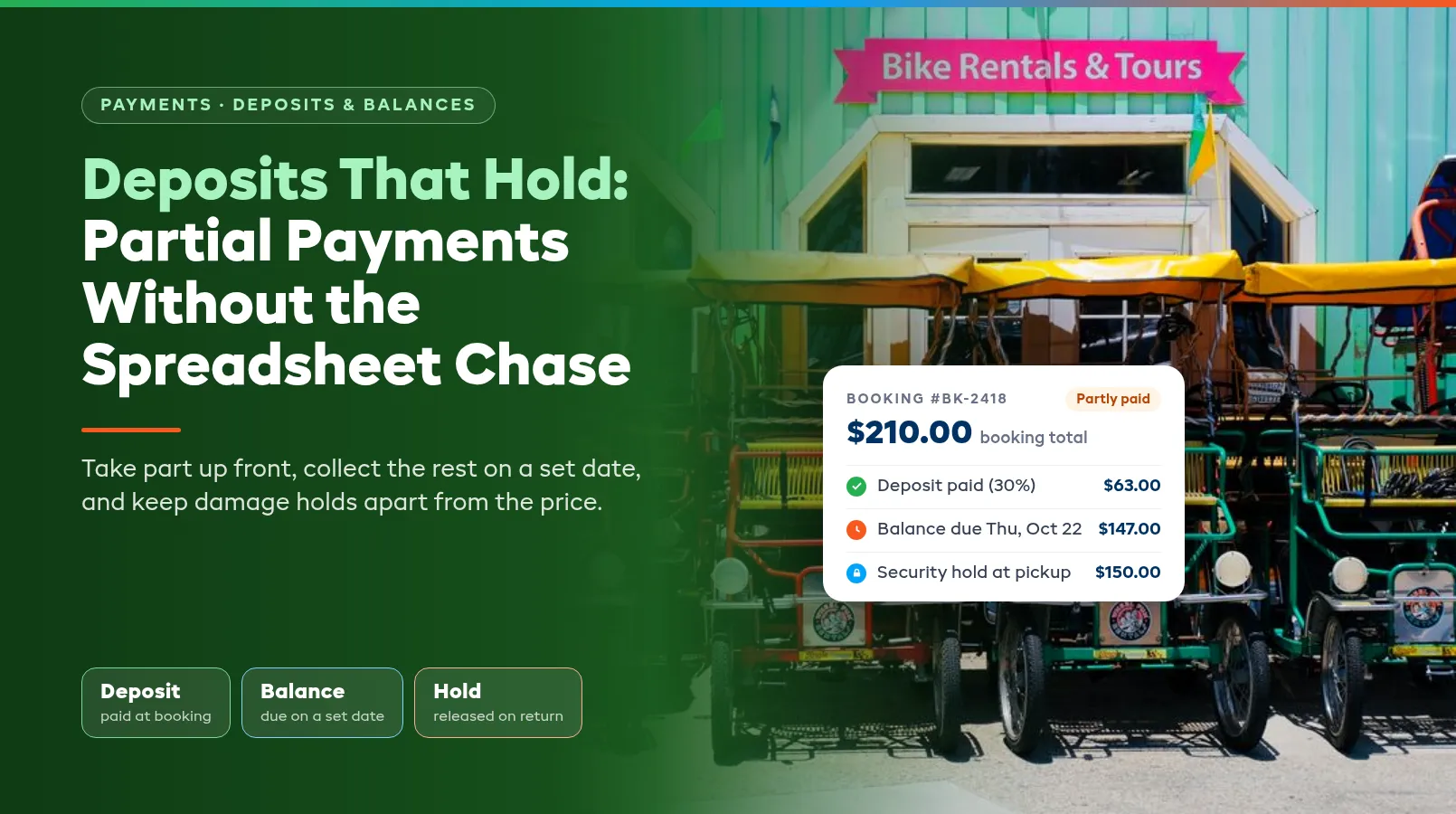
- Payment processing. Deposits, authorizations, damage charges, and refunds. You need a system that can hold an authorization at booking, charge at checkout, and process a damage charge days later if needed.
What you need when you scale past 8–10 vessels:
- Staff scheduling tied to vessel bookings. If you have 15 rentals on Saturday, you need X dock staff. Your system should tell you X, not make you count manually.
- Utilization reporting. Revenue per vessel, per day of week, per time slot. This data drives fleet expansion, pricing changes, and retirement decisions.
- Multi-location support if you operate at more than one marina or launch point.
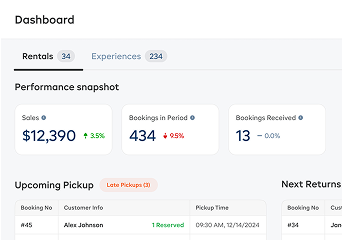
Dash AI handles the operational layer — from booking management and automated customer communications to maintenance tracking and real-time availability. Operators using it report 3–5 hours/week saved on admin tasks that used to require manual coordination.
If you're evaluating boat rental technology specifically, our boats vertical hub breaks down how booking and operations platforms map to marine rental requirements. And when your fleet outgrows owner-operator mode, our guide to scaling a pontoon rental business past 10 vessels covers the breakpoints.
Dive deeper into specific operations:
- Captained vs bareboat economics — revenue models, staffing, and insurance differences
- Maintenance logs that keep your fleet earning — engine-hour tracking, service windows, and digital logs
- Winterization and storage as an off-season revenue line — haul-out week, winterization pricing, storage billing, spring recommission upsell
- Damage deposits and customer communications — structuring holds, documenting condition, handling disputes
- Marina slip logistics and handoffs — slip assignment, dock traffic, staff protocols
- Fuel policies, provisioning, and fine print — fuel models, cleaning fees, and repeat-customer framing
FAQ
How much does it cost to start a boat rental business? Budget $150,000–$350,000 for a 5-pontoon fleet including vessels, insurance, marina fees, safety equipment, permits, and first-season operating costs. A smaller 2–3 boat operation with used vessels can launch for $60,000–$120,000. The biggest line items are vessels (60–70% of startup capital) and insurance (10–15%).
Do I need a captain's license to run a boat rental business? Not if you only offer bareboat rentals where customers drive. You need a USCG captain's license (OUPV/Six-Pack minimum) only if you or your staff operate the vessel with paying passengers aboard. Many states also require a basic boating safety course for rental operators even if they don't captain vessels.
How many boats do I need to be profitable? Most operators reach profitability with 4–6 vessels. Below 4, your fixed costs (insurance, marina fees, staff) eat too much of the revenue. Each additional vessel beyond your break-even point has a disproportionately positive impact because fixed costs are already covered.
What's the best boat for a rental business? Pontoons between 22–24 feet with a 115–150 HP outboard. They're the most forgiving for inexperienced renters, carry the most passengers, have the lowest damage rates, and the best revenue-to-cost ratio for most markets. Start with pontoons, add specialty vessels once you know your market.
How do I handle boat damage from renters? Collect a security deposit hold ($500–$2,000) before departure. Document pre-departure and post-return condition with timestamped photos using a standardized checklist. Offer an optional damage waiver ($35–$75) that reduces customer liability. Process damage charges promptly with photo evidence and clear communication.
Is boat rental insurance expensive? Yes. Budget $2,500–$4,000 per vessel per year for a combined hull and P&I policy. Jet skis and ski boats cost more. Your total insurance spend will be 8–12% of gross revenue. Claims history is the single biggest factor in premiums — one bad season can double your rates.
What permits do I need for a boat rental business? State vessel registration for each boat, commercial use or livery license (varies by state), standard business licenses, sales tax permits, and potentially federal USCG documentation for vessels over 5 net tons. If operating on public waterways, add permits from your local parks department or port authority.
in one place