Equipment Maintenance Tracking for Rental Businesses
A busted brake cable on a rental bike. A wetsuit zipper that jams mid-fitting. A kayak with a slow leak nobody noticed. Every rental operator has been there — handing gear to a customer and hoping it holds up.
Hope is not a maintenance strategy. Equipment failures cost you three ways: the refund, the repair bill that's always worse when you wait, and the one-star review that follows both. This guide covers how to build a practical maintenance schedule that catches problems early and keeps gear earning revenue. For the full picture, see our complete guide to rental inventory management.
Why Maintenance Tracking Matters
Rental gear takes more abuse than gear you own. Customers drop paddleboards on concrete, over-tighten ski bindings, and return bikes caked in mud. Every rental cycle adds wear — and if you're not tracking it, you're guessing when things will fail.
Without maintenance tracking you get:
- Unplanned downtime. A cracked kayak hull sits in the shop for a week because nobody caught it early. That's a week of lost bookings.
- Safety incidents. A frayed harness puts a customer at risk — and your business on the wrong end of a liability claim.
- Shorter asset life. A $3,000 mountain bike with regular tuning lasts 4–5 seasons. Skip maintenance and you're replacing it after 2.
- Reactive chaos. Every repair becomes an emergency. Staff scramble to fix things during peak hours instead of serving customers.
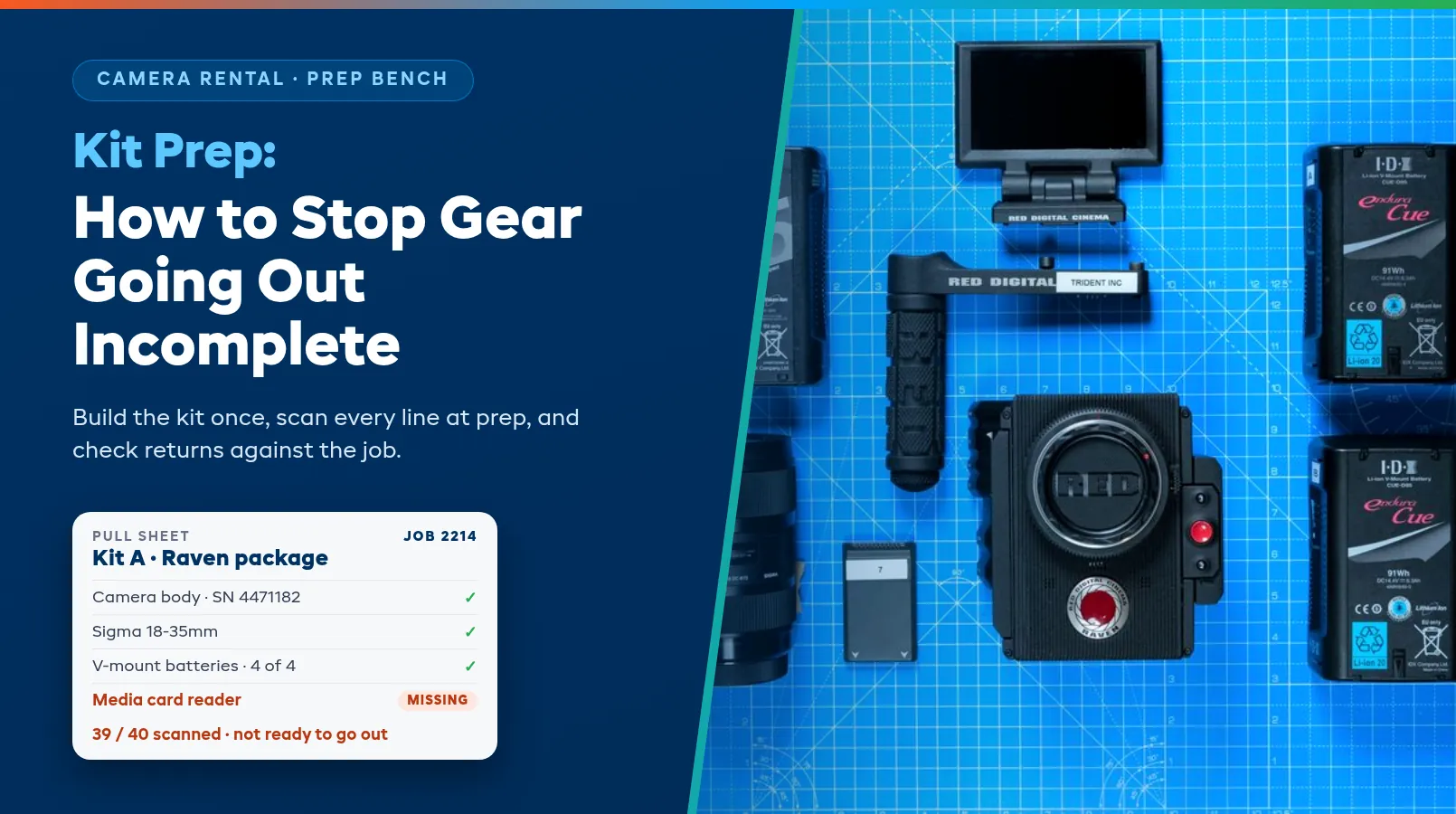
The foundation of maintenance tracking is knowing what condition gear is in when it leaves and when it comes back. If you're still using paper at the counter, our equipment sign-out sheet template includes condition fields for both checkout and return — the minimum you need to catch damage early.
Operators who track maintenance spend less on repairs, keep gear longer, and rarely hand a customer broken equipment. It also keeps your utilization numbers honest — maintenance days excluded from availability give you a true picture of fleet performance.
Time-Based vs Usage-Based Triggers
There are two ways to decide when gear needs servicing: by calendar or by usage. Most rental businesses need both.
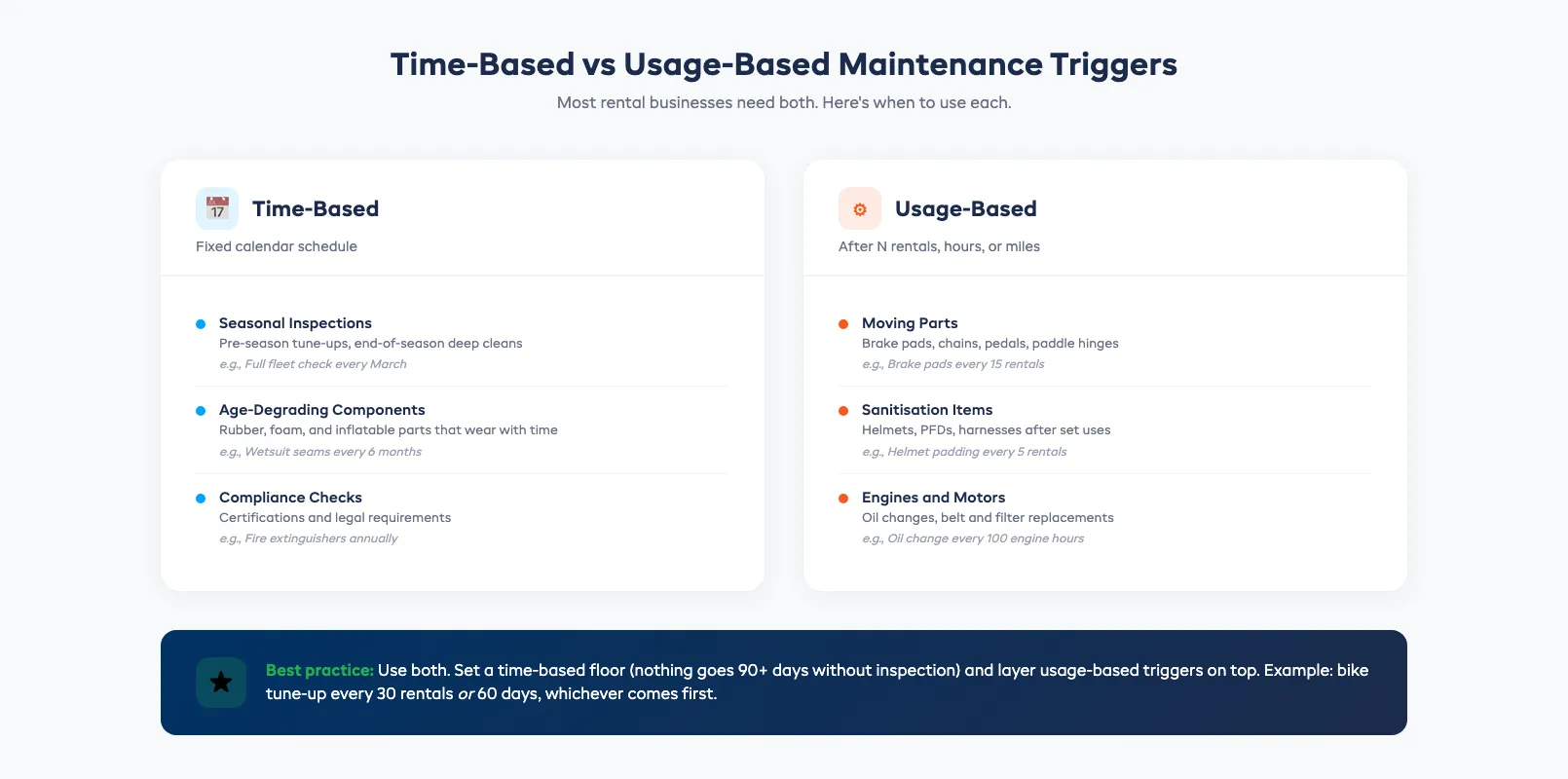
Time-based triggers fire on a fixed schedule. They work for seasonal inspections, components that degrade with age (wetsuit seams, helmet padding, inflatable bladders), and compliance checks (fire extinguishers on boats, e-bike electrical inspections).
Usage-based triggers fire after a set number of rentals, hours, or miles. They suit moving parts (brake pads, chains, paddle hinges), items needing sanitising after a certain number of uses, and engines (oil changes every 100 hours).
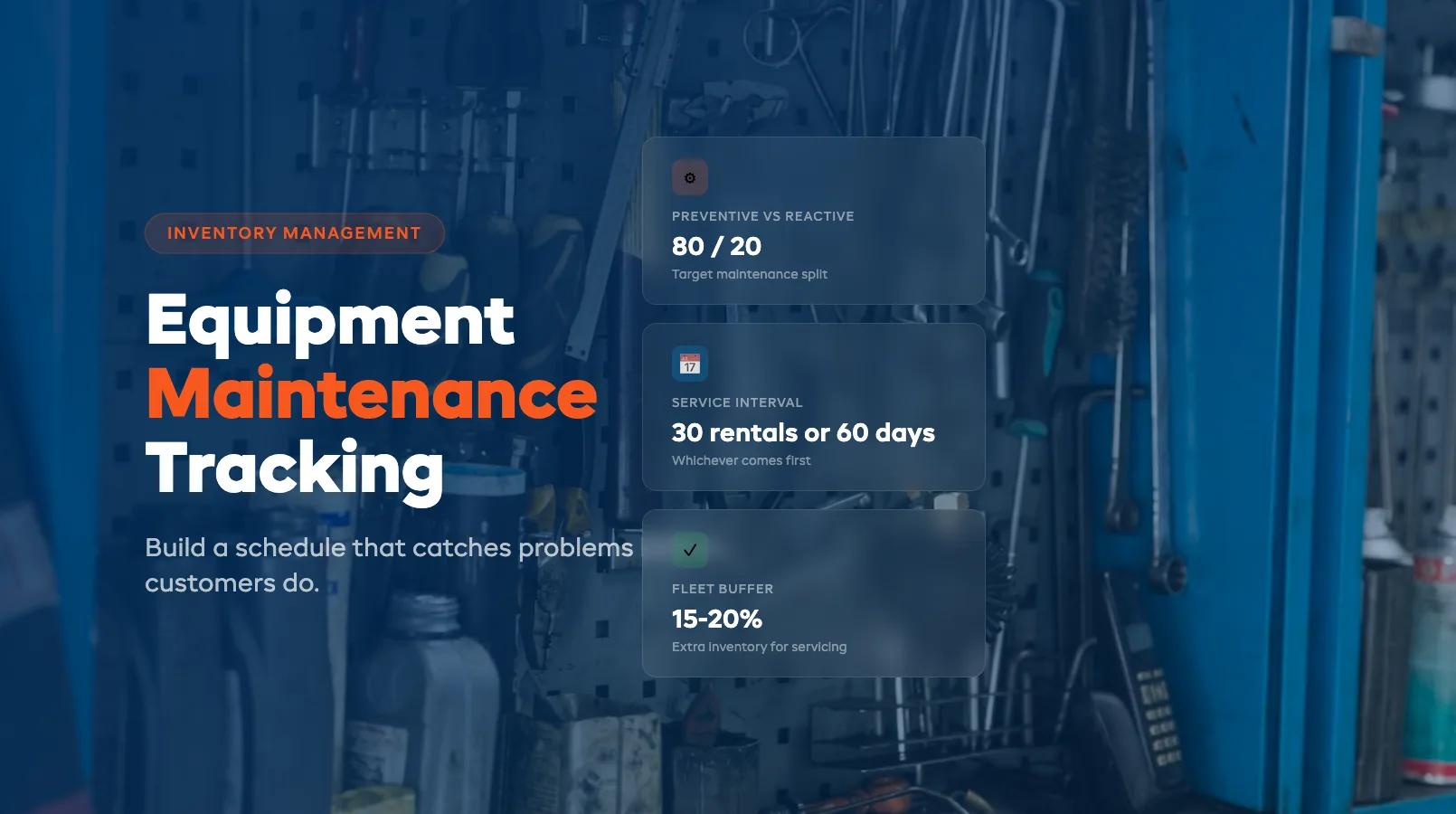
Use both. Set a time-based floor — nothing goes more than 90 days without inspection, even in storage. Layer usage-based triggers on top. A rental bike gets a full tune-up every 30 rentals or every 60 days, whichever comes first.
Building a Maintenance Schedule
A maintenance schedule doesn't need to be complicated. It needs to be consistent.
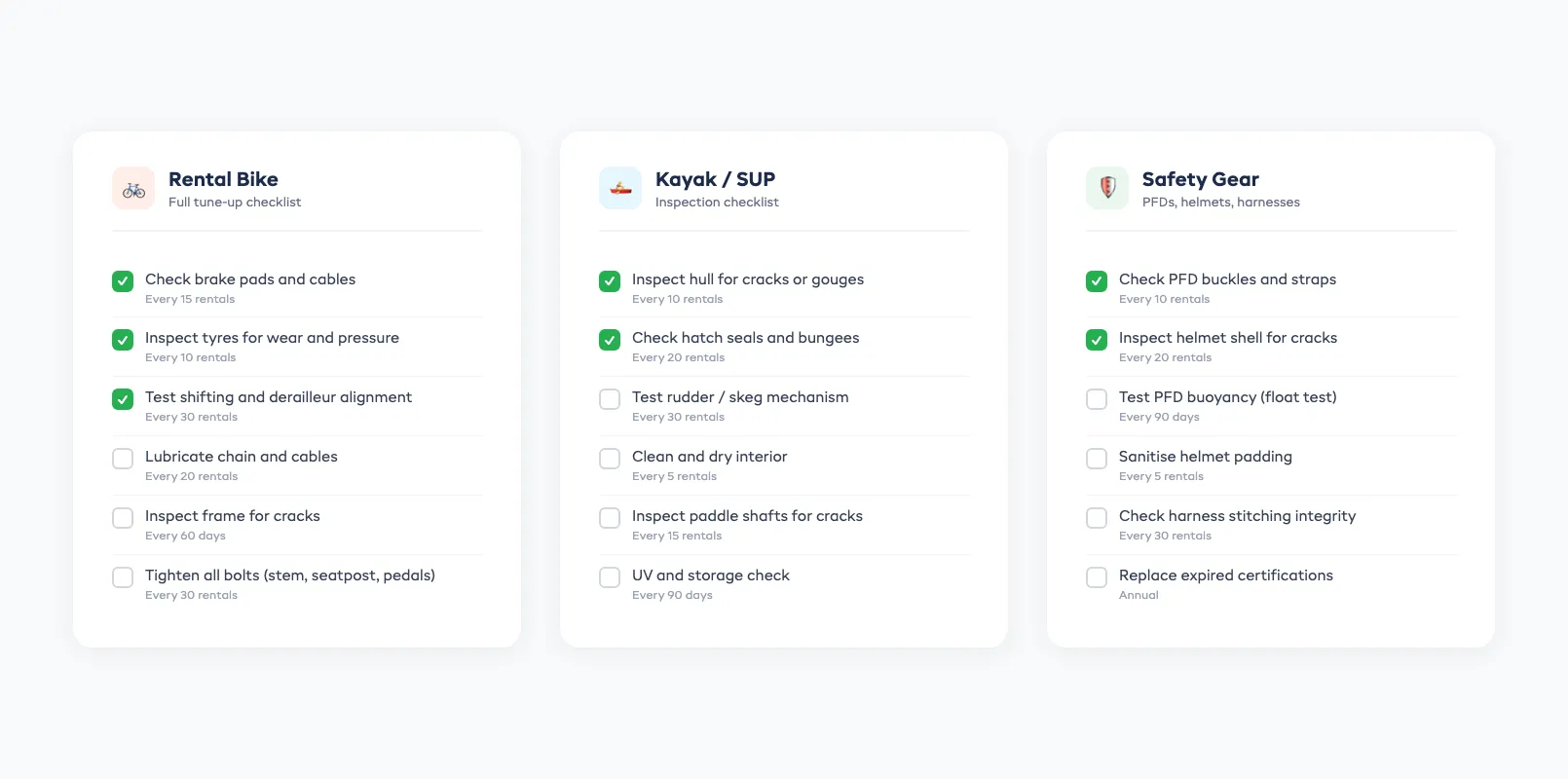
- List every item type. Group by category — bikes, kayaks, SUPs, helmets, PFDs. Each category gets its own checklist.
- Define tasks per category. A bike checklist: check brakes, inspect tires, test shifting, lubricate chain, check frame for cracks. A kayak: inspect hull, check hatch seals, test rudder.
- Set trigger intervals. Quick visual inspections every 5 rentals. Full tune-ups every 30 rentals or 60 days. Deep cleans every 2 weeks in peak season.
- Assign responsibility. Name the staff member who owns each task. "The team" is not a person.
- Record everything. Date, staff name, and notes for every completed task. This log is your proof of diligence if a liability question comes up — and your data for spotting patterns. See our guide on how to track rental equipment for the full workflow. Your return counter is your first line of defense — most maintenance flags get raised right there.
A spreadsheet works for small fleets. Past 30–40 items, you'll spend more time managing the spreadsheet than doing the maintenance. That's when tracking software starts saving time.
Tracking in Your Rental Software
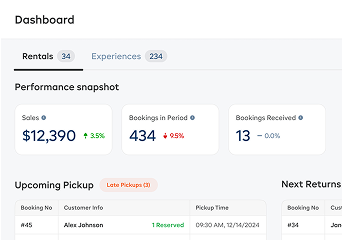
Software-based maintenance tracking beats spreadsheets because maintenance data lives alongside booking and inventory data — so the system can act on it.
- Automated alerts. The system counts rentals per item and flags when it hits the service threshold.
- Status blocking. An item marked "in maintenance" can't be booked. No more customers arriving to find their reserved kayak in pieces on a workbench. This ties directly into preventing double bookings.
- Maintenance history. Every service event logged with date, task, and cost. Over time, this shows which items cost more to maintain than they earn.
- Cost tracking. Parts and labor per item reveal true cost of ownership. That $800 paddleboard with $400 in repairs over two seasons might not be worth keeping.
Dash AI can take this further by analyzing patterns and flagging items trending toward failure before they hit a scheduled check — moving up a service date based on increasing complaint frequency rather than waiting for the next trigger.
Keeping Gear in Rotation During Servicing
Maintenance only works if it doesn't crater your availability.
Schedule for off-peak windows. Monday and Tuesday mornings are dead at most shops. Do tune-ups then — not Friday afternoon.
Stagger your schedule. Don't service all 10 kayaks the same week. Rotate 2–3 per week so inventory stays available.
Build a fleet buffer. If you need 20 bikes on a peak Saturday, own 23–25. That 15–20% buffer lets you pull items for service without running out.
Use maintenance status in your booking system. Gear flagged for maintenance should be invisible to the booking engine — not blocked at the counter after the customer arrives.
Frequently Asked Questions
How often should I inspect rental equipment? Quick visual check at every check-in. Full mechanical inspection every 20–30 rentals or 60 days, whichever comes first.
What's the difference between preventive and corrective maintenance? Preventive is scheduled — you service gear before it breaks. Corrective is reactive — you fix it after. A good program is 80% preventive and 20% corrective.
Should I track maintenance in a spreadsheet or software? Spreadsheets work for under 30 items. Beyond that, software automates counting, sends alerts, and blocks bookings on items out for service.
How do I handle maintenance during peak season? Shift heavy maintenance to pre-season and post-season. During peak, limit to quick checks and critical repairs. Never pull more than 10–15% of your fleet at once.
What maintenance records should I keep for insurance? Log every inspection, repair, and part replacement with dates and staff names. Documented maintenance schedules prove reasonable care if a customer makes a claim.
When should I retire equipment instead of repairing it? When cumulative repairs exceed 50–60% of replacement cost. Retire immediately for structural damage that can't be fully restored.
in one place