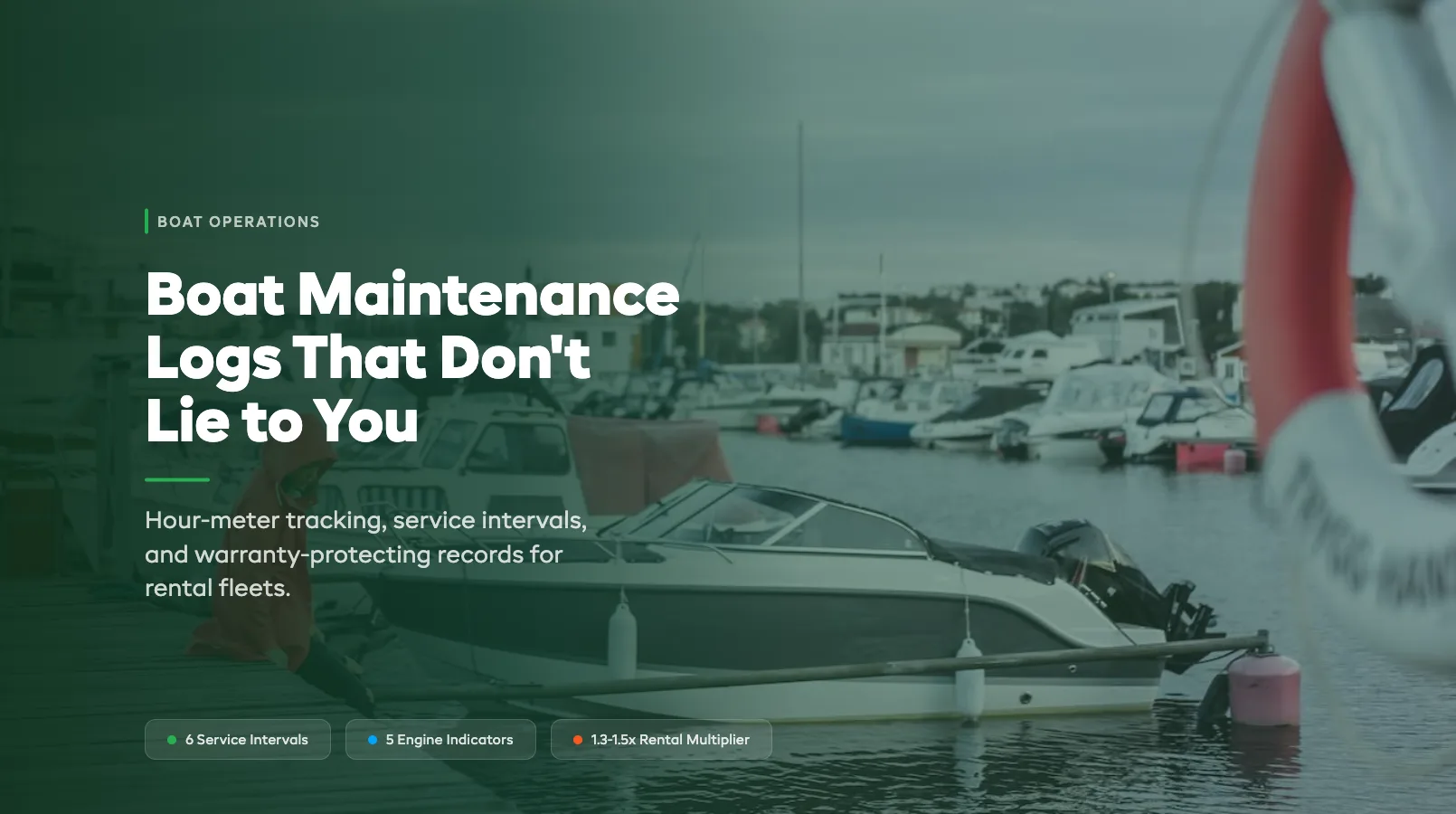
Boat Maintenance Logs That Don't Lie to You
Your maintenance log says the oil was changed 40 hours ago. The dipstick says otherwise. The tech who signed off on it left three weeks ago. And now your 150-hp outboard is making a noise that sounds expensive.
This is the gap between what maintenance logs record and what actually happens to your fleet. Most boat rental operators have some form of tracking — a binder in the dock office, a spreadsheet on someone's laptop, a stack of receipts in a drawer. The problem isn't the absence of a log. It's that the log lies by omission, by rounding, and by letting tasks fall through the cracks when the dock gets busy.
Boat rental maintenance tracking done right protects three things: your engines, your warranty coverage, and your ability to prove due diligence when something goes wrong. This guide covers how to build a boat service log that tracks what actually happened — tied to real engine hours, not calendar guesses.
For the full boat rental operator playbook covering licensing, insurance, fleet composition, and tech stack, see our complete boat rental business guide. If you're weighing captained charters against bareboat rentals, our captained vs bareboat economics breakdown covers the revenue and risk trade-offs.
Why Logs Fail
The most common maintenance log failure isn't "we don't have one." It's "we have one and nobody trusts it."
Here's how it usually breaks down:
Calendar-based intervals instead of hour-based. You schedule an oil change every 30 days. But a pontoon that runs 6 hours a day during peak season hits 180 hours in that month. A jet ski that only goes out on weekends hits 40. Same calendar interval, completely different wear. The pontoon is overdue. The jet ski is wasting a change. Neither is getting serviced at the right time.
"I'll log it later" syndrome. Your dock tech finishes a lower-unit service between rentals, plans to update the log after the next check-in, gets slammed with a 3 p.m. rush, and goes home at 6 without ever writing it down. The work happened. The record didn't.
Incomplete entries. The log says "oil change" but not which oil weight, how many quarts, or what the hour meter read. Six months later, when the dealer asks for service history during a warranty claim, a line that says "oil change — July" is worthless.
No accountability chain. If anyone can write in the log and nobody verifies, the log becomes a wish list. "Checked impellers" might mean someone looked at the cover plate and called it good. Without a sign-off from a second person or a photo, there's no way to know.
These failures compound over a season. By August, the gap between your log and your fleet's actual condition is wide enough to miss a real problem — a corroded anode, a failing water pump impeller, a prop shaft vibration that started as a wobble and became a bearing replacement.
Hour-Meter Tracking
Engine hours are the only honest measure of when service is due. Calendar dates lie. Booking counts approximate. Hour meters don't care how busy your dock was last Saturday.
What to track for every vessel:
- Current hour-meter reading (recorded weekly and at every service event)
- Hours since last oil change
- Hours since last impeller replacement
- Hours since last lower-unit service
- Total season hours (reset at winterisation)
- Lifetime hours
How to read hour meters accurately. Most outboards and stern drives have built-in hour meters accessible through the gauge cluster or engine diagnostic port. Older engines may need an aftermarket Hobbs meter wired to the ignition circuit — a $30 part and 20-minute install. Don't skip this. An engine without an hour meter is an engine you're guessing about.
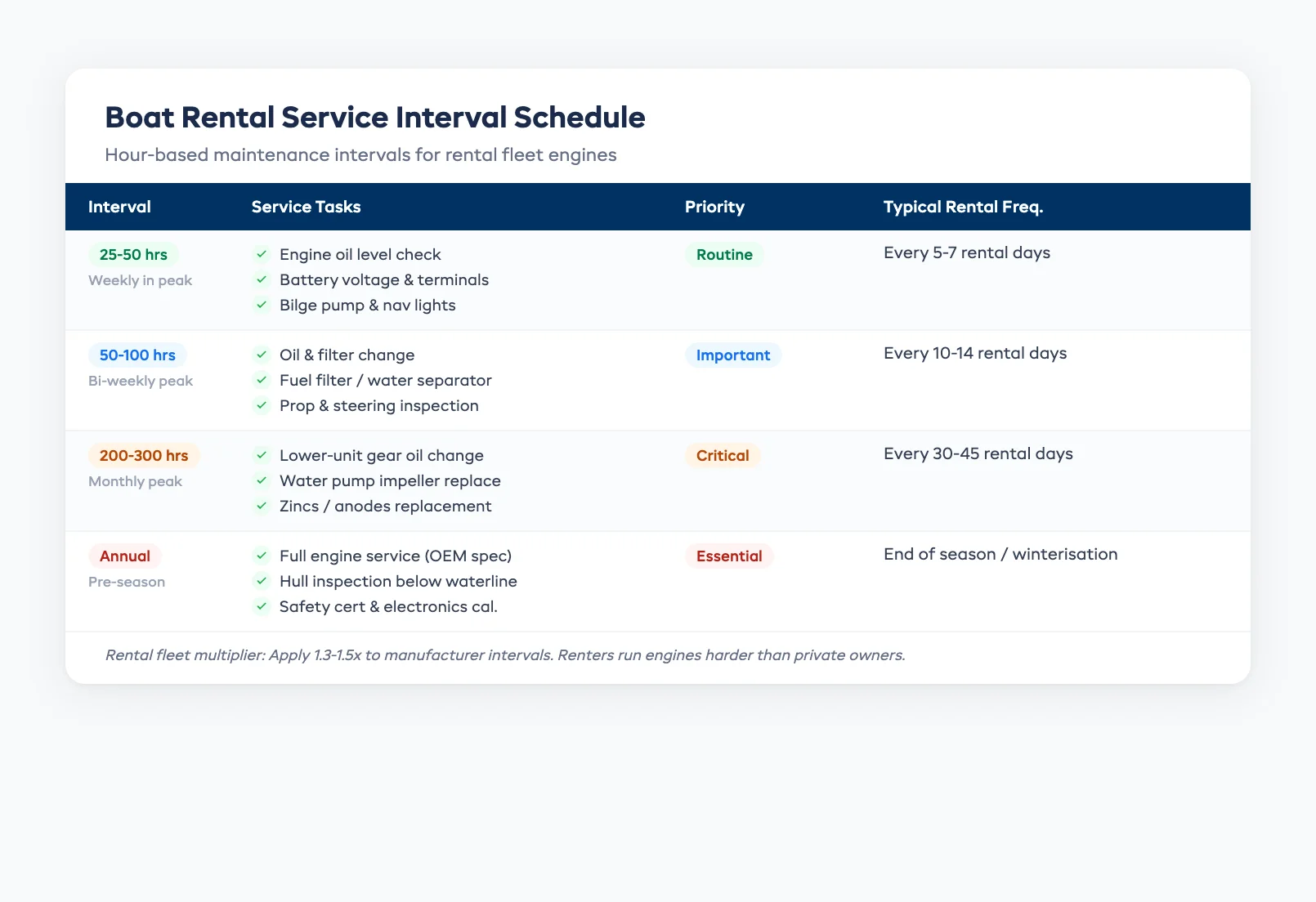
The rental multiplier. Rental engines work harder than privately owned engines. A private boat owner idles, cruises, and varies RPM. A renter runs at full throttle because they paid for four hours and want to cover water. Apply a 1.3–1.5x multiplier to manufacturer service intervals for rental fleet engines. If Yamaha says oil change at 100 hours, change at 65–75 hours.
Use your boat engine service log to record every service event against the hour-meter reading. When it's time for a warranty claim, that log is your evidence that the engine was maintained to spec — or better.
Service Interval Checklists
Every boat in your fleet should have a service schedule that triggers on hours, not dates. Here are the intervals that matter most for rental fleets:
Every 25–50 hours (weekly during peak):
- Engine oil level check
- Coolant level (closed-cooling systems)
- Belt tension and condition
- Battery voltage and terminal corrosion
- Bilge pump function test
- Navigation lights
Every 50–100 hours:
- Engine oil and filter change
- Fuel filter/water separator
- Spark plug inspection (4-stroke) or replacement (2-stroke)
- Steering cable and hydraulic fluid check
- Prop inspection — nicks, dings, fishing line wrapped on shaft
Every 200–300 hours:
- Lower-unit gear oil change
- Water pump impeller replacement
- Thermostat test
- Exhaust system inspection
- Zincs/anodes replacement
Annual (or at winterisation):
- Full engine service per manufacturer spec
- Hull inspection below waterline
- Trailer bearing repack (trailer-launched boats)
- Safety equipment certification check
- Electronics calibration
Build this into a per-vessel checklist that your techs follow. The daily pre-departure check catches the obvious stuff before each rental. The service interval checklist catches the stuff that accumulates silently.
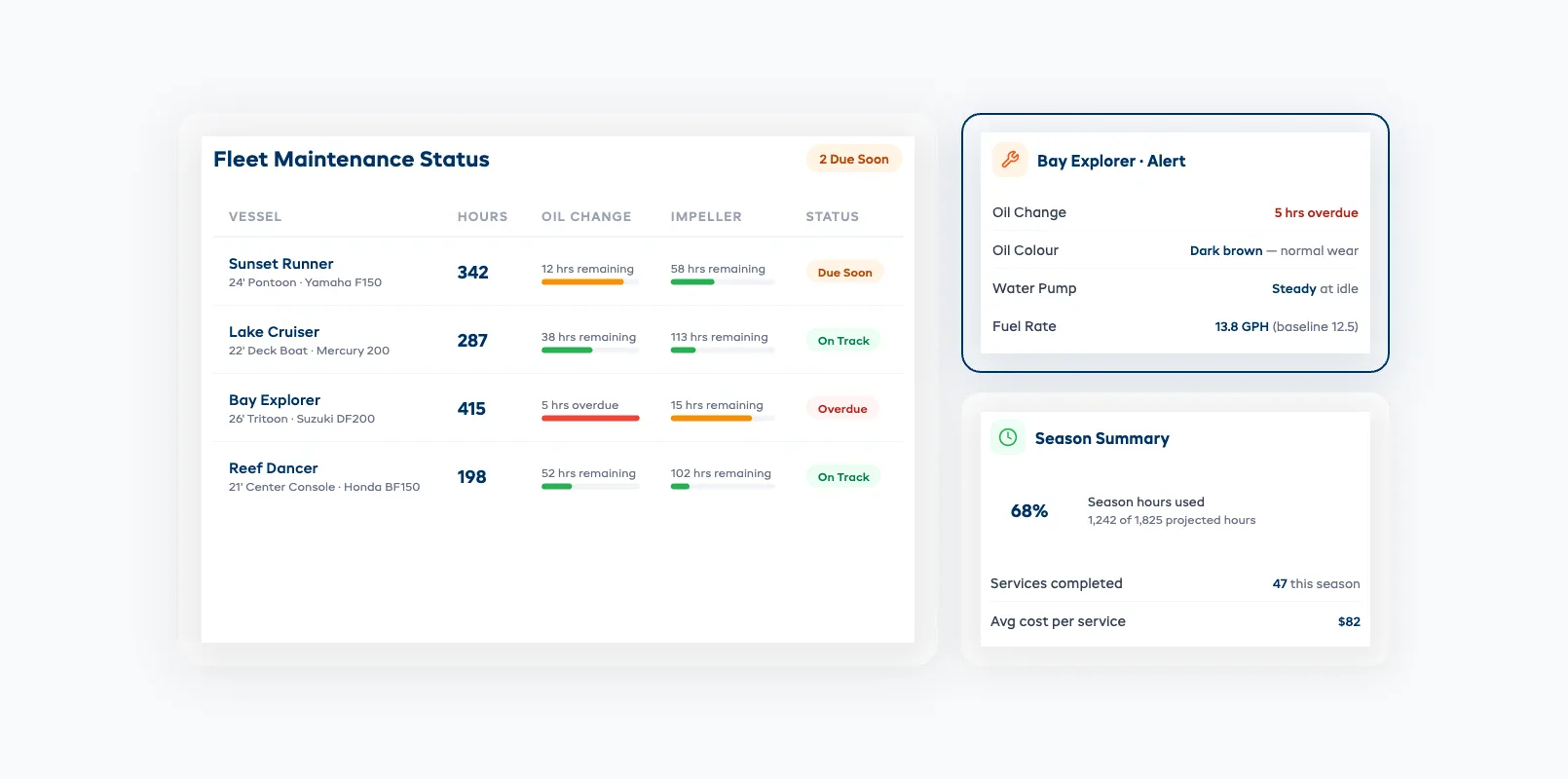
The missed-interval problem. When a service interval passes without being completed, the log should flag it — not silently move the goalposts. If a pontoon hits 105 hours without its 100-hour oil change, the next entry should show "Oil change — 5 hours overdue" not just "Oil change — 105 hours." The overdue notation creates accountability and a paper trail.
Engine Health Indicators
Maintenance logs track what you did. Engine health indicators track what the engine is telling you. The best boat service log records both.
Five readings your log should capture at every oil change:
- Oil color and consistency. Clean amber = good. Dark brown = normal wear. Milky = water intrusion (head gasket, exhaust issue). Metal flake = bearing or ring wear. Record what you see.
- Compression (at annual service). Cylinders should be within 10% of each other. A 15%+ variance means one cylinder is wearing faster — and that's a repair before it becomes a rebuild.
- Water pump output. The telltale stream should be steady and strong at idle. Weak or intermittent flow means the impeller is going. Record "strong/weak/intermittent" at every service.
- Fuel consumption trend. A 150-hp outboard burning 12 GPH at cruise that slowly creeps to 14 GPH at the same RPM has a developing issue — fouled injectors, prop damage, or hull growth. Track fuel consumption per engine hour across the season.
- Vibration at idle and cruise. Abnormal vibration is the earliest warning of prop damage, shaft misalignment, or mount deterioration. If your tech notices a change, it goes in the log with a description — not "runs rough" but "vibration felt at 3200 RPM, smooth below and above."
These indicators turn your maintenance log from a record of past work into an early-warning system. A single milky oil reading is a finding. Two in a row is a diagnosis. Three is a rebuild — and you should have caught it at one.
Digital vs Paper
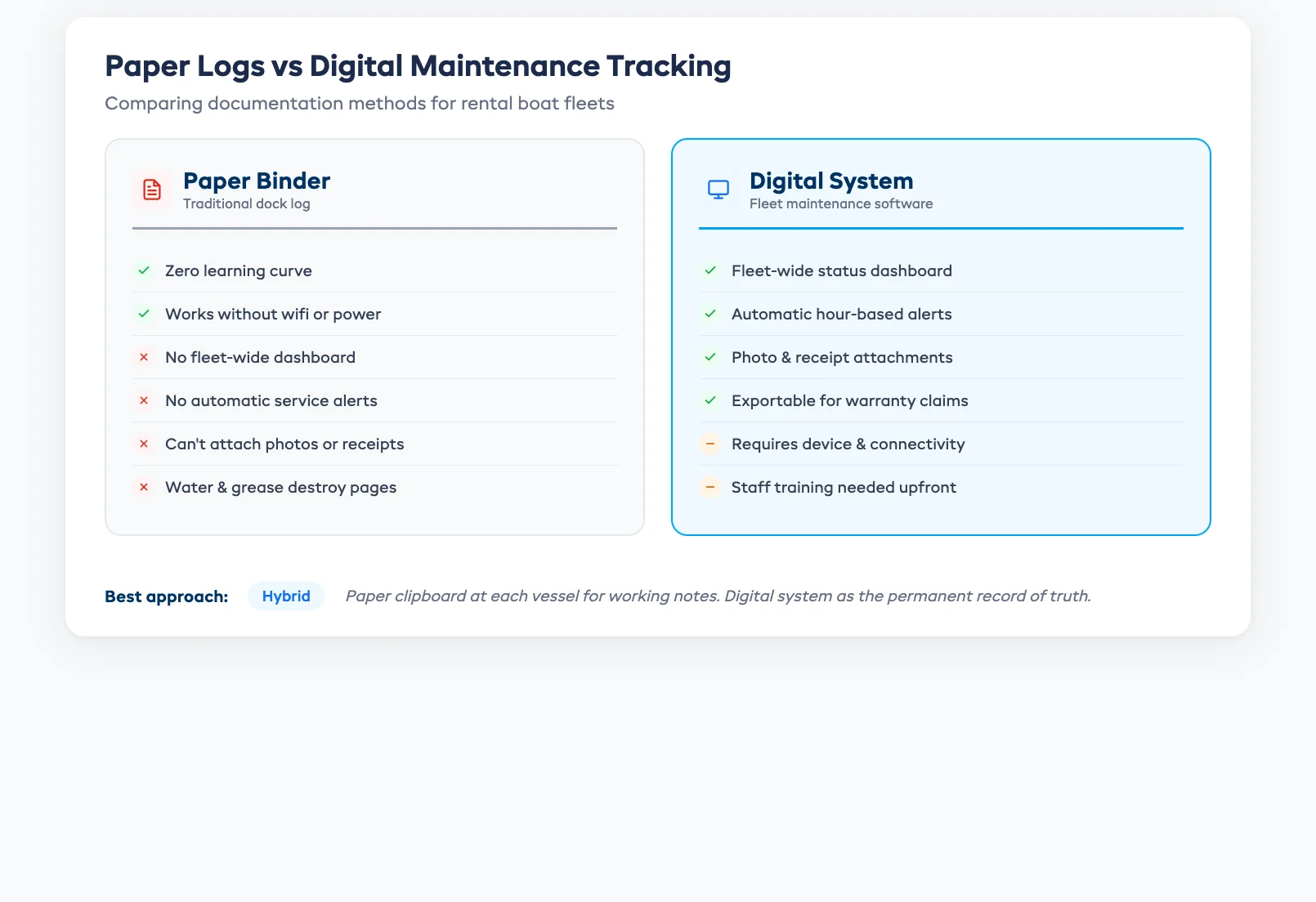
Paper logs work until they don't. Here's where each breaks:
Paper strengths:
- Zero learning curve — anyone can write in a binder
- Works without wifi, power, or a login
- Visible on the dock without pulling out a phone
Paper failures:
- One binder per vessel means nobody has the fleet view
- Handwriting varies from legible to forensic challenge
- Water, grease, and sun destroy pages
- No alerts — the binder doesn't knock on your door when service is overdue
- Can't attach photos or diagnostic readouts
Digital strengths:
- Fleet-wide dashboard — every vessel's status in one view
- Automatic alerts when hour-based intervals are due
- Photo attachments for damage, readings, and before/after
- Search and filter history by date, tech, vessel, or service type
- Exportable for warranty claims, insurance audits, and vessel resale
Digital failures:
- Dock staff need a device and connectivity
- Data entry takes longer if the interface is clunky
- Tech-resistant staff may fill in fields with garbage data
The hybrid approach most operators land on: Digital as the system of record. Paper checklist on a clipboard at each vessel as the working document. Tech fills out the clipboard during service, then enters it into the system within 24 hours. The clipboard is the prompt. The digital record is the truth.
A maintenance-due alert agent can monitor hour meters against service intervals and flag upcoming service automatically — so you're not relying on someone to remember to check the spreadsheet.
Warranty-Protecting Records
Engine warranties on outboards and stern drives run 3–5 years for recreational use. But warranty claims get denied for one reason more than any other: insufficient maintenance documentation.
What the dealer needs to approve a warranty claim:
- Proof of oil changes at manufacturer-specified intervals (hours, not calendar)
- Proof of correct oil type and weight
- Proof of OEM or equivalent filter use
- Service performed by a qualified technician (or detailed DIY records with part numbers)
- No evidence of abuse, overheating, or running with known issues
What "proof" actually means: A log entry that says "oil change" doesn't cut it. A log entry that says "Oil change at 98 hours — Yamalube 4M 10W-30, 6 quarts, OEM filter 69J-13440-03-00, performed by Mike S." — that's proof. Part numbers, quantities, tech initials, and hour reading. Every time.
The resale multiplier. Complete service records increase used vessel value by 10–15% at resale. Dealers and private buyers pay more for a boat with a documented history than an identical boat with "we maintained it, trust us." If you're planning to cycle vessels every 3–5 seasons — and most rental fleets should — those records pay for themselves at sale.
Keep a digital copy of every receipt for parts and service. Cross-reference receipts to log entries by date and hour reading. When the warranty claim comes, hand the dealer a folder — physical or digital — that matches every service event to a receipt and an hour reading. Make it impossible to deny.
For seasonal maintenance, the pre-season launch checklist and end-of-season winterisation checklist provide the structured documentation your warranty records need. If you also winterize and store customer boats, the boat winterization and storage guide covers how those jobs get logged and billed.
FAQ
How often should I update maintenance logs for rental boats? Every service event gets logged within 24 hours — no exceptions. Weekly hour-meter readings even when no service was performed. The hour reading is the backbone of the log. Without it, service intervals are guesswork.
What's the minimum information each log entry needs? Date, hour-meter reading, vessel ID, what was done, parts used (with part numbers), quantity of fluids, and tech initials. Six fields. If any are blank, the entry is incomplete and useless for warranty purposes.
Can I use a spreadsheet instead of dedicated software? You can, and many operators do for fleets under 5 vessels. The spreadsheet works until you need alerts, photo attachments, or fleet-wide reporting. Most operators outgrow spreadsheets by their second season because the manual overhead of checking every vessel's tab eats an hour a day.
Do marine engine warranties require dealer-performed service? Most recreational outboard warranties (Yamaha, Mercury, Suzuki) allow owner-performed maintenance if you use OEM-spec parts and document everything. The key is the documentation — complete records with part numbers and quantities. Check your specific warranty terms, but "must use dealer" is less common than operators assume.
How do I handle maintenance logs when I sell a vessel? Export or print the complete service history and hand it to the buyer with the bill of sale. It's the single biggest trust signal in a used vessel transaction. Buyers who see 200+ logged service events with photos pay more and negotiate less. Keep a copy for your records in case of future liability questions.
What's the biggest maintenance log mistake you see? Logging calendar dates instead of engine hours. A boat that ran 300 hours in July has completely different service needs than one that ran 40. Calendar-based schedules systematically under-serve busy boats and over-serve slow ones. Neither is good for the engine or your budget.
Should I photograph maintenance work? Yes — especially impeller replacements, anode condition, oil color, and any damage found during service. Photos take 10 seconds and provide evidence that no written description can match. They're particularly valuable for warranty claims and insurance documentation.
A maintenance log that reflects reality — not intentions — is the cheapest insurance in boat rental. Start with hour meters, build service intervals around them, and document like the warranty depends on it. Because it does. For a structured approach to fleet maintenance records, pair this guide with the boat engine service log template and the daily pre-departure check. If you're growing past 10 vessels and maintenance scheduling is getting complex, see our guide to scaling a pontoon rental fleet.
More in the boats series: Damage deposits & customer comms · Marina slip logistics · Fuel policies & provisioning
in one place