How to Run a Camping Gear Rental Business: The Complete Operator's Guide (2026)
Most camping gear rental businesses start the same way. Someone living in a gateway town (near a national park, a popular trailhead, or a lake district) notices tourists arriving without gear and leaving money on the table. They buy a dozen tents, a rack of sleeping bags, and a stack of cookware sets. The first season goes well enough. Then gear comes back wet, sleeping bags smell like campfire and sweat, a tent is missing two stakes and a guyline, and the "deposit" they collected in cash doesn't cover the replacement cost of a $400 backpack that never returned. The gap between "I rent tents" and "I run a profitable outdoor gear rental operation" is measured in mouldy nylon and unreturned inventory.
This guide is the operator playbook for 2026. It covers the gateway-town business model, inventory strategy across tents, sleeping bags, packs, and cookware, pricing for multi-day rentals, cleaning and hygiene at scale, seasonal cash-flow management, partnerships with guides and outfitters, and the technology that holds the operation together. Whether you're outfitting weekend car campers heading into a state park or supplying backcountry hikers with ultralight setups for a five-day traverse, the fundamentals are here.
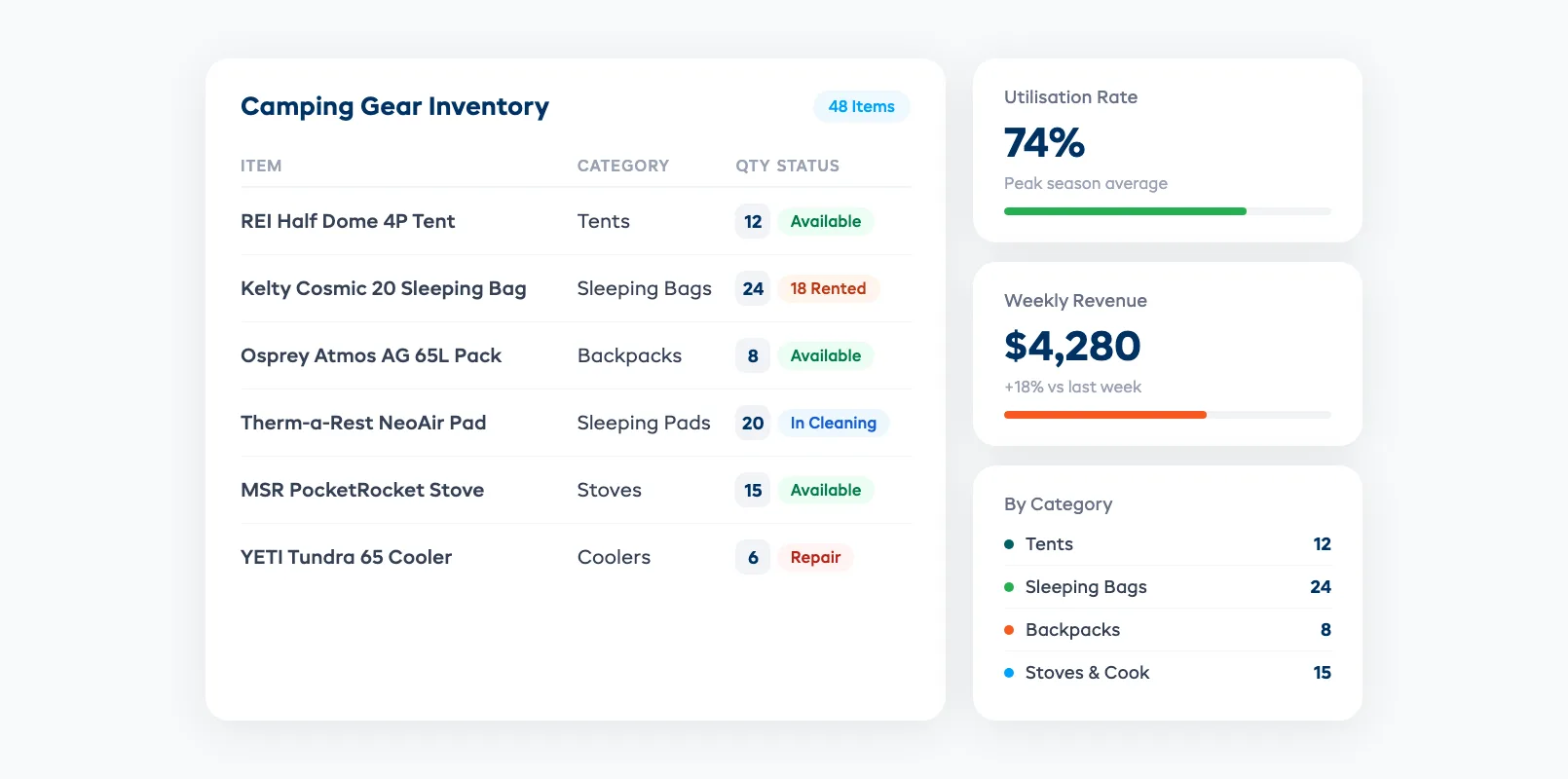
The Gateway Town Business Model
Camping gear rental businesses thrive in gateway towns — the last stop before the wilderness. Estes Park outside Rocky Mountain National Park. Springdale at Zion. West Yellowstone. Bozeman. Bend, Oregon. These towns share three things: a constant stream of visitors, limited retail options, and customers who need gear right now.
Why gateway towns work. Tourists driving to a national park or popular trail system often lack specific gear, or they flew in and couldn't check a tent. Others are first-timers who don't want to buy $1,500 worth of equipment for a single weekend trip. Your rental shop sits at the intersection of convenience and commitment-free access to the outdoors.
The customer segments. You'll serve three distinct groups:
- Weekend car campers (50-60% of revenue): families and groups heading to established campgrounds. They need tents, sleeping bags, coolers, camp chairs, and maybe a stove. Rentals are 1-3 nights. They value convenience and don't care about ultralight specs. Average transaction: $80-$200.
- Backcountry hikers (20-30% of revenue): experienced or semi-experienced hikers doing multi-day traverses. They need lightweight packs, sleeping bags rated for altitude, water filtration, and bear canisters. Rentals are 3-7 nights. They know gear and will ask questions. Average transaction: $150-$400.
- First-timers and try-before-you-buy (15-20% of revenue): people testing camping before committing to purchases. They rent everything. This segment has the highest conversion to retail sales if you also sell gear. Average transaction: $100-$250.
Location matters more than marketing. A shop on the main road into a national park entrance will outperform a better-stocked shop two blocks off the highway. Visibility, signage, and proximity to the trailhead or park gate are your primary marketing channels. If you can secure a lease within sight of the turn-off to the park, your foot traffic does the selling.
Revenue benchmarks. A well-run gateway-town rental shop with $40,000-$60,000 in gear inventory typically generates $80,000-$150,000 in rental revenue during a 5-7 month season, before retail sales and add-ons. Gross margins on rentals run 65-80% once gear is paid off (usually by end of second season). The biggest cost isn't gear. It's rent and staff during shoulder months when bookings are thin.
For a complete look at how rental technology maps to the camping vertical, from inventory tracking to multi-day booking flows, visit the camping & hiking hub page.
Gear Inventory: What to Stock and How Much
Your inventory mix determines your capital outlay, maintenance burden, and the customers you attract. Here's a framework by gear category:
Tents (30-35% of inventory value)
- 40% 2-person tents ($150-$300 each) — the workhorse for couples and solo campers who want space
- 30% 4-person tents ($200-$450 each) — families and small groups, your highest-demand category on weekends
- 20% 6-person tents ($300-$600 each) — group camping, car camping families with kids
- 10% ultralight 1-2 person ($250-$500 each) — backcountry hikers who need weight under 3 lbs
Sleeping bags (25-30% of inventory value)
- 50% 3-season bags rated to 30-35°F ($80-$200 each) — covers 80% of rental demand
- 30% warm-weather bags rated to 45-50°F ($50-$120 each) — summer car camping
- 20% cold-weather bags rated to 15-20°F ($150-$350 each): alpine, shoulder season, higher altitude
Backpacks (15-20% of inventory value)
- 60% 50-65L packs ($100-$250 each) — multi-day hiking standard
- 25% 30-40L daypacks ($60-$150 each) — day hikers, short overnights
- 15% 70L+ expedition packs ($150-$350 each) — extended backcountry trips
Cookware and accessories (10-15% of inventory value)
- Camp stoves and fuel canisters, cookware sets, water filtration, headlamps, trekking poles, camp chairs, coolers, bear canisters (where required)
- These items are high-turn, low-margin, and frequently lost or damaged — budget for 20-30% annual replacement
How much gear do you need? Start with enough inventory to serve your expected peak weekend plus a 20% buffer for gear in cleaning/maintenance rotation. For a gateway-town shop, that typically means 25-40 tents, 50-80 sleeping bags, and 20-30 packs. You'll learn your actual demand curve in the first season — resist the urge to over-invest before you have booking data.
Run a tent pre-rental inspection on every tent before it goes out. Check zippers, seams, poles, and rainfly grommets. A tent that fails at the campsite is a refund, a bad review, and a customer who never comes back.
Sizing and fit. Sleeping bags come in regular and long. Packs come in multiple torso lengths and hip belt sizes. Stock a range. A customer who can't get a pack that fits walks out, or worse, rents one that doesn't fit and blames you when their back hurts on day three.
Pricing Models for Multi-Day Rentals
Camping gear pricing is fundamentally different from hourly rentals. Your customers rent for days, not hours, and multi-day packages drive higher average order value than per-item pricing.
Per-item daily rates (2026 market benchmarks):
| Gear Category | 1 Night | 2-3 Nights | 4-7 Nights | Weekly |
|---|---|---|---|---|
| 2-person tent | $25-$40 | $20-$30/night | $15-$25/night | $90-$150 |
| 4-person tent | $35-$55 | $28-$42/night | $22-$35/night | $130-$210 |
| Sleeping bag (3-season) | $12-$20 | $10-$16/night | $8-$12/night | $45-$75 |
| Sleeping bag (cold-weather) | $18-$30 | $15-$24/night | $12-$18/night | $70-$110 |
| Backpack (50-65L) | $15-$25 | $12-$20/night | $10-$15/night | $55-$90 |
| Camp stove + cookset | $10-$18 | $8-$14/night | $6-$10/night | $35-$60 |
| Bear canister | $5-$8 | $5-$8/night | $5-$8/night | $25-$40 |
Package pricing outperforms per-item. Bundle a tent, two sleeping bags, two sleeping pads, and a cookware set into a "Weekend Camping Package" for $120-$180 per weekend. Customers see a clear price, you increase average transaction value by 30-50% compared to individual items, and checkout is faster.
Package tiers that work:
- Solo Backpacker: 1-person tent, sleeping bag, pack, stove, water filter. $60-$90/night, $180-$300/week.
- Couple's Weekend: 2-person tent, 2 sleeping bags, 2 pads, cookware set, headlamps. $80-$120/weekend.
- Family Car Camping: 4-person tent, 4 sleeping bags, 4 pads, cookware, cooler, camp chairs. $150-$250/weekend.
- Backcountry Premium: ultralight tent, down sleeping bag, fitted pack, water filter, bear canister, trekking poles. $90-$140/night.
Pricing rules:
- Weekend anchor. Friday-to-Sunday is your primary unit. Set weekend rates at 2.5x one-night. Most customers plan in weekends, not days.
- Weekly ceiling. Cap weekly at 4x the weekend rate. Multi-day hikers on a 5-7 day trip are your lowest-effort bookings — gear goes out Monday, comes back the following weekend.
- Seasonal surcharges. Add 15-25% during peak months (June-August for most mountain destinations, October for fall foliage). Post it on your website and booking page — surprise pricing generates complaints.
- Late-return fees. Charge $15-$25 per day per item. Make it clear at checkout and in the rental agreement. Late returns mess up your next booking.
Deposits and damage fees. Pre-authorize $100-$500 on a credit card depending on the total gear value. Never collect cash deposits. They create disputes and you can't collect additional charges. Use a camping gear damage assessment checklist to document condition at check-out and check-in with photos. Release the hold within 48 hours of clean return.
Multi-Day Rental Logistics
Multi-day rentals are the bread and butter of camping gear rental, but they introduce logistics that single-day operations don't face.
The checkout process sets the tone. Every checkout should include:
- Gear walkthrough: show the customer how every item works. How to set up the tent (poles, rainfly, stakes). How to light the stove. How to use the water filter. Budget 15-20 minutes per rental for car campers, 25-30 minutes for backcountry customers who need pack fitting and gear orientation.
- Condition documentation: photograph everything with timestamps. Use a post-rental camping return check at both ends. The 3 minutes spent documenting saves hours of disputes.
- Rental agreement: damage liability, late-return fees, cleaning expectations, emergency contacts. Digital waivers signed before arrival cut checkout time by 10 minutes.
- Trail and weather briefing, not required, but it builds trust and reduces gear misuse. Tell them where the bear boxes are, what the weather looks like, and where the nearest bail-out point is.
Returns and turnaround. Here's where multi-day rentals get operationally complex. A tent that comes back Sunday afternoon needs to be inspected, cleaned, dried, and ready for the next Friday booking. That's a 4-day turnaround window — enough if you have a system, not enough if you wing it.
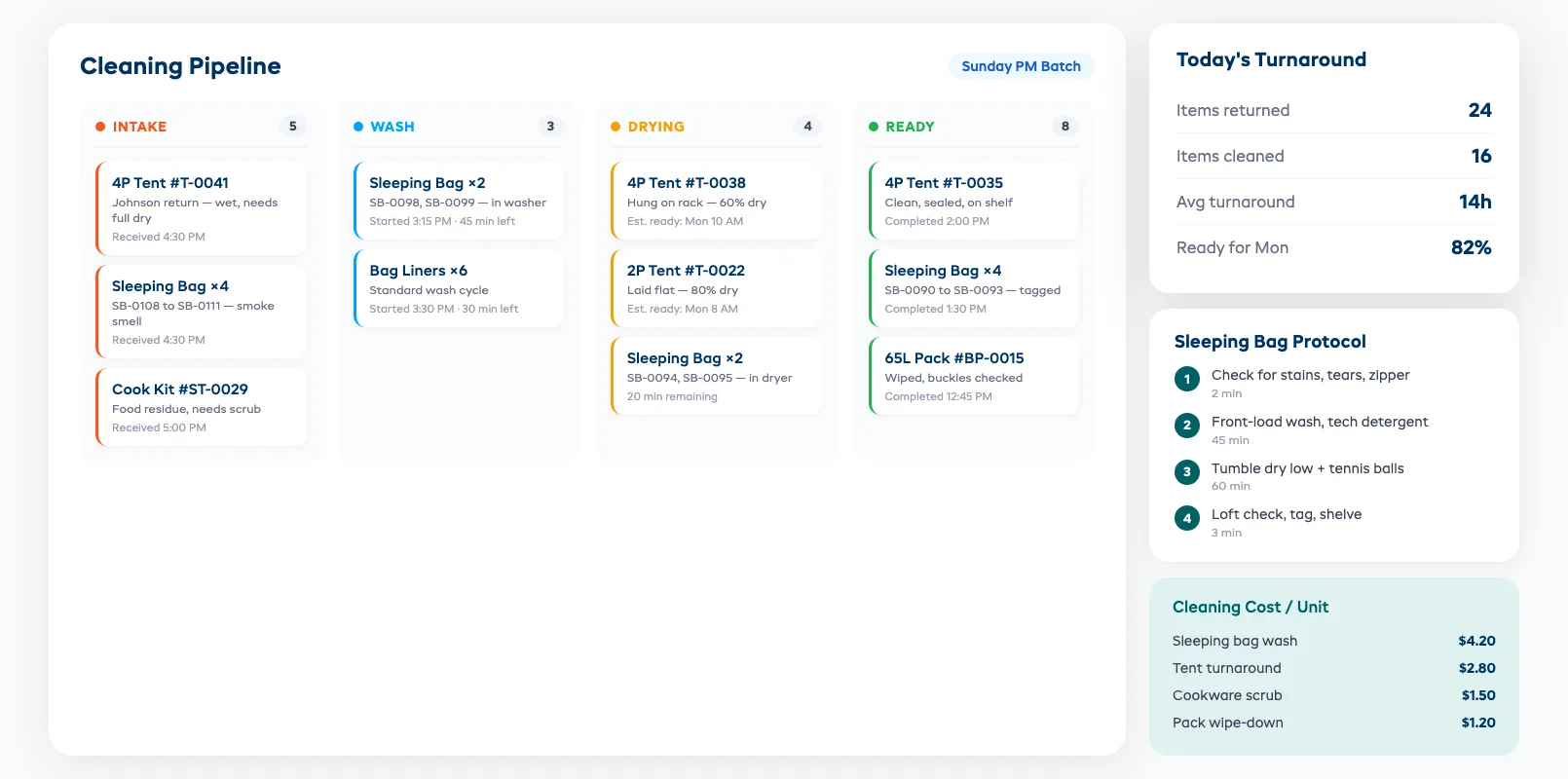
The turnaround workflow:
- Return inspection (15-20 minutes per kit). Check all items against the packing list. Count tent stakes. Check zippers. Smell sleeping bags. Look for tears, stains, and broken components.
- Cleaning queue: tents get hung to dry or laid flat (never stuff a wet tent). Sleeping bags go into a commercial washer with tech wash (every 3-5 rentals, or immediately if visibly dirty). Cookware gets scrubbed and sanitised.
- Repair queue: seam tape a leaky rainfly. Replace missing stakes. Patch a sleeping pad. Minor repairs happen in-house. Major repairs go to a gear-repair specialist or the item gets retired.
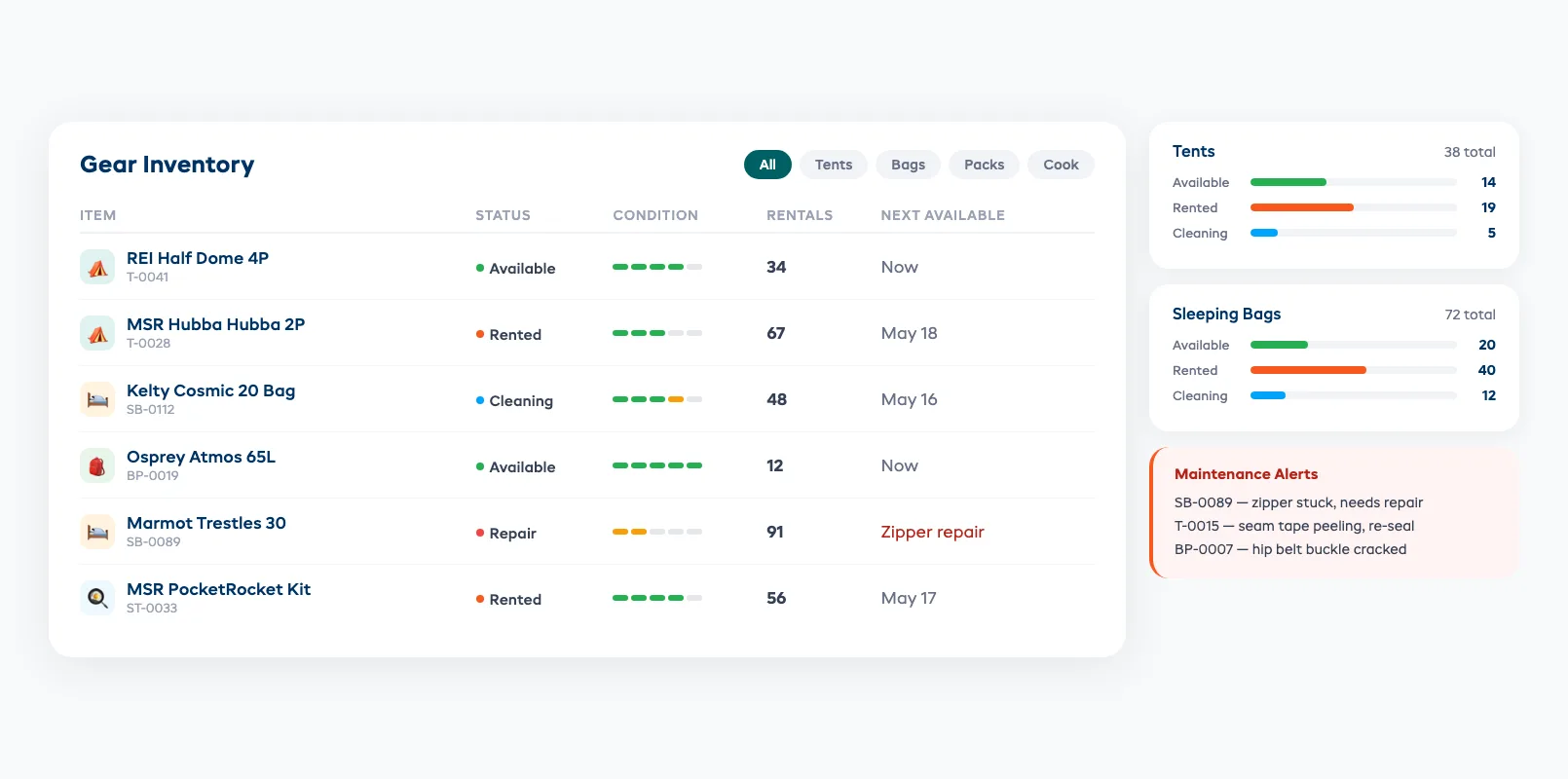
- Re-stock: clean gear goes back on the shelf, tagged as ready. Your inventory system should track which items are rented, in cleaning, in repair, or available.
For backcountry rentals specifically (where gear goes into remote areas for 3-7 days) see our guide to multi-day backcountry rental operations for customer screening, deposit sizing, and missing-gear protocols that differ from car camping logistics.
The unreturned-gear problem. It happens. Budget for 3-5% annual gear loss from unreturned items. Your rental agreement should specify: charge the card on file after 48 hours overdue, at replacement cost minus depreciation. An overdue return reminder agent sends automated texts at the 12-hour and 24-hour marks — most "lost" gear is just a customer who forgot to drop off.
Gear Hygiene at Scale
Cleanliness is the difference between a rental business that earns repeat customers and one that collects one-star reviews. When 30 sleeping bags come back on a Sunday evening, you need a system, not a garden hose and good intentions.
Tents. Never machine-wash a tent. Hang or lay flat to dry completely — mold starts within 24 hours on damp nylon. Spot-clean with mild soap and a sponge. Check seams and re-apply seam sealer every 10-15 rentals. UV exposure degrades waterproof coatings. Store out of direct sunlight. Run a tent pre-rental inspection before every deployment.
Sleeping bags. Wash every 3-5 rentals in a front-loading commercial washer with tech-specific detergent (Nikwax Tech Wash or equivalent). Never use top-loaders, the agitator destroys baffles. Tumble-dry on low with clean tennis balls to restore loft. Between washes, use a removable sleeping bag liner that gets washed after every rental. This extends bag life by 40-60% and addresses the "someone else slept in this" concern. Follow the full sleeping bag cleaning and care protocol.
Backpacks. Wipe down the interior with a damp cloth. Check all zippers, buckles, and hip belt padding. Vacuum out debris. Spot-clean sweat stains on shoulder straps and hip belts with mild detergent. Air-dry completely. Inspect with a backpack pre-rental inspection before each rental.
Cookware. Scrub pots, pans, and utensils. Run through a commercial dishwasher if you have one, or hand-wash with hot water and dish soap. Check camp stove and fuel systems — fuel canisters must be weighed and either refilled or replaced. A stove that doesn't light at the campsite is a ruined dinner.
The cleaning station. Invest $3,000-$8,000 in a dedicated cleaning area: commercial front-load washer and dryer (for sleeping bags and liners), drying racks for tents, a deep sink for cookware, and shelving for staging clean inventory. This pays for itself in the first season through gear longevity and customer satisfaction.
Cost of cleaning. Budget $3-$6 per sleeping bag wash cycle (detergent + energy + labor), $2-$4 per tent turnaround, and $1-$2 per cookware set. On a 500-rental season, your cleaning costs run $2,000-$4,000. Cheap compared to the cost of replacing gear that degrades from neglect.
Seasonality and Cash-Flow Management
Camping gear rental is aggressively seasonal. In most mountain and park destinations, 70-80% of annual revenue lands in a 4-5 month window (June through September, sometimes extending to mid-October for fall camping).
The seasonal revenue curve:
- Pre-season (March-May): 5-10% of annual revenue. Spring break campers, early-season hikers. Use this period for gear prep, repairs, marketing setup, and pre-season bookings.
- Peak season (June-August): 55-65% of annual revenue. Every weekend is fully booked. Weekday rentals pick up in July-August. This is when you make your money.
- Shoulder season (September-October): 15-25% of annual revenue. Fall foliage drives demand in some markets. Cooler weather means cold-rated sleeping bags get their turn. Less competition for camping sites means experienced campers book more multi-day trips.
- Off-season (November-February): 0-5% of annual revenue. Near zero in most camping markets. Some operators pivot to winter gear (snowshoes, cross-country skis, winter camping kits) if the market supports it.
Cash-flow rules for seasonal businesses:
- Bank 40-50% of peak-season revenue for off-season expenses. Rent, insurance, and loan payments don't stop in December.
- Pre-season deposits. Open bookings in March for summer rentals. Collect 25-50% deposits. This front-loads cash flow and gives you demand signals.
- End-of-season gear sales. Retire 15-20% of your inventory each year and sell it at 40-60% of original cost. This recovers capital and makes room for fresh gear. Run an end-of-season camping retirement review to decide what stays and what goes.
- Off-season revenue streams. Consider: gear storage for locals, corporate team-building equipment packages, gear repair services, or winter gear rental if your location supports it.
- Annual gear budget. Plan to reinvest 20-30% of gross rental revenue into new gear each year. Replacement and growth capital should be budgeted, not improvised.
Run a pre-season camping fleet audit before opening for the season. It catches the gear that wintered poorly, identifies replacement needs, and ensures your inventory count matches reality.
Partnerships with Guides and Outfitters
Partnerships extend your reach without extending your overhead. In gateway towns, you're surrounded by potential partners: hiking guides, fishing outfitters, tour companies, lodges, and campground operators.
Partnership models that work:
Revenue share with guides. A hiking guide brings 6-8 clients who all need gear. You provide the equipment, the guide provides the customers. Typical split: 70/30 or 75/25 in your favor (you own the gear, bear the maintenance cost, handle the cleaning). The guide gets a commission without carrying inventory. Set minimum booking thresholds — a guide who sends you 2 rentals a month isn't worth a partnership agreement.
Wholesale rates for tour operators. A multi-day guided backpacking company needs 40 sleeping bags and 20 tents for the season. Offer a seasonal bulk rate at 30-40% below retail rental prices. You get guaranteed utilization on a large chunk of inventory. They get gear without the capital outlay. Put it in a written SLA with damage liability, cleaning responsibilities, and replacement terms.
Campground and lodge referrals. Place QR-code flyers at campground check-in desks and lodge lobbies. Offer the property a 10-15% referral fee on bookings that come through their code. Track with unique promo codes per partner. This is low-cost, high-conversion — guests arriving at a campground without gear are your most motivated customers. Some properties will want to go further and sell gear kits inside their own reservation flow: our guide to campground and glamping gear rentals covers how those add-on programs work from the site's side, and where a rental operator fits as the inventory partner.
White-label gear for branded experiences. Some tour operators want their logo on the gear. You supply tents and bags with the operator's branding (custom stuff sacks, branded tags). Price this at a 20-30% premium over standard wholesale. It's a commitment signal — partners who brand your gear are partners who stay.
What to watch out for. Partners who don't respect your gear cost you money. Set clear terms: cleaning expectations (or a cleaning fee), damage liability, return condition standards. Review partner-returned gear with the same post-rental return check you use for direct customers. A guide who consistently returns trashed gear gets a conversation, then a revised rate, then a terminated partnership.
Tech Stack: Systems That Run Your Operation
A camping gear rental business runs on four systems. Get them right and you scale to multiple locations and hundreds of items. Get them wrong and you cap out at a whiteboard and a box of index cards.
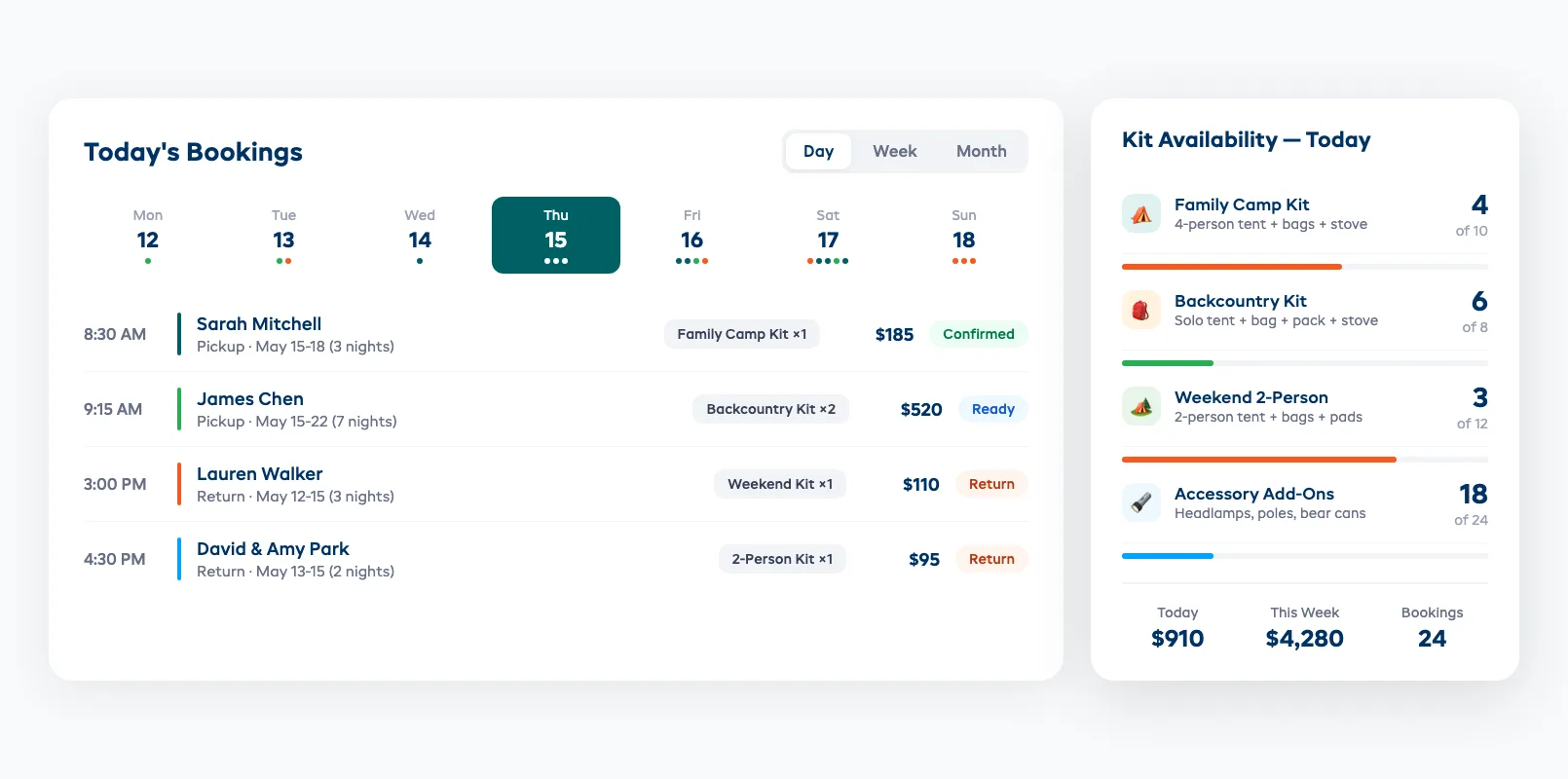
1. Online booking and availability. Customers, especially out-of-town visitors, want to reserve gear before they arrive. A phone number that goes to voicemail during your lunch break loses bookings to the shop down the road that has online checkout. You need real-time availability that shows what's bookable for which dates, accepts payment, and sends a confirmation. Multi-day date-range selection is critical — camping isn't a time-slot business, it's a calendar business.
2. Inventory management. Every tent, sleeping bag, and pack needs a status: available, rented, in cleaning, in repair, retired. When you're running 200+ individual items across 8 gear categories, a spreadsheet breaks within the first month. You need a system that answers: what's available this weekend, what comes back Tuesday, and what's been in the wash pile for three days. Tag each item with a unique ID — barcodes or QR codes on stuff sacks and pack tags work well.
3. Digital waivers and rental agreements. Paper agreements stored in a filing cabinet are a liability nightmare. Digital waivers signed before arrival (via emailed link) cut 10 minutes off checkout, are timestamped, searchable, and stored automatically. Include: equipment responsibility, damage liability, late-return terms, assumption of risk for outdoor activities. A pre-trip customer reminder agent sends the waiver link, packing suggestions, and weather forecast 48 hours before pickup.
4. Payment processing and reporting. Accept cards online and at the counter. Track revenue by gear category, rental duration, and season. The data tells you which items earn their keep and which are dead weight. Monthly reporting should answer: What's my revenue per item? What's my utilization rate by category? What's my cleaning cost per rental? Where should I invest in more inventory?
Dash AI handles the booking confirmations, waiver reminders, and overdue-return follow-ups that eat your mornings. A camping weather alert agent can automatically notify customers of incoming severe weather — a safety feature that also reduces gear damage from unprepared campers.
For a complete look at how rental technology fits the camping and hiking vertical, from inventory tracking to multi-day booking flows, visit the camping & hiking hub page.
FAQ
How much does it cost to start a camping gear rental business?
A basic operation with 25-40 tents, 50-80 sleeping bags, and accessories runs $30,000-$60,000 in gear inventory. Add first/last on a lease ($5,000-$15,000), commercial insurance ($3,000-$6,000/year), cleaning equipment ($3,000-$8,000), and working capital for the first season. Total startup: $50,000-$100,000 depending on location and gear quality.
What gear gets rented the most?
Tents and sleeping bags account for 60-70% of rental transactions. After that: camp stoves, backpacks, and coolers. Bear canisters are mandatory-rental items in many national parks and have near-100% utilization during peak season despite low unit cost.
How do I handle gear that comes back damaged?
Document condition at checkout and return with timestamped photos. Pre-authorize a credit card deposit ($100-$500 depending on total gear value). For minor damage (bent tent stake, small tear), absorb the cost. It's the price of doing business. For significant damage (broken poles, torn sleeping bag), charge a repair or replacement fee against the deposit. Use a clear damage assessment checklist and communicate the charge with photographic evidence.
What's the best pricing model for camping gear rentals?
Package pricing outperforms per-item by 30-50% in average transaction value. Bundle tent, sleeping bags, pads, and cookware into weekend, week-long, and per-person packages. Use the weekend (Friday-Sunday) as your base unit, price weekly at 4x weekend, and add 15-25% peak-season surcharges. Late-return fees of $15-$25/day/item protect your turnaround schedule.
How do I clean sleeping bags at scale?
Front-loading commercial washer with tech-specific detergent (Nikwax Tech Wash or similar). Never use top-loaders, the agitator destroys baffles. Tumble-dry on low with clean tennis balls to restore loft. Use removable liners between washes (wash liners after every rental, bags every 3-5 rentals). Budget $3-$6 per wash cycle.
Is camping gear rental seasonal?
Highly seasonal. 70-80% of revenue falls in a 4-5 month window (June-September in most mountain markets). Bank 40-50% of peak revenue for off-season expenses. Open pre-season bookings in March to front-load cash flow. Consider winter gear rental (snowshoes, winter camping kits) or gear repair services for off-season revenue.
How many rental turns can I get per item per season?
Tents: 15-25 turns per season. Sleeping bags: 20-35 turns. Backpacks: 12-20 turns. Higher-turn items (bags, cookware) need more frequent cleaning and inspection. Track utilization weekly and move under-performing inventory to package bundles or discount pricing.
Running a camping gear rental business is seasonal, hands-on work. The operators who thrive aren't the ones with the most gear. They're the ones with the best systems for turnaround, cleaning, and booking. If you're ready to move past the spreadsheet and index-card stage, see how EquipDash handles camping and hiking operations or start a free trial and see for yourself.
in one place