Pricing Camping Rentals: Daily, Weekend, and Week-Long Packages
You started your camping gear rental business with a simple price list. Tent: $30/night. Sleeping bag: $15/night. Backpack: $20/night. Cookware set: $10/night. A family of four heading out for a three-night weekend adds it all up, sees $225 before tax, and decides to buy a cheap tent at the big-box store instead.
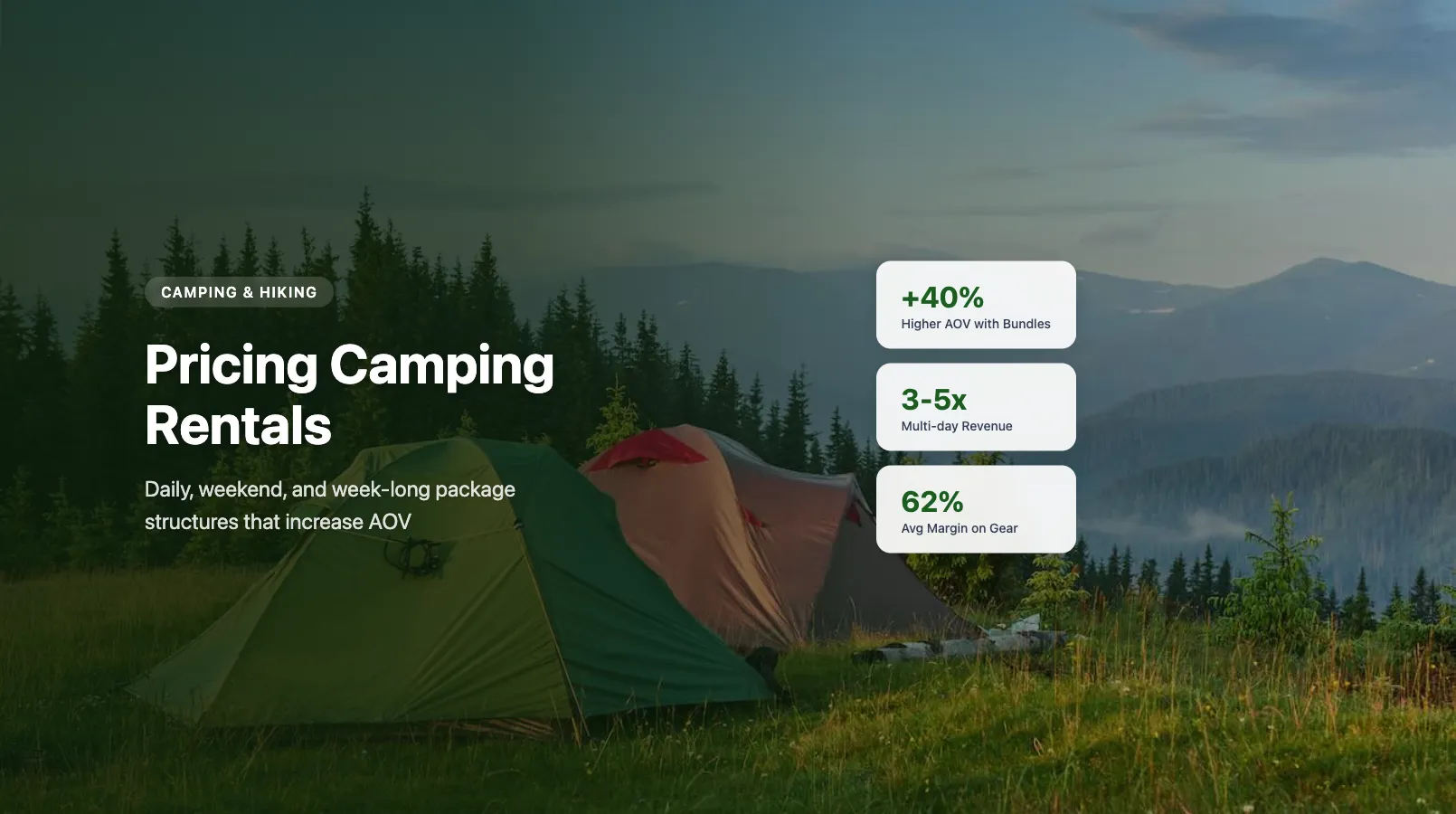
Per-item, per-night pricing feels logical. It's easy to calculate. But it leaves money on the table and pushes customers toward shorter rentals or fewer items. The operators pulling higher revenue per booking aren't charging more. They're packaging differently.
This guide breaks down how to structure daily, weekend, and week-long camping rental packages that increase your average order value while making the price feel like a deal. For the full operator playbook (inventory, logistics, hygiene, partnerships) start with our complete guide to running a camping gear rental business.
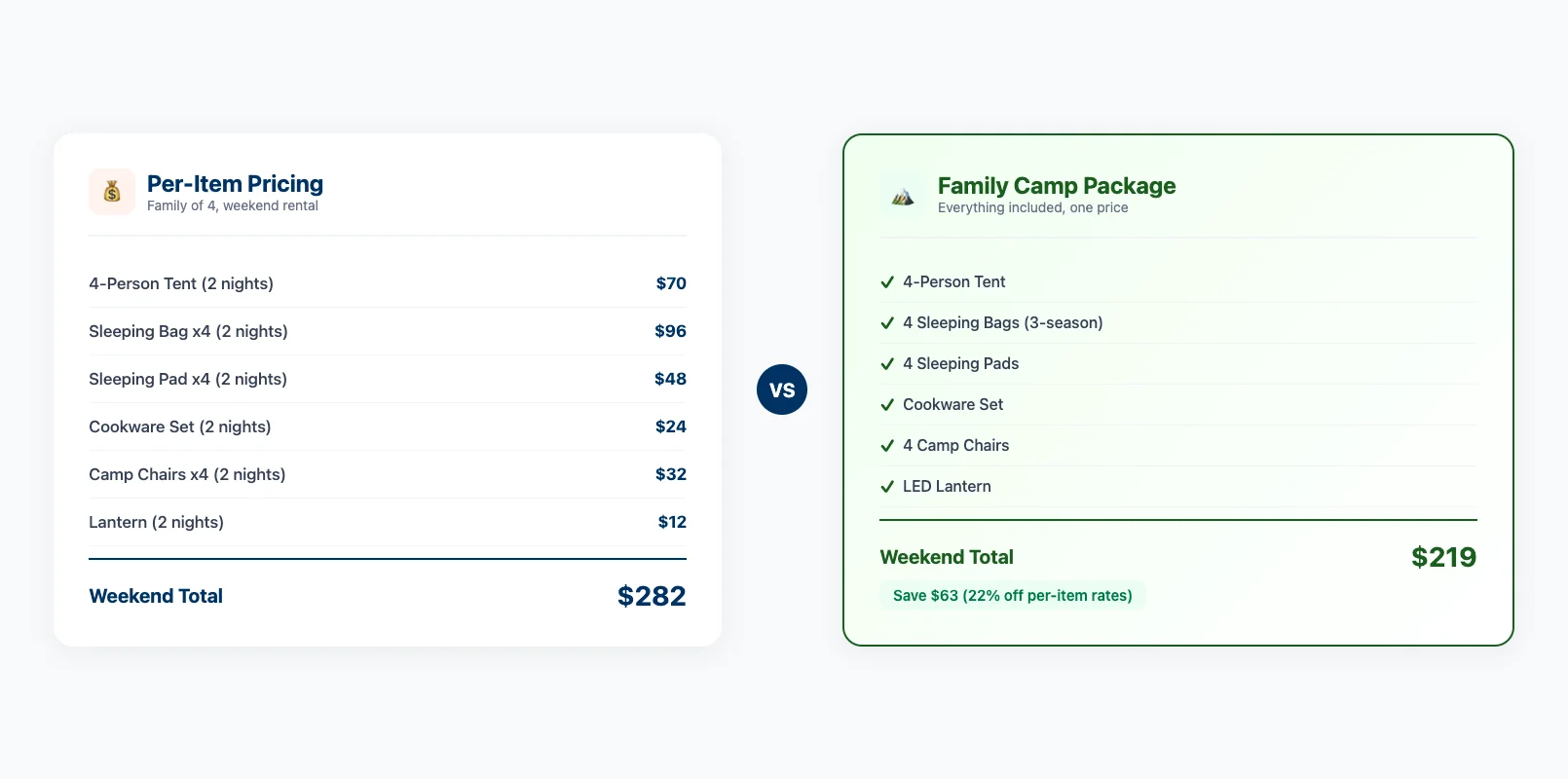
Per-Item vs Package Pricing
Per-item pricing works when customers know exactly what they need and want just one thing. A solo hiker renting a bear canister for the weekend. A climber grabbing a sleeping pad. For single-item rentals, a clean per-night rate is fine.
The problem is most camping customers don't rent one item. They need a full kit: tent, bags, pads, cookware, headlamps. When they price each item individually, the total feels expensive. A four-person weekend kit at per-item rates might hit $250-$300. The same kit bundled as a "Weekend Family Camp Package" at $179 feels like a bargain — even if your margin is identical.
Why packages win:
- Higher AOV. Customers add items they wouldn't have rented individually. Nobody rents a camp chair at $8/night on its own. But when it's included in a package, they don't think twice.
- Simpler checkout. One line item instead of eight. Less decision fatigue. Faster bookings.
- Lower return friction. Everything goes out in one bag and comes back in one bag. Your post-rental return check is faster when items are pre-grouped.
- Fewer price comparisons. A customer can Google "tent rental per night" and compare you against ten competitors. "Weekend Family Camp Package" is harder to comparison-shop.
The sweet spot for most operators is a hybrid model. Keep per-item rates for single-item renters and walk-ins. Build 3-5 packages for your high-volume customer segments. Let both options coexist on your booking page. And if you supply gear to campgrounds or glamping sites, note that they price differently again — flat per-stay kits attached to the site reservation, covered in our guide to campground and glamping gear rentals.
Weekend Package Pricing
The Friday-to-Sunday rental is your bread and butter. In most gateway towns, weekend rentals account for 55-65% of total bookings between May and September.
How to structure a weekend package:
Start with your per-item cost for two nights. Then discount 15-25% and round to a clean number. If the individual items total $180 for two nights, price the package at $139 or $149. The customer sees savings. You see a guaranteed multi-item rental instead of a maybe-they'll-add-the-cookware situation.
Typical weekend package tiers:
| Package | What's Included | Per-Item Value | Package Price | Savings |
|---|---|---|---|---|
| Solo Hiker | 1-person tent, sleeping bag, pad, headlamp | $120 | $89 | 26% |
| Couple's Camp | 2-person tent, 2 sleeping bags, 2 pads, cookware | $180 | $139 | 23% |
| Family Camp (4) | 4-person tent, 4 sleeping bags, 4 pads, cookware, lantern, chairs | $300 | $219 | 27% |
Timing matters. A "weekend" rental in camping means Friday afternoon pickup, Sunday evening return. Build your pricing around 2-night minimums on weekends during peak season. Single-night weekend rentals are operationally expensive: same check-out, same cleaning, same tent inspection, half the revenue.
Some operators add a Friday-only surcharge instead of a minimum. Either way, incentivise the full weekend.
Week-Long Discount Structures
Multi-day renters are your most profitable customers. The gear goes out once, comes back once, and generates 3-5x the revenue of a single-night rental. Cleaning and inspection costs are fixed regardless of rental length.
The standard discount ladder:
| Duration | Discount off Daily Rate | Example (Family Package) |
|---|---|---|
| 1-2 nights | 0% (base rate) | $110/night = $220 |
| 3-4 nights | 15% off | $94/night = $375 |
| 5-6 nights | 25% off | $83/night = $495 |
| 7+ nights | 35% off | $72/night = $500 |
Notice the 7-night price barely exceeds the 5-night price. That's intentional. You want the customer thinking "we might as well do the full week." The marginal cost to you is near zero — the gear is already out.
Cap your discounts. Don't go below your floor rate (the cost where you stop making money after accounting for depreciation, cleaning, and replacement reserves). For most operators, the floor is 40-50% off daily rate. Below that, you're subsidising the rental.
For a complete look at how multi-day booking flows and inventory tracking map to the camping vertical, visit the camping & hiking hub.
Require deposits for long rentals. A weekend renter puts down 20%. A week-long renter should put down 30-50%. Longer rentals have higher loss and damage exposure. Your sleeping bag care protocol costs the same whether the bag was out for 2 nights or 7, but the bag comes back dirtier after a week.
Family Packages That Drive Higher AOV
Families are your highest-value segment in camping rentals. A family of four rents more gear, rents for longer, and is more likely to add extras like camp chairs, a lantern, or a cooler.
Build packages around family sizes, not item counts. "Family of 4 Package" is clearer than "Premium Kit B." Name it what the customer calls it.
Smart family package add-ons:
- Kids' extras bundle (+$25/weekend). Child-sized sleeping bags, a camp game kit, glow sticks, a kid-friendly headlamp. Parents love this because it solves the "we forgot stuff for the kids" problem.
- Comfort upgrade (+$35/weekend). Thicker sleeping pads, camp pillows, a better cookware set, a portable coffee maker. Targets couples and families who want campground comfort without buying gear.
- Rainy day kit (+$15/weekend). Tarps, extra guylines, a packable shelter. Gateway towns near mountains sell this well — afternoon storms are part of the deal.
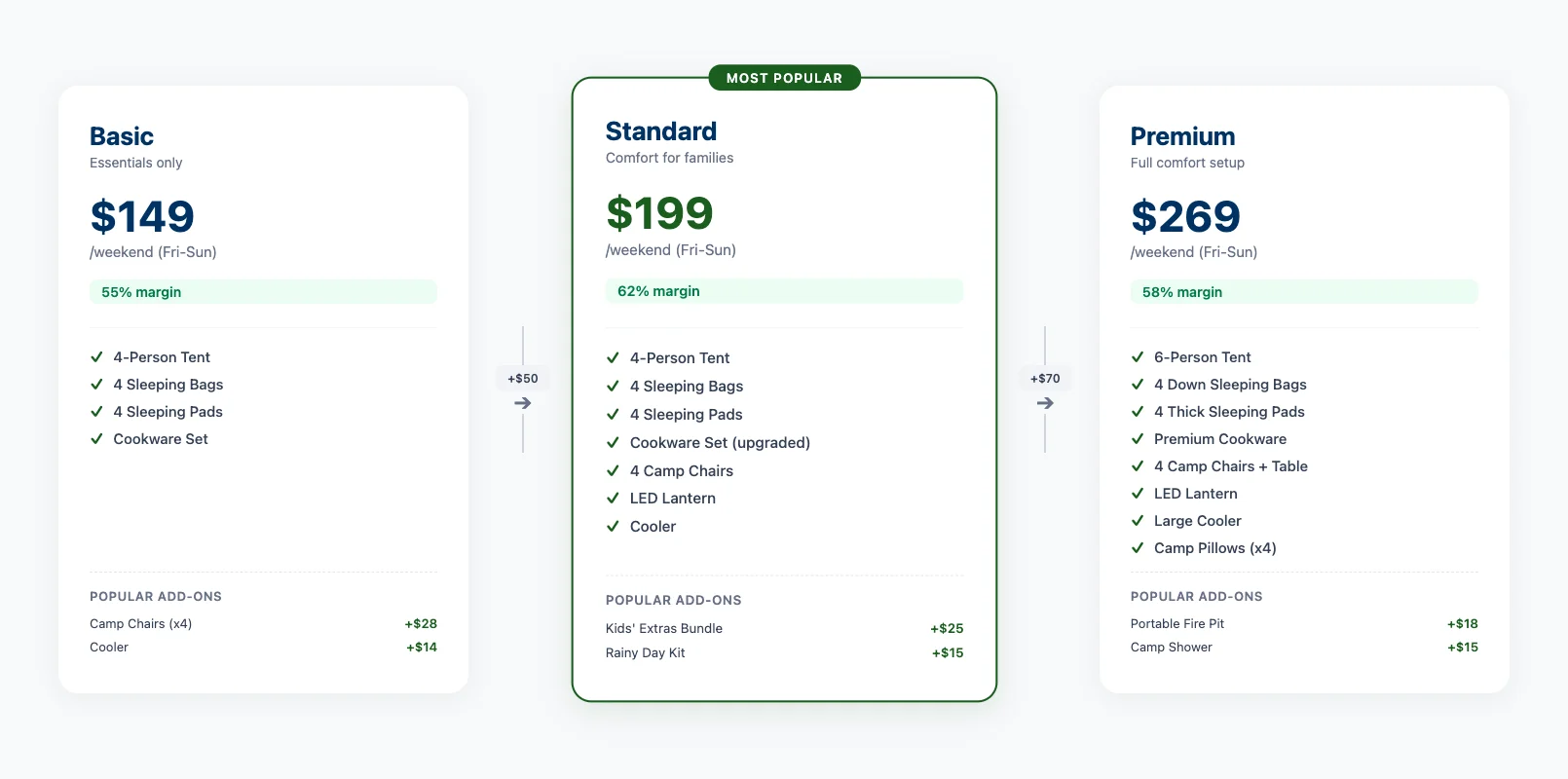
Price anchoring works. Show three tiers: Basic, Standard (recommended), Premium. Most customers pick the middle option. Make "Standard" the package with the margin you want.
| Tier | Price (Weekend) | Margin |
|---|---|---|
| Basic | $149 | 55% |
| Standard (recommended) | $199 | 62% |
| Premium | $269 | 58% |
The Premium tier exists partly to make Standard look reasonable. Some customers pick it — great. But its real job is pushing people toward Standard.
Upgrade Paths and Upsells
The initial booking is step one. The real revenue lift comes from what customers add between booking and pickup.
Pre-trip email upsells. Two days before pickup, send an automated email: "Your Weekend Family Package is confirmed! Want to add any of these?" List 3-4 relevant add-ons with one-click "add to booking" buttons. Operators using this approach report 15-25% of customers adding at least one item.
At-counter upsells. When the customer arrives for pickup, your staff walks through the kit. "Looks like you're heading to [campground name]. The nights get cold up there this time of year — want to grab a fleece liner for the sleeping bags? It's $8 each for the weekend." Specific, helpful, low-pressure.
Upgrade tiers. Let customers bump from Solo to Couple's or from Basic to Standard at pickup for a prorated price. Make it easy. "For $40 more, you get the thicker pads and the cookware upgrade." Most customers who started with the budget option will upgrade if the gap is small.
What works as add-ons:
- Camp chairs ($8-12/weekend each)
- Cooler ($12-15/weekend)
- Portable camp shower ($15/weekend)
- Bear canister ($10/weekend — required in many backcountry areas)
- Trekking poles ($10-15/weekend per pair)
- Water filter ($8/weekend)
Keep add-on prices under $20 individually. These are impulse decisions. The moment you have to explain why a tarp costs $25, you've lost the sale.
Late-Return Fees and Penalty Pricing
Late returns aren't just annoying. They break your next booking. If gear comes back Monday afternoon instead of Sunday evening, your Tuesday renter's kit isn't cleaned and inspected in time.
Structure late fees to discourage, not punish.
- Grace period: 2 hours past the agreed return time. No charge. Stuff happens: traffic, slow campsite teardown, kids.
- Same-day late (2-6 hours past return): 50% of the daily rate. Enough to sting. Not enough to start an argument.
- Next-day late: Full daily rate for each additional day. At this point, it's a rental extension, not a late return.
- 48+ hours late with no communication: Full daily rate plus a $50 administrative fee. This is for the no-shows who ghost you and force you to cancel downstream bookings.
Communicate fees upfront. Print them on the rental agreement. Mention them at checkout. Send a reminder the morning of the return day. The goal is zero surprises. Your pre-trip customer reminder should include return time and the late fee schedule.
Automate late-return tracking. Manually checking who's overdue is a recipe for missed fees. A system that flags overdue returns and sends automated SMS reminders saves your staff from awkward phone calls, and recovers more of the fees you're owed.
The deposit connection. Hold a security deposit ($50-100 per package) that covers potential late fees. Refund the deposit when gear returns on time and in good condition. This gives you leverage without having to chase payments after the fact. Check your backpack inspection checklist and tent inspection process on return to determine deposit release.
FAQ
How much should I charge for camping gear rentals?
Base your pricing on replacement cost. A general rule: charge 5-8% of the item's retail replacement cost per night. A $400 tent rents for $20-32/night. Package discounts reduce the per-night effective rate by 15-35% depending on duration.
Should I offer daily rates or only packages?
Both. Keep per-item daily rates for single-item rentals and walk-ins. Build 3-5 packages for your main customer segments (solo, couple, family). Most booking revenue will shift to packages within a season.
How do I price camping rental packages competitively?
Check 2-3 local competitors and the nearest REI rental location. Price your standard weekend package 10-15% below REI's per-item rates for comparable gear. Your advantage is convenience and local service — customers shouldn't have to choose between you and a big-box rental on price alone.
What's a good average order value for camping rentals?
Operators running package pricing typically see AOV of $140-$200 for weekend rentals and $350-$500 for week-long rentals. Per-item-only operators average $80-$120 per booking. The gap is almost entirely explained by bundling.
How do I handle pricing for peak vs off-season?
Add a 15-25% peak-season surcharge on weekends from June through August (or your local high season). Keep weekday and shoulder-season rates at base price. Communicate peak pricing clearly on your booking page, no hidden fees at checkout.
Should I charge differently for premium vs standard gear?
Yes. If you carry both budget and premium tents (e.g., a basic Coleman vs a premium MSR), create separate package tiers. The premium tier should cost 30-50% more and target customers who care about weight, comfort, or brand. Don't mix quality levels within a single package.
What deposit amount should I collect?
20-30% of the total rental value for weekend packages. 30-50% for week-long rentals. Plus a separate security/damage deposit of $50-100 per package. Release the security deposit within 48 hours of return inspection. For backcountry kits that need higher deposits (50-60% of replacement value), see our guide to multi-day backcountry rental operations.
Pricing camping rentals isn't about finding the perfect per-night number. It's about structuring packages that make the total feel fair while increasing what each customer spends. Start with three packages (solo, couple, family) at weekend and weekly rates. Add a handful of sub-$20 add-ons. Set clear late-fee rules. Then watch your average order value climb without a single price increase. For backcountry kits that need higher deposits and different pricing, see our guide to multi-day backcountry rental operations.
in one place