E-Bike Rental Operations: Battery Management and Safety
E-bikes are the fastest-growing segment in bike rental. They command premium prices — $22-$30 per hour versus $12-$18 for a standard city bike. Customers love them. Margins look great on paper. Then you find a swollen battery in a back room, a customer doing 28 mph on a shared-use path, and a charger drawing enough amps to trip the breaker for your entire shop.
This guide covers the operational side of running e-bikes as part of a rental fleet. It's the companion piece to our complete bike rental business guide, focused on what's unique to electric: batteries, charging, speed regulations, checkout training, maintenance, and insurance. If you're already running pedal bikes and thinking about adding e-bikes — or you've got a few and they're causing headaches — start here.
Battery Charging Logistics
Battery management is the single biggest operational difference between e-bikes and pedal bikes. A pedal bike comes back, you check it, park it. An e-bike comes back, and the clock starts ticking on when it'll be ready to go out again.
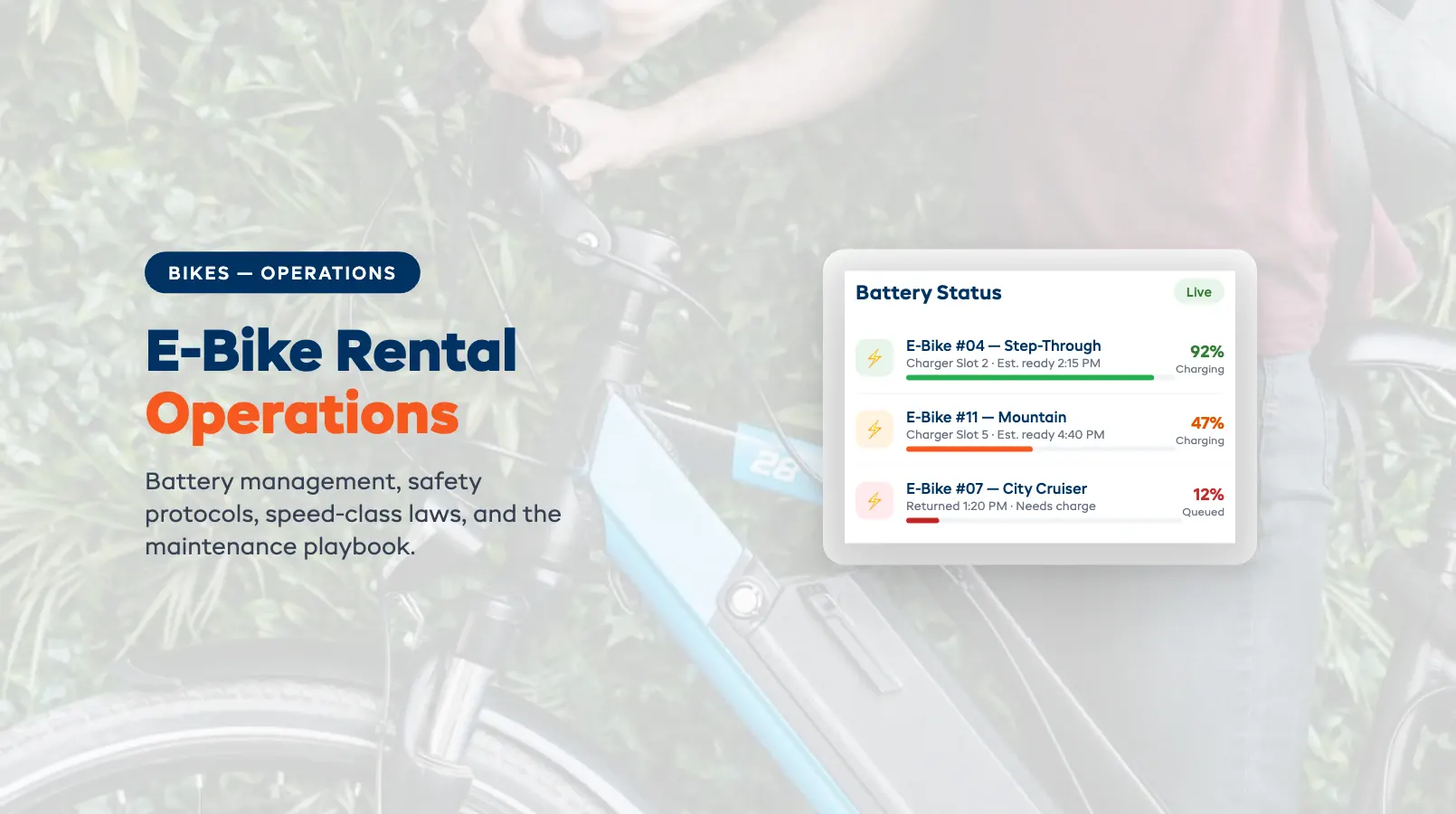
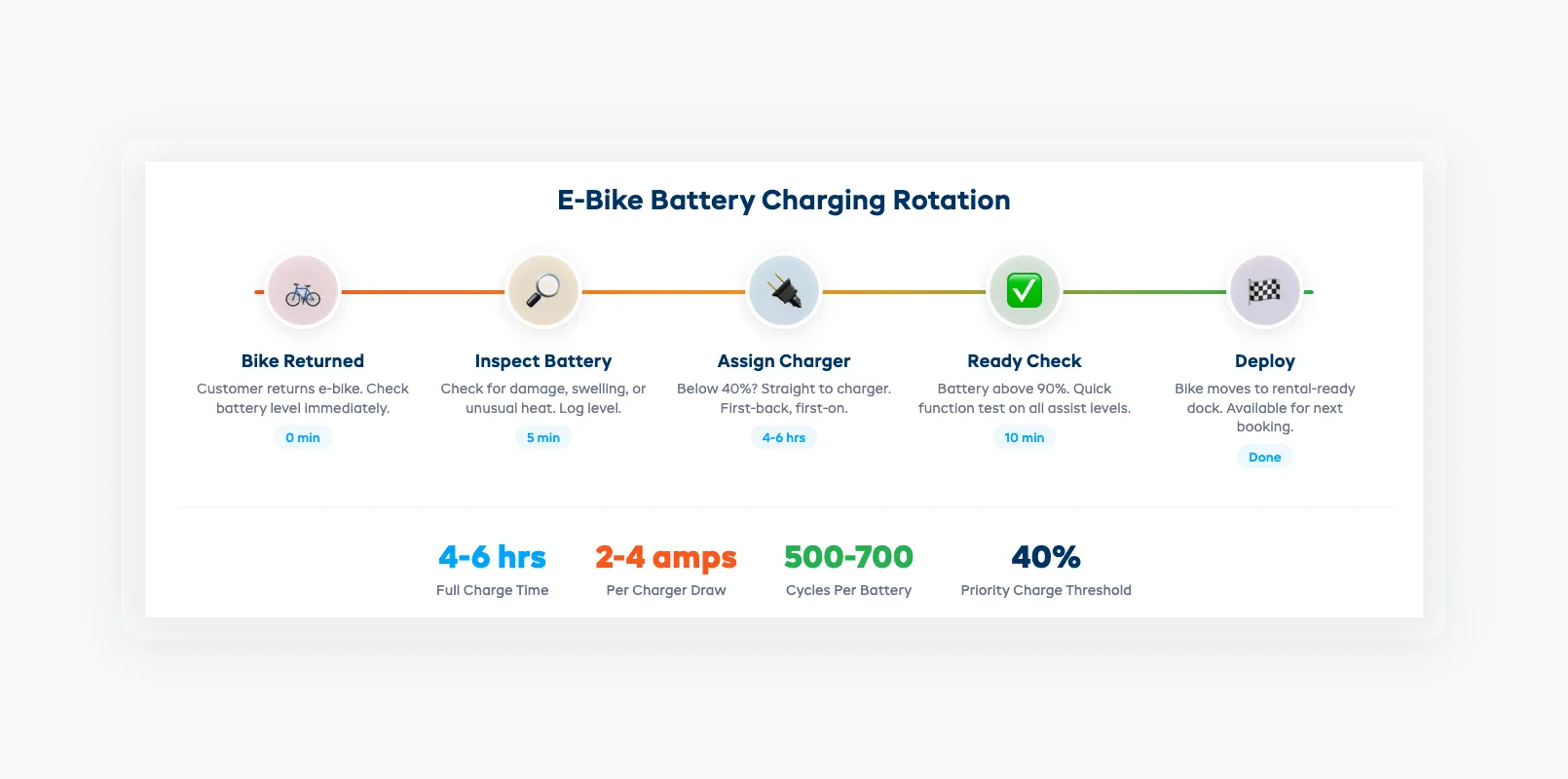
Charging time matters. Most rental e-bikes take 4-6 hours for a full charge from empty. A bike returned at 3 PM won't be ready for an evening rental. That's a missed turn.
Build a charging rotation. Number your chargers and assign bikes to slots. First-back, first-on-charger. Any bike returning below 40% goes straight to charge. Post the rotation on a whiteboard or track it in your rental system.
Infrastructure planning. Each charger draws 2-4 amps at 110V. Twenty e-bikes charging simultaneously pulls 40-80 amps — that's a dedicated 100-amp circuit. Most shops don't have that on one circuit. Talk to an electrician before you buy your fleet, not after. Stagger charging across two circuits, install a dedicated sub-panel ($800-$2,000), or use timer-based rotation overnight.
Removable vs integrated batteries. Removable batteries let you charge inside while the bike stays on the dock. Integrated batteries mean running extension cords or rolling bikes to a charging station. For fleet operations, removable wins.
Track battery health. Lithium-ion cells degrade with each cycle. After 500-700 cycles, capacity drops to 70-80% of original — a 40-mile-range bike now gets 28-32 miles. Run a monthly e-bike battery health check to catch degrading packs before a customer gets stranded mid-ride. Replace at 70% capacity — the customer complaint costs more than the $500 battery.
Battery Safety and Storage
Lithium-ion batteries are safe when handled correctly. Rental operators handle more batteries, more often, in tighter spaces than consumers. That raises the stakes.
Charging area requirements:
- Concrete or tile floor — never carpet or wood
- Minimum 3 feet clearance around charging stations
- Smoke detector and lithium-rated fire extinguisher within 10 feet
- No flammable materials in the same room
- Temperature-controlled: 50-77F (10-25C) ideal
Never charge a damaged battery. If a bike was dropped, crashed, or submerged, inspect the battery before connecting to power. Swelling, unusual odour, or visible casing damage means quarantine in a fire-safe container. Contact the manufacturer.
Storage between seasons. Store batteries at 40-60% charge in a cool, dry space. Full charge accelerates degradation. Empty risks permanent deep-discharge damage. Check monthly and top up if voltage drops below the manufacturer's minimum.
Staff training is non-negotiable. Every employee needs to know: how to spot a damaged battery, where the extinguisher is, the evacuation procedure, and who to call. Run a 15-minute safety briefing each season and document it. Your insurer may ask for proof.
Speed Classes and Local Laws
E-bike regulations vary by state, province, and city. Getting this wrong means fines, liability exposure, and banned access to your best routes.
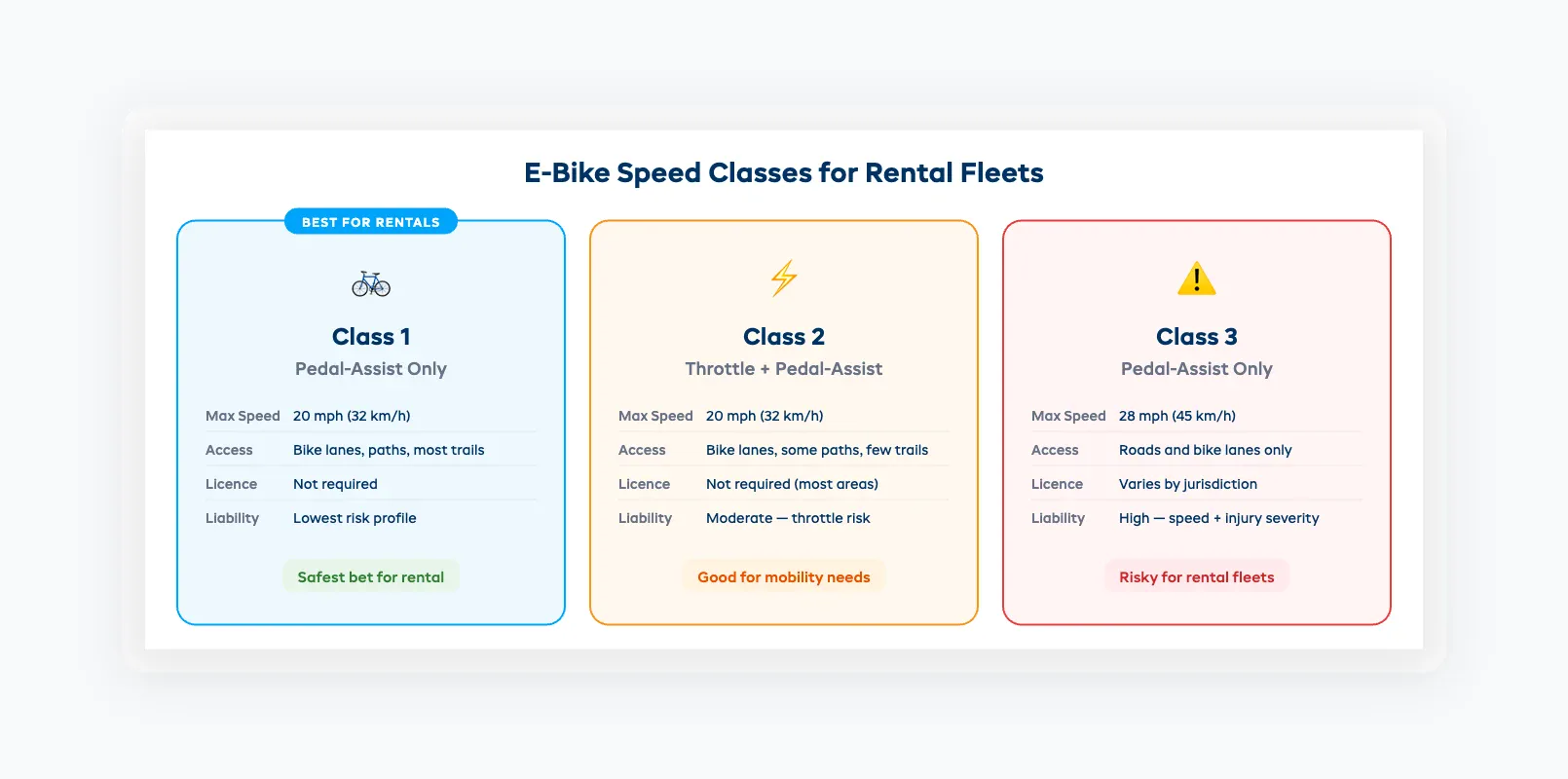
| Class | Assist Type | Max Speed | Typical Access |
|---|---|---|---|
| Class 1 | Pedal-assist only | 20 mph (32 km/h) | Bike lanes, paths, most trails |
| Class 2 | Throttle + pedal-assist | 20 mph (32 km/h) | Bike lanes, some paths, few trails |
| Class 3 | Pedal-assist only | 28 mph (45 km/h) | Roads and bike lanes only |
For rental operations, Class 1 is the safest bet. Fewest restrictions, lowest liability, widest trail access. Some operators stock Class 2 for customers with mobility limitations. Class 3 is risky for rentals: higher speeds, higher injury severity, and restricted access.
Check your specific jurisdiction. Some cities ban e-bikes from certain park trails. Some states require helmets for Class 3. Build a reference sheet for your area and update it annually. Post restricted areas on a map at checkout.
Speed limiting. Most commercial e-bike brands let dealers set max-assist speed via software. Consider capping your fleet at 15-18 mph. Slower speeds reduce injuries, extend battery life, and keep you on the right side of shared-path rules.
Customer Training at Checkout
An e-bike handles differently than a pedal bike. The motor engages faster than expected. First-time riders grab the brakes too hard, wobble through the first turn, or panic when pedal-assist kicks in on a hill. A 90-second briefing prevents most incidents.
The checkout briefing:
- Power on/off — show the button, explain display readings (battery %, assist level)
- Assist levels — demonstrate low vs high. Start in low for the first 5 minutes
- Braking — e-bikes weigh 45-65 lbs vs 25-35 for pedal bikes. More stopping distance needed. Rear-first braking
- Range — realistic range at their assist level. "About 35 miles on medium, 25 on high"
- Where not to ride — hand them the map with restricted areas marked
- Dead battery protocol — it's still rideable, just heavy. Call for pickup if more than 3 miles out
Use a laminated card or a bike fit check to standardize across staff. Have customers ride a 50-meter test loop before leaving — you'll spot the riders who need extra coaching.
Maintenance Differences from Pedal Bikes
E-bikes share most components with pedal bikes. But the motor and battery add systems that need attention, and the extra weight accelerates wear on everything else.
Components that wear faster:
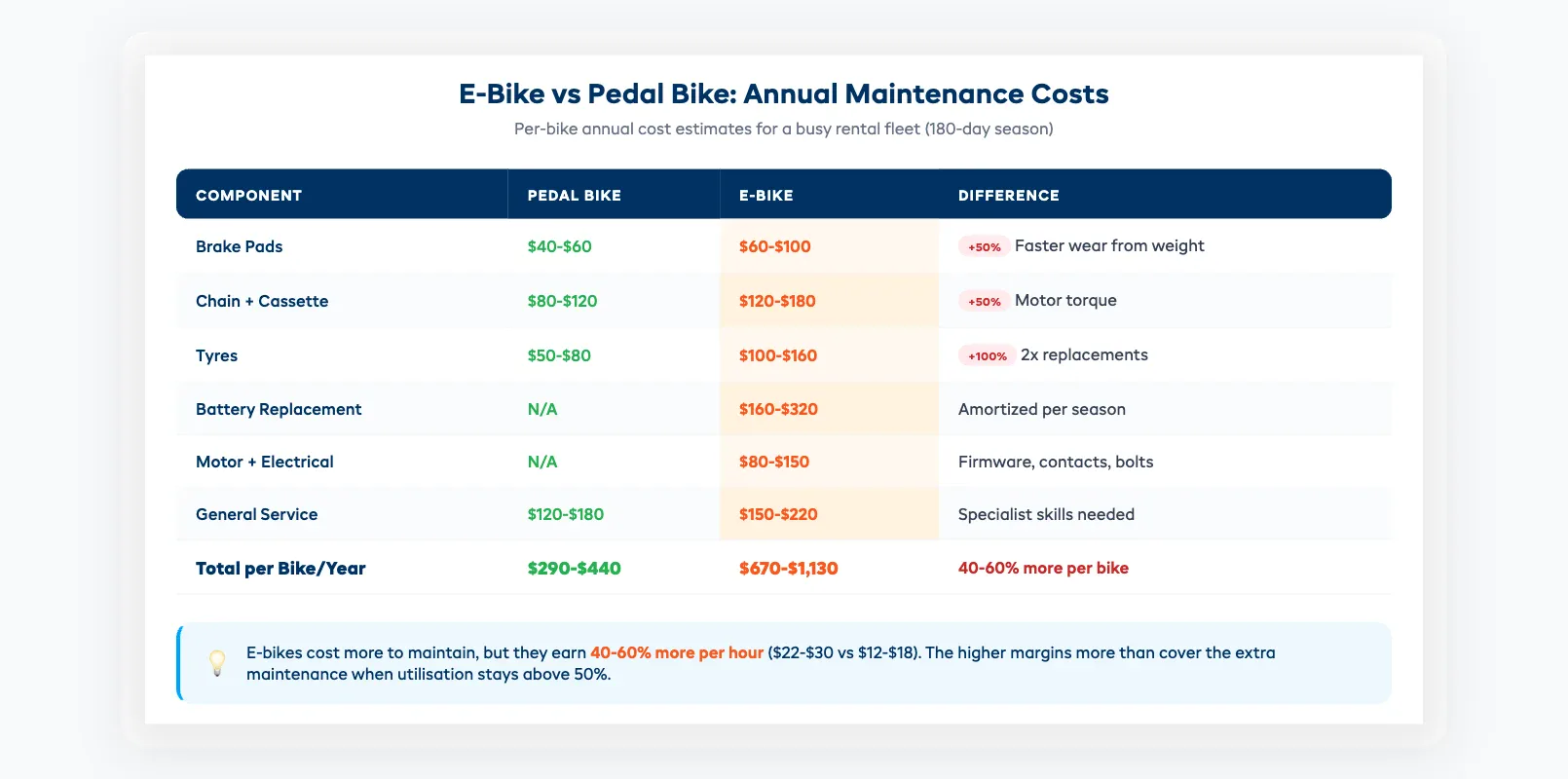
- Brake pads — 30-50% shorter life. Run a brake pad inspection every 2 weeks during peak season instead of monthly
- Chains and cassettes — motor torque accelerates drivetrain wear. Replace chains every 1,500-2,000 miles (vs 2,500-3,000 on pedal bikes)
- Tires — extra weight means faster tread wear. Budget 2x the replacements
Motor-specific maintenance: keep firmware updated, inspect mounting bolts monthly (vibration loosens them), clean the motor housing quarterly, and listen for grinding during test rides.
Electrical connections. Check battery contacts, charging ports, and display wiring monthly. Clean with electrical contact cleaner and apply dielectric grease.
Your mechanic needs e-bike-specific skills — reading error codes, using manufacturer diagnostic tools, knowing warranty vs field repair. Most brands offer dealer certification courses ($200-$500, 1-2 days).
A daily pre-rental ABC check catches most issues. For e-bikes, add a D: Display — confirm power-on, correct battery level, and all assist modes working. For full service intervals across all components, see our bike fleet maintenance schedule guide.
Insurance for E-Bike Rental Fleets
E-bikes change your insurance profile. Higher speeds, heavier bikes, lithium batteries, and more expensive units mean higher risk and higher premiums.
What you need beyond standard bike rental coverage:
- Product liability — covers injury from a defective motor, battery, or controller. $800-$2,000/year for 15-30 e-bikes
- Property coverage — e-bikes cost $1,500-$4,000 each. A charging-area fire could destroy $30,000-$80,000. Insure at full replacement value
- Theft coverage — e-bikes are high-value targets. GPS tracking helps recovery but doesn't prevent the loss
What your insurer will ask about: battery storage procedures, staff safety training records, maintenance logs, waiver language covering e-bike-specific risks, and fire suppression equipment.
Budget $3,000-$8,000 per year for comprehensive coverage on a mixed fleet. Shop multiple brokers — commercial recreation insurance is niche and quotes vary widely. For the full breakdown of all four coverage types bike operators need, see our bike rental insurance guide.
Update your waivers. Add clauses for motorised assistance, battery hazards, speed capability, and weight differences. A $500 legal review beats a $50,000 liability claim with a waiver gap.
FAQ
How many e-bikes should I add to my fleet?
Start at 20-30% of your total fleet. Track utilization weekly — above 70%, add more. Below 40%, you've over-invested. E-bike customers tend to book in advance, so online booking data gives you early demand signals.
How often do e-bike batteries need replacing?
Most packs last 500-800 charge cycles before dropping to 70% capacity. For a busy rental fleet charging daily during a 180-day season, that's 2.5-4.5 seasons. Budget $400-$800 per replacement.
Can I charge batteries overnight unattended?
Yes, with precautions. Use manufacturer-approved chargers on non-flammable surfaces with smoke detection nearby. Check your insurance policy — some require specific fire suppression equipment.
Do customers need a license to ride a rental e-bike?
In most US states and EU countries, Class 1 and Class 2 e-bikes don't require a license, registration, or rider insurance. Class 3 varies by jurisdiction. Always check local regulations and communicate requirements at booking.
What's the biggest maintenance difference?
Brake pads wear 30-50% faster. Chains need replacing every 1,500-2,000 miles instead of 2,500-3,000. You're also maintaining electrical systems — battery contacts, motor bolts, firmware, and display wiring. Budget 40-60% more per bike for annual maintenance.
E-bikes are worth the complexity — they're the highest-margin bikes in your fleet when managed right. The operators who struggle treat them like pedal bikes with a battery bolted on. They're a different animal. For the full picture on running a bike rental operation, head back to our complete bike rental business guide, or visit the bikes hub to see how EquipDash fits the bike vertical.
in one place