Boat Damage Deposits and Customer Communications
A renter brings your pontoon back with a gouge in the gel coat. You charge their card $800. They file a chargeback and win — because you took one blurry photo after the fact and sent no written notice. You're out the repair cost and the deposit.
This happens more often than most boat rental operators admit. The damage was real. The evidence was weak. And the communication that followed didn't meet the standard a payment processor or small-claims court expects.
Boat rental damage deposits protect your fleet — but only when the hold amount, inspection process, and charge communications are built to survive a dispute. This guide covers how to set hold amounts by boat class, document condition at dispatch and return, write charge letters that stick, and defend against chargebacks when customers push back.
For the full boat rental operator playbook — licensing, insurance, fleet sizing, and tech stack — see our complete boat rental business guide. For the revenue trade-offs between captained and bareboat models, read our captained vs bareboat economics breakdown. And if your maintenance records need tightening, our boat maintenance logs guide covers hour-meter tracking and service intervals.
Hold Amount by Boat Class
Your damage deposit needs to cover the most likely repair — not the worst-case scenario. Set it too low and you eat the difference. Set it too high and you kill conversions. Customers who see a $5,000 hold on a $300 rental book elsewhere.
Here's what works for most rental fleets:
Kayaks and paddleboards: $100–$200 hold. Damage is usually cosmetic — hull scratches, cracked handles. Repair costs rarely exceed $150.
Pontoons (18–24 ft): $500–$1,000 hold. Gel-coat gouges, bent railings, and prop damage are common. A single gel-coat repair runs $300–$600 depending on location and severity.
Deck boats and bowriders: $750–$1,500 hold. Higher speeds mean more impact damage. Upholstery tears and fibreglass cracks are the top two claims.
Center consoles and fishing boats: $1,000–$2,000 hold. Electronics, trolling motors, and outboard lower units are expensive to repair. A bent prop shaft on a 150-hp outboard is a $1,200 fix.
Two rules for setting holds:
- Base the hold on your actual repair history — not guesses. Pull your last two seasons of damage claims. What's the average charge? Set the hold at 120% of that number.
- Disclose the hold amount before booking confirmation. Show it on your booking widget, in your confirmation email, and on your waiver. Surprise holds generate complaints and chargebacks.
Photo Evidence at Dispatch
The moment you hand over the keys, the clock starts on accountability. Every scratch, scuff, and dent on that boat needs to be documented before the renter leaves the dock.
What to photograph at dispatch:
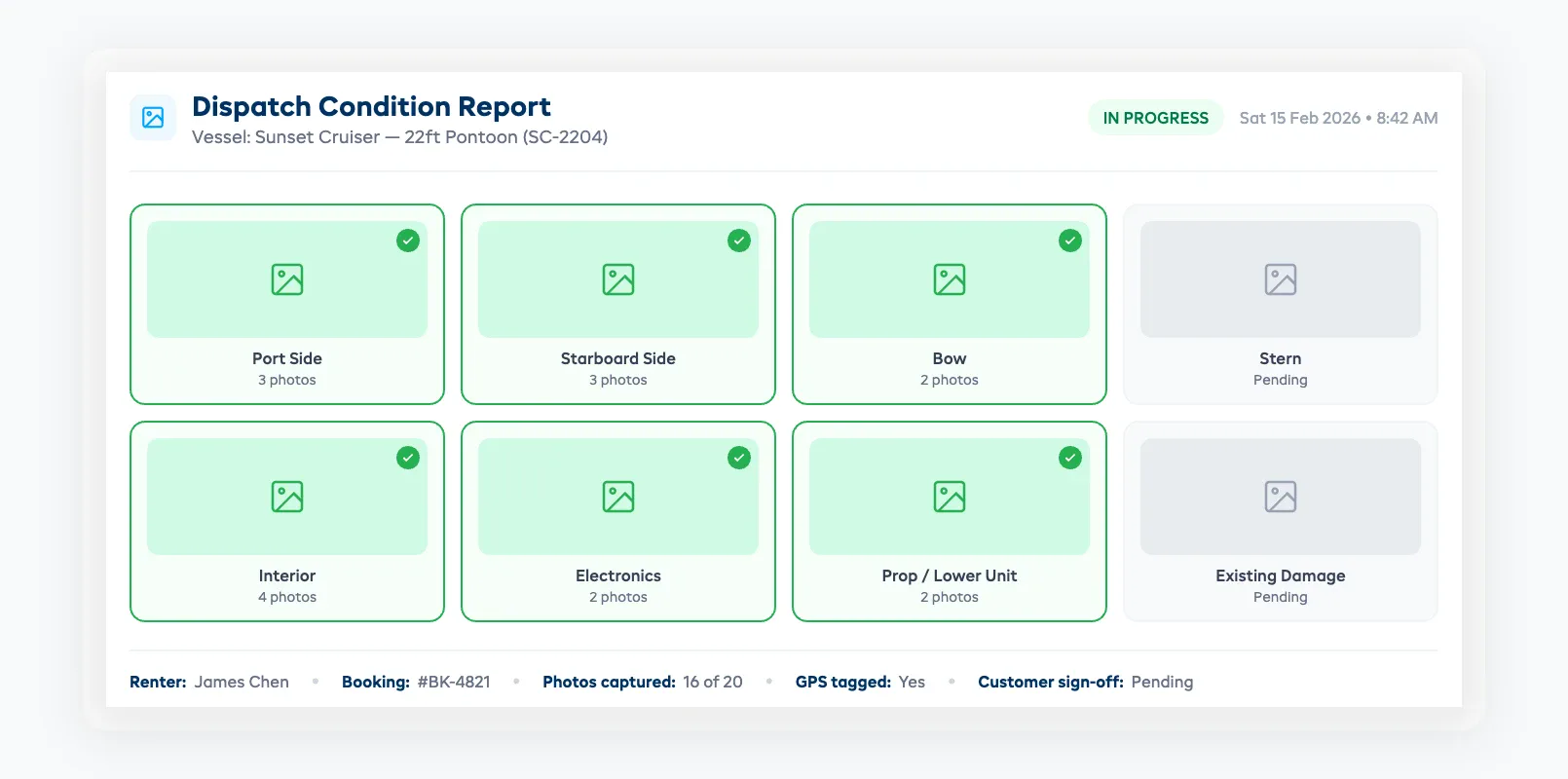
- All four sides of the hull (port, starboard, bow, stern) — at least 8 photos
- Close-ups of any existing damage with a measuring reference (a coin or ruler)
- Interior upholstery — seats, cushions, flooring
- Electronics and gauges (take a photo of the dash powered on)
- Prop and lower unit (if accessible from the dock or trailer)
- Trailer condition for trailered boats
How to make the photos defensible. Use a timestamped camera app or your booking software's condition report feature. Phone photos work, but only if the metadata (date, time, GPS) is intact. Include the vessel registration number in at least one photo per set. Have the customer sign off on the pre-rental condition — a digital signature on a tablet beats a paper form that gets wet.
This takes 5–7 minutes per boat. Your dock staff will push back during a Saturday morning rush. But one defended $800 charge pays for a hundred dispatch inspections.
Use our boat rental damage assessment checklist to standardize what your dock team photographs at every handover.
Return Inspection
The return inspection mirrors the dispatch — same checklist, same angles, same attention. The goal is to produce a before-and-after comparison that makes new damage undeniable.
Walk-around with the customer present. Do the inspection before they leave the dock. If they drive away and you find damage an hour later, your position weakens significantly. Their argument: "That was there when I brought it back."
What to check at return:
- Hull: new scratches, gouges, gel-coat chips, paint transfer from dock contact
- Prop: nicks, bends, fishing line or rope wrap
- Interior: upholstery tears, stains, burns, missing cushions
- Electronics: gauges working, fish finder intact, VHF radio present
- Safety equipment: life jackets accounted for, fire extinguisher in place, throwable device present
- Fuel level: match the dispatch level or charge the fill-up fee
When you find damage:
- Photograph the damage immediately — same close-up standards as dispatch
- Show the customer the damage and the matching dispatch photo showing it wasn't there before
- Get their written acknowledgement if possible. Even a text message saying "I see the scratch" helps.
- Note the damage on the return form with the customer's name, date, time, and weather conditions
Not every customer will agree. Some will deny, argue, or leave. That's fine. Your documentation does the talking from here.
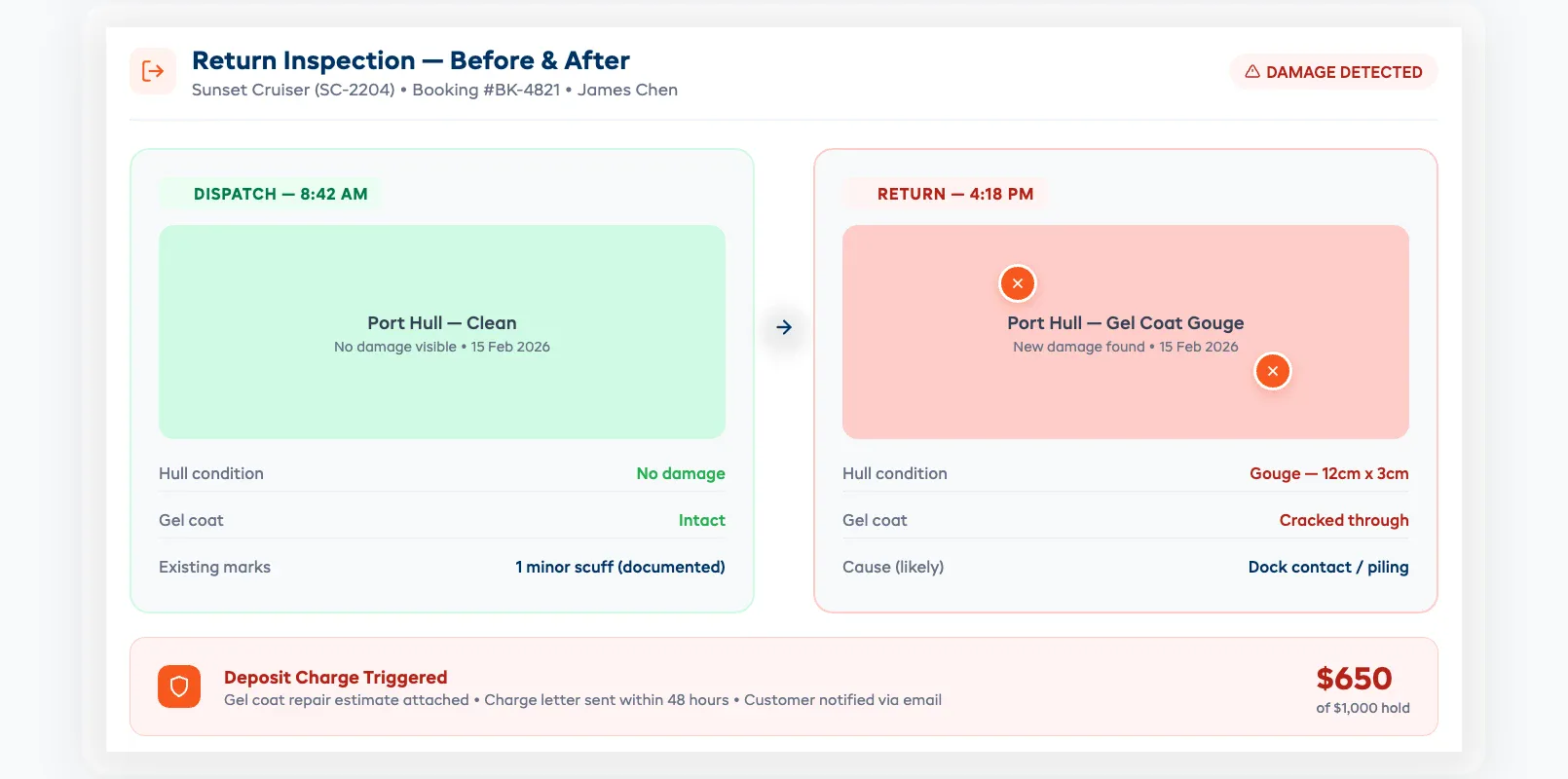
Charge Letter Template
When you charge a damage deposit — partially or fully — the customer needs a written explanation within 48 hours. This isn't optional politeness. It's the standard that payment processors and courts expect.
A defensible charge letter includes:
- Customer name and booking reference number
- Vessel name/ID and rental dates
- Description of the damage found at return
- Side-by-side dispatch and return photos (attached or linked)
- Repair estimate from a marine shop or your documented internal rate card
- Amount charged and the calculation behind it
- Timeline for when the repair will happen
- Contact information for questions or disputes
- Refund policy for the unused portion of the hold
Send this via email with read-receipt enabled. Keep a copy. If the customer responds, keep that too. Every exchange becomes evidence if the charge is disputed.
The boat rental damage report drafter agent can generate this letter automatically from your condition report data — pulling dispatch photos, return photos, and repair estimates into a formatted document.
Dispute Resolution
Most customers don't dispute charges to be difficult. They dispute because they feel blindsided, the amount seems arbitrary, or they don't understand the process. Handle the easy ones before they become hard ones.
Tiered resolution approach:
Tier 1 — Explanation (resolves 60–70% of disputes). Call within 24 hours of sending the charge letter. Walk through the photos. Explain the repair cost. Most customers accept when they see the evidence side by side.
Tier 2 — Negotiation (resolves 20–25%). The customer disagrees with the amount. Offer to split the difference or reduce the charge to documented cost only (no markup). A $500 settlement you collect is better than an $800 charge you lose on appeal.
Tier 3 — Formal response (5–10%). The customer files a chargeback or threatens legal action. Now you're in documentation mode. Gather everything: signed waiver, dispatch photos, return photos, charge letter, repair estimate, any customer communications. This package goes to your payment processor or your attorney.
What not to do:
- Don't charge the deposit and go silent. Silence invites chargebacks.
- Don't argue on the dock. Document, photograph, and follow up in writing.
- Don't charge for pre-existing damage. If your dispatch photos are weak or missing, eat the cost and fix your process.
Chargeback Defense
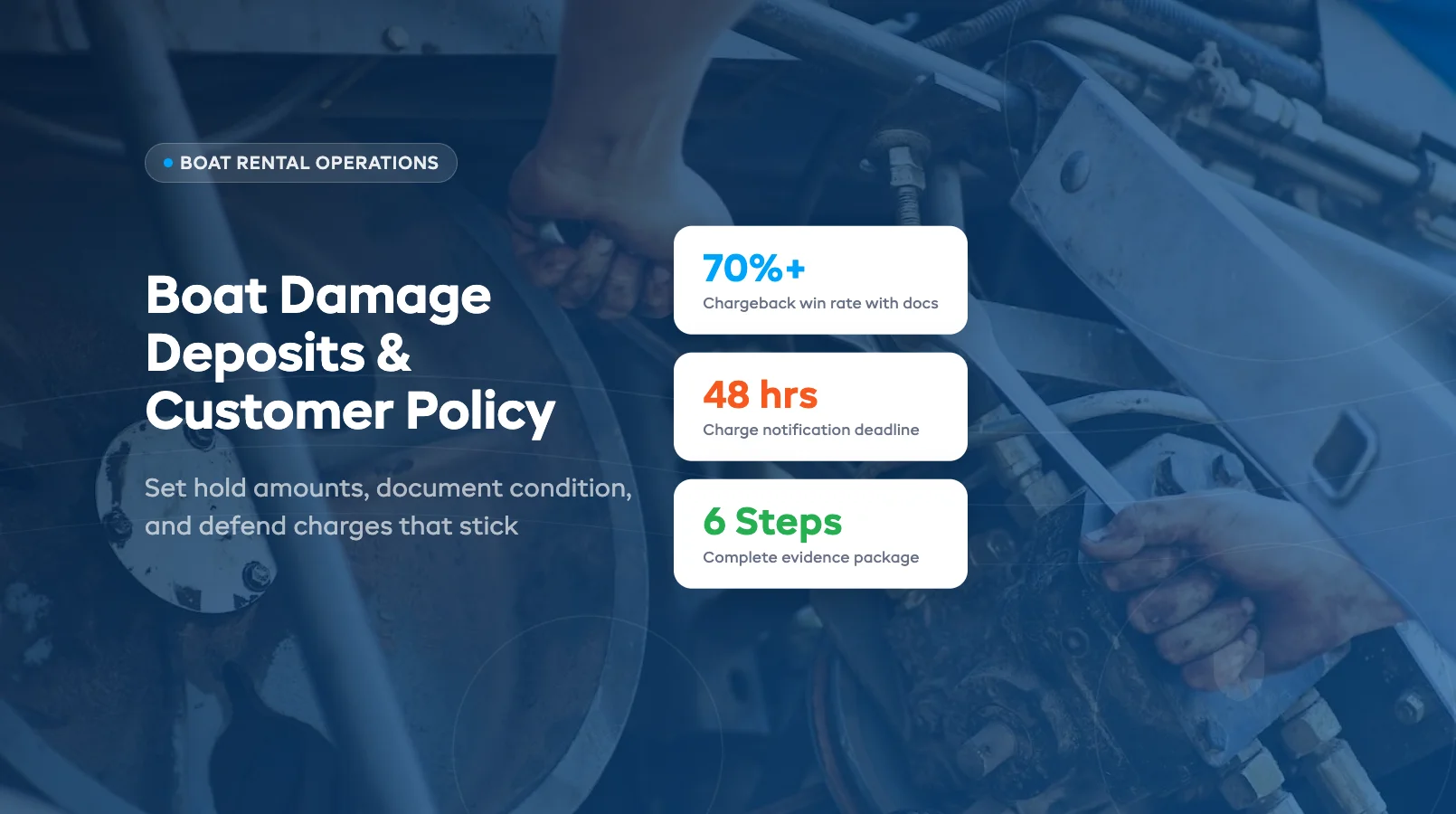
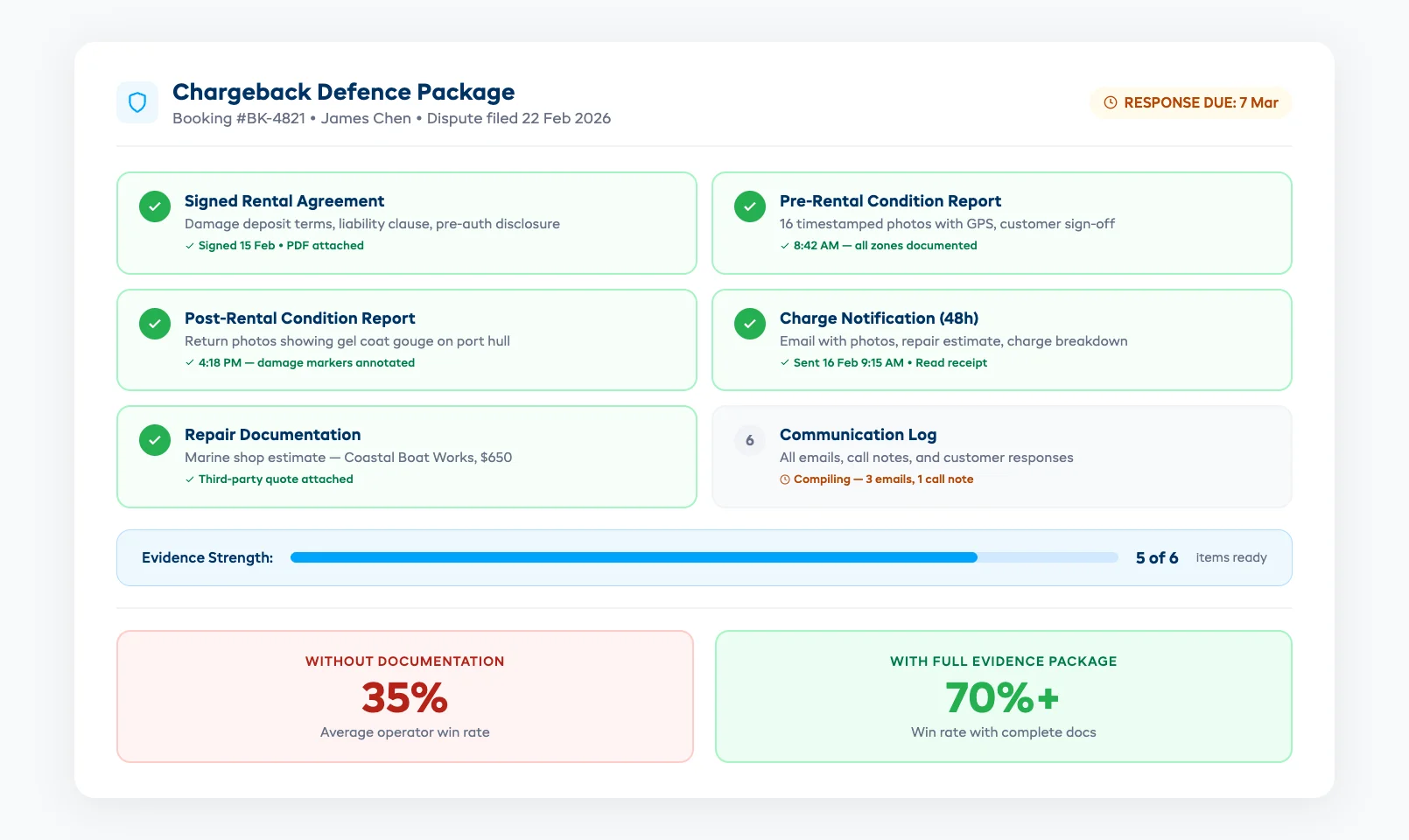
A chargeback is a customer asking their bank to reverse a charge. You have one chance to respond with evidence. Win rates for rental operators average 35–45% — but operators with strong documentation win 70%+ of the time.
What the payment processor wants to see:
- Signed rental agreement with damage deposit terms clearly stated
- Pre-rental condition report with timestamped photos
- Post-rental condition report showing new damage
- Charge notification sent to the customer within 48 hours
- Repair documentation — estimate or invoice from a marine repair shop
- Communication log — every email, text, and call note
Timeline matters. Most processors give you 7–14 days to respond. Have your documentation package ready before the chargeback arrives. If your dispatch/return photos, charge letter, and signed agreement are already in one folder per booking, you can respond in 30 minutes instead of scrambling for three days.
Operators using EquipDash store dispatch photos, return condition reports, and signed waivers in the booking record. When a chargeback hits, the evidence package is already assembled — no digging through email threads or camera rolls.
For the full boats vertical — fleet management, licensing, seasonal operations, and more — visit our boats resource hub. If you're growing your fleet and want to understand how deposit policies change at scale, see our guide to scaling a pontoon rental business.
FAQ
How much should I hold for a damage deposit on a pontoon rental? $500–$1,000 covers most pontoon damage claims. Base the exact amount on your repair history from the last two seasons. A pontoon gel-coat repair runs $300–$600 on average.
Can I charge a non-refundable damage waiver instead of a deposit? Yes. Many operators offer a $30–$75 damage waiver that covers the first $500–$1,000 in damage. This shifts the risk to you but increases booking conversion and average revenue per rental. Offer it as an opt-in, not a requirement.
What if the customer refuses to sign the return condition report? Document the refusal in writing with the date and time. Take your photos regardless. A customer's refusal to sign doesn't prevent you from charging for documented damage — it just means you rely entirely on your photographic evidence and the signed pre-rental agreement.
How quickly do I need to charge the deposit after finding damage? Charge within 48 hours and send the charge letter the same day. Delays weaken your position. Payment processors view charges made weeks after the rental as suspicious.
Do I need a professional marine repair estimate to defend a charge? A third-party estimate is strongest. But a documented internal rate card — showing standard costs you've charged consistently — also works. The key is consistency. Don't charge $800 for one gel-coat scratch and $200 for the same damage on another booking.
Should I use a hold or an actual charge for the security deposit? Use a hold (pre-authorization), not a charge. A hold reserves funds without completing a transaction. If there's no damage, the hold releases automatically — no refund processing, less dispute risk.
Protecting your fleet starts before the customer touches the boat. Set the right hold, document everything at dispatch and return, and communicate charges clearly. The operators who win damage disputes aren't the ones with the biggest deposits — they're the ones with the best paperwork.
More in the boats series: Marina slip logistics & handoffs · Fuel policies, provisioning & fine print · Pre-season recommissioning checklist
in one place