How to Run an Adventure Activity Business: The Complete Operator's Guide (2026)
Adventure activity businesses have one thing in common with rental shops and tour companies: the gap between "we take people rafting" and "we run a profitable, defensible operation" is enormous. The first version is a guide with a raft and a dream. The second is a licensed, insured, certified operation with trained staff, maintained gear, documented safety protocols, and enough off-season cash reserves to survive the four months when nobody books.
This guide is the operator playbook for running an adventure activity business in 2026. Rafting, rock climbing, canyoning, zip lining, caving, paragliding — the specific activity changes, but the operational bones are the same. Licensing, insurance, guide management, gear lifecycle, pricing architecture, seasonal economics, and the technology stack that ties it all together. Whether you're running half-day whitewater trips or multi-day climbing expeditions, the fundamentals are here.
For checklists that standardize your daily operations, see the adventure activity hub and activities glossary.
Activity Type Overview: What You're Actually Operating
Adventure activities break into four risk tiers, and your entire operational structure (insurance premiums, guide ratios, gear budgets, regulatory burden) scales with the tier you're in.
Tier 1: Low-consequence guided activities. Guided hikes, nature walks, snorkeling tours, stand-up paddleboard excursions. Minimal technical gear. Guide-to-guest ratios around 1:10-1:12. Insurance premiums run $2,000-$5,000/year. Regulatory burden is light — business license, possibly a land-use permit for specific trails or waterways.
Tier 2: Moderate-consequence water and land activities. Whitewater rafting (Class II-III), kayak touring, zip lining, ropes courses, mountain biking guided tours. Specialized gear required. Guide ratios tighten to 1:6-1:8. Insurance premiums jump to $5,000-$15,000/year. You need certified guides, documented safety procedures, and regular gear inspections.
Tier 3: High-consequence technical activities. Rock climbing, canyoning, caving, high-altitude trekking, Class IV-V whitewater. Technical gear with manufacturer-mandated retirement schedules. Guide ratios at 1:4-1:6. Insurance premiums: $15,000-$40,000/year. Guides need recognized certifications (AMGA, ACA, SRT). Gear inspection logs become legally significant.
Tier 4: Extreme-consequence aerial and alpine activities. Paragliding, bungee jumping, mountaineering, backcountry skiing guiding. The highest insurance costs ($30,000-$80,000+/year), the strictest guide ratios (1:2-1:4), and the most demanding regulatory environment. Some jurisdictions require specific operator licenses beyond standard business registration.
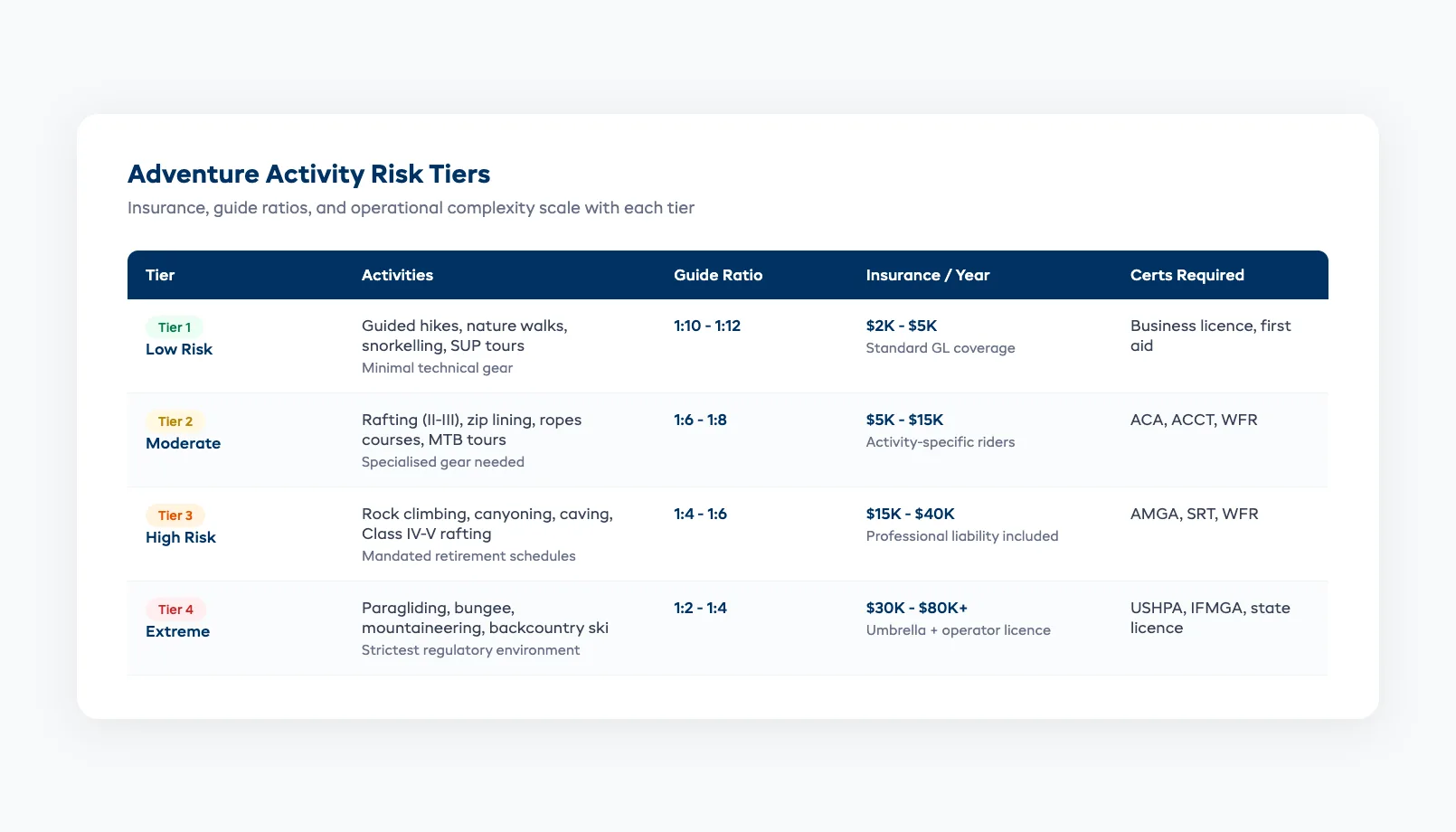
Most operators start in Tier 1 or 2 and expand upward. Each tier you add multiplies your operational complexity: more certifications, more insurance, more documentation. Plan your growth path before you buy the gear.
Licensing and Certifications
Every adventure activity business needs at minimum a standard business license and general liability insurance. Beyond that, the requirements vary by activity, location, and land ownership.
Federal land permits. If you operate on national forest, BLM, or national park land (US), you need a Special Use Permit or Commercial Use Authorization. These specify allowed activities, group sizes, frequency, and operating seasons. Application lead times run 3-12 months. Annual fees are typically 3-5% of gross revenue from permitted activities. Similar frameworks exist in Australia (national park commercial activity licenses), the UK (access agreements), and New Zealand (DOC concessions).
State and local licenses. Many US states require specific adventure operator licenses. Colorado, for example, requires commercial rafting companies to register with the Division of Parks and Wildlife. California requires permits for commercial activity in state parks. Check your state's parks and recreation department — the requirements aren't always obvious.
Guide certifications by activity type:
- Whitewater: ACA (American Canoe Association) Swiftwater Rescue, Wilderness First Responder
- Climbing: AMGA Single Pitch Instructor or Rock Guide certification
- Caving: NSS (National Speleological Society) Guide Training, vertical rescue certification
- Zip line/ropes: ACCT (Association for Challenge Course Technology) practitioner certification
- Paragliding: USHPA (United States Hang Gliding & Paragliding Association) instructor rating
Renewal tracking matters. A guide whose Wilderness First Responder expired last month is an uninsured guide. Track every certification's expiry date. Set 90-day advance alerts. Some insurance policies void coverage if a guide's certification lapsed, even by a day. Use the Guide Certification Tracking checklist to stay on top of renewals across your team.
Insurance and Liability
Insurance is the single largest fixed cost for most adventure operators, and the one you can't negotiate away. Skimping here is how businesses end with a single incident wiping out ten years of revenue.
General liability covers third-party bodily injury and property damage. For Tier 1-2 activities, expect $2,000-$8,000/year for $1M/$2M coverage. Tier 3-4 activities push into $15,000-$50,000+/year. Your premium is driven by activity type, annual participant count, claims history, and guide certification levels.
Professional liability (errors and omissions) covers claims that your instruction, route choice, or safety briefing was negligent. Not all general liability policies include this. Ask specifically. Costs $1,000-$5,000/year as a standalone rider.
Commercial auto covers your vehicles transporting participants to launch sites, trailheads, or put-in points. If you run shuttle services, this is mandatory. Standard personal auto policies exclude commercial use.
Workers' compensation covers guide injuries on the job. Adventure guiding has higher-than-average incident rates. Premiums vary by state and activity — expect 8-15% of payroll for climbing guides, 5-10% for rafting guides.
Waiver strategy. Waivers don't replace insurance. They reduce your exposure. A well-drafted assumption-of-risk waiver, signed before every activity, demonstrates informed consent. Key elements: plain-language risk description, specific activity named, participant acknowledgment of physical requirements, minor provisions (parent/guardian signature), and a photo/timestamp of signing. Digital waivers collected through your booking system create a cleaner paper trail than clipboard-and-pen. Use the Digital Waiver Collection Process checklist to standardize your flow.
The incident documentation rule. Every near-miss, every injury, every equipment failure gets documented the same day. Not for litigation, for prevention. Operators who log incidents systematically spot patterns: the same rapid where swimmers happen, the same anchor that shifts, the same harness buckle that jams. Your incident log is your most valuable safety tool. The Adventure Incident Report Procedure template covers every field your insurer and your future self will need. For the full first-hour through first-week protocol, see Adventure Incident Response and Reporting.
Guide Hiring and Training
Your guides are your business. A bad guide costs you a one-star review, a safety incident, and possibly your operating permit. A great guide generates word-of-mouth that no ad budget can match.
Hiring for judgment, not just skill. Technical competence is table stakes. You need guides who make good decisions under pressure. When the weather shifts mid-trip, when a participant panics on a cliff face, when the river is running higher than forecast. Interview for scenarios, not just certifications. "Tell me about a time you changed your plan mid-activity because conditions shifted."
Guide-to-guest ratios by activity:
- Guided hiking/nature: 1:10-1:12
- Whitewater rafting (Class II-III): 1:6-1:8 per raft
- Rock climbing (outdoor): 1:4-1:6
- Canyoning: 1:4-1:6
- Zip line/ropes course: 1:8-1:10 (with ground crew)
- Paragliding tandem: 1:1
Training structure. Every new guide should complete a shadow period (2-4 weeks), a solo-with-observer period (1-2 weeks), and a signed-off certification before leading groups independently. Document the progression. Your insurer may ask for it.
Daily briefing protocol. Before the first guest arrives, your guides should be running through weather conditions, equipment status, participant medical flags, and route-specific hazards. The Guide Daily Briefing checklist standardizes this across your team, so the morning brief happens consistently, regardless of which guide is leading.
Seasonal staff retention. Adventure guiding is seasonal work, and your best guides have options. Competitive pay helps, but what keeps guides coming back is: consistent scheduling, gear perks (discounted or free personal use), professional development budget (certification courses), and a culture where their judgment is respected. Operators who retain 70%+ of guides year-over-year spend far less on training than those cycling through a new roster each spring.
Gear Lifecycle Management
Adventure gear splits into two categories: consumable PPE (helmets, harnesses, ropes, PFDs) and durable equipment (rafts, climbing hardware, zip line trolleys). The consumable category has manufacturer-mandated retirement schedules that your insurer treats as gospel.
Manufacturer retirement schedules (typical):
- Climbing ropes: 2-5 years from first use, or after any significant fall. Inspect before every use.
- Harnesses: 3-5 years from manufacture date, or after any fall. UV degradation is the silent killer.
- Helmets: 5-10 years from manufacture, or after any impact. Replace immediately after a strike.
- PFDs: 5-10 years. Check for UV damage, buoyancy loss, and buckle integrity seasonally.
- Rafts: 7-15 years depending on material and use frequency. Annual professional inspection recommended.
Inspection cadence. Daily visual inspection before use. Monthly detailed inspection with documentation. Annual professional audit by a qualified third party. Log every inspection: date, inspector name, pass/fail, notes. These logs are your defense in a liability claim. Use the Daily Adventure Gear Inspection checklist to ensure nothing gets skipped.
Budget planning. Plan to replace 15-25% of your PPE inventory annually. For a mid-size climbing operation with 40 harnesses, 30 helmets, and 200m of rope, that's $8,000-$15,000/year in replacement costs. Build this into your per-participant pricing. It's not discretionary.
Documentation for insurance. Your insurer wants to see: purchase dates, manufacturer retirement schedules, inspection logs, retirement records (what was retired, when, why), and proof that retired gear was destroyed (not sold, donated, or left in the gear shed where someone might grab it). Cut retired ropes. Drill retired helmets. Document the destruction.
Pricing Architecture
Adventure pricing is more complex than flat-rate rental pricing. You're selling an experience with variable inputs (guide time, gear, permits, transport, risk) and your customers have different willingness-to-pay depending on group type.
Per-person base rate. Your floor price. Calculate: (guide cost per trip + gear depreciation per participant + permit allocation + transport + insurance allocation + overhead allocation) × target margin (1.4-1.6x). For a half-day rafting trip with a guide at $200/day, 6 guests per raft, $15 gear depreciation, $8 permit allocation, and $12 insurance: cost per person ≈ $68. At 1.5x margin: $102 retail price. Round to $99 or $109 depending on market positioning.
Private group pricing. Charge 1.3-1.5x the equivalent per-person rate. A 6-person raft trip at $99/person ($594 group) becomes $799-$899 as a private booking. You fill the raft either way — private groups just pay for exclusivity.
Corporate and team-building tiers. 1.5-2x standard pricing. Corporates expect: branded welcome, professional photography, post-event debrief, certificate of completion, and invoice billing (not credit card at the counter). The margin is worth the extra touchpoints. For the quote, deposit, invoicing, and weather-backup mechanics that win these bookings, see landing fall corporate group bookings.
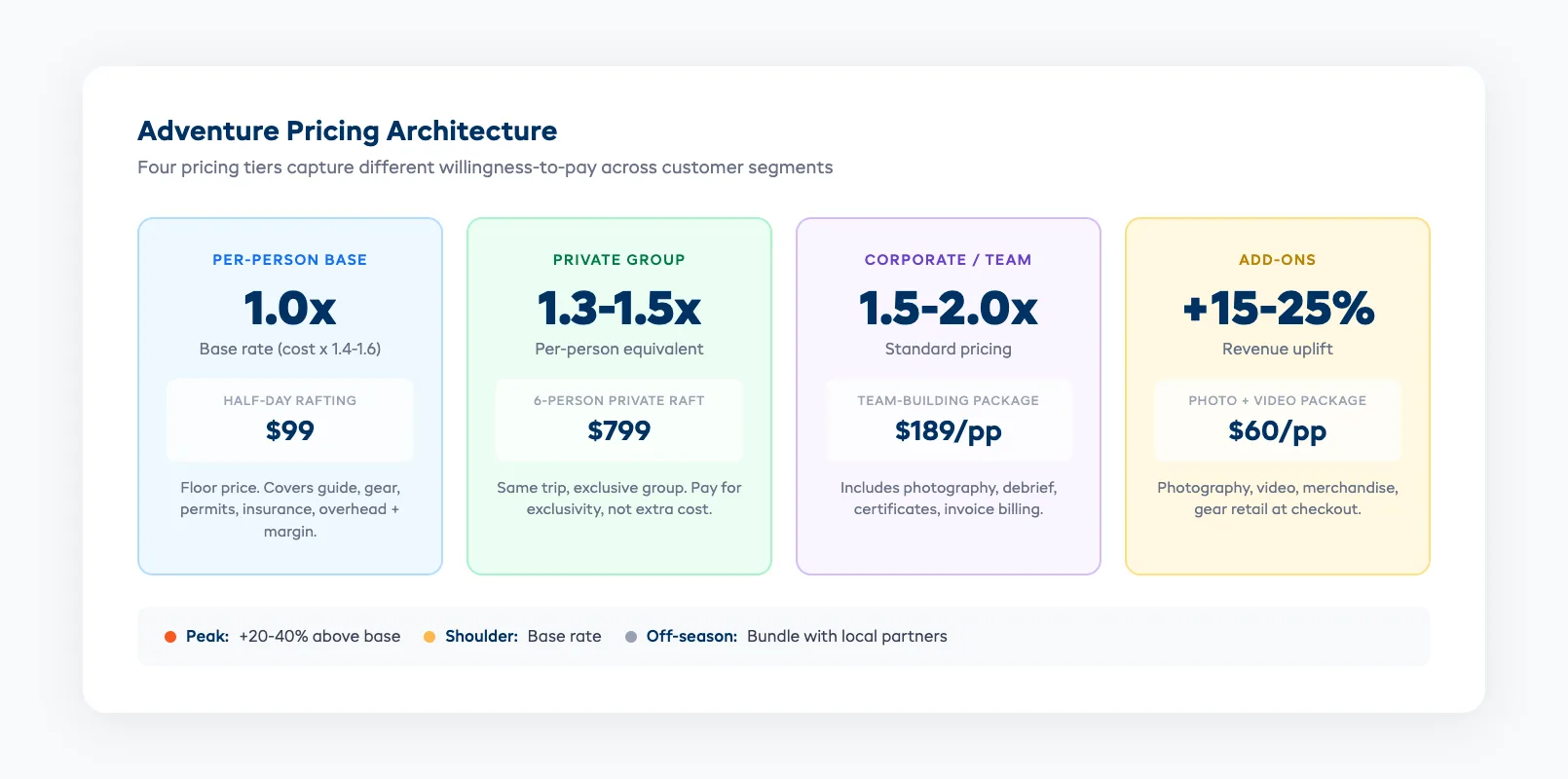
Seasonal pricing. Peak-season rates should be 20-40% above shoulder-season rates. If you're at 90%+ capacity on July Saturdays, your prices are too low. If you're at 40% capacity on October Tuesdays, create a shoulder-season package that bundles the activity with a local partner (brewery, restaurant, accommodation).
Add-on revenue. Photography packages ($30-$60/person), video packages ($50-$80), merchandise, and gear retail. Top-performing adventure operators generate 15-25% of revenue from add-ons. Capture the sale at booking, not at the trailhead. Your booking system should offer add-ons during checkout.
Season Economics
Most adventure businesses earn 70-85% of annual revenue in 4-5 months. The remaining 7-8 months are about survival, preparation, and building next season's pipeline.
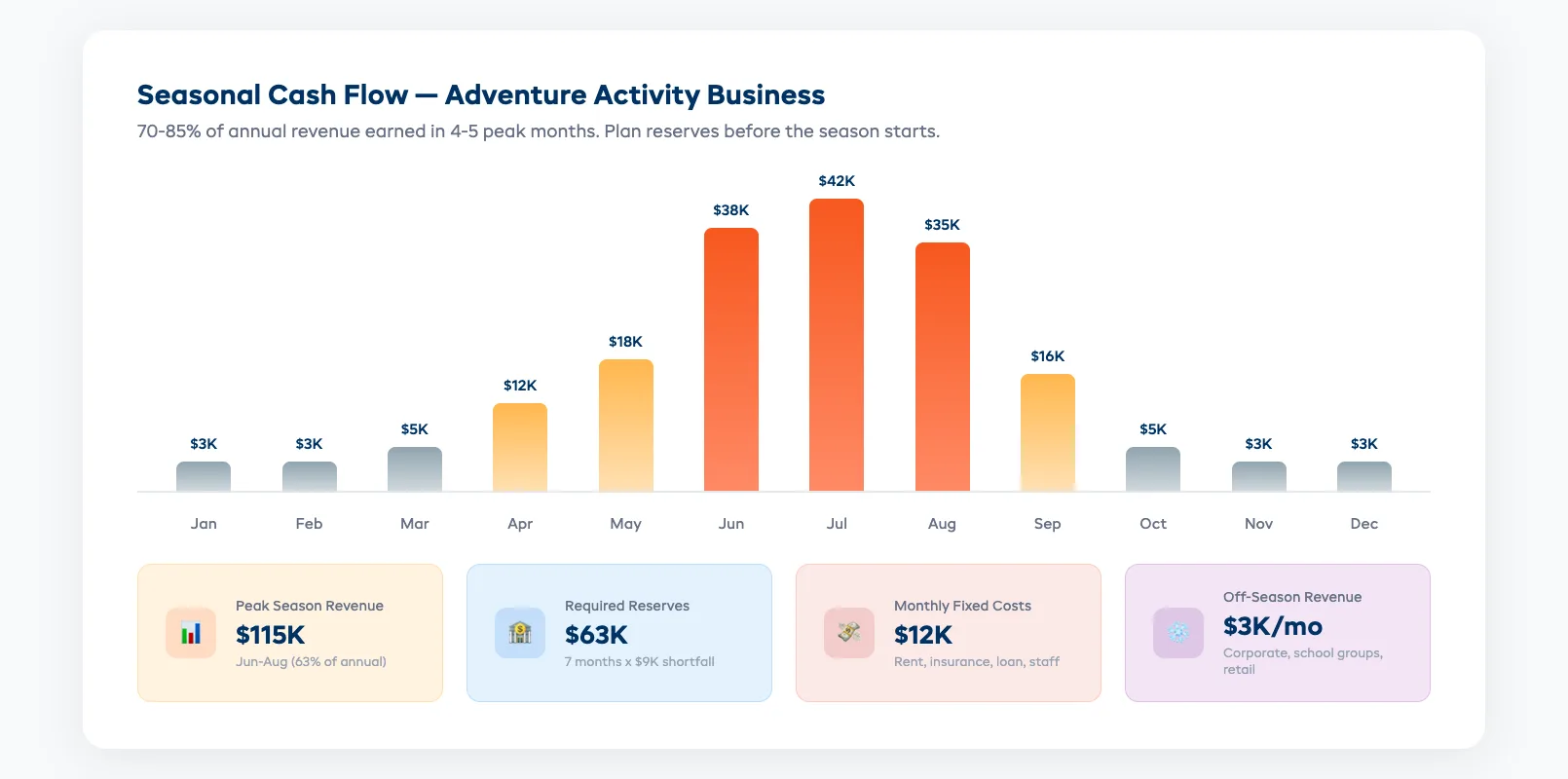
Peak-season cash flow. The money comes fast, and it needs to last. Set aside 35-45% of peak-season revenue for off-season fixed costs (rent, insurance, loan payments, skeleton staff). Don't spend July revenue in August. Model your annual cash flow monthly: if your fixed costs are $12,000/month and your off-season revenue is $3,000/month, you need $63,000 in reserves to cover the gap (7 months × $9,000 shortfall).
Off-season revenue streams. Don't let your assets sit idle for seven months:
- Corporate team-building events run year-round in temperate climates. Lower-intensity activities (ropes courses, guided hikes) work even in shoulder seasons.
- School and youth group programs fill midweek slots that recreational customers won't book.
- Equipment maintenance and certification courses: some operators train guides for other companies during the off-season.
- Gear retail: sell retired rental gear, branded merchandise, and outdoor essentials from your shopfront or online.
Staff planning. Your core team (operations manager, lead guide, maintenance tech) stays year-round. Seasonal guides come on 4-6 weeks before peak season for training. Plan your hiring pipeline in January for a June start. The guides you want are getting offers by February. For the full playbook on cash flow math, guide retention strategies, and off-season revenue streams, see Seasonal Adventure Business Management.
Pre-season operations audit. Before your first customer of the season, run a full audit: gear inspections, permit renewals, insurance confirmations, guide certification checks, vehicle inspections, safety equipment (first aid kits, throw bags, radios) verification. The Pre-Season Adventure Operations Audit checklist covers every line item. Don't skip it — the first trip of the season shouldn't be the one where you discover the radio batteries are dead.
Technology Stack
Running an adventure activity business on paper and spreadsheets works until it doesn't, and it usually stops working right when you're busiest. Peak-season Saturday morning, three trips going out, and you're cross-referencing a paper waiver binder, a whiteboard schedule, and a text chain with your guides about which group has the participant with the bad knee.
What your tech stack needs to handle:
- Online booking with real-time availability. Customers book at 10pm on a Tuesday for Saturday's trip. If your booking process requires a phone call during business hours, you're losing those bookings to the operator down the road who has a "Book Now" button. Your booking widget should show live availability, collect participant details, and process payment, all before you wake up.
- Waiver collection tied to bookings. Digital waivers sent automatically at booking confirmation. Completed before arrival. Stored searchably for years. No clipboards, no missing forms, no "I thought I already signed one."
- Guide scheduling and assignment. Which guide is on which trip, what's their certification status, are they approaching overtime? A shared calendar and a spreadsheet stop working at 3+ guides.
- Gear tracking. What's checked out, what's due for inspection, what's approaching retirement. When you're running 200+ harnesses and helmets, mental inventory tracking fails.
- Participant communication. Confirmation emails, pre-trip preparation guides, weather-related schedule changes, post-trip review requests. Manual follow-up doesn't scale past 20 bookings a week.
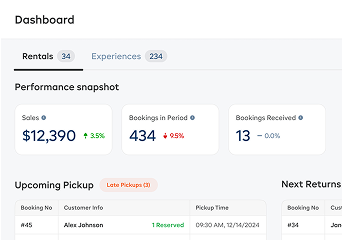
A platform like EquipDash consolidates booking, waivers, staff scheduling, gear tracking, and participant communication into one dashboard. The built-in AI assistant handles the follow-up emails, review requests, and scheduling conflicts that eat your mornings. Check out the Weather Go/No-Go Decision checklist and the Pre-Activity Briefing checklist for examples of how standardized workflows keep your operation tight when things get hectic.
Frequently Asked Questions
How much does it cost to start an adventure activity business? Startup costs range from $15,000-$30,000 for a Tier 1 guided hiking operation (gear, insurance, permits, marketing) to $100,000-$250,000+ for a Tier 3-4 operation like a commercial rafting company (rafts, safety gear, vehicles, permits, insurance, facility). The biggest variable is whether you need vehicles and a physical location.
What insurance do I need for an adventure activity business? At minimum: general liability ($1M/$2M), professional liability, commercial auto (if transporting participants), and workers' compensation. Tier 3-4 activities may need additional umbrella coverage. Expect $5,000-$50,000+/year depending on activity type and participant volume.
How do I price adventure activities to stay profitable? Calculate your true cost per participant (guide labor, gear depreciation, permits, insurance, transport, overhead), then apply a 1.4-1.6x margin. Don't copy competitor pricing without knowing their cost structure. They might be undercharging.
What certifications do adventure guides need? It depends on the activity. Whitewater guides need ACA certification and Swiftwater Rescue. Climbing guides need AMGA certification. All guides should hold Wilderness First Responder (WFR) at minimum. Your insurance policy will specify required certifications. Read it carefully.
How do I handle weather cancellations without losing revenue? Build a reschedule-first policy. Don't default to refunds — offer alternative dates or activity swaps. Keep a 48-hour cancellation window for weather-related changes. Communicate proactively: if tomorrow looks marginal, text the guest tonight with options rather than canceling at the put-in.
What's the biggest mistake new adventure operators make? Underestimating insurance and gear replacement costs. They price based on guide wages and fuel, then get blindsided by a $25,000 insurance renewal and $12,000 in mandatory harness replacements. Build every fixed cost into your per-participant pricing before you set rates.
How many guides do I need to hire? Start with your peak-day capacity. If you run 4 trips per day with 1 guide per trip, you need 4 guides working simultaneously. Add 1-2 backup guides for days off and sick cover. For a 5-day operating week, that's 6-8 guides minimum. Scale from there based on booking demand.
Getting Started
Running an adventure activity business is equal parts outdoor passion and operational discipline. The operators who last aren't the best climbers or the most experienced paddlers. They're the ones who treat licensing, insurance, gear maintenance, and cash flow with the same seriousness they bring to reading a rapid or setting an anchor.
Start with your tier. Get licensed. Get insured properly, not cheaply. Hire guides for judgment, not just technical skill. Track every piece of gear from purchase to retirement. Price to cover your real costs, not just what feels competitive. And build your off-season plan before peak season starts, not after it ends.
The adventure activity hub has checklists, templates, and tools built specifically for adventure operators. Start your free trial and see how much of the operational busywork disappears when your booking, waivers, scheduling, and gear tracking live in one place.
in one place