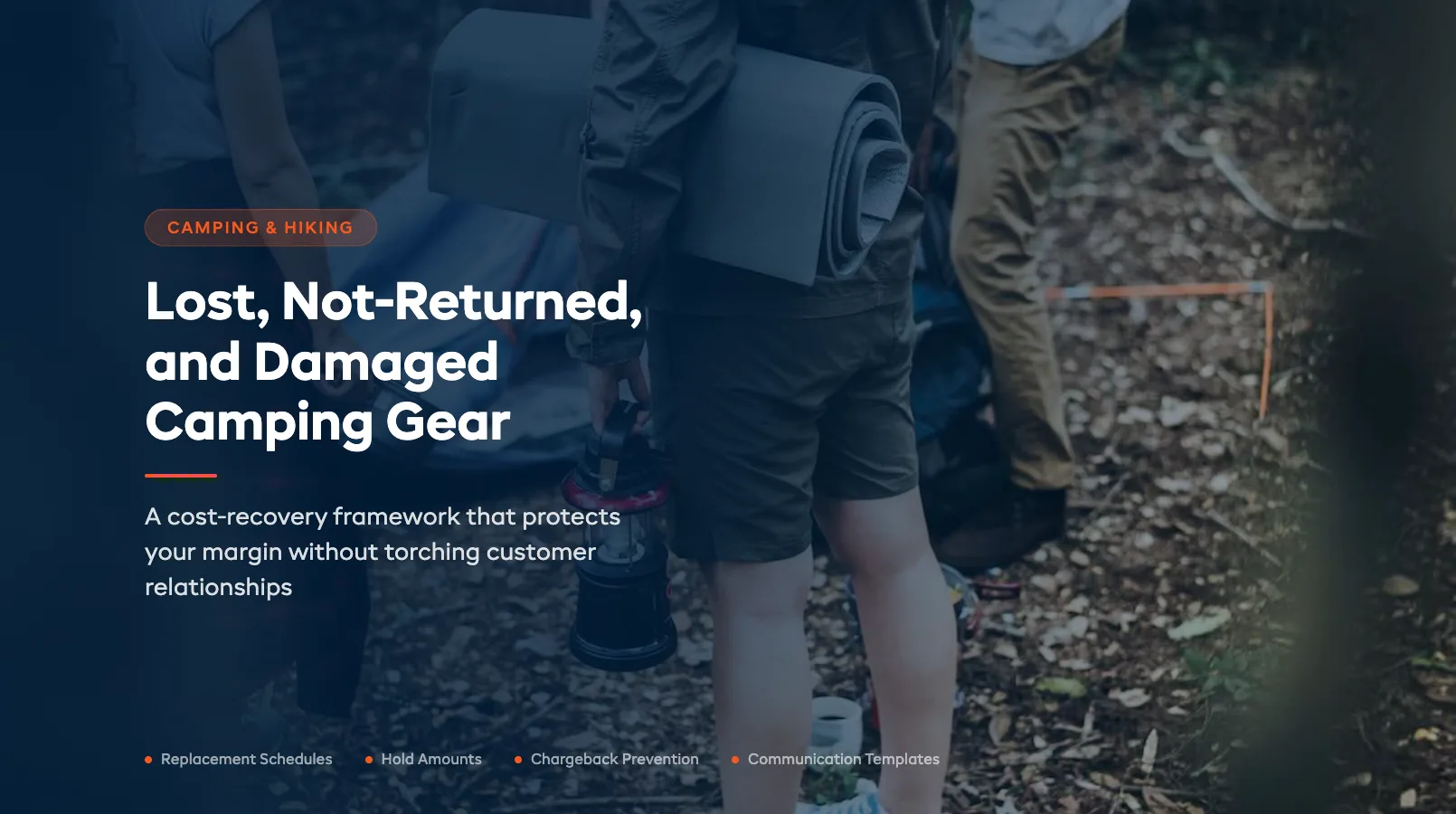
Lost, Not-Returned, and Damaged Camping Gear: A Cost-Recovery Framework
A customer rents a four-person tent, two sleeping bags, and a camp stove for the weekend. Monday morning, they return two sleeping bags and a stove. No tent. "Must have left it at the site." That's $350 in replacement cost and a conversation nobody wants to have.
Every camping gear rental operator deals with this. Industry loss rates run 2-5% of fleet value per season. At 500 items averaging $80 replacement cost, that's $800-$2,000 walking out the door annually, before you count damage. The operators who survive aren't the ones who never lose gear. They're the ones with a system for recovering costs without burning bridges.
This guide gives you that system. Six areas: replacement pricing, communication scripts, hold amounts, chargeback prevention, partial returns, and knowing when to write it off. For the full camping rental operator playbook, start with our complete guide to running a camping gear rental business.
Build a Replacement Cost Schedule Before You Need One
The worst time to figure out what a lost tent costs is when a customer is standing at your counter arguing about it. Build your schedule now, print it, and attach it to every rental agreement.
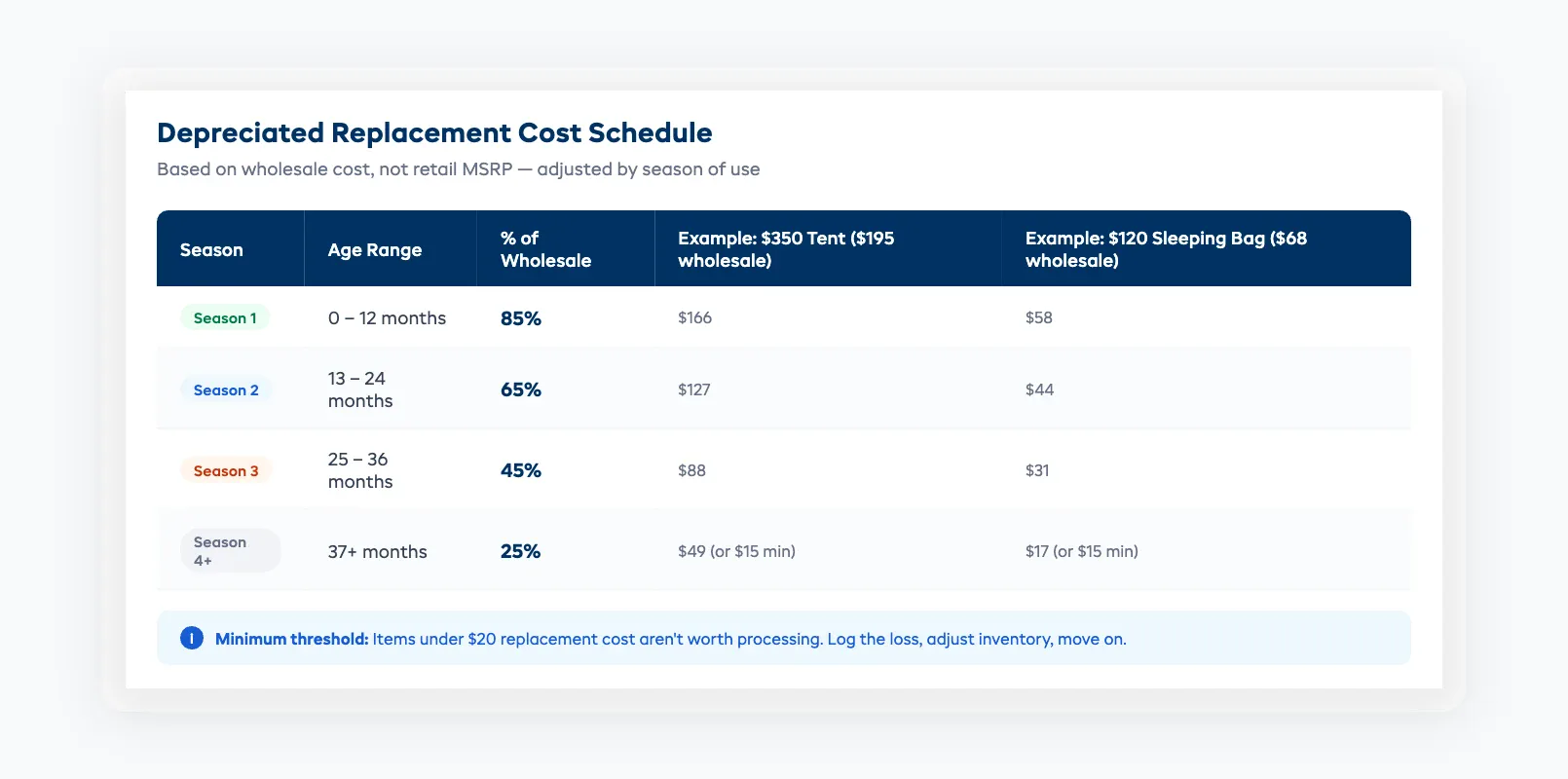
Depreciated replacement, not retail. Charging full MSRP for a tent that's been rented 40 times feels unfair, and it is. Customers push back harder, chargebacks increase, and your reputation takes a hit. Instead, use depreciated replacement cost: what it would cost you to replace that item at its current condition level.
A simple depreciation model:
- Season 1 (0-12 months): 85% of wholesale cost
- Season 2 (13-24 months): 65% of wholesale cost
- Season 3 (25-36 months): 45% of wholesale cost
- Season 4+ (37+ months): 25% of wholesale cost or $15 minimum, whichever is higher
Wholesale cost, not retail. You buy a $350 tent at $195 wholesale. In season two, that's $127 replacement charge, not $350. Customers accept this faster because the math is transparent.
Category-specific caps. Some items aren't worth chasing. A $6 stuff sack or a $4 tent stake set costs more in staff time to process than you'll recover. Set a minimum threshold, most operators use $20. Below that, log the loss, adjust inventory, and move on.
Post your schedule on your website, in the rental agreement, and on the wall behind the counter. When the conversation happens, you're pointing to a published policy, not making it up on the spot. For pricing context across your full rental catalog, see our guide on camping rental pricing packages.
Communication Templates That Protect the Relationship
How you deliver the news matters more than the dollar amount. A $127 charge delivered poorly creates a one-star review. The same charge delivered with empathy creates a customer who comes back next season.
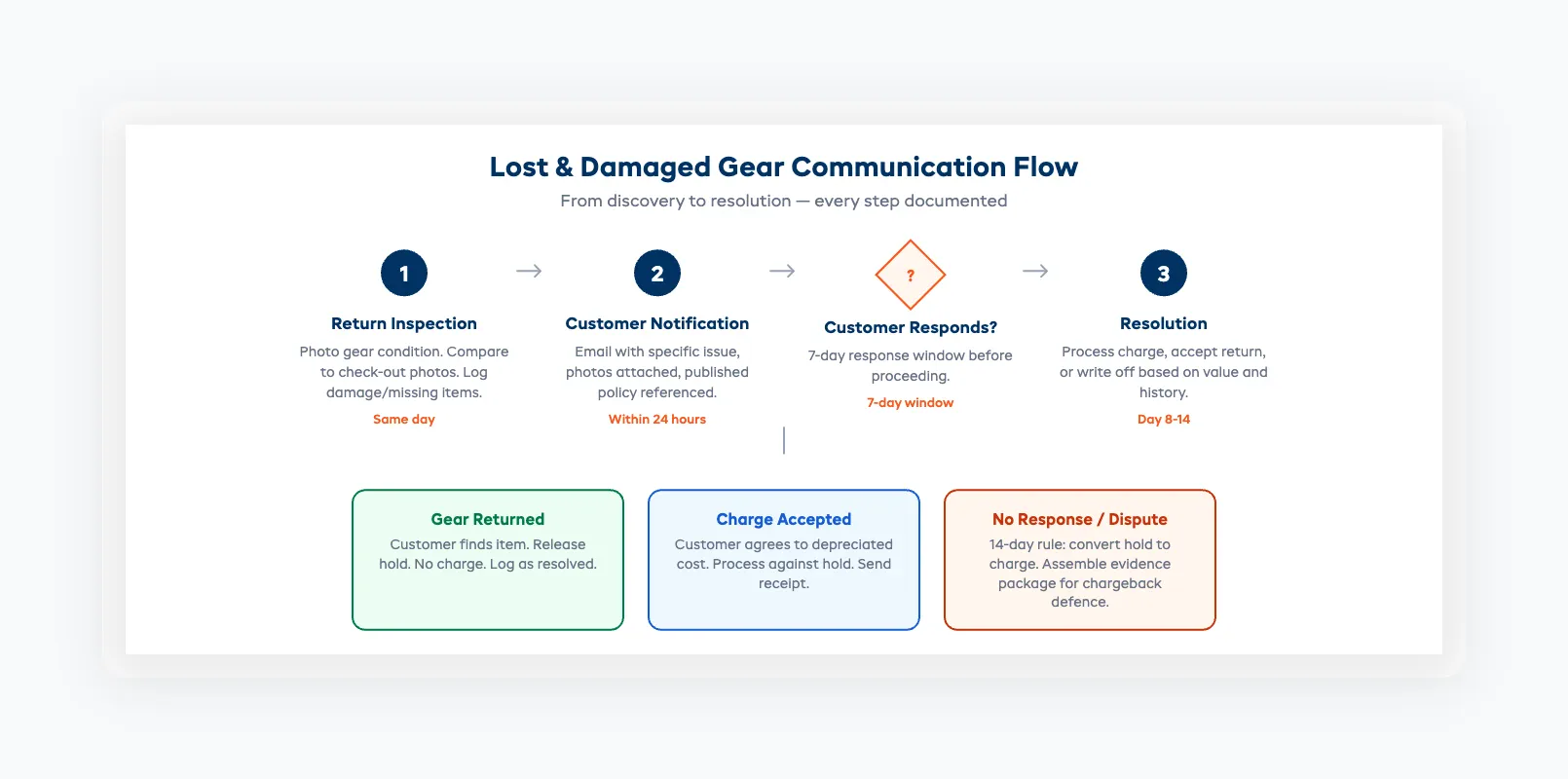
The 24-hour rule. Never charge a card without talking to the customer first. Send a message within 24 hours of discovering the issue. Email works better than phone for this. It gives the customer time to process and respond without feeling ambushed.
Template: Missing gear notification
Hi [Name], thanks for renting with us last weekend. During our return check, we noticed the [item] wasn't included. Sometimes gear gets left at the site or mixed in with personal items — happens more than you'd think. Could you take a quick look? If it turns up, just drop it off or ship it back within 7 days and we'll waive any charges. If it's gone, our replacement policy (attached to your rental agreement) applies. The depreciated replacement cost for your [item] is $[amount]. Happy to walk you through the breakdown — just reply here.
Three things this template does right: assumes good faith, offers an out, and references a published policy. No accusation. No surprise charge. A customer who genuinely lost the tent at the campsite responds differently when you treat it as an honest mistake.
Template: Damage assessment
Hi [Name], we finished inspecting the gear from your rental. The [item] came back with [specific damage — e.g., "a 6-inch tear in the rain fly"]. Photos attached. Based on our depreciated replacement schedule, the repair/replacement cost is $[amount]. If you'd like to discuss, we're happy to go over the details. Otherwise, we'll process the charge against your security hold on [date — 7 days out].
Always include photos. Always specify the damage. "Your tent was damaged" invites an argument. "6-inch tear in the rain fly, photo attached" doesn't. Use your post-rental return checklist to catch and document damage at the counter.
Hold Amounts That Actually Cover You
A security hold is your safety net. Too low and you eat the loss. Too high and customers abandon the booking. The sweet spot depends on your gear mix and average rental value.
Tiered holds by rental value:
- Under $100 rental: $75 hold
- $100-$250 rental: $150 hold
- $250-$500 rental: $250 hold
- $500+ rental: $400 hold or 50% of rental value, whichever is higher
These aren't charges. They're authorization holds that expire if nothing goes wrong. Make that clear at checkout. "We place a temporary hold of $150 on your card. If everything comes back in good shape, it releases automatically within 3-5 business days." Most customers don't blink.
Pre-authorization timing matters. Place the hold at check-out, not at booking. Holds placed days before the rental start often expire before you've completed the return inspection. If your payment processor supports extended holds (Stripe does, up to 7 days), use them.
The gap problem. Even a $400 hold won't cover a customer who rents $1,200 worth of backcountry gear. For high-value rentals, require a signed damage agreement alongside the hold. This gives you a paper trail for disputes. Operators running multi-day backcountry trips should review our logistics and liability guide for additional deposit strategies.
Chargeback Prevention Starts at Booking
Chargebacks on damage and loss charges eat 2-3x the original amount once you factor in processor fees and lost merchandise. Prevention is cheaper than fighting them.
The documentation chain:
- At booking: Customer signs rental agreement with replacement schedule attached. Digital signature with timestamp. Dash can automate this with digital waivers at booking confirmation.
- At check-out: Photos of gear condition before handoff. Staff initials on the check-out form. Customer acknowledges condition.
- At return: Photos of gear condition at return. Side-by-side comparison with check-out photos. Logged in your system with timestamps.
- Before charging: Written notification to customer. 7-day response window. Evidence package assembled.
If a chargeback comes in, you submit: signed agreement, replacement schedule, check-out photos, return photos, written notification, and the 7-day window proof. Visa and Mastercard side with merchants who have this chain more than 70% of the time.
Descriptor clarity. Make sure your payment descriptor says something recognizable — "YOURSHOP GEAR RENTAL" not "PYMT*XYZ123." Customers who don't recognize the charge dispute it reflexively. This alone reduces chargebacks by 15-20%.
Use your damage assessment checklist to standardize the documentation at every return. Consistent process means consistent evidence.
Partial Returns: The Gear That Almost Came Back
Full losses are straightforward. Partial returns are where it gets messy. The customer returns 8 of 10 items, or returns a tent with a broken pole but the fly intact, or brings everything back but a week late.
Missing individual items from a kit. If someone rents a "family camping package" (tent + 4 bags + stove + lantern) and returns everything except the lantern, charge the depreciated replacement for the lantern only. Don't penalise the full package. But log it — repeat partial returns from the same customer signal a pattern.
Damaged components. A tent with one broken pole doesn't need full replacement. If the pole costs $35 to replace and takes 20 minutes of staff time, charge $55 (parts + labor). Keep a parts-cost reference sheet for your top 20 items. Most manufacturers publish replacement part pricing on their dealer portals.
Late returns. Late isn't lost, but it blocks revenue. If a customer keeps gear an extra day during peak season, you've lost that booking. Charge the daily rate for each late day, plus a flat late fee ($25-$50). Make the late policy as visible as your rental rates. For more on how seasonal demand affects your pricing and penalty structure, see our seasonal hiking gear guide.
The 14-day rule. If gear hasn't been returned within 14 days and the customer hasn't responded to two contact attempts, convert the hold to a charge and move on. Chasing beyond two weeks costs more in staff time than most items are worth.
When to Walk Away
Not every dollar is worth recovering. The math changes when you factor in staff time, customer lifetime value, and reputation risk.
Walk away when:
- The replacement cost is under $25. Log it and move on
- The customer has a strong rental history (5+ bookings, no prior issues) and the damage is borderline. Offer a 50% goodwill discount on the charge
- The damage was arguably caused by normal use, not negligence — a tent zipper failing after 60 rentals isn't the customer's fault
- Fighting the charge would cost more than absorbing it — one hour of staff time at $25/hr plus a potential chargeback fee makes a $40 recovery a net loss
Don't walk away when:
- The loss is clearly negligent (gear left unattended, obvious misuse)
- The customer has a pattern (second or third incident)
- The value exceeds $200, at this level, the write-off hurts your season
- You have photographic evidence and a signed agreement — exercise the policy you built
The 80/20 rule in practice. Most operators recover 60-75% of loss value when they have a system. The remaining 25-40% are write-offs, either too small to chase, too ambiguous to win, or goodwill concessions to retain high-value customers. Budget 1-2% of fleet value annually for unrecoverable losses and treat it as a cost of doing business.
For operators partnering with guides and outfitters, loss recovery gets more complex. See our guide on gear-sharing partnership models for how to build loss accountability into partner agreements. Operators managing cleaning and hygiene between rentals should also review our camping gear hygiene guide — gear that comes back clean but damaged is easier to assess than gear that's both dirty and broken.
Frequently Asked Questions
What percentage of camping rental gear is typically lost or damaged per season?
Industry rates vary, but most camping gear rental operators report 2-5% of fleet value lost or damaged per season. Operators with documented replacement policies and security holds tend to land closer to 2%. Without a system, losses can exceed 7%.
Should I charge retail or wholesale price for lost rental gear?
Charge depreciated wholesale cost, not retail MSRP. Customers push back harder against inflated charges, and payment processors are more likely to side with the cardholder in disputes. A transparent depreciation schedule based on wholesale cost gets accepted faster and holds up better in chargebacks.
How much should I hold on a customer's card as a security deposit?
Match the hold to the rental value: $75 for rentals under $100, $150 for $100-$250 rentals, $250 for $250-$500, and $400 or 50% of value for larger rentals. These are authorization holds, not charges. Make that clear at checkout to avoid friction.
How do I prevent chargebacks on damage charges?
Build a documentation chain: signed rental agreement with replacement schedule, check-out and return photos with timestamps, written notification to the customer with a 7-day response window. Merchants who present this evidence win chargeback disputes more than 70% of the time.
When should I write off lost gear instead of pursuing recovery?
Write off items under $25 — the staff time to process recovery exceeds the value. Also consider writing off borderline damage for customers with strong rental history (5+ bookings, no prior issues). Budget 1-2% of fleet value annually as unrecoverable loss.
How long should I wait before charging for unreturned gear?
Give customers 7 days to respond after your initial notification. If the gear hasn't been returned and the customer hasn't responded to two contact attempts within 14 days, convert the security hold to a charge. Chasing beyond two weeks rarely produces results.
Can I include a loss/damage waiver as an add-on at booking?
Yes. And many operators do. A $10-$15 per-rental damage waiver that covers the first $150 in loss or damage is popular with customers and creates a revenue stream that offsets your annual write-offs. Frame it as optional protection, not mandatory insurance.
Lost gear is part of the business. The operators who manage it well don't lose sleep over missing tent stakes. They lose sleep over missing systems. Build your replacement schedule, template your communications, hold the right amounts, and know when the fight isn't worth it. Your gear library, pricing strategy, and return process all connect. Explore the full camping rental operator hub for the complete picture.
in one place