End-of-Season Gear Retirement and Refresh Planning
Your last customer of the season drops off a tent that's been rented 87 times. The zipper sticks. The waterproof coating is peeling at the seams. The poles have three splints held together with duct tape from the field repair kit. You could send it out again next spring, but should you?
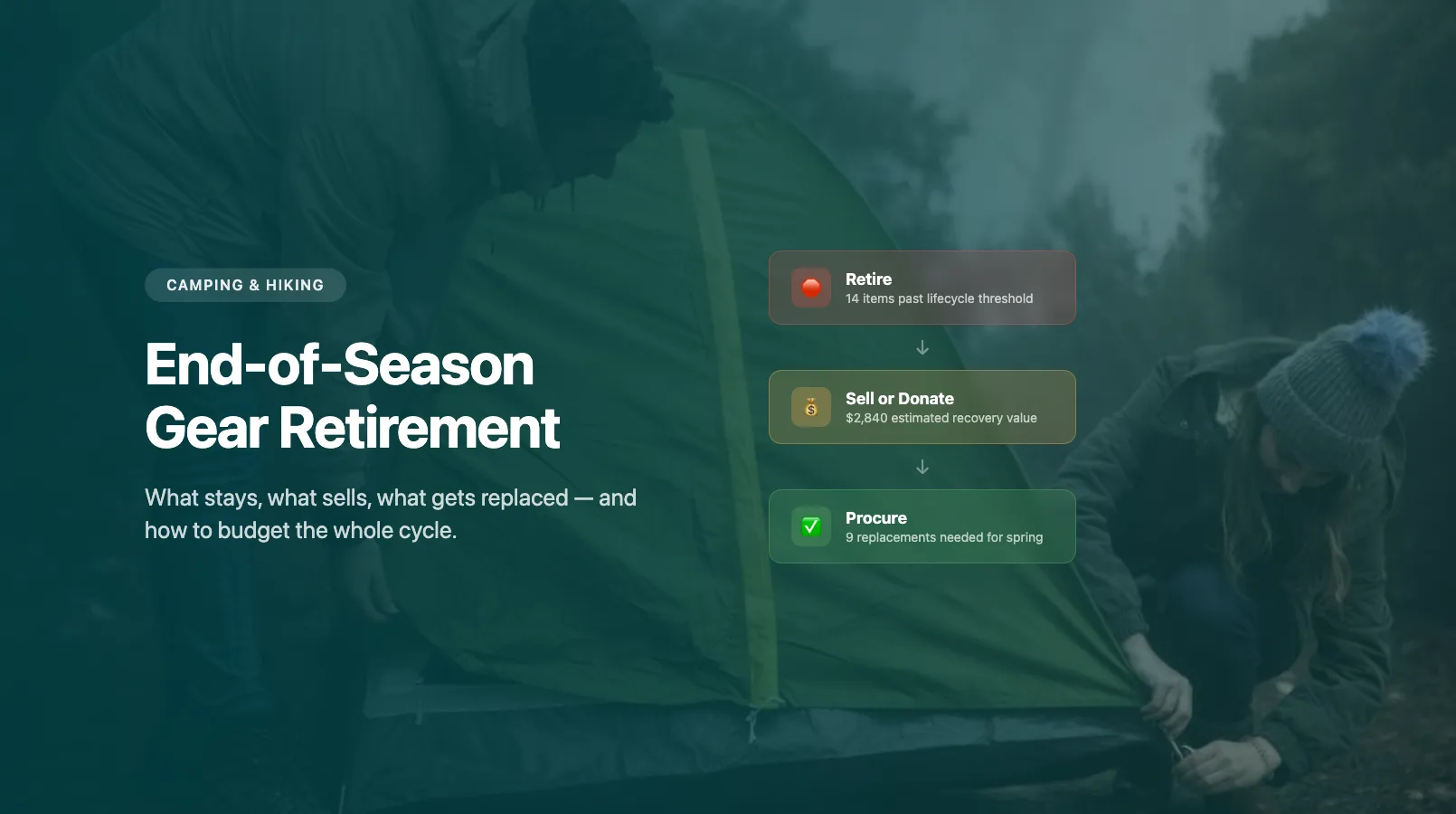
Every piece of rental gear has a lifecycle. Push past it and you eat repair costs, warranty claims, and one-star reviews about "ratty equipment." Retire too early and you're replacing functional inventory that had another 30 rentals left in it. The operators who get this right aren't guessing. They're running a structured end-of-season retirement review and buying replacements before spring prices spike.
This guide covers the full cycle: what to retire, where to sell it, when to donate, how to plan procurement, and how to store what stays. For the complete camping rental operator playbook, start with our guide to running a camping gear rental business.
Retirement Criteria Per Gear Category
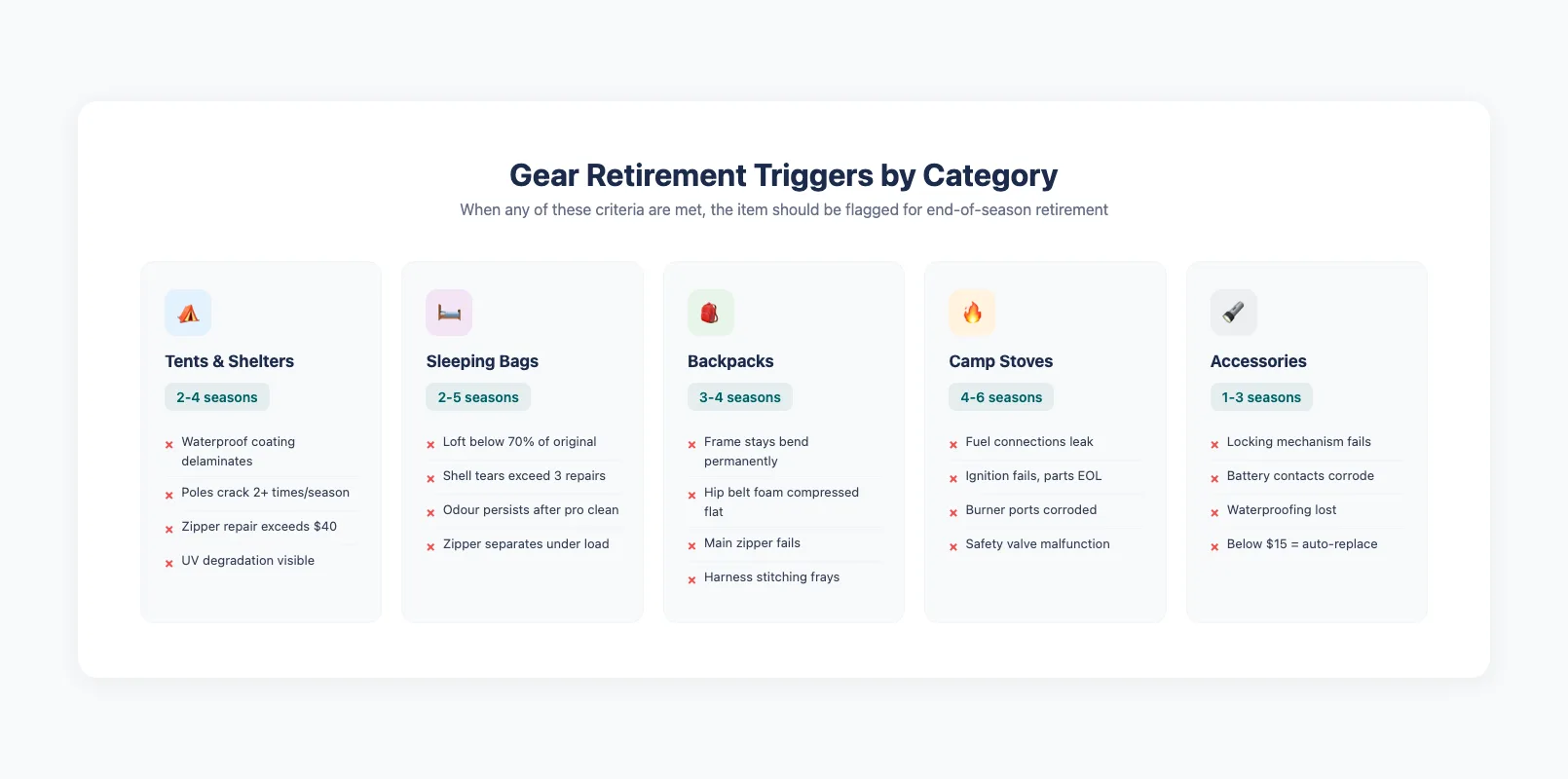
Not all gear ages the same way. A stainless steel cook set lasts five seasons with zero maintenance. A tent rain fly might be done after two. Set retirement triggers by category, not a blanket rule across your whole fleet.
Tents and shelters. Retire when: waterproof coating delaminates (not patchable), pole segments crack more than once per season, zipper replacement exceeds $40, or fabric shows UV degradation (thin spots you can see light through). Typical lifespan: 2-4 seasons or 60-120 rentals. If cleaning can extend that lifespan, see our guide on camping gear hygiene at scale before you retire items prematurely.
Sleeping bags. Retire when: loft drops below 70% of original (measured flat), shell fabric tears exceed three repairs, or odour persists after professional cleaning. Down bags last longer than synthetic — budget 3-5 seasons for down, 2-3 for synthetic.
Backpacks. Retire when: frame stays bend permanently, hip belt foam compresses flat, main zipper fails, or harness stitching frays at stress points. Budget 3-4 seasons for packs with 80+ rental cycles.
Camp stoves and cookware. Stoves retire when: fuel connections leak (safety issue — immediate), ignition fails and parts are discontinued, or burner ports corrode beyond cleaning. Cookware rarely retires — dents don't affect function. Budget 4-6 seasons for stoves.
Trekking poles, headlamps, accessories. Poles retire when locking mechanisms fail permanently. Headlamps retire when battery contacts corrode or waterproofing fails. Most accessories cost less to replace than to inspect. Set a $15 threshold below which you replace rather than evaluate.
Use the End-of-Season Camping Retirement Review checklist to standardize this inspection across your team. Consistent criteria mean consistent decisions — regardless of which staff member is doing the review.
Resale Options for Retired Gear
Retired doesn't mean worthless. A tent that's too worn for 3-day backcountry rentals still works fine for a festival-goer who'll use it twice a year. Your retired fleet is a revenue source if you price it right and choose the right channel.
Direct sale from your shop. Easiest margin. Set up a "Previously Rented" section — online or physical. Price at 25-40% of retail depending on condition. Customers love the transparency: "Rented 60 times over two seasons, professionally cleaned, waterproof coating has wear. $89." No auction fees. No shipping headaches. Sell during your last month of the season when traffic is still high.
Online marketplace (Facebook Marketplace, Gumtree, eBay). Higher reach, more time investment. Best for premium items — a $600 tent sells better online than a $30 headlamp. Budget 20 minutes per listing (photos, description, condition notes). Expect 30-50% of retail for premium items in good cosmetic condition.
Bulk sale to second-hand retailers. Lowest price per unit but fastest turnover. Some outdoor resale shops buy retired rental fleets at 15-20% of retail. Good for clearing 50+ items at once when you don't have the bandwidth for individual sales.
Staff purchase program. Offer retired gear to your team at cost-minus-depreciation. They know the gear intimately, they won't complain about condition, and it builds loyalty. Most operators report 15-25% of retired stock moves through staff sales.
Track what sells and at what margin. After two seasons, you'll know which brands hold resale value, and that data informs your next procurement decisions.
Donation and Disposal
Some gear doesn't sell. The sleeping bag with permanent mildew smell. The tent with a shredded floor. The pack whose frame snapped. Here's how to handle the rest responsibly.
Donation candidates. Gear that's functionally sound but cosmetically done: stained, faded, patched visibly. Scout troops, outdoor education programs, wilderness therapy organizations, and community gear libraries accept used equipment happily. Many will pick up. Get a donation receipt for tax purposes, at depreciated value, it's still a write-off.
Textile recycling. Torn nylon, dead synthetic bags, and irreparable shells. Companies like TerraCycle and local textile recyclers accept these. Not all regions have programs. Check your local council first. Some manufacturers (Patagonia, REI) run take-back programs for specific brands.
Responsible disposal. Camp stoves with corroded fuel lines and damaged gas canisters require hazardous waste disposal. Never bin them with general waste. Your local transfer station or council hazardous collection days handle these. Alloy tent poles and steel cookware go to metal recycling.
Documentation. Log every item that leaves your fleet: sold, donated, recycled, or binned. This isn't just good practice. It's your insurance record. If a donated tent causes an issue, you need proof it was retired with documented defects disclosed. For the financial side of handling items that never come back at all, see our cost-recovery framework for lost and damaged camping gear.
Next-Season Procurement Planning
The worst time to buy replacement gear is March, when every rental operator is scrambling for the same stock. The best time is October through December: off-season pricing, full availability, and manufacturers clearing previous-year colorways at 20-30% off.
Replacement ratio. Not every retired item needs a 1:1 replacement. Check your booking data. If you retired five two-person tents but three of them sat unused half the season, you need two replacements, not five. Use last season's utilization rate: items rented fewer than 30% of available days probably don't need replacing. Our seasonal hiking gear guide breaks down which categories move in which months. Use that to right-size your replacement orders.
Standardization saves money. Every unique tent model is a training burden, a spare-parts inventory, and a cleaning protocol. Narrow your fleet to 2-3 models per category. You get volume pricing, simpler training, and parts interchangeability. The operators running 15 different tent models spend twice as much on maintenance as those running three.
Pre-order timing by category:
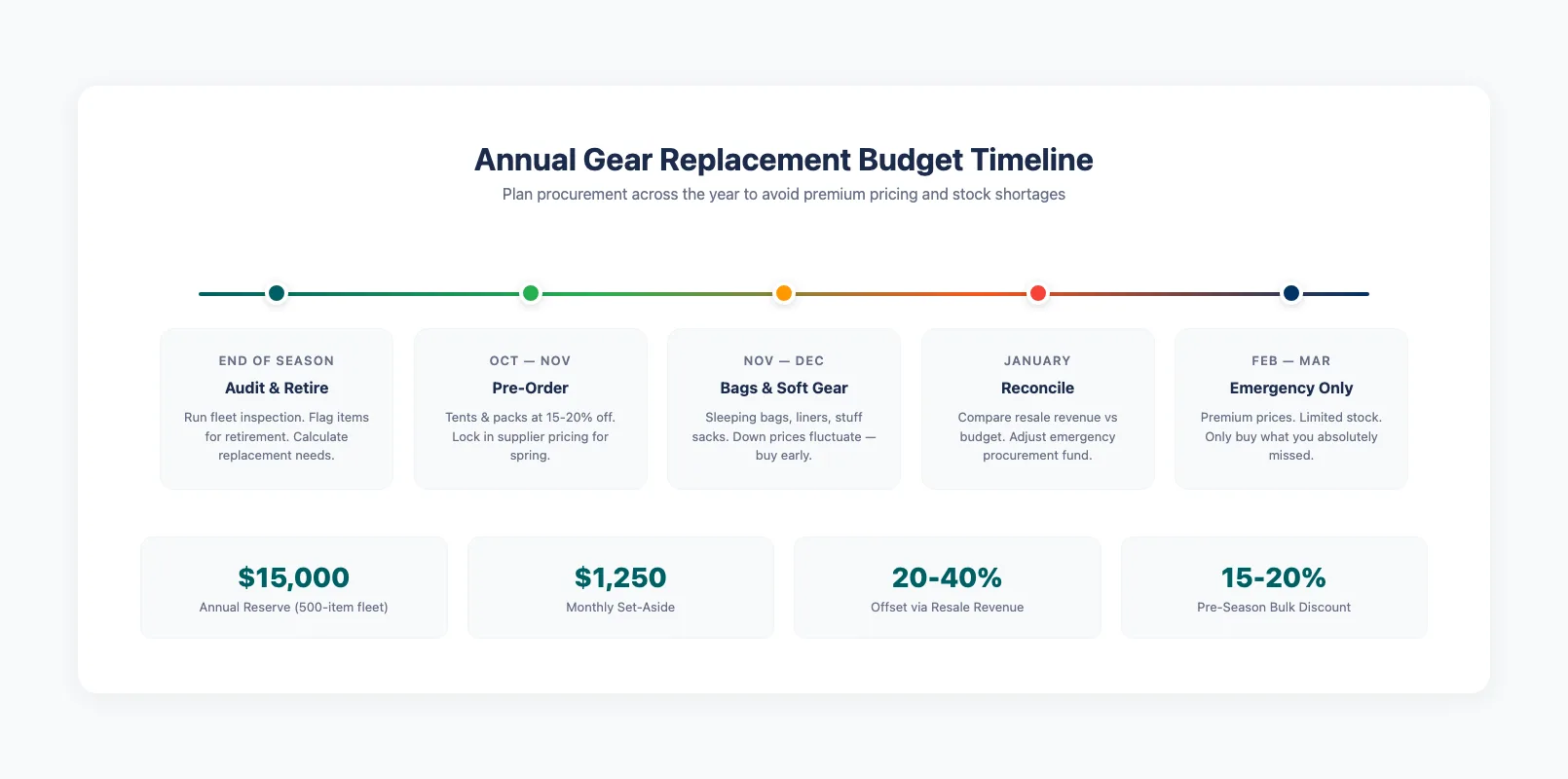
- Tents and packs: Order October-November for spring delivery. Manufacturers often discount 15-20% for pre-season bulk orders.
- Sleeping bags: Order November-December. Down prices fluctuate — locking in early protects your margin.
- Stoves and accessories: Order January-February. These ship fast and rarely sell out.
Supplier relationships matter. If you're ordering 20+ tents annually, you should be on first-name terms with your rep. Ask about demo stock, warranty replacements for fleet use, and end-of-line deals. Operators who build supplier relationships report 10-25% lower procurement costs versus ad-hoc purchasing.
For guidance on how procurement costs feed into your per-item pricing, see our camping rental pricing guide.
Budgeting for Gear Retirement and Replacement
Gear replacement shouldn't be a surprise expense. Build it into your annual operating budget using a simple depreciation-and-reserve model.
The reserve fund approach. Take your total fleet replacement value (what it would cost to buy everything new today). Divide by average fleet lifespan in seasons. That's your annual reserve contribution. Example: $45,000 total fleet value, 3-season average lifespan = $15,000 annual reserve. Set aside $1,250/month and you'll never scramble for replacement capital.
Per-rental depreciation. Alternative model: add $2-5 per rental to a replacement fund. At 2,000 rentals per season with a $3/rental reserve, that's $6,000 — enough to replace 15-20% of your fleet annually, which is roughly what most operators retire.
Offset with resale. Your retirement revenue (direct sales + bulk sales + staff purchases) offsets 20-40% of procurement costs if you're selling actively. Factor this into your budget as a line item. It's real revenue, not a bonus.
Budget timing:
- End of season (now): Calculate retirement count and replacement needs
- October-November: Place pre-orders using reserve fund
- January: Reconcile actual resale revenue against projected
- Pre-season (March): Emergency procurement only. You'll pay premium prices
Track cost-per-rental-day. Every item in your fleet has a lifetime cost: purchase price + maintenance + cleaning, divided by total rental days. When cost-per-day exceeds 30% of your daily rental rate, the item is costing you money to keep. This metric makes retirement decisions objective rather than emotional.
Storage That Preserves What Stays
The gear you keep needs proper off-season storage. Poor storage turns next season's fleet into this season's retirement pile. Six months in a damp shed costs more in replacements than a proper storage setup.
Climate matters. Ideal: cool (10-20°C), dry (below 60% humidity), dark, and ventilated. A garage works if it's insulated. A shipping container in direct sun doesn't — internal temperatures hit 60°C+ and cook waterproof coatings, adhesives, and foam padding.
Tents. Store loosely, never in their stuff sacks long-term. Compression degrades waterproof coatings and stresses seam tape. Hang from ridgelines or drape over wide shelves. Ensure they're bone dry before storage. One damp tent stored folded = mildew that ruins a $200 item.
Sleeping bags. Same rule: never compressed. Store in large cotton or mesh storage sacks (most manufacturers sell these). Hang if possible. Down bags need air circulation to maintain loft.
Backpacks. Store upright, hip belt unbuckled, all straps loosened. Stuff the main compartment loosely with paper or a pillow to maintain shape. Zippers left slightly open to prevent seal-lock.
Stoves and metal items. Clean thoroughly, dry completely, apply light oil to threads and moving parts. Store with fuel connections uncapped to prevent gasket compression. Remove batteries from headlamps — corroded contacts are the number one headlamp killer.
Inspection before storage. Run every item through a quick condition check before it goes on the shelf. If it needs repair, repair it now while you remember, not in March when you're scrambling to open. Use the Pre-Season Camping Fleet Audit checklist as your storage-entry checklist too. Same criteria, different timing.
FAQ
How many seasons should camping rental gear last? It depends on the category. Tents typically last 2-4 seasons (60-120 rentals), sleeping bags 2-5 seasons depending on fill type, backpacks 3-4 seasons, and stoves 4-6 seasons. Heavy-use items at high-volume shops skew toward the lower end.
Should I sell retired rental gear or donate it? Sell anything that's functionally sound and cosmetically acceptable. You'll recover 25-50% of retail value. Donate items that work but look too worn to sell. Dispose of anything with safety concerns (corroded fuel lines, structural failures).
When is the best time to buy replacement camping gear? October through December. Manufacturers offer pre-season bulk discounts of 15-20%, previous-year colorways clear at deeper discounts, and stock availability is at its peak. March purchasing means premium prices and limited selection.
How do I budget for gear replacement each season? Use the reserve fund model: divide your total fleet replacement value by average lifespan in seasons. Set aside that amount monthly. Most operators budget $1,000-$2,000/month for a mid-size camping rental fleet (200-500 items).
What's the best way to store gear over winter? Cool, dry, dark, and ventilated. Never store tents or sleeping bags compressed. Keep humidity below 60%. Remove batteries from electronics. Dry everything completely before storage — one damp tent stored folded will grow mildew within weeks.
How do I decide which gear to retire? Set objective triggers per category: waterproof coating failure, structural damage exceeding repair cost, safety concerns, or cost-per-rental-day exceeding 30% of your daily rate. Run a standardized inspection using the Climbing Gear Retirement Inspection checklist adapted for your categories.
Running a camping gear rental business means managing the full lifecycle, from procurement through retirement. For the complete operator's guide covering every aspect of the business, see our camping rental business guide. Ready to track gear condition, automate retirement flags, and manage your fleet lifecycle in one place? See how Dash handles it.
in one place