Weather Operations for Water Sports: Reschedule-First Revenue Recovery
A thunderstorm rolls in at 11 a.m. on a Saturday in July. You have 14 bookings on the board — $2,800 in revenue. Within 20 minutes you need to decide: cancel, delay, or push through. Get the call wrong and you either put people on the water in unsafe conditions or refund $2,800 that could have been a $2,800 reschedule.
Most water sports operators lose 8-15% of peak-season revenue to weather cancellations. But the operators who build a reschedule-first system recover 60-80% of those bookings instead of refunding them. The difference isn't luck — it's having clear go/no-go criteria, a communication timeline, and a weather policy that customers agree to before they book.
This guide covers the operational framework that turns weather days from revenue holes into rescheduled revenue. For the full water sports operations playbook, see our complete water sports rental business guide.
Go/No-Go Criteria per Activity
"Bad weather" means different things for different activities. A kayak can handle conditions that would ground a SUP lesson. Your criteria need to be activity-specific, written down, and non-negotiable.
Wind speed thresholds:
| Activity | Green (Go) | Yellow (Caution) | Red (No-Go) |
|---|---|---|---|
| SUP (beginner) | Under 10 knots | 10-15 knots | Over 15 knots |
| SUP (experienced) | Under 15 knots | 15-20 knots | Over 20 knots |
| Kayak (tandem/guided) | Under 15 knots | 15-20 knots | Over 20 knots |
| Kayak (single/unguided) | Under 12 knots | 12-18 knots | Over 18 knots |
| Surf lesson | Under 20 knots (offshore) | Onshore 10-15 knots | Onshore over 15 knots |
| Jet ski | Under 20 knots | 20-25 knots | Over 25 knots |
Beyond wind — other no-go triggers:
- Lightning. Any lightning within 10 miles is an automatic no-go. No exceptions, no "wait and see." Clear the water immediately if lightning appears mid-session.
- Visibility. Fog under 200 meters. Customers can't navigate, and rescue becomes dramatically harder.
- Water temperature. Below 10°C (50°F) without wetsuits for all participants. Hypothermia risk spikes for beginners who fall in repeatedly.
- Swell height. Over 1.5 meters for SUP beginners, over 2 meters for kayak tours. Surf lessons have their own swell windows — see our surf lesson operations guide for surf-specific thresholds.
- Tidal conditions. Strong ebb tides at river mouths, spring tides that expose hazards or create dangerous currents.
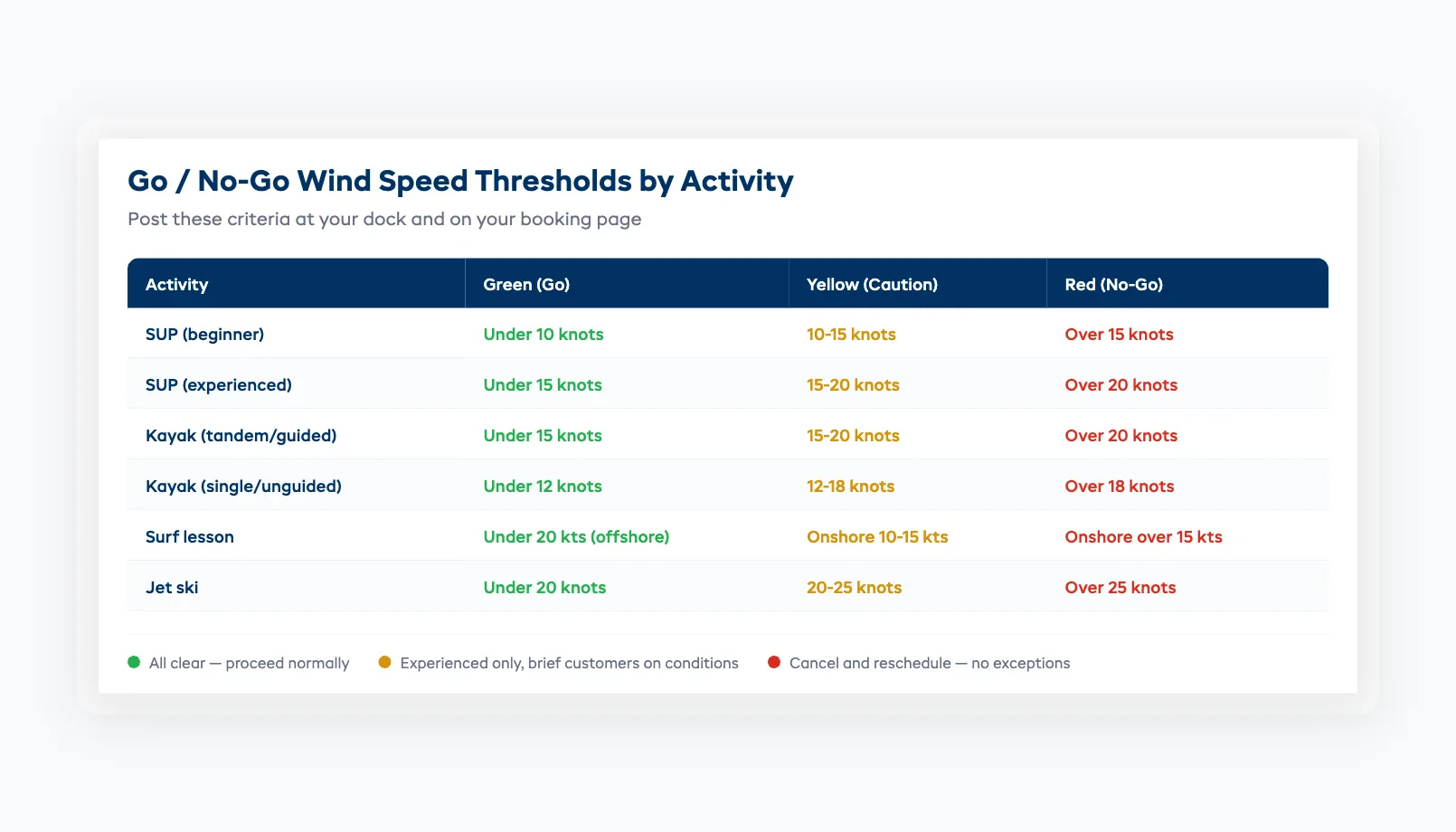
Post these criteria on your booking page, in your shop, and in your pre-trip briefing materials. When a customer asks "why can't we go out?", point to the chart. It removes the argument. For a deeper dive on safety operations including PFD requirements and waiver structure, see our water sports safety guide.
Timing: When to Call It
The single biggest mistake operators make with weather cancellations is calling it too late. A 6 a.m. cancellation gives customers time to make other plans. A 30-minute-before cancellation wastes their morning and guarantees frustration — even if the refund is instant.
The decision timeline:
| Window | Action |
|---|---|
| 48 hours out | Check extended forecast. Flag any bookings on at-risk days internally. |
| Evening before (6-8 p.m.) | Check updated forecast. If probability of no-go conditions exceeds 70%, send a "weather watch" message to affected customers. Don't cancel yet — just prepare them. |
| Morning of (6-7 a.m.) | Final call. Check real-time conditions and updated hourly forecast. If no-go, send the cancellation/reschedule message before 7 a.m. |
| Same-day pop-up | Weather changes mid-morning? You have 90 minutes max from the time conditions deteriorate to contact afternoon bookings. |
Why early matters financially: Customers contacted 12+ hours before their booking reschedule at 70-80% rates. Customers contacted under 2 hours before their booking reschedule at 30-40% rates and request refunds at 2x the rate. The earlier you call it, the more revenue you keep.
Don't wait for certainty. A 70% chance of thunderstorms at 2 p.m. is enough to cancel the 2 p.m. slot and offer a morning alternative. Operators who wait for 100% certainty end up making last-minute calls that cost them both the booking and the customer relationship.
Reschedule-First vs Refund-First
Here's the revenue difference between these two approaches over a typical summer season:
Refund-first operator (20 weather days, 12 bookings/day average, $200 avg booking):
- 240 affected bookings × $200 = $48,000 in cancellations
- Refund rate: 85%. Reschedule rate: 15%
- Revenue recovered: $7,200. Revenue lost: $40,800.
Reschedule-first operator (same numbers):
- 240 affected bookings × $200 = $48,000 in cancellations
- Reschedule rate: 65%. Refund rate: 20%. Credit rate: 15%
- Revenue recovered: $38,400. Revenue lost: $9,600.
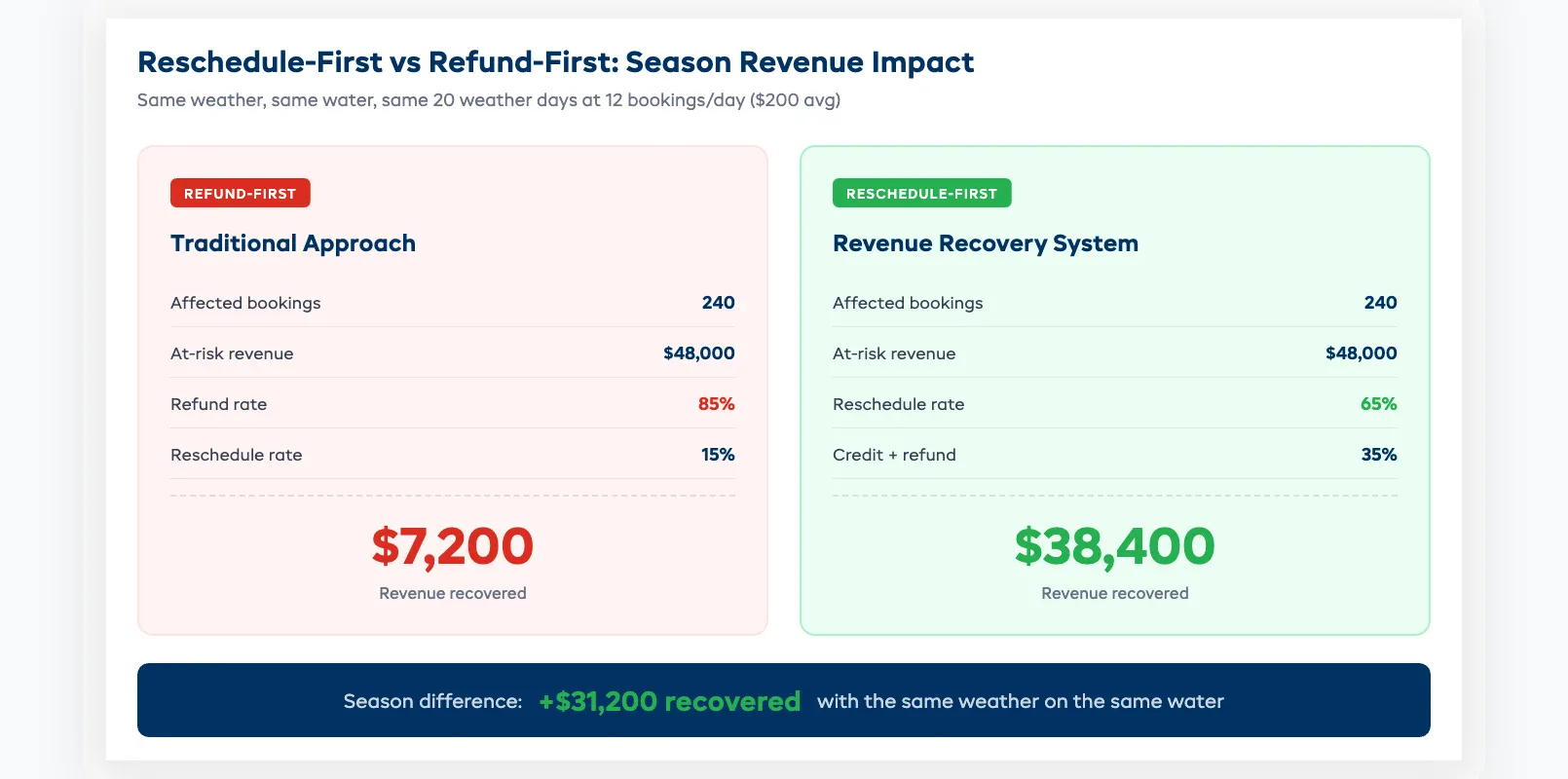
That's a $31,200 difference from the same weather on the same water. The reschedule-first operator keeps 80% of weather-day revenue. The refund-first operator keeps 15%.
How to build a reschedule-first system:
- Default to reschedule in your terms. Your booking policy should state: "Weather cancellations result in a reschedule to the next available slot. Refunds are available if no suitable alternative exists within [X] days."
- Offer the reschedule before mentioning refunds. Your cancellation message should lead with "We've moved you to [date/time]" — not "Would you like a refund or reschedule?"
- Make rescheduling frictionless. One-click reschedule link. Pre-populated with available slots. No phone tag, no forms.
- Offer a sweetener. A $10 credit, a free photo package, or a complimentary upgrade turns a weather day into a better experience than the original booking.
- Time-limit credits. Open-ended credits become accounting liabilities. Set a 90-day expiry and remind customers at 60 days.
This pairs directly with your pricing strategy. If you've built margins to absorb occasional sweeteners, weather days actually boost customer lifetime value. See our SUP and kayak pricing guide for margin benchmarking.
Communication Templates
Every message you send during a weather event should be pre-written, approved by your team, and ready to deploy in under 5 minutes. Here are the three you need:
Template 1 — Weather watch (evening before):
Hi [Name], we're keeping an eye on tomorrow's forecast for your [Activity] booking at [Time]. Conditions may change — we'll confirm by 7 a.m. tomorrow. No action needed from you right now. If we do need to reschedule, we'll have alternative times ready for you.
Template 2 — Reschedule notification (morning of):
Hi [Name], due to [wind/storms/visibility], we've moved your [Activity] from [Original Time] to [New Time on New Date]. This is the closest available slot with good conditions. Click here to confirm or choose a different time: [Reschedule Link]. Questions? Reply to this message or call us at [Phone].
Template 3 — Multi-day closure:
Hi [Name], we're closed [Date Range] due to [Weather Event]. Your booking on [Date] has been moved to [New Date/Time]. As a thank-you for your flexibility, we've added a $[Amount] credit to your account. Confirm your new time here: [Link]. If none of these times work, let us know and we'll find a solution.
Key principles:
- Name the specific weather condition. "Bad weather" feels vague and arguable. "25-knot winds and 2-meter swell" is factual.
- Lead with the reschedule, not the problem.
- Include a direct action link. Every extra step between "read message" and "confirmed reschedule" loses 10-15% of customers.
- Send via the channel the customer booked through (SMS for phone bookings, email for online bookings). If you have both, send SMS first — open rates are 3-5x higher.
Legal Framework
Your weather cancellation policy needs to do two things: protect your revenue and hold up if a customer disputes a charge. Here's the legal minimum:
What your terms must include:
- Definition of "weather cancellation." Spell out that it means conditions determined unsafe by the operator, not by the customer's personal preference. "I don't want to go because it looks cloudy" is not a weather cancellation.
- Reschedule-first default. State clearly that weather cancellations result in a reschedule or credit, not an automatic refund.
- Refund conditions. Define when a refund is available — typically when no reschedule slot exists within a reasonable window (7-14 days for tourists, 30 days for locals).
- Customer-initiated cancellation distinction. If a customer cancels because of a forecast but conditions are actually green (go), that's a customer cancellation subject to your standard cancellation policy — not a weather cancellation.
- Force majeure clause. Multi-day closures from hurricanes, floods, or extended severe weather should have a separate process — typically full credit with extended expiry or partial refund.
Display requirements:
- On your booking confirmation page (before payment)
- In your confirmation email
- On signage at your location
- In your digital waiver (weather acknowledgement clause)
Your waiver should already cover weather-related risk acknowledgement. If it doesn't, update it. See our safety and waiver guide for waiver structure that holds up legally. If you offer lessons, the legal framework around weather cancellations intersects with instructor liability and minor waivers — our lesson liability guide covers these boundaries.
Chargeback protection: Customers who dispute reschedule-only policies through their credit card company lose when you can show: (a) the policy was displayed before booking, (b) a reschedule was offered, and (c) the customer didn't respond within the stated window. Keep screenshots of your booking flow showing the policy disclosure.
Tooling
Manual weather operations — checking forecasts, sending texts, tracking who's rescheduled — work until you hit about 8 bookings per weather day. Beyond that, you need automation.
What to automate:
- Weather monitoring. Set up alerts for your specific location using marine weather services (not generic city forecasts). You need wind speed, swell height, and lightning proximity — not just "chance of rain."
- Batch notifications. When you trigger a weather cancellation, every affected booking should get a personalised message within minutes, not one-by-one manual texts over an hour.
- Reschedule tracking. Know exactly which customers have confirmed their new slot, which haven't responded, and which requested a refund. Follow up on non-responders at 24 and 48 hours.
- Credit management. Track issued credits, expiry dates, and redemption rates. A credit that expires unredeemed is recovered revenue — but only if you tracked it.
A weather alert agent can monitor conditions and flag at-risk bookings automatically, so your morning decision is informed by data rather than a quick glance at a weather app. Pair it with a no-show follow-up agent to chase non-responders after reschedule offers.
For operators running multiple locations, weather decisions get more complex — conditions at your harbor location might be red while your lake location is green. A centralised system lets you move bookings between locations instead of just rescheduling to a later date. See our multi-location operations guide for cross-location workflow design.
FAQ
What wind speed should cancel SUP rentals? For beginners, 15 knots is the standard no-go threshold. Experienced paddlers can handle up to 20 knots in sheltered water. Post your thresholds on your booking page so customers know the criteria before they book. Wind direction matters too — offshore wind on a lake pushes beginners away from shore, making 12 knots as dangerous as 20 knots onshore.
How far in advance should I cancel for weather? Make the final call by 7 a.m. for morning bookings and by 11 a.m. for afternoon bookings. Send a "weather watch" the evening before if the forecast looks bad. Customers contacted 12+ hours early reschedule at 70-80%. Last-minute cancellations drop that to 30-40%.
Can I refuse a refund for weather cancellations? Yes, if your terms clearly state that weather cancellations result in a reschedule or credit and the customer agreed to those terms before booking. Display the policy on your booking page, in your confirmation email, and on-site. Most payment processors side with the operator when the policy was clearly disclosed.
What if a customer cancels because of the forecast but conditions are fine? That's a customer-initiated cancellation, not a weather cancellation. Your standard cancellation policy applies — typically a cancellation fee or partial refund. Make this distinction clear in your terms. If the forecast says 50% chance of storms but conditions are actually calm, the customer chose to cancel based on their own risk assessment.
How do I handle multi-day weather closures like hurricanes? Separate process from single-day weather. Offer full booking credit with an extended expiry window (6-12 months instead of 90 days). For tourists who won't return, offer a partial refund (50-70%) or a transferable credit they can give to friends or family. Document everything — extended closures are the most common trigger for credit card disputes.
Should I offer weather insurance to customers? Some operators offer a "weather protection" add-on for $5-$15 that guarantees a full refund regardless of your reschedule policy. It works well for tourist-heavy operations where customers can't easily reschedule. Price it so that the insurance revenue across all bookings covers the refund payouts on weather days — typically, 60-70% of customers buy it but only 8-15% use it.
What's the best way to track weather cancellation costs? Tag every weather-affected booking in your system with the reason (wind, lightning, visibility) and the outcome (rescheduled, credited, refunded). At season end, run the numbers: total affected revenue, recovery rate by outcome type, and average revenue loss per weather day. This tells you exactly how much your weather policy is worth.
Weather days also accelerate gear wear — salt spray and sand damage wetsuits and soft gear faster when you're rushing through unplanned returns. Keep your maintenance schedule tight even on canceled days. Our wetsuit and soft gear care guide covers the inspection and storage protocols that prevent weather-day shortcuts from becoming end-of-season replacement costs.
Weather operations are a revenue strategy, not just a safety protocol. The operators who build reschedule-first systems recover tens of thousands in revenue that refund-first operators simply hand back. For the complete water sports operations playbook, visit the water sports hub.
in one place