Water Sports Lesson Liability: Minors, Waivers, Instructor Certifications
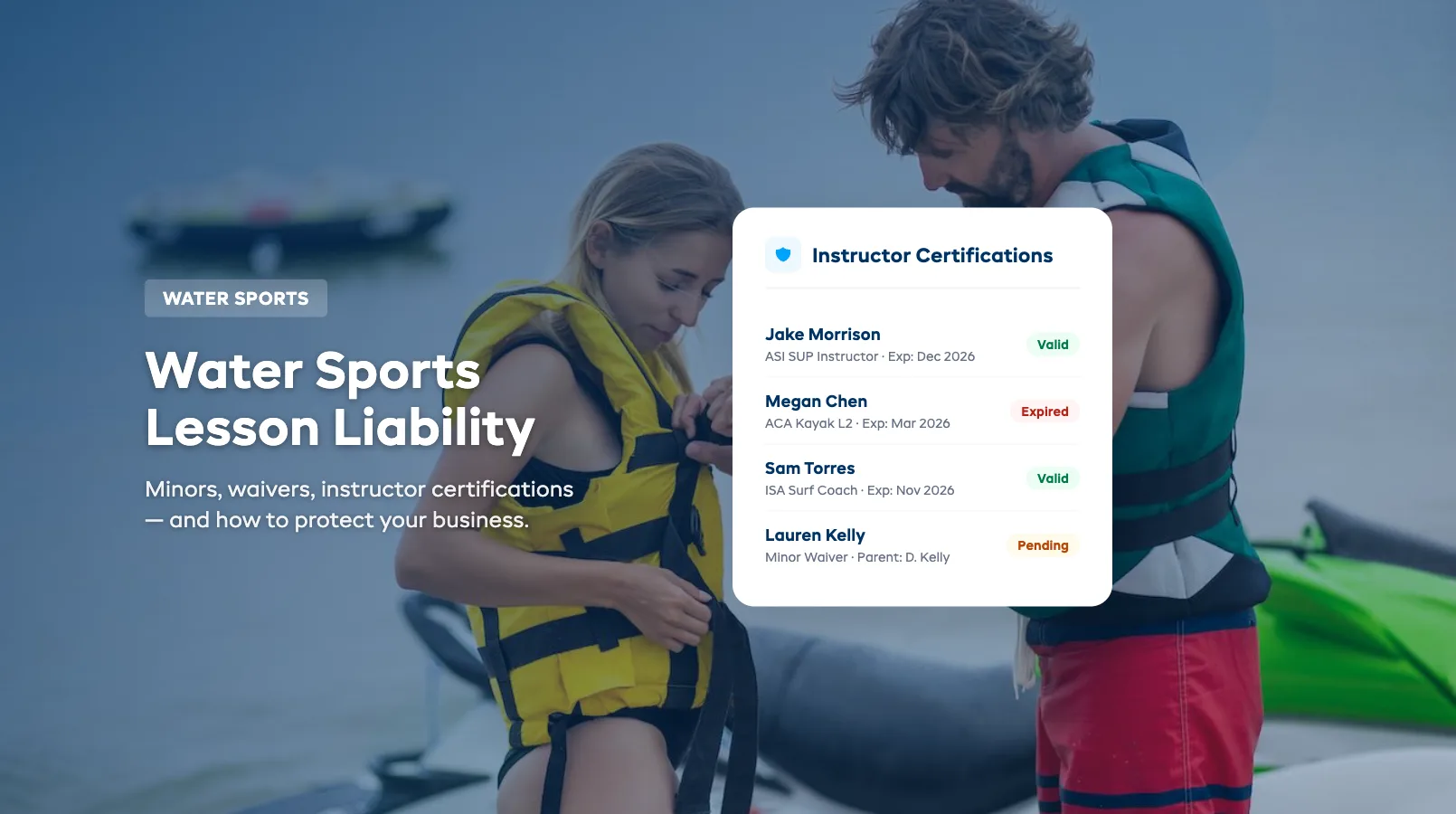
A 14-year-old capsizes during a SUP lesson. Her parent wasn't present — they signed a waiver online two days ago. The instructor is a seasonal hire with a lapsed certification. Your insurance company asks for documentation. You have none.
This scenario plays out every summer at water sports operations that blur the line between "rental" and "instruction." The moment you add lessons to your business, your liability profile changes completely. Rental waivers don't cover instructional negligence. General liability doesn't always cover minor participants. And a single claim from a poorly documented incident can cost $50,000-$150,000 in legal fees — even if you win.
This guide covers the specific legal exposure points of teaching water sports and how to build defensible documentation around each one. For the full water sports operations playbook, see our complete water sports rental business guide.
Minor Waiver Requirements
Minors can't legally sign contracts. That means your standard digital waiver is void if the participant is under 18. You need a parent or legal guardian's signature — and the requirements around that are stricter than most operators realize.
What a defensible minor waiver must include:
- Named parent/guardian signature. Not "adult accompanying" — the actual legal guardian. If the child arrives with an aunt, uncle, or family friend, that person may not have authority to waive the minor's rights.
- Specific activity description. "Water sports lesson" isn't enough. Name the activity: "1-hour group SUP lesson in sheltered bay with maximum 4:1 student-to-instructor ratio."
- Risk acknowledgement specific to minors. Adults assume risk differently than children. Your waiver needs language acknowledging that the minor may lack judgment to assess their own limitations.
- Medical disclosure section. Swimming ability, medical conditions, medications, allergies. A child who can't swim confidently has no business in an unassisted kayak lesson — and you need documentation showing you asked.
- Photo/video consent. Separate from the liability waiver. Many jurisdictions require explicit photo consent for minors.
The pre-arrival problem: Most injuries happen to walk-ins — families on holiday who decide to try a lesson on the spot. They haven't signed anything. Build a 3-minute digital waiver flow that parents complete on a tablet before the child touches the water. No signature, no lesson. Zero exceptions.
Age thresholds that matter:
| Jurisdiction | Minor age | Guardian presence required? |
|---|---|---|
| Australia (most states) | Under 18 | Written consent sufficient; presence not mandatory |
| US (varies by state) | Under 18 | Written consent; some states void minor waivers entirely |
| UK | Under 18 | Written consent from person with parental responsibility |
| EU (GDPR applies) | Under 16 for data; under 18 for liability | Consent + GDPR-compliant data handling |
Some US states — including California, Louisiana, and Virginia — will not enforce liability waivers signed on behalf of minors regardless of parental consent. In those jurisdictions, your only protection is proof that you operated to a reasonable standard of care. That makes documentation everything. For broader waiver structure and PFD requirements, see our water sports safety guide.
Instructor Certification Verification
Your instructor's certification is your first line of legal defense. If an incident occurs and your instructor doesn't hold current, verifiable credentials, you've lost the negligence argument before it starts.
Certifications that matter by activity:
| Activity | Recognized certifications |
|---|---|
| SUP instruction | ASI (Academy of Surfing Instructors), ISA (International Surfing Association), BSUPA (UK) |
| Kayak/canoe instruction | ACA (American Canoe Association), British Canoeing, Paddle Australia |
| Surf instruction | ISA, Surfing Australia, BSA (UK), NSSIA (US) |
| General water safety | RLSSA Bronze Medallion, Red Cross Lifeguard, NRSA (US) |
Verification isn't a one-time task. Certifications expire. Build a quarterly audit into your operations calendar:
- On hire: Sight original certificate, verify with issuing body (most have online verification portals), photograph and file.
- Quarterly check: Cross-reference expiry dates. Flag anyone within 60 days of expiry.
- Annual CPR/first-aid refresh: Most certifying bodies require annual first-aid currency as a condition of instructor certification.
- Document the check. A spreadsheet showing "Verified: [date], Cert #: [number], Expiry: [date], Verified by: [manager name]" is your proof that you maintained standards.
Seasonal hires present the highest risk. A backpacker with an expired certification from another country is not a qualified instructor — even if they surf every day. Your insurance policy likely requires "appropriately certified" instructors. Using uncertified staff may void your coverage entirely.
For instructor management structures and pay models, see our surf lesson business operations guide.
Insurance Coverage Boundaries
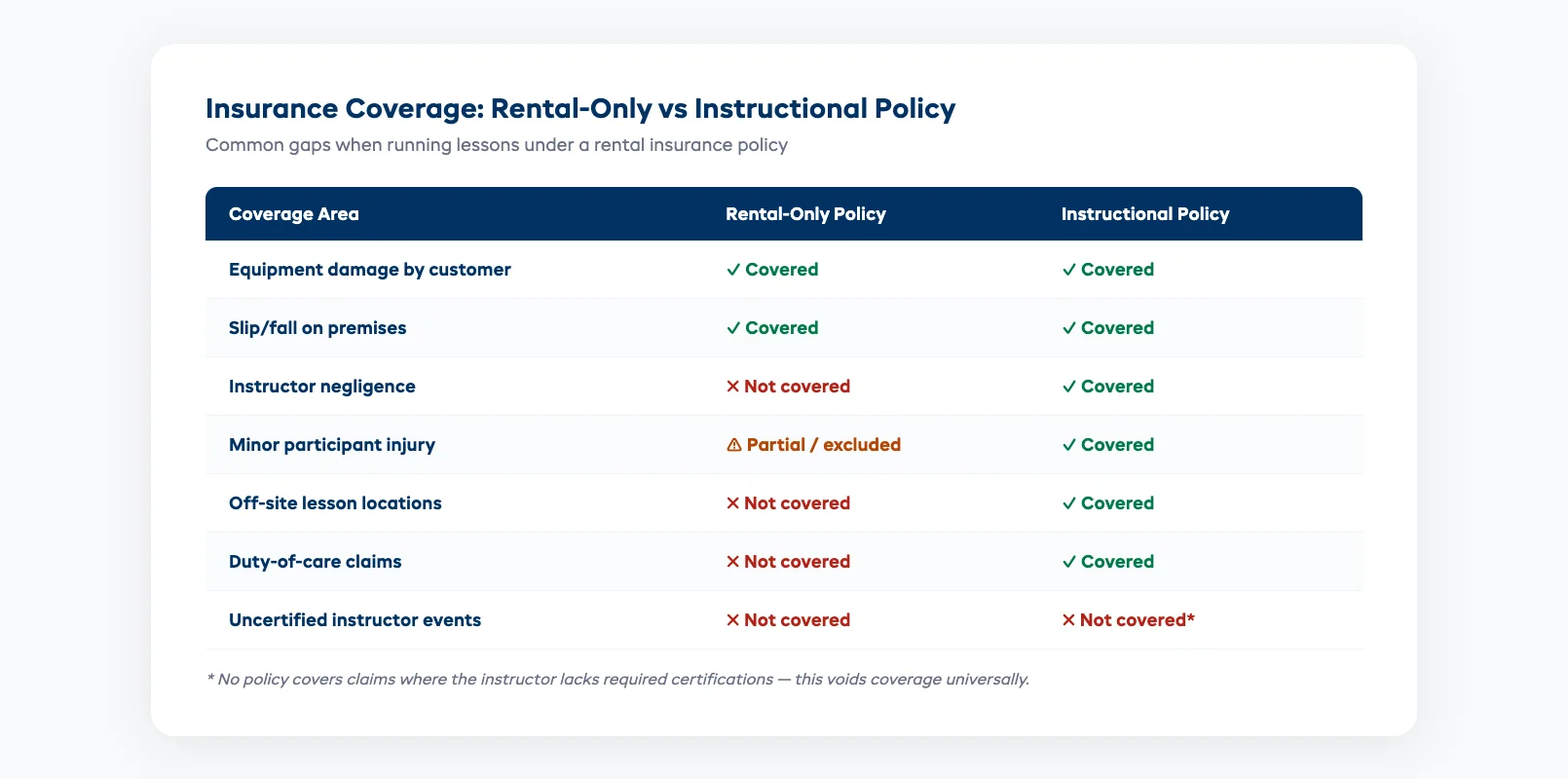
General liability insurance covers slips on your dock. It may not cover instructional negligence, minor injury during supervised activities, or equipment failure during a lesson. You need to know exactly where your policy draws the line.
Common gaps in water sports lesson insurance:
- Instruction vs rental. Many policies distinguish between "equipment hire" (lower risk) and "guided/instructed activities" (higher risk). If your policy was written for rentals and you've since added lessons, you may be uninsured for your highest-risk activity.
- Minor participants. Some policies exclude participants under a certain age, or require specific safety ratios. A 6:1 instructor ratio when your policy requires 4:1 means you're uninsured for those extra two students.
- Geographic boundaries. Your policy may cover lessons in a specific sheltered bay but not open ocean. If conditions push you to a different launch point, check your coverage.
- Instructor qualifications. Policies often specify minimum instructor certification levels. An uncertified instructor means an uncovered claim.
What to ask your broker:
- Does my policy explicitly cover instructed/guided water activities?
- What instructor-to-student ratios are required for coverage?
- Are minors covered, and what documentation do you require?
- Is there a geographic limitation on where lessons can occur?
- What certifications must my instructors hold for claims to be valid?
The premium difference is smaller than you think. Adding proper instructional coverage to an existing water sports policy typically costs $800-$2,000/year extra. One uninsured claim costs 50-100x that. If you're running lessons off a rental-only policy, fix this before your next booking.
For pricing your lessons to cover proper insurance overhead, see our SUP & kayak pricing strategy guide.
Documentation for Defense
If an incident occurs, your defense depends entirely on what you documented before, during, and after the event. Courts don't care what your "usual practice" is — they care what you can prove.
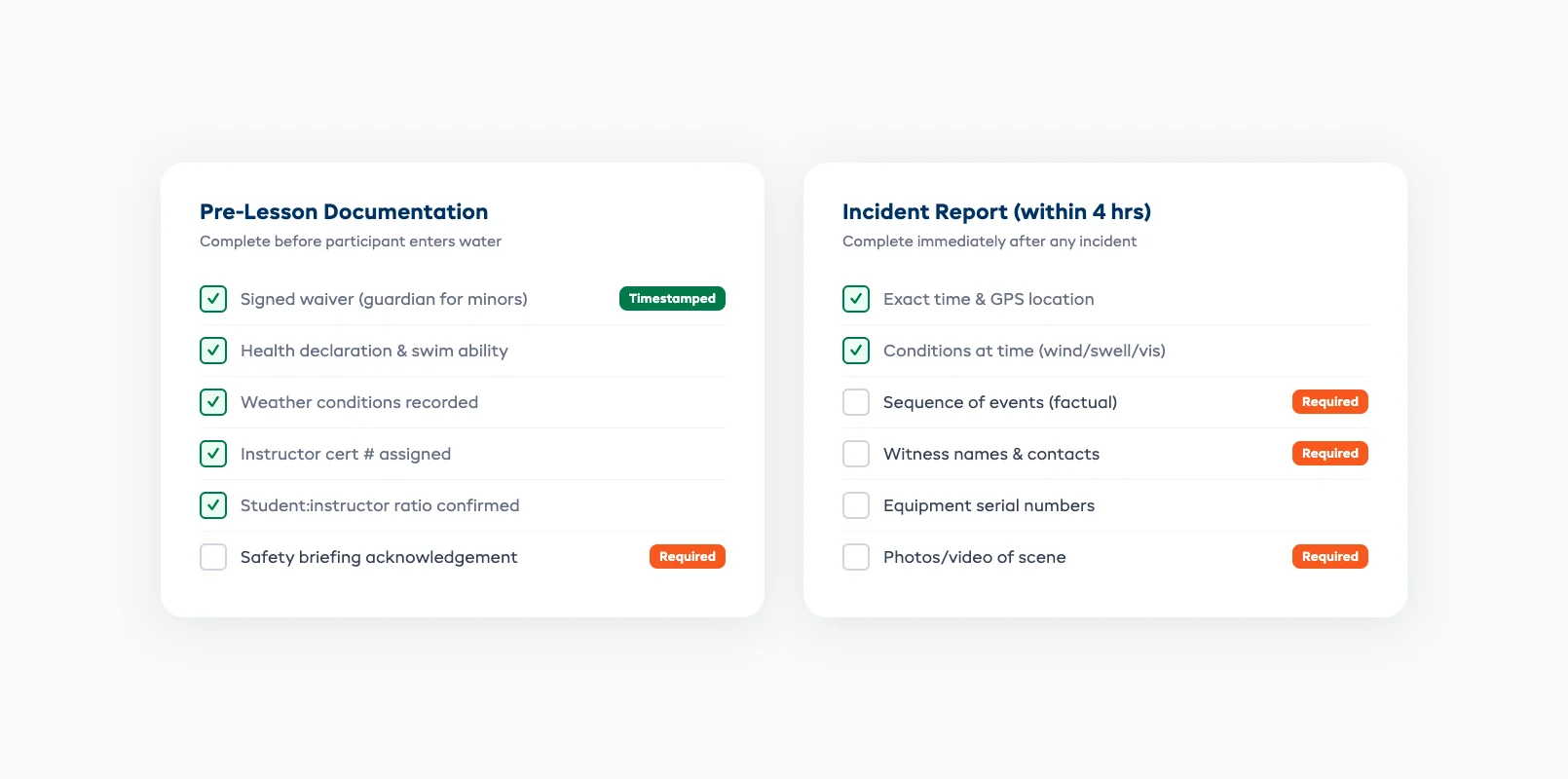
Pre-lesson documentation:
- Signed waiver (guardian-signed for minors) with timestamp
- Participant health declaration — swimming ability, medical conditions
- Weather conditions at lesson start (wind speed, swell, visibility)
- Instructor name and certification number assigned to the session
- Student-to-instructor ratio for that specific session
- Safety briefing completion (checkbox or signature confirming briefing delivered)
During-lesson documentation:
- Session log: start time, end time, activities covered, any incidents or near-misses
- Equipment assignment: which PFD, board, paddle went to which participant
- Any modifications made (e.g., "moved to sheltered bay due to wind increase at 10:15 a.m.")
Post-lesson documentation:
- Equipment return condition
- Any participant complaints or observations
- Instructor debrief notes for anything unusual
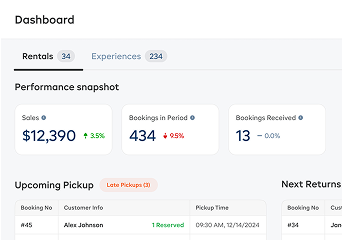
This sounds like a lot of paperwork. It isn't — with digital systems, most of it auto-populates. Dash captures waiver timestamps, equipment assignments, and session logs in one flow. The key is having a system that creates the documentation automatically, so it exists whether or not anyone remembers to fill in a form.
For weather-specific documentation and go/no-go decision records, see our weather operations guide.
Incident Reporting
When something goes wrong, the first 24 hours of documentation determine your legal position for the next 2-3 years. Most operators under-document because they're in crisis mode. Build a template that forces completeness.
The incident report must capture:
- Time and location. Exact. Not "around 2 p.m." — check your booking system timestamp.
- Conditions at time of incident. Wind, swell, visibility, water temperature, tide state.
- Participants involved. Names, ages, waiver status, medical disclosures.
- Instructor on duty. Name, certification number, years of experience.
- Sequence of events. What happened, in order, factually. No opinions, no blame.
- Response taken. First aid delivered, emergency services called, timeline of response.
- Witnesses. Names and contact details of anyone who saw what happened.
- Equipment involved. Serial numbers, last inspection date, condition at time of incident.
- Photos/video. Scene, equipment, conditions. Take these immediately — not an hour later when the tide has changed.
- Follow-up actions. What did you change as a result? This shows continuous improvement.
Critical rule: Complete the incident report within 4 hours. Memory degrades fast under stress. Details you think you'll remember tomorrow — you won't.
Notify your insurer within 24 hours. Most policies require prompt notification. Delayed notification can be grounds for claim denial. Even if the incident seems minor, report it. A "minor" bump on the head can become a concussion claim six months later.
For multi-location operations where incidents may occur at unsupervised sites, see our multi-location operations guide.
Jurisdictional Differences
Water sports liability law varies dramatically by country, state, and even local council area. What protects you in Queensland may be worthless in California. Here's what to know.
Australia:
- Civil Liability Acts (state-based) provide "obvious risk" defenses for recreational activities
- Waivers are generally enforceable for adults but limited for minors
- National Safety Guidelines (SLSA, Paddle Australia) set the standard of care courts reference
- Local council permits may impose additional safety requirements (e.g., lifeguard presence)
United States:
- State-by-state variation is extreme. Some states enforce assumption-of-risk waivers; others void them for minors entirely
- Recreational Use Statutes may apply if operating on public waterways
- ADA requirements apply if offering lessons as a public accommodation
- State boating commissions may regulate instructor qualifications separately from certifications
United Kingdom:
- Adventure Activities Licensing Authority (AALA) covers some water sports instruction
- Health & Safety Executive guidelines apply
- Waivers cannot exclude liability for death or personal injury caused by negligence (UCTA 1977)
- Operating on coastal waters may trigger Maritime & Coastguard Agency requirements
The bottom line: Get jurisdiction-specific legal advice. A $500-$1,000 legal review of your waiver, insurance structure, and operational procedures is the cheapest protection available. Review annually or whenever you expand to a new location.
For managing operations across multiple jurisdictions when scaling, see our multi-location water sports guide. For gear maintenance documentation that supports your duty-of-care argument, see our wetsuit and soft-gear care guide.
FAQ
Do I need a separate waiver for lessons vs rentals? Yes. Rental waivers cover equipment-related risk. Lesson waivers must additionally cover instructional negligence, the duty-of-care relationship between instructor and student, and activity-specific risks. Using a rental waiver for lessons leaves significant gaps in your legal protection.
Can a grandparent sign a waiver for a minor? Only if they hold legal guardianship or have documented authority (like a power of attorney). In most jurisdictions, only parents or legal guardians can waive a minor's rights. If you accept a non-guardian signature and a claim arises, the waiver likely won't hold.
What happens if my instructor's certification lapses mid-season? Your insurance coverage for lessons taught by that instructor may be void from the date of lapse. Treat certification expiry like an expired driver's license — the instructor cannot teach until renewed. Build a 60-day warning system into your operations calendar.
How long should I retain lesson documentation? Minimum 7 years for adult participants. For minors, retain until the participant reaches the age of majority plus the relevant statute of limitations — typically until they're 21-25 depending on jurisdiction. Digital storage makes this easy; paper filing does not.
Does my general liability policy cover lessons? Probably not fully. Most GL policies written for "equipment hire" businesses don't explicitly cover the higher duty of care created by an instructor-student relationship. Ask your broker specifically about "instructed activities" coverage. Get the answer in writing.
What instructor-to-student ratio should I maintain? Industry standards vary by activity and participant experience: 1:4 for beginner SUP/kayak, 1:6 for intermediate, 1:8 for experienced groups in sheltered water. Your insurance policy may specify ratios — whatever your policy requires is your minimum, regardless of what feels manageable.
Am I liable if a participant ignores safety instructions? Potentially yes, especially for minors. Courts consider whether you took reasonable steps to enforce safety rules — verbal warning, written acknowledgement, physical intervention if needed. Document that you delivered instructions and note any non-compliance. "Contributory negligence" may reduce your liability but rarely eliminates it entirely.
Running lessons adds revenue and builds customer loyalty — but it fundamentally changes your legal exposure compared to pure rentals. The operators who avoid claims aren't lucky. They document everything, verify every certification, and treat waivers as legal instruments rather than formalities. Build these systems once, maintain them consistently, and your lesson program becomes an asset rather than a liability.
For the complete water sports operations framework — from startup to multi-location scaling — see our water sports rental business guide.
in one place