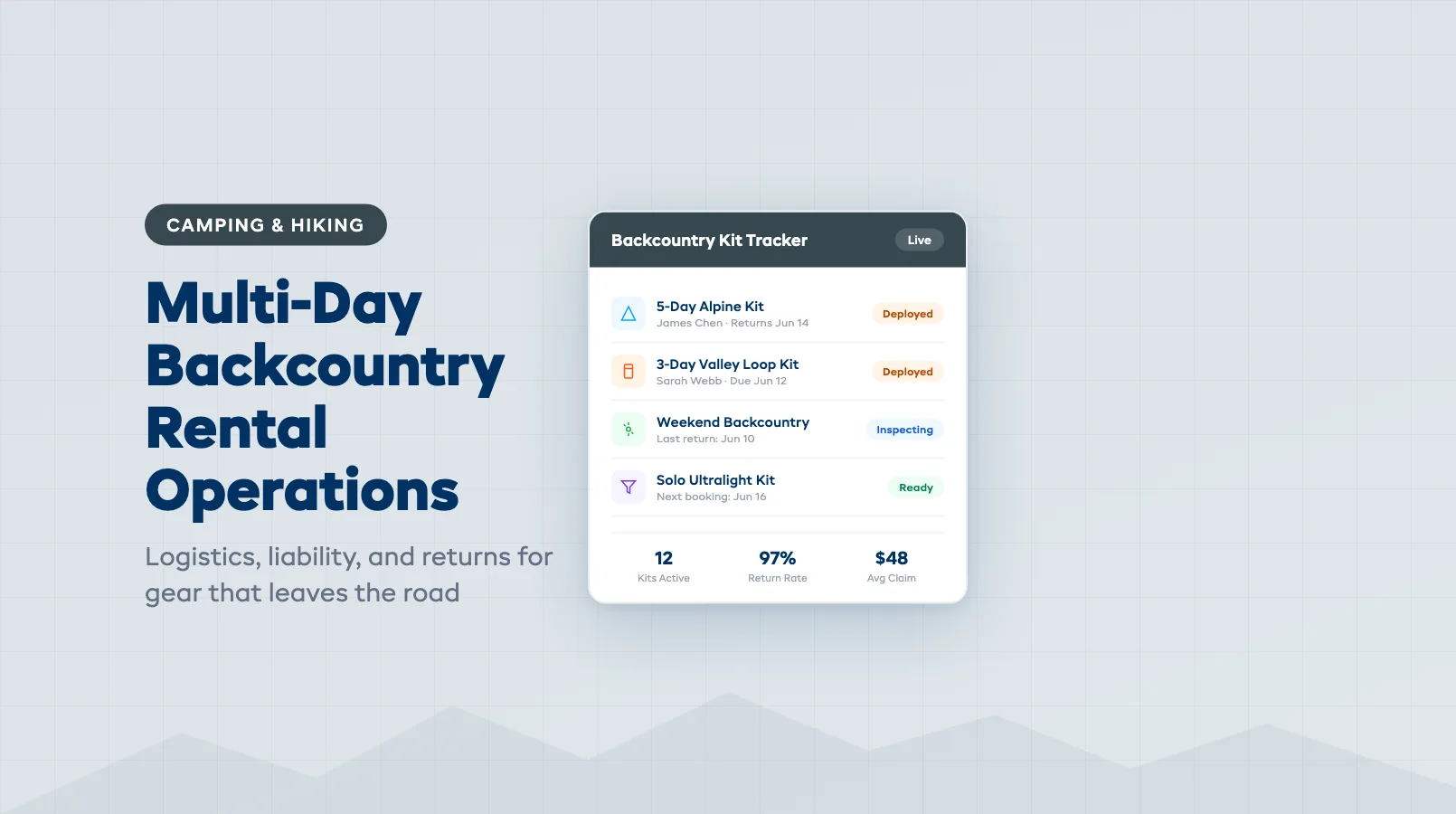
Multi-Day Backcountry Rentals: Logistics, Liability, and Returns
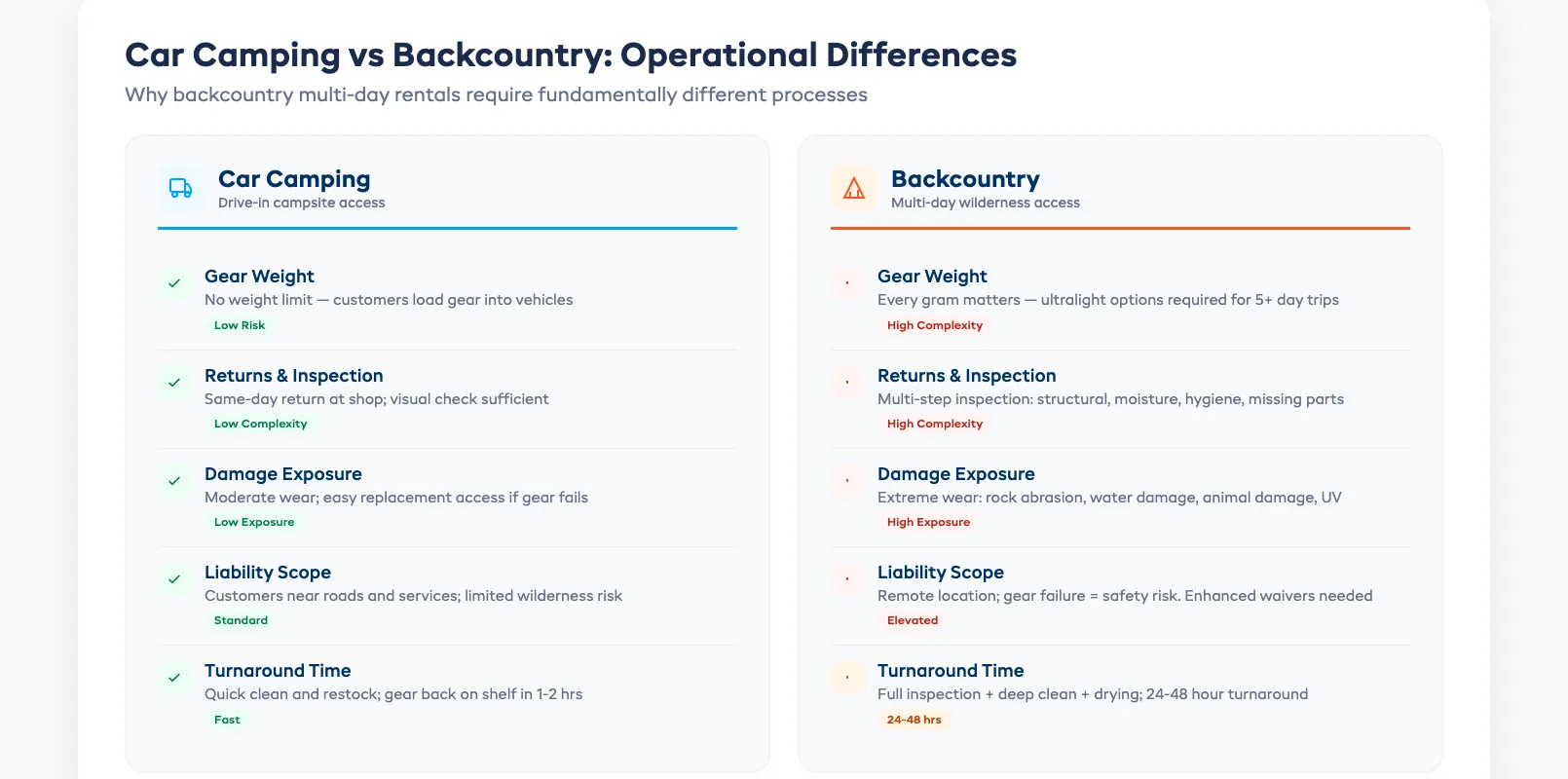
A family renting a 4-person tent for a weekend at a state park campground is a low-risk transaction. The car is 50 meters from the pitch. If a pole snaps, they drive home. If they forget to return the cookware set, you call them Monday morning and it shows up by Wednesday.
A solo hiker renting an ultralight pack, a 15-degree bag, and a water filter for a five-day traverse through backcountry wilderness is a completely different animal. They're unreachable after the trailhead. Gear failure could be a safety issue. And when they come back on day six (muddy, tired, and missing two tent stakes) you need a system that captures what happened without turning the return counter into a courtroom.
Most camping rental operators start with car-camper workflows and never update them for backcountry. This guide covers the six things that change when rental gear leaves the road: customer screening, gear selection, deposit sizing, emergency protocols, return inspection, and missing-gear recovery. For the full operator playbook, start with our complete guide to running a camping gear rental business.
Customer Screening for Backcountry Rentals
Not every customer should take your best ultralight gear into the backcountry. That's not gatekeeping. It's risk management. A first-time camper who doesn't know how to use a bear canister is a liability to themselves and a near-certain damage claim on your gear.
What to screen for:
- Trip details. Where are they going, how many nights, what's the terrain? A three-night loop on maintained trails is different from a five-day ridge traverse above treeline. The trip profile determines what gear you recommend and how much deposit you collect.
- Experience level. Ask directly: "Have you done multi-day backcountry trips before?" You're not gatekeeping. You're sizing the rental. A first-timer gets a full orientation on every item. An experienced hiker gets a quick gear check and goes.
- Group size and composition. Solo hikers in remote areas carry more risk. Families with young children on a backcountry permit need different gear than a pair of experienced thru-hikers.
Build a screening form. Keep it to 5-6 questions. Capture trip destination, dates, party size, experience level, and any medical considerations (altitude sensitivity, allergies to water treatment chemicals). This data protects both you and the customer.
Some operators use a tiered access model: Tier 1 gear (car-camping essentials) available to anyone, Tier 2 (backcountry-rated equipment) requires a completed screening form and higher deposit. This protects your premium inventory without adding friction for weekend car campers.
Gear Selection for Multi-Day Trips
Backcountry gear selection is about weight, durability, and conditions, not price tiers. A customer heading into alpine terrain at 3,000 meters needs different sleeping bag ratings and shelter options than someone hiking a valley trail at 500 meters.
The backcountry rental kit differs from car-camping in three ways:
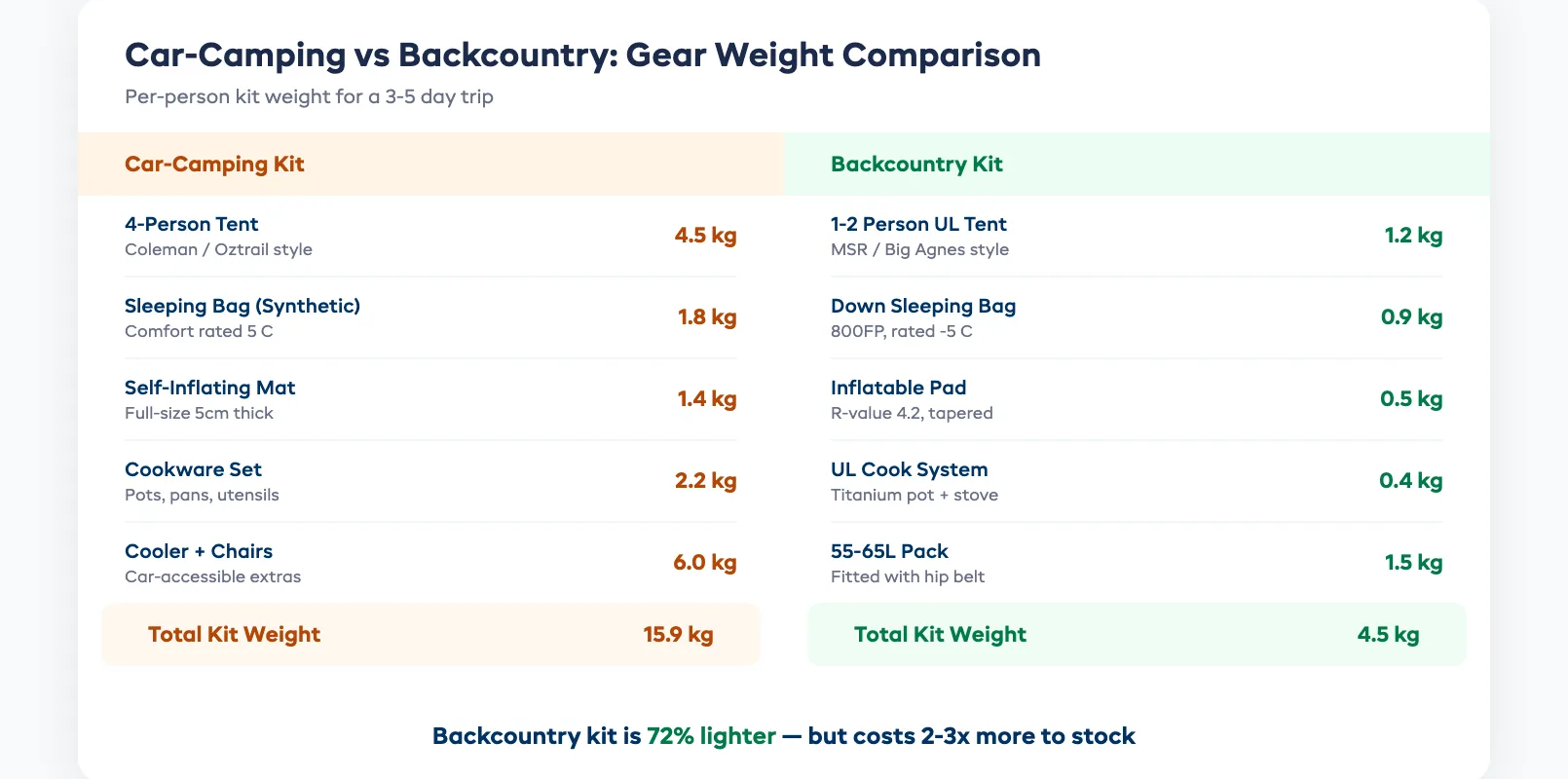
- Weight matters. Every gram counts when it's on your back for five days. Stock ultralight tents (under 1.5 kg), sleeping bags with high fill-power down (800+), and 50-65L packs with proper hip-belt fit. Car campers don't care about 500 grams. Backcountry hikers do.
- Temperature ratings need margin. Altitude drops temperature roughly 1°C per 150 meters of elevation gain. A "30-degree bag" that's fine at a state park campground won't cut it at a ridgeline camp in September. Recommend bags rated 5-10 degrees below the expected low.
- Mandatory extras. Bear canisters (where required by permit), water filtration, emergency shelter (bivy or tarp), headlamp with spare batteries, trekking poles. These aren't upsells. They're non-negotiable for backcountry safety.
Create pre-built backcountry kits. Instead of letting customers piece together their own setup, offer 3-5 pre-configured kits matched to common local trips. "3-Day Valley Loop Kit" and "5-Day Alpine Traverse Kit" reduce selection errors and speed up the checkout. Reference your backpack pre-rental inspection checklist to verify frame integrity, hip-belt adjustment, and compression strap function before each deployment.
Fit sessions are mandatory. A pack that doesn't fit properly causes back pain by day two and gets returned early (with a refund request). Spend 10 minutes adjusting torso length, hip belt, and load lifters. Charge a flat fitting fee or build it into the backcountry rental price.
Deposit Amounts for Multi-Day Backcountry Rentals
Weekend car-camper deposits typically run 20-25% of gear replacement value. That's not enough for backcountry. Gear is out longer, used harder, exposed to worse conditions, and more likely to come back damaged or incomplete.
The backcountry deposit formula:
| Trip Length | Deposit (% of Replacement Value) | Why |
|---|---|---|
| 1-2 nights (car camping) | 20-25% | Low risk, easy returns |
| 3-4 nights (backcountry) | 35-40% | Extended exposure, moderate risk |
| 5-7 nights (backcountry) | 50-60% | High exposure, replacement likely on some items |
| 7+ nights (expedition) | 60-75% | Near-certain wear, high loss risk |
Replacement cost, not rental price. Your deposit should be calculated against what it costs to replace the gear, not what you charged for the rental. A $400 ultralight tent rented for $45/night needs a $200-$240 deposit for a five-day backcountry trip, not $50.
Hold, don't charge. Pre-authorize the deposit on a credit card rather than charging it. This reduces refund requests and customer friction. Release the hold after the return inspection passes. For the pricing strategy that wraps deposits into multi-day packages, see our guide to camping rental pricing and packages.
No cash deposits for backcountry. Cash deposits are hard to enforce for partial claims. A credit card pre-auth lets you capture exactly what's owed ($35 for a missing stuff sack, $120 for a torn rainfly) without the awkwardness of handing back partial cash at the return counter.
Emergency Procedures
Backcountry customers are beyond phone range for most of their trip. That changes your liability profile and your customer communication obligations.
What to include in your rental agreement:
- Gear failure disclaimer. Your rental agreement should state that the customer accepts responsibility for safe use and acknowledges that gear can fail in the field. This doesn't absolve you of providing gear in good working order, but it does establish shared responsibility.
- Emergency contact exchange. Collect an emergency contact for every backcountry rental. Provide your shop's emergency line (or after-hours number) in return.
- Trip itinerary on file. Ask customers to provide their planned route and expected return date. If they're two days overdue, you have a starting point for follow-up, and potentially for coordinating with search and rescue.
- Gear failure instructions. Brief every backcountry customer on what to do if critical gear fails: broken pole (splint tape provided), torn tent (repair patch kit provided), water filter failure (backup purification tablets provided). Include a small field-repair kit with every backcountry rental. It costs $5 and saves you a $400 tent replacement.
Late-return protocol. Establish a clear policy: 24 hours grace after the agreed return date, then a daily late fee kicks in. After 48 hours overdue with no contact, call the emergency contact. After 72 hours, escalate per your local missing-persons protocol. Document this in writing.
Dash AI can send automated check-in reminders the day before a customer's expected return date. This reduces no-shows and gives early warning on late returns before you start the escalation chain.
Return Inspection for Backcountry Gear
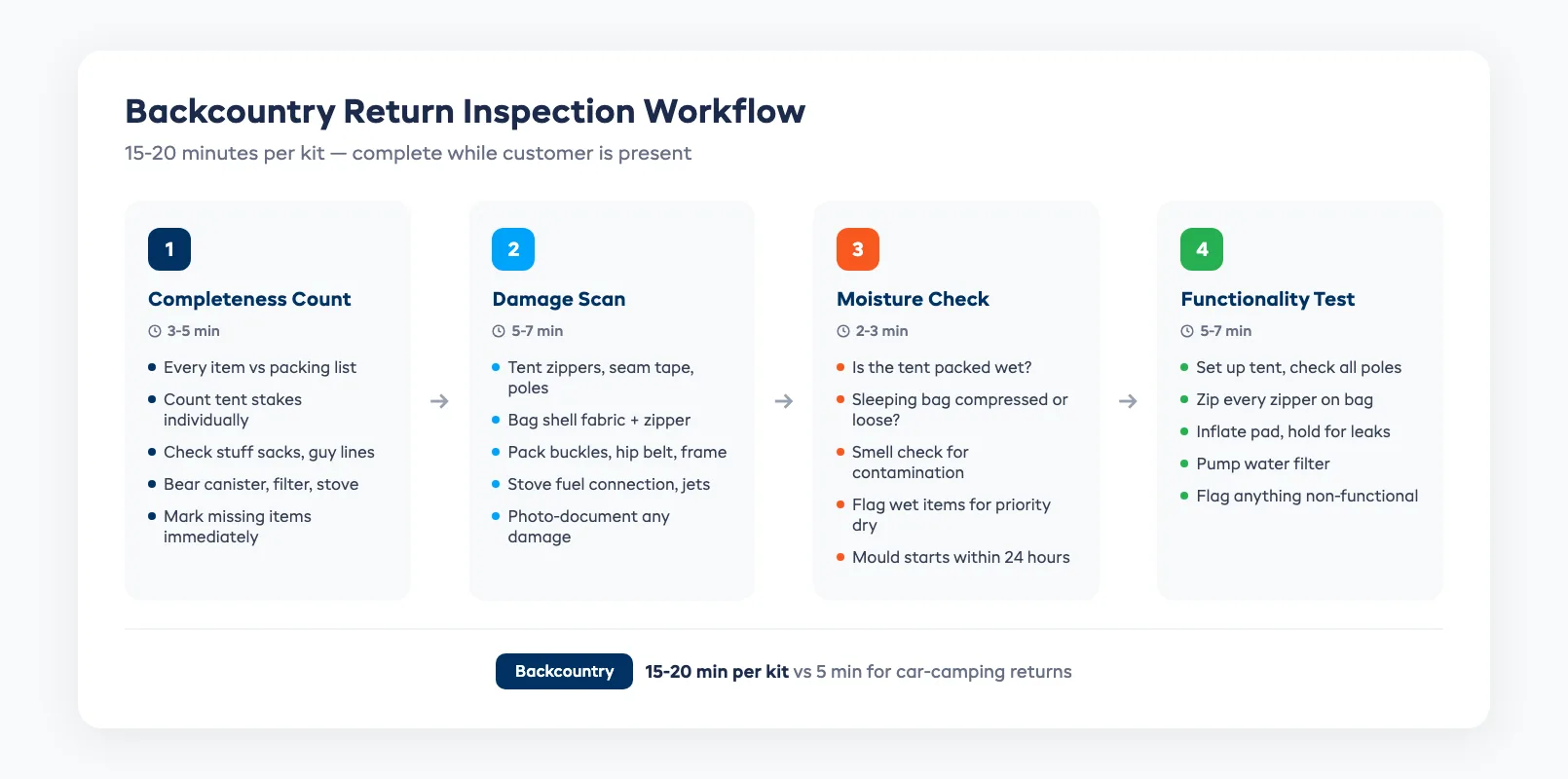
Car-camping returns take 5 minutes. Backcountry returns take 15-20 minutes per kit, and they should. Gear that's been on a backcountry trip for five days has been through rain, dirt, abrasion, UV exposure, and hard use.
The backcountry return checklist (in order):
- Completeness count. Every item against the packing list. Tent body, fly, poles, stakes (count them), guy lines, stuff sack. Sleeping bag, stuff sack, liner. Pack, rain cover. Cookware, stove, fuel canister, utensils. Bear canister. Water filter. Miss nothing — do this while the customer is present.
- Damage scan. Tent: check zipper teeth, seam tape, pole joints, grommets. Bag: check zipper, shell fabric for tears, smell for contamination. Pack: check all buckles, hip-belt padding, frame stays.
- Moisture assessment. Is the tent dry or packed wet? Sleeping bag compressed or loose? Wet gear entering your cleaning pipeline needs priority processing — every hour it sits damp, you're growing mold.
- Functionality test. Set up the tent. Zip every zipper. Inflate the pad. Pump the water filter. Anything that doesn't work gets flagged.
Use the post-rental camping return check template to standardize this. Your staff should follow the same sequence every time regardless of how experienced the customer looks or how busy the counter is.
Photo-document before and after. Take photos of each kit at checkout and at return. Timestamped photos eliminate disputes. "The zipper was already broken when I got it" is hard to argue when you have a photo from three days ago showing it working.
Turnaround gap. Don't re-rent backcountry gear the same day it comes back. Build a 24-hour cleaning and inspection buffer. This gives you time for a proper tent drying protocol, seam inspection, and loft check on sleeping bags.
Missing-Gear Protocol
Backcountry rentals have higher missing-item rates than car camping. A stake blows away at an exposed campsite. A stuff sack gets left at a lunch stop. A trekking pole tip breaks off on a scree field. This is normal wear, not negligence, and your protocol should treat it that way.
Tiered response based on item value:
| Category | Examples | Action |
|---|---|---|
| Low-value consumables (<$10) | Stakes, stuff sacks, cord, repair patches | Absorb the cost. Build it into your rental price as a line-item loss allowance (~3-5% of rental revenue). |
| Mid-value accessories ($10-$75) | Trekking pole tips, fuel canisters, headlamps, rain covers | Charge replacement cost from deposit. Show the customer the price. No markup. |
| High-value components ($75+) | Tent poles, sleeping bags, water filters, entire packs | Charge from deposit. Offer the customer the option to find and return within 7 days for a partial refund. |
Communication matters more than policy. The way you handle a missing tent stake determines whether a customer rents from you again. "We noticed two stakes missing — that's $4 each, so we'll deduct $8 from your deposit. Everything else looks great." That's different from "You're missing items and we need to charge you."
Track patterns. If the same items go missing repeatedly, the problem is your packing process, not your customers. Bear canister lids, stuff sacks, and tent stake bags are the top three missing items across the industry. Pre-attach them (carabiner clip, sewn-in bags) or accept the loss rate and price accordingly.
Review your camping gear damage and refund assessment template quarterly. Adjust your replacement cost schedule as gear prices change, and update your deposit calculations to match.
For the full cleaning and turnaround process after backcountry returns, see our guide to camping gear hygiene at scale. Items returning from multi-day trips need priority processing, especially sleeping bags and tents that may have been packed wet.
FAQ
How much deposit should I charge for a 5-day backcountry rental?
Charge 50-60% of the total gear replacement value, not the rental price. For a typical backcountry kit worth $1,200 in replacement cost, that means a $600-$720 pre-authorization on a credit card. Hold it, don't charge it, and release after the return inspection passes.
Should I require backcountry experience before renting gear?
No, but adjust your process. First-timers get a full gear orientation (15-20 minutes), a mandatory fit session for packs, and a field-repair briefing. Experienced hikers get a quick check and sign-off. Tier your inventory so premium ultralight gear requires a screening form, while standard backcountry kits are available to all.
What's the most commonly lost item on backcountry rentals?
Tent stakes. Across the industry, stakes account for 30-40% of all missing-item claims on backcountry returns. They're small, they blend into dirt and grass, and customers pull them in the dark on the last morning. Price the loss into your rental rate and carry spares.
How do I handle a customer returning gear two days late?
Apply your late-return policy consistently. Most operators use a 24-hour grace period, then $15-$25/day per kit. The key is disclosure — the late fee must be in your rental agreement and confirmed verbally at checkout. If a customer calls ahead to explain a delay (trail closure, weather), consider waiving the first late day as a goodwill gesture.
Should backcountry rental gear be inspected differently than car-camping gear?
Yes. Backcountry returns need a 15-20 minute per-kit inspection versus 5 minutes for car camping. You're checking zipper function, seam integrity, waterproof coating, pole joints, and moisture levels. Use your post-rental return checklist and add a functionality test. Set up the tent, pump the water filter, zip every zipper. Never skip this even when the counter is busy.
What should I include in a backcountry field-repair kit?
Tent pole splint sleeve, adhesive repair patches (for tent and pad), duct tape (wrapped around a pencil to save weight), spare cord, spare stakes, water purification tablets (backup for filter failure), and a small multi-tool. Total cost: ~$5 per kit. It prevents $200+ in damage claims.
How do I price backcountry rentals differently from car camping?
Backcountry kits use lighter, more expensive gear and need longer turnaround time between rentals. Price 30-50% higher than equivalent car-camping packages. A weekend car-camping family kit at $139 becomes a 5-day backcountry kit at $289-$349. The deposit is also higher (50-60% vs 20-25%), which you should disclose upfront to avoid checkout surprises.
Backcountry rentals are the highest-margin, highest-risk segment in camping gear rental. The operators who handle them well build a loyal customer base of repeat hikers who rent every season. The ones who don't screen, don't inspect, and don't size deposits correctly end up subsidising lost gear out of pocket. Build the systems once (screening form, deposit tiers, return checklist, missing-gear protocol) and the backcountry segment becomes your most profitable line, not your most expensive headache. Visit the camping & hiking hub to see how these workflows connect to your broader rental operation.
in one place