Bike Rental Damage Policies That Don't Scare Customers Away
A scratched frame. A buckled wheel. A derailleur hanger snapped clean off. Every bike rental shop deals with damage — it comes with the territory. The question isn't whether it happens. It's whether your policy handles it without torching your Google reviews or eating into margins.
Most shops land in one of two ditches. Either they charge nothing and absorb thousands per season in repairs. Or they demand $500 deposits, multi-page waivers, and pre-authorize credit cards — then watch their conversion rate drop 15-20% while competitors with simpler checkout get the bookings.
The middle ground exists. This guide covers how to build a damage policy that recovers costs when bikes come back hurt, without making customers feel like they're signing up for a mortgage. If you're setting up your rental operation from scratch, start with our complete bike rental business guide for the full picture.
Damage Fee Schedules
A fee schedule does two things: it tells the customer what they're on the hook for, and it tells your staff exactly what to charge. Both need clarity.
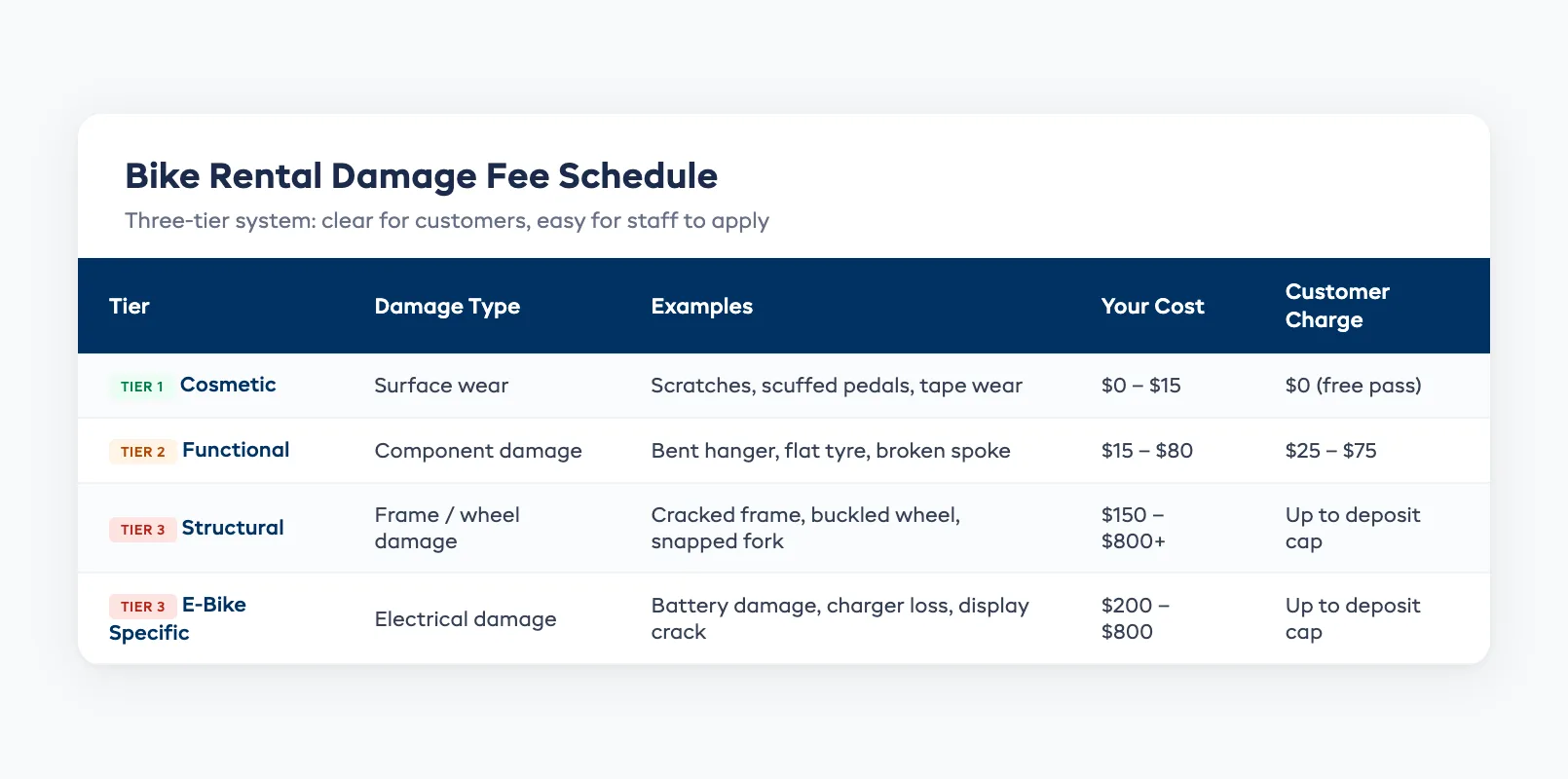
Tiered damage categories work best. Most shops use three tiers:
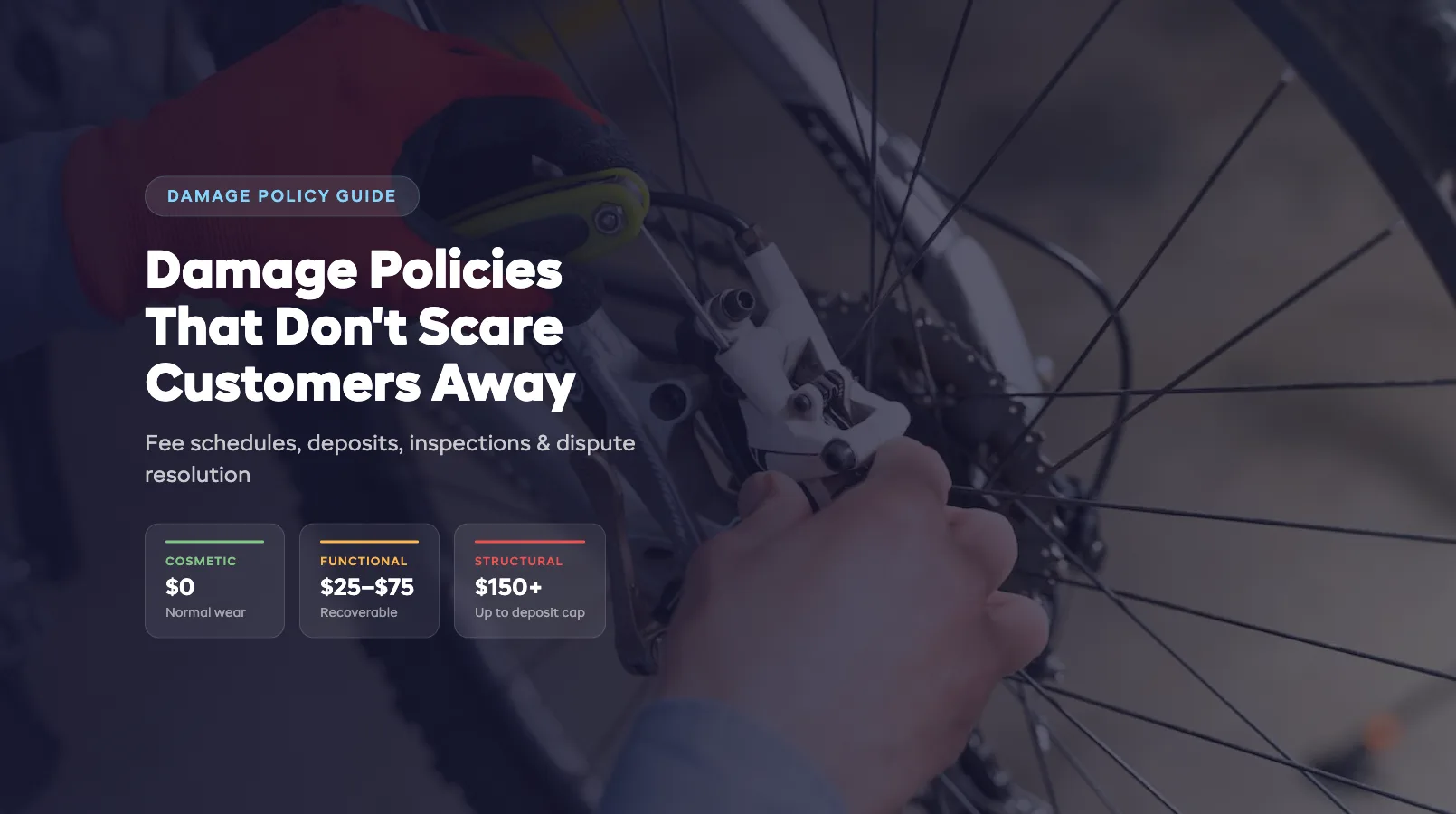
- Cosmetic (Tier 1): Surface scratches, scuffed pedals, handlebar tape wear. Cost to you: $0-$15. Charge to customer: $0. This is normal wear. Charging for it signals distrust and kills repeat business.
- Functional (Tier 2): Bent derailleur hanger, flat tire from negligence, broken spoke, damaged saddle. Cost to you: $15-$80. Charge to customer: $25-$75 depending on component. These are recoverable from the deposit or charged post-return.
- Structural (Tier 3): Cracked frame, buckled wheel, destroyed fork. Cost to you: $150-$800+. Charge to customer: up to the deposit cap or the repair/replacement cost — whichever is lower.
Publish the schedule. Print it on the counter. Include it in booking confirmations. Put a simplified version on your website FAQ page. Customers who see the numbers before checkout don't feel ambushed after return.
Key principle: charge replacement cost, not retail price. A customer who snaps a derailleur hanger owes you $25 for the part plus $15 in labor — not $60 for a new hanger at bike-shop retail. Fair pricing reduces disputes by 60-70% compared to shops that charge at full retail markup.
E-bike-specific additions. Battery damage, charger loss, and display screen cracks need separate line items. A replacement e-bike battery runs $400-$800 wholesale. Make this crystal clear at checkout. For e-bike operational details, see our e-bike rental operations guide.
Deposit Hold Amounts
Deposits protect you from the worst-case scenario without requiring customers to hand over cash. The shift to card pre-authorization has made this far less painful for everyone.
Standard bikes: $150-$250 pre-auth. This covers most Tier 2 and partial Tier 3 damage. It's enough to replace a wheel or repair a groupset. It's not so high that it triggers "are you serious?" reactions at checkout.
E-bikes: $300-$500 pre-auth. Higher because component costs are higher. Battery replacement alone justifies the top end. Most customers with e-bike experience expect a larger hold.
Premium/carbon bikes: $500-$1,000 pre-auth. If you rent high-end road bikes or full-suspension mountain bikes, the deposit needs to match the risk. Some shops require a separate damage waiver purchase ($15-$25/day) as an alternative to the full deposit — it works like rental car CDW insurance.
Pre-auth vs actual charge. Always use pre-authorization, never an actual charge. The hold drops off automatically after 5-7 days if you don't capture it. Customers see "pending" on their statement, not a charge. This small distinction eliminates 80% of deposit-related complaints.
When to reduce or waive deposits. Repeat customers with clean history. Corporate accounts with master agreements. Hotel concierge partners who guarantee damage costs. Build loyalty tiers into your system — a customer who's rented 5+ times without incident earns a reduced hold.
Photo Documentation at Checkout
Photos are the single best investment in damage dispute prevention. They take 30 seconds and save hours of arguments.
What to photograph at check-out:
- Both sides of the frame (full bike profile)
- Wheels (close-up of rims and spokes)
- Drivetrain (chain, cassette, derailleur)
- Any existing damage (scratches, dents, tape wear)
Make it systematic. Use a pre-rental checklist that prompts staff through the same 4-6 photos every time. Consistency matters more than perfection. When every bike has check-out photos, you have evidence. When only some do, you have a he-said-she-said problem.
Include the customer. Show them the photos before they ride. Better yet, have them confirm on a tablet. "Here's your bike — these scratches are pre-existing, see?" Takes 15 seconds. Removes all ambiguity at return.
Storage and retrieval. Photos tied to the booking record, not floating in a camera roll. When a customer disputes damage 3 days later, you need to pull up those photos in under 60 seconds. If your system doesn't link photos to bookings automatically, staff won't do it consistently.
Time-stamped and geotagged. Phone photos include metadata by default. Don't strip it. That timestamp is evidence if a dispute escalates.
Return Inspection Process
The return is where damage gets caught — or missed. A 2-minute structured inspection catches problems before the customer walks away.
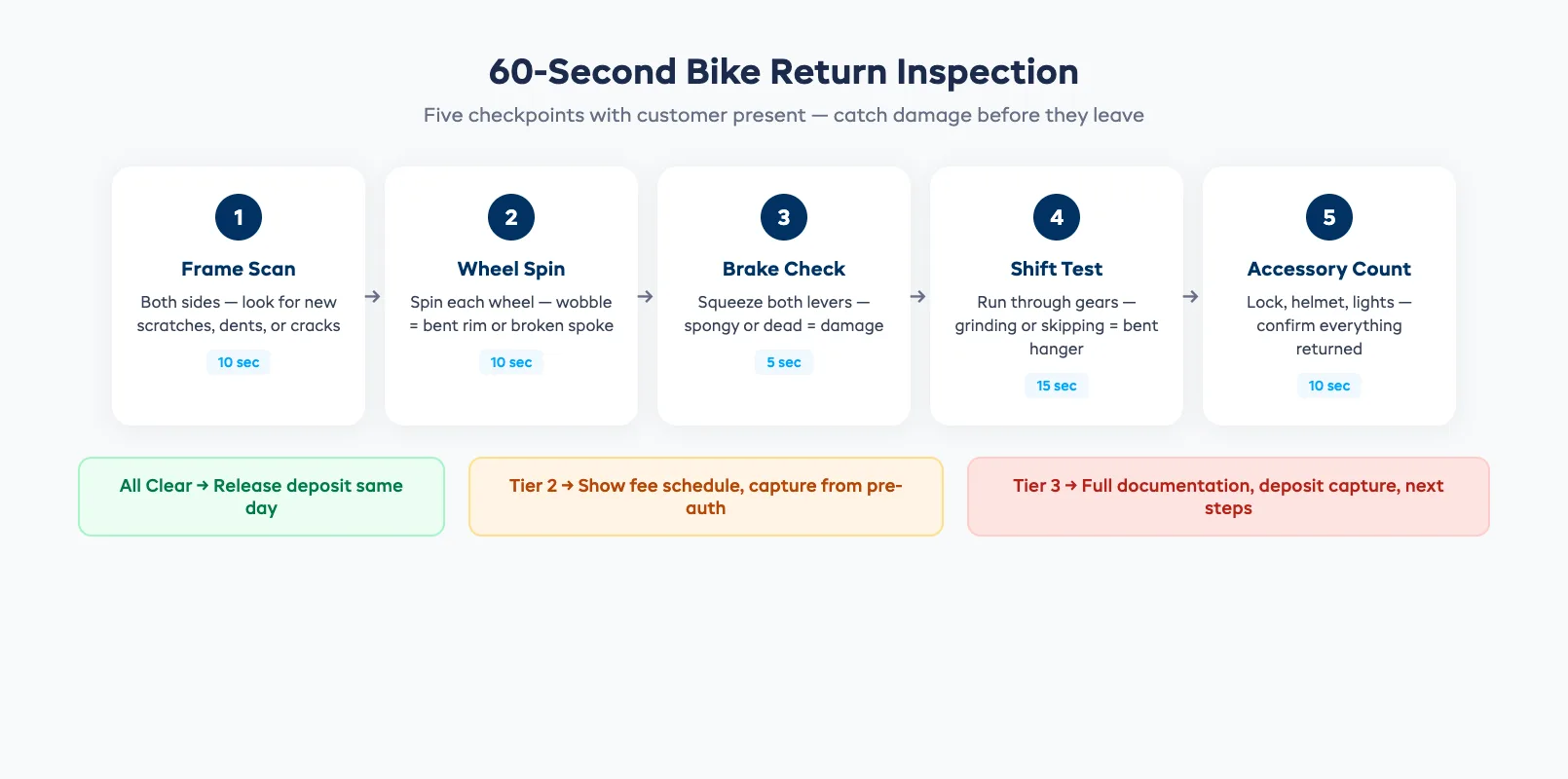
The 60-second walk-around:
- Frame: scan both sides for new scratches or cracks
- Wheels: spin each wheel — wobble means bent rim or broken spoke
- Brakes: squeeze both levers — spongy or non-responsive means something happened
- Drivetrain: shift through gears on the stand — grinding or skipping means bent hanger or damaged chain
- Accessories: count what went out (lock, helmet, lights) — confirm what came back
Do it with the customer present. This is non-negotiable. Once they leave, you've lost leverage. If damage is found, address it immediately while context is fresh. "Hey, looks like the rear derailleur took a hit. Let me check what happened." Calm, factual, not accusatory.
Grade the damage on the spot. Tier 1? Note it, smile, send them off. Tier 2? Show them the fee schedule, explain the charge, process it from the pre-auth. Tier 3? Document thoroughly (photos, written description), explain next steps, and process the deposit capture.
Peak-season shortcuts that backfire. When you're turning 40 bikes per day, the temptation is to skip inspections and just photograph at check-out. Don't. A missed bent rim means the next customer gets a dangerous bike. Safety trumps speed. If volume demands it, add a dedicated return-inspection role during peak hours.
Customer Communication
How you talk about damage matters as much as how you charge for it. The goal: customers leave understanding what happened and feeling the charge was fair — even if they're paying $75.
At booking (before they arrive):
- Include your damage policy link in the booking confirmation email
- Keep the language neutral: "Our damage policy" not "damage charges" or "penalties"
- Frame it positively: "Most rentals come back with zero charges. Here's how our policy works just in case."
At checkout (when they pick up):
- Brief verbal overview: "We do a quick photo check before and after — it protects both of us"
- Don't read the full policy aloud. Nobody listens. Just hit the key point: pre-existing damage is documented, normal wear is free, real damage comes from the deposit hold
At return (when damage exists):
- Start with the facts: "I can see the rear derailleur hanger is bent. That wasn't in the check-out photos."
- Show, don't tell: pull up the before photo on a tablet
- State the cost matter-of-factly: "That's a $35 repair — I'll capture that from the pre-auth we took earlier"
- Don't apologize or negotiate unless the evidence is ambiguous
After return (follow-up):
- Send a receipt showing the deposit release amount and any charges captured
- Include repair photos if you charged for damage — transparency builds trust
- For clean returns: "Your full deposit has been released. Thanks for looking after the bike!" — this small message drives repeat bookings
Dispute Resolution
Disputes happen. Even with photos and clear policies, some customers will contest charges. Build a resolution path that's fast, fair, and doesn't require your owner or manager to get pulled in every time.
Tier 1: Staff-level resolution (80% of disputes). Empower front-desk staff to waive charges under $30 if the evidence is ambiguous. The cost of arguing for 20 minutes (staff time = $10-$15 in wages alone) exceeds the repair cost. Set a clear threshold: "If the charge is under $30 and photos are inconclusive, waive it."
Tier 2: Manager review (15% of disputes). Charges over $30 or repeat disputes from the same customer. Manager reviews photos, speaks with staff, and makes a call within 24 hours. The key: respond fast. A customer waiting 5 days for a resolution goes straight to Google Reviews.
Tier 3: Escalation (5% of disputes). Structural damage, insurance claims, or legal threats. Document everything. Involve your insurance if the amount exceeds your deductible — see our bike rental insurance guide for what each policy covers and the claims process. For claims over $500, a brief phone call often resolves what 10 emails cannot.
The refund-as-goodwill tool. Sometimes a half-refund on a $75 charge turns an angry 1-star reviewer into a neutral customer who simply doesn't return. That's a $37.50 cost to avoid a public review that might cost you 5-10 future bookings. Do the math case by case.
Track dispute patterns. If the same bike triggers disputes repeatedly (because its frame has pre-existing damage that looks new), document it better or retire the cosmetics. If the same staff member generates more disputes, they need return-inspection training. Your booking system should flag repeated dispute patterns automatically.
FAQ
How much should I charge for a deposit on bike rentals?
Standard bikes: $150-$250 as a pre-authorization. E-bikes: $300-$500. Premium or carbon bikes: $500-$1,000. Use pre-auth (not actual charges) — it drops off the customer's statement automatically if no damage occurs.
Should I charge for cosmetic scratches on rental bikes?
No. Surface scratches, scuffed pedals, and minor handlebar tape wear are normal rental use. Charging for cosmetics signals distrust and kills repeat bookings. Reserve charges for functional or structural damage only.
How do I handle damage disputes with customers?
Start with photo evidence from check-out. Show the before-and-after comparison. If evidence is clear, state the charge factually. If evidence is ambiguous and the charge is under $30, empower staff to waive it — the goodwill is worth more than the repair cost.
What's the best way to document bike condition at checkout?
Take 4-6 photos per bike: both frame sides, wheels close-up, drivetrain, and any existing damage. Use a standardized checklist so every rental gets the same documentation. Link photos directly to the booking record for instant retrieval at return.
Should I offer damage waiver insurance to customers?
Yes — especially for e-bikes and premium bikes. Charge $10-$25 per day. It reduces or eliminates the customer's liability for Tier 2 damage. You pocket the waiver fee on 85-90% of rentals where no damage occurs. It's profitable insurance for your shop and peace of mind for the customer.
How quickly should I release deposits after a clean return?
Same day. Within hours if possible. Delayed deposit releases generate support inquiries and erode trust. If your system supports automatic release on clean inspection sign-off, enable it.
What damage should trigger a full deposit capture?
Structural damage only: cracked frames, destroyed wheels, snapped forks, missing components. The threshold is when repair cost exceeds 60-70% of the deposit amount. Always document with photos before capturing and send the customer a detailed breakdown.
Wrapping Up
A good damage policy isn't about maximizing what you recover from customers. It's about setting clear expectations, documenting everything, and resolving issues quickly when they arise. The shops that get this right recover most legitimate damage costs while maintaining 4.5+ star reviews and strong repeat-booking rates.
Start with a published fee schedule. Add photo documentation at every checkout. Train your team on calm, factual return inspections. And give staff the authority to waive small charges when evidence is unclear. The math always favors keeping a customer over winning a $25 argument.
If you're building out your full bike rental operation, our complete bike rental business guide covers fleet selection, pricing, staffing, and marketing alongside policy setup. For tour-specific revenue strategies, see our bike tour operator revenue playbook.
in one place