Running Bike Rentals at Hotels and Resorts: Partnership Models
A hotel concierge calls your shop. They want bikes available for guests — maybe a dozen cruisers parked at the lobby, maybe a full e-bike fleet at the spa entrance. Sounds like free distribution. But the deal you sign determines whether this channel adds $2,000/month to your bottom line or costs you money after maintenance, transport, and liability.
Hotel and resort partnerships are one of the highest-leverage growth channels for bike rental operators. They put your bikes in front of tourists who've already decided to spend money on experiences. But the partnership model matters more than the partnership itself. If you're still building your operation from scratch, start with our complete bike rental business guide for the full picture.
This guide breaks down the three main partnership models, what to put in your service-level agreement, how to handle branding, and why your exit clause might be the most important paragraph in the contract.
Partnership Models
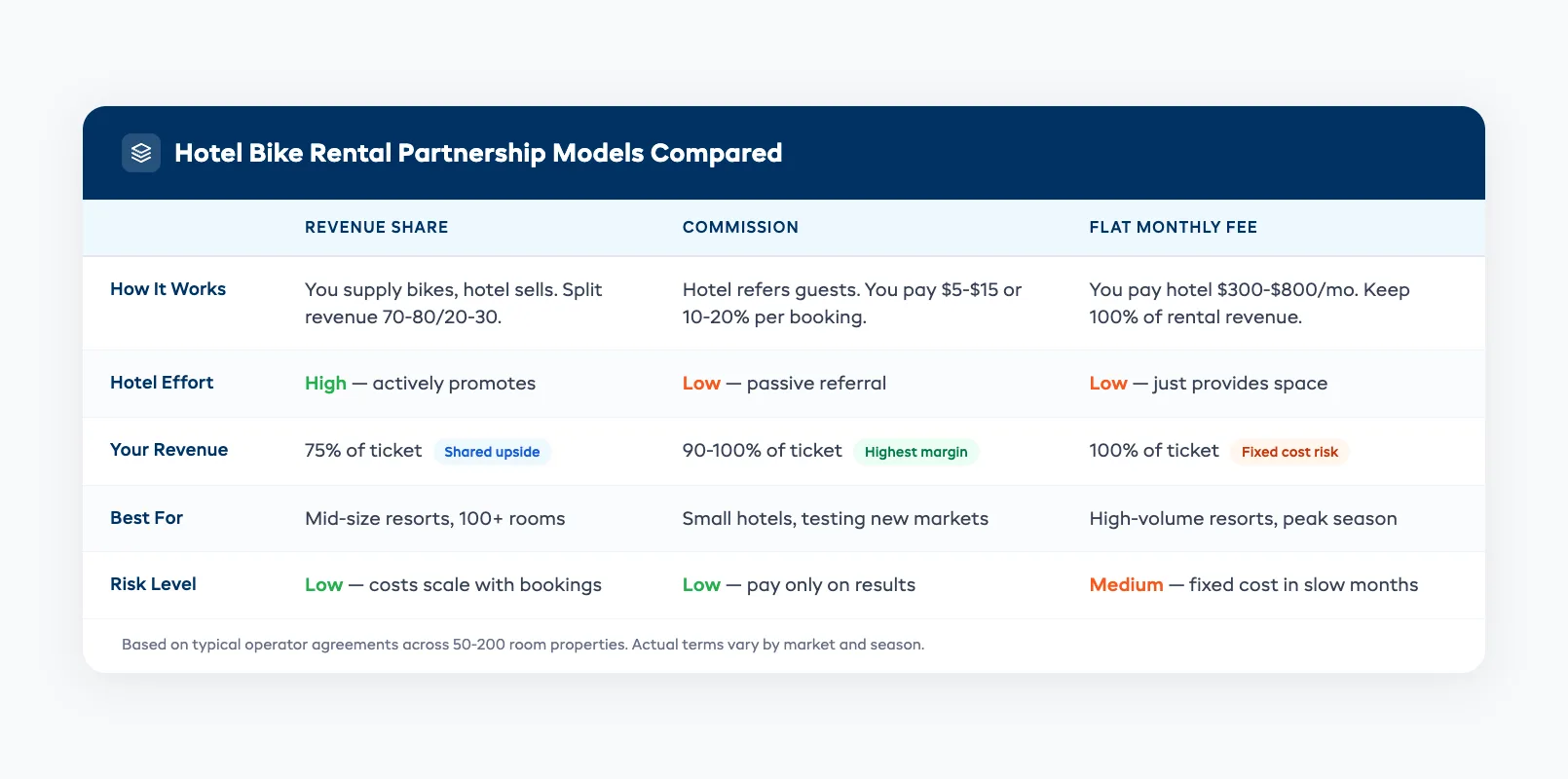
There are three common structures for hotel bike rental partnerships. Each shifts risk and reward differently between you and the property.
Model 1: Revenue share. You supply the bikes, maintain them, and handle bookings. The hotel promotes the service and collects payment at the front desk or through their concierge app. Revenue splits typically range from 70/30 to 80/20 in the operator's favor. The hotel earns passive income. You get guaranteed placement and a warm lead pipeline.
Model 2: Commission per booking. The hotel refers guests to your shop or booking page. You handle everything — bikes, bookings, payment, pickup, return. The hotel earns a flat commission per booking, usually $5-$15 per rental or 10-20% of the ticket. Lower hotel involvement means lower hotel commitment. They'll promote you if it's easy, but you're competing with whatever else the concierge is recommending that week.
Model 3: Flat monthly fee. You pay the hotel a fixed monthly fee ($300-$800 depending on property size and season) for the right to park bikes on-site and access their guest pipeline. You keep 100% of rental revenue. This works best at high-volume resorts where you're confident you'll generate enough bookings to cover the fee and then some.
Which model wins? Revenue share gives both parties skin in the game. Commission models work for lower-volume properties where a flat fee doesn't make sense. Flat fees reward operators who can drive volume — but they also mean you eat the loss during slow weeks.
Revenue Share vs Commission
The difference between revenue share and commission isn't just math. It changes how the hotel treats your bikes and how much effort they put into selling.
Revenue share aligns incentives. When the hotel earns a percentage of every dollar, the front desk staff actually recommend bike rentals. They mention it at check-in. They put a card in the room. They train the concierge to upsell half-day rides. A 75/25 split on a $50 half-day rental gives the hotel $12.50 per booking — not life-changing, but enough to make it worth their time across 200+ rooms.
Commission models create passive referrals. A flat $8 commission per booking means the hotel doesn't care whether the guest rents for 2 hours or 8 hours. They'll hand over your business card and move on. No upselling. No route recommendations. No "you should really try the sunset ride." You'll get bookings, but fewer of them, and at lower average ticket values.
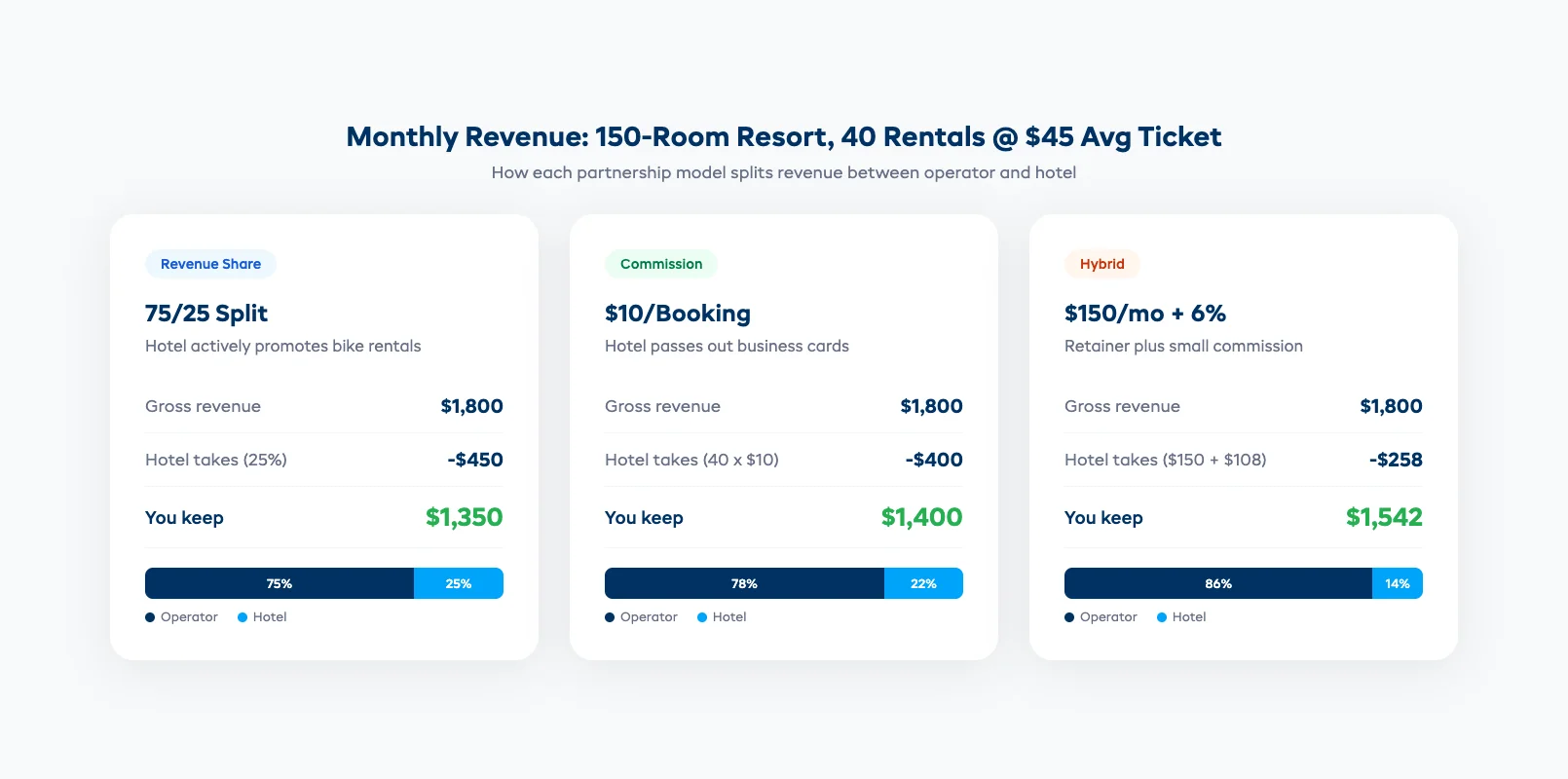
The numbers. Say a 150-room resort generates 40 bike rentals per month at an average ticket of $45. Under a 75/25 revenue share, the hotel earns $450/month and you keep $1,350. Under a $10/booking commission, the hotel earns $400 and you keep $1,400. Similar on paper — but the revenue-share hotel will push harder to get that number to 60 rentals, because their take scales with volume.
Hybrid structures work too. Some operators use a small monthly retainer ($150-$200) plus a reduced commission (5-8%). This guarantees the hotel some income even in slow months and keeps them motivated.
Service-Level Agreements
A handshake deal with a hotel GM lasts until the GM leaves. Put everything in writing.
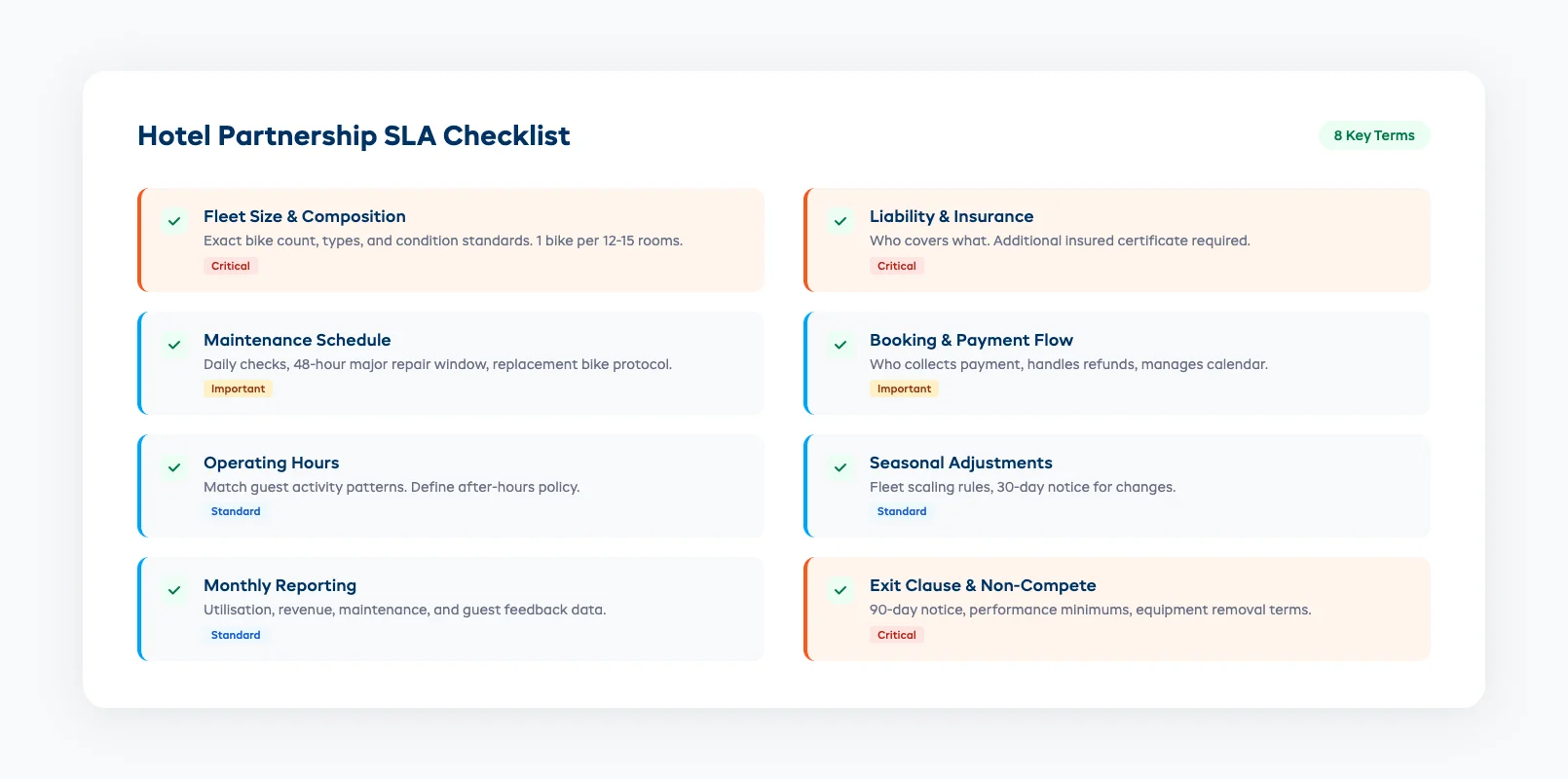
Bike supply and condition. Specify the exact number of bikes, types (cruiser, e-bike, mountain), and condition standards. "Fleet of 12 cruiser bikes maintained in rideable condition" is vague. "12 Electra Townie 7D cruiser bikes, each less than 18 months old, with functioning brakes, gears, lights, and tires above 2mm tread depth" is enforceable.
Response times. Define how quickly you'll replace a damaged or broken bike. Same-day swap is the gold standard for resort partnerships. If you can't do same-day, specify "within 24 hours" and keep 2-3 spare bikes at the property. For maintenance scheduling across your fleet, see our bike fleet maintenance guide.
Booking and payment flow. Who collects payment? Who handles refunds? Who manages the booking calendar? If you're using booking software, clarify whether the hotel gets a sub-account, a booking widget on their site, or just a phone number for the concierge to call. The cleaner the handoff, the fewer disputes you'll have.
Seasonal adjustments. Most hotel partnerships need different terms for high and low season. You might supply 20 bikes in summer and 8 in winter. The SLA should specify minimum fleet sizes by month or season, with 30 days notice for changes.
Reporting. Agree on a monthly report covering total rentals, revenue, maintenance events, and guest feedback. Hotels love data. A one-page report showing "your guests rented 47 bikes this month, generating $2,115 in guest-experience revenue" keeps the partnership alive at budget review time.
Branding
Hotel partnerships create a branding tension. The hotel wants the bikes to feel like their amenity. You want your brand visible so guests book directly next time.
Co-branding is the compromise. Bikes carry a small tag or basket card with your shop name and booking URL. The hotel provides branded helmets, maps, or lock bags. The guest experience feels seamless — "the hotel's bike program, powered by [Your Shop]."
What to negotiate:
- Your logo on the bike frame or basket (non-negotiable — you own the asset)
- A QR code on the helmet or handlebar card linking to your direct booking page
- Your business listed on the hotel's activities page or in-room tablet
- Social media cross-promotion: the hotel tags your shop in cycling content
What to avoid:
- White-labeling where your brand disappears entirely. If the hotel rebrands your bikes as "Resort Cycles" and guests never learn your name, you've built a channel with zero direct-booking upside.
- Exclusivity clauses that prevent you from partnering with competing properties unless the hotel guarantees minimum volume.
Insurance and Liability
This is where hotel partnerships get complicated. Two businesses, shared customers, one incident — who pays?
Your existing policy probably isn't enough. Standard bike rental insurance covers your shop operations. A hotel partnership means your bikes are stored and rented from a different premises, often with different staff handling the checkout. Call your insurer before signing anything. You may need a rider (pun intended) for off-premises operations. For a complete breakdown of coverage types, costs, and gaps, see our bike rental insurance guide.
Liability split. The SLA should clearly state:
- You are liable for bike condition, mechanical failure, and equipment defects
- The hotel is liable for premises conditions (e.g., a guest trips on a poorly-lit bike rack area)
- The guest assumes risk of riding (covered by your waiver)
Waivers at the property. Every guest must sign a waiver before riding. Digital waivers work best here — the concierge sends a link, the guest signs on their phone, and you have a timestamped record. Paper waivers at a hotel front desk get lost, misfiled, or skipped entirely. For damage policy frameworks, see our bike rental damage policy guide.
Additional insured. Most hotels will require you to add them as an "additional insured" on your policy. This is standard. Budget $200-$500/year extra depending on your insurer and the property size.
Exit Clauses
The exit clause is the paragraph nobody reads until someone needs it. Write it carefully.
Minimum term. 6-12 months is standard. Shorter terms favor you (easy exit if the partnership underperforms). Longer terms favor the hotel (stable amenity for their marketing). A 12-month initial term with 6-month auto-renewals is a fair middle ground.
Notice period. 60-90 days written notice for either party. This gives you time to relocate bikes and the hotel time to find a replacement or wind down the program.
Performance minimums. Tie exit rights to performance. "If monthly rental revenue falls below $800 for three consecutive months, either party may terminate with 30 days notice." This protects you from paying a flat fee at a property that isn't generating bookings, and protects the hotel from an operator who stops maintaining the fleet.
Bike removal logistics. Specify who pays for transport if the partnership ends. You supplied the bikes — you should retrieve them. But if the hotel terminates without cause before the minimum term, they should cover removal costs.
Non-compete window. A 90-day non-compete preventing the hotel from launching a competing bike program immediately after termination is reasonable. A 2-year non-compete is not.
FAQ
What's the best partnership model for a small bike rental shop? Commission-based partnerships are lowest risk for small operators. You don't commit bikes to one location full-time, and you only pay the hotel when bookings come through. Start with commission, then graduate to revenue share once you've proven the volume justifies dedicated fleet.
How many bikes should I place at a hotel? Start with 1 bike per 15-20 rooms. A 100-room hotel gets 5-7 bikes. Track utilization for 60 days and adjust. If bikes sit idle more than 60% of the time, you've over-supplied. If they're booked out by 10 a.m., add more.
Should I offer e-bikes at hotel partnerships? Yes, if the property attracts guests who'll pay the premium. Resort guests typically will. Budget hotels typically won't. E-bikes command 40-60% higher rates and the hotel's share increases proportionally, which motivates their staff to upsell. See our e-bike operations guide for battery management at remote locations.
Who handles maintenance for bikes at a hotel? You do. Always. Never let hotel staff attempt repairs — it creates liability issues and usually makes things worse. Schedule weekly maintenance visits and keep a small toolkit plus spare tubes on-site.
How do I track bookings from a hotel partner? Use your booking software's multi-location or referral tracking features. Each hotel gets a unique booking link or referral code. This gives you clean data on which properties are performing and makes commission calculations transparent.
What if a hotel guest damages a bike and refuses to pay? Your waiver should cover this. The guest's credit card pre-authorization (taken at check-out) covers damage up to the deposit amount. For damage beyond the deposit, your insurance kicks in. The hotel is not responsible for guest-caused damage — make this explicit in the SLA.
Can I partner with multiple hotels in the same area? Yes, unless you've signed an exclusivity clause. Non-exclusive partnerships let you spread risk and volume across multiple properties. If a hotel demands exclusivity, require a minimum booking guarantee in return.
Running bike rentals at hotels is one of the fastest ways to scale without opening a second shop. The partnership model you choose, the SLA you sign, and the exit clause you negotiate will determine whether this channel compounds or collapses. Get the contract right first. The bookings will follow.
in one place