How to Run a Ski & Snowboard Rental Business: The Complete Operator's Guide (2026)
Running a ski and snowboard rental shop looks simple from the lift line. A customer walks in cold, walks out geared up, and you collect the money. Behind the counter it is a different story. You are managing a fleet that turns over by the hour, a staff that triples in size for four months, boot fittings that make or break a customer's day, and a season where you earn most of your year's revenue in roughly twenty weekends.
Get the operation right and a single mountain-town shop can clear a healthy living on snow alone. Get it wrong and you are bleeding margin on idle gear, turning away walk-ins because you double-booked, and burning out staff in January. This guide walks through every major decision an operator faces — from the kind of shop you build to how you survive the months when the lifts stop turning.
Shop models: resort base-area vs in-town
The first decision shapes everything else: where do you set up? There are two classic models, and they run on completely different economics.
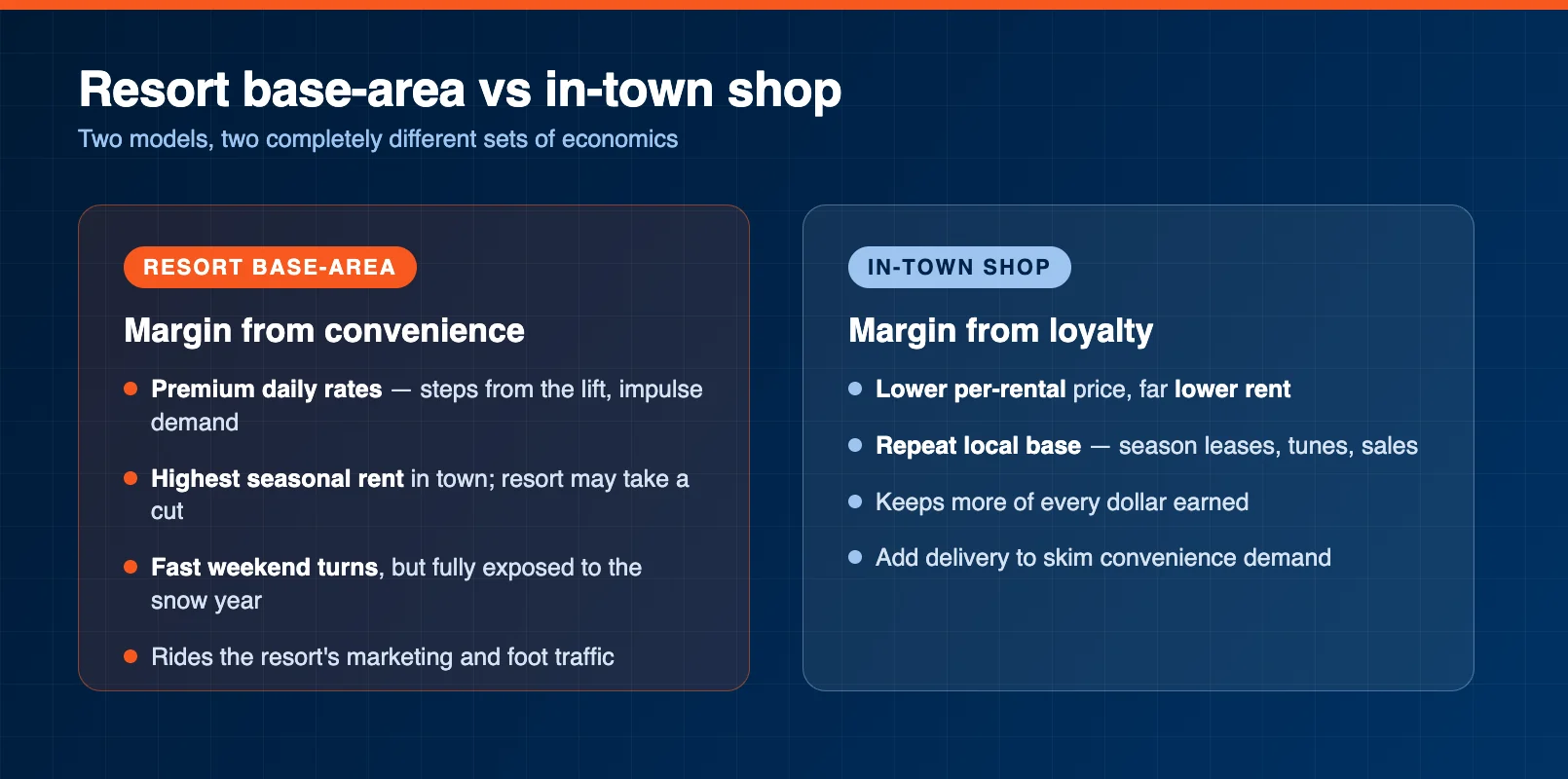
Resort base-area shops sit at the bottom of the mountain, often steps from the lift. They live on convenience. A guest who forgot to pre-book, a family that decided to ski on a whim, a destination visitor who flew in with nothing — they all pay a premium not to walk another hundred yards. You charge more per rental, you turn gear fast on weekends, and you ride the resort's marketing. The catch is rent. Base-area commercial space is some of the most expensive real estate in any mountain town, and resorts often take a cut or restrict what you can sell. You are also fully exposed to the resort's calendar: a bad snow year or a closed lift hits you directly.
In-town shops sit a few minutes' drive from the lifts, on a main street or in a strip near where people actually park and sleep. Your per-rental price is lower because you are competing on value, but your rent is a fraction of base-area, you keep more of every dollar, and you build something the resort shops struggle to: repeat local business. Locals don't pay resort prices twice. They find the town shop with fair rates and good boot fitters and they come back every season, often on a season-long lease.
Most successful operators eventually run a hybrid. A town flagship holds the fleet, the tuning bench, and the loyal customers, while a small base-area satellite or a delivery service skims the high-margin convenience demand. You don't have to choose forever — but you do have to choose where you start, because rent and fleet size cascade from it.
Fleet composition: building the right gear mix
Your fleet is your single biggest capital outlay and your biggest source of waste if you get it wrong. The mistake new operators make is buying a wall of identical mid-range skis. Real demand is layered, and your gear should be too.
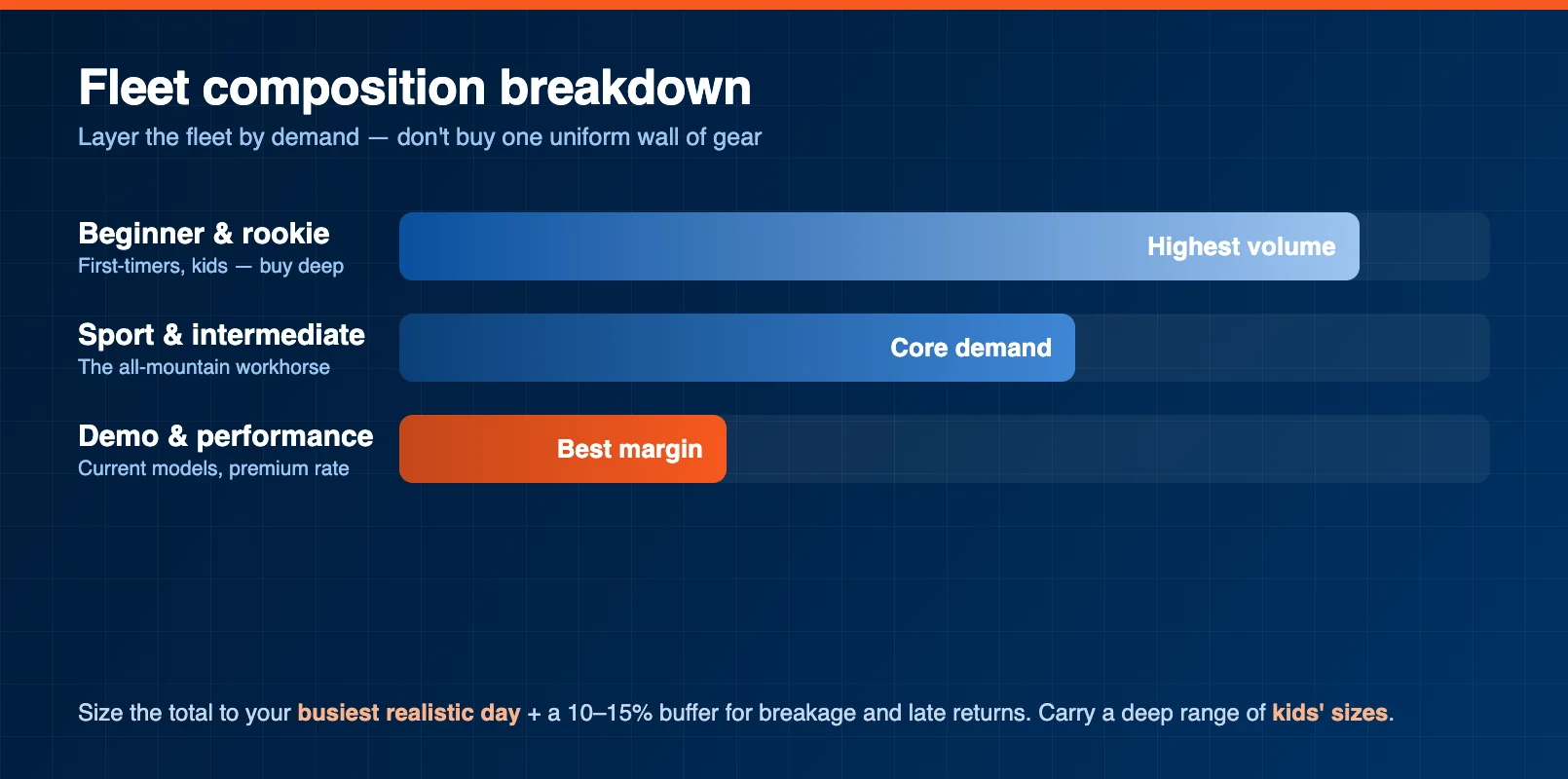
Think of the fleet in three tiers:
- Beginner and rookie gear — forgiving, shorter skis and soft-flex snowboards for first-timers and kids. This is the highest-volume, lowest-cost tier and it turns over constantly. Buy plenty; it absorbs abuse and you replace it often anyway.
- Sport and intermediate gear — the workhorse middle. Most of your adult rentals land here. Reliable, all-mountain skis and boards that handle a wide range of guests without complaint.
- Demo and performance gear — premium, current-model skis and boards you rent at a higher rate to advanced skiers and people considering a purchase. This tier carries the best margin per unit but the thinnest demand, so keep the quantity tight.
Kids' gear deserves its own planning. Families are a huge share of rental volume, and a parent who can't get the right size for a seven-year-old walks out and takes the whole group with them. Carry a deep range of small sizes even though each unit earns little.
Size the total fleet to your busiest realistic day, not your average. If your biggest Saturday needs 200 setups out the door, build to roughly 200 plus a 10 to 15 percent buffer for breakage, repairs, and the gear that never comes back on time. A fleet sized to your average will sell out every peak weekend — and a sold-out weekend is revenue you can never get back.
Seasonal staffing: hiring for a four-month sprint
A ski rental shop is one of the most extreme seasonal employers there is. You might run with three people in October and twenty-five in January. Staffing is not a side issue — it is the operation.
Start hiring early. The best seasonal staff — experienced boot fitters, returning techs, people who actually ski — are gone by November. Open applications in late summer, lock in your returners with a small loyalty bump, and recruit from the local ski community where word of mouth does your screening for you.
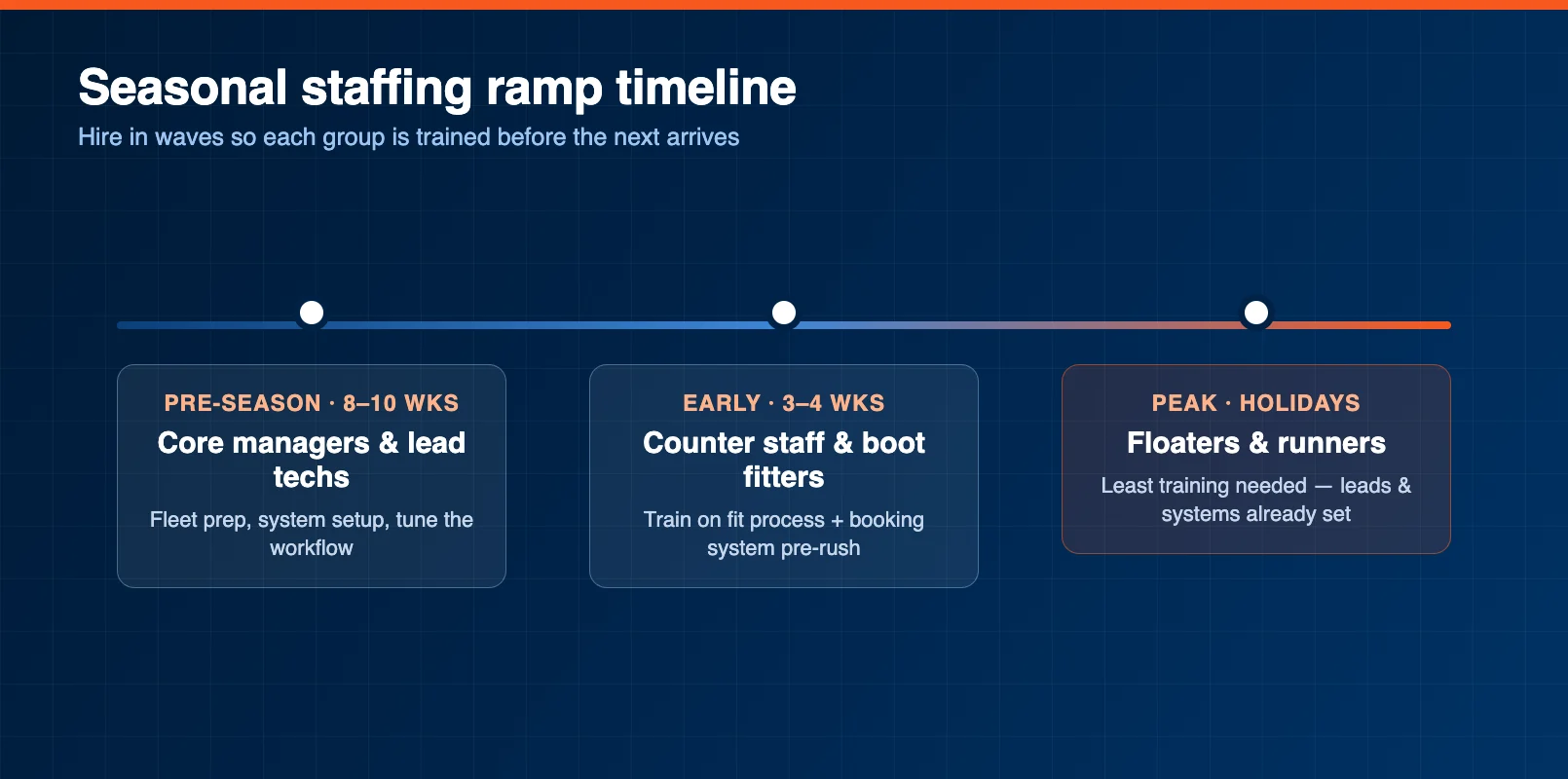
Plan the ramp deliberately. You don't hire everyone at once; you bring people on in waves so each group gets trained before the next wave arrives:
- Pre-season (8–10 weeks out): core managers and lead techs. Fleet prep, system setup, tuning the workflow.
- Early season (3–4 weeks out): counter staff and boot fitters. Train on the fit process and the booking system before real customers show up.
- Peak (holidays, weekends): seasonal floaters and runners for the busiest days. These roles need the least training because the systems and leads are already in place.
Cross-train relentlessly. The boot fitter who can also run the counter, the tech who can also size kids, is worth two single-skill hires when a Saturday line is out the door. And document everything — fit steps, return procedures, how to log damage — because you are re-teaching the same playbook to a new crew every single year. A written opening-day checklist turns a green hire into a useful one in days instead of weeks.
Boot fitting operations: the make-or-break station
Nothing defines a customer's day like their boots. A great ski with a bad boot is a miserable experience; a modest ski with a boot that fits is a good one. Boot fitting is where rental shops win or lose repeat business, and it is also the single biggest bottleneck at your counter.
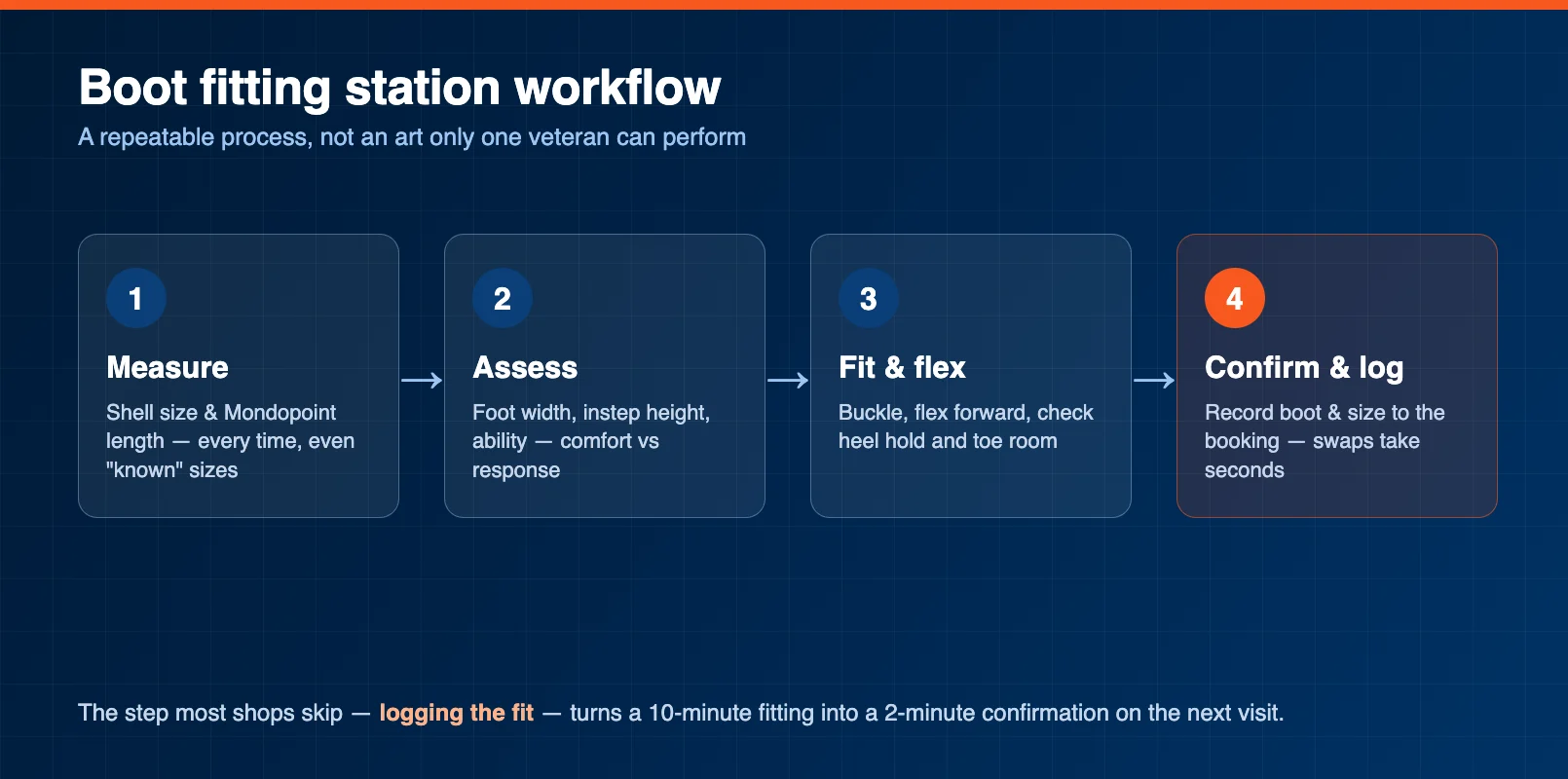
Treat fitting as a station with a repeatable workflow, not an art only one veteran can perform. A clean process looks like this:
- Measure — shell size and Mondopoint length, every time, even when the customer "knows their size." Guessed sizes are returns waiting to happen.
- Assess — foot width, instep height, and ability level. A beginner wants comfort and warmth; an advanced skier wants response.
- Fit and flex-check — get them buckled, have them flex forward, check heel hold and toe room standing and in ski position.
- Confirm and log — record the exact boot and size against the booking so a same-day swap or next-visit rental takes seconds, not another full fitting.
That last step is the one most shops skip and the one that compounds. When the fit is logged to the customer's record, a return visit, a mid-trip swap, or a sister's rental two days later all start from known data. You turn a ten-minute fitting into a two-minute confirmation, and on a peak Saturday that throughput difference is the difference between serving the line and losing it.
Staff your bench for it. Boot fitting is the role you cannot under-hire, because it gates everything downstream. If fitters are the bottleneck, skis sit on the rack and money sits on the floor.
Resort partnerships: feeding the funnel
You do not have to win every customer at your own door. The resort, the lodges, the ski schools, and the property managers around you all touch guests before you do — and a good partnership puts your shop in front of them at the moment they need gear.
A few arrangements that work:
- Referral and commission deals with the resort's ski school or guest services, where front-desk staff book your gear for arriving guests in exchange for a cut.
- Lodging and property-manager tie-ins, where the condo or hotel offers your rentals as an add-on at check-in. Destination guests love booking everything in one place.
- Delivery and slope-side service, where you fit and drop gear at the guest's lodging or a base-area locker. This is premium, high-margin convenience that resort shops can't easily match, and it turns an in-town location into a base-area competitor without the base-area rent.
- Group and event deals with corporate trips, school programs, and clubs that book dozens of setups at once.
Partnerships live or die on reliability. The resort will only keep sending guests if every handoff is smooth — the booking is there, the size is right, the gear is ready. That means your systems have to be airtight, because a partner's reputation is on the line every time they recommend you. Treat your biggest referrers like your most important customers, because they effectively are.
Pricing: capturing peak without losing locals
Ski rental pricing has to do two jobs at once: extract full value from peak-demand destination guests, and stay fair enough that locals rent from you all season. Get greedy and you lose the repeat base; get timid and you leave money on the table every holiday weekend.
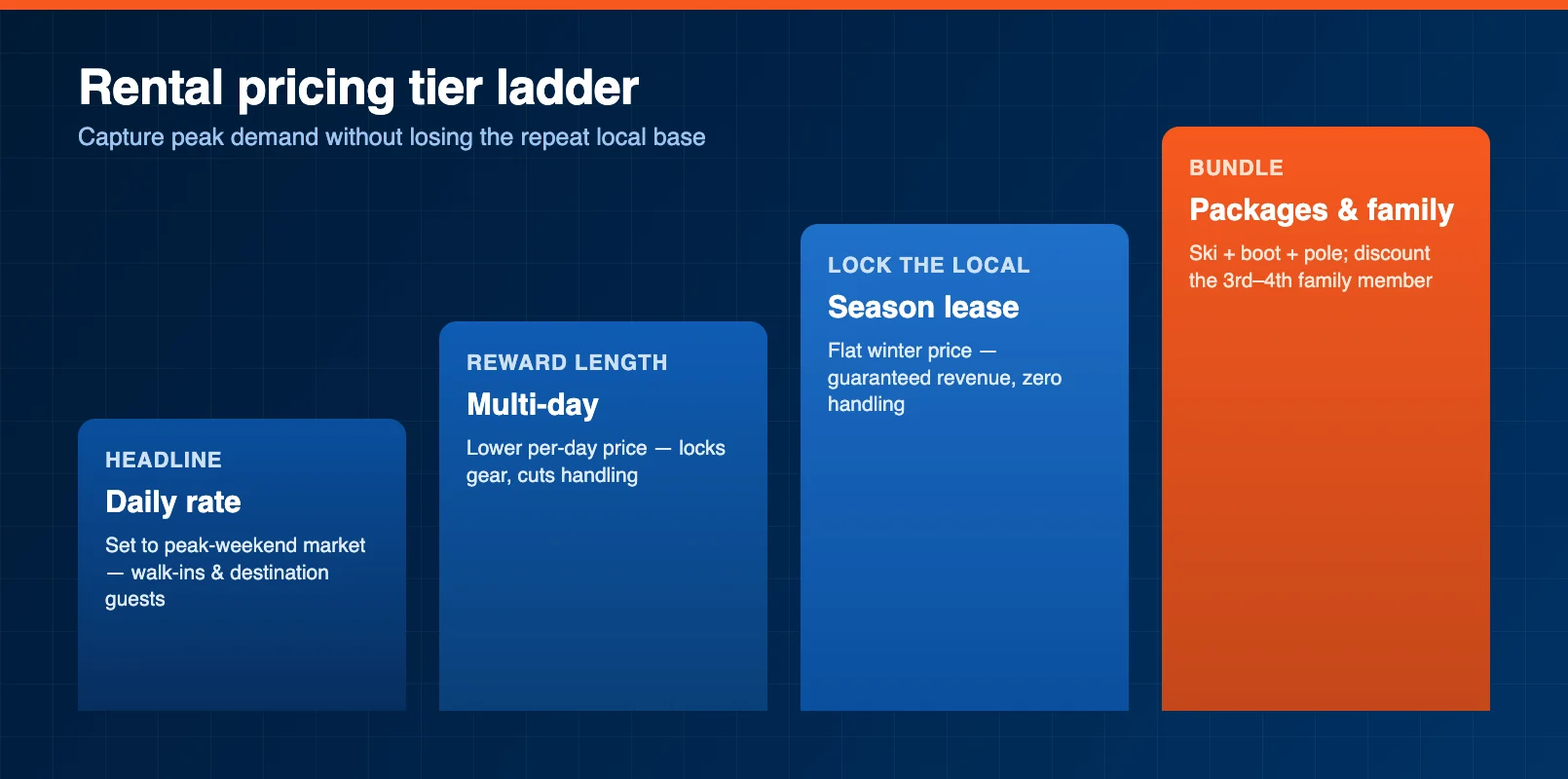
Build a pricing ladder rather than a single rate:
- Daily rates are your headline price, set to what the market bears on a peak weekend. This is where destination guests and walk-ins land.
- Multi-day rates discount per day to reward longer rentals — a four-day rental should cost less per day than a single day, because it locks the gear and reduces your handling.
- Season leases put gear in a local's hands for the whole winter at a flat price. Margin per day is low, but it is guaranteed revenue, zero per-rental handling, and a customer who now buys tunes, sales, and next year's lease from you.
- Packages and family pricing bundle ski, boot, and pole (and helmet) and discount the third or fourth family member. Families book as a unit; price them as one.
Layer demand-based pricing on top. Peak weeks, holidays, and powder days command higher rates; midweek and shoulder-season days should be cheaper to pull demand into your quiet periods. The shops that do this well don't reprice by hand every morning — they let their booking system flag high-demand days and suggest a rate, so the premium gets captured automatically instead of being forgotten in the rush.
Technology: running the shop on one system
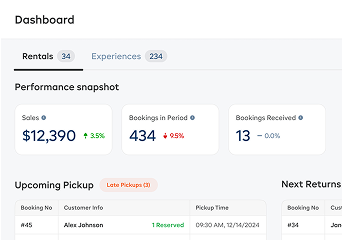
Most struggling rental shops are not struggling because of demand. They are struggling because the operation runs on a stack of disconnected tools — a paper waiver here, a spreadsheet fleet log there, a separate point-of-sale, and a phone that rings off the hook with booking requests no one can answer after 6pm. Every gap between those tools is where a double-booking, a lost reservation, or an unbilled rental hides.
The fix is consolidation. A modern ski rental shop runs on a single booking and operations platform that handles the whole chain:
- 24/7 online booking, so the guest who decides at 9pm to ski tomorrow reserves gear instead of giving up. After-hours bookings are pure recovered revenue.
- Live fleet tracking, so you always know what's out, what's due back, and what's actually available before you promise it — no more overselling the wall.
- Integrated point of sale and digital waivers, so checkout, payment, and liability all happen in one flow at the counter instead of three.
- Customer records that remember boot sizes and past rentals, turning every return visit into a faster transaction.
This is also where automation earns its keep. Booking confirmations, return reminders, and high-demand pricing suggestions can run on their own, which matters most in the exact weeks you have no spare hands. EquipDash is built for this kind of single-system operation, and its Dash Agents can handle the repetitive booking and reminder busywork so your crew stays on the floor with customers. The goal is simple: spend your peak season serving the line, not fighting your tools.
Off-season: surviving the months without snow
The lifts stop and the revenue does too — unless you plan for it. The off-season is not downtime; it is when smart operators do the work that makes next winter profitable.
Use spring and summer for:
- Fleet maintenance and turnover. Tear down, inspect, tune, and bind-test every setup. Decide what to sell off as ex-rental and what to reorder — our end-of-season ski retirement guide covers the per-item criteria and binding rules. Doing this in May, not November, means you open in peak condition with no scramble.
- Cash management. Winter revenue has to carry you through summer. Budget for it, and don't let a strong January fool you into thinking the money is all profit — a chunk of it is next year's fleet and your summer rent.
- Pre-selling next season. Early-bird season leases, package deals, and pre-booked group trips bring winter cash into the off-season and lock in demand before your competitors open their books.
- Diversifying. Many mountain shops rent summer gear — bikes, paddleboards, camping equipment — or run servicing and retail to keep the lights on and the staff employed year-round.
The operators who treat the off-season as a planning season, not a holiday, are the ones who open in December already booked, already maintained, and already cash-positive.
Putting it together
A ski and snowboard rental business is a fleet-management, staffing, and customer-experience operation compressed into a brutally short season. The winners aren't the shops with the flashiest gear — they're the ones who chose the right model, sized their fleet to real demand, hired and trained ahead of the rush, made boot fitting a repeatable strength, partnered with the mountain, priced for peak, ran everything on one system, and used the off-season to set up the next one.
Start with the decisions that cascade — your shop model and your fleet — then build the systems that let a small crew handle a big weekend. If you want a running start, the ski & snowboard operator hub collects the tools and playbooks in one place, and these are good first downloads:
- Ski shop opening-day checklist — everything that has to be true before you unlock the door.
- Pre-season ski rental inventory audit — the fleet walkthrough that catches problems in October instead of January. The full September-October sequence around that audit — early-bird season bookings, customer reactivation, the staffing pipeline — is in the pre-season ski shop prep playbook.
- Powder-day pricing suggestion agent — flags high-demand days and proposes a rate so you never forget to charge for a powder Saturday.
FAQ
How much does it cost to start a ski rental business?
A small in-town shop can typically open for somewhere between $80,000 and $150,000 once you cover a starter fleet, boots, a tuning bench, shop fit-out, software, and a few months of working capital. Resort base-area locations run considerably higher because of premium rent and the larger fleet a high-traffic location demands. Starting town-side and adding a delivery service is the lower-capital path into the market.
Is a resort or town location better for a ski rental shop?
It depends on whether you want margin or volume. Resort base-area shops capture impulse and convenience demand at premium daily rates, but they pay some of the highest seasonal rent in town and live and die by the resort's calendar. Town shops earn less per rental but keep far more of each dollar and build a repeat local base that resort shops struggle to hold. Many established operators eventually run both, with a town flagship and a small base-area or delivery presence.
How big should my rental fleet be?
Size your fleet to your busiest realistic day, not your average day. Estimate the number of setups your peak Saturday needs to push out the door, then add a 10 to 15 percent buffer for breakage, repairs, and gear that comes back late. A fleet built to your average will sell out every peak weekend, and a sold-out weekend is revenue you can never recover. Split the total across beginner, intermediate, and premium demo tiers rather than buying one uniform wall of gear.
How do ski rental shops make money in the off-season?
Off-season revenue comes from a mix of summer gear rentals, retail and ex-rental gear sales, servicing and tuning, and pre-selling next winter's season leases and group packages. Just as importantly, the off-season is when you do fleet maintenance and lock in early-bird bookings, so you open the next winter already maintained and already booked. Many mountain shops diversify into summer rentals like bikes or paddleboards to keep staff employed year-round.
What software do ski rental businesses use?
Most modern shops run on a single booking and operations platform that handles online reservations, live fleet tracking, point of sale, and digital waivers in one place, instead of stitching together spreadsheets and separate tools. Consolidating onto one system is what eliminates the double-bookings and lost reservations that come from gaps between tools, and it lets a small seasonal crew handle a big weekend. Look for 24/7 online booking and customer records that remember boot sizes between visits.
How far ahead do customers book ski rentals?
Destination guests often book weeks in advance alongside their lodging and lift tickets, while locals and walk-ins book days or even hours out. Because demand spans both ends, a 24/7 online booking option is essential — it captures the planner who reserves with their hotel and the spontaneous skier who decides at 9pm to hit the slopes tomorrow. Every after-hours booking you can take online is revenue a phone-only shop loses.
in one place