Maximizing OTA Distribution (Viator, GetYourGuide, Klook) for Attractions

Online travel agencies are the single biggest source of new visitors most attractions never spoke to first. A traveler plans a trip, opens Viator or GetYourGuide or Klook, searches "things to do" in your city, and books you before they've ever seen your website. That reach is real money — and it comes with a commission bill that can quietly become your largest single cost line. The operators who win on OTAs aren't the ones who list everywhere and hope. They're the ones who treat each marketplace as a paid channel with rules, run the commission math honestly, and protect the direct bookings that actually pay the bills.
This guide covers the parts of attraction OTA distribution that move revenue: the landscape of the major platforms, what commission really costs you, the ranking factors that decide whether travelers ever see your listing, how to defend your direct channel, and how to balance the mix across domestic and international demand. It sits under our complete guide to running a ticketed attraction — start there if you're building the wider operation.
The OTA Landscape: Who Sends Attractions Bookings
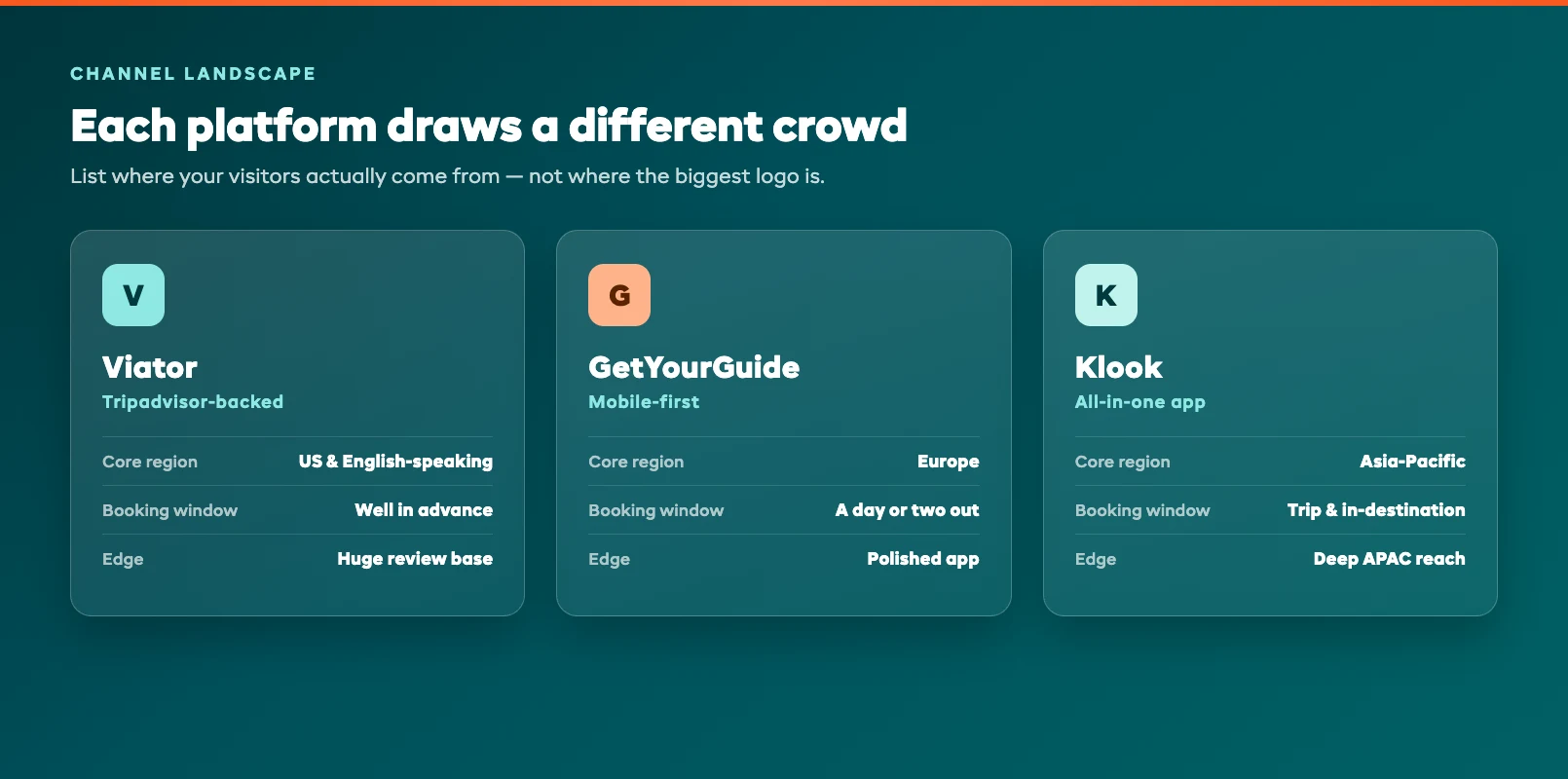
Three platforms dominate attraction distribution, and each pulls a different crowd. Viator — backed by Tripadvisor — leans heavily toward US and English-speaking travelers researching trips well in advance, and benefits from Tripadvisor's enormous review footprint. GetYourGuide is the strongest in Europe, with a polished mobile app and a large base of travelers who book activities a day or two out. Klook is the giant of the Asia-Pacific market, with deep penetration in Hong Kong, Singapore, South Korea and mainland China, and a base that books everything from a single app.
The mistake is treating them as interchangeable. A coastal attraction drawing European summer visitors will see very different results from Klook than from GetYourGuide, and a museum relying on North American tourists lives or dies on Viator. List where your actual visitors come from, not where the biggest logo is. Beyond the big three, regional players and bed-bank resellers can fill specific gaps — but they add operational load for every contract, so start narrow.
Commission Rates for Attractions: The Real Math
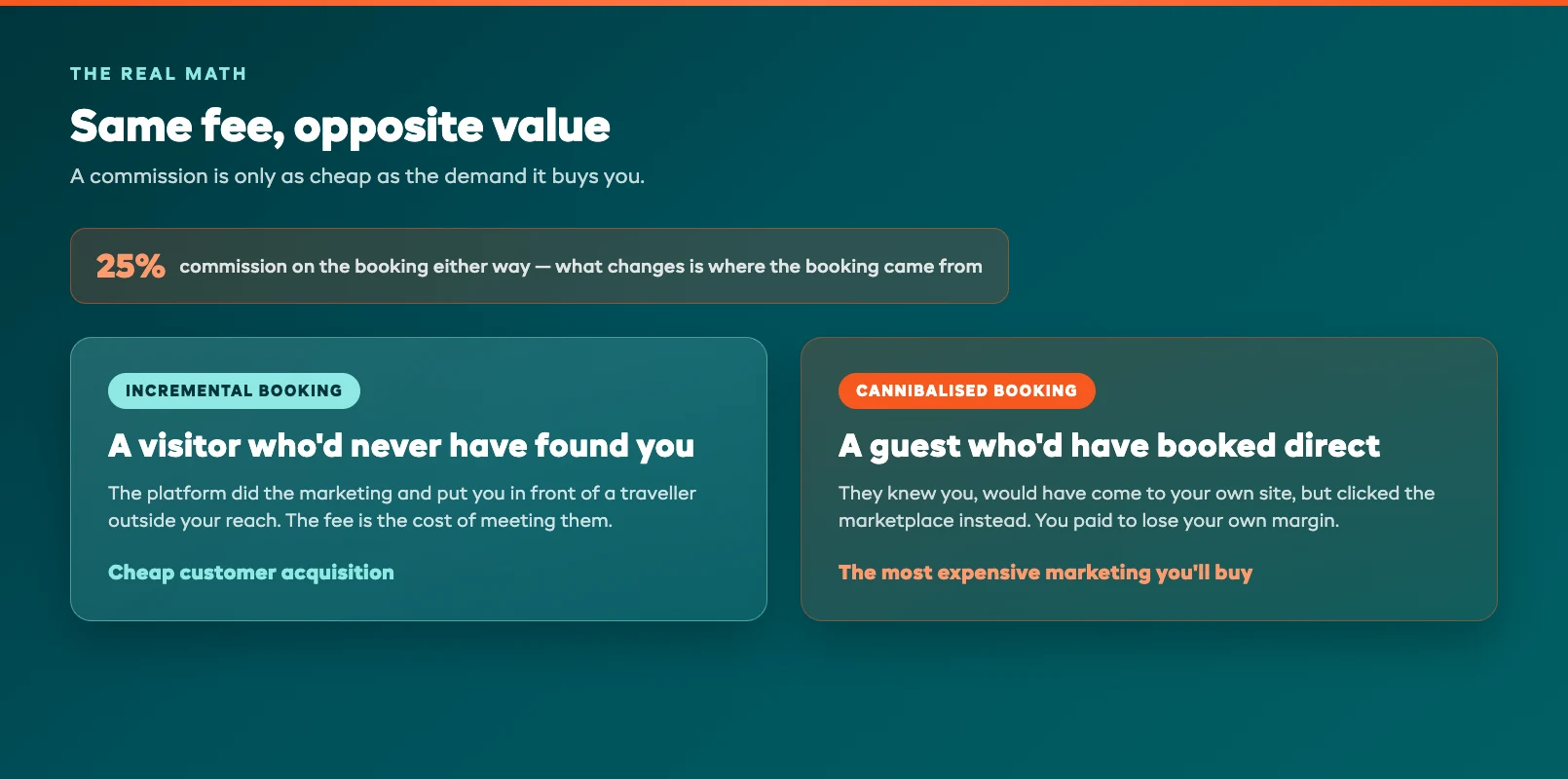
OTA commission for attractions and activities typically runs 20–30% of the booking value — higher than the single-digit margins hotels negotiate, because activity inventory is fragmented and the platforms do the marketing heavy lifting. That number is the headline, but the real cost depends on what the booking would have done otherwise. A commission paid on a visitor who'd never have found you is pure incremental revenue. A commission paid on a guest who'd happily have booked direct is margin you simply handed away.
So run two calculations, not one. First, the blended cost: total OTA commission divided by total revenue tells you what distribution actually costs as a share of the business. Second, the incrementality question: for each platform, roughly how many of those bookings are genuinely new versus visitors you'd have captured anyway? A 25% commission on truly new demand is cheap customer acquisition. The same 25% on guests cannibalised from your own site is the most expensive marketing you'll ever buy. Most operators only ever look at the first number and miss the one that matters.
Ranking Factors: Why Some Listings Get All the Bookings
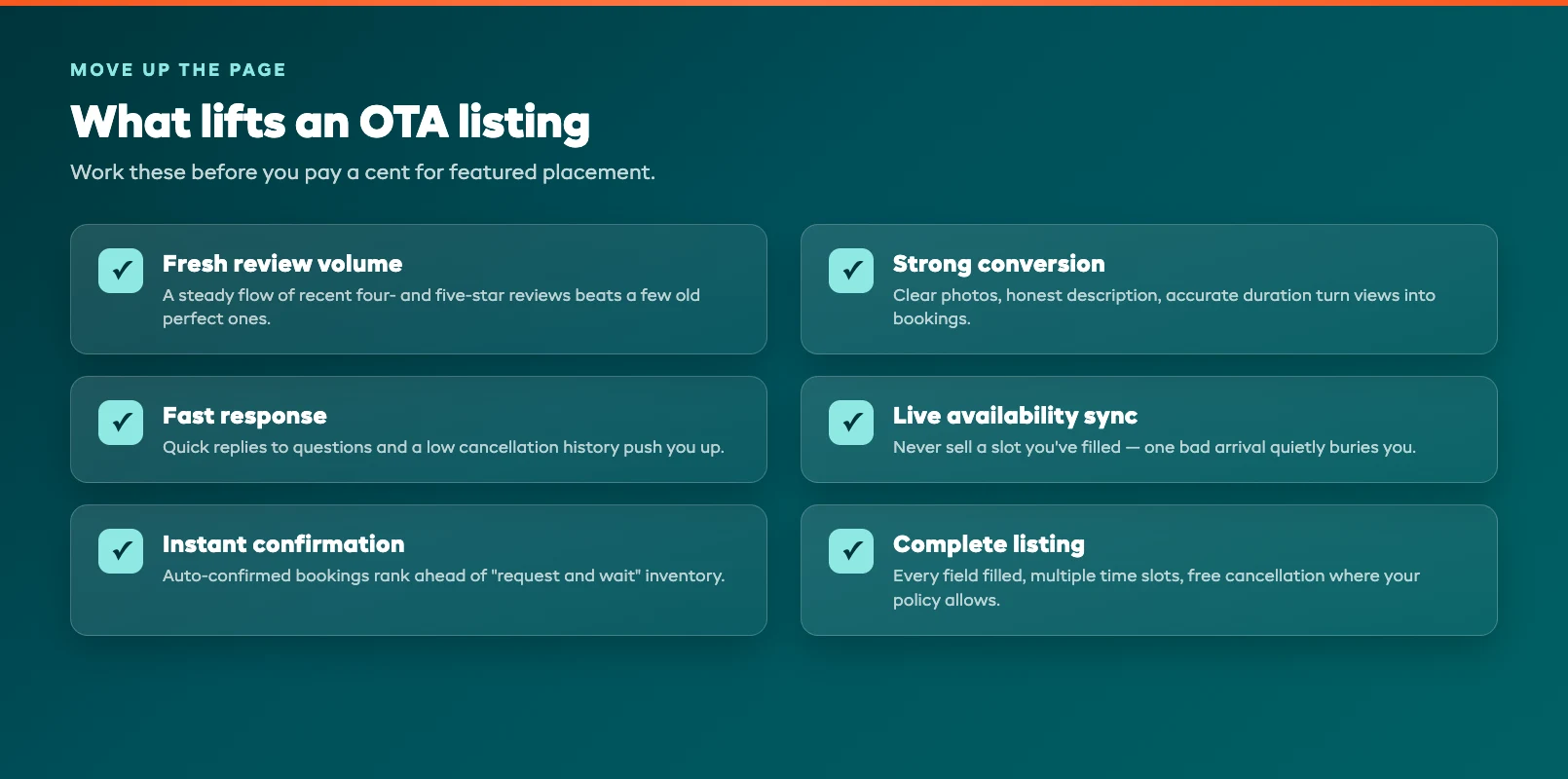
A listing nobody sees earns nothing, and OTA search results are a ranking game much like Google. The platforms don't publish their exact algorithms, but the levers are consistent across all three. Review volume and recent rating carry enormous weight — a steady flow of fresh four- and five-star reviews lifts you far more than a handful of old perfect ones. Conversion rate matters too: listings that turn views into bookings get shown more, so clear photos, an honest description, and an accurate duration all feed your position.
Operational signals are the underrated half. Fast response to questions, low cancellation rates, instant confirmation, and live availability that's never out of date all push you up — and a single "unavailable on arrival" complaint can quietly bury you. Keep your inventory synced in real time so an OTA never sells a slot you've already filled. Competitive, consistent pricing helps, and so does completeness: filling every field, offering multiple time slots, and adding free cancellation where your policy allows. Work the list below before you spend a cent on featured placement.
Protecting Your Direct Channel
Every booking that arrives through an OTA at 25% commission is a booking you'd rather have taken on your own site at zero. OTAs are worth it for reach, but if you let them become your default front door, you're renting your own customers back at a permanent discount. The goal isn't to leave the platforms — it's to use them to acquire visitors once, then bring them home for the next visit.
The mechanics are straightforward and mostly happen on-site, after the OTA has done its job. Capture the guest's email at check-in or through your own confirmation flow, and follow up with a reason to book direct next time — a member rate, a season pass, an exclusive add-on the OTA never lists. Make your own booking experience faster and cheaper than the marketplace so a repeat visitor has no reason to go back through Viator. A clean post-visit follow-up is the cheapest direct-channel builder you have, and our post-visit review and rebooking agent can run that nudge automatically so it never gets forgotten on a busy week. The same capacity discipline you use for managing attraction capacity applies here: reserve your best inventory and time slots for direct guests where you can.
Optimizing the Channel Mix
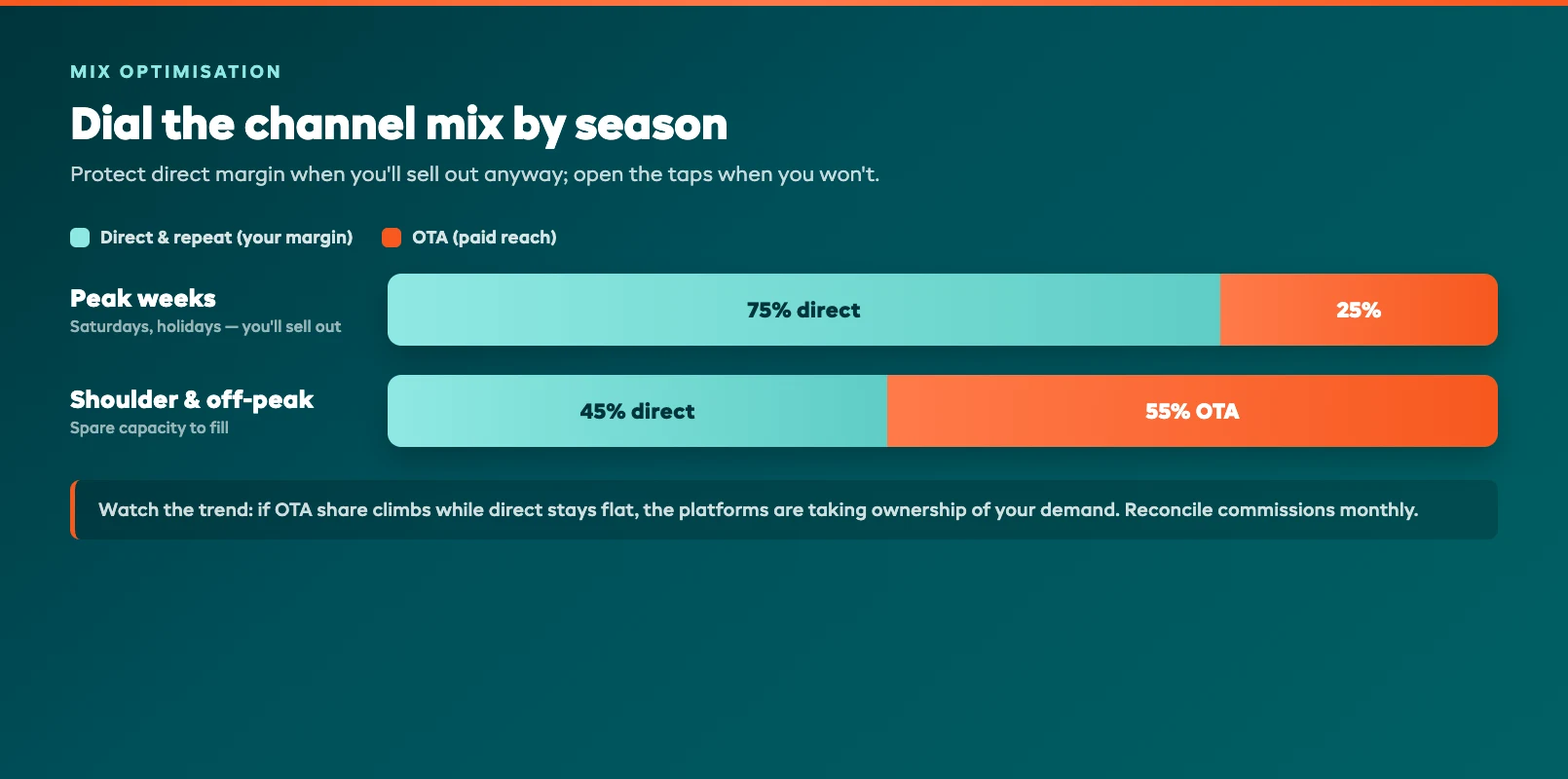
The right mix is the one where OTAs fill demand you couldn't reach yourself, while direct and repeat bookings carry the margin. There's no universal ratio — a brand-new attraction with no audience might lean 70% OTA in year one and work that down as its own channel grows, while an established site with a strong local name might keep OTAs to a quarter of volume. What matters is watching the trend: if your OTA share is climbing while direct is flat, the platforms are slowly taking ownership of your demand.
Treat the mix as a dial you adjust by season and by slot. In peak weeks when you'll sell out regardless, dial OTA inventory back and protect direct margin — you don't need to pay 25% to fill a Saturday that fills itself. In shoulder and off-peak periods, open the taps and let the OTAs do what they're good at: finding visitors you'd otherwise never see. Reconcile commissions monthly against bookings so the cost never drifts unnoticed, and keep your admission and ticketing audit current so every channel reports against the same numbers. The operators who run their group and school bookings and season pass programs direct, while feeding OTAs only the inventory they can't sell themselves, end up with the healthiest margin.
International vs Domestic Demand
Where your visitors come from should shape which platforms you prioritize and how you present your listing. International travelers book further ahead, value instant confirmation and clear cancellation terms because their plans are fragile, and lean on the platform they trust at home — which is why Klook matters so much for Asia-Pacific arrivals and GetYourGuide for European ones. Domestic visitors book later, often on mobile, and are far more likely to find you directly or through a quick search, so they're the easiest to pull off the OTAs and onto your own channel over time.
Practical adjustments follow from that. List currency and language to match the platform's core audience, lead your photos and description with what an out-of-town visitor needs to know — how to get there, what's included, how long it takes — and weight your platform effort toward the regions your real bookings come from. If your seasonal pattern swings between domestic spring crowds and international summer ones, your channel strategy should swing with it. Weather-driven changes feed in here too; keep your weather refund policy consistent across every OTA so an international guest sees the same terms wherever they book, and make sure your front-line staff and safety and compliance standards read the same to every visitor regardless of channel.
Putting It Together
OTAs are not the enemy and they're not a free lunch — they're a paid acquisition channel with its own rules. Pick the platforms that match where your visitors actually come from, run both the blended and the incremental commission math so you know what distribution really costs, work the ranking factors before you pay for placement, and use every OTA booking as a chance to win a direct relationship for next time. Get that balance right and the marketplaces become what they should be: a way to meet travelers you'd never have reached, on terms you can live with. For the full operating picture, the attractions hub and our attractions glossary tie the rest of the playbook together.
FAQ
What commission do OTAs charge attractions?
Most OTAs charge attractions and activities 20–30% of the booking value, higher than the rates hotels negotiate because activity inventory is fragmented and the platforms handle the marketing. The headline rate matters less than whether the booking is incremental — a commission on a visitor you'd never have reached is cheap acquisition, while the same fee on a guest who'd have booked direct is margin handed away.
Which OTA is best for my attraction — Viator, GetYourGuide or Klook?
It depends on where your visitors come from. Viator skews toward US and English-speaking travelers and benefits from Tripadvisor's reviews, GetYourGuide is strongest in Europe with a heavy mobile base, and Klook dominates the Asia-Pacific market. List where your actual bookings originate rather than chasing the biggest brand, and you'll get far more from the same effort.
How do I rank higher in OTA search results?
The levers are consistent across platforms: a steady flow of fresh four- and five-star reviews, a strong conversion rate from clear photos and accurate descriptions, fast response times, low cancellation rates, instant confirmation, and live availability that's never out of date. Fill every listing field, offer multiple time slots, and keep inventory synced in real time before you spend anything on featured placement.
How do I stop OTAs from cannibalising my direct bookings?
Use OTAs to acquire a visitor once, then bring them home. Capture the guest's email through your own confirmation or check-in flow, follow up with a reason to book direct — a member rate, season pass or exclusive add-on the OTA never lists — and make your own booking experience faster and cheaper than the marketplace. An automated post-visit nudge keeps that follow-up from slipping on a busy week.
What's a healthy OTA-to-direct booking ratio?
There's no universal number. A brand-new attraction with no audience might lean 70% OTA in year one and work it down as its direct channel grows, while an established site might keep OTAs to a quarter of volume. Watch the trend rather than the snapshot — if OTA share is rising while direct stays flat, the platforms are slowly taking ownership of demand you should own.
Should I list different inventory on OTAs by season?
Yes. Treat the mix as a dial: in peak weeks when you'll sell out anyway, pull OTA inventory back and protect your direct margin, and in shoulder and off-peak periods open it up so the platforms find visitors you couldn't reach yourself. Reconcile commissions monthly so the cost of distribution never drifts unnoticed.
in one place