How to Scale a Pontoon Rental Business Past 10 Vessels
You started with two pontoons and a clipboard. Bookings came through phone calls. You cleaned boats yourself. The money was good, and adding a third felt like a no-brainer.
Now you're at six or eight vessels and something feels different. You're not running a side business anymore — you're managing a fleet. The systems that worked at three boats are breaking at eight. You're double-booking weekends, your maintenance schedule is guesswork, and hiring is eating your margins.
Pontoon rental businesses hit predictable breaking points. Not every operator reaches them at the same vessel count, but the pattern is consistent: what works at 5 boats fails at 10, and what works at 10 collapses at 20.
For the full boat rental operator playbook — licensing, insurance, and fleet economics — see our complete boat rental business guide. For damage deposit strategy as you scale, see our boat damage deposits guide. If you're weighing whether to offer captained charters alongside self-drive rentals, our captained vs bareboat economics breakdown covers the numbers.
Scale Breakpoints
Pontoon fleet growth isn't linear. It moves in steps, and each step demands a structural change — not just more of the same.
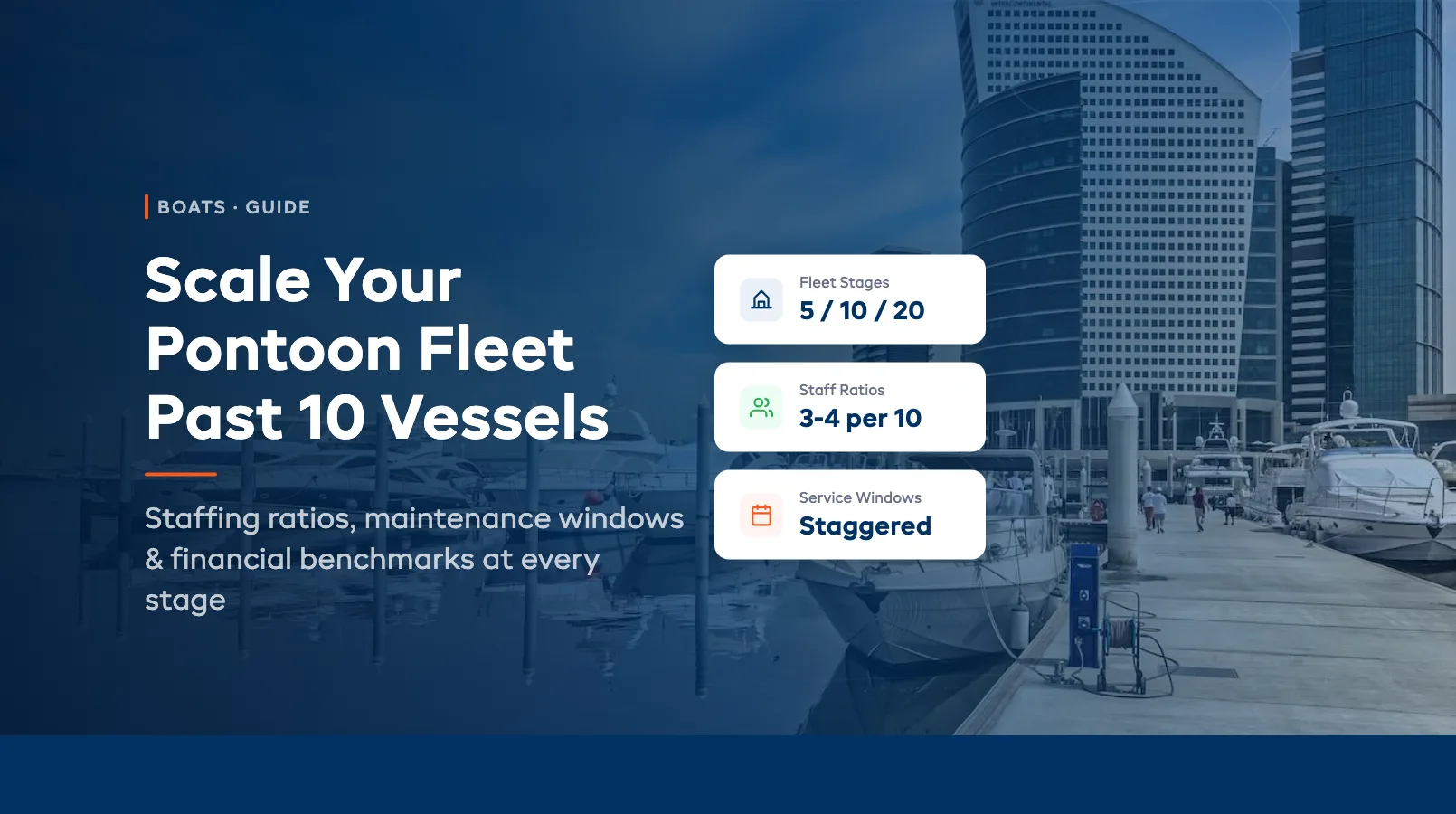
1–5 vessels: Owner-operator mode. You handle bookings, cleaning, maintenance scheduling, and customer interactions personally. A shared calendar and a phone number work. Revenue per boat is high because overhead is almost zero. You might gross $40,000–$60,000 per vessel per season in a strong market.
6–10 vessels: First management layer. You can't personally clean, brief, and dispatch 8 boats on a Saturday morning. You need at least 2–3 part-time dock hands, a scheduling system that prevents conflicts, and a maintenance tracker that doesn't rely on your memory. This is where most operators stall — they resist hiring because it cuts into per-boat margins.
11–20 vessels: Operations manager required. At this scale, you need a full-time person who isn't you managing daily operations. You're spending time on fleet acquisition, marketing, marina negotiations, and possibly a second location. Trying to run 15 boats and handle strategy simultaneously burns operators out within two seasons.
20+ vessels: Multi-location or specialized fleet. You're running a regional operation. Separate profit centers, dedicated maintenance crews, and booking technology that handles dynamic pricing and yield management across locations.
Staff-to-Vessel Ratios
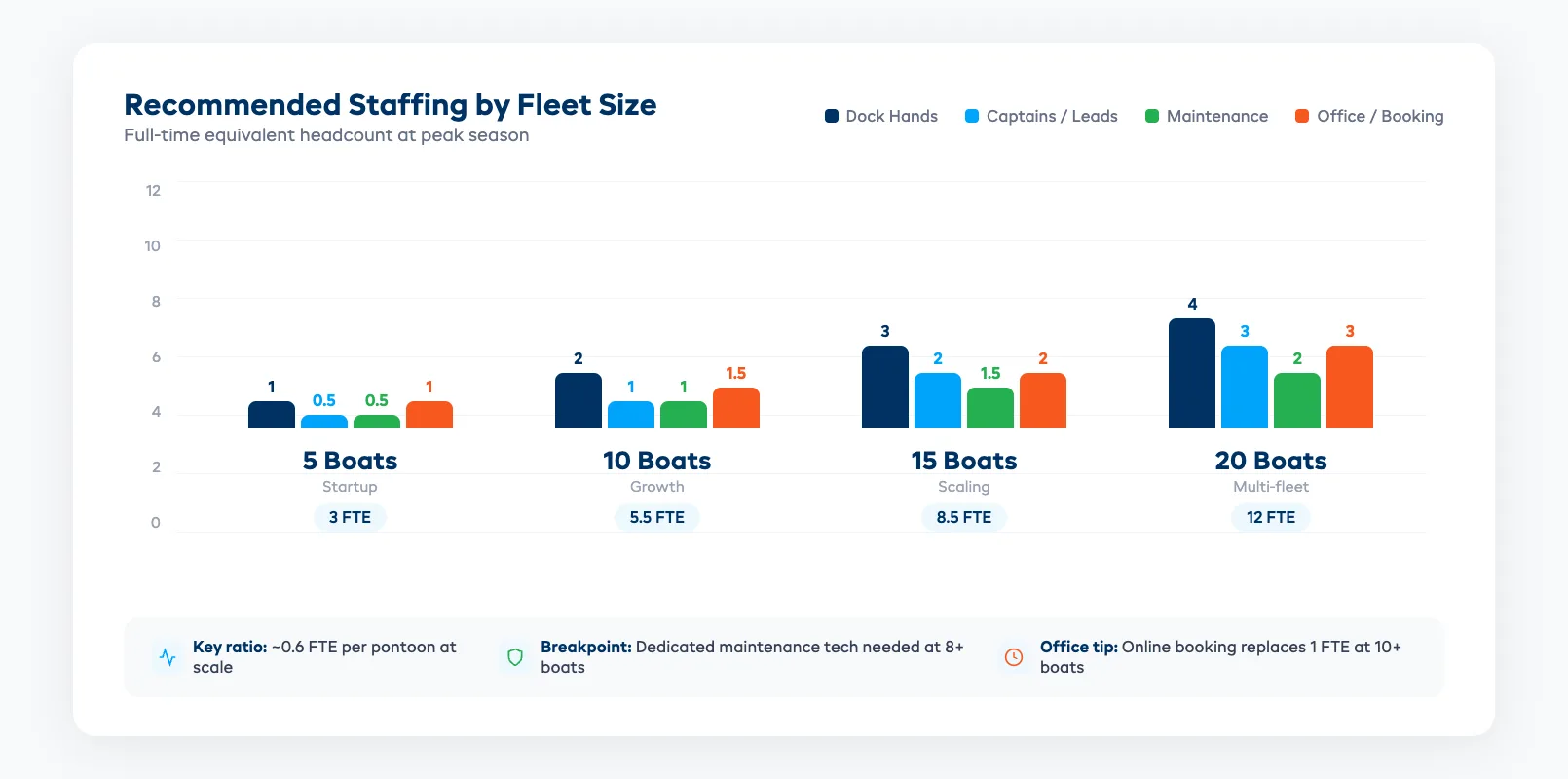
Understaffing is the fastest way to kill customer experience as you grow. Overstaffing kills margins. Here's what actually works:
Dock hands: 1 per 3–4 active boats. An active boat means one that's departing or returning that day. If you have 10 boats and 8 are booked on Saturday, you need 2–3 dock hands working. They handle pre-departure checks, customer walkthroughs, cleaning between rentals, and fueling.
Check-in staff: 1 per 5–6 departures per shift. A check-in takes 8–12 minutes — ID verification, deposit hold, waiver, safety briefing. One person can't process more than 6 customers per hour without rushing the safety briefing or creating a queue.
Maintenance tech: 1 per 8–10 boats. Pontoons are lower-maintenance than outboard ski boats, but they still need engine service, upholstery cleaning, bimini repairs, and annual haul-outs. Below 8 boats, your dock hands can handle basic maintenance. Above 8, you need a dedicated tech — or you'll defer maintenance until something fails mid-rental.
Operations manager: required at 10+ boats. This person owns the schedule, handles customer escalations, coordinates maintenance, and manages staff. Without this role, you're the bottleneck. Every decision routes through your phone.
Use our boat dock handling and check-in protocol checklist to standardize what your growing team does at each touchpoint.
Maintenance Scheduling
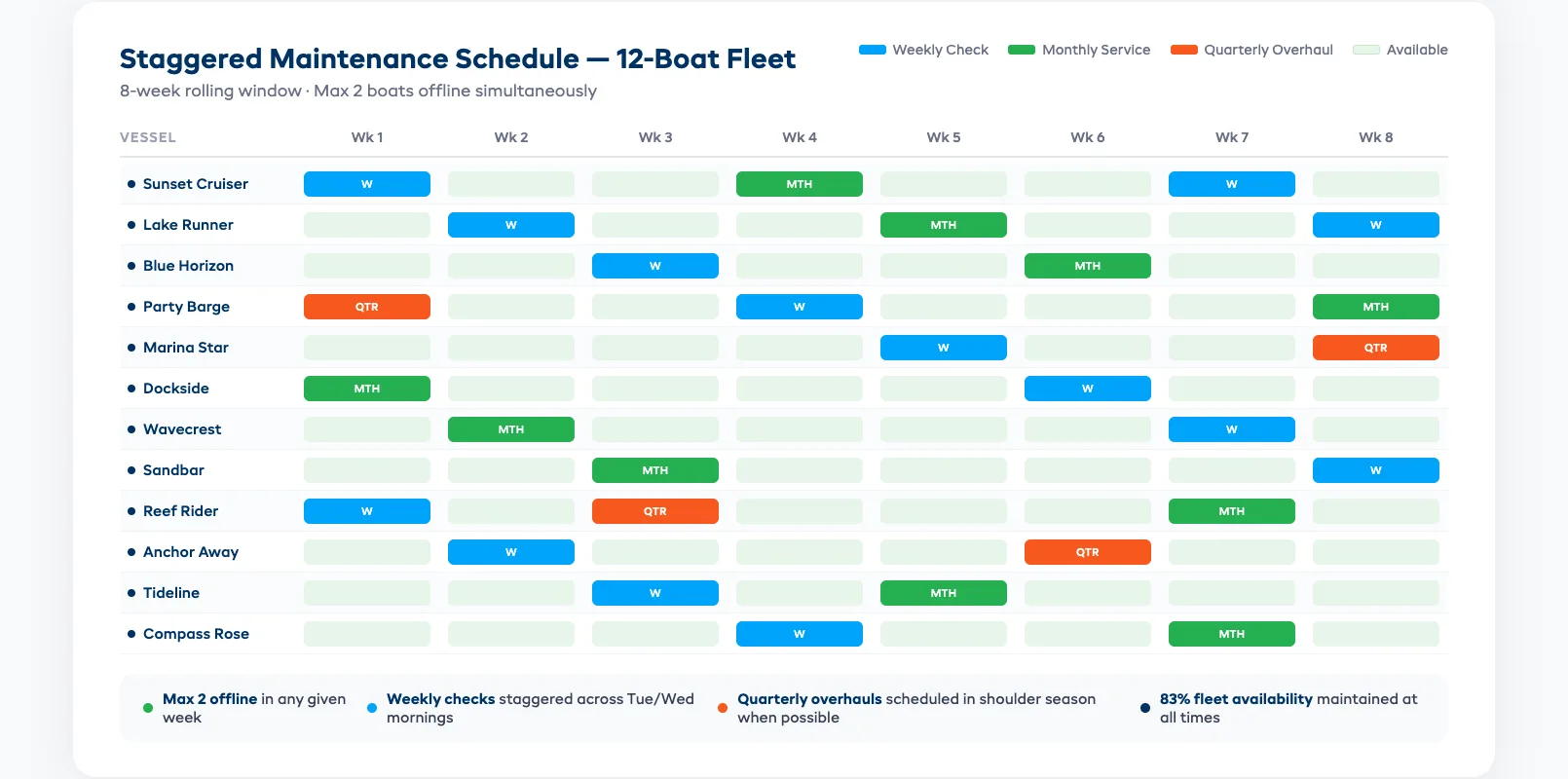
At 3 boats, you remember which engine has 200 hours on it. At 12 boats, you don't. Deferred maintenance at scale creates cascading failures — a blown impeller grounds a boat on your busiest Saturday, costing you $800–$1,200 in lost rentals plus the repair.
Engine hours, not calendar days. Pontoon outboards need service every 100 hours. A boat rented 6 hours a day, 5 days a week hits 100 hours in 3.3 weeks during peak season. Calendar-based scheduling (every 3 months) misses high-use boats and over-services low-use ones.
Stagger your service windows. Never pull more than 20% of your fleet for maintenance simultaneously. If you have 10 boats, one is in service at any time. Schedule routine maintenance for your slowest days — Tuesdays and Wednesdays for most lake and river markets.
Track by vessel, not by gut. Each boat gets a service log: engine hours at last service, impeller replacement date, upholstery condition score, trailer bearing status, and next service threshold. When the booking system flags a boat approaching its hour limit, pull it before it breaks. Our boat engine service log template standardizes this tracking.
Winter maintenance is non-negotiable. Every pontoon gets a full inspection and service during the off-season — lower units, anodes, fuel system, electrical, upholstery, and bimini. Operators who skip winter prep lose 2–4 boats to preventable failures in the first month of the next season.
For detailed maintenance logging systems, see our boat maintenance logs guide.
Booking Technology Requirements
Your booking system needs change at each scale breakpoint. Here's the minimum viable tech stack at each stage:
1–5 boats: Calendar + manual confirmations. Google Calendar with color-coded boats works. You confirm bookings by phone or text. It's manual but manageable because you're fielding 15–30 bookings per week.
6–10 boats: Real-time online booking required. At 50+ bookings per week, manual confirmation creates double-bookings. You need a system that shows real-time availability, accepts bookings 24/7, processes deposits automatically, and sends confirmation emails without your involvement. This is the stage where most operators adopt booking software.
11–20 boats: Dynamic pricing + maintenance integration. Your booking system needs to adjust pricing based on demand (weekends vs weekdays, holidays vs shoulder season), block boats automatically when maintenance is due, and report utilization per vessel. You're making fleet decisions based on data — which boats earn their keep, which ones should be sold.
20+ boats: Multi-location + yield management. Different marinas, different pricing, different staff schedules. Your system needs location-level reporting, cross-location availability (so a customer can see all your inventory regardless of where they search), and API integrations with your accounting and maintenance systems.
At every stage, the system must handle waivers, damage deposits, and automated customer communications. Operators who outgrow their booking technology lose 10–15% of potential bookings to friction — customers abandon a phone-only booking process or bounce from a clunky website.
Financial Benchmarks
Know your numbers at each stage so you can spot problems before they become crises.
Revenue per vessel per season:
- 5-boat operation: $45,000–$65,000 per boat (high utilization, minimal overhead)
- 10-boat operation: $35,000–$55,000 per boat (staff costs reduce per-boat margin)
- 20-boat operation: $30,000–$50,000 per boat (overhead increases, but total profit grows)
Utilization target: 55–70% of available days during peak season. Below 55%, you have too many boats or too little marketing. Above 70%, you're likely turning away bookings and should add capacity.
Labor cost: 25–35% of revenue. Below 25% means you're understaffed (expect bad reviews). Above 35% means you're overstaffed or paying above-market rates.
Maintenance reserve: 8–12% of gross revenue. Set this aside monthly. A single engine replacement ($5,000–$12,000) will cripple a season if you haven't reserved for it.
Customer acquisition cost matters more at scale. At 5 boats, word-of-mouth and Google Business fill your calendar. At 15 boats, you're spending $3,000–$8,000/month on advertising. Track cost per booking and lifetime customer value — repeat customers cost $0 to acquire and book 2–3x more than new customers.
Pitfalls at Each Stage
At 5 boats: Refusing to hire. You're saving $15/hour by cleaning boats yourself, but you're missing $500/day in bookings because you can't answer the phone while you're scrubbing a pontoon. The first hire pays for itself within a week.
At 10 boats: No operations manager. You think you can keep running everything by working harder. You can — for one season. Then you burn out, quality drops, reviews slip, and bookings decline. Hire an ops manager before you need one. The transition takes 4–6 weeks and you don't want to be training someone while managing 10 boats during peak season.
At 10 boats: Outgrowing your booking system. You're still using the calendar system from when you had 3 boats. Double-bookings happen weekly. Customers complain they can't book online. You're losing 15–20% of inquiries because you don't respond fast enough. Switch systems during your off-season — never mid-peak.
At 15 boats: Ignoring maintenance data. You haven't tracked engine hours properly since boat #8. Two engines fail in the same week. You're down 13% of your fleet on the July 4th weekend. Total loss: $5,000–$8,000 in refunds and missed bookings, plus $9,000 in emergency repairs at peak-season labor rates.
At 20 boats: Expanding locations without systems. Opening a second marina before your first location runs independently of you. Now you're splitting time between two sites, neither gets full attention, and both decline. Rule: your first location must run without you for 30 consecutive days before you open a second. For the operational details of running a multi-slip marina operation, see our marina operations guide.
FAQ
How many pontoons should I add per year? Add 2–3 vessels per season maximum. Each new boat needs 4–6 weeks of integration — getting it into your systems, training staff on its specific layout, and building rental history. Adding 5 boats at once overwhelms your team and your maintenance schedule.
When should I get a second location vs adding more boats to my current marina? When slip availability limits your growth. If your marina can't accommodate more vessels, or if there's demand in a market 30+ minutes away that you're not serving, a second location makes sense. But only after your first location is systemised.
What's the ideal pontoon size mix for a rental fleet? 60% standard 22–24ft tritoons (fits most families), 25% party barges (26–28ft, higher revenue per hour), and 15% smaller 18–20ft boats (couples, fishermen, lower price point). This mix maximizes revenue while spreading demand across different customer segments.
How do I finance fleet growth? Marine lending at 6–8% for new vessels. Used pontoons (3–5 years old) cost 40–50% less than new and have 70–80% of their useful rental life remaining. Lease-to-own works for operators who want to preserve cash flow. Never finance more than 2 boats per year until your existing fleet covers all debt service.
What insurance changes when I scale past 10 boats? Your commercial marine policy needs fleet coverage, not individual vessel policies. Fleet policies offer 15–25% savings over per-boat coverage. You'll also need higher liability limits ($2M+ aggregate) and possibly an umbrella policy. Get quotes from marine-specialist brokers — standard commercial insurers underwrite poorly for rental fleets.
Should I hire W-2 employees or 1099 contractors for dock staff? W-2 employees. Dock hands work set schedules, use your equipment, and follow your procedures — that's employment by any definition. Misclassifying as 1099 saves money short-term but creates six-figure liability if audited. The IRS and state labor boards are aggressive about this in seasonal businesses.
When do I need a dedicated mechanic vs outsourcing maintenance? At 10+ boats, a full-time marine tech (at $55,000–$75,000/year) costs less than outsourced maintenance ($150–$200/hour x 500+ hours of annual service). The tech also reduces downtime — they're on-site, they know your boats, and they fix issues same-day instead of waiting for a marina service appointment.
Scaling a pontoon rental business is about recognizing breakpoints before they break you. Hire before you're desperate. Systemise before you expand. Track maintenance by hours, not memory. The operators who make it past 20 boats didn't get lucky — they built the infrastructure at 8 boats that let them grow without chaos.
For the full boats vertical — fleet management, captained vs bareboat economics, marina logistics, and more — visit our boats resource hub. Browse key terms in our boat rental glossary.
Also in this series: Fuel policies, provisioning & fine print · Pre-season recommissioning checklist
in one place