Fuel Policies, Charter Provisioning, and Fine Print That Drives Repeat Bookings
Your rental agreement is 3 pages long. Nobody reads it. Then the customer brings the boat back with the tank on empty, cooler trash jammed under the seats, and a $200 cleaning charge they didn't expect. They leave a one-star review about "hidden fees." You lose the rebooking.
This is what happens when fuel policies and extras aren't communicated clearly upfront. The operators who maintain 60%+ repeat booking rates don't have more lenient policies — they have clearer ones. They frame charges as choices, not penalties. They make provisioning feel like a service, not a surcharge.
For the full boat rental operator playbook — licensing, insurance, fleet sizing — see our complete boat rental business guide. For damage deposit structure and communication, see our boat damage deposits guide.
Fuel Policy Options
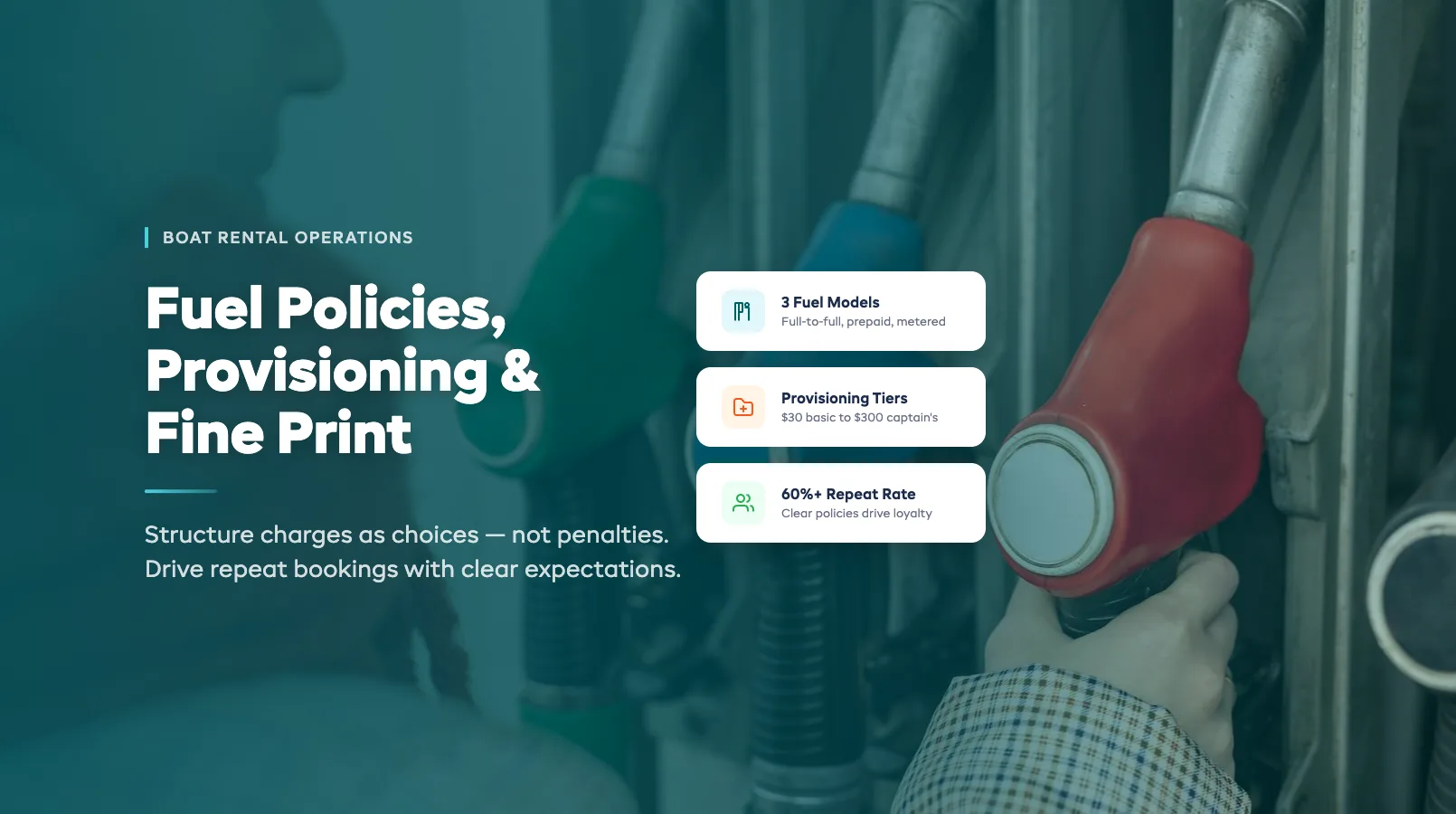
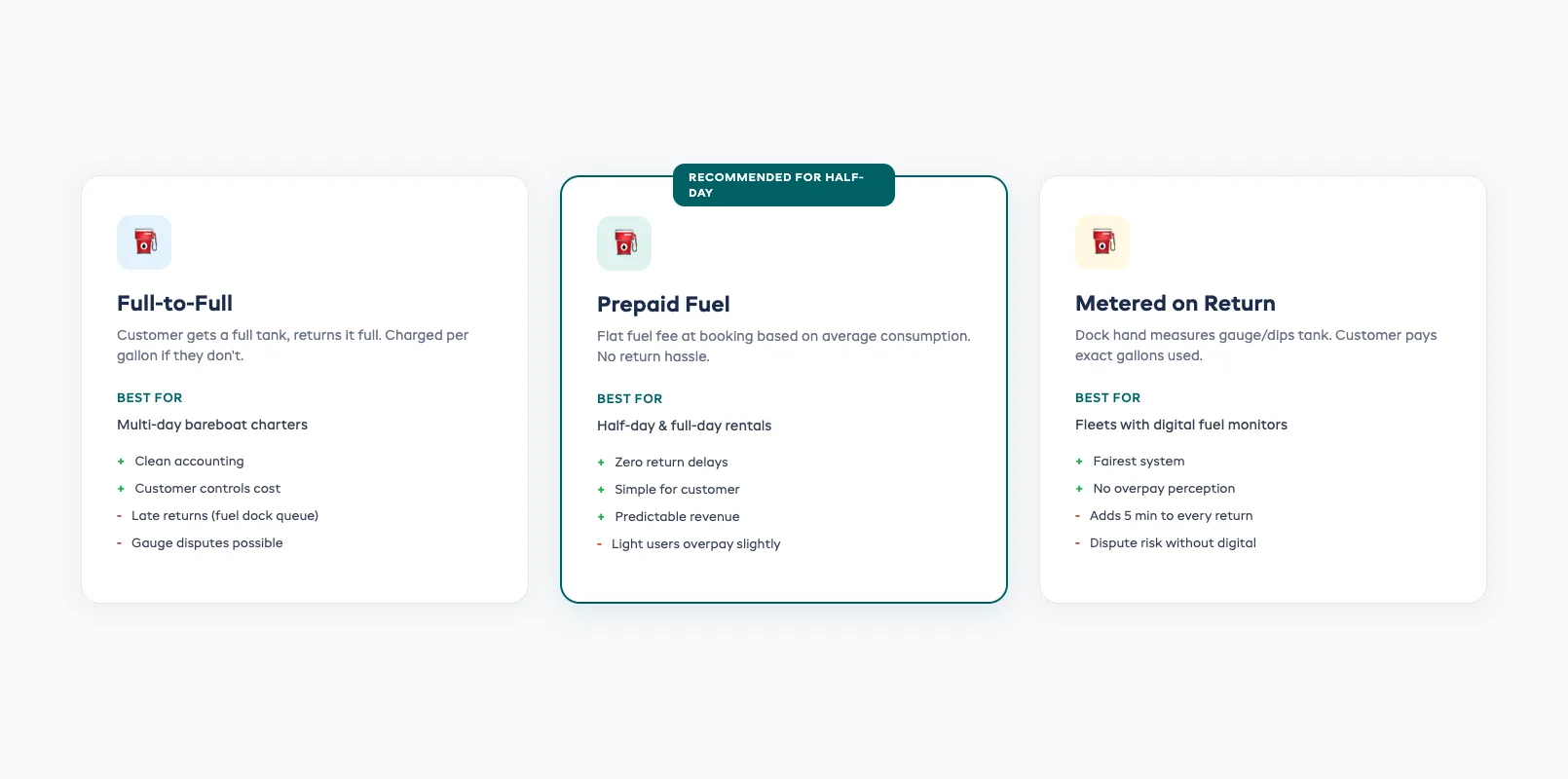
Three models exist. Each has trade-offs in revenue, customer friction, and operational complexity.
Full-to-full. Customer receives a full tank, returns it full. If they don't, you charge your posted per-gallon rate (typically $1.50–$3.00 above marina pump price to cover your time and handling). This is the industry standard for multi-day charters and bareboat rentals.
Pros: clean accounting, customers control their cost, no disputes about how much fuel was used. Cons: customers must find a fuel dock before returning — which means they're late 15% of the time if the nearest pump has a queue.
Full-to-empty (prepaid fuel). Customer pays a flat fuel charge at booking — calculated from average consumption for that vessel class. A 24-foot pontoon on a 4-hour half-day rental burns 8–12 gallons. Charge for 12 at your posted rate.
Pros: zero return delays, no fuel dock detours, simple for the customer. Cons: customers who run gently overpay and some will notice. Works best for half-day and full-day rentals where the fuel cost is $40–$80 and not worth arguing about.
Fuel measured on return. Dock hand checks the gauge or dips the tank. Customer pays for gallons consumed at your posted rate. This requires a reliable fuel gauge and a consistent measurement protocol.
Pros: fairest system — customers pay exactly what they used. Cons: adds 5 minutes to every return, creates potential disputes if your gauge reads differently than the customer's perception. Best for fleets with digital fuel monitors.
Which to choose: Half-day and single-day rentals — prepaid fuel. Multi-day bareboat — full-to-full. Captained charters — include fuel in the charter rate (it's a business expense, not the customer's problem). For captained vs bareboat economics, see our captained charter economics breakdown.
Provisioning Packages
Provisioning is where you turn a boat rental into an experience — and add $50–$200 per booking in ancillary revenue without increasing fleet wear.
Basic provisioning ($30–$50). Ice, bottled water, sunscreen, a Bluetooth speaker, and basic snorkelling gear. Cost of goods: $8–$15. Margin: 70%+. Offer this as a default add-on at checkout — not buried in an "extras" menu.
Premium provisioning ($80–$150). Everything in basic plus a cooler stocked with local craft beers or sparkling water, charcuterie board, towels, floating mat, and waterproof phone pouch. Cost of goods: $30–$50. Present this as "the sunset cruise package" or "the birthday package" — named bundles sell 3x better than à la carte lists.
Captain's provisioning ($150–$300). White-glove setup for captained charters. Champagne, catered lunch, premium Bluetooth sound system, decorations for celebrations. This is a concierge service. Price it like one.
Operational rules for provisioning:
- Prep provisioning the night before or early morning — never while the customer waits on the dock. Your boat shop opening-day checklist should include a provisioning prep step.
- Stock non-perishables in bulk at the start of season. Perishables (cheese, fresh fruit) ordered day-of from a local supplier.
- Track provisioning uptake per booking. If 40%+ of customers select the basic package, raise the price $10 — demand supports it.
Ice and Coolers
Ice seems trivial. It's not. It's the most common customer complaint on half-day rentals: "We ran out of ice by noon."
Provide more than they expect. A 48-quart cooler needs 20 lbs of ice for a half-day rental in summer. Most operators provide 10 lbs. Double it. The ice costs you $4. The five-star review mentioning "they even gave us extra ice" is worth $400 in future bookings.
Cooler placement matters. Bolt a cooler mount in the shade — under the bimini or in the bow storage area. A cooler sitting in direct sun on the back deck melts in 90 minutes. Tell customers where to keep it during the safety briefing.
Offer a cooler upgrade. Your fleet coolers are standard 48-quart Colemans. Offer a 65-quart Yeti-style cooler for $25/day extra. It stays cold 2x longer and feels premium. Some operators buy 5–10 premium coolers and rotate them — they pay for themselves in 8–10 rentals.
Ice refill option for full-day rentals. If your waterway has a marina or dock bar mid-route, tell customers where they can buy ice. If it doesn't, consider offering a mid-day ice delivery for multi-boat party groups (you bring a bag out on your tender). Charge $15. It's a memorable touch.
Cleaning Expectations
Cleaning fees generate more negative reviews than any other charge. The problem isn't the fee — it's the surprise.
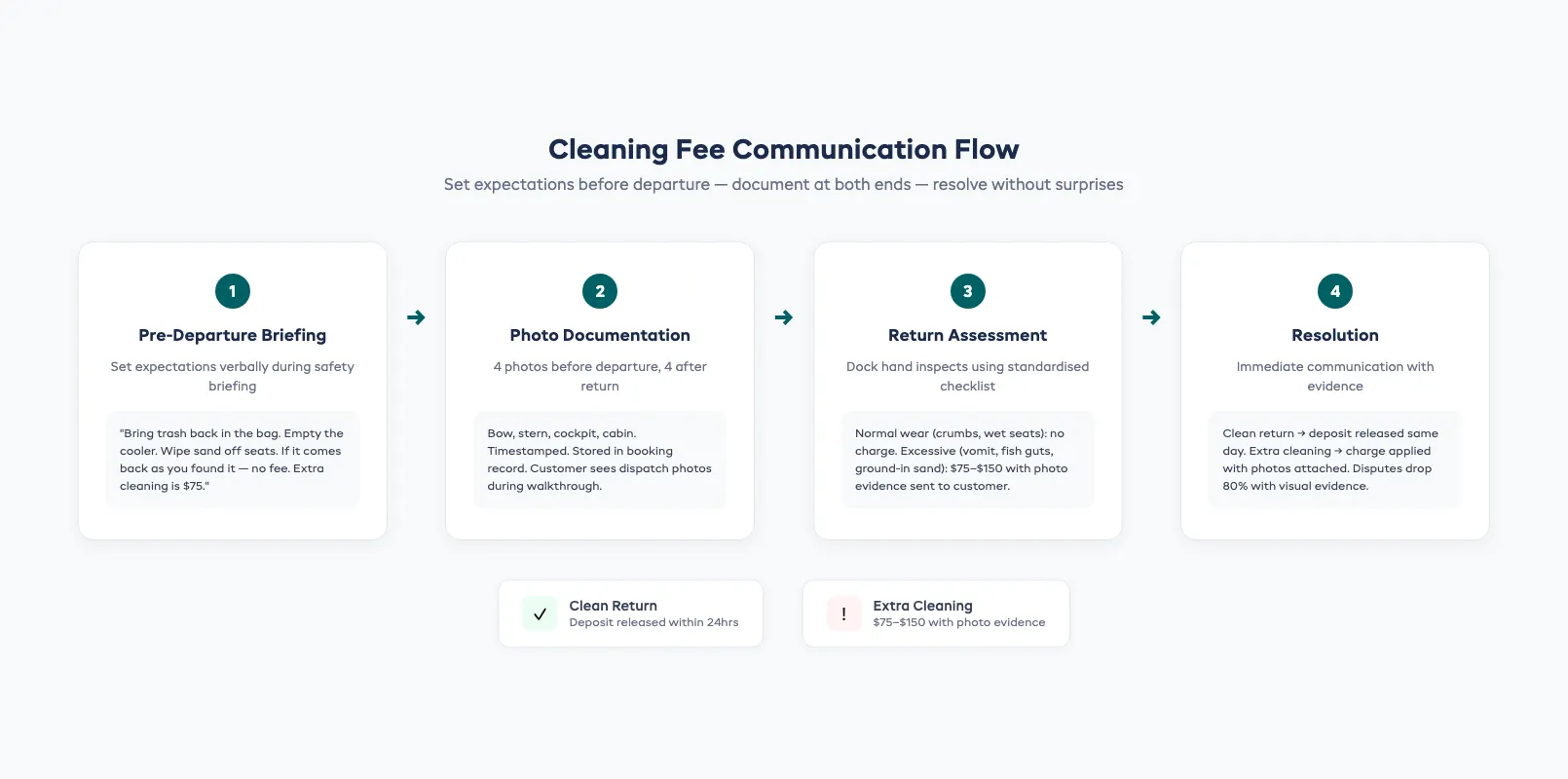
Set expectations before departure, not after return. During the safety briefing, say: "Bring your trash back in the bag we provide. Empty the cooler. Wipe sand off the seats. If the boat comes back in the condition you found it, there's no cleaning fee. If it needs extra work, there's a $75 charge." That's it. Clear, specific, fair.
Define "normal" vs "extra" cleaning. Normal: emptying the cooler, wiping down surfaces, sweeping sand. Your dock team does this between every rental regardless — it's built into your turnaround time. Extra: vomit, fish guts ground into carpet, sunscreen stains on upholstery, trash left everywhere. Extra costs $75–$150 depending on severity.
Photo document before and after. Take 4 photos of the boat before departure (bow, stern, cockpit, cabin). Take 4 after return. If you charge a cleaning fee, send the photos with the charge notification. Disputes drop by 80% when you have visual evidence. Use our boat damage assessment checklist to standardize your return inspection.
Never charge for minor cleaning. A few crumbs, a forgotten water bottle, wet towels on the seat — absorb these silently. Nickel-and-diming on trivial mess destroys repeat business faster than any other operational mistake.
Deposit Release Timing
The deposit release is the last interaction your customer has with your business. It shapes their memory of the entire experience.
Release within 24 hours for clean returns. If the boat came back undamaged and on time, release the hold immediately — or within 24 hours at most. Every day you hold the deposit erodes goodwill. Some operators hold deposits for 7–14 days "just in case." This generates support tickets, frustration, and customers who never rebook.
Communicate the timeline at booking. "Your $500 security deposit hold is released within 24 hours of return, assuming no damage or excessive cleaning required." Put it in the booking confirmation email. Say it during check-in. Remove all uncertainty.
Partial release for fuel or cleaning charges. If the customer owes $45 for fuel, release the remaining $455 immediately and charge the $45 separately. Don't hold the full $500 while you calculate a $45 fuel charge. The math isn't hard. Do it at the dock.
Damage holds: communicate immediately. If you find damage during the return inspection, tell the customer before they leave the dock. Show them the damage and the pre-departure photos. Explain the process: "We'll get a repair quote within 48 hours and contact you. The deposit hold remains until we resolve this." Our boat damage deposits guide covers the full damage communication workflow.
For tracking deposit releases and damage claims across a growing fleet, the boat damage report drafter agent automates the documentation.
Repeat-Customer Framing
Every policy decision is a framing decision. The same rule — stated differently — either builds loyalty or creates resentment.
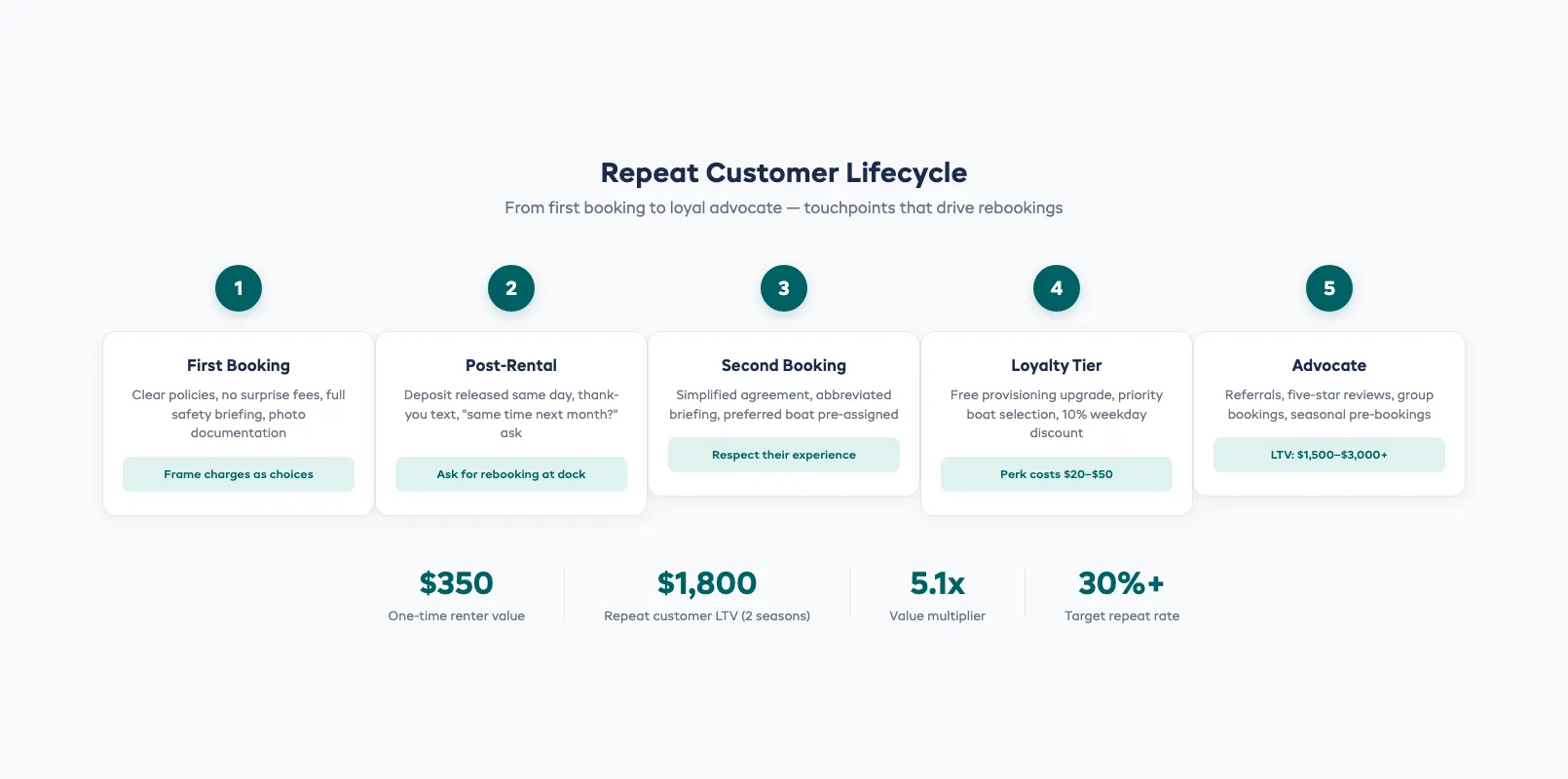
Frame charges as choices, not penalties. "Fuel: return full and pay nothing, or we'll top it off for you at $6.50/gallon" sounds like a service. "Failure to return with a full tank results in a $6.50/gallon fuel surcharge" sounds like a punishment. Same policy. Different emotional response.
Create a "returning renter" tier. After someone's second booking, waive the provisioning fee on their third. Or upgrade their cooler for free. Or send a "welcome back" text with their preferred boat pre-assigned. These gestures cost $10–$30 and increase lifetime value by $300–$500.
Simplify the agreement for repeats. First-time renters get the full 3-page agreement and safety briefing. Returning renters get a one-page renewal acknowledgment and an abbreviated dock briefing. Respecting their experience level respects their time — and signals you remember them.
Ask for the rebooking before they leave. "Same time next month? I can hold this boat for you." A 15-second question at the dock converts 20–30% of satisfied customers into confirmed future bookings. No email sequence needed.
Track repeat customer rates in your booking system. If you're below 30% repeat rate after 2 seasons, your policies — not your boats — are the problem. For scaling your operations to handle growing repeat demand, see our pontoon scaling guide.
FAQ
What's the best fuel policy for half-day pontoon rentals? Prepaid fuel. A half-day rental burns 8–12 gallons on a typical pontoon. Charge a flat $50–$70 fuel fee at booking. It eliminates return delays, simplifies accounting, and customers prefer knowing the total cost upfront.
Should I include provisioning in my base rental price? No. Keep your base rate competitive and offer provisioning as an add-on. This lets price-sensitive customers book at a lower rate while experience-focused customers self-select into higher-margin packages. You make more revenue overall.
How much should I charge for a cleaning fee? $75–$150 for excessive mess (fish guts, vomit, ground-in sand, abandoned trash). Never charge for normal wear — crumbs, wet seats, a forgotten bottle. The threshold should be "did this require extra staff time beyond normal turnaround?"
When should I release the security deposit? Within 24 hours for clean returns. Same day if possible. If damage exists, communicate immediately at the dock and explain that the hold remains until you get a repair quote (48 hours max). Long deposit holds kill repeat bookings.
How do I handle customers who dispute fuel charges? Photo the fuel gauge at departure and return. Log the reading on the rental agreement with the customer's initials. Digital fuel monitors remove ambiguity entirely. If a dispute still arises, split the difference once — then add that customer a note for next time.
What provisioning items have the highest margin? Bluetooth speakers ($3 rental cost, charge $15/day), floating mats ($8 cost, charge $25/day), and basic snorkel sets ($5 cost, charge $20/day). Consumables like ice and water have lower margin but drive satisfaction. Bundle them together for best results.
How do repeat customer programs work for boat rentals? Track bookings per customer. After their second rental, offer a perk on the third — free provisioning upgrade, priority boat selection, or a 10% weekday discount. The gesture costs $20–$50 but increases lifetime value by 3–5x compared to one-time renters.
Running a boat rental operation? Our complete boat rental business guide covers everything from licensing to fleet economics. For marina-specific logistics, see our marina operations guide. And for maintenance systems that keep your fleet earning, check our boat maintenance logs guide.
For the full boats vertical — fleet management, captained vs bareboat economics, marina logistics, and more — visit our boats resource hub. Browse key terms in our boat rental glossary.
in one place