Surf Lesson Business: Pricing, Insurance, and Instructor Management
You're a solid surfer. You've taught friends and family. You think: "I could charge for this." You're right — but the gap between giving a buddy a push into whitewater and running a surf lesson business that pays rent is bigger than it looks. Instructor certifications, liability coverage, no-show policies, weather cancellations, and the economics of group vs private lessons all hit at once.
This guide covers the operational side of running a surf school — the pricing math, the insurance you actually need, how to hire and retain instructors, and the policies that keep your calendar full past the first lesson. For the full water sports rental playbook — fleet, gear, tech stack — see our complete water sports rental business guide.
Lesson Pricing Models
Surf lesson pricing comes down to three formats: per-person group lessons, private one-on-one sessions, and multi-lesson packages. Each has different margins, and the right mix depends on your location, instructor count, and customer profile.
2026 market benchmarks:
| Lesson Type | Budget Market | Mid-Range (Beach Towns) | Premium (Resort Areas) |
|---|---|---|---|
| Group lesson (2h, 4–8 students) | $50–$65/person | $70–$95/person | $100–$140/person |
| Semi-private (2h, 2–3 students) | $75–$90/person | $100–$130/person | $140–$180/person |
| Private lesson (1.5–2h) | $100–$130 | $140–$180 | $200–$300 |
| 5-lesson package | $225–$275 | $300–$400 | $450–$600 |
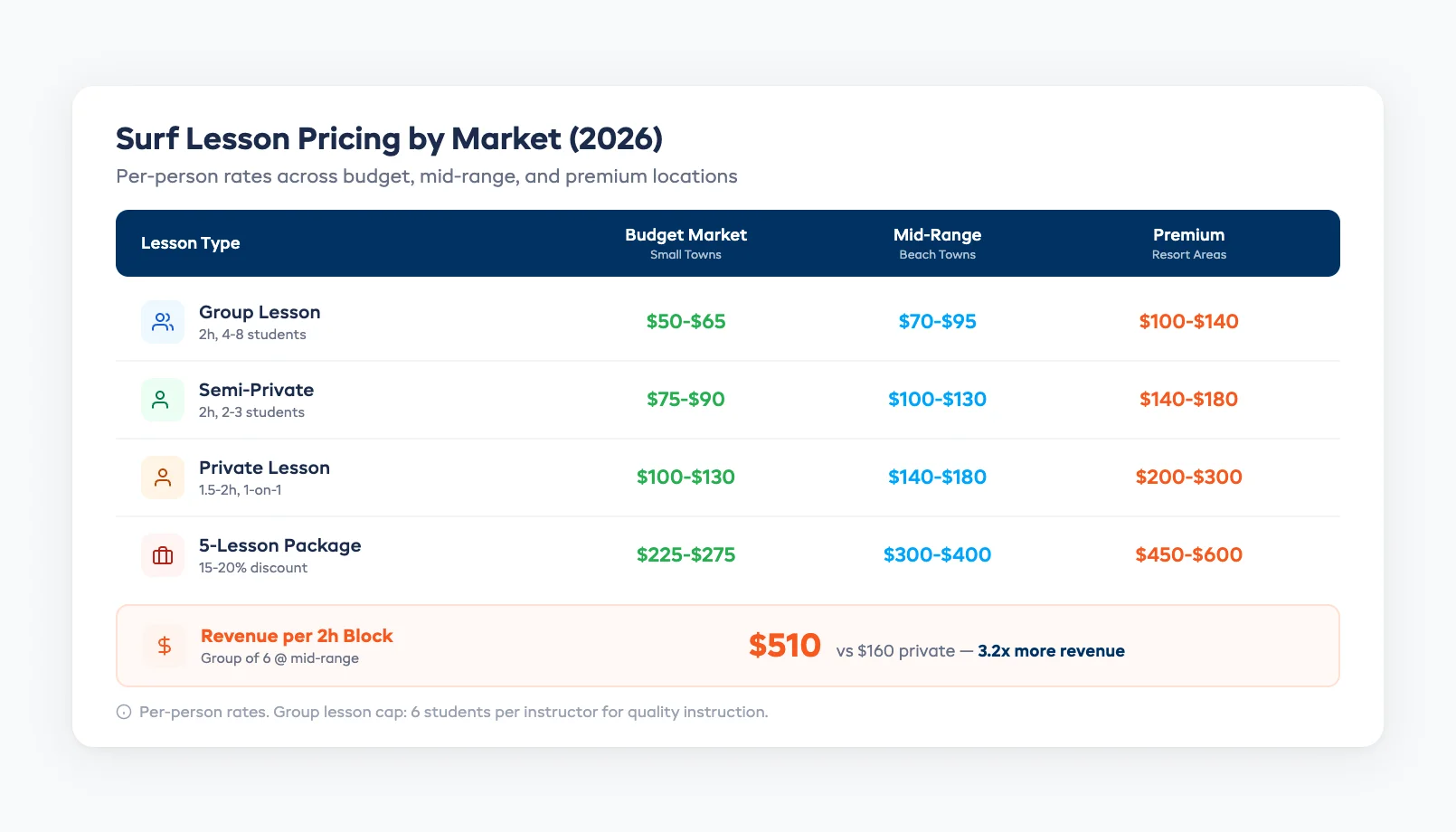
Group lessons are your volume play. A single instructor teaching 6 students at $85 each generates $510 in a 2-hour block. That same instructor doing a private lesson earns you $160. The math is obvious — until you factor in quality. Overcrowded groups get bad reviews. Bad reviews kill your Google listing. Cap groups at 6 students per instructor maximum.
Package pricing rules:
Price your 5-lesson package at 15–20% below the per-lesson rate. A $85/lesson group rate becomes $340–$360 for five sessions. The discount works because it locks the student in for multiple visits — each visit is another chance to upsell board rentals, photos, or gear.
Don't discount beyond 20%. Surf lessons are high-touch, instructor-intensive services. Deep discounts signal low quality and attract price-shoppers who won't convert to repeat customers.
For pricing context across other water sports rentals — SUPs, kayaks, and gear — see our SUP and kayak pricing guide.
Instructor Hiring and Certification
Your instructors are your product. A great instructor fills your calendar through word of mouth. A mediocre one fills your Google reviews with 2-star complaints.
Required certifications (US, 2026):
- ISA (International Surfing Association) Level 1 or 2 — the global standard. Level 1 covers beginner instruction, water safety, and surf etiquette. Level 2 adds intermediate coaching and ocean dynamics. Most insurance providers require at least ISA Level 1.
- CPR and First Aid — current certification from the Red Cross, AHA, or equivalent. Non-negotiable. Renew every 2 years.
- Lifeguard certification — not legally required in most states, but strongly recommended. Some municipalities mandate it for commercial beach instruction.
Pay structures:
| Model | Rate | Pros | Cons |
|---|---|---|---|
| Per-lesson flat fee | $30–$60/lesson | Simple, predictable costs | Instructor doesn't care if 2 or 8 students show up |
| Per-student commission | $10–$20/student | Instructor incentivised to fill groups | Earnings vary wildly by season |
| Hourly + tip share | $18–$28/hr + tips | Stable for instructors, tips reward quality | Higher fixed cost for you |
| Revenue split | 40–50% of lesson fee | Aligns incentives | Complex to track without software |
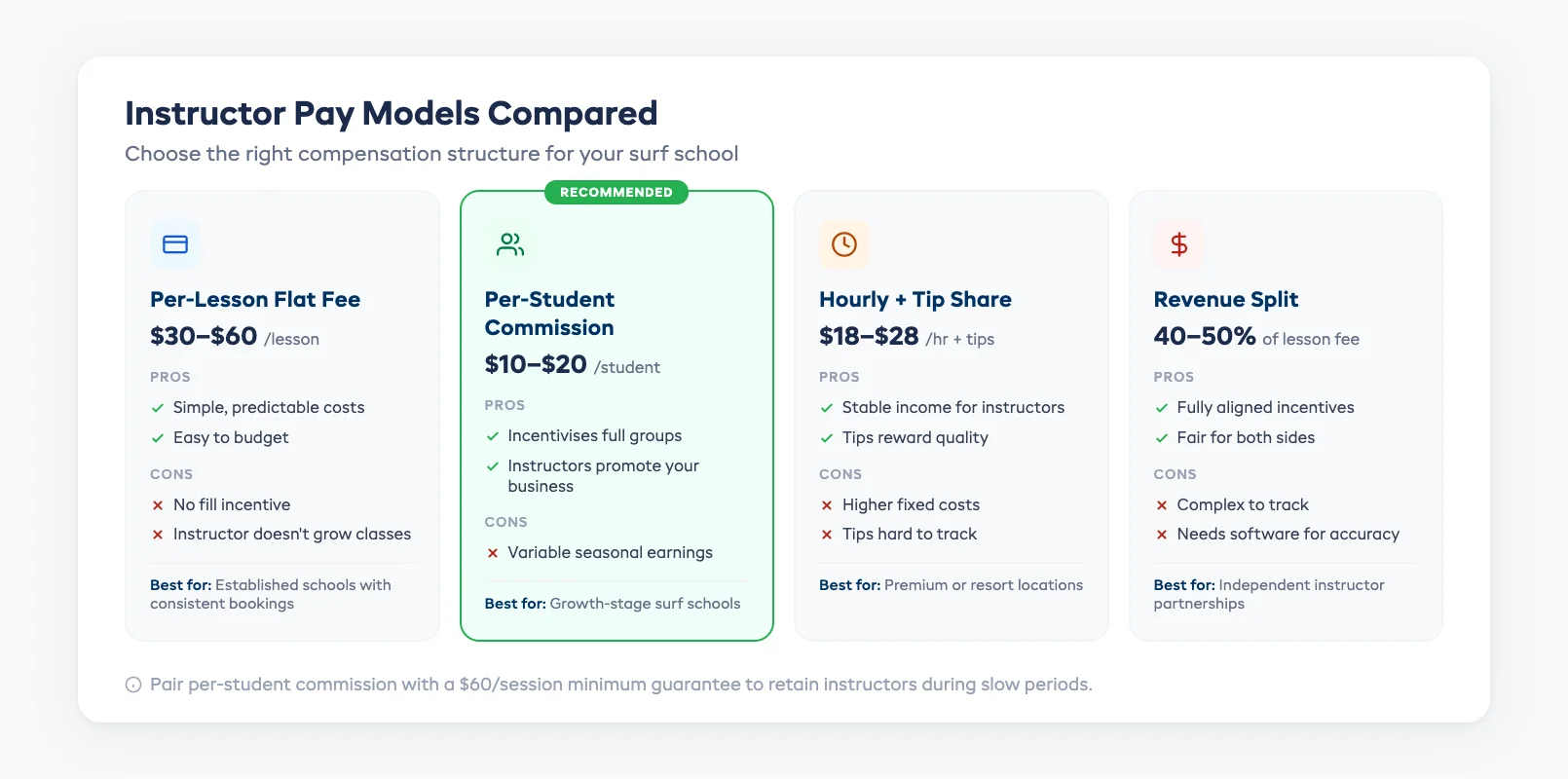
The per-student commission model works best for growth-stage surf schools. Instructors earn more when classes fill, and they start promoting your business to make that happen. Pair it with a minimum guarantee — $60/session floor — so instructors don't bail on slow Tuesday mornings.
Use a surfboard pre-rental inspection checklist before every lesson. Boards take more damage during lessons than during rentals — students drop them, drag fins on sand, and collide with each other. Catching dings before the next session saves you repair costs and liability.
Insurance Requirements
Surf instruction carries real liability. Students are in open ocean, often for the first time, on equipment they don't know how to handle. You need three layers of coverage:
1. General liability insurance Covers bodily injury and property damage claims. A student gets hit by a board, cuts a foot on reef, or claims your instructor was negligent. Standard policy: $1M per occurrence, $2M aggregate. Cost: $1,200–$3,500/year depending on location, student volume, and claims history.
2. Professional liability (errors & omissions) Covers claims that your instruction itself was inadequate — "the instructor didn't warn me about the rip current." This is separate from general liability and often missed by new surf schools. Cost: $500–$1,500/year.
3. Equipment/property coverage Covers your boards, wetsuits, and gear against damage, theft, and loss. A quiver of 20 boards at $800 each is $16,000 in assets sitting on the beach. Cost: $300–$1,000/year depending on inventory value. For daily cleaning routines and retirement criteria that keep your wetsuits and soft gear in rentable condition, see our wetsuit and soft-gear care guide.
Waivers: Every student signs a liability waiver before stepping on the sand. No exceptions. Digital waivers with e-signatures are legally valid in all 50 US states and eliminate the "I lost the paper" excuse. Store waivers for at least 3 years — 7 years if you teach minors, since the statute of limitations doesn't start until they turn 18 in most states. For a detailed breakdown of minor waiver requirements, instructor cert verification, and jurisdictional differences, see our water sports lesson liability guide.
Your waiver should include: assumption of risk, acknowledgment of ocean hazards, medical disclosure, photo/video release, and a cancellation policy clause. Have a lawyer in your state review it — template waivers from the internet are better than nothing, but a state-specific review costs $300–$500 and is worth every dollar.
If you also rent gear alongside lessons, the water sports hub covers how rental operations and lesson businesses integrate under one roof. And if you're considering a second beach or dock, our multi-location scaling guide walks through the staffing, inventory, and tech decisions.
Group vs Private Lessons
This isn't just a pricing decision — it's a scheduling, staffing, and capacity decision.
Group lessons (4–6 students per instructor):
- Revenue per instructor-hour: $170–$285 (at $85/person × 4–6 students, minus instructor cost)
- Require consistent wave conditions — you can't teach 6 beginners in overhead surf
- Work best with standardized curriculum: same briefing, same drills, same progression
- Higher no-show impact — 2 no-shows in a group of 4 tanks your per-session revenue
Private lessons (1 student, 1 instructor):
- Revenue per instructor-hour: $80–$140 (after instructor pay)
- Work in almost any conditions — instructor adapts in real time
- Higher customer satisfaction scores — personal attention, faster progression
- Premium customers who book privates also buy photos, rent boards, and return more often
The optimal mix: Run group lessons mornings (consistent conditions, higher demand, families), privates in afternoons (flexible scheduling, premium clients). Allocate 60–70% of instructor-hours to groups, 30–40% to privates. Adjust seasonally — summer skews group-heavy, shoulder seasons skew private.
Track your no-show rate by lesson type. If group no-shows exceed 15%, tighten your cancellation policy or require deposits. A 24-hour cancellation window with a 50% fee is industry standard.
Weather Policy
Surf instruction is weather-dependent, but not in the way most people think. Rain doesn't cancel a surf lesson. Flat surf does. Lightning does. High surf advisories do.
Your weather policy needs to cover:
- Flat days (< 1 ft): Offer a reschedule or switch to a SUP lesson. Don't refund — you held the slot. If you can pivot to SUP, you keep the revenue and the student still has a good experience.
- High surf advisory: Cancel and offer full reschedule. Don't send beginners into overhead surf. Ever. This is where lawsuits start.
- Lightning within 10 miles: Immediate evacuation. No exceptions. Wait 30 minutes after the last strike before returning to the water.
- No-shows due to weather anxiety: Customers see "cloudy" on their weather app and panic-cancel. A pre-lesson text the morning of — "Conditions look great today, 2–3ft and clean. See you at 9am!" — reduces weather-anxiety cancellations by 30–40%.
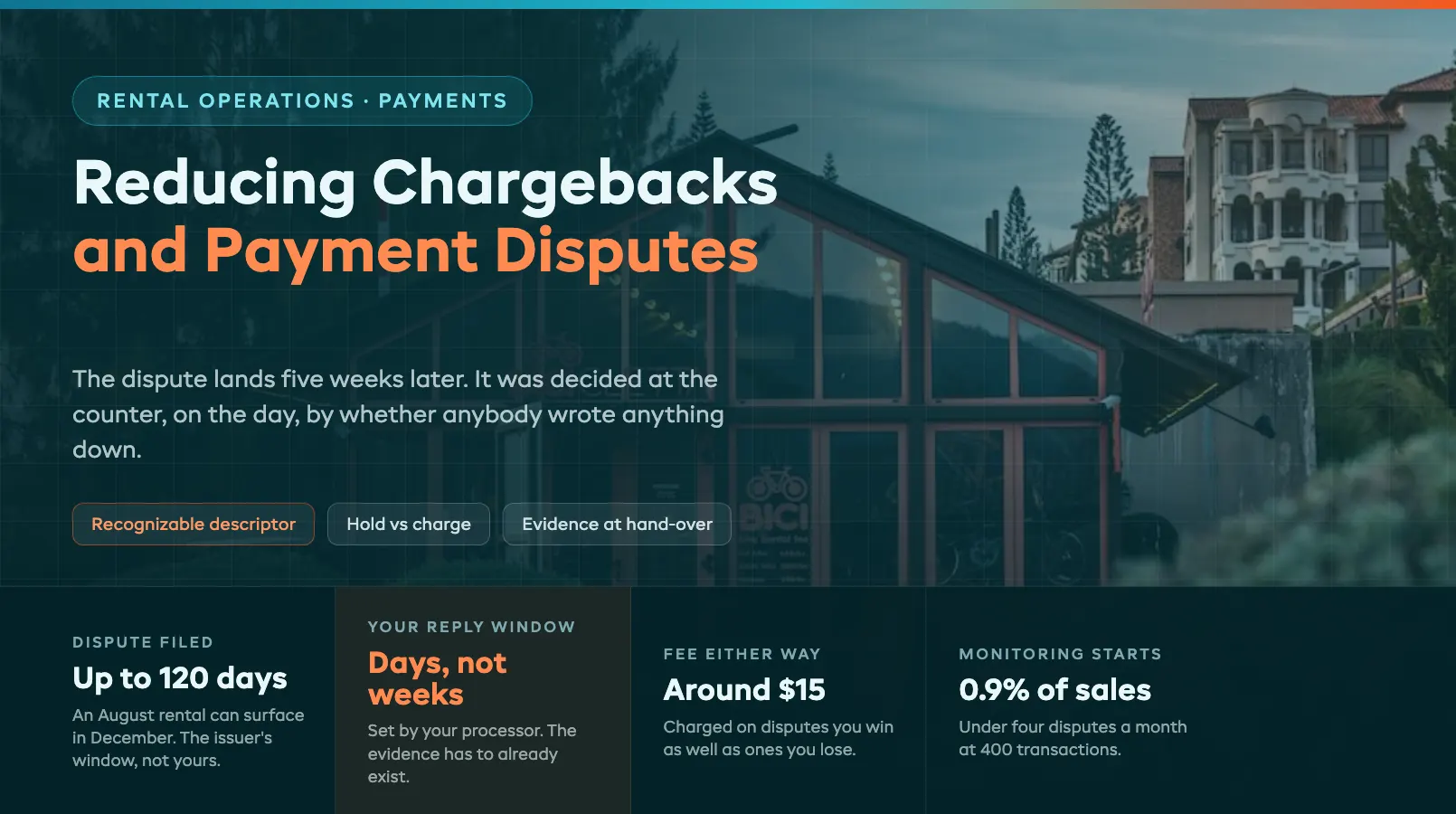
Post your weather policy on your booking page, in your confirmation email, and on your waiver. When a customer disputes a charge, you point to the policy they agreed to three times.
A weather alert agent can automate the morning condition check and send that "conditions look great" text without you pulling up surf reports at 6am. For the full framework on go/no-go timing, reschedule-first communication templates, and the legal structure that protects your revenue on weather days, see our weather operations guide.
Retaining Students Past Lesson One
Most surf schools treat each lesson as a one-time transaction. The student has fun, posts a photo, and never comes back. That's a massive revenue leak.
The retention playbook:
-
Book lesson 2 before lesson 1 ends. While the student is still dripping wet and stoked, your instructor says: "You stood up three times today. In lesson 2, we work on turning. Want to book now?" Conversion rate on beach-side rebooking: 35–45%. Conversion rate on a follow-up email two days later: 8–12%.
-
Send a progress recap within 24 hours. A short email: what they learned, what's next, and a link to book lesson 2 at a 10% returning-student discount. Include one photo or short video clip from their session. This email alone can lift rebooking rates by 15–20%.
-
Create a 3-lesson "Learn to Surf" progression. Lesson 1: pop-up and whitewater. Lesson 2: paddling out and turning. Lesson 3: reading waves and catching green waves. Sell the progression as a bundle at 15% off. Students who complete the series are 4× more likely to rent boards independently — and that's where your recurring revenue lives.
-
Transition surfers to board rentals. After 3–5 lessons, most students are ready to practice on their own. Offer a "graduates" rental rate — 10% off standard board rental for students who completed your lesson series. They're already comfortable with your shop, your gear, and your beach. You've built the relationship; now monetise it as recurring rental revenue.
-
Seasonal reactivation. At the start of each season, email last year's students: "Waves are back. Your skills are rusty. Book a refresher lesson." A customer reactivation agent can automate this outreach and track who rebooks.
The surf schools that grow year over year aren't the ones with the best waves — they're the ones that turn one-time tourists into returning locals and multi-session package buyers. Once you've got one beach running smoothly, the next step is often a second location.
FAQ
How much does it cost to start a surf lesson business? Budget $15,000–$30,000 for year one. That covers 10–15 softop boards ($200–$400 each), wetsuits ($100–$200 each), insurance ($2,000–$5,000), permits and beach access fees ($500–$2,000), instructor certifications ($400–$800 per instructor), and a basic booking system. You can start leaner at $8,000–$12,000 if you already own boards and operate from a public beach with no storefront.
What certifications do surf instructors need? At minimum: ISA Level 1, current CPR/First Aid, and a clean background check. Some states require a business license for commercial beach instruction. Lifeguard certification is strongly recommended. Check your local municipality — some beaches require additional permits for group instruction.
How much do surf instructors get paid? $30–$60 per lesson (flat fee) or $18–$28/hour plus tips. Commission-based models pay $10–$20 per student. Experienced instructors at premium locations can earn $50,000–$70,000/year during the full season when combining base pay, tips, and photo commissions.
Do I need a physical shop to teach surf lessons? No. Many surf schools operate from a beach tent, van, or partner location (hotel, resort, surf shop). A physical storefront adds credibility and retail revenue (selling wax, leashes, rash guards) but increases overhead by $1,500–$4,000/month. Start mobile, build demand, then consider a lease.
What's the best student-to-instructor ratio for surf lessons? 4:1 for beginners. 6:1 maximum for experienced students doing intermediate drills. Never exceed 8:1 — insurance providers may deny claims if an incident occurs in an overcrowded class, and the instruction quality drops sharply beyond 6 students.
How do I handle cancellations and no-shows? Require a credit card at booking. Charge a 50% fee for cancellations within 24 hours. Full charge for no-shows. Weather cancellations get a full reschedule (not refund). Post this policy on your booking page, confirmation email, and waiver. Consistency prevents disputes.
Is surf instruction seasonal? In most locations, yes. Peak season runs May–September in the Northern Hemisphere. Hawaii, Southern California, and tropical destinations can operate year-round. Use off-season months for instructor training, equipment maintenance, and building your online presence. Some schools pivot to SUP lessons or indoor surf training during the off-season.
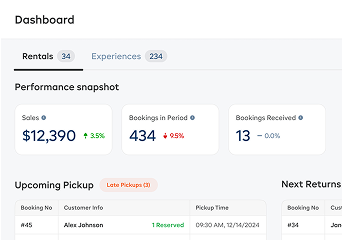
Ready to manage your surf lesson bookings, waivers, and instructor schedules from one dashboard? See how EquipDash works for water sports operators.
in one place