Wetsuit, Paddle, and Soft-Gear Care for Rental Shops
A wetsuit that smells like low tide and yesterday's sunscreen doesn't get a five-star review. It gets a one-star review with a photo. And the next 200 people who search "kayak rental near me" see that photo before they see your pricing.
Soft gear — wetsuits, paddles, harnesses, booties, gloves, rash guards — makes up 30-40% of a typical water sports rental fleet by unit count but gets maybe 10% of the maintenance attention. Hard goods like kayaks and SUP boards are expensive, visible, and obvious when damaged. Soft goods degrade quietly. A neoprene seam delaminates over 50 rentals, not one. A paddle grip wears smooth over a season, not a weekend. By the time you notice, you've been renting subpar gear for weeks.
This guide covers the cleaning, storage, and lifecycle protocols that keep soft gear in rentable condition longer — and the math that tells you when to retire it. For the full water sports rental playbook covering fleet, pricing, and tech stack, see our complete water sports rental business guide.
Daily Cleaning Routine
Every piece of soft gear that touches a customer needs to be cleaned before it touches the next one. Not tomorrow. Not when the bin is full. That day.
Post-rental rinse protocol (5 minutes per batch):
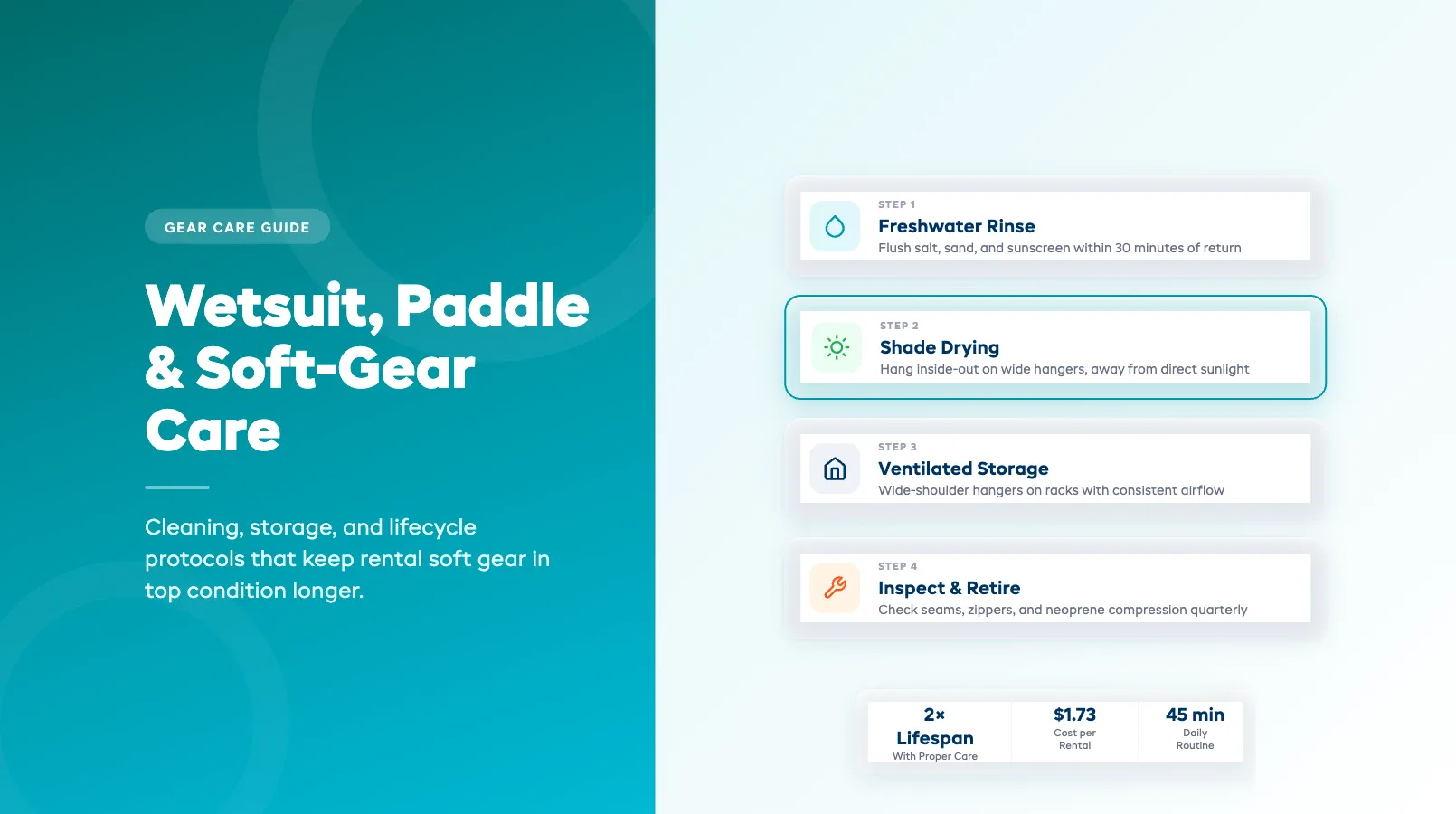
- Fresh water rinse. Hose down every wetsuit, bootie, glove, and rash guard with fresh water immediately after return. Salt water, chlorine, sand, and sunscreen all degrade neoprene and stitching. A 60-second rinse removes 80% of contaminants.
- Wetsuit shampoo bath. Fill a tub or large bin with cool fresh water and wetsuit-specific cleaner (not dish soap — it strips neoprene). Soak wetsuits for 5-10 minutes. One capful per 20 liters is usually enough.
- Inside-out flip. Turn wetsuits inside out before hanging. The interior lining holds the most bacteria, sweat, and skin oils. Drying inside-out first prevents odour buildup.
- Hang on wide hangers. Never use wire hangers or fold wetsuits over a rail. Both create permanent creases in the neoprene. Use wide-shoulder wetsuit hangers or horizontal bars with the suit draped at the waist.
- Paddle wipe-down. Wipe paddle shafts and grips with fresh water and a microfibre cloth. Check for hairline cracks in fibreglass shafts. Sand trapped in adjustable ferrules will seize the mechanism — flush the joint.
What not to do:
- Don't use hot water. It softens the glue in neoprene seam tape and accelerates delamination.
- Don't leave gear in a pile on the floor. 30 minutes in a wet heap breeds bacteria faster than a week of normal use.
- Don't use bleach, vinegar, or household detergents. They all damage neoprene cell structure.
- Don't dry in direct sunlight. UV breaks down neoprene faster than salt water does. Hang in shade or a covered, ventilated area.
A shop running 30 wetsuit rentals per day should budget 45-60 minutes of staff time daily on the rinse-and-hang routine. That's $15-$25 in labor. Skipping it costs $150-$300 per wetsuit in early replacements.
Seasonal Deep Clean
Daily rinses handle surface contamination. But over a full season, wetsuits accumulate body oils, mineral deposits, and bacteria deep in the neoprene cells. A quarterly deep clean extends suit life by 1-2 seasons.
Deep clean protocol:
| Step | Action | Frequency | Time |
|---|---|---|---|
| Soak | Submerge in wetsuit cleaner at double concentration for 30 minutes | Every 60-80 rentals or quarterly | 30 min soak + 10 min rinse |
| Seam inspection | Check every glued and blind-stitched seam for separation | Quarterly | 2 min per suit |
| Zipper treatment | Apply beeswax or zipper lubricant to all zippers | Monthly during season | 1 min per suit |
| Neoprene conditioner | Apply neoprene-specific conditioner to exterior panels | Quarterly | 3 min per suit |
| Odour treatment | Enzymatic cleaner soak for persistent odour suits | As needed | 60 min soak |
Paddles: Disassemble adjustable paddles completely. Clean the ferrule joint with a bottle brush. Inspect the blade-to-shaft junction for hairline cracks. Apply marine-grade wax to carbon fibre shafts — it prevents UV micro-cracking and keeps the finish smooth.
Booties and gloves: These are the most bacteria-prone items in your fleet. Soak in enzymatic cleaner (not bleach) for 30 minutes every 2 weeks during peak season. If a bootie still smells after enzymatic treatment, retire it. No amount of cleaning fixes neoprene that's absorbed months of foot sweat. If you're also running surf lessons, booties cycle even faster — see our surf lesson operations guide for instructor-specific gear rotation tips.
Run a wetsuit cleaning and care checklist to standardize the process across your team. Seasonal staff won't remember the protocol unless it's written down and tracked.
Storage Conditions
How you store soft gear between sessions — and especially between seasons — determines whether it lasts 3 seasons or 5.
During season (daily storage):
- Hang wetsuits on wide hangers in a covered, ventilated area. Ideal temperature: 15-25°C (60-77°F). Never in a sealed room without airflow — mold starts in 48 hours.
- Store paddles vertically in a rack, not leaning against a wall. Leaning puts constant pressure on the blade edge and warps carbon fibre over time.
- Keep booties and gloves on a drying rack with airflow underneath. Not in a bin, not in a bag, not on the floor.
Off-season storage:
- Clean everything using the deep clean protocol before storing.
- Lay wetsuits flat on shelves or hang on wide hangers. Never fold — folds create permanent creases that crack the neoprene.
- Store in a cool, dark, dry space. Ideal: 10-20°C (50-68°F), under 60% humidity. A dehumidifier in the storage room is worth the electricity.
- Cover paddle blades with blade socks to prevent impact damage.
- Ziplock booties and gloves in breathable garment bags with a silica gel packet. Not plastic bags — they trap moisture.
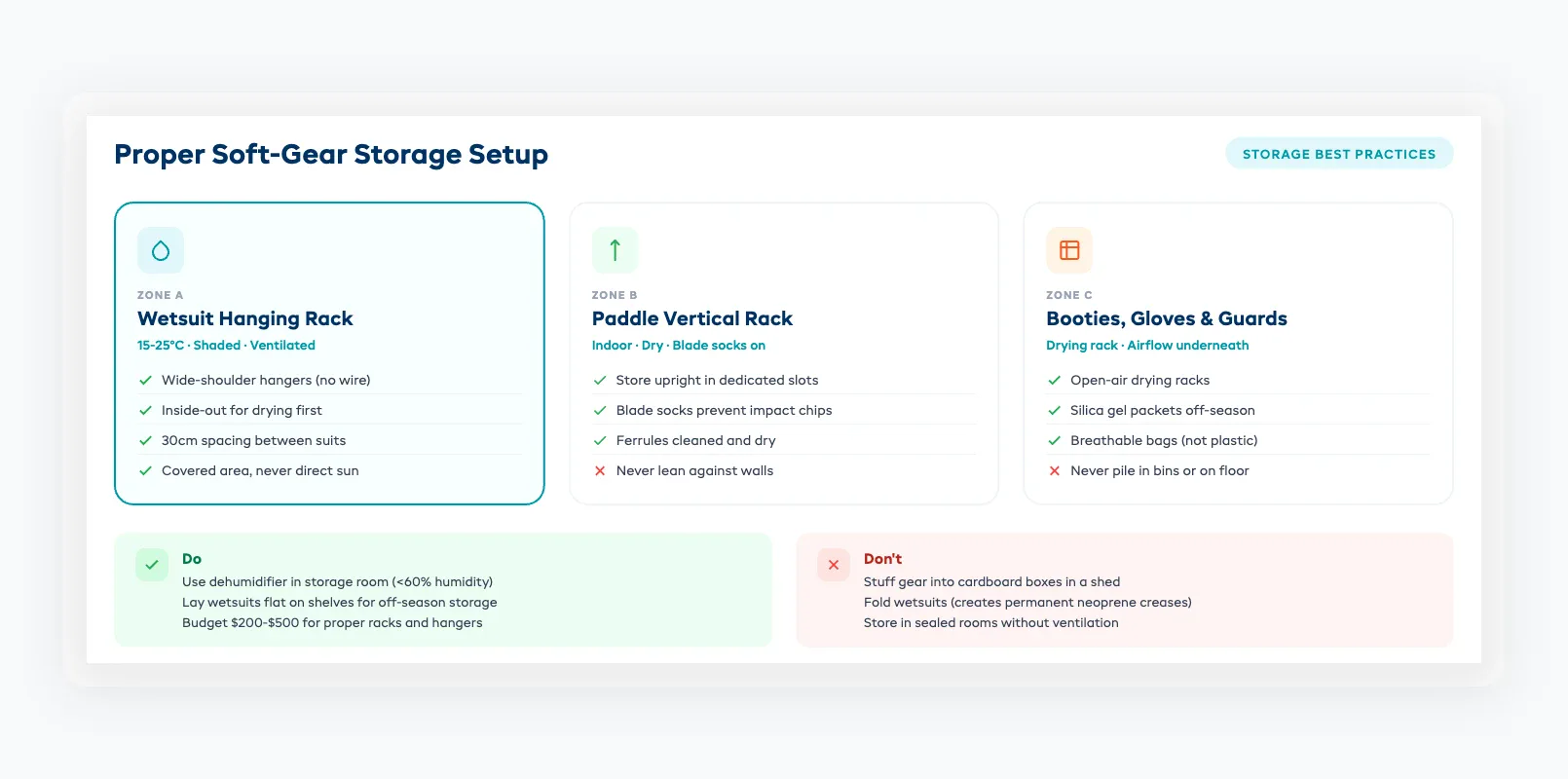
The biggest off-season mistake is stuffing everything into cardboard boxes in a non-climate-controlled shed. You'll open those boxes in spring to find mouldy neoprene, seized zippers, and warped paddle shafts. Budget $200-$500 for proper storage infrastructure — racks, hangers, dehumidifier — and you'll save $2,000+ in early replacements every season. Weather cancellation days are also prime maintenance windows — when bookings get rescheduled, use the freed-up hours for deep cleans and inspections. Our weather operations guide covers how to turn those canceled days into productive maintenance time.
Retirement Criteria
The hardest call in soft-gear management is knowing when to stop repairing and start replacing. Renting gear past its useful life hurts the customer experience, increases liability, and actually costs more per rental than replacing it early. Soft-gear condition ties directly into your safety and compliance operations — degraded wetsuits and worn booties are safety issues, not just cosmetic ones. Equipment condition documentation also supports your duty-of-care defense if a lesson participant makes a claim — see our lesson liability guide for what to document.
Retire immediately if:
- Neoprene is compressed and no longer springs back when pressed (lost insulation value)
- Seams are separating at stress points (underarms, crotch, knees) and glue repair has failed twice
- Zipper teeth are missing or the slider jams consistently after lubrication
- Persistent odour survives enzymatic deep clean treatment
- Visible UV degradation — neoprene feels chalky, stiff, or crumbly
Paddle retirement signals:
- Hairline cracks in the shaft that are visible without magnification
- Blade delamination — layers of fibreglass or carbon separating at edges
- Ferrule joint wobbles or won't lock after cleaning
- Grip foam is compressed flat and won't absorb shock
Lifecycle benchmarks (high-volume rental shop):
| Item | Expected Rentals | Expected Seasons | Retirement Trigger |
|---|---|---|---|
| 3/2mm wetsuit | 150-200 | 2-3 | Neoprene compression or seam failure |
| 5/4mm wetsuit | 100-150 | 2 | Neoprene compression (thicker suits degrade faster under UV) |
| Paddle (aluminum) | 300-400 | 3-5 | Shaft bend or grip failure |
| Paddle (carbon fibre) | 200-300 | 2-4 | Hairline cracks or blade delam |
| Booties | 80-120 | 1-2 | Sole separation or persistent odour |
| Gloves | 60-100 | 1-2 | Seam failure at fingertips |
| Rash guard | 100-150 | 1-2 | Fabric thinning or elasticity loss |
Use an end-of-season retirement review checklist to audit every piece of soft gear before off-season storage. Tag items that are close to retirement so you can budget replacements before the next season starts.
Cost-per-Rental Calculation
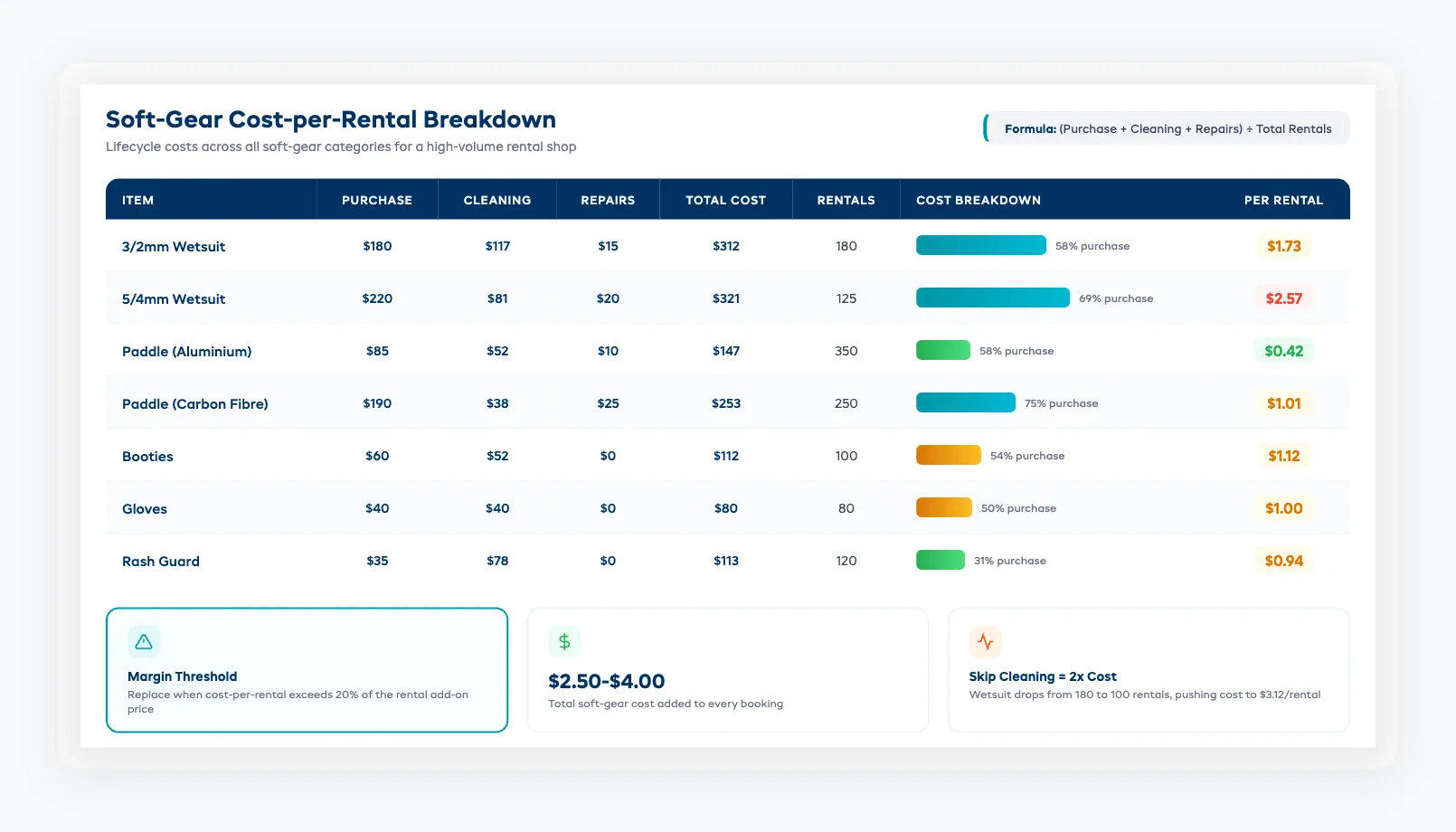
Soft gear feels cheap compared to a $1,200 kayak. But the math changes when you factor in lifespan. A $180 wetsuit that lasts 150 rentals costs $1.20 per rental. A $60 pair of booties that lasts 80 rentals costs $0.75 per rental. Add cleaning supplies ($0.15 per rental), staff time for cleaning ($0.50 per rental), and storage costs, and soft gear adds $2.50-$4.00 to every booking.
Cost-per-rental formula:
(Purchase price + lifetime cleaning costs + repair costs) ÷ total rentals before retirement = cost per rental
Worked example — 3/2mm rental wetsuit:
| Cost Component | Amount |
|---|---|
| Purchase price | $180 |
| Cleaning supplies (180 rentals × $0.15) | $27 |
| Staff cleaning time (180 rentals × $0.50) | $90 |
| Repairs (1 seam repair at $15) | $15 |
| Total lifetime cost | $312 |
| Rentals before retirement | 180 |
| Cost per rental | $1.73 |
That $1.73 matters when your wetsuit rental add-on is priced at $10-$15. You're keeping $8-$13 margin per rental if you manage the lifecycle well. Skip the cleaning routine, and that wetsuit hits retirement at 100 rentals instead of 180 — pushing cost per rental to $3.12 and cutting your margin nearly in half.
Track cost-per-rental for every soft gear category. When it climbs above 20% of the rental price, either renegotiate your supplier pricing or raise your add-on rates. For pricing strategy across your full operation, see our SUP and kayak pricing guide.
Branded vs Unbranded Gear
Should you buy name-brand wetsuits (O'Neill, Rip Curl, Xcel) or unbranded bulk suits from a supplier? The answer depends on your price point and customer expectations.
Branded pros:
- Customers recognize the brand and perceive higher value. You can charge $2-$5 more per rental.
- Better neoprene quality typically means longer lifespan — 20-30% more rentals before retirement.
- Easier to resell retired gear. A used O'Neill still has value on marketplace. A no-name suit doesn't.
- Consistent sizing across models. Staff learn one size chart instead of guessing.
Branded cons:
- 40-60% higher purchase price ($160-$220 vs $80-$130 for unbranded)
- Lead times of 4-8 weeks for bulk orders. Unbranded suppliers ship in 1-2 weeks.
- Color and style changes every season. Your fleet looks mismatched after year two.
Unbranded pros:
- Lower upfront cost means faster ROI on each unit
- Easier to maintain a uniform look — order the same color and style every year
- Some suppliers offer custom logos and colors at bulk pricing
The math usually favors branded — barely. A $180 branded suit lasting 200 rentals costs $0.90 per rental on the suit alone. A $100 unbranded suit lasting 140 rentals costs $0.71 per rental. The branded suit costs more per rental on purchase price, but its longer life means lower total spend on cleaning and staff time. Factor in the $2-$5 premium you can charge, and branded suits typically generate 15-25% more margin over their lifecycle.
The exception: Booties and gloves. Customers don't care what brand is on their booties. Buy unbranded, replace often, and save the brand premium for the items customers actually see and feel — wetsuits and rash guards.
If you're tracking fleet condition across multiple locations, a pre-season audit checklist helps you standardize what stays, what goes, and what gets ordered before the rush. For multi-location fleet management, see our guide to scaling water sports operations.
FAQ
How often should rental wetsuits be cleaned? After every single rental. A fresh water rinse and wetsuit shampoo soak should happen the same day the suit comes back. Skipping even one rental's cleaning allows salt, bacteria, and body oils to set into the neoprene. Shops running 20+ wetsuits per day should assign a dedicated staff member to the rinse-and-hang routine — it takes about 45-60 minutes.
Can I repair a wetsuit with separated seams? Yes, once. Neoprene cement (like Gear Aid Aquaseal) works well for small seam separations under 3 inches. Apply to both sides, press together, and let cure for 24 hours. If the same seam separates a second time, retire the suit — the neoprene around the seam has degraded past the point of reliable repair.
What's the best way to eliminate wetsuit odour? Enzymatic cleaners designed for neoprene (not vinegar, not baking soda, not Febreze). These break down the organic compounds that cause odour rather than masking them. Soak for 30-60 minutes, rinse thoroughly, and dry inside-out in shade. If the odour persists after two enzymatic treatments, the suit's interior lining has absorbed too much — retire it.
How do I know when a paddle needs replacing? Check three things: shaft integrity (any visible hairline cracks mean immediate retirement), blade condition (delamination at edges, chips larger than a coin), and ferrule function on adjustable paddles (wobble or failure to lock after cleaning). Aluminum paddles are more forgiving — they bend before they crack. Carbon fibre paddles fail suddenly and can splinter, so retire at the first sign of cracking.
Should I charge separately for wetsuit rental? Yes. Bundling wetsuits into the base rental price hides the cost and makes it harder to track soft gear economics. A separate $10-$15 add-on for wetsuit rental lets you track demand, calculate per-unit margins, and adjust pricing independently. Most customers expect to pay extra for a wetsuit — it's standard practice at surf schools and dive shops. See our SUP and kayak pricing guide for more on add-on pricing strategy.
How should I store wetsuits in the off-season? Clean using the deep clean protocol first. Then hang on wide-shoulder hangers or lay flat on shelves in a cool, dark, dry space (10-20°C, under 60% humidity). Never fold wetsuits — folds create permanent creases that crack the neoprene. A dehumidifier in the storage room prevents mold. Budget 2-3 hours for the full fleet clean-and-store process at season end.
What's the environmental impact of retiring wetsuits? Traditional neoprene isn't recyclable through standard channels, but several programs now accept old wetsuits for repurposing (Patagonia's trade-in, Suga mats, Isogenica). Some suppliers offer limestone-based neoprene that's more sustainable to produce. As a rental shop, your best environmental move is extending suit life through proper cleaning and storage — every extra season you get from a suit is one fewer suit in a landfill.
Soft-gear care is the unglamorous side of running a water sports rental shop — but it directly impacts customer satisfaction, review scores, and your bottom line. For the complete operator's playbook on fleet, pricing, and technology, visit the water sports hub.
in one place