How to Scale a Multi-Location Water Sports Business
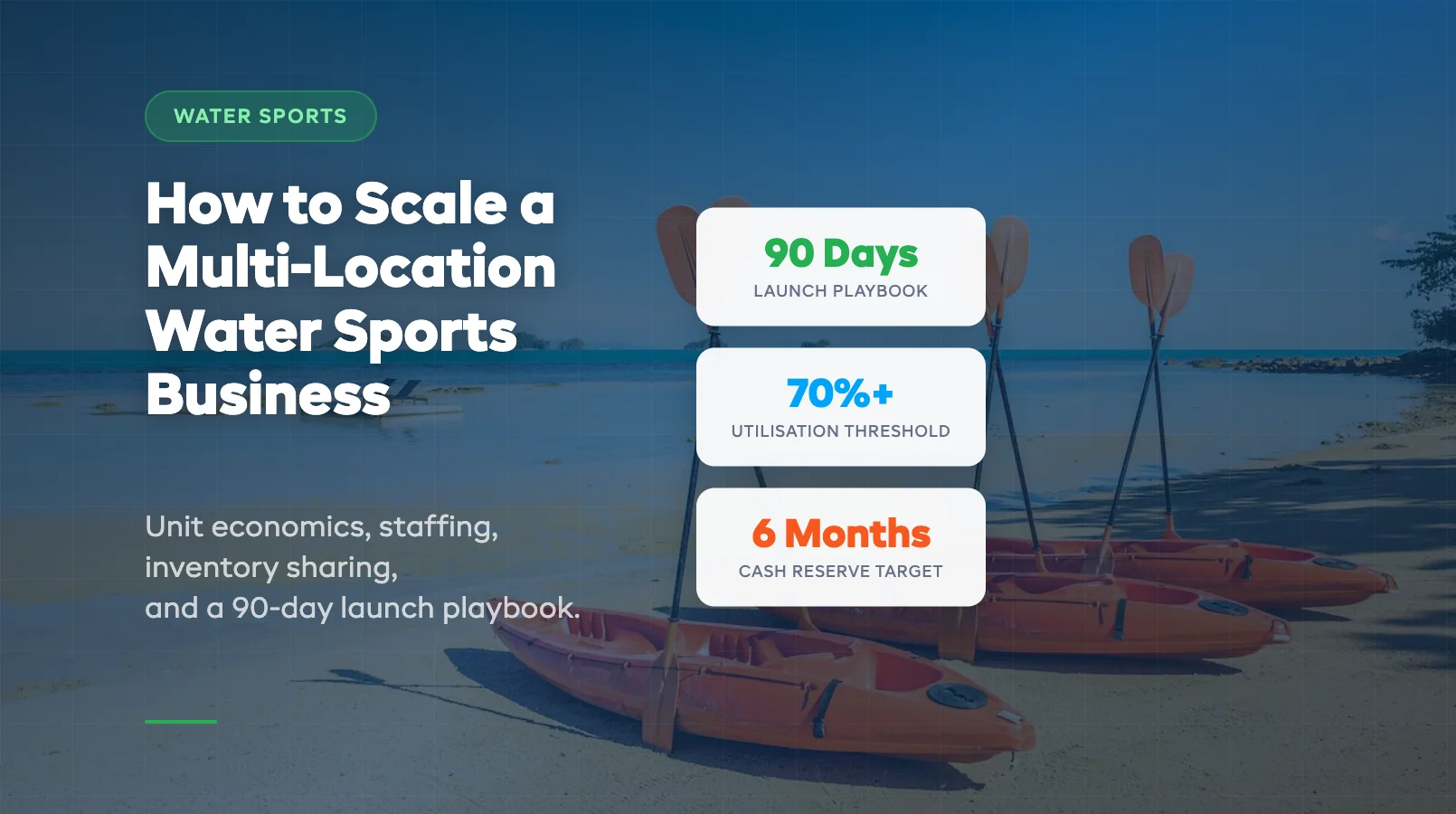
Your first location is humming. Weekends are fully booked by Thursday. You're turning walk-ins away on holidays. And someone — maybe a landlord, maybe your own ambition — keeps asking: "Have you thought about a second spot?"
Opening a second water sports location isn't the same as doubling your current one. It's a different business problem. You're not adding kayaks to a rack. You're adding a second team, a second lease, a second set of problems that fire at the same time as your first set. Get it right and you double revenue without doubling your hours. Get it wrong and you dilute both locations until neither one works.
This guide covers the signals that say you're ready, the financial math, and a concrete 90-day playbook. For the full water sports rental playbook covering fleet, pricing, and tech stack, see our complete water sports rental business guide.
When You're Actually Ready
Most operators expand too early. A packed Saturday doesn't mean you need a second location — it might mean you need better pricing or longer rental windows. Before you sign a lease, check these boxes:
- Your first location runs without you for 2+ weeks. If you can't leave for a holiday without the phone ringing, you don't have a business that scales — you have a job with equipment.
- You've turned away measurable revenue. Not "it felt busy." Actual declined bookings you can count. If your system doesn't track turn-aways, you're guessing.
- You have a documented operating playbook. Opening checklists, closing procedures, safety briefings, pricing rules. If it lives in your head, it dies the moment you split your attention.
- Your current utilization rate exceeds 70% during peak months. Below that, you haven't maxed out what you have.
A second location should solve a geography problem — customers who want your service but won't drive to your current spot. If the demand is just seasonal overflow, consider extended hours or a pop-up setup first.
Financial Signals That Say Go
The romance of expansion dies fast when rent is due at two addresses. Run these numbers before committing:
Minimum thresholds:
| Metric | Target Before Expanding |
|---|---|
| Location 1 net profit margin | 20%+ after owner salary |
| Cash reserve | 6 months of Location 2's projected expenses |
| Location 1 peak utilization | 70%+ for 3+ consecutive months |
| Debt-to-revenue ratio | Below 30% |
Unit economics for Location 2:
Start with your Location 1 numbers and adjust. Your second location will typically run at 40-60% of Location 1's revenue in year one. Budget accordingly:
- Lease + fit-out: $2,000–$8,000/month depending on waterfront access. Expect $15,000–$40,000 in fit-out costs (racks, signage, point-of-sale setup, safety equipment).
- Initial fleet: Don't duplicate your full fleet. Start with 60% of Location 1's inventory — your most popular categories only. For most SUP and kayak shops, that's 15–25 boards and 10–15 kayaks.
- Staff: 2–3 FTE minimum (one lead, 1–2 seasonal). Budget $4,000–$7,000/month in wages before you make a dollar.
- Break-even timeline: 4–8 months for a seasonal waterfront location. 8–14 months for year-round operations.
If Location 1 can't absorb 3 months of Location 2 losses without stress, you're not ready. Expansion should feel like a strategic choice, not a bet.
Staffing Model for Two Locations
The biggest mistake in multi-location expansion: assuming you can manage both yourself. You can't. Not well. Not for long.
The minimum viable team:
Your second location needs a site lead — someone who opens, closes, handles customer issues, and makes weather calls without texting you. This is your most important hire. Pay them 15–20% above market. The cost of a bad site lead is a dead location.
Hiring timeline:
Hire your site lead 6–8 weeks before opening. They should spend 3–4 weeks working at Location 1 to absorb your standards, then 2–3 weeks setting up Location 2. If they can't run Location 1 solo for a weekend, they're not ready for Location 2.
Cross-training is non-negotiable. Every staff member should be able to work at either location. When someone calls in sick at Location 2, you pull from Location 1 — not scramble on Craigslist. Build your shift schedule so staff rotate between sites at least once per month.
Keep your safety briefing protocols identical across both locations. Different safety standards at different sites is a liability lawsuit waiting to happen. If either location offers lessons, ensure instructor certifications and minor waivers meet the same standard everywhere — our lesson liability guide covers the jurisdictional differences that matter when operating across multiple areas.
Technology Requirements
Running two locations on separate spreadsheets is a recipe for double-bookings, inventory ghosts, and conflicting pricing. Your tech stack needs to show both locations in one view.
Non-negotiables:
- Unified booking system. Customers book Location 1 or Location 2 from the same widget. Availability updates in real time across both. No phone calls between staff to check what's available.
- Centralised inventory. You need to see every kayak, every SUP, every PFD across both sites in one dashboard. When Location 2 is short on tandem kayaks and Location 1 has three sitting idle, you need to know — and move them.
- Multi-location reporting. Revenue, utilization, and customer data broken out by site but viewable together. If you can't compare Location 1's Tuesday utilization to Location 2's, you're flying blind.
- Single customer database. A customer who rents at Location 1 shouldn't have to re-enter their details at Location 2. One profile, one waiver, one booking history.
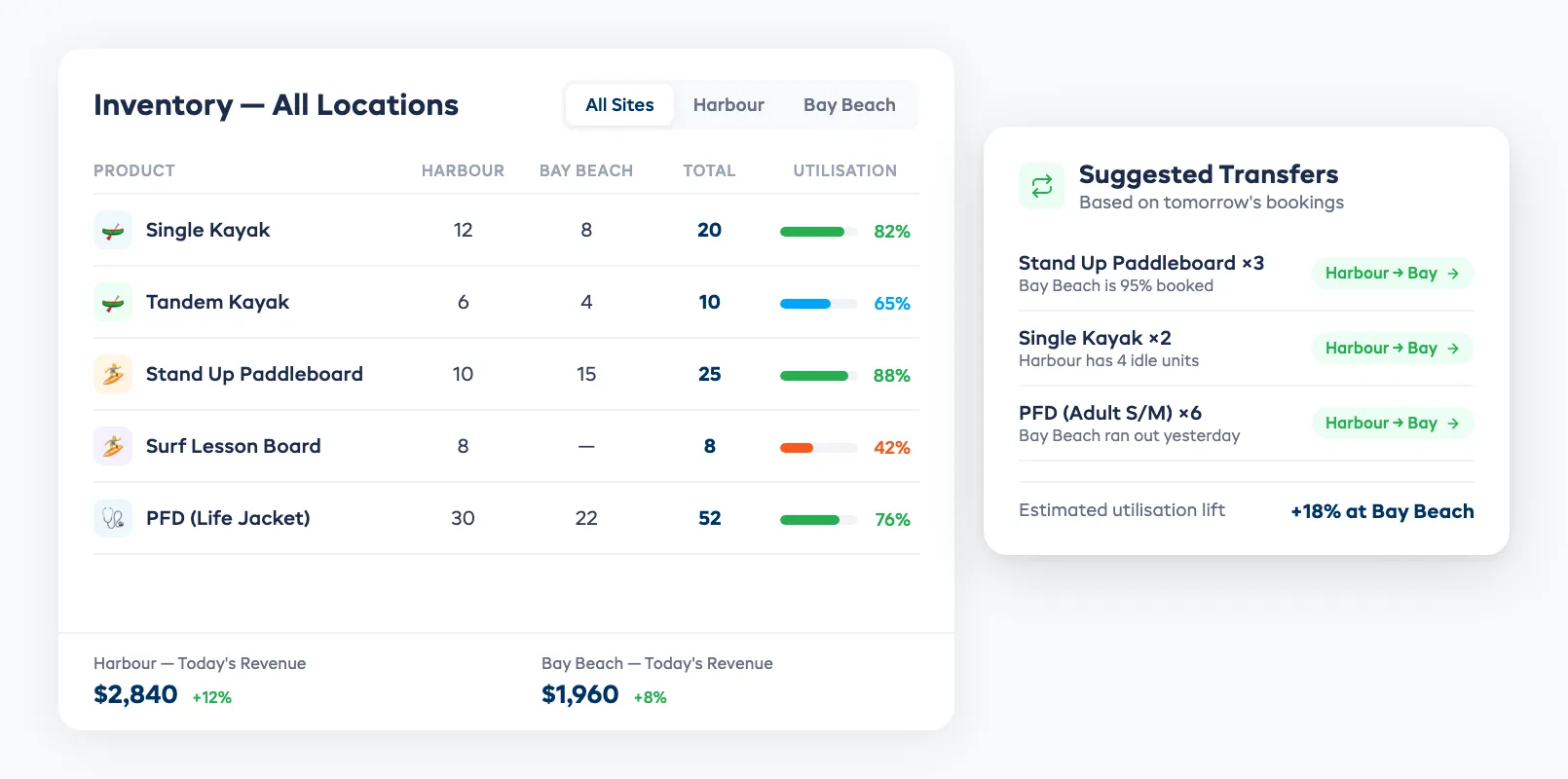
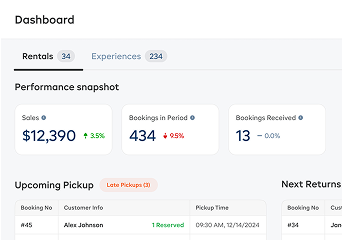
Dash consolidates bookings, inventory, and customer data across locations into one dashboard. You can set location-specific pricing while keeping your product catalog consistent — no duplicate data entry.
What breaks without centralised tech: A customer books a tandem kayak at Location 2, but that kayak was moved to Location 1 this morning and nobody updated the spreadsheet. The customer shows up, the kayak isn't there, and you've lost a booking plus a review. This happens weekly at multi-location shops running on shared Google Sheets.
Inventory Sharing Between Locations
Your fleet is your biggest capital expense. Sharing inventory between locations is how you keep utilization high without buying duplicate stock.
The 80/20 split:
Keep 80% of each location's fleet as permanent stock. The remaining 20% is a "floating pool" that moves between sites based on demand. On a sunny Saturday when Location 2 is fully booked and Location 1 is slow, move 3–4 SUPs over. On a rainy Tuesday, consolidate everything at the busier site.
Rules for fleet transfers:
- Transfer decisions are made by 6pm the day before, not morning-of. Your team needs time to load and drive.
- Every transfer gets logged — unit ID, from-location, to-location, condition at departure. No exceptions.
- Run a pre-rental inspection at the receiving location before anything goes on the water. A board that was fine at Location 1 might have picked up damage in transit.
- If your locations are more than 30 minutes apart, the floating pool model breaks down. The transport cost and time eat the margin.
Seasonal rebalancing: At the start of each month during peak season, review utilization by location and category. If Location 2's single kayaks run at 85% but tandem kayaks sit at 30%, swap some tandems to Location 1 and bring over more singles. Let the data decide — not your gut.
Brand Consistency Across Sites
Your second location is not a franchise experiment. It's the same business. Customers shouldn't notice a quality difference.
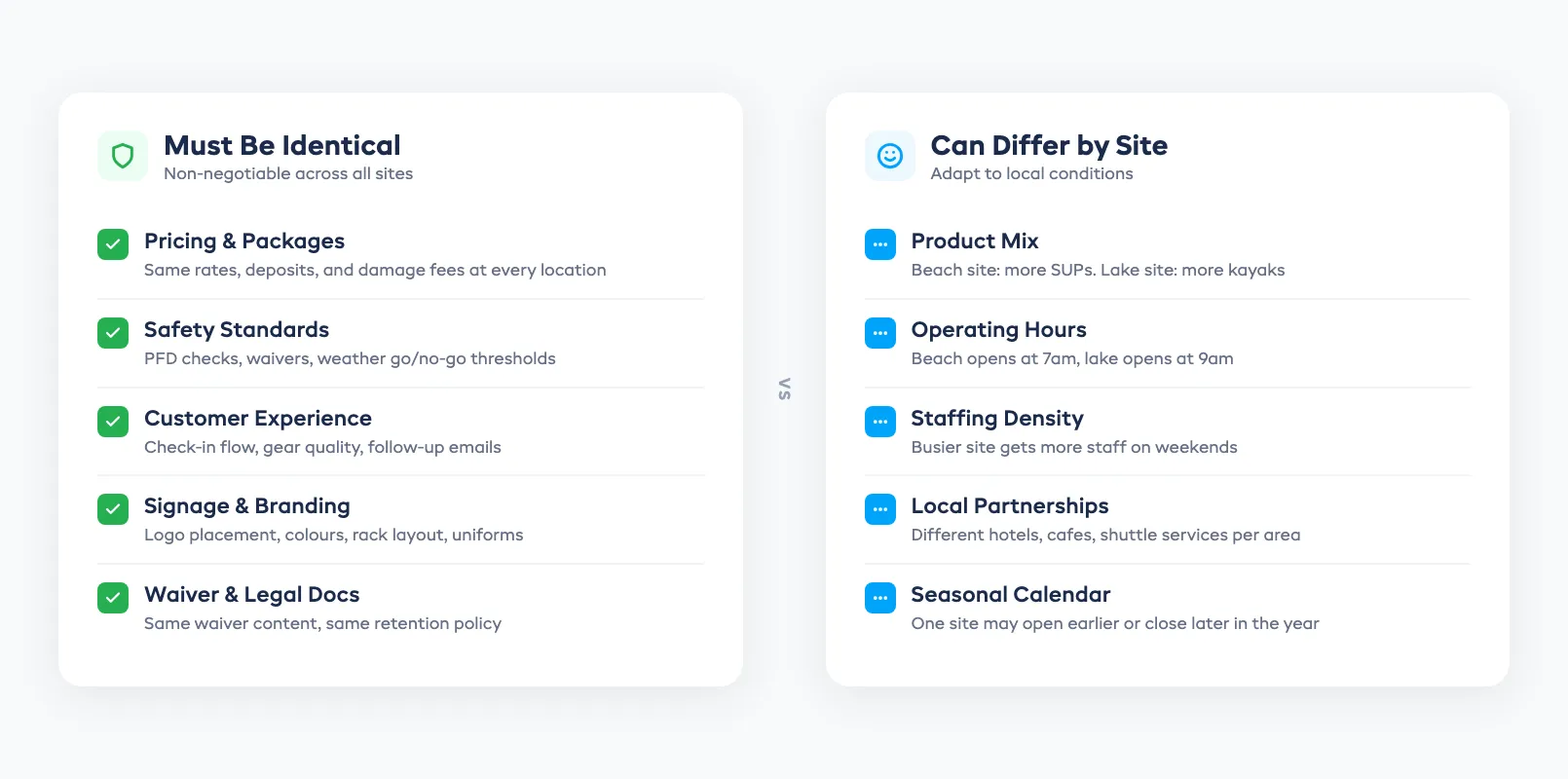
What must be identical:
- Pricing. Same rates, same packages, same damage deposit. If Location 2 charges more for SUP rentals because rent is higher, you've created a customer service nightmare. Build the cost difference into your overall pricing model.
- Safety standards. Same PFD inspection checklists, same waiver, same weather go/no-go thresholds. Train both teams on the same briefing script. When weather hits one location, you can redirect bookings to a clear-conditions site — see our weather operations guide for cross-location reschedule workflows.
- Customer experience. Same check-in flow, same gear quality, same follow-up email. A customer who loved Location 1 should feel at home at Location 2.
- Signage and branding. Same logo placement, same color scheme, same rack layout. This seems obvious but gets skipped when you're rushing to open.
What can differ:
- Product mix (Location 2 might skew toward SUPs while Location 1 is kayak-heavy)
- Operating hours (a beach location might open earlier than a lake location)
- Staffing density (busier location gets more staff)
- Lesson offerings — if one location runs surf lessons, the other doesn't have to, as long as the core rental experience is identical
The test: if a regular customer visits your new location for the first time, would they say "this feels like the same place" or "this feels like a knockoff"? If it's the second one, you're not ready to open.
90-Day Launch Playbook
Here's the timeline that works. Compress it and you'll open with gaps. Stretch it and you'll burn cash on rent before revenue starts.
Days 1–30: Foundation
- Sign lease and begin fit-out
- Order fleet (60% of Location 1's inventory in top categories)
- Hire site lead — start them at Location 1 immediately
- Set up your booking system for multi-location (add Location 2 as a new site, configure availability, enable cross-location inventory view)
- Order signage, PFDs, safety equipment, wetsuits (follow our wetsuit and soft-gear care protocols from day one)
Days 31–60: Build
- Complete fit-out (racks, counter, storage, wash station)
- Site lead transitions to Location 2 for setup
- Hire 1–2 seasonal staff — train at Location 1
- Transfer floating pool inventory
- Run opening-day operations checklist as a dry run
- Soft-launch with friends/family for 2–3 days to shake out issues
Days 61–90: Launch and Stabilise
- Open to the public
- Monitor daily: bookings, utilization, customer feedback, staff issues
- Weekly check-in between site leads (15 minutes max — what's working, what's broken)
- Adjust fleet allocation based on first 30 days of booking data
- Run your first cross-location report at day 90: revenue per location, utilization, customer acquisition cost
The day-90 decision: If Location 2 is hitting 40%+ of Location 1's revenue and trending up, you're on track. If it's below 25% with no upward trend, diagnose fast — is it a demand problem (wrong location), an execution problem (wrong team), or a visibility problem (nobody knows you're there)?
FAQ
How much does it cost to open a second water sports rental location? Budget $35,000–$80,000 for initial setup including lease deposit, fit-out, fleet, safety equipment, and signage. Monthly operating costs typically run $8,000–$18,000 before revenue. Plan for 4–8 months to break even at a seasonal location.
How far apart should two water sports locations be? Close enough to share inventory (under 30 minutes drive) but far enough to serve a different customer base. Two locations on the same lake competing for the same customers defeats the purpose. Look for geographic gaps — the other side of a bay, a different beach town, or an inland lake versus a coastal spot.
Can I share staff between two water sports locations? Yes, and you should. Cross-train every employee to work at either site. Build rotation into your schedule so staff are comfortable at both locations. When someone calls in sick, you pull from the other site instead of scrambling. Pay a small travel premium for staff who commute to the farther location.
When should I open my second location — peak season or off-season? Open 4–6 weeks before peak season. You get the build-out done during quieter months when contractors are available and leases are negotiable, then open into rising demand. Opening mid-peak means scrambling to hire and set up while your first location needs you most. Opening in off-season means burning months of rent before meaningful revenue.
What's the biggest mistake operators make when expanding? Expanding before Location 1 runs independently. If you're still the person who opens the shop, makes weather calls, and handles every customer complaint, adding a second location doesn't double your business — it halves your attention. Hire and train a site lead who can run Location 1 without you before you even start looking at Location 2.
Do I need separate insurance for a second location? Yes. Your existing general liability and marine insurance policy almost certainly covers a single named location. Adding a second site requires a policy endorsement or a separate policy. Contact your broker before signing a lease — waterfront liability premiums vary significantly by geography. Budget $2,000–$5,000/year for the additional coverage.
How do I prevent inventory loss when sharing equipment between locations? Log every transfer with unit ID, origin, destination, and condition. Use a centralised system that tracks which unit is at which location in real time. Run inspections at the receiving location before anything goes on the water. If a unit goes missing, you'll know exactly when and where it was last seen.
Opening a second location is the biggest operational leap most water sports businesses make. The right systems — unified booking, centralised inventory, cross-location reporting — make it manageable instead of chaotic. See how Dash handles multi-location operations →
in one place