Water Sports Safety: PFDs, Waivers, and Weather Operations
A kayak flips in 3-foot chop. The paddler isn't wearing a PFD because your staff handed them a size XL and they're a size small — so they unclipped it ten minutes in. Now you're dealing with a rescue, an incident report, and a phone call to your insurance carrier.
Most water sports safety failures aren't dramatic. They're quiet. A waiver that doesn't cover the right risks. A weather call made 20 minutes too late. A 14-year-old signing their own form because the parent was still parking the car. These are the gaps that turn a normal Tuesday into a liability event.
This guide covers the operational side of water sports safety — the systems, checklists, and policies that prevent incidents before they start. For the full water sports rental playbook covering fleet, pricing, and tech stack, see our complete water sports rental business guide.
PFD Inventory and Sizing
The US Coast Guard requires PFDs for every person on the water in a rental vessel. That's not optional — it's federal law. But compliance isn't just about having enough PFDs on the rack. It's about having the right sizes, in the right condition, assigned to the right people.
Minimum inventory by size (per 20 concurrent rentals):
| Size | Weight Range | Chest (in) | Recommended Stock | Notes |
|---|---|---|---|---|
| Youth | 50–90 lbs | 26–29 | 8–10 | Required when you rent to families |
| Adult S/M | 90–150 lbs | 30–40 | 12–15 | Most common for women and teens |
| Adult L/XL | 150–200+ lbs | 40–52 | 10–12 | Most common for men |
| Infant | < 50 lbs | 20–25 | 4–6 | Only if you serve children under 6 |
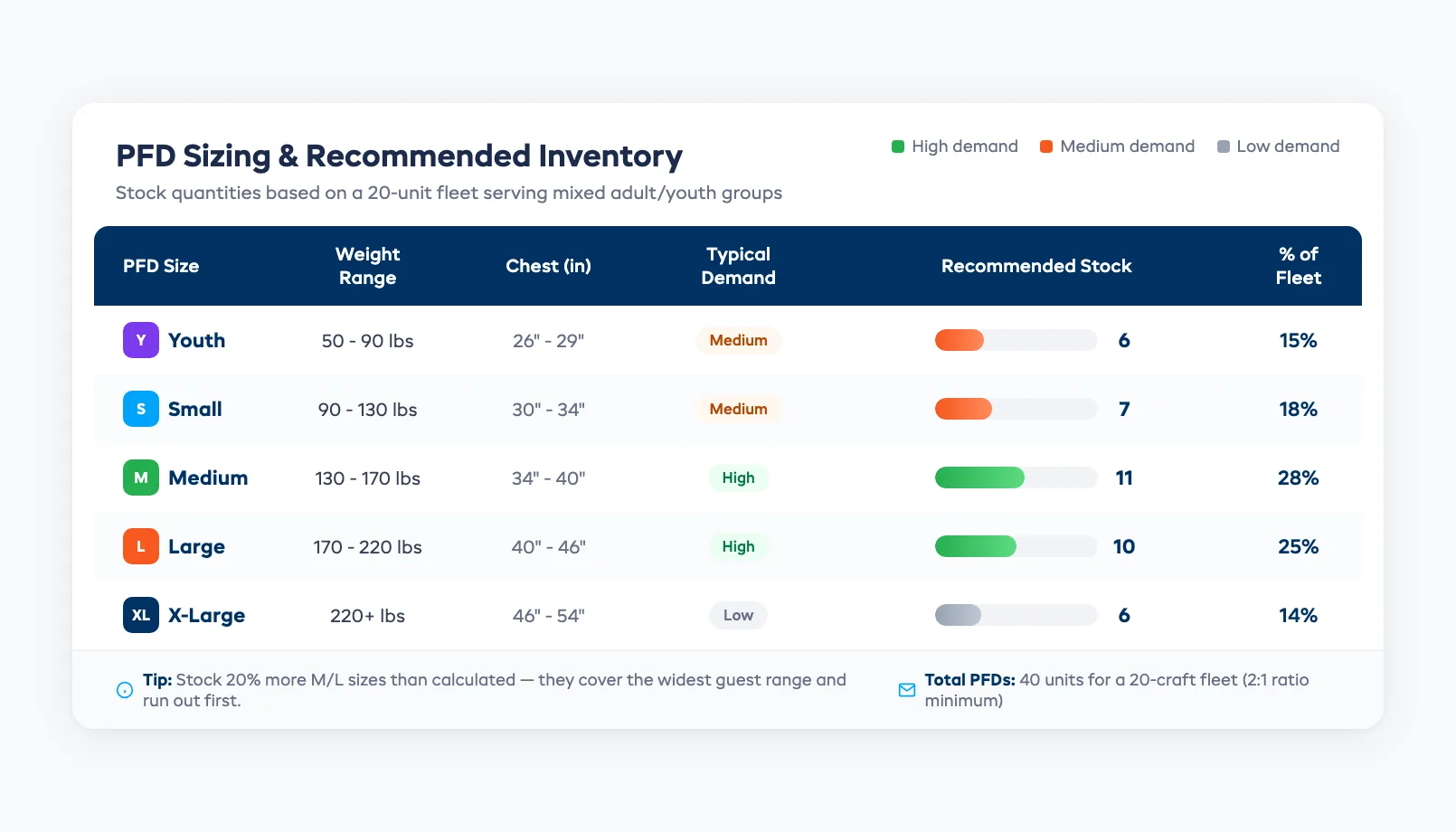
Over-index on Adult S/M. Most shops stock 60% L/XL because that's what the owner wears. But walk-in traffic skews toward couples and families — women and teens grab S/M first. Running out of S/M means those customers either squeeze into an ill-fitting PFD (dangerous) or don't go out (lost revenue).
Inspection cadence:
Run a PFD inspection checklist before every shift. Check buckles, straps, foam integrity, and zipper function. Retire any PFD with torn fabric, degraded foam, or a non-functional buckle. A PFD that doesn't fit or doesn't close isn't a PFD — it's a prop.
Replace your entire stock every 3–5 years depending on usage. UV exposure, salt water, and sunscreen degrade foam faster than most operators expect. Budget $45–$80 per PFD (Type III, USCG-approved) — $2,500–$4,500 for a full fleet replacement of 50 units. The same UV and salt damage applies to wetsuits and soft gear — see our wetsuit and soft-gear care guide for cleaning and retirement protocols.
Sizing at check-in:
Don't let customers grab their own PFD off a rack. Staff should ask weight, check chest size, and physically confirm the PFD is snug before anyone touches the water. This takes 60 seconds and eliminates the number-one PFD failure: wrong size.
Digital Waivers That Hold Up
Paper waivers get wet, lost, and illegible. Digital waivers with e-signatures are legally valid in all 50 US states (ESIGN Act, 2000) and in every Australian state. But a valid e-signature doesn't mean a valid waiver. The content matters more than the format.
What your waiver must include:
- Assumption of risk — specific to water sports (drowning, hypothermia, collision, marine wildlife). Generic "outdoor activity" language is too vague and gets thrown out in court.
- Acknowledgment of swimming ability — ask the customer to confirm they can swim. If they can't, you need a different risk protocol (tandem kayak, guide escort, or refusal of service).
- Medical disclosure — heart conditions, seizure disorders, pregnancy. You're not a doctor, but you need to know if someone is at elevated risk.
- Photo/video release — separate checkbox, not buried in the assumption of risk. Courts treat these as distinct consents.
- Cancellation and refund policy — tie it directly to your weather policy so there's one source of truth.
- Equipment responsibility clause — customer agrees to report damage immediately and acknowledges financial responsibility for negligent damage.
Timing matters: Send the waiver link 24 hours before the booking. Customers who sign on their couch at 8pm the night before read the document. Customers who sign on their phone in the parking lot while their kids run toward the water don't read anything. Pre-arrival waivers also eliminate the check-in bottleneck — your morning rush moves 40% faster.
A waiver chaser can automate follow-ups. If the waiver isn't signed 12 hours before the booking, the system sends a reminder. If it's still unsigned at check-in, your staff knows before the customer walks in. Set up an automated reminder flow so unsigned waivers get flagged before check-in.
Retention: Store signed waivers for at least 3 years. If you serve minors, store for 7 years — the statute of limitations doesn't start until the minor turns 18 in most US states.
Go/No-Go Weather Criteria
Weather cancellations cost money. But sending customers out in dangerous conditions costs more — in liability, in reputation, and potentially in lives. You need a written go/no-go matrix, not a gut feel.
Go/no-go criteria by activity:
| Condition | Kayak/SUP | Surf Lessons | Boat Tours | Jet Ski |
|---|---|---|---|---|
| Wind > 15 knots | No-go | Instructor call | No-go (small vessels) | No-go |
| Lightning within 10 mi | No-go | No-go | No-go | No-go |
| Waves > 3 ft | No-go (beginner) | Instructor call | Go | Go (experienced) |
| Visibility < 0.5 mi | No-go | No-go | No-go | No-go |
| Water temp < 55°F | Go (wetsuits req.) | Go (wetsuits req.) | Go | Go (wetsuits req.) |
| Small craft advisory | No-go | No-go | No-go | No-go |
| Air quality (AQI > 150) | No-go | No-go | No-go | No-go |
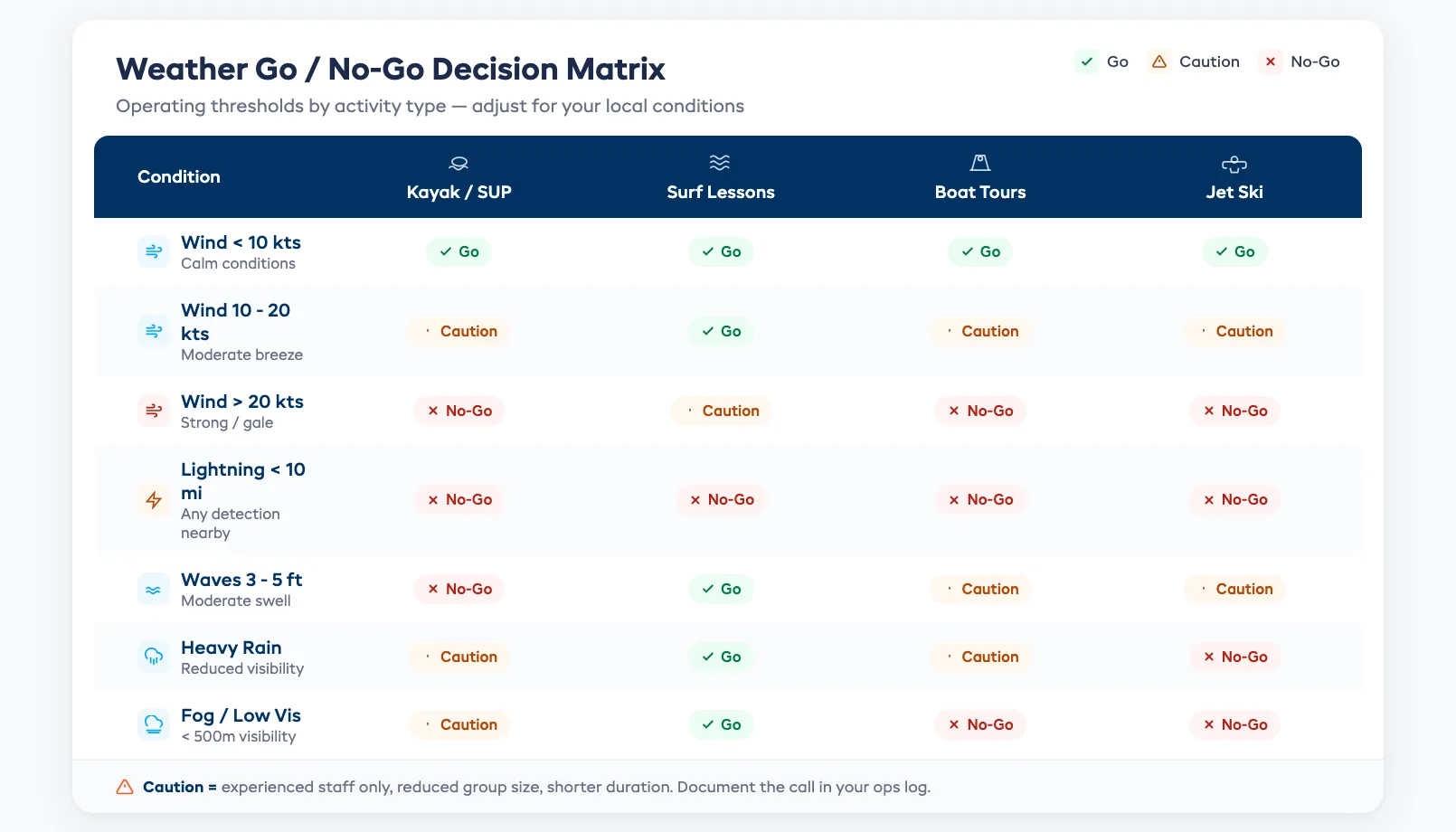
The 6am check: Assign one person to run the weather check every morning before your first booking. Check NOAA marine forecast, local tide charts, and wind speed. Make the go/no-go call by 6:30am. If it's a no-go, trigger cancellation notifications immediately — customers appreciate 3 hours of notice, not 30 minutes.
A weather alert automation can handle this entirely. It pulls NOAA data, compares against your criteria, and sends you a go/no-go recommendation before your alarm goes off. If conditions are borderline, it flags for manual review.
Cancellation economics: A weather cancellation costs you the booking revenue but protects you from liability. Offer a full reschedule (not a refund) for weather cancellations. Most customers rebook within 7 days. Your policy should state: "Weather cancellations receive a full reschedule credit valid for 90 days. No refunds for weather cancellations." Post this on your booking page, confirmation email, and waiver. For the complete reschedule-first revenue recovery system — including communication templates and the timing that gets 70-80% reschedule rates — see our weather operations guide.
Minor Liability
Minors are your highest-risk, highest-reward customer segment. Family bookings generate 2–4× the revenue of a solo rental. But minors can't legally sign waivers, and the liability exposure is significantly higher.
Rules that protect you:
-
Parent or legal guardian must sign the waiver. Not an older sibling, not an aunt, not a family friend. The person signing must have legal authority. If the parent drops the kids off, the waiver must be signed before the parent leaves — not after.
-
Age minimums by activity: Kayak (tandem with adult) 6+, SUP 10+ (or 8+ with adult on same board), surf lessons 8+, jet ski 16+ passenger / 18+ operator in most states, boat tours no minimum with guardian present.
-
PFD requirements for minors are stricter. Children under 13 must wear a PFD at all times on the water in most US states — not just "have one available." Verify state-specific rules. In some states (California, Florida), the age threshold is different.
-
Staff ratios for youth groups: If a summer camp books 12 kids for kayaking, you need a minimum of 1 staff member per 4 minors on the water. This isn't a suggestion — your insurance provider likely mandates it. Check your policy.
-
Photo/video of minors: Your waiver should include a separate, clearly-marked checkbox for photo/video consent for minors. Some parents consent to the activity but not to photos appearing on your social media.
Document everything. The incident that triggers a claim often happened three months ago, and the only thing standing between you and a lawsuit is the paperwork you filed that day. If you're running multiple locations, your safety standards and waiver procedures must be identical at every site — inconsistency is the first thing a plaintiff's attorney looks for. For a deeper dive into minor waivers, instructor certification verification, and the insurance boundaries specific to lessons, see our lesson liability guide.
Safety Briefings That Actually Work
Most safety briefings are a 90-second mumble that customers tune out while adjusting their sunglasses. That's a liability gap, not a briefing.
The 5-point briefing framework (3–4 minutes):
-
PFD check — physically verify every customer's PFD is buckled, snug, and the right size. Tug the shoulder straps. If it rides up to their ears, swap it.
-
Paddle/equipment basics — demonstrate proper grip, basic strokes, and how to reboard if they fall off. For kayaks: wet exit drill. For SUP: kneeling recovery. 60 seconds of demo prevents 80% of "I can't get back on" radio calls.
-
Boundary and route — point to physical landmarks. "Stay between that red buoy and the fishing pier. If you drift past the pier, you're in the shipping channel and we're coming to get you." Customers remember landmarks, not GPS coordinates.
-
Emergency signals — whistle on PFD (show them where it is), wave both arms overhead, and how to call for help. Give kayakers and SUP paddlers a waterproof whistle clipped to their PFD if it doesn't have one built in.
-
Weather watch — "If you hear thunder, see lightning, or feel a sudden wind shift, paddle to shore immediately. Don't wait for us to call you in." Empower customers to self-rescue in fast-changing conditions.
Make it visual. Laminate a one-page quick-reference with diagrams showing paddle grip, re-entry technique, and boundary map. Hand it to the customer in a dry bag. They'll reference it on the water — and it reinforces everything you just said.
Track briefing completion. If your booking system logs that a customer received a safety briefing, that's evidence in a liability claim. A checkbox in your rental flow is all it takes. If you're running multiple locations, keeping safety briefings identical across sites is non-negotiable.
Incident Response
You will have incidents. A customer will capsize, get stung, twist an ankle on the dock, or panic in deep water. The question isn't if — it's whether your response is fast, documented, and defensible.
Incident response protocol (4 steps):
Step 1: Secure the scene. Get the customer out of the water and to safety. Administer first aid. Call 911 if there's any question about severity — err on the side of calling. Never ask a customer to "walk it off."
Step 2: Document immediately. Within 30 minutes of the incident, complete an incident report: date, time, location, weather conditions, equipment used, customer name, what happened, witnesses, and actions taken. Photos of the scene, the equipment, and any visible injuries. Don't editorialize — state facts.
Step 3: Notify your insurance carrier within 24 hours. Most policies require timely notification. A late report can give your insurer grounds to deny the claim. Even minor incidents (scraped knee, PFD malfunction) should be reported. It's better to over-report than to have a "minor" incident turn into a lawsuit six months later with no paper trail.
Step 4: Internal review within 48 hours. What went wrong? Was it preventable? Does a policy need to change? Did equipment fail? Did staff follow the briefing protocol? Turn every incident into a process improvement. The second time the same incident happens, your insurer gets nervous. The third time, your premiums spike.
Equipment after an incident: Quarantine any gear involved. Don't re-rent a kayak that capsized until you've inspected it. Use a post-rental watercraft return check to verify hull integrity, seat attachment, and rudder function before it goes back on the rack.
Keep incident reports for a minimum of 7 years. If a minor was involved, keep them until the minor turns 25.
FAQ
What PFD type is required for kayak and SUP rentals? Type III (flotation aid) is the USCG-approved standard for paddle sports rentals. Type III PFDs are the most comfortable for active use and provide 15.5+ pounds of buoyancy. Type I (offshore) is bulkier and not required for near-shore rentals. Make sure every PFD is USCG-approved — imported knockoffs without the certification are worthless legally and often structurally.
Do I need a different waiver for each water sport? You can use one master waiver that covers all activities, but the assumption of risk section must list sport-specific hazards. A generic "water activities" waiver is weaker in court than one that specifically names kayaking, SUP, surfing, and jet ski risks. Update your waiver annually as you add new activities.
How do I handle weather cancellations without losing revenue? Offer a reschedule credit valid for 60–90 days instead of a cash refund. Most customers rebook within a week. State your weather cancellation policy clearly on the booking page, confirmation email, and waiver. Track your weather cancellation rate — if it exceeds 15% of bookings, your go/no-go criteria may be too conservative for your location.
Can a 16-year-old sign their own waiver? No. In most US states and all Australian states, minors cannot enter binding contracts. A parent or legal guardian must sign. Some states allow 16–17-year-olds to sign certain agreements, but relying on this is risky. Always require a parent/guardian signature for anyone under 18.
What should I do if a customer refuses to wear a PFD? Refuse service. PFDs are a federal requirement on rental vessels and a condition of your insurance. No PFD, no rental — no exceptions, no matter how strong a swimmer the customer claims to be. Document the refusal. Train staff to be firm but polite: "It's a Coast Guard requirement, not our policy."
How often should I replace PFDs? Every 3–5 years for high-volume rental operations (daily use during season). Inspect every PFD before each shift — check buckles, straps, foam integrity, and UV degradation. Retire immediately if foam is compressed, fabric is torn, or buckles don't clasp securely. Budget $45–$80 per replacement unit.
Do I need separate insurance for surf lessons vs kayak rentals? Check with your carrier, but typically yes — instruction carries higher liability than equipment rental because you're directing the customer's activity. Most commercial water sports policies offer a combined rental + instruction rider. Expect to pay 20–40% more for instruction coverage. See our surf lesson business operations guide for specific insurance requirements.
Running a water sports operation means safety is the product, not just a checkbox. For the complete operator's playbook on fleet, pricing, and technology, visit the water sports hub.
in one place