AI Demand Forecasting for Rental Companies: Plan Your Season Before It Starts
Last July you ran out of paddleboards on a Thursday. Not a holiday weekend. Not a festival. Just a random Thursday that turned out to be 34 degrees with zero wind and every family in the county looking for something to do on the water.
You couldn't have predicted that. Or could you?
AI demand forecasting takes the signals you'd watch if you had unlimited time -- historical bookings, weather forecasts, school calendars, local events -- and turns them into a rolling prediction of what your next two to six weeks look like. Not a crystal ball. A data-driven planning tool that gets more accurate the longer it runs.
This guide covers what AI demand forecasting actually does for rental operators, what data it uses, and how one kayak shop used it to stop guessing and start planning. For the full picture of how AI applies across your operation, see our AI for Equipment Rental Business guide.
In this guide:
- Why Gut-Feel Forecasting Fails
- What AI Uses to Predict Rental Demand
- Pre-Season Planning With Forecast Data
- Staffing and Fleet Decisions
- Event-Based Demand Spikes
- Worked Example: A Kayak Shop's First AI Season
- FAQ
Why Gut-Feel Forecasting Fails
Every rental operator has a version of "I just know when it gets busy." And for the big patterns, you're right. Summer is busy. Winter is slow. Long weekends spike.
The problem is the medium-sized patterns. The ones that catch you off guard three or four times a season.
Common gut-feel misses:
- Shoulder-season surges. A warm spell in April books out your fleet before you've even opened fully. You don't have seasonal staff on yet.
- Mid-week spikes. A local triathlon or school excursion day fills Tuesday's calendar and you're running a skeleton crew.
- Demand dips you overstaffed for. The long weekend that everyone assumed would be packed -- except gas prices spiked and bookings came in 30% below last year.
- Category shifts. SUP boards are trending up 25% year-on-year, but your fleet mix still reflects 2023 demand.
Gut feel works for the 80% of days that follow obvious patterns. It fails for the 20% that drive your biggest wins or losses. Those 20% days account for a disproportionate share of your annual revenue -- and your biggest operational headaches.
The fix isn't working harder. It's feeding data into a system that can spot the pattern before the day arrives.
What AI Uses to Predict Rental Demand
AI demand forecasting isn't magic. It's pattern matching at a scale you can't do manually. Here's what the system actually watches:
Your historical booking data. This is the foundation. Two or more seasons of booking records -- dates, equipment types, group sizes, lead times -- give the model enough to identify recurring patterns. The system learns that your kayak bookings spike 4 days after a heatwave forecast, not the day of.
Weather forecasts. Temperature, precipitation probability, wind speed, UV index. The system correlates weather windows with booking velocity. A 7-day forecast of 30-degree-plus weather triggers a demand alert weeks before customers actually book.
Local event calendars. Festivals, school holidays, sporting events, cruise ship schedules. A triathlon two towns over drives bike rental demand. A music festival fills your campground overflow crowd with kayak renters.
Economic signals. Fuel prices, accommodation occupancy rates, tourism board visitor projections. These are secondary signals, but they help explain why a "normal" July might be 15% softer than last year.
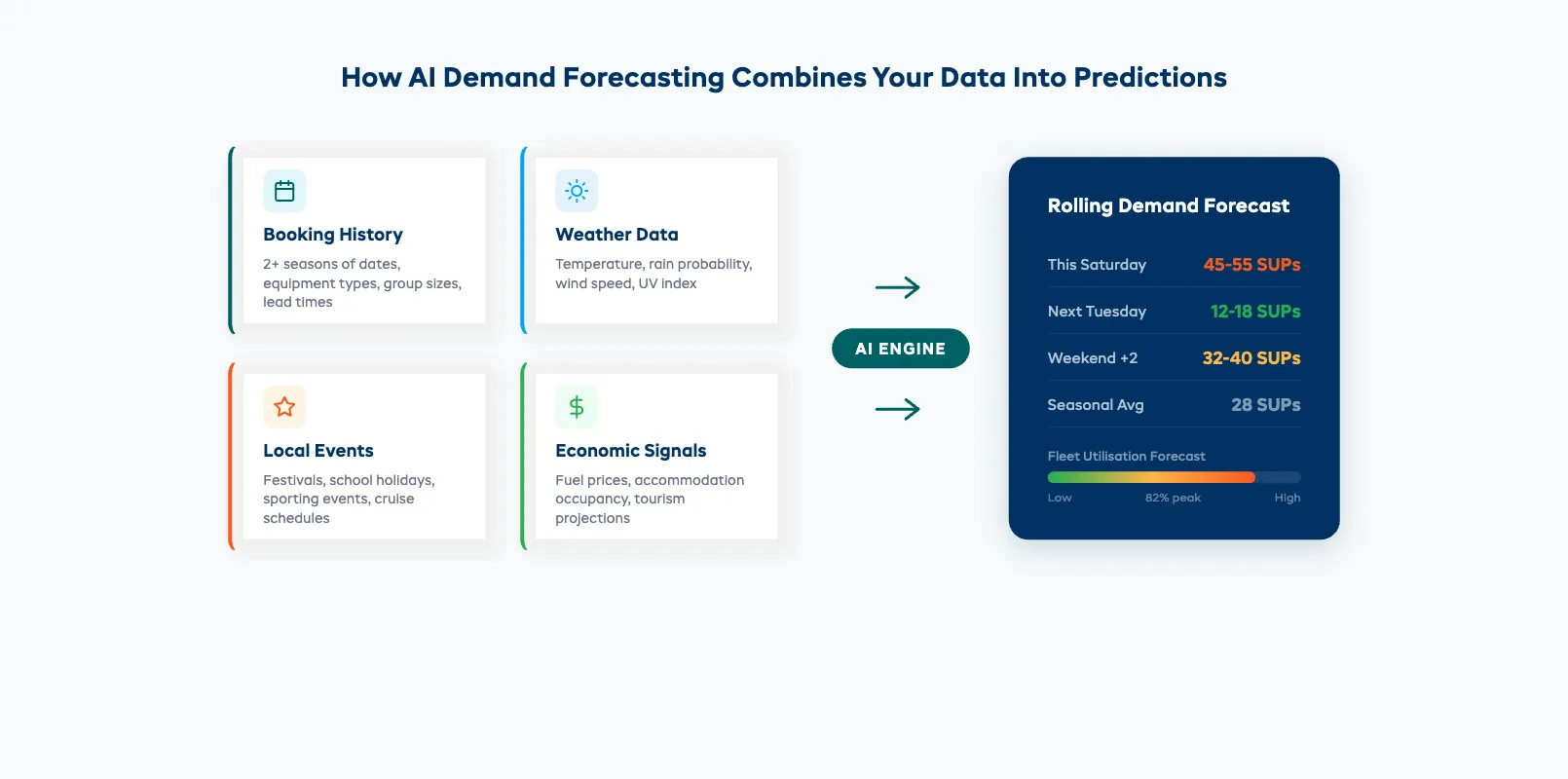
How it comes together: The system doesn't rely on any single signal. It weights them against your actual historical outcomes. If weather was the strongest predictor last season, it gets more weight this season. If event-driven spikes dominated your shoulder season, the model learns that too.
The output is a rolling demand forecast -- usually 2 to 6 weeks out -- broken down by equipment category and day. Not a single number, but a range: "Expect 45-55 SUP bookings next Saturday, compared to your seasonal average of 32."
Pre-Season Planning With Forecast Data
The biggest value of demand forecasting isn't real-time adjustments. It's the decisions you make before the season starts.
Fleet sizing. Instead of ordering "about the same as last year, plus a few more paddleboards," you get data-backed recommendations. The system analyzes your utilization rates by category, projects next season's demand based on trends, and flags where you're likely short or overstocked.
A typical output: "Based on 2024-2025 trends, your SUP fleet will hit 95% utilization on 28 days next season (up from 19 in 2025). Adding 4 boards would capture an estimated $12,800 in currently-lost bookings."
Maintenance scheduling. If demand forecasting shows a soft two-week window in late April, that's your maintenance window. Pull equipment for deep service when the forecast says you won't need it -- not when something breaks on a busy Saturday.
Pricing strategy. Demand forecasts feed directly into dynamic pricing. If the model predicts a high-demand Saturday, your rates adjust upward automatically. If a rainy week is coming, early-bird discounts go out to fill the gap.
Staffing and Fleet Decisions
Overstaffing on quiet days burns cash. Understaffing on peak days burns customers. AI forecasting gives you a middle path.
Weekly staff scheduling. A 2-week demand forecast lets you build rosters that match expected volume. If next Wednesday looks like 60% of peak capacity, you schedule accordingly. No more "everyone works every Saturday just in case."
Seasonal hiring triggers. The forecast can tell you when shoulder season tipping points are coming. "Bookings are trending 22% above last year's April pace -- recommend bringing on seasonal staff 2 weeks earlier than planned." That advance notice is the difference between being ready and scrambling.
Fleet deployment across locations. If you run multiple sites, forecasting shows which location will be busier. Move three kayaks from the quiet lakeside spot to the beach location before the weekend rush -- not after you've already turned people away.
The connection between demand forecasting and inventory management is tight. Forecasting tells you what's coming. Inventory management tells you what you have. Together, they close the gap between "we think we'll be busy" and "we're ready because we know we'll be busy."
Event-Based Demand Spikes
Recurring events are the easiest wins for demand forecasting. A triathlon happens every September. A music festival fills the town every June. School holidays fall on predictable dates.
But one-off events are where operators get caught out. A viral TikTok about your lake. A new cruise ship route adding 3,000 tourists to your harbor on Wednesdays. A corporate retreat that books 40 bikes with two weeks' notice.
How AI handles events:
- Recurring events get baked into the seasonal model automatically. The system knows your bookings spike 40% during the annual regatta because it happened the last three years.
- Known one-off events (concerts, sporting events, festivals) can be manually flagged or pulled from event APIs. The system estimates impact based on similar events in your history.
- Surprise spikes trigger real-time alerts. "Booking velocity for Saturday is 3x the seasonal average as of Monday morning." You don't know why, but you know to prepare.
The best operators combine forecasting with predictive maintenance to make sure their fleet is physically ready when the demand spike hits. A forecast that says "big weekend coming" isn't useful if half your fleet is waiting on brake pads.
Worked Example: A Kayak Shop's First AI Season
Here's how demand forecasting played out for a 40-kayak operation on a coastal lake.
Before AI (2024 season):
- Ran out of kayaks on 14 peak days, turning away an estimated 220 bookings ($17,600 lost revenue)
- Overstaffed by 2+ people on 23 slow weekdays (approximately $6,900 in unnecessary wages)
- Ordered 6 new tandem kayaks in June -- supplier lead time meant they arrived mid-July, missing 4 weeks of peak demand
- Pricing was flat: $45/hour regardless of demand
With AI forecasting (2025 season):
- Demand model flagged fleet shortage by February. Ordered 8 new boards and 4 tandems in March -- delivered by April 15.
- Forecast-driven staffing saved an estimated $5,200 in avoided overstaffing while maintaining coverage on 12 surprise-busy days.
- Event-based alerts caught a previously unknown rowing regatta that drove 35% more bookings one August weekend. Staff and fleet were pre-positioned.
- Combined with dynamic pricing, revenue per booking increased 11% on peak days without reducing booking volume.
Net result: Revenue up 18% season-over-season. Labor costs down 8%. Zero days where walk-up customers were turned away due to fleet shortage.
The system wasn't perfect. It over-predicted demand for two rainy weekends that ended up quiet. But across a full season, the accuracy was high enough that every operational decision improved.
Demand forecasting is one of 8 AI use cases that rental operators are adopting today.
FAQ
How much historical data does AI demand forecasting need? At minimum, one full season of booking data. Two seasons gives significantly better accuracy because the model can compare year-over-year patterns and account for trend shifts. If you're just starting, the system works with what you have and improves with every month of data.
Does demand forecasting work for small rental shops (under 20 units)? Yes. Smaller operations actually see faster impact because every booking matters more. If you have 15 kayaks and the forecast helps you avoid running out on 5 peak days, that's potentially $4,000-$6,000 in recovered revenue per season.
How far in advance can AI predict rental demand? Useful forecasts typically range from 2 to 6 weeks. Beyond 6 weeks, accuracy drops significantly because weather and event data becomes less reliable. For fleet purchasing and seasonal hiring, the system uses trend projections (not daily forecasts) that look 3-6 months ahead.
What's the difference between demand forecasting and dynamic pricing? Demand forecasting predicts how busy you'll be. Dynamic pricing uses that prediction (plus other signals) to adjust your rates. They work together but solve different problems. Forecasting drives staffing, fleet, and maintenance decisions. Pricing drives revenue per booking.
Can I override the forecast when I disagree with it? Always. The forecast is a recommendation, not an autopilot. Most operators review it weekly and flag any days where local knowledge suggests the model is off. Over time, those corrections improve the model's accuracy for your specific business.
Does weather data really improve forecast accuracy? Significantly. For outdoor rental businesses, weather is the single strongest short-term predictor of demand. A 7-day heatwave forecast is more predictive of next Saturday's bookings than last Saturday's numbers. The system weights weather more heavily for 1-2 week horizons and less for longer-range planning.
Planning your season shouldn't mean guessing and hoping. AI demand forecasting gives you the data to make fleet, staff, and pricing decisions with confidence -- not hindsight. If you're still sizing next summer's fleet based on a gut feeling and last year's memory, you're leaving money on the table.
Start with your booking data. The patterns are already there. You just need a system that can read them.
in one place