Maintenance Schedules for High-Turnover Bike Rental Fleets
A customer-owned bike might see 2,000 km per year. A rental bike in a busy shop can hit that number in six weeks. Different riders every day. Different body weights, riding styles, and levels of mechanical sympathy. Someone grinds the gears in first hour, someone drags the brakes down a hill in second. By sundown that bike has lived a harder life than most commuters put theirs through in a month.
Standard manufacturer service intervals — the ones in the owner's manual — assume owner use. Apply those to a rental fleet and you'll find cracked brake pads, stretched chains, and worn-out tires weeks before your calendar says "time to check." The result: a safety incident, a bad review, or a bike that costs more to repair than it should because you caught the problem too late.
This guide covers how to build maintenance schedules that match rental-intensity use. If you're setting up your bike rental operation from scratch, start with our complete bike rental business guide for the full picture.
Service Intervals for Rental Use
Forget the 6-month or annual service schedule. Rental bikes need time-compressed intervals based on turns, not calendar dates.
Measure use in rental days, not months. A bike that rents 5 days per week accumulates wear roughly 8-10x faster than an owner bike. A "6-month service" on a manufacturer schedule translates to every 3-4 weeks in a busy rental fleet.
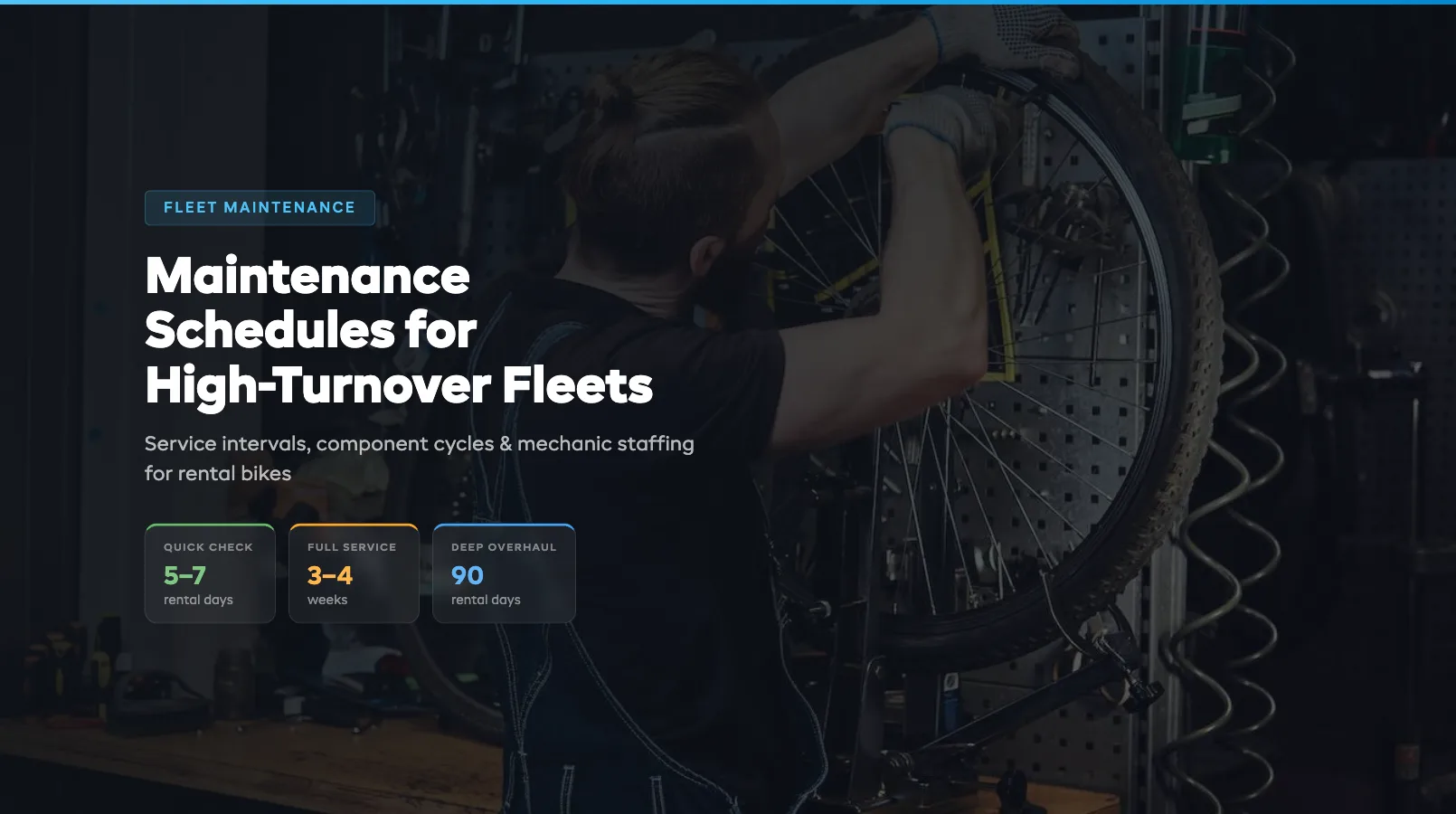
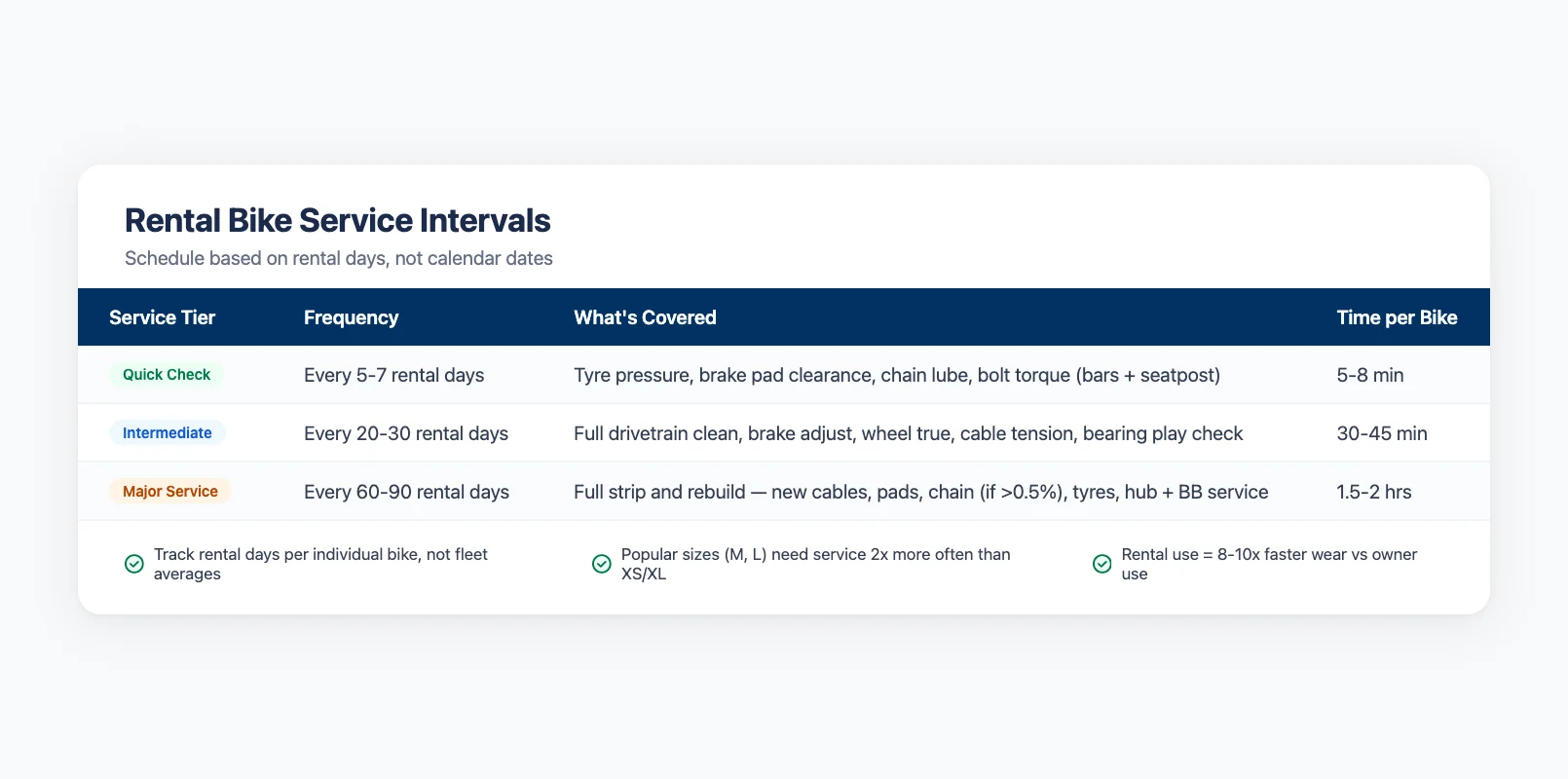
Three service tiers for rental fleets:
- Quick check (every 5-7 rental days): Tire pressure, brake pad clearance, chain lube, bolt torque on handlebars and seatpost. Takes 5-8 minutes per bike. This is your first defense against the small problems that become big ones.
- Intermediate service (every 20-30 rental days): Full drivetrain clean, brake adjustment, wheel true, cable tension check, bearing play inspection. Takes 30-45 minutes. This is where you catch stretched chains before they destroy cassettes.
- Major service (every 60-90 rental days): Full strip and rebuild. New cables, new brake pads, chain replacement (if worn past 0.5%), tire replacement if tread is low, hub and bottom bracket service. Takes 1.5-2 hours. Think of this as a bike reset.
Track rental days per bike, not fleet averages. Your most popular sizes (Medium, Large) get rented twice as often as XS or XL. Schedule by individual bike usage, not a blanket fleet calendar. A system that logs rental days per asset and triggers service alerts saves you from the guesswork. Dash has a maintenance due alert agent that flags bikes hitting their interval thresholds automatically.
Critical Component Replacement Cycles
Some parts wear predictably. Knowing replacement cycles lets you bulk-order parts before the season and budget accurately.
Chains: replace every 1,500-2,000 km (roughly every 60-80 rental days in a busy fleet). A chain checker tool costs $10 and takes 5 seconds. When elongation hits 0.5%, replace immediately. A $15 chain swap now prevents a $60 cassette replacement later. Every major service should include a chain measurement.
Brake pads: inspect every intermediate service, replace every 30-50 rental days. Rim brakes eat pads faster in wet conditions. Disc brake pads last longer but cost more per set ($15-$30 vs $5-$10). Keep 2-3 sets per bike in stock at season start.
Tires: replace every 2,000-3,000 km. Rental tires take more punctures because riders don't avoid debris like owners do. Puncture-resistant tires (Schwalbe Marathon, Continental Contact Plus) cost $10-$15 more per tire but cut flat rates by 60-70%. The maths works out within two weeks of avoided repair time.
Cables and housing: replace every major service. Frayed cables cause sudden brake or shift failure. At $3-$5 per set, this is cheap insurance. Don't wait for a failure to replace them.
Bearings (hubs, bottom bracket, headset): service every 2-3 major services. Repack or replace when play develops. A bottom bracket replacement costs $25-$40 in parts. Ignoring it costs $80+ when the spindle damages the frame shell.
E-bike specifics: Battery health degrades with charge cycles — expect 500-800 full cycles before capacity drops below 80%. Track charge cycles per battery. Motor service intervals depend on the system (Bosch, Shimano, Bafang) but plan for annual motor inspection on high-use e-bikes. See our e-bike operations guide for battery management details.
The Pre-Rental ABC Check
Every bike goes out the door with an ABC check. No exceptions. This 60-second inspection is your last line of defense before a customer rides away.
A — Air. Squeeze both tires. They should be firm, not squishy. Check the sidewalls for cuts or bulges. Top up with a floor pump if pressure is low. Target PSI depends on tire width: 80-100 for road tires, 40-60 for hybrids, 25-40 for mountain.
B — Brakes. Squeeze each lever to the bar. The wheel should stop. Spin each wheel and confirm pads don't rub. Check pad wear — if you can't see the wear-indicator groove, the pads need replacing before that bike goes out.
C — Chain and cranks. Spin the pedals and shift through all gears. Listen for grinding, clicking, or skipping. Check the chain for visible rust or stiff links. Grab each crank arm and push laterally — any play means the bottom bracket needs attention.
Beyond ABC — the quick extras:
- Saddle and seatpost: confirm the quick-release or bolt is tight
- Handlebars: twist — they shouldn't move independently of the wheel
- Quick-releases or thru-axles: confirm both wheels are secured
- Accessories: lights work, bell rings, lock is included if your shop provides one
Standardize it. Print the checklist. Mount it at the staging area. Use a pre-rental ABC check template so every staff member runs the same sequence. When you're turning 30+ bikes per day in peak season, consistency is the only thing standing between you and a liability claim. Documented maintenance records also strengthen your position with insurers — see our bike rental insurance guide for how maintenance logs reduce premiums and speed up claim settlement.
Daily and Weekly Routines
Individual bike checks catch bike-specific issues. Daily and weekly fleet routines catch systemic problems.
End-of-day routine (15-20 minutes for a 30-bike fleet):
- Walk the return line. Flag any bikes with visible damage or customer-reported issues
- Check tire pressure on every returned bike (a floor pump with a gauge makes this fast)
- Lube chains on any bike that went out in wet conditions
- Plug in all e-bike batteries. Log charge levels if your system supports it
- Move flagged bikes to the workshop queue — they don't rent tomorrow until cleared
Weekly routine (1-2 hours, typically Monday morning or whichever day is slowest):
- Run through the intermediate service checklist on the 3-5 bikes with the highest rental days since last service
- True any wheels that developed wobble during the week
- Inspect brake pads fleet-wide — replace any at the wear limit
- Check chain wear on high-use bikes with a chain checker
- Inventory spare parts: tubes, pads, chains, cables. Reorder anything below your minimum stock threshold
- Clean frames and drivetrains on the dirtiest bikes — customers notice grime, and it signals neglect
Seasonal deep-clean. At the start and end of each season, every bike gets a major service regardless of rental-day count. This is your reset. It's also when you make retirement decisions (more on that below). For a structured approach to this, use a pre-season fleet audit template.
Mechanic Staffing
Maintenance doesn't happen if nobody's assigned to do it. The most common failure mode isn't a bad schedule — it's a good schedule that nobody has time to follow. The bigger your fleet, the harder it gets to remember which bike is due for what, which is why most growing shops eventually move from paper logs to bike rental software that tracks service intervals per bike and queues mechanic jobs automatically.
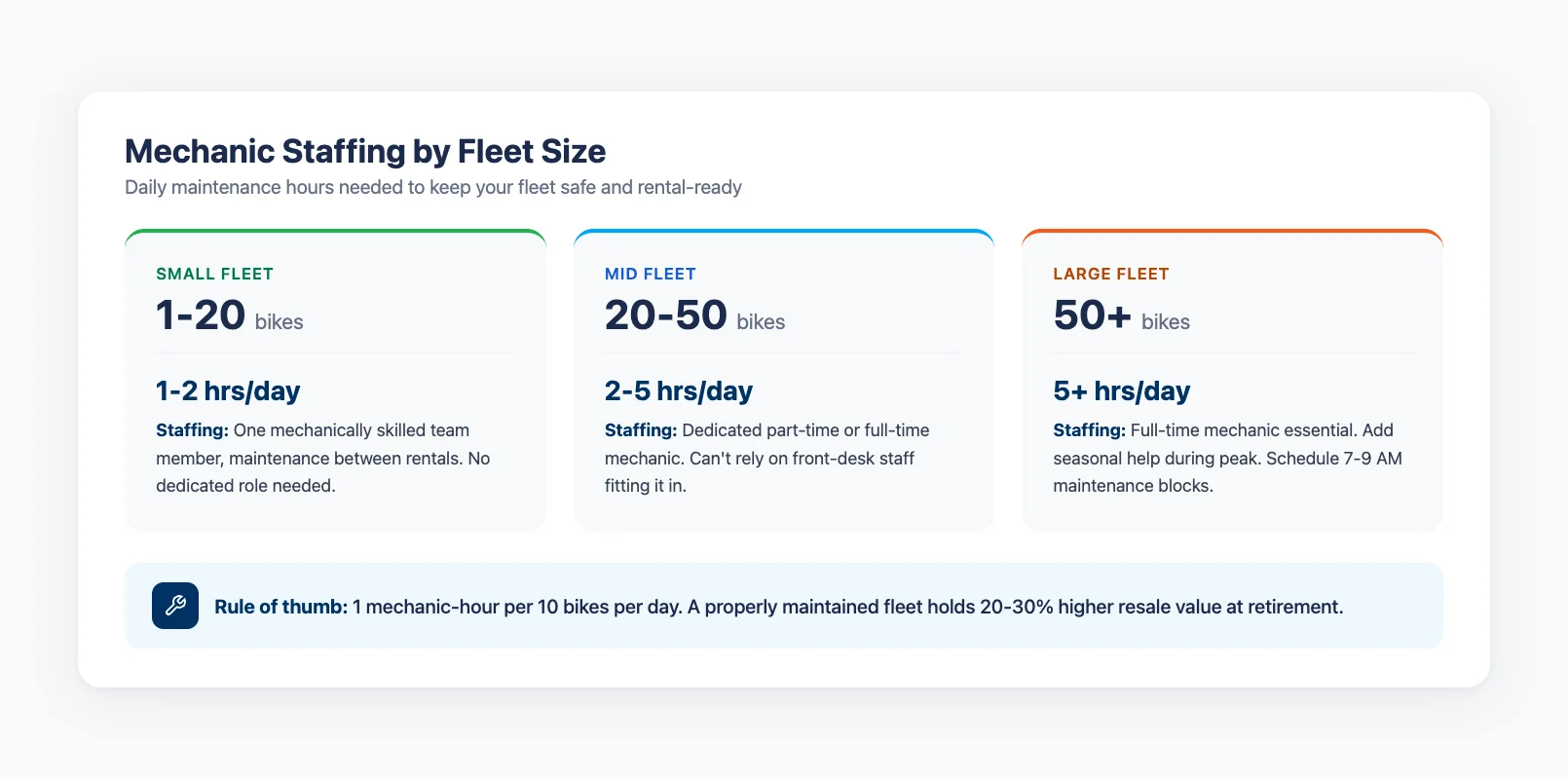
Rule of thumb: one dedicated mechanic-hour per 10 bikes in your fleet, per day. A 30-bike fleet needs 3 mechanic-hours daily. A 60-bike fleet needs 6. This covers quick checks, repairs, and intermediate services. Major services are extra — budget those as weekly blocks.
In-house vs outsource. Shops under 20 bikes can often rely on one mechanically skilled staff member doing maintenance between rentals. Above 20 bikes, you need a dedicated mechanic role — even if it's part-time. Above 50 bikes, you need a full-time mechanic or you'll fall behind by mid-season.
The cost of skipping maintenance is higher than the mechanic's wage. A full-time bike mechanic costs $35,000-$50,000 per year. One safety incident, one lawsuit, or one season of accelerated component wear from neglected maintenance costs more. A properly maintained fleet also holds resale value 20-30% higher at retirement.
Peak season surge. Your busiest months need more wrench time, not less. If your mechanic is doing 3 hours of maintenance on a quiet Tuesday, they need 5-6 hours on a packed Saturday. Schedule maintenance blocks before opening (7-9 AM) so bikes are ready when the first customers arrive. If you need a chain and drivetrain service checklist or a brake pad inspection template, standardized templates keep quality consistent even when you bring in seasonal help.
When to Retire a Bike
Every bike has a rental lifespan. Holding onto bikes past their useful life costs more in repairs, lost rental days, and customer complaints than replacing them.
Frame fatigue is the hard limit. Aluminum frames develop micro-cracks with use. Carbon frames can fail catastrophically. Steel lasts longest but weighs more. For aluminum rental bikes (the most common), plan for retirement at 3-4 years or 15,000-20,000 rental km — whichever comes first.
The repair-cost trigger. When a bike's monthly repair cost exceeds 15-20% of its monthly rental revenue, it's costing you money to keep it in the fleet. Track this per bike. Some bikes hit this threshold at 2 years; others last 5. Average isn't useful — individual tracking is.
Signs it's time:
- Frame has visible cracks, dents near welds, or persistent creaking that survives bottom bracket replacement
- Wheels won't hold true after repeated truing
- Dropout alignment is off and can't be corrected
- Customer complaints spike for a specific bike (poor shifting, brake issues despite recent service)
- E-bike motor or controller shows intermittent faults
What to do with retired bikes. Sell as-is to staff or the public at 20-30% of original price. Donate to bike co-ops or community programs (tax-deductible in many jurisdictions). Strip for parts — a retired bike's cassette, derailleurs, and wheels can keep other bikes running. Use an end-of-season retirement review template to make the call systematically rather than emotionally.
Fleet refresh rate. Plan to replace 20-30% of your fleet per year. Buy new bikes in the off-season when prices and availability are best. Stagger purchases so you're not replacing the entire fleet at once — that's a cash-flow hit most shops can't absorb.
For damage-related replacement decisions and how they connect to your customer-facing policies, see our bike rental damage policy guide.
FAQ
How often should rental bikes be serviced compared to personal bikes?
Rental bikes need service 8-10x more frequently than personal bikes due to higher use intensity. A manufacturer's 6-month service interval translates to roughly every 3-4 weeks for a busy rental bike. Track service by rental days per bike, not calendar dates.
What's included in a pre-rental bike check?
The ABC check covers Air (tire pressure and condition), Brakes (lever function and pad wear), and Chain/cranks (shifting, chain condition, bottom bracket play). Add saddle tightness, handlebar alignment, wheel security, and accessory checks. It takes 60 seconds per bike.
How many mechanics do I need for my bike rental fleet?
Budget one mechanic-hour per 10 bikes per day. A 30-bike fleet needs 3 hours of dedicated maintenance time daily. Shops above 20 bikes need a dedicated mechanic role. Above 50, a full-time position is essential to avoid falling behind during peak season.
When should I replace a rental bike's chain?
Replace when chain elongation reaches 0.5%, measured with a chain checker tool. In a busy rental fleet, that's roughly every 1,500-2,000 km or 60-80 rental days. Replacing a worn chain promptly ($15) saves your cassette ($60) and chainrings ($40+) from accelerated wear.
How do I know when to retire a rental bike from the fleet?
Retire when monthly repair costs exceed 15-20% of monthly rental revenue, the frame shows cracks or irreparable damage, or the bike hits 15,000-20,000 rental km on an aluminum frame. Customer complaint patterns for a specific bike are another strong signal.
What spare parts should I keep in stock for a rental bike fleet?
At minimum: inner tubes (2 per bike), brake pads (2-3 sets per bike), chains (1 per 3 bikes), gear and brake cables with housing, and tires (1 per 5 bikes). Order puncture-resistant tires and bulk chains before the season to avoid mid-season stockouts.
Should I use puncture-resistant tires on rental bikes?
Yes. Puncture-resistant tires (like Schwalbe Marathon or Continental Contact Plus) cost $10-$15 more per tire but reduce flat rates by 60-70%. They pay for themselves within two weeks of avoided repair time and lost-rental downtime during peak season.
Wrapping Up
Rental bike maintenance isn't complicated. It's consistent. The shops that keep fleets safe and profitable don't have secret techniques — they have schedules that match actual use intensity, staff assigned to follow them, and systems that track which bikes are due.
Start with the ABC check on every rental. Build your quick-check, intermediate, and major service intervals around rental days, not calendar dates. Staff your maintenance hours to match fleet size. And retire bikes before they become repair sinks.
If you're building a bike tour operation alongside your rentals, our bike tour revenue playbook covers pricing and upsell strategies. For the complete operational picture, see our bike rental business guide — or jump straight to the bike rental software hub to see how EquipDash tracks rental days per bike, schedules service automatically, and flags bikes due for retirement before they become repair sinks.
in one place