How to Run a Scuba Diving Business: The Complete Operator's Guide (2026)
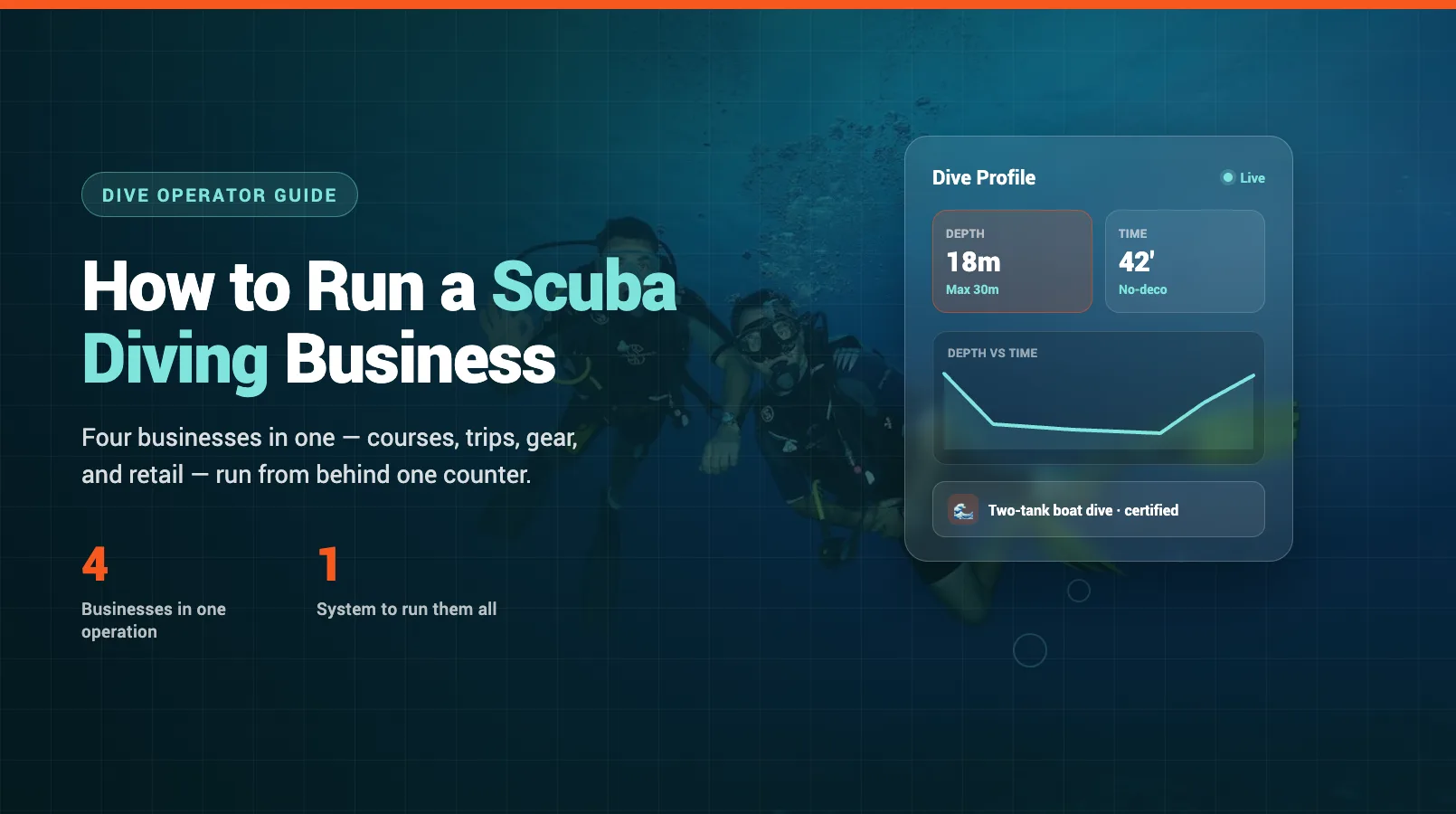
From the surface, a dive center looks like a shop that fills tanks and points people at the water. Behind the counter it is four businesses stacked on top of each other. You are running a retail store, a training school, a rental fleet, and a boat charter, and each one has its own margins, its own risks, and its own way of eating your day. On top of that sits a wall of liability that most retail owners never have to think about: you are taking people underwater, where a paperwork miss or a servicing lapse is not a refund problem, it is a safety problem.
Get the operation right and a well-run center in the right location earns a genuine living from courses, trips, gear, and retail combined. Get it wrong and you are drowning in seasonal cash-flow gaps, no-shows on a half-empty boat, and instructors standing around on a flat-calm day you should have sold out. This guide walks through every major decision an operator faces — from the kind of center you build to how you survive the months the tourists stop coming.
Dive center business models
The first decision shapes everything else: what kind of dive operation are you actually building? There are four common models, and they run on very different economics.
Shore-based retail dive centers are the classic model — a storefront with a compressor, a rental fleet, a classroom or pool access, and a retail wall. You earn from courses, gear rental, air fills, servicing, and equipment sales. This model has the lowest barrier to entry because you do not need a boat, and it builds a loyal local base of certified divers who keep coming back for fills and gear. The catch is that without a boat you depend on shore-accessible sites or on partnering with a boat operator for deeper trips.
Resort and hotel dive operations live inside or alongside a hotel and feed off its guest traffic. Demand is handed to you, occupancy drives your calendar, and you can charge premium rates to captive vacationers. The trade-off is that the resort usually takes a cut or charges rent, controls your access to the guest, and ties your fortunes to their booking numbers.
Day-boat charter operators center the whole business on the vessel. You run scheduled trips to reef, wreck, or wall sites, selling two-tank and three-tank days to certified divers and courses that need boat access. Boats unlock better diving and higher ticket prices, but they add fuel, crew, maintenance, insurance, and mooring costs that never stop, whether the boat sails full or half-empty.
Liveaboards are the top of the market — multi-day trips where divers eat, sleep, and dive from the vessel for a week at a time. Revenue per guest is high and bookings come months ahead, but the capital and operating cost is a different league entirely, and one bad season or a major mechanical failure can sink the whole operation.
Many established operators run a hybrid: a shore-based center that owns or charters a day boat, teaches courses, and sells retail all under one roof. If you are still mapping the terms and roles in this business, the scuba diving glossary is a useful reference for the certifications, equipment, and site types referenced throughout this guide.

Boat diving vs shore diving operations
Whether your best diving is reachable from the beach or only from a boat drives more of your operation than almost any other factor. It sets your capital costs, your daily schedule, your staffing, and your weather exposure.
Shore-diving operations are lean. Divers gear up at the shop or a beach entry, walk in, and dive. You avoid the single largest capital item in the industry, and you can run a trip with one guide and a van. The limits are real, though: shore sites are usually shallower and more crowded, they are exposed to surf and surge, and once your local shore diving is "done," repeat customers want something deeper. Shore operators often cap out on how much they can charge because the customer knows there is no expensive boat in the equation.
Boat-diving operations open up the sites people fly in to see — offshore reefs, wrecks, walls, and drift dives that are impossible from the beach. You can charge two to three times the per-dive rate, and a full boat of two-tank divers is one of the most profitable trips in the business. But the boat is a hungry asset. Fuel, an engine service schedule, hull and safety inspections, crew wages, mooring or berth fees, and marine insurance all run whether you sail full or nearly empty. A half-full boat on a slow Tuesday can wipe out the profit from a sold-out Saturday.
The practical answer for most operators is to know your break-even headcount per trip cold, and to never let a boat leave the dock below it without a deliberate decision. That means tight scheduling, real-time visibility of who has actually paid, and the discipline to combine or cancel undersold departures early enough to redeploy staff.
Certification agencies: PADI, SSI, and the course ladder
Teaching is where a lot of dive centers make their real money, and it starts with picking an agency to affiliate with. The two dominant names are PADI and SSI, though NAUI, RAID, and TDI all have their place.
PADI has the largest global brand recognition. When a first-timer searches for a dive course, PADI is the name they have usually heard of, which pulls walk-in students to a PADI dive center almost automatically. SSI often runs with lower per-student material costs and a more flexible, digital-first course structure that some instructors prefer. NAUI has a strong academic reputation, and technical agencies like TDI cover the deeper, decompression, and rebreather end of the market.
The core of the business is the recreational course ladder, and it is worth understanding as a revenue funnel:
- Entry courses — Discover Scuba and try-dives. Low price, high volume, and the top of the funnel. This is where a vacationer becomes a lifelong diver, or does not.
- Open Water — the first full certification and the single biggest course revenue line for most centers. A student who certifies with you often buys gear and books trips with you for years.
- Advanced and specialty — deep, nitrox, wreck, night, and drift certifications. Higher margin, sold to divers you already have.
- Rescue and professional — Rescue Diver, Divemaster, and Instructor. Long, high-value programs that also feed you a pipeline of future staff.
The smart operator treats the ladder as a customer journey, not a price list. Every Discover Scuba student is a potential Open Water booking, every Open Water graduate is a future advanced student and gear buyer, and every Divemaster candidate is cheap labor you trained yourself.

Building and maintaining your gear fleet
Rental gear is both a revenue stream and a liability you carry every single day. Unlike a kayak or a bike, a failed regulator or an out-of-date tank is a life-safety issue, so the fleet is as much a maintenance operation as a rental one.
A working rental fleet for a mid-size center covers tanks (aluminum 80s as the workhorse, plus a few larger and smaller sizes), regulators with a primary, octopus, and gauges, BCDs across the full size range, wetsuits in enough sizes and thicknesses for your water, masks, fins, and boots, and dive computers. Size the fleet to your busiest realistic day plus a buffer for units that are out for service, not to your average day.
The part that separates a safe center from a lawsuit waiting to happen is the servicing schedule:
- Tanks need periodic visual inspections and hydrostatic testing on a fixed cycle. An out-of-test tank cannot legally be filled, and a shop that fills one is exposed badly.
- Regulators need annual or usage-based servicing by a certified technician, tracked per unit.
- BCDs need inflator and dump-valve checks and are pulled from the fleet the moment they show wear.
- Computers need battery and firmware management so a dead unit never leaves the shop.
The operational challenge is tracking all of this per serial number across a fleet that is constantly out on boats and in customers' hands. Paper logs fail here — the tank that slips past its inspection date is the one that ends up on the deck of a boat forty minutes offshore. Tracking each unit's service history, next-due date, and current status is exactly the kind of record-keeping that belongs in a system, not a clipboard.

Guide ratios and staffing
Staffing a dive center is a balancing act between safety compliance, customer experience, and payroll. Every agency sets ratio standards — the maximum number of students or divers one professional can supervise — and they are not suggestions. Breaking them voids your insurance and your agency affiliation, and it is the first thing an investigator looks at after an incident.
Broadly, training ratios are tighter than fun-dive ratios. Open Water confined-water and open-water training typically caps around eight students per instructor, and often tighter with newer divers or harder conditions. Certified fun dives are commonly guided at somewhere between four and eight divers per guide depending on site difficulty, current, and visibility. Deeper or technical diving tightens the numbers further.
The staffing math is where many centers bleed money. Instructors and divemasters are your largest variable cost, and the temptation is to over-crew so you are never caught short. The better approach is to schedule to actual, paid bookings and to build a bench of on-call staff and Divemaster candidates you can call in when a trip fills, rather than paying full-timers to stand around on a slow week. Knowing exactly how many divers are confirmed on tomorrow's boat — and at what certification level — is what lets you crew each trip correctly instead of guessing.

Course economics: where the money actually is
New operators often assume the money is in fun dives and gear rental. In reality, certification courses are the engine for most healthy dive centers, and they are worth thinking about as a portfolio.
An Open Water course carries a healthy ticket price and a predictable cost structure — instructor time, materials, agency certification fees, pool or confined-water access, and gear. The margin is solid on its own, but the real value is downstream. A newly certified diver typically buys their own mask, fins, and often a computer within the first year, books fun dives with the shop that trained them, and works up the course ladder into advanced and specialty programs. The lifetime value of one Open Water student dwarfs the course fee.
Continuing education — advanced, nitrox, rescue, and specialties — is the highest-margin teaching you do, because you are selling to divers you already have, often in small groups, with lower marketing cost. Professional programs like Divemaster and Instructor are long, high-value, and double as a recruiting pipeline for cheap, well-trained staff.
The costly mistake is pricing courses to compete on the sticker and forgetting the downstream value, or worse, discounting the entry course so hard that the whole funnel runs at a loss. Package courses with gear and trip credits, price continuing education as the profit center it is, and measure a student by what they spend over three years, not three days. This is exactly the kind of pricing and packaging strategy covered in more depth across the scuba operations hub.
Seasonality and cash flow
Almost every dive business is seasonal, and the operators who fail usually fail on cash flow, not on demand. Whether your peak is driven by warm water, tourist calendars, or school holidays, you earn a disproportionate share of the year's revenue in a handful of months and then have to fund the fixed costs — rent, insurance, core staff, loan payments — through the quiet stretch.
The financial discipline is to treat peak-season profit as money you have to make last. Build a cash buffer during the busy months instead of spending it, and know your monthly break-even in the off-season so you are never surprised.
The operational side is about filling the quiet months with the right work. Low season is when you:
- Service the fleet — the tank inspections, regulator servicing, and BCD checks you cannot spare a unit for during peak.
- Retrain and recertify staff, and run internship or Divemaster programs that cost little and build your bench.
- Sell into the future — pre-sell next season's courses, run early-bird trip deposits, and push pool-based refresher courses to rusty locals.
- Do the marketing you never have time for when the boat is full.

Running it all on one system
The thread running through every section above is record-keeping. A dive center juggles course bookings, boat manifests, gear service dates, certification levels, medical forms, and waivers, and the traditional answer is a stack of spreadsheets, a paper waiver folder, and a whiteboard for the boat schedule. That stack is exactly what causes the double-booked boat, the expired certification discovered at the dock, and the tank that slips past its inspection date.
Modern operators consolidate all of it onto a single booking and operations platform: online reservations for courses and trips, real-time boat capacity and manifests, per-unit gear tracking with service dates, digital waivers and medical statements captured before the customer arrives, and point of sale for retail and air fills. When one system holds the whole operation, the check-in desk sees a diver's certification level and signed paperwork instantly, and the office sees which trips are under break-even in time to act.
This is also where automation earns its keep. Dash AI can chase an unsigned waiver before the trip, flag a diver whose certification does not match the dive they booked, and nudge a customer to rebook when weather forces a cancellation — the routine follow-ups that fall through the cracks when the boat is full and the shop is busy.
Putting it together
Running a dive center is four businesses in one, wrapped in a layer of safety and liability that most retail owners never carry. The operators who thrive are the ones who choose a model that fits their sites and capital, treat certification courses as the funnel that feeds everything else, run their gear fleet like the safety-critical operation it is, staff to real bookings instead of guesses, and manage cash across a seasonal year with eyes open.
Do those things well and the diving takes care of itself. The customer walks in nervous, learns to breathe underwater, and comes back for years. Your job behind the counter is to make sure the paperwork, the tanks, the boat, and the schedule are all ready when they do.
FAQ
How much does it cost to start a scuba diving business?
A shore-based dive center can open for roughly $60,000 to $150,000 once you cover a rental gear fleet, a compressor and tanks, retail stock, fit-out, agency affiliation, and working capital. Adding a dive boat pushes the number well past $200,000 depending on the vessel, so many operators start shore-based and add boat capacity once the customer base is built.
Do I need to be a dive instructor to own a dive center?
No. Plenty of dive centers are owned by non-diving investors who employ certified instructors and a course director. But most successful independents are owner-operators who teach, because instructor payroll is one of the largest costs in the business, and teaching yourself protects margin in the early years while you build volume.
Is PADI or SSI better for a dive shop?
Both are widely recognized and let you certify divers worldwide. PADI has the largest brand recognition and marketing pull, which helps attract walk-in students. SSI often has lower material costs and a more flexible, digital-first course structure. Many shops choose based on local competition and what their instructors are already certified to teach.
How many divers can one guide take?
Ratios depend on the certification level and the agency. Open Water training typically caps at eight students per instructor in open water, and often tighter with newer divers or difficult conditions. Certified fun dives are commonly guided at four to eight divers per professional depending on the site, current, and visibility.
How do dive centers make money in the off-season?
Off-season revenue comes from gear servicing, retail and equipment sales, pool-based training and refresher courses, and pre-selling next season's trips and courses. Quiet months are also when operators service the fleet, inspect and test tanks, and retrain staff, so the slow period does double duty as maintenance season.
What software do scuba diving businesses use?
Modern dive centers run on a single booking and operations platform that handles online reservations for courses and trips, gear rental with per-unit service tracking, digital waivers and medical forms, and point of sale. Consolidating replaces the paper logs and spreadsheets that cause double-booked boats and expired-certification surprises at the dock.
in one place