How to Run a Tour Operator Business: The Complete Operator's Guide (2026)
Running a tour business looks simple from the outside. You know a place, you show it to people, they pay you. But between that first booking and a profitable operation, there's a gap that swallows most small tour operators within three years: licensing you didn't know you needed, insurance quotes that make your eyes water, guides who freelance for your competitor on weekends, pricing that barely covers fuel, and a six-month off-season that drains every dollar you earned in summer.
This guide is the full operator playbook for building and running a tour business in 2026, whether you're launching a walking tour company, scaling a guided tour operation, or tightening up a small tour operator business that's been running on instinct. We'll cover the seven pillars that determine whether a tour company survives or thrives: business models, licensing and insurance, guide management, pricing, marketing, customer experience, and seasonal cash flow.
For operational checklists and templates, see the tours hub and tour operator glossary.
Tour Business Models: Pick the Right One Before You Build
Not every tour business works the same way. Your model determines your staffing, capital requirements, pricing ceiling, and scalability. Get this wrong and you'll build infrastructure for a business that doesn't match your market.
Scheduled group tours. Fixed departures at set times — 9 AM, 1 PM, sunset. Guests book individual seats. This is the bread-and-butter model for walking tour businesses, food tours, and most sightseeing operations. Low capital requirements, predictable scheduling, and the highest volume potential. The downside: you're competing on OTA platforms where price pressure is brutal.
Private tours. Custom departures for one group: families, couples, corporate teams. Higher per-booking revenue, lower volume. Private tours typically command 30-60% premiums over group rates. The trade-off is utilization: a guide dedicated to a family of 4 at $400 earns less per guide-hour than a group tour with 12 guests at $45 each ($540). But private tours fill mid-week dead spots and attract higher-spending customers.
Multi-day tours. Guided multi-day itineraries with accommodation, meals, and transport included. Capital-intensive (you're fronting supplier costs), logistics-heavy, and margin-rich when executed well. Typical gross margins run 35-50% on multi-day packages priced at $200-500 per person per day. The barrier to entry keeps competition lower.
Specialty and niche tours. Photography tours, culinary experiences, historical deep-dives, ghost tours, craft brewery crawls. Niche tours attract customers who book on expertise rather than price. A 2-hour photography walking tour at $120 per person outprices a general city tour at $35 because the perceived value is skills-based, not access-based.
Hybrid models. Most successful small tour operators run a mix. Scheduled group tours generate volume and OTA visibility. Private tours fill gaps and boost average revenue. An occasional multi-day offering captures the high-value segment. Start with one model, prove it, then layer.
The model you choose dictates everything downstream. A walking tour business needs minimal equipment but maximum marketing. A multi-day adventure operation needs supplier relationships, transport logistics, and enough working capital to float $15,000-$30,000 in pre-paid supplier costs per month.
Licensing, Permits, and Insurance: The Non-Negotiable Foundation
This is where most new tour operators stumble. Licensing requirements vary by country, state, and sometimes city, and the penalties for operating without them range from fines to shutdown.
Business registration and tour-specific licenses. Beyond your standard business license, most jurisdictions require tour-specific permits. In the US, this varies by state and city: New York City requires a licensed tour guide for any guided group; national parks require Commercial Use Authorizations (CUAs); state parks have their own permit systems. In Australia, you'll need relevant state tourism operator licenses and potentially specific land-use permits. Research your specific jurisdictions before you take a single booking.
Land-use and access permits. If you're running tours on public land (national parks, state forests, heritage sites, waterways) you need access permits. These are typically annual, capacity-limited, and competitive. Apply 6-12 months in advance. Losing your permit access means losing your business overnight.
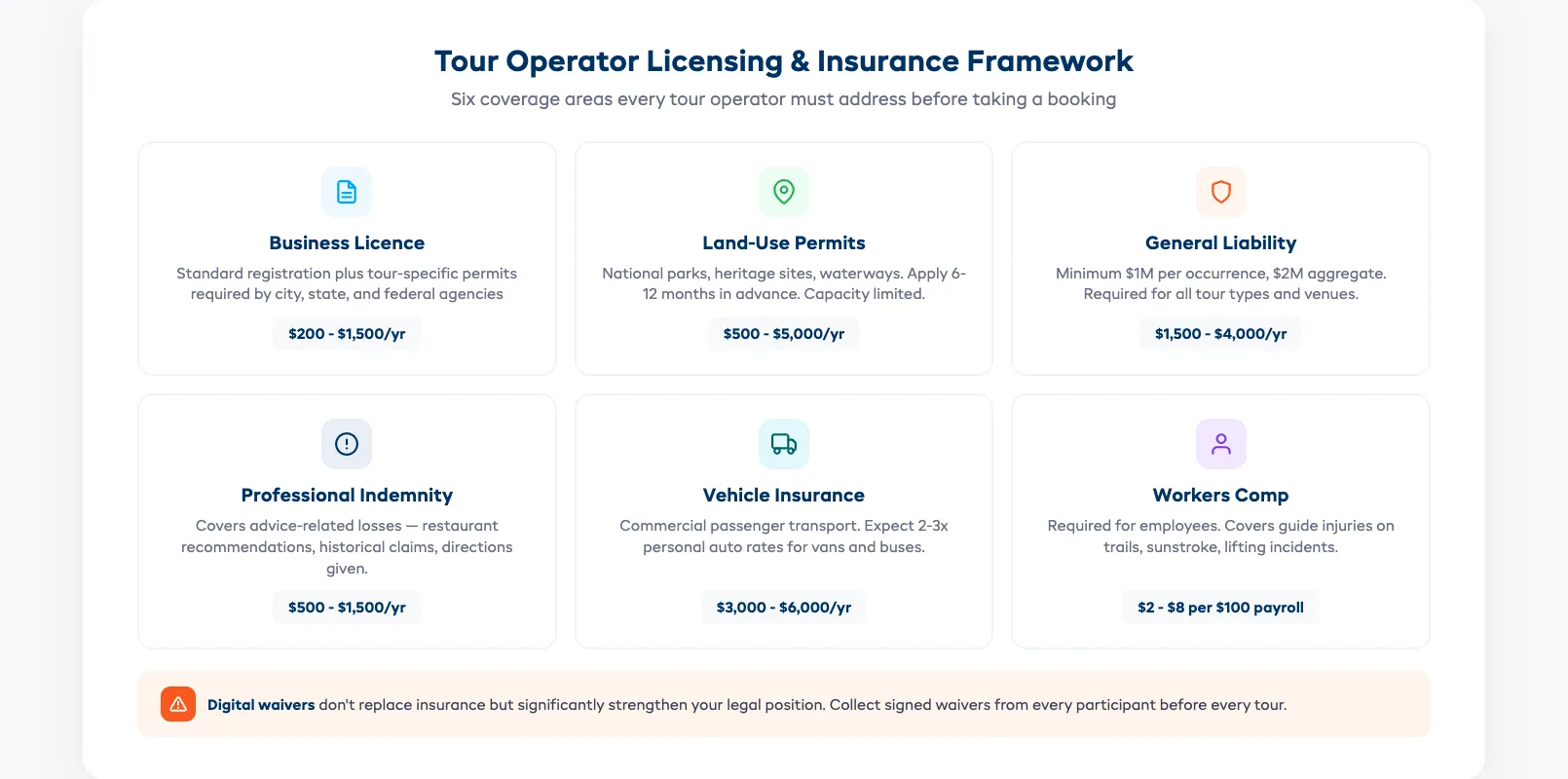
General liability insurance. Non-negotiable. Minimum $1M per occurrence, $2M aggregate is standard for low-risk tours (walking, food, sightseeing). Expect to pay $1,500-$4,000 per year for a small operation. Premiums scale with participant volume, activity risk level, and your claims history. Get quotes from at least three brokers who specialize in tourism — generic commercial insurance brokers don't understand the sector.
Professional indemnity and errors & omissions. Covers you when advice or information you give causes a loss. If you recommend a restaurant that gives 10 guests food poisoning, or your historical facts are wrong and someone sues. This is your coverage. $500-$1,500 per year for most tour operators.
Vehicle and transport insurance. If you use vehicles (vans, buses, boats) you need commercial vehicle insurance, not personal. Commercial passenger transport insurance costs 2-3× personal auto insurance. A 12-seat van running daily tours will run $3,000-$6,000 per year in commercial coverage.
Workers' compensation. Required in most jurisdictions once you have employees (not contractors). Guides who trip on a trail, lift heavy coolers, or get sunstroke are covered. Costs vary wildly by state and risk classification — $2-$8 per $100 of payroll for tour guide classifications.
Waivers. A waiver doesn't replace insurance, but it significantly strengthens your legal position. Collect signed waivers from every participant before every tour. Digital waivers eliminate the paper chase — guests sign on their phone when they book, not at check-in when they're distracted and rushing. Use the Tour Pre-Departure Check template to ensure nothing's missed.
Guide Hiring and Training: Your Product Is Your People
Your guides are your product. A $45 walking tour with an exceptional guide gets 5-star reviews and repeat bookings. The same tour with a mediocre guide gets 3 stars and disappears from OTA rankings. Everything else (your pricing, your marketing, your tech stack) is secondary to guide quality.
Where to find guides. Tourism and hospitality programs at local universities. Improv and acting communities (storytelling ability matters more than subject expertise. You can teach content). Retired professionals with deep local knowledge. Other tour companies (yes, guides move around — offer better pay, better scheduling, or better culture). Local Facebook groups for tour guides and hospitality workers.
What to screen for. Energy and presence in front of a group. The ability to read a room — knowing when guests are engaged and when they're drifting. Time management (a guide who consistently runs 20 minutes over is costing you the next departure). Reliability (a no-show guide on a Saturday morning costs you $800+ in refunds and review damage). Subject knowledge is trainable. Charisma isn't.
Training structure. New guides should shadow experienced guides for a minimum of 5-10 tours before leading solo. Create a standardized training manual with: tour script (talking points, not word-for-word), timing benchmarks for each stop, safety protocols, emergency procedures, customer service escalation paths, and equipment checklists. Record your best guide running the tour on video. It becomes your training baseline. See the Tour Guide Certification & Training Review checklist.
Pay structures. Three common models:
- Per-tour flat rate. $75-$200 per tour depending on duration and market. Simple, predictable. Guides earn based on tours run, not tips. Works for scheduled group tours with predictable volume.
- Hourly + tips. $15-$25 per hour base plus tips. Common for free walking tours and tip-based models. Risk: guide income is inconsistent and you'll lose good guides to steadier work.
- Base + revenue share. Salary or guaranteed minimum plus 5-10% of tour revenue above a threshold. Aligns guide incentives with business growth. Best for senior guides and team leads.
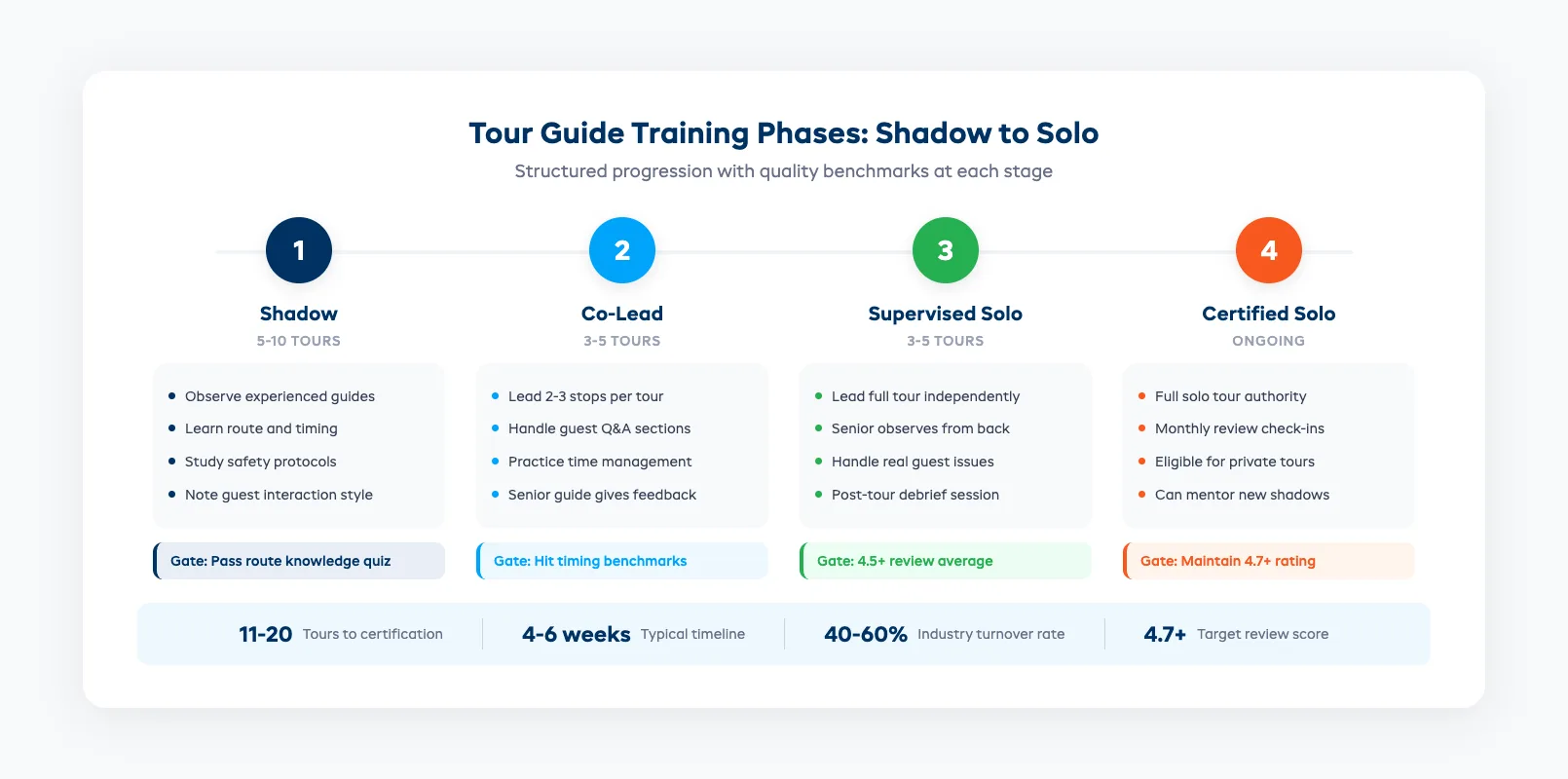
Guide retention. Tour guide turnover averages 40-60% annually in the industry. The operators who retain guides invest in three things: predictable scheduling (published 2-4 weeks in advance), clear advancement paths (lead guide → training guide → operations), and genuine respect for guides' time (no last-minute schedule changes without premium pay).
Pricing Architecture: Beyond Per-Person Flat Rates
Most small tour operators default to one price: $X per person. That's leaving money on the table every single day. A proper pricing architecture captures different customer segments at different price points without adding tours or guides.
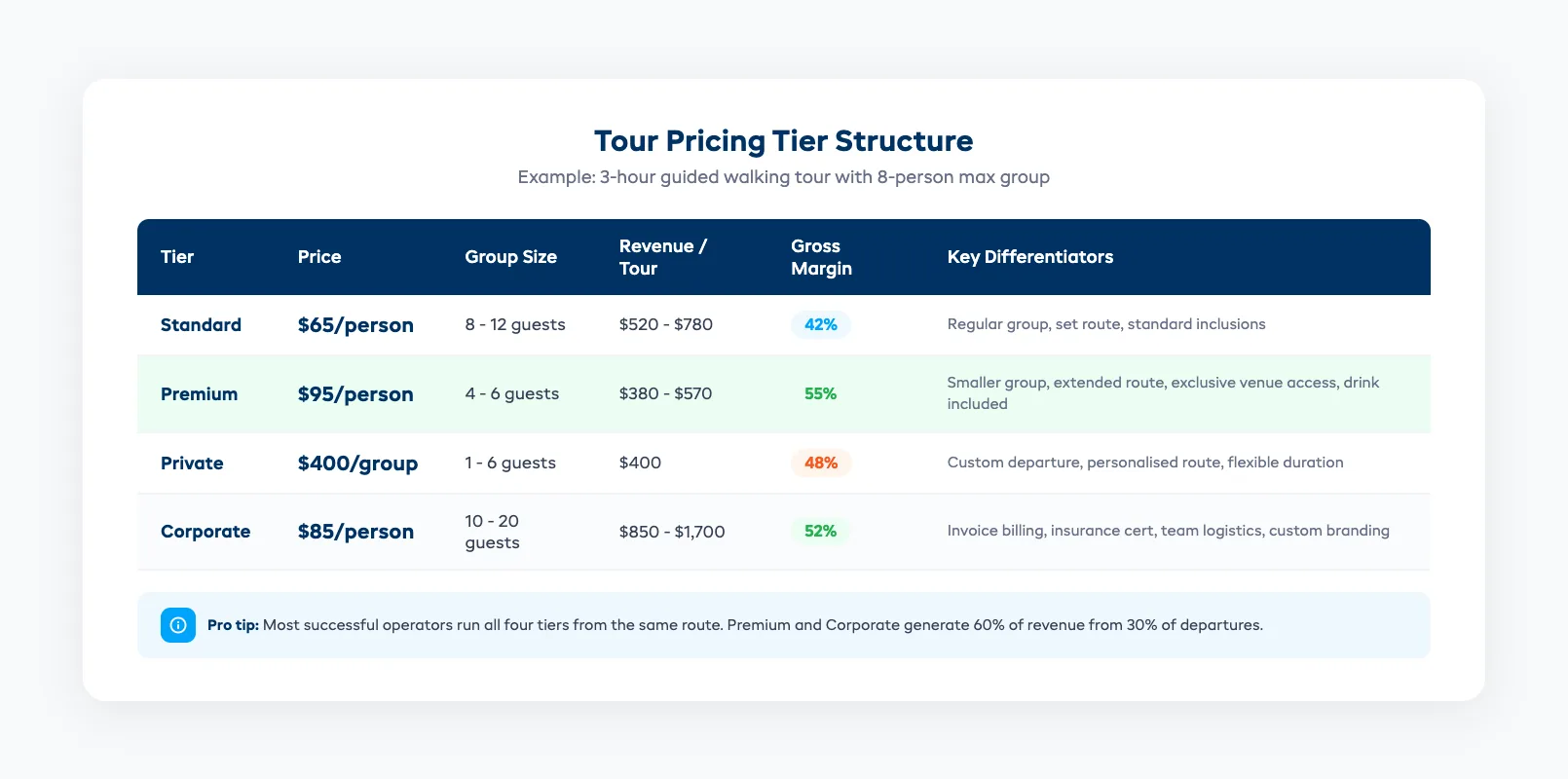
Cost-plus baseline. Calculate your true cost per tour: guide pay, insurance allocation per tour, permit fees, transport, any inclusions (food, drinks, entry tickets), equipment depreciation, booking platform fees, and overhead allocation. Divide by your minimum viable group size (not your maximum). If a 3-hour walking tour costs $280 to run and your minimum is 6 guests, your floor is $47 per person. Price at $65-75 for a healthy 40-55% gross margin.
Tiered pricing by experience level. Standard tour at $65. Premium tour (smaller group, extended route, exclusive access) at $95. Private tour at $350-500 for the group. Each tier uses the same guide and roughly the same route: the perceived value difference is group size, exclusivity, and add-ons.
Seasonal pricing. Peak season (summer in most markets) commands 15-30% higher rates than shoulder season. Off-season rates drop 10-20% to maintain volume. Don't discount deeper than 20% off peak. It trains customers to wait for deals and devalues your product. Instead, add value at the same price: off-season tours include a hot drink, a bonus stop, or a small gift.
Dynamic pricing rules. Departures filling quickly? Price the last 3-4 seats 15-20% higher. Monday morning tour with 2 bookings? Drop a same-week flash deal at 10% off. The goal isn't to race to the bottom. It's to match price to demand in real time. Dash AI can automate these adjustments based on booking velocity and days-to-departure.
Group and corporate tiers. Groups of 10+ get a per-person discount (10-15%). Corporate bookings get a package price that includes logistics, invoicing, and insurance certificates — priced 20-30% above your standard per-person rate because the service level is higher and the hassle is lower for the buyer.
OTA pricing parity. If you list on Viator or GetYourGuide, your OTA price should match your website price. But your website should offer a "book direct" incentive: a free add-on, priority time slots, or a small discount code. The OTA brings discovery; your website converts loyalty.
Marketing and Distribution: Filling Tours Without Bleeding Commission
A tour with no guests is just a walk. Your marketing strategy determines whether you're running full tours or paying guides to stand around.
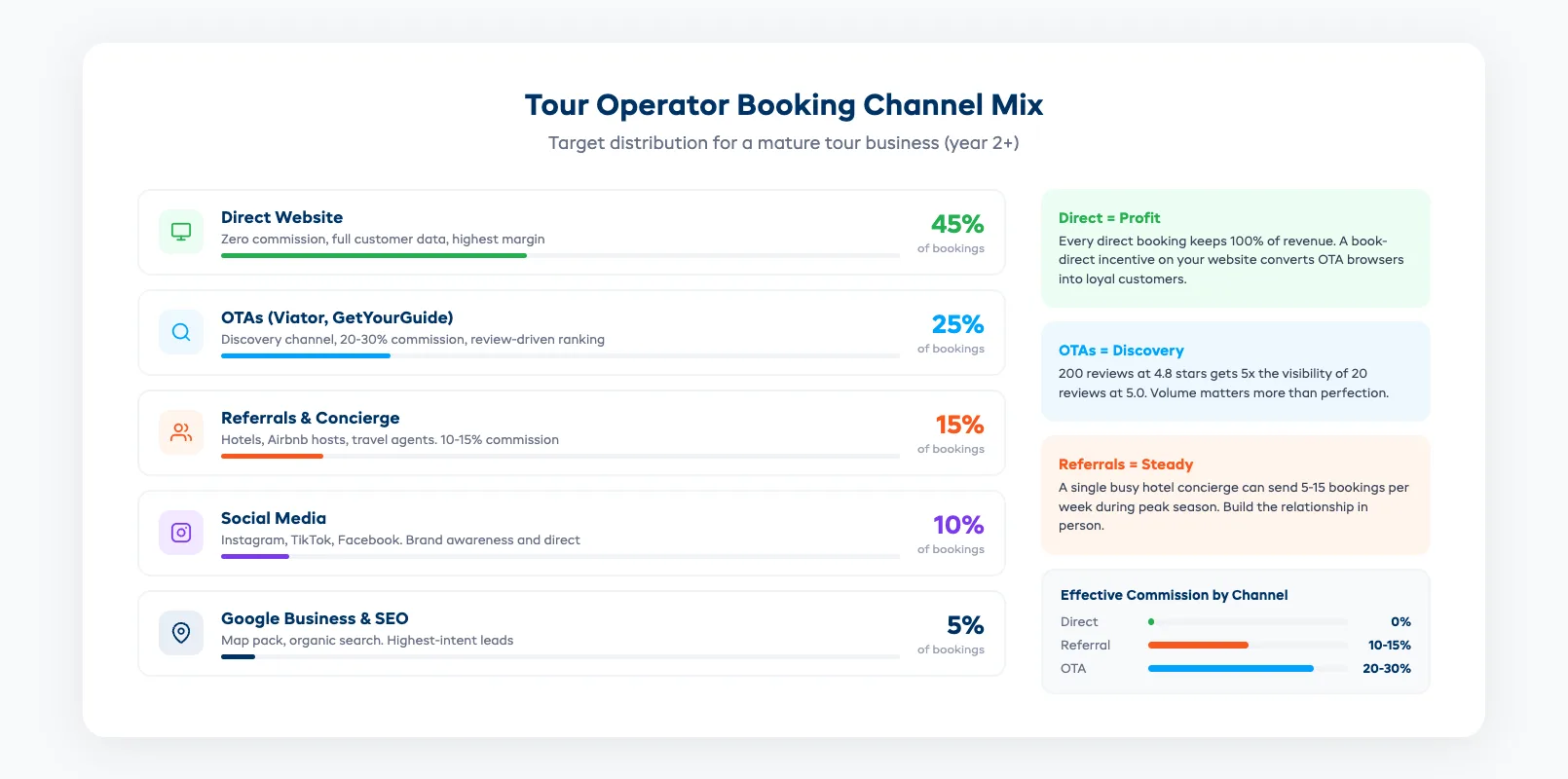
OTA platforms (Viator, GetYourGuide, Airbnb Experiences). OTAs are your discovery channel, not your profit center. Commission rates run 20-30%. List your flagship tours, optimize your listings with professional photos and keyword-rich descriptions, and collect reviews aggressively. OTAs rank by review volume and recency — a tour with 200 reviews and a 4.8 rating gets 5x the visibility of a tour with 20 reviews and a 5.0 rating. Volume matters more than perfection.
Google Business Profile. Free and criminally underused by most tour operators. Claim your profile, add all tour types as products, post weekly updates with photos, and respond to every review within 24 hours. A well-optimized Google Business Profile shows up in "tours near me" and map pack results, your highest-intent, lowest-cost leads.
Your own website. Your website is your only zero-commission booking channel. Invest in fast load times, mobile-first design, professional photography, and a booking widget that converts in 3-4 clicks. Every tour page needs: what's included, what to bring, meeting point with map, cancellation policy, and real customer reviews. Embed your booking calendar directly. Don't send people to a third-party site.
Social media (Instagram, TikTok, Facebook). Post guest content with permission. Short video clips of tour highlights — 15-30 seconds, vertical format. Behind-the-scenes guide content. Local tips that establish expertise. Don't oversell; provide value. The algorithm rewards engagement, not promotion. One post per day across platforms is the minimum for visibility.
Partnerships and concierge referrals. Hotels, Airbnb hosts, travel agents, and local businesses refer guests to tours they trust. Build a referral program: 10-15% commission per booking, tracked by a unique referral code or link. Visit concierge desks in person with a sample tour and printed materials. A single busy hotel concierge can send you 5-15 bookings per week during peak season.
Email marketing. Collect every guest email. Send a post-tour thank-you with a review request. Build a seasonal newsletter with upcoming special tours, local events, and early-bird offers. Email has the highest ROI of any marketing channel for repeat and referral bookings. Past guests who had a great experience are your cheapest acquisition source.
SEO for tour operators. Target "[city] + [tour type]" keywords on dedicated landing pages. "Melbourne walking tour," "Queenstown wine tour," "San Diego whale watching tour." One page per tour type per location. These pages compete for organic traffic that converts at 3-5× the rate of social media traffic.
Customer Experience: From Booking to Review
Tour operators obsess over the tour itself and ignore everything around it. But the customer experience starts at booking and ends at the review, and the moments before and after the tour matter as much as the tour itself.
Booking experience. The booking should take less than 2 minutes on mobile. Date, time, number of guests, payment. No account creation required. Instant confirmation via email and SMS with: meeting point (with Google Maps link), what to bring, what to wear, cancellation policy, and your contact number. If a customer has to call or email to book, you've already lost 30-40% of potential bookings. Use a Tour Booking Confirmation Process to standardize this.
Pre-tour communication. Send a reminder 24 hours before the tour. Include weather forecast, any last-minute changes, and a "reply here if you have questions" prompt. This reduces no-shows by 15-25% and gives you a chance to upsell (rain gear rental, upgraded experience, photo package).
The tour itself. Arrive 15 minutes early. Greet guests by name (pull from your booking system). Start on time, never wait more than 5 minutes for latecomers. Set expectations in the first 2 minutes: duration, number of stops, where the bathrooms are, when photos will happen. End with a clear wrap-up and a personal recommendation for what to do next in the area.
Post-tour follow-up. Within 2 hours of tour completion, send a thank-you message with: a link to leave a review (choose one platform. Don't overwhelm), a discount code for their next tour or a referral code for friends, and a link to your photo gallery if you took tour photos. This window is critical — the guest is still riding the high of the experience. Wait 48 hours and the conversion rate on review requests drops by 60%.
Handling complaints. When something goes wrong, and it will, respond within 4 hours. Acknowledge the problem, apologize without making excuses, and offer a concrete resolution (partial refund, free future tour, or upgrade). A guest who complains and gets a fast, generous response becomes a more loyal advocate than a guest who had a perfect experience. Use the Tour Customer Complaint Handling template for consistency.
Accessibility and inclusivity. State clearly on your website which tours are wheelchair accessible, which require moderate fitness, and which involve stairs, uneven terrain, or extended walking. Offering a seated option or a shorter route variation opens your market to guests who would otherwise skip your tour entirely. This isn't just good ethics. It's good business.
Seasonal Cash Flow: Surviving the Off-Season
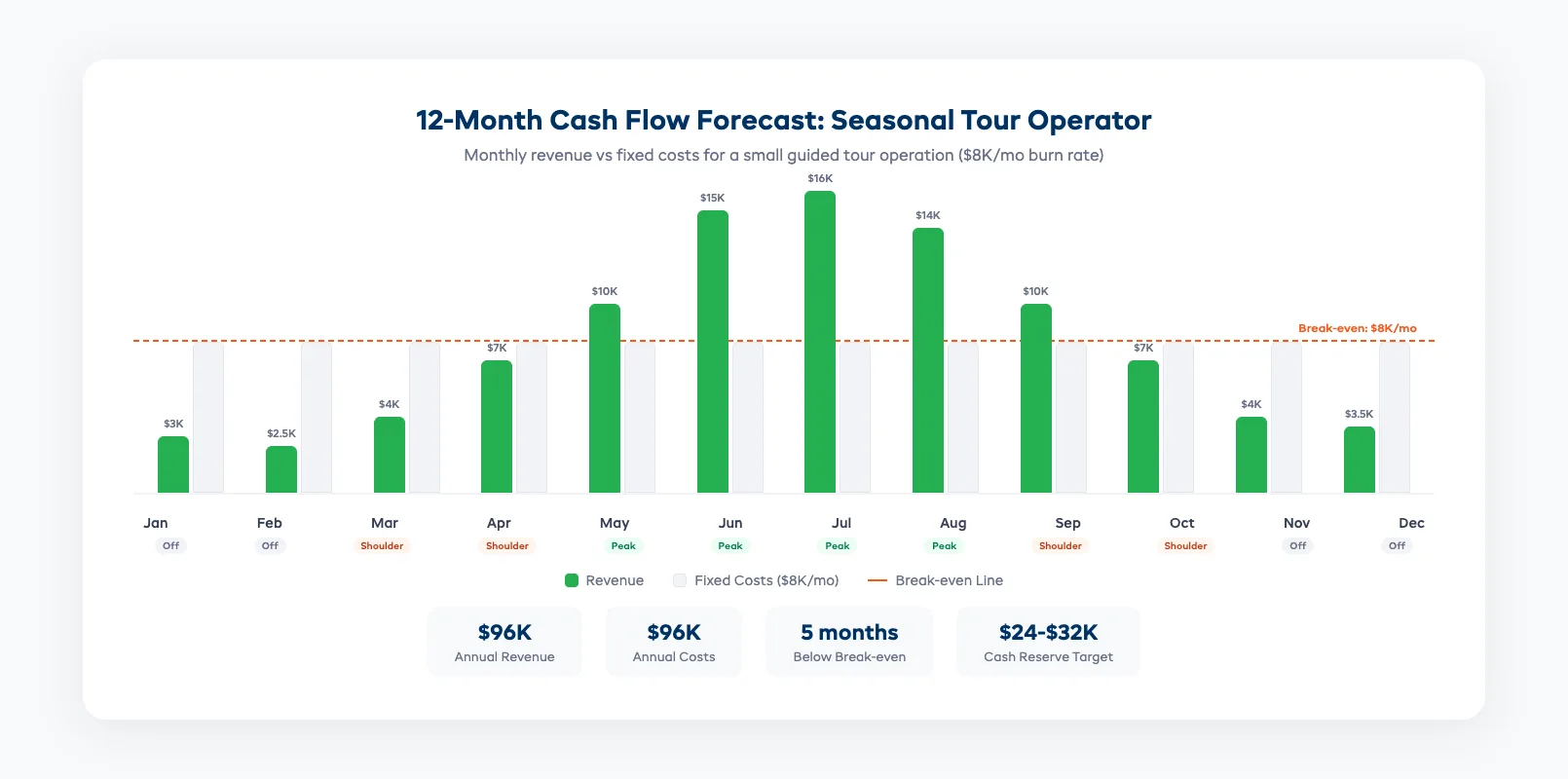
Seasonality is the tour operator's existential challenge. Most tour businesses generate 60-80% of annual revenue in 4-6 months. The other 6-8 months are a cash drain. The operators who survive (and grow) manage cash flow like it's a separate business.
Cash reserve target. Save 3-4 months of operating expenses during peak season. If your monthly burn rate (rent, insurance, loan payments, phone, software, minimum staffing) is $8,000, you need $24,000-$32,000 in reserve before off-season hits. This isn't profit. It's survival capital.
Off-season revenue strategies. Don't shut down. Adapt.
- Local-focused tours. Residents don't travel during off-season, but they'll try a food tour, pub crawl, or historical tour in their own city. Locals-only pricing at 20-30% below tourist rates fills seats that would otherwise be empty. For the September and October version of this - foliage departures, harvest variants, midweek rates, and a locals' pass - see our fall shoulder season playbook for tours.
- Corporate events and team-building. Companies book team activities year-round. A 2-hour team-building scavenger hunt in February generates revenue when tourists don't exist.
- School and educational groups. Term-time school excursions fill weekday capacity during shoulder season. Pricing is lower but volume is reliable.
- Private events. Birthday parties, hen nights, corporate dinners combined with tours. Package your tour with a local restaurant or bar for a combined experience.
- Content and product development. Use the off-season to build new tour products, create marketing content, train new guides, and overhaul your systems.
Expense management. Variable costs should be truly variable. Guides should be per-tour contractors during off-season, not salaried employees (unless your jurisdiction limits this). Pause OTA advertising spend when conversion rates drop below breakeven. Negotiate seasonal rates with suppliers.
Cash flow forecasting. Build a 12-month rolling forecast that maps expected revenue by month against fixed and variable costs. Update it monthly with actuals. If your forecast shows a cash gap in March, you know in November: early enough to secure a line of credit, pre-sell spring tours at a discount, or cut a discretionary expense.
Pre-selling next season. Offer early-bird pricing for next peak season during the current off-season. A 10-15% early-bird discount on bookings made 3-6 months in advance brings cash in during your lean months and locks in future revenue. Promote these through your email list — past guests who loved your tour are the easiest pre-sell.
Dash AI can forecast seasonal demand patterns based on your historical booking data, flagging the months where cash reserves will dip below your target, so you can act before the gap arrives, not after.
Your Next Steps
Running a tour operator business is a craft. The operators who make it past year three are the ones who treat it like a real business: licensed, insured, staffed with trained guides, priced for margin, marketed across multiple channels, and built to survive the off-season.
Start with the model that fits your market and capital. Get your licensing and insurance airtight. Hire one great guide and build your training program around what makes them great. Price for margin, not volume. Market where your customers actually look. Deliver an experience that earns 5-star reviews without asking. And save enough cash to survive the months when nobody books.
For operational checklists that standardize your daily tour operations, explore the tours hub. For a glossary of terms and definitions, see the tour operator glossary. And for the technology that ties operations together (bookings, waivers, scheduling, payments, and AI-powered automation) start a free trial and see how the pieces connect.
FAQ
How much does it cost to start a tour operator business?
Startup costs vary by model. A walking tour business can launch for $2,000-$5,000 (business registration, insurance, website, initial marketing). A vehicle-based tour operation requires $15,000-$40,000 (vehicle purchase or lease, commercial insurance, permits, equipment). Multi-day tour businesses need $30,000-$80,000 in working capital to front supplier costs. The biggest ongoing cost is insurance, typically $3,000-$8,000 per year depending on activity risk level.
Do I need a license to run tours?
In most jurisdictions, yes. Requirements vary by location and tour type. At minimum, you'll need a business license. Many cities require specific tour guide licenses (New York City, London, Paris). Operating on public land (national parks, heritage sites) requires access permits. Check with your local council, state tourism authority, and any relevant land management agencies before launching.
How do I price my tours competitively without losing margin?
Start with your true cost per tour (guide pay, insurance, permits, transport, inclusions, overhead) divided by your minimum viable group size. Add a 40-55% gross margin. Benchmark against competitors, but compare what's included, not just the headline price. Use tiered pricing (standard, premium, private) to capture different customer segments rather than competing on a single price point.
Should I list on OTAs like Viator and GetYourGuide?
Yes, but treat OTAs as a discovery channel rather than your primary booking source. Commission rates of 20-30% eat into margins significantly. List your flagship tours, invest in professional photos and keyword-rich descriptions, and collect reviews aggressively. Simultaneously build your direct booking channel (your website) where you keep 100% of revenue. A healthy split is 40-60% direct bookings and 40-60% OTA bookings in your first two years, shifting toward 60%+ direct as your brand matures.
How many guides do I need to start?
Start with yourself and one backup guide. A single guide running 2 tours per day, 5-6 days per week can handle 10-12 departures weekly. Add a second full-time guide when you're consistently filling 80%+ of capacity and turning away bookings. Each additional guide should be revenue-positive within their first month. If you're hiring guides who don't have tours to run, you've scaled too early.
How do I handle the off-season cash crunch?
Save 3-4 months of operating expenses during peak season before off-season arrives. Diversify into off-season products: locals-only tours, corporate team-building events, school group excursions, and private events. Pre-sell next season's tours at 10-15% early-bird discounts to bring in cash during lean months. Switch guides to per-tour contractor arrangements and pause OTA ad spend when conversion rates drop below breakeven.
What software do I need to run a tour business?
At minimum: a booking system with real-time availability and online payments, a digital waiver solution, a basic CRM for guest communication, and accounting software. Most tour operators juggle 4-6 disconnected tools that don't sync. An all-in-one platform like EquipDash consolidates bookings, waivers, scheduling, customer management, and payments into a single dashboard, with Dash AI handling automated confirmations, follow-ups, and review requests.
in one place