Surf Instructor Scheduling and Certification (ISA)
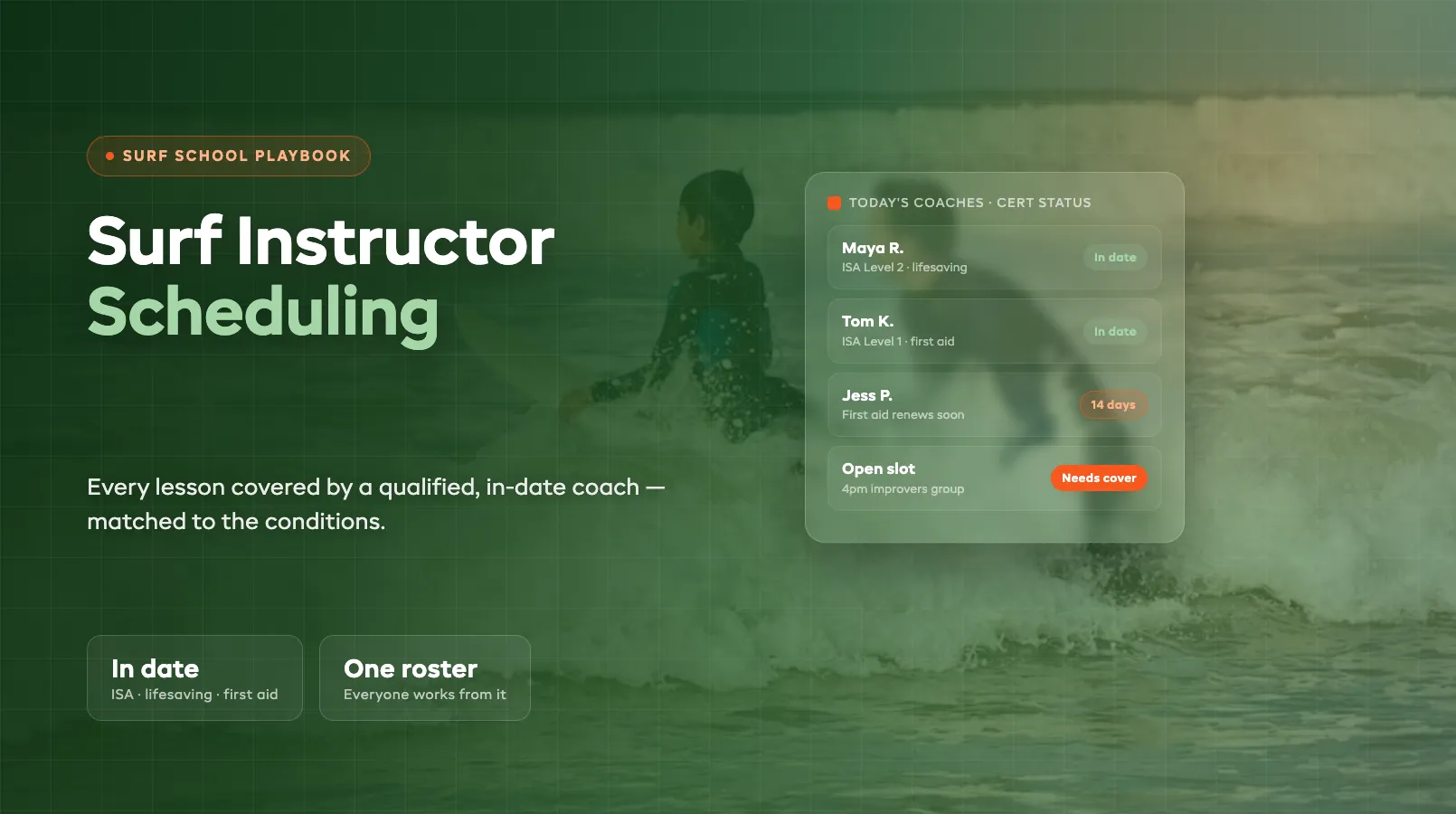
Every surf lesson you sell is a promise: a qualified coach will be on the beach, in date, and matched to the conditions. Keeping that promise across a busy summer (with tides shifting the timetable, groups of different abilities, and certifications quietly ticking towards expiry) is the real job of surf instructor scheduling. Get it right and the water runs smoothly week after week. Get it wrong and you are either canceling lessons or, worse, putting an under-qualified coach in front of a group.
Scheduling and certification are two sides of the same problem. A roster is only as good as the qualifications behind each name on it, and a stack of certificates is worthless if you can't get the right coach to the right session. This guide walks through both: what instructors need to be qualified, how to match coaches to conditions, how to build a workable weekly roster, and how to keep every certification in date. If you are still setting up the wider operation, start with the full playbook on how to run a surf school and board rental business.
Start with certification, not the calendar
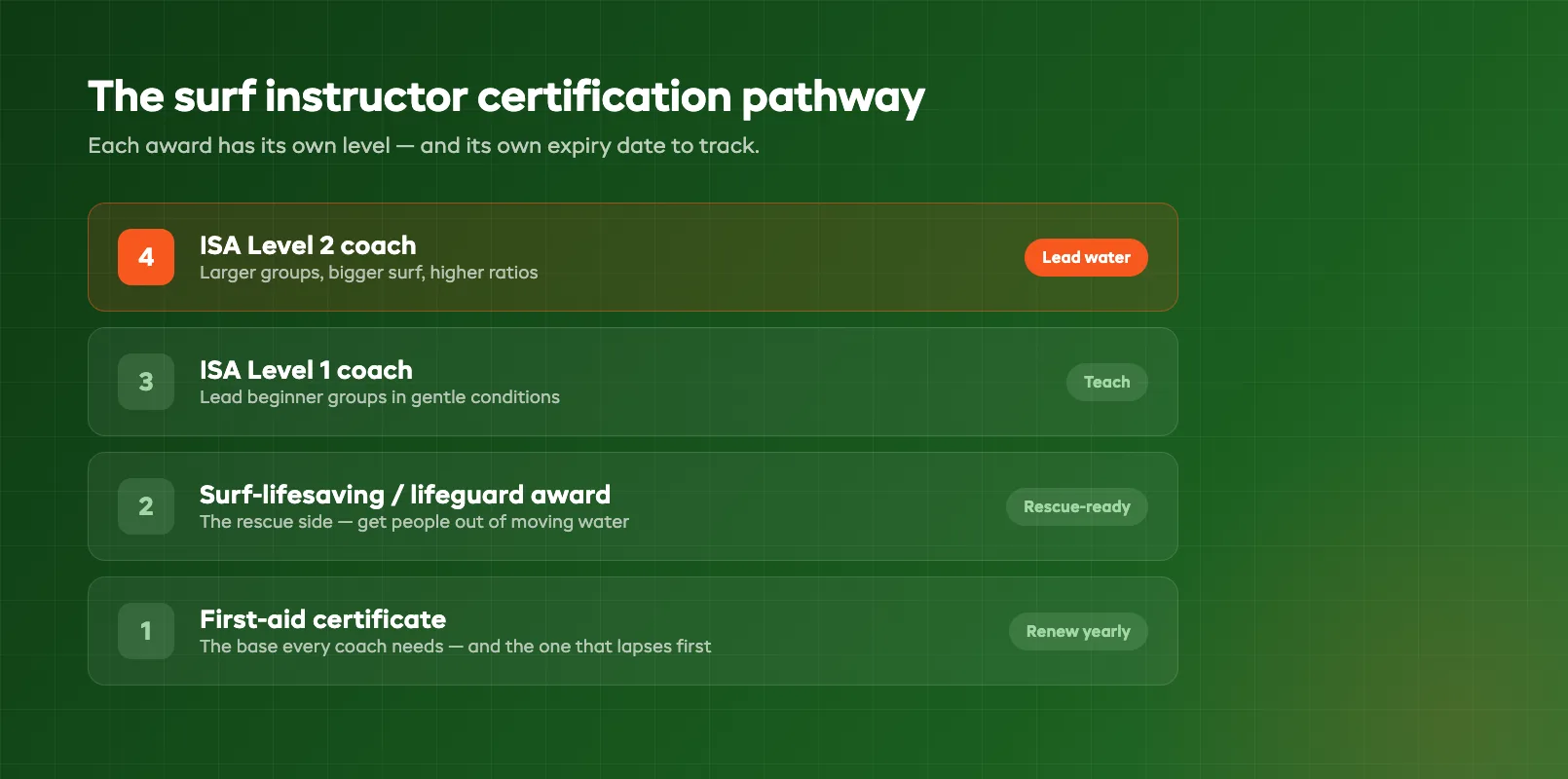
You cannot schedule a coach you are not sure is qualified, so the roster starts with a clear record of what every instructor holds. For most surf schools that means three things, and each one has an expiry date that matters as much as the qualification itself.
- A surf-coaching qualification: most commonly an ISA (International Surfing Association) Level 1 or 2, or the equivalent from your national federation. This proves the coach can actually teach surfing safely, and the level often caps how many students they can lead.
- A surf-lifesaving or lifeguard award: the rescue side. Anyone leading people into moving water needs to be able to get them out of trouble.
- A current first-aid certificate: usually the shortest-lived of the three, and the one that most often lapses without anyone noticing.
The exact combination depends on your country, your governing body, and your insurer, so confirm the specifics with all three rather than copying another school. What is universal is the discipline of writing down each instructor's qualifications and, crucially, the expiry date of each, so scheduling always starts from a truthful picture of who can legally lead water.
Set the ratio before you set the timetable
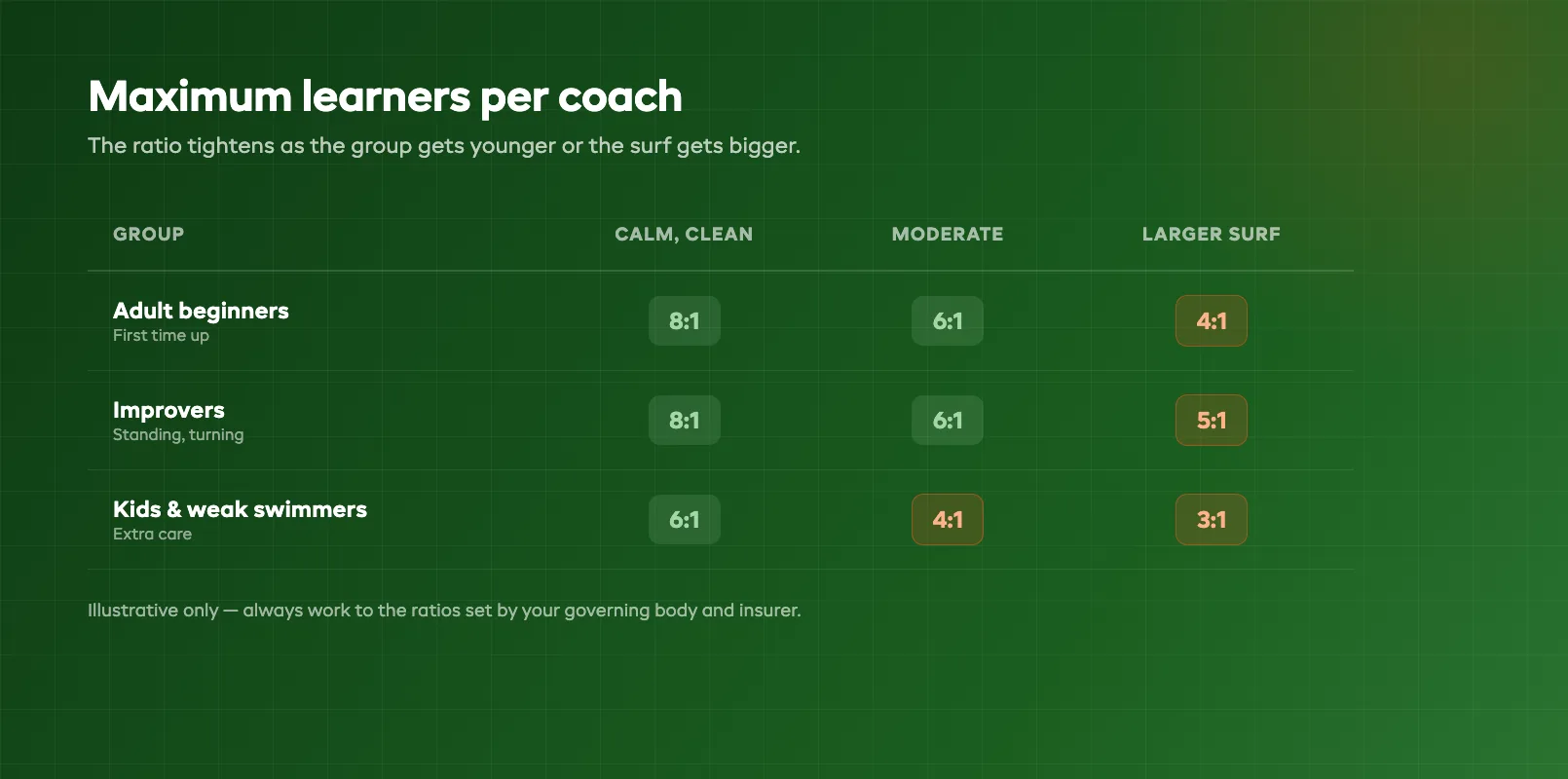
The number that drives everything else is your instructor-to-student ratio — how many learners a single coach can safely lead. It changes with ability and with the surf, and it is the rule that decides how many coaches a session needs.
A gentle beginner group in small, clean waves might run at one coach to six or eight students. Put children, weaker swimmers, or bigger surf into the mix and that number tightens fast. Your national federation and your insurer will set the ratios you are required to work to, and those are the floor, not a target to push against on a busy Saturday.
The practical move is to write the maximum ratio for each lesson type and condition down as a simple matrix, then schedule against it. Once the ratio is fixed, staffing a session is just arithmetic: a group of sixteen beginners at one-to-eight needs two in-date coaches on the sand, not one coach stretched thin because bookings came in strong.
Build the roster around tides and demand
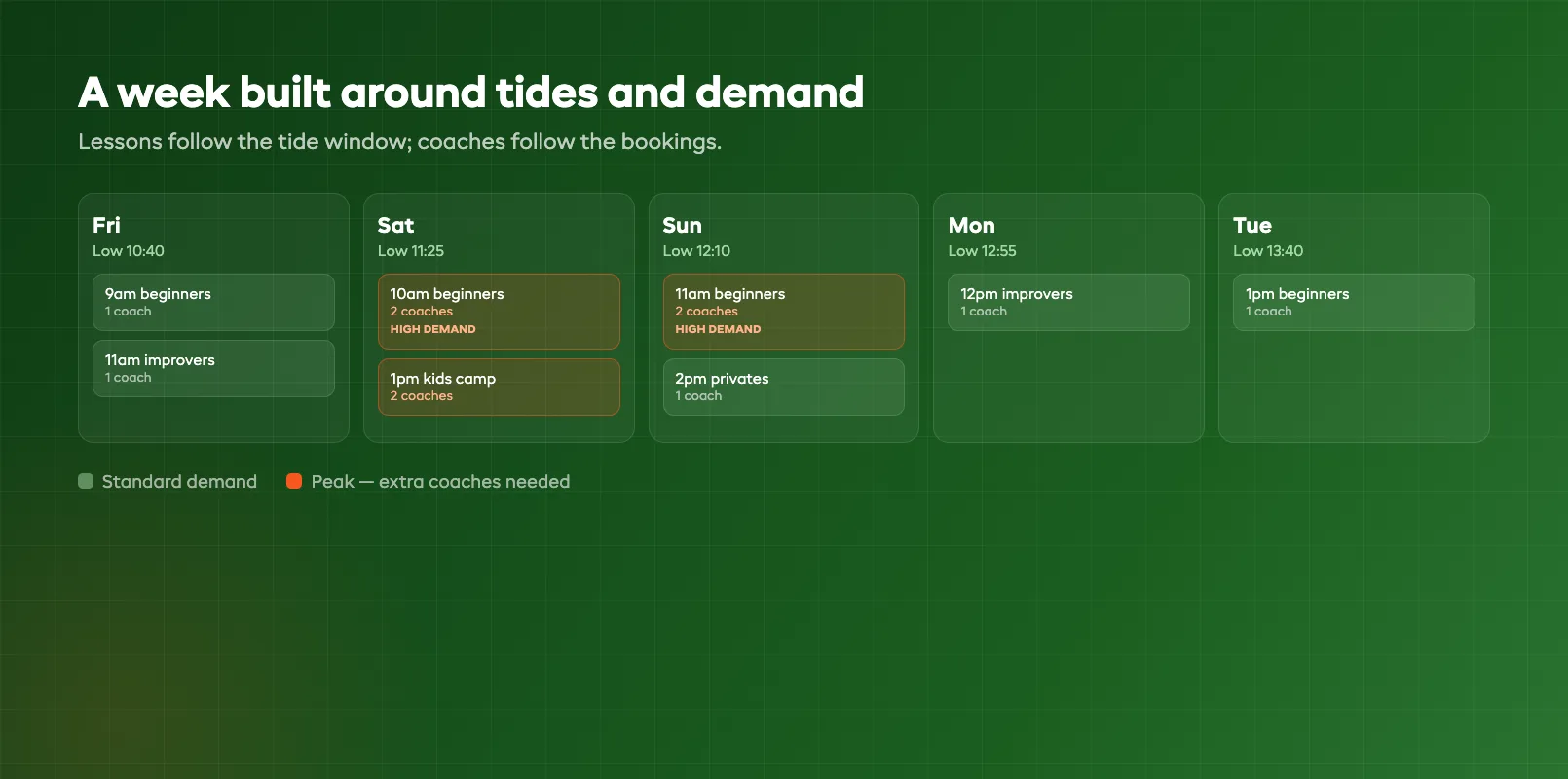
A surf timetable does not run on office hours. It runs on the ocean. Lessons have to land when there is workable water, which means the roster is built against the tide chart first and the clock second. A spot that only works two hours either side of low tide will pull your lesson slots with it as the week goes on, and your instructor shifts have to follow.
Layer expected demand on top of the tide windows. Weekends, school holidays, and settled weather all spike bookings, and those are exactly the sessions that need enough qualified coaches lined up in advance. The mistake is rostering a flat number of instructors every day and then scrambling when a sunny Saturday sells out three group lessons at once.
Work a week or two ahead so gaps show up while you can still fix them. Publishing the roster early does two jobs at once: instructors can plan their lives, and you get time to spot a session that has bookings but no in-date coach assigned. Keep a single live version of the schedule that everyone works from — the moment shifts live in one person's head or a buried group chat, someone turns up on the wrong day.
Keep certifications in date automatically
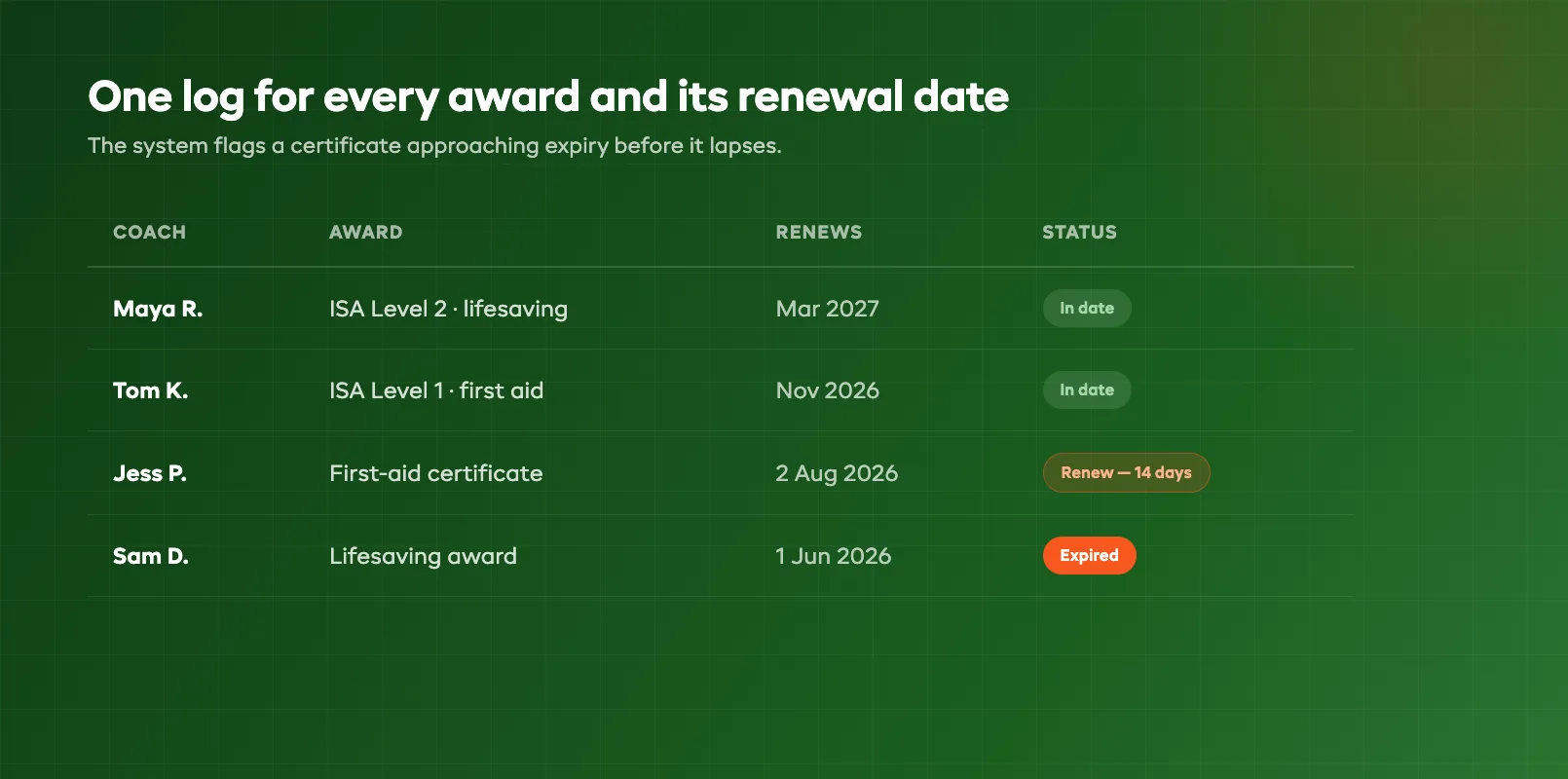
The quiet risk in every surf school is the certificate that expired without anyone noticing. A coach keeps teaching, the summer rolls on, and it is only when a claim is made that someone discovers the first-aid award ran out in March. An expired qualification can void your insurance exactly when you need it most, so tracking expiry is not admin. It is protection.
The fix is to record every qualification's expiry date in one place and get warned before it lapses, not after. A whiteboard works for three instructors; it falls apart at ten, especially when each person holds three separate certificates with three different renewal dates. This is where booking software earns its place: when qualifications and expiry dates sit alongside the roster, the system can flag a coach whose certificate is about to run out and stop them being scheduled past it. That turns a memory task nobody owns into an automatic check.
Cover gaps before they cancel a class
Even a perfect roster meets a coach who wakes up sick. What separates a smooth operation from a stressful one is having a plan for the gap before it happens. Canceling and refunding a full group lesson costs you the revenue, the goodwill, and often the review.
Two things keep a class alive. The first is a short bench of qualified cover (part-time or freelance coaches who are already in date and know how you run) plus a fast way to reach them. The second is being able to see, at a glance, which of your in-date instructors is free at that time. When lessons, staff, and qualifications all live on one booking system, reassigning a session is a quick swap: the software shows who is available and qualified, you move the coach, and the customer never knows there was a wobble. Dash Agents can even watch for an unfilled session and prompt you to reassign before the lesson time arrives.
The principle to hold onto is simple: a single no-show should move a coach, not the class.
Putting it together
Surf instructor scheduling is really certification management with a timetable on top. Start from a truthful record of who is qualified and when their awards expire, fix your ratios so staffing is arithmetic rather than guesswork, build the roster around tides and real demand, and keep a bench ready for the days the ocean or a sick note throws you a curveball. Do those four things and the promise behind every lesson you sell (a qualified, in-date coach on the beach) keeps itself.
When the roster, the qualifications, and the bookings sit on one system instead of three spreadsheets, most of this stops being a daily worry. To go deeper on the surrounding pieces, see how to choose surf lesson booking software, keep the board fleet in shape with surfboard rental management, and scale into longer stays with surf camp operations. It is also worth setting up a repeatable surfboard inspection checklist and a water-sports weather alert agent so conditions and kit never catch the schedule off guard. New to the terms above? The surf glossary has plain-English definitions, and the surf vertical hub collects everything in one place.
FAQ
What qualifications does a surf instructor need?
Most surf schools require a recognized surf-coaching qualification such as an ISA (International Surfing Association) Level 1 or 2, a current surf-lifesaving or lifeguard award, and an in-date first-aid certificate. The exact combination depends on your country and insurer, but the principle is the same everywhere: whoever leads people into the water must be able to coach, rescue, and treat. Always confirm the specific requirements with your national federation and your insurance provider.
What is the ISA and why does it matter for scheduling?
The ISA is the International Surfing Association, the world governing body for surfing, and its coaching and instructor awards are the most widely recognized surf-teaching qualifications. It matters for scheduling because an ISA level often sets the maximum number of students a coach can lead and the conditions they can work in. Knowing each instructor's level lets you assign the right coach to the right session instead of guessing.
What is a safe instructor-to-student ratio for surf lessons?
A common starting point is around one instructor to six or eight students for beginners in gentle conditions, tightening to smaller groups for children, weaker swimmers, or bigger surf. Your governing body and insurer will set the ratios you have to work to. The safest approach is to write the maximum ratio for each lesson type and condition down and treat it as the rule that decides how many coaches a session needs.
How do I stop an instructor teaching on a lapsed certificate?
Record the expiry date of every qualification (coaching award, lifesaving award, and first aid) in one place and set a reminder well before each one runs out. The risk is an instructor coaching on a first-aid certificate that quietly expired months ago, which can void your insurance if anything goes wrong. Booking software that flags expiring certifications turns this from a memory task into an automatic check.
How do I cover a surf instructor who calls in sick?
Keep a short bench of qualified cover (part-time or freelance coaches who are in-date and know your setup) and a clear way to reach them fast. When a lesson lives on one booking system, you can see which other in-date instructor is free and reassign the session rather than canceling and refunding. The goal is that a single no-show moves a coach, not the class.
How far ahead should I publish the instructor roster?
Most schools publish at least a week ahead so instructors can plan their lives and you can spot gaps early, with the next few days firmed up as bookings land. Publishing early also surfaces certification clashes in time to fix them. Keep one live version everyone works from, so a change to Thursday's schedule is seen by the whole team rather than lost in a thread.
in one place