Ski Boot Fitting for Rental Shops: The Complete Operational Guide
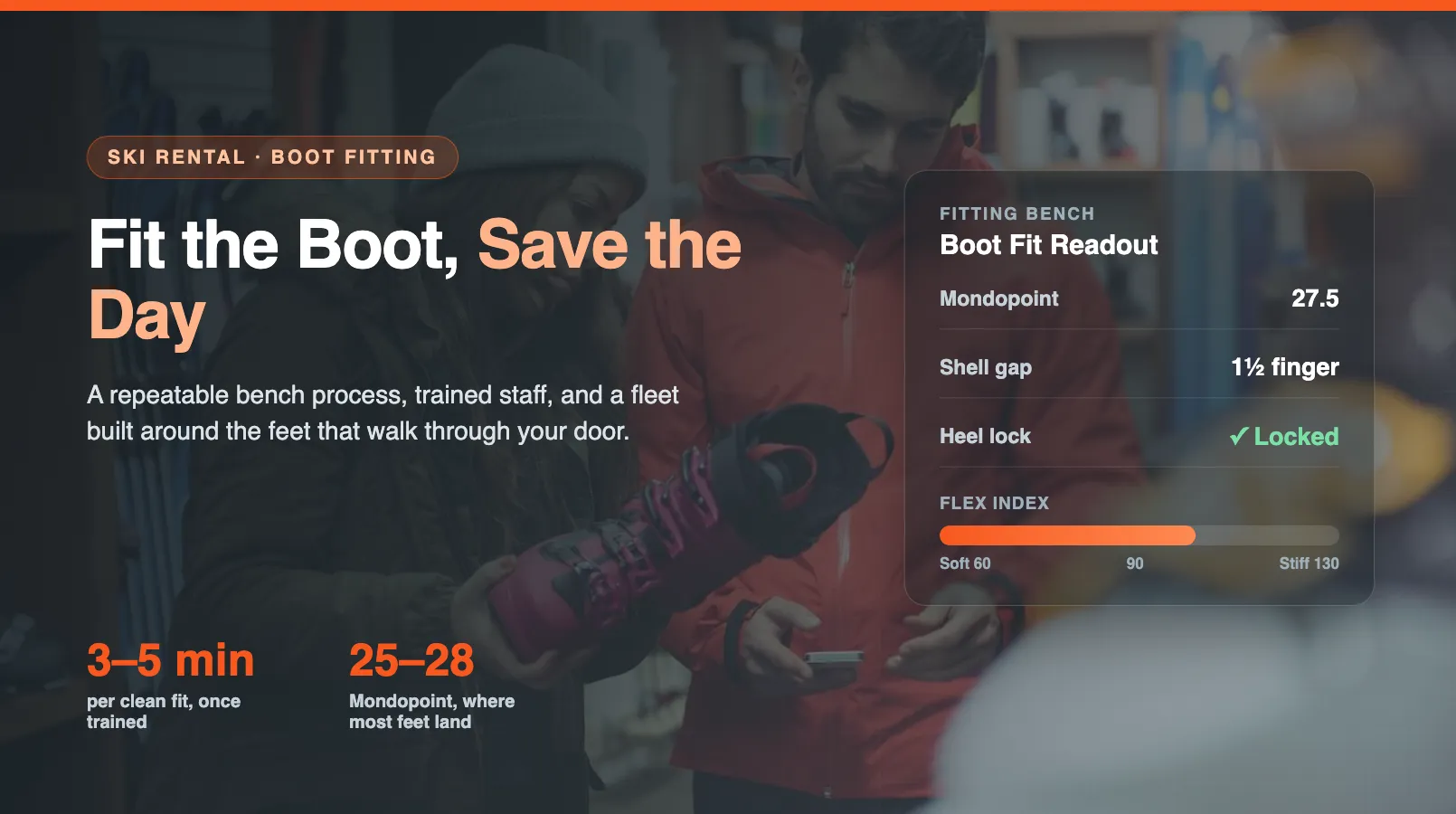
Skis get the attention, but boots make or break the day. A guest can ride almost any pair of rental skis and have a fine time. Put them in a boot that's half a size too big, badly buckled, or pinching across the forefoot, and nothing else matters — their feet are cold and sore by mid-morning, they're back at your counter by lunch, and the review they leave talks about pain, not powder. Boot fitting is the single rental task with the most upside when you get it right and the most damage when you get it wrong.
The good news is that fitting a rental boot well is a repeatable process, not a dark art. It doesn't need a master bootfitter on every shift — it needs a clear sequence, staff trained to follow it, honest words at the counter, and a fleet built around the feet that actually walk through your door. This guide covers all of it: the fit process step by step, how to train staff to run it, the common problems you'll see every week and how to fix them, what to tell guests, how to handle same-day returns, and how to compose a boot fleet that fits more people the first time.
The fit process
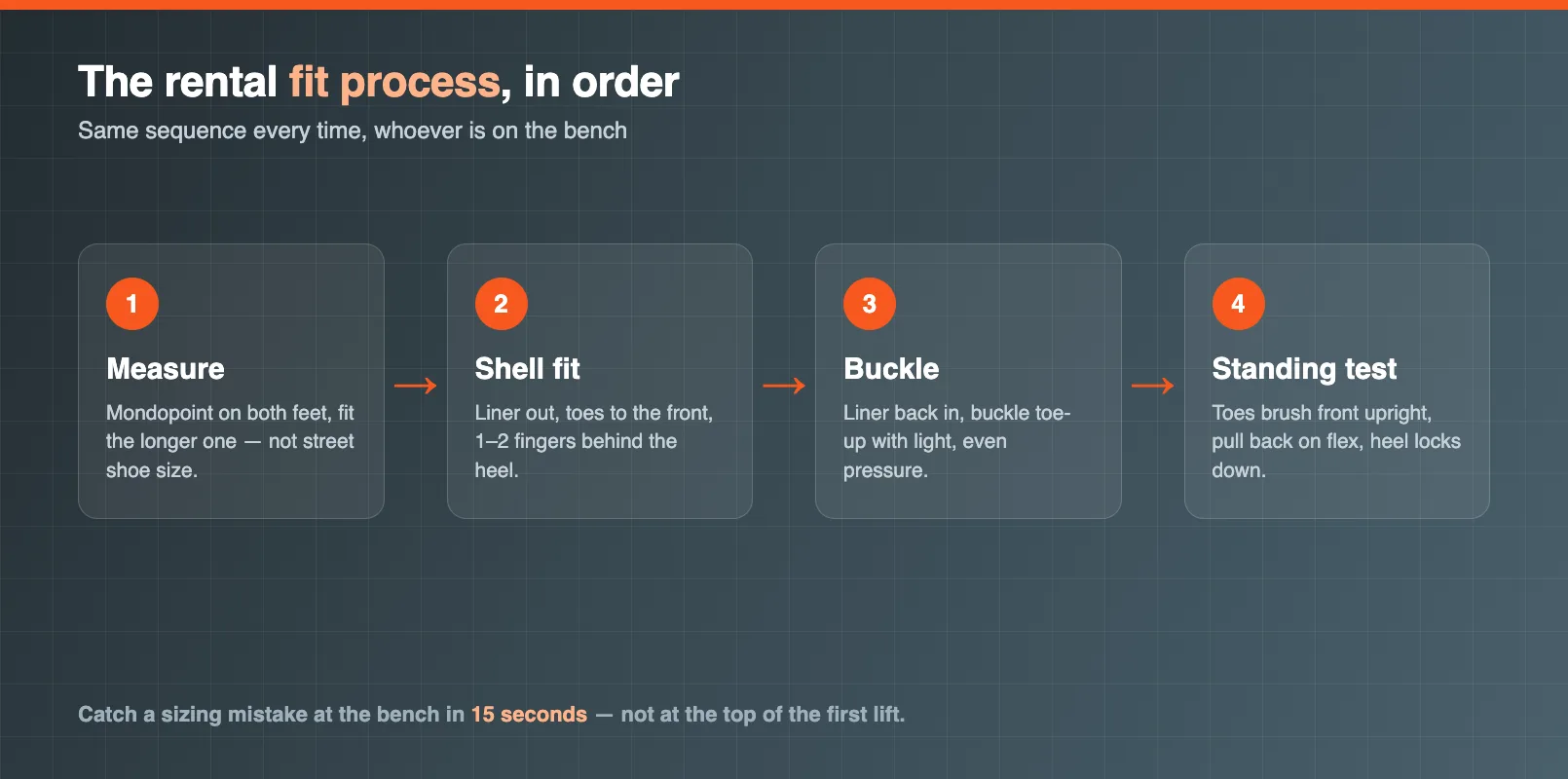
A good rental fit follows the same sequence every time, regardless of who's at the counter. Start by measuring the foot, not asking for a shoe size. Use a Mondopoint measure on both feet — the foot's length in centimetres — and fit to the longer one. Street shoe size is a guess that's wrong often enough to cause most of your fit complaints, so treat it as a backup, never the starting point.
Next, confirm with a shell fit before you hand over a finished boot. Pull the liner out, have the guest slide their bare foot into the empty shell, and slide it forward until the toes touch the front. The gap behind the heel should be about one to two fingers wide — tighter for a stronger skier, looser for a nervous beginner. This single check catches more sizing mistakes than anything else and takes fifteen seconds.
Put the liner back, buckle from the toe up with light pressure, and run the standing test. Knees straight, the toes brush the front; flexed forward into a ski stance, the toes pull back and the heel locks down. Finish with a walk and a few last questions — any pinch points, any numbness, anything that already hurts — because the time to find a problem is now, not at the top of the first lift.
Staff training
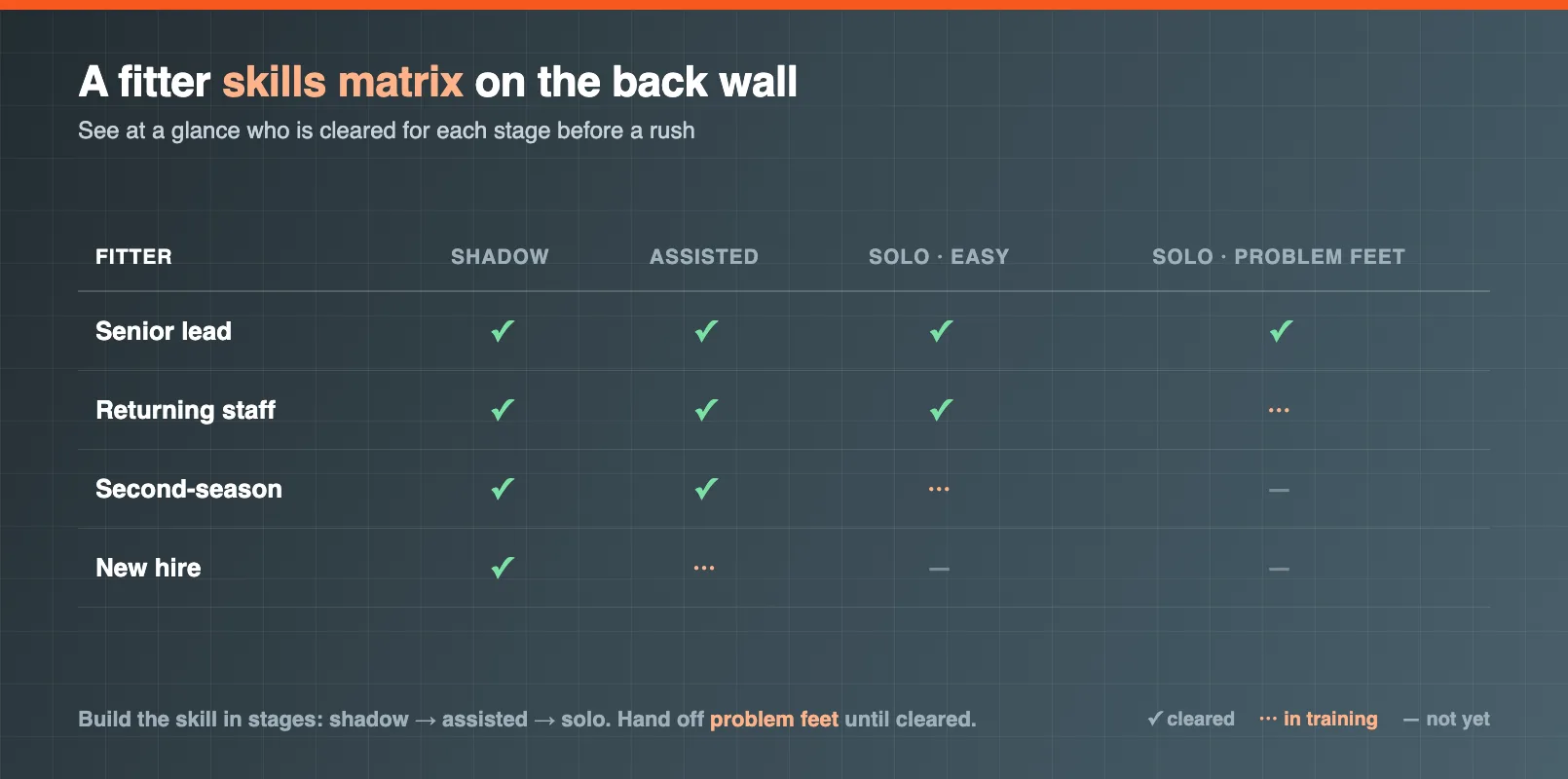
Nobody fits boots well on their first shift, and pretending otherwise is how bad fits reach the hill. Treat fitting as a skill that's built in stages. A new hire starts by shadowing an experienced fitter, then runs assisted fits with someone checking the shell gap, then handles easy fits solo, and only later takes on the problem feet that need real judgment. Map those stages out so everyone knows what each person is cleared to do.
The core knowledge is small but specific: how to read a Mondopoint measure, how to convert a guest's stated shoe size into a starting shell to grab, and how to recognize the feet that won't fit a standard boot — high arches, wide forefeet, a big difference between left and right, calves that won't fit the cuff. Teach staff to spot those early and hand off rather than force a fit.
A simple skills matrix on the back wall does more than any manual. List each fitter against the stages they've cleared, and you can see at a glance who to put on the bench during a rush and who still needs supervision. It also tells you when your roster is thin on real fitting skill — useful before a holiday week, not during it.
Common fit problems
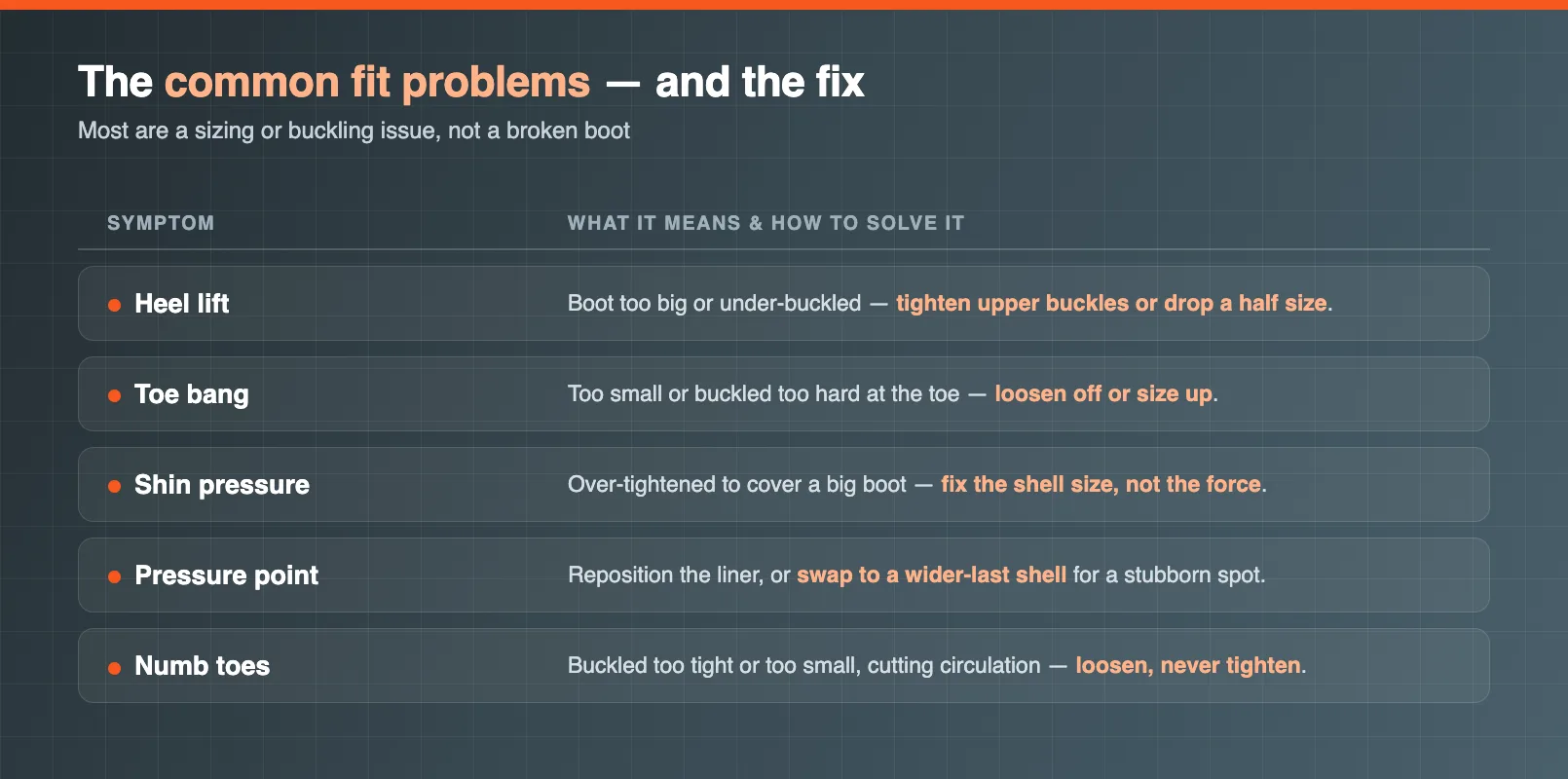
The same handful of problems turn up week after week, and a trained fitter solves most of them at the counter. Heel lift — the heel rising as the guest flexes — usually means the boot is too big or under-buckled; tighten the upper buckles or drop a half size. Toe bang, where toes jam the front on every turn, is almost always a boot that's too small or buckled too hard at the toe; loosen off or size up.
Shin bang and pressure across the top of the foot come from over-tightening the lower buckles to compensate for a boot that's too big elsewhere — the fix is the right shell size, not more force. Pressure points on the ankle or the outside of the foot can often be eased by repositioning the liner or, for a stubborn spot, swapping to a shell with a wider last. Numb or cold toes are the classic sign of a boot buckled too tight or too small, cutting off circulation, not a boot that needs to be tighter.
The pattern across all of them is the same: most "the boot hurts" complaints are a sizing or buckling issue, not a broken boot. Train staff to diagnose the cause rather than reach straight for a different pair, and you'll solve more fits faster and burn through less of your fleet doing it.
Customer communication
Most boot pain is a communication failure before it's a fitting failure. A guest who has only ever worn sneakers expects a ski boot to feel like one, so when you hand them a correctly snug boot, their instinct is that it's too small. Get ahead of that at the counter. Tell them plainly: a ski boot should feel firm and supportive, the toes should brush the front when they stand tall and pull back when they bend their knees, and that's exactly right — not too small.
Show, don't just tell. Demonstrate how to buckle from the toe up, explain that the boot should be loosened on the lift and in the lodge and snugged for skiing, and warn them that cranking every buckle to the max makes feet colder and more painful, not more secure. Thirty seconds of this saves a mid-morning return.
The most valuable sentence you can say is "if anything hurts, come straight back — don't tough it out." Guests assume pain is the price of skiing and suffer through a ruined day rather than bother you. Giving them explicit permission to return turns a silent bad review into a two-minute fix.
Same-day returns
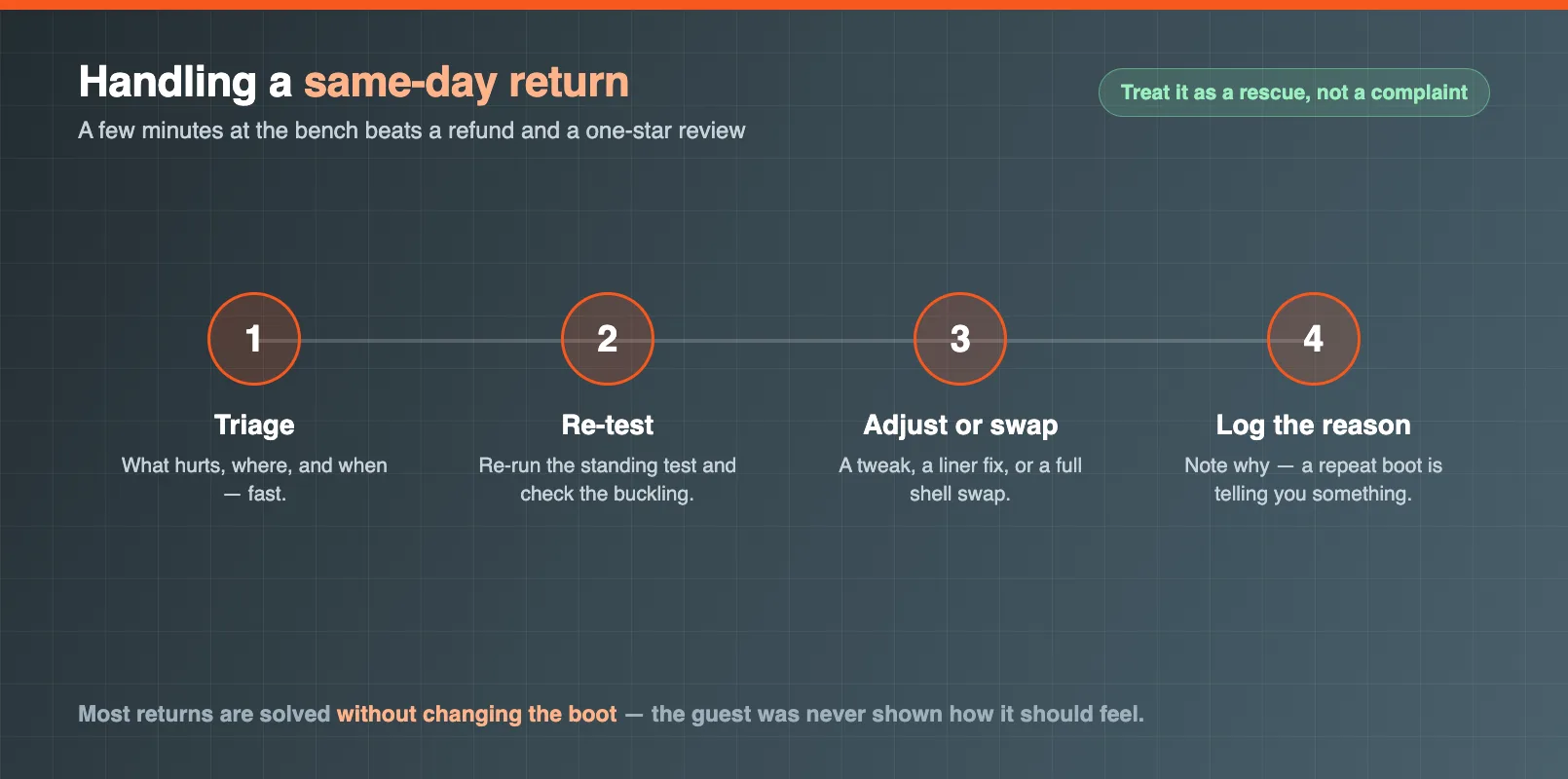
A same-day boot swap is one of the cheapest saves in your shop. It costs a few minutes at the bench; the alternative — a guest skiing all day in a boot that hurts — costs you a refund, a bad review, and a customer who never rents from you again. Treat the return desk as a rescue, not a complaint, and your staff will too.
Keep the process tight. When a guest comes back, triage fast: what hurts, where, and when. Re-run the standing test, check the buckling, and decide whether it's a quick adjustment, a liner tweak, or a full shell swap. Most returns are solved without changing the boot at all — the guest was simply never shown how it should feel or how to buckle it.
Log every swap and the reason behind it. A boot that keeps coming back is telling you something — a worn liner, a cracked shell, a size that runs small — and the log is how you catch it before it ruins three more days. A quick note at return turns scattered complaints into a maintenance signal you can act on.
Boot fleet composition
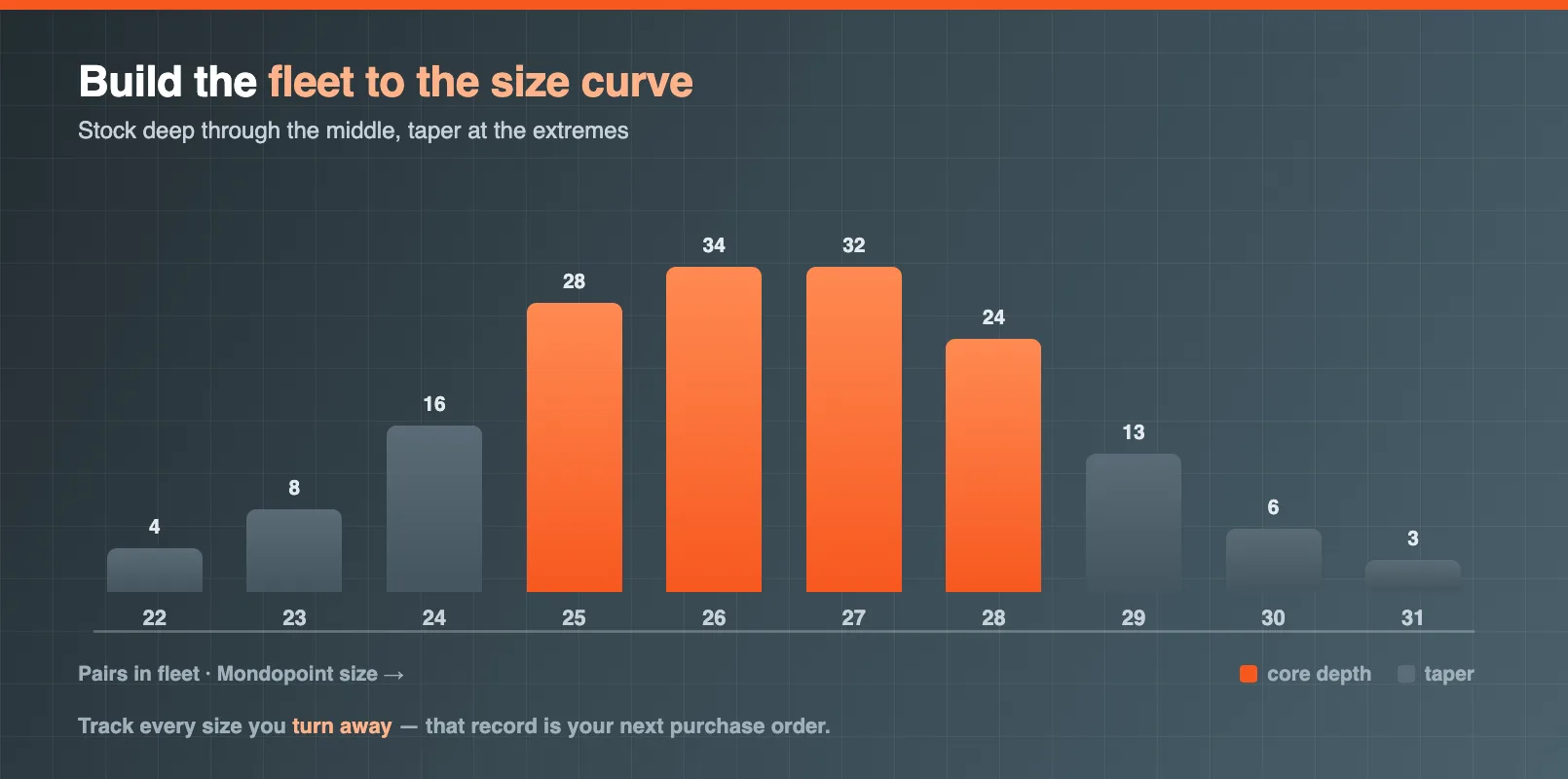
You can't fit feet you don't stock, so build the fleet around the size curve, not around an even spread. Adult feet cluster heavily through the middle — roughly Mondopoint 25 to 28 — so carry your deepest inventory there and taper off at the small and large extremes. An even number of pairs across every size guarantees you're short where it matters and overstocked where it doesn't.
Depth isn't the whole story. Carry a spread of flex ratings so a nervous first-timer and a strong skier both get a boot suited to them — softer flex for beginners, stiffer for experts — and keep a few wide-last shells on hand for the forefeet a standard boot will never close around comfortably. Those wide shells solve the fits that would otherwise walk out unhappy or unrented.
The fleet should evolve from evidence, not guesswork. Track every size and width you turn away because you didn't have it — that record is your next purchase order. A tool like Dash can flag when a popular size is running low across the day so you reorder before a holiday week instead of after it. Match your stock to the feet that actually show up, and your first-time fit rate climbs season over season.
Putting it together
Boot fitting rewards structure over talent. A shop with a fixed fit sequence, staff trained in stages, honest counter talk, an easy returns desk, and a fleet built around real demand will out-fit a shop leaning on one gifted bootfitter. Each piece reinforces the next — good communication cuts returns, returns data shapes the fleet, the right fleet makes fitting faster.
Start with the part you're weakest on. If fits are inconsistent, write down the sequence and drill it. If you're guessing at next season's order, log the sizes you turn away today. For how fitting fits into the rest of the shop, see our guide to running a ski rental business and our ski rental pricing strategy, browse the ski and snowboard rental hub, see when packed-out boots come off the fleet in our end-of-season retirement guide, and put the process to work with a daily boot fit-check and a low-stock boot alert.
FAQ
How should a ski rental boot fit?
Snug, not painful. Standing upright with knees straight, the toes should just brush the front of the boot; when the guest flexes forward into a skiing stance, the toes pull back off the front and the heel locks down. A boot that feels comfortable like a slipper in the shop is too big and will give the guest cold, sloppy, sore feet on the hill.
What size ski boot should I give a rental customer?
Fit by Mondopoint, the length of the foot in centimetres, not by the guest's street shoe size. Measure both feet, fit to the longer one, and confirm with a shell fit before you ever hand over a buckled boot. Street size is a starting guess at best and is wrong often enough that fitting to it directly causes most rental boot complaints.
How long does it take to fit a ski boot?
A clean fit on a normal foot runs three to five minutes once your staff are trained. Problem feet — high arches, wide forefeet, big calf differences — take longer, which is exactly why you want your strongest fitters free on a busy morning rather than buried in easy walk-ins.
Why do customers complain about ski boot pain?
Usually because the boot was fitted too big, buckled wrong, or the guest was never told what a correct ski boot is supposed to feel like. Most pain complaints trace back to communication, not the boot itself. Set expectations at the counter, show the guest how to buckle, and tell them to come straight back rather than tough it out.
Should rental shops allow same-day boot swaps?
Yes. A same-day swap costs you a few minutes of fitting time; a guest who skis all day in a painful boot costs you a refund, a one-star review, and a customer who never comes back. Make the swap quick and judgment-free and you turn a bad fit into a save.
What sizes should a rental boot fleet carry?
Stock deep through the middle of the size curve — roughly Mondopoint 25 to 28 for adults — where most feet land, and carry thinner depth at the extremes. Add a small spread of flex ratings and a few wide-last shells so you can solve the feet that a standard boot won't. Track every size you turn away so your next order matches real demand, not a guess.
in one place