AI Dynamic Pricing for Tours and Activities: Yield Management Made Simple
The 9am Saturday kayak tour sells out three weeks ahead, every week, all summer. The same tour on a Tuesday afternoon in October runs half empty. You charge $65 a seat for both. One of those departures could have charged more and still sold out. The other could have filled those empty seats at a discount that still cleared your costs. Flat pricing left money on both.
This is the problem yield management solves, and airlines and hotels have been solving it for forty years: charge more when demand is high, less when it's soft, and squeeze more revenue out of the same fixed supply. The catch is that yield management used to need a revenue analyst and a spreadsheet the size of a wall. AI dynamic pricing does the same job automatically: reading demand, adjusting prices within rules you set, and doing it for every departure without you touching a thing.
You are not an airline, and you don't need to price like one. This guide covers how AI dynamic pricing actually works for tours and activities, where it earns its keep, and, just as importantly, the guardrails that keep it from doing something stupid. For the bigger picture of how AI is reshaping tour operations, start with our AI for tour operators guide.
Why Static Pricing Leaves Money on the Table
A single flat rate is a compromise that's wrong in both directions. On your busiest departures, it's too low — guests would happily pay more for the sunset slot that sells out every time, and that gap between what they'd pay and what you charge is pure margin you're handing away. On your quietest departures, it's too high. There are travelers who'd book a Tuesday afternoon at a discount, but not at full price, so the seat sails away empty instead of earning anything.
Empty seats are the silent killer. A tour seat is the most perishable thing you sell: once the boat leaves the dock, an unsold seat is worth zero forever. You can't warehouse it, you can't sell it tomorrow. Every departure that runs below capacity is revenue that evaporated because the price never moved to meet the demand that was actually there.
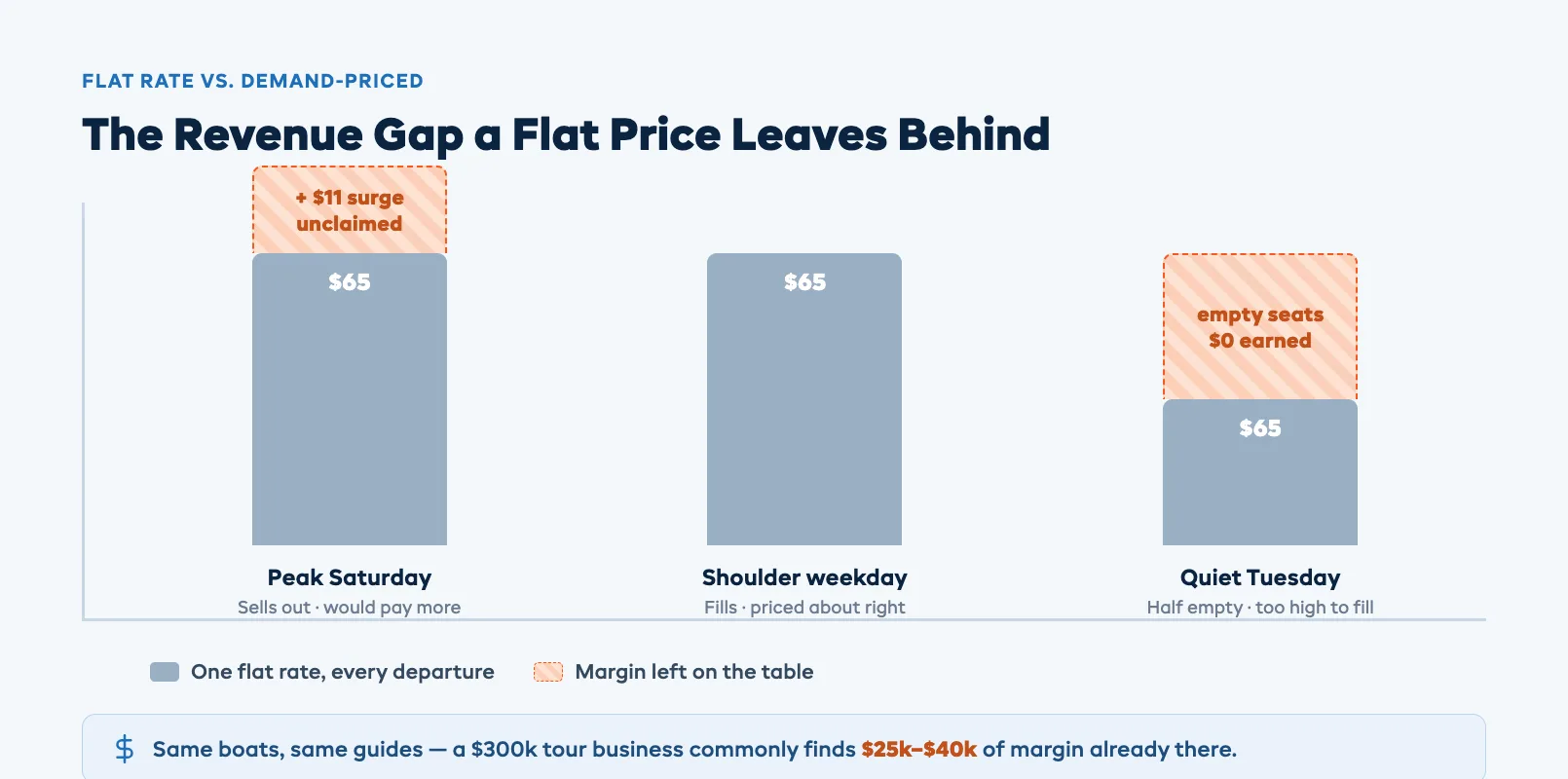
The numbers add up faster than operators expect. Lift your peak departures 15% and fill even a third of your off-peak empty seats at a discount, and a tour business doing $300k a year can find $25k–$40k of margin that was always there: same boats, same guides, same trips. Dynamic pricing doesn't sell more tours. It prices the ones you already run for what they're actually worth.
How AI Sets Tour Prices
The fear operators have is that "AI pricing" means a black box randomly changing numbers and confusing guests. That's not how it works. AI dynamic pricing is a stack of rules you define, applied automatically to live demand signals. You set the logic and the limits; the AI does the watching and the math for every departure, every day.
It reads the signals you'd read yourself if you had time: how fast a departure is filling versus the same date last year, how many days until the trip runs, the day of week and season, local events and holidays, and the weather forecast. Then it nudges the price up or down within the floor and ceiling you've set, never below your break-even, never above the cap you're comfortable showing a guest.
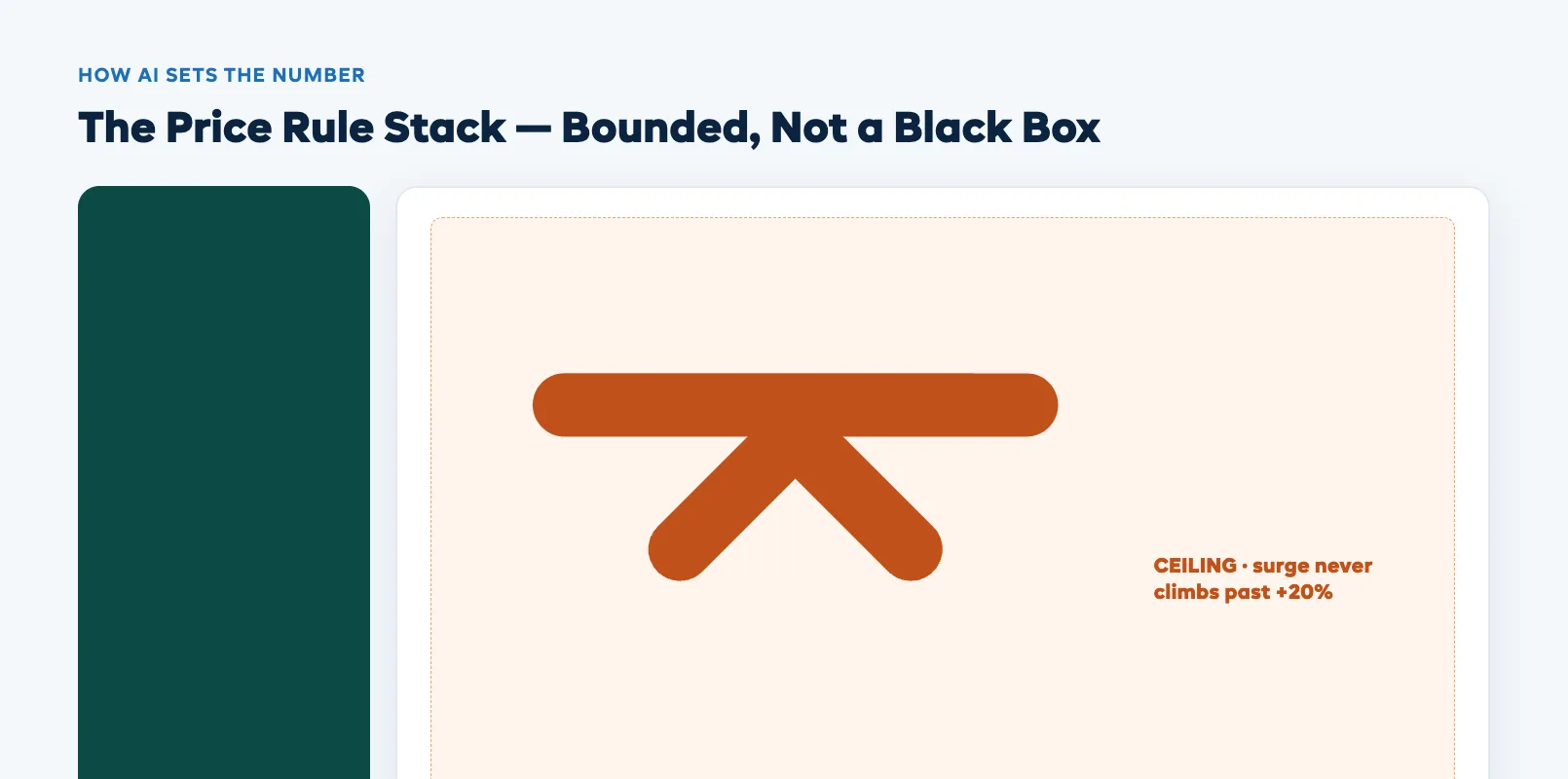
The important word is bounded. Good dynamic pricing isn't the AI inventing prices. It's the AI moving your price along a track you laid down. You decide the base rate, the lowest you'll ever go, and the highest you'll ever charge. Inside those rails, it optimizes. Outside them, it can't move. That's what makes it safe to switch on and walk away from.
Peak-Time Surge Pricing
Surge pricing is the half operators worry about, but it's the simplest to get right. When a departure is filling faster than normal (the Saturday sunset slot at 80% sold with a week to go) demand is clearly outrunning supply, and the AI lifts the price for the remaining seats. The guests who really want that slot still book; you just capture more of what they were willing to pay.
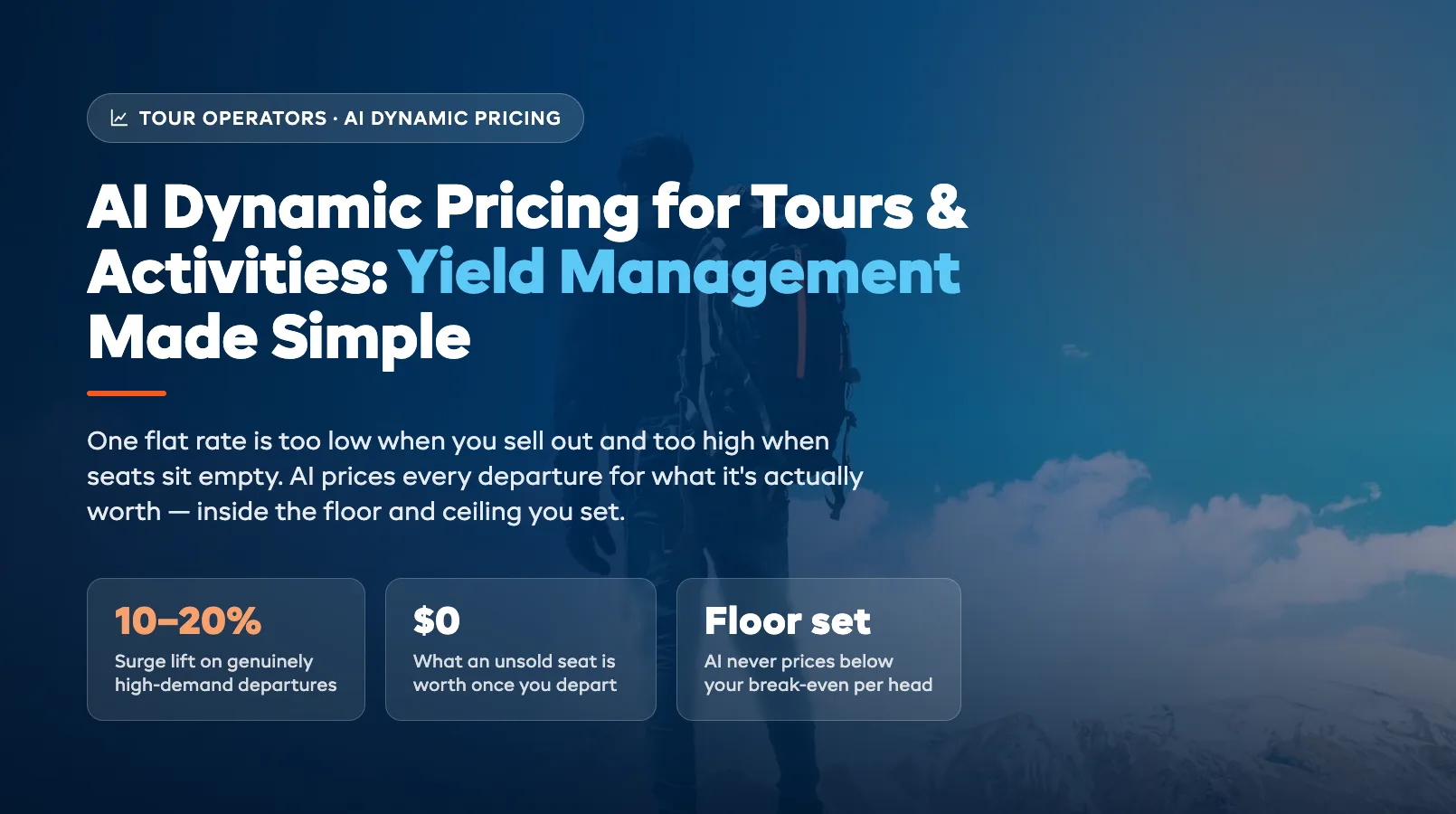
The trick is restraint and transparency. A 10–20% lift on genuinely high-demand departures feels fair to guests and rarely dents conversion, because the people booking a sold-out-every-week slot are the least price-sensitive you have. What kills trust is a 60% spike or a price that visibly jumps while someone is mid-checkout. Keep the cap modest, keep the price stable once a guest is in the booking flow, and surge pricing reads as normal — the same way nobody blinks at a higher hotel rate on a festival weekend.
One caution worth stating: never surge in a way that punishes loyalty or looks like gouging during a crisis. If a storm cancels every other operator and you triple your price on the one running boat, you'll win the booking and lose the reputation. Cap the upside, and let it work on ordinary demand.
Early-Bird and Last-Minute Rates
The flip side of surge is the discount, and it works on two clocks. Early-bird rates reward guests who book well ahead — say, 5–10% off for booking more than 30 days out. That cash-in-advance fills your calendar early, smooths demand, and gives you a read on the season before it starts. The guest gets a deal; you get certainty and working capital.
Last-minute rates work the opposite end. A departure that's still half empty 24 hours out is about to lose those seats forever, so a discount to move them is almost pure upside — any revenue beats zero on a seat that's about to expire. The AI watches the fill rate against the clock and quietly drops the price on under-booked departures as they approach, recovering seats that flat pricing would have wasted.
Both of these pair naturally with smarter booking flows: waitlists, group consolidation, and auto-fill all feed the same goal of running fuller departures. Our guide to AI booking optimization for tours covers how those mechanics work alongside dynamic pricing to close the gap between a half-empty boat and a full one.
Group Pricing Automation
Groups are where manual pricing falls apart fastest. A family of four, a stag party of twelve, and a corporate booking of thirty all need different math, and working it out by hand for every enquiry is slow and inconsistent. Dynamic pricing handles group rates as another rule layer: tiered per-person discounts that kick in automatically at size thresholds, plus flat private-departure rates when a group wants the whole boat.
The AI also weighs the trade-off you'd otherwise eyeball, whether a discounted group of twenty is better than the individual bookings those seats might have drawn. On a departure that reliably sells out at full price, a deep group discount is a loss; on one that usually runs half empty, locking in twenty guaranteed seats at a tiered rate is a clear win. Set the thresholds and the floor once, and every group quote comes back instantly and on-policy.
Setting Rules and Price Floors
This is the part that separates dynamic pricing that helps from dynamic pricing that hurts: the guardrails. Before you switch anything on, you set the limits. A price floor, the lowest the AI may ever go, anchored to your real break-even per head so a discount never sells a seat at a loss. A ceiling that caps how high surge can climb. And caps on how much any single discount can stack.
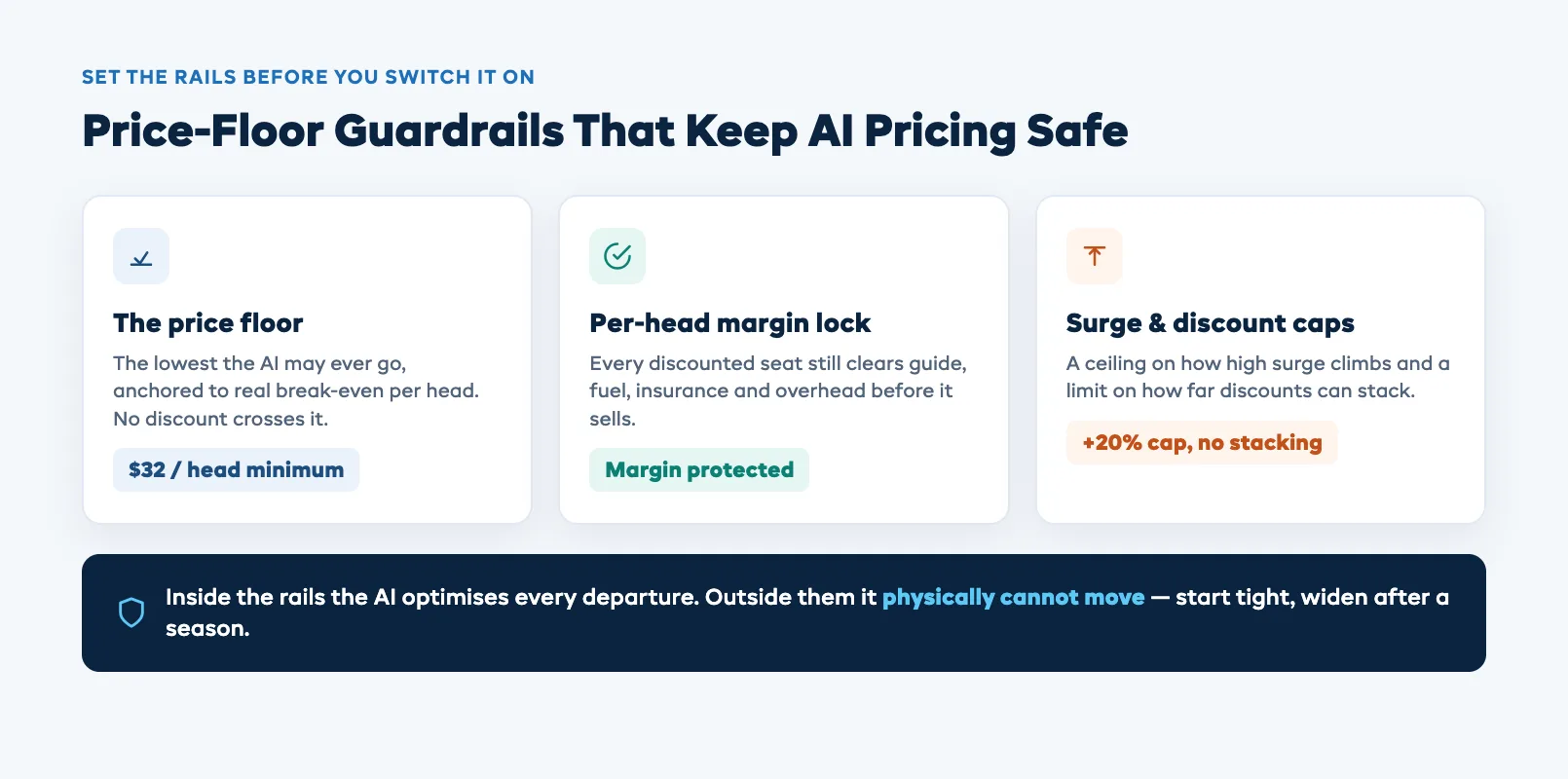
Know your numbers first. If your break-even per seat is $32 once you've covered the guide, fuel, insurance, and overhead allocated to that departure, then $32 is the floor the AI must never cross: no last-minute discount, no group rate, nothing. Start conservative: a tight band around your current price, modest surge and discount caps, and widen it only once you've watched it run for a season and trust what it's doing.
The operators who win with dynamic pricing aren't the ones who hand the keys to a black box. They're the ones who set clear rules, keep the floor honest, and let the AI do the relentless, every-departure watching that no human has time for. Done right, it's the closest thing tours have to free money — the same trips, priced for what they're actually worth. If you want booking, group rates, and automated pricing running on one system instead of three, that's what an AI chatbot for tour operators and a connected booking platform are built to deliver.
FAQ
What is AI dynamic pricing for tours and activities?
AI dynamic pricing automatically adjusts the price of your tour or activity based on live demand signals: how fast a departure is filling, days until the trip, day of week, season, local events, and weather. Instead of charging one flat rate all season, the price moves up on high-demand departures and down on soft ones, always within a floor and ceiling you set. It's the same yield management airlines and hotels have used for decades, run automatically for every departure so you don't have to touch it.
Won't dynamic pricing confuse or annoy my guests?
Not if it's bounded and transparent. Keep surge lifts modest (10–20% on genuinely high-demand slots), hold the price stable once a guest is in the booking flow, and never spike prices during a crisis. Guests already accept that a hotel costs more on a festival weekend and a flight costs more at the last minute — tours work the same way. The trust problems come from huge, visible jumps and prices that change mid-checkout, both of which you prevent with sensible caps.
How do I stop AI pricing from selling seats at a loss?
You set a price floor anchored to your real break-even per head: the point that covers the guide, fuel, insurance, and overhead for that departure. The AI is never allowed to drop below it, no matter how empty the boat or how close the departure. You also cap how far surge can climb and how much any single discount can stack. Inside those rails the AI optimizes; outside them it physically cannot move, which is what makes it safe to switch on.
What signals does AI use to set tour prices?
It reads the same things you would if you had time for every departure: fill rate versus the same date last year, how many days until the trip runs, day of week and season, local events and public holidays, and the weather forecast. It combines those into a demand read and nudges the price up or down within your floor and ceiling. The more booking history it has, the sharper the reads get over a season or two.
Do I need to be a big operator to use dynamic pricing?
No. Dynamic pricing helps any operator who runs the same trip at different demand levels, which is nearly all of them. A single-boat kayak outfit with sold-out Saturdays and quiet Tuesdays has exactly the spread that dynamic pricing captures. The setup is mostly knowing your break-even and your comfortable price ceiling; the AI handles the per-departure watching, so a small team gets the same yield-management edge a large one would, without hiring a revenue analyst.
in one place