AI Booking Optimization for Tours: Fill More Seats, Waste Less Time
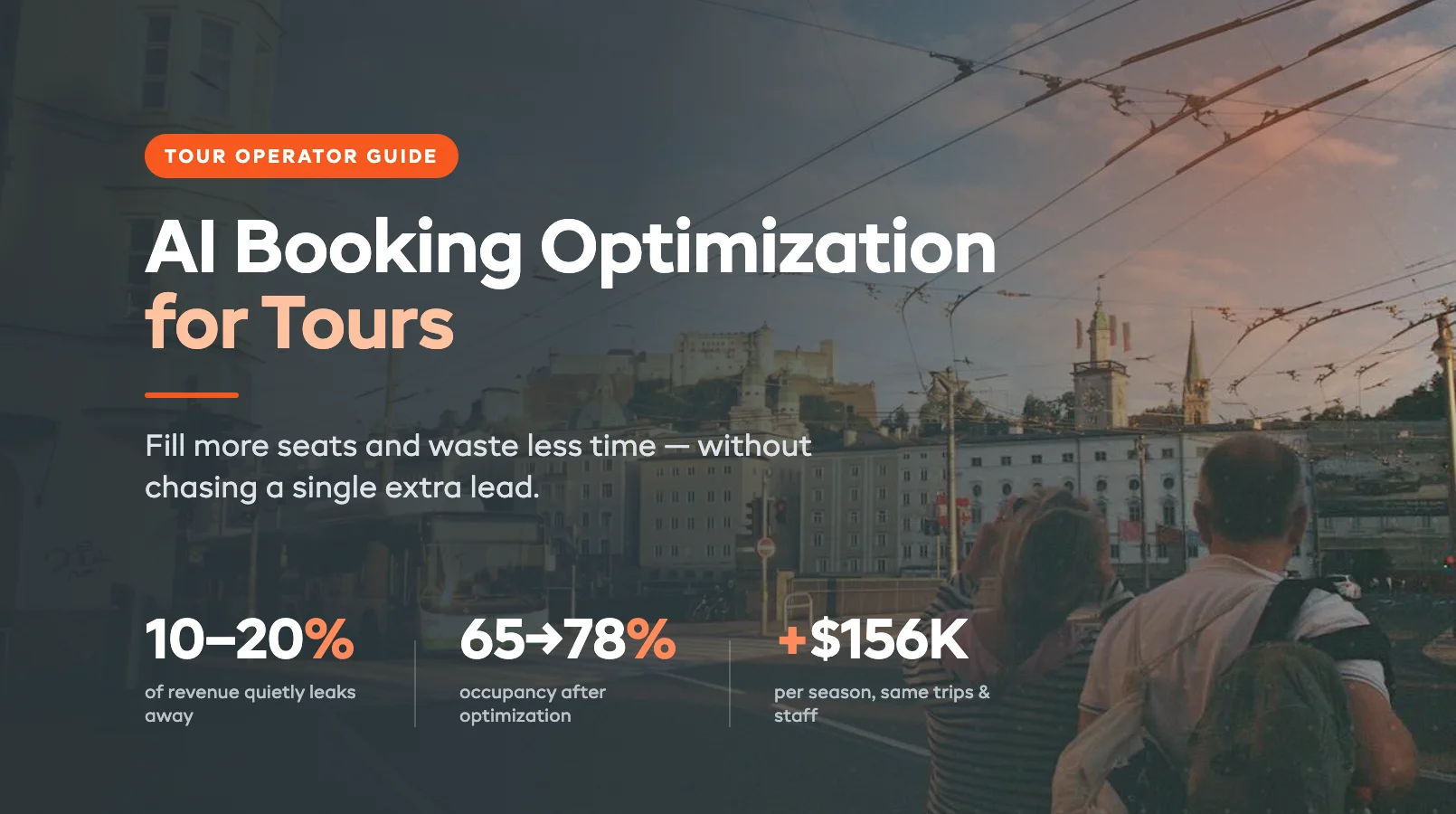
Every empty seat on a tour that still runs is money you'll never get back. The guide still shows up, the van still burns fuel, the permit still costs the same — but four of the twelve spots went unsold. Run that trip a few hundred times a season and the gap between "ran" and "ran full" is the difference between a good year and a tight one. Most operators know this in their gut, yet they manage bookings exactly the way they did when the business was half the size: by hand, by memory, and by hoping the last few seats fill themselves.
Booking optimization is the unglamorous fix. It's not about chasing more leads or spending more on ads — it's about getting more revenue out of the demand you already have. This guide walks through where tour bookings quietly leak money, and how a modern booking system closes those gaps automatically: filling cancellations from a waitlist, nudging small groups onto the same departure, holding trips to a sensible minimum, and stopping the double-bookings that cost you guests and reviews. For the wider picture of where this fits, see our guide to AI for tour operators.
Where Tour Bookings Leak Revenue
Before you fix anything, it helps to see exactly where the money goes. Tour revenue rarely leaks in one dramatic place. It seeps out of a dozen small cracks that each look minor on their own.
The biggest leak is the partially-full departure. A kayak tour with twelve spots that runs with seven isn't a disaster — it still made money — but those five empty seats had real demand somewhere that never connected to that timeslot. The second leak is the late cancellation. Someone drops out 18 hours before the trip, the seat sits empty because nobody had time to re-sell it, and you eat the loss. Third is the no-show on an unpaid hold. Fourth is the group that wanted six spots but only found four on the time they checked, so they booked a competitor instead of a different departure of yours.
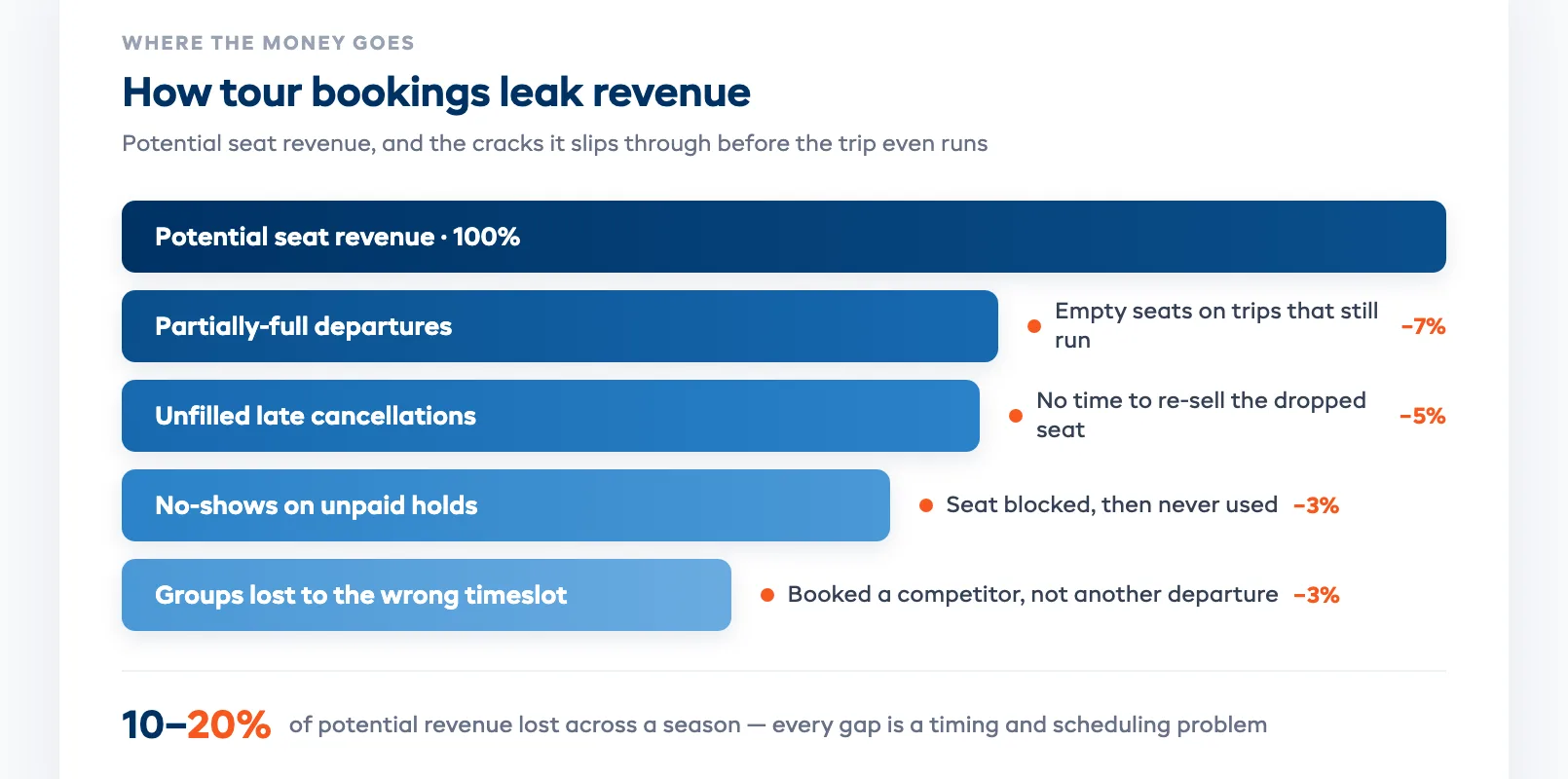
Add a fifth leak that most operators never see: the trip that ran with three guests when it needed five to break even. You didn't lose a sale — you lost money running a trip that should have been consolidated or canceled with a polite rebooking offer. None of these are dramatic. Together, across a season, they routinely add up to 10–20% of potential revenue. The good news is that every one of them is a scheduling and timing problem, which is exactly the kind of problem software is good at solving.
AI-Powered Availability Optimization
The first job is making sure the right inventory shows up in front of the right guest at the right moment. That sounds obvious, but it's where manual systems fall down hardest.
When availability lives across a wall calendar, a couple of OTA extranets, and a booking inbox, the picture is never quite current. You oversell because two channels both sold the last seat. You undersell because a slot looked full on one screen and you forgot to reopen it after a cancellation. An optimization layer sits on top of one connected calendar and keeps every channel honest in real time — the moment a seat frees up anywhere, it reappears everywhere it can be sold.
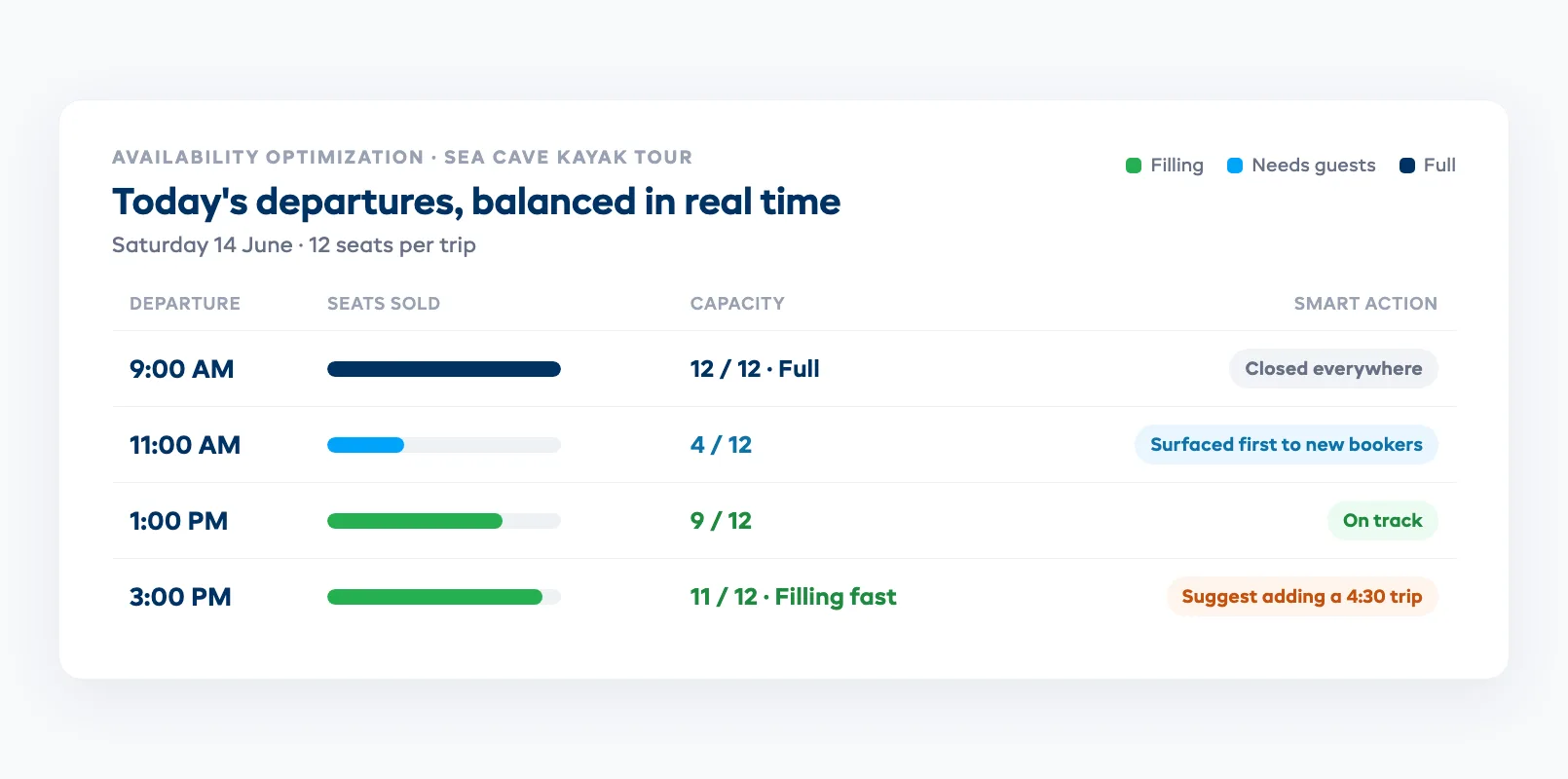
From there, the system can start shaping demand instead of just recording it. If your 9am departure is overflowing and your 11am is empty, it can surface the 11am slot first to new bookers, gently steering the next few guests toward the trip that needs them. If a date is filling fast, it can flag it so you add a departure before you turn people away. This is where AI earns its keep: spotting the pattern across hundreds of bookings and nudging the next decision, rather than leaving you to notice it three days too late. The deeper mechanics of how a connected calendar drives this sit in our tour operator software overview.
Smart Waitlists and Auto-Fill
A waitlist is the single highest-ROI booking feature most operators don't use properly. Done by hand, it's a sticky note that says "call the Hendersons if someone cancels" — and you never call, because by the time the cancellation lands you're already on the water with another group.
A smart waitlist removes the human bottleneck entirely. When a guest cancels or a held seat expires, the system instantly offers the open spot to the next person in line — by text or email, with a time-limited link to confirm and pay. If they don't take it within the window, it rolls to the next name automatically. Seats that used to die quietly now refill themselves while you're busy running trips.
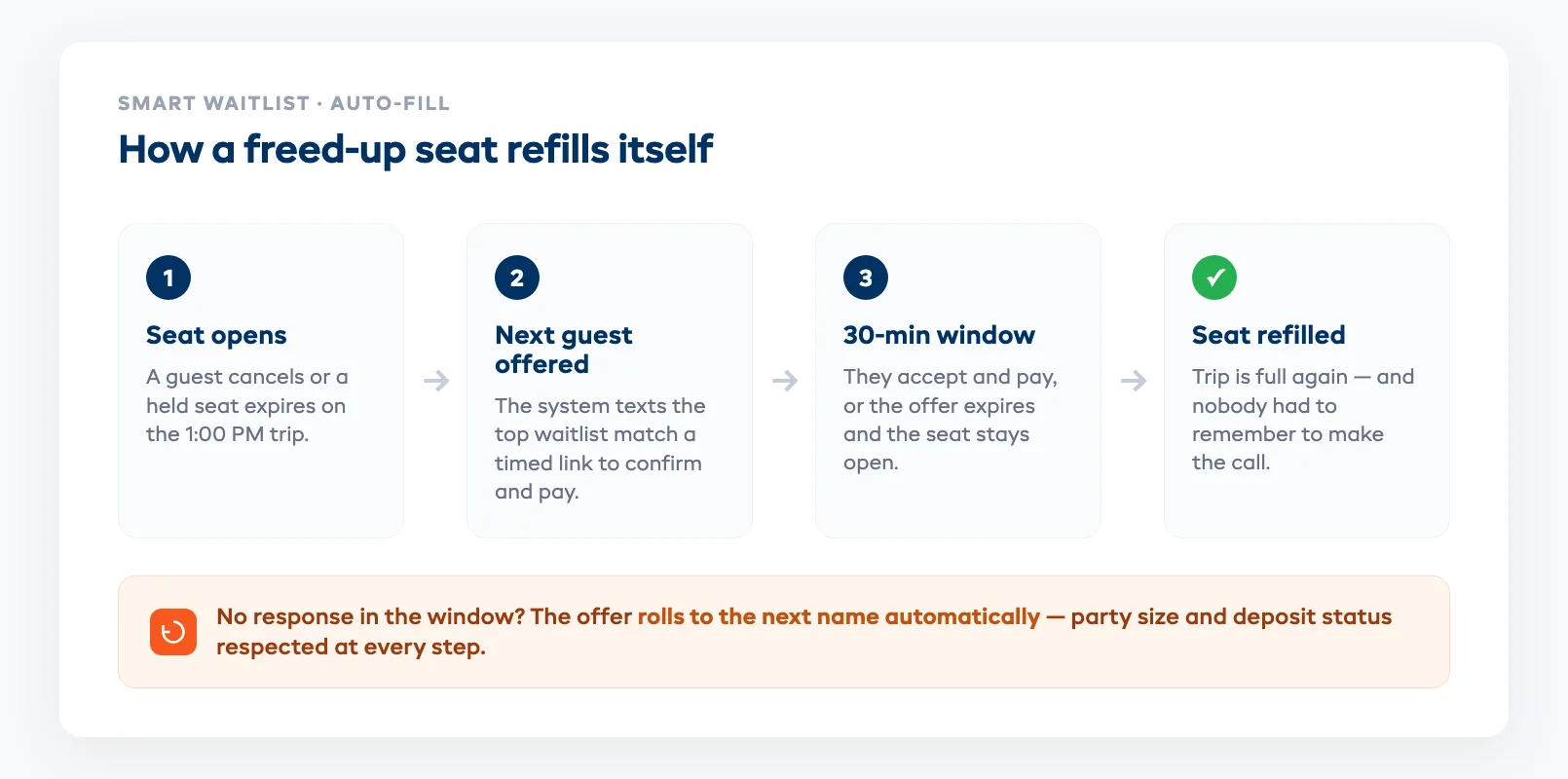
The auto-fill logic matters more than it looks. A good system respects party size — it won't offer a single open seat to a waitlisted group of four — and it prioritizes sensibly, favoring guests who've paid a deposit or who match the trip's requirements. The result is a recovery rate on cancellations that hand-managed waitlists never come close to. For a busy operator running ten departures a day in peak season, recovering even one seat per day is often a five-figure swing across the season — from a feature that runs entirely in the background.
Group Consolidation and Min-Pax Triggers
Two half-empty departures of the same tour are worse than one full one. You're paying two guides, burning two vans, and giving guests a thinner experience on both. Consolidation fixes that, and it's a job AI handles far better than a stressed operator scanning a calendar at 7am.
When the system sees that your 2pm and 4pm trips are each running at a third capacity, it can flag them for merging and — with your rules in place — proactively offer affected guests a move to the fuller, better departure, sometimes with a small incentive. You run one strong trip instead of two weak ones, your cost per guest drops, and the guests who move usually have a better time on a livelier tour.
Minimum-pax triggers are the other half of the same coin. Set a floor — say, four guests for a trip to run — and the system watches each departure against it. As a cutoff approaches, it can automatically prompt waitlisted or flexible guests to fill the gap, or, if the trip genuinely won't make its minimum, trigger a clean cancellation-and-rebook flow before you've committed a guide and gear to a money-losing run. You stop discovering at 8:55am that the 9am can't go. The decision gets made earlier, calmly, with the guest experience protected.
Overbooking Prevention
Filling seats aggressively only works if you never sell the same seat twice. An overbooked tour is one of the most expensive mistakes in the business: a guest who drove two hours and now can't go, a public apology, a refund, and a one-star review that follows you for years. The trust you lose dwarfs the seat you oversold.
The root cause is almost always disconnected channels. Your website, your front desk, and three OTAs each think they own the inventory, and without a single source of truth, two of them eventually sell the last spot at once. The fix is structural: one live calendar that every channel reads from and writes to, with each booking decrementing real availability the instant it's confirmed. When the last seat sells, it closes everywhere at the same moment — no lag, no double-count.
On top of that hard limit, the system can carry smart buffers. If a particular tour has a reliable 8% no-show rate on unpaid holds, you can choose to let it sell slightly past capacity in a controlled way, the way airlines do — but with floors and caps you set, so a genuinely full trip stays full and protected. Used carefully, that recovers the revenue lost to no-shows without ever putting a paying guest on the curb.
ROI: Before and After AI Booking
The case for booking optimization isn't a feeling — it's arithmetic. Picture a tour operator running eight departures a day, twelve seats each, across a 150-day season, at $80 a seat.
Before optimization, average occupancy sits at 65%. That's roughly 62 seats sold a day, or about $744,000 across the season — with the other 35% of capacity bleeding out through the leaks above. Now lift occupancy to 78% with waitlist auto-fill recovering cancellations, consolidation killing half-empty runs, and overbooking buffers reclaiming no-shows. That's about 75 seats a day, or roughly $900,000 — an extra $156,000 from the same trips, the same staff, and the same marketing spend.
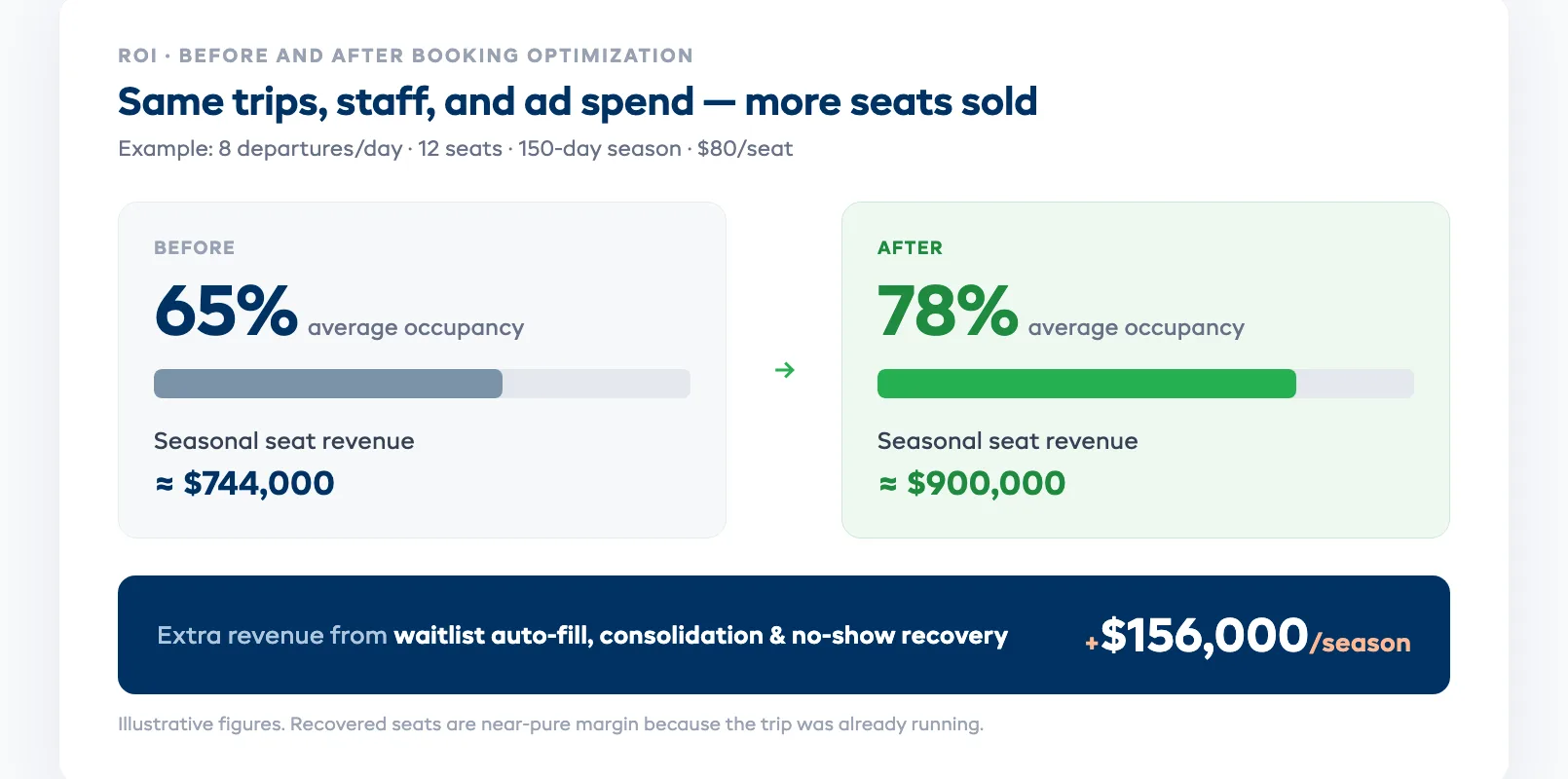
Even if your numbers are a fraction of that, the shape holds: a few recovered points of occupancy compound fast because every recovered seat is almost pure margin — the trip was already running. That's why optimization tends to pay for the software many times over within the first season. To see how the booking, waitlist, and consolidation pieces fit into one connected system, book a quick demo and we'll walk through it on your own departures.
FAQ
What is AI booking optimization for tours?
AI booking optimization is software that automatically improves how your tour seats get sold and filled, rather than just recording the bookings you take. It handles tasks like offering canceled seats to a waitlist, steering new bookers toward departures that need filling, merging half-empty trips, enforcing minimum group sizes, and preventing double-bookings across channels. The goal is to lift the occupancy of trips you already run, so you earn more from the same departures, staff, and marketing without adding admin work.
How much extra revenue can booking optimization actually add?
Most operators leak 10–20% of potential revenue through partly-full departures, unfilled cancellations, no-shows, and groups lost to the wrong timeslot. Closing even part of that gap moves the needle quickly because recovered seats are almost pure margin — the trip was already running with its fixed costs covered. As a rough example, lifting average occupancy from 65% to 78% on eight daily 12-seat departures at $80 over a 150-day season adds roughly $156,000. Your figures will differ, but the compounding effect of a few recovered occupancy points is consistent.
Will a smart waitlist annoy my guests?
No, when it's set up sensibly it does the opposite. A guest on a waitlist has already told you they want the trip, so a prompt offering them an opened seat is welcome news, not spam. Good systems send one timed, personalised offer with a link to confirm, then roll to the next person if there's no response — they don't blast everyone at once or pester people repeatedly. The result is guests who get onto trips they'd otherwise miss, and seats that fill themselves instead of running empty.
How does overbooking prevention work without losing the no-show revenue?
The foundation is one live calendar that every sales channel reads from, so the last seat closes everywhere at the same instant and the same spot can never be sold twice. On top of that hard limit, you can optionally allow a controlled buffer on tours with a reliable no-show rate — selling slightly past capacity the way airlines do, but with caps and floors you define. That recovers revenue lost to no-shows while still guaranteeing that a genuinely full, all-paid trip stays protected and no paying guest gets turned away.
Do I need a lot of booking history before this works?
For the core features — waitlist auto-fill, real-time availability, overbooking prevention, and minimum-pax rules — you can start on day one, because they work off your live bookings and your own rules rather than historical patterns. Features that predict demand or suggest the best departure times sharpen with data, and usually become genuinely useful after a single season of digital booking history. The main requirement is that your bookings live in one connected system rather than scattered across spreadsheets and separate channels.
What's the difference between booking optimization and dynamic pricing?
Booking optimization is about filling the seats you have — moving guests onto the right departures, recovering cancellations, consolidating trips, and preventing double-bookings. Dynamic pricing is about what you charge for those seats — raising prices at peak times and offering early-bird or last-minute rates. They work well together: optimization makes sure trips run full, and pricing makes sure each seat is sold at the right price. This guide focuses on optimization; for the pricing side, see our guide to AI dynamic pricing for tours and activities. Both are part of a complete approach to tour revenue.
in one place