Sailing Charters vs Fishing Charters: Operations Side-by-Side
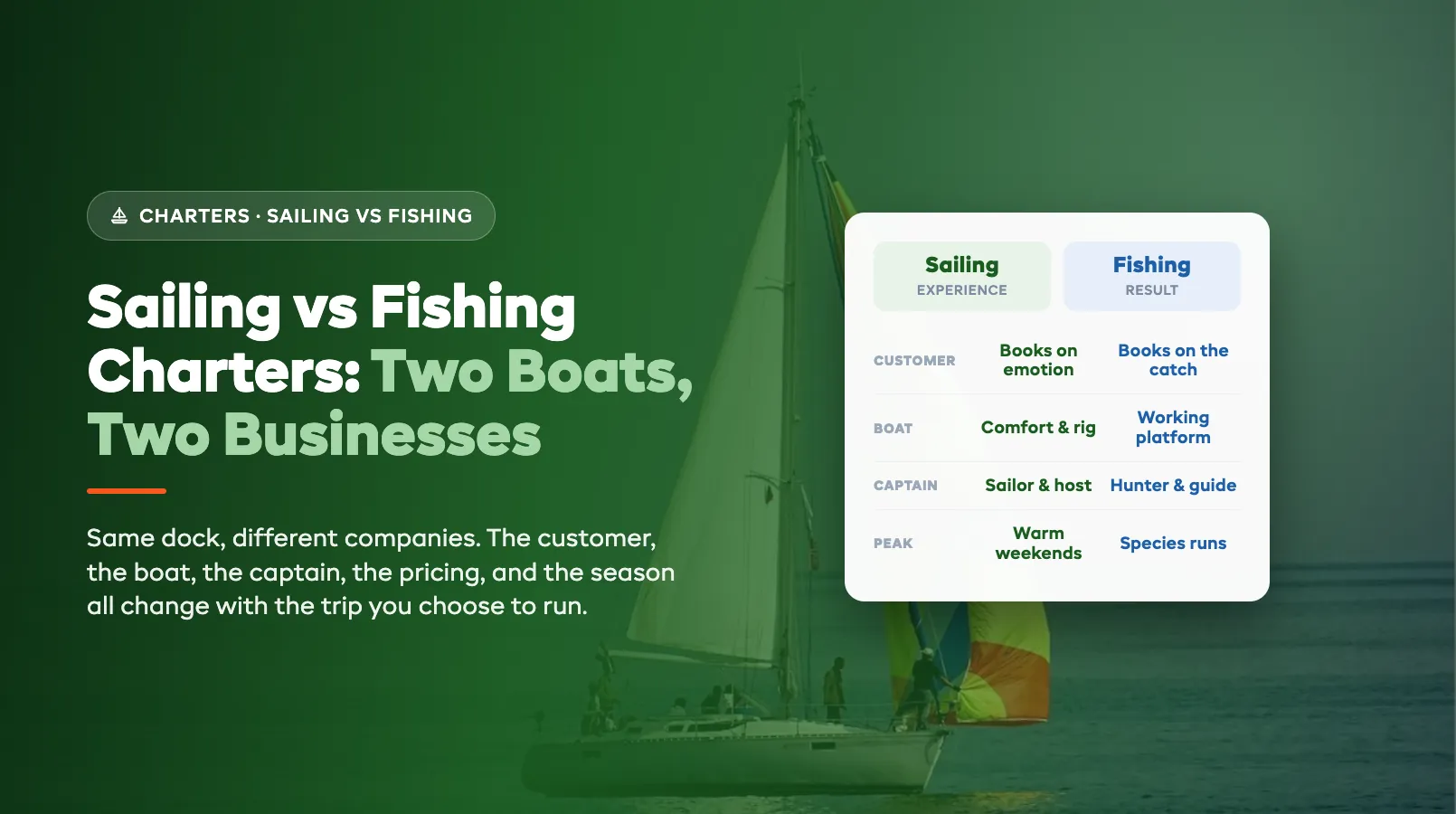
From the end of the dock, a sailing charter and a fishing charter look like the same business: a boat, a captain, paying guests, a half-day on the water. Spend one season running each and you learn fast that they are two different companies wearing the same life jacket. The customer wants different things, the boat is rigged differently, the captain needs a different skill set, the money comes in on a different curve, and the calendar peaks at different times for different reasons. Confuse the two — buy the wrong hull, hire the wrong captain, price one like the other — and you spend a year fighting your own setup.
This is a spoke off our broader guide to running a charter business, zoomed in on the one decision that shapes everything downstream: which kind of charter you are actually running. We will put sailing and fishing side by side across the six things that decide whether a charter operation is profitable or painful — and finish with the crossover plays that let one boat earn from both.
Customer Profile: Who Actually Books Each Trip
The two trips sell to two different people, and everything else follows from that.
A sailing charter sells an experience. The guest is buying a feeling — calm, wind, a sunset, a glass of something on a heeling deck, a backdrop for an anniversary or a corporate afternoon. They often do not care where the boat goes, only that the few hours feel special. They book on emotion, decide late, and are heavily swayed by photos and reviews that look like a holiday. Many have never sailed and never will again; the trip is the destination.

A fishing charter sells a result. The guest wants to catch something, and they will judge the day by the cooler. They tend to research hard, ask about target species and recent reports, book earlier, and return season after season if you put them on fish. They are more forgiving of a plain boat and far less forgiving of an empty net. Word of mouth among anglers is brutal and fast — a captain who finds fish builds a repeat book that barely needs marketing, while one who does not cannot discount their way out of it. The first-season economics of building that angler following are covered in our guide to starting a fishing charter business.
The practical upshot: sailing is a marketing-and-ambience business, fishing is a results-and-reputation business. Your photos, your reviews, and your sales pitch have to speak to whichever guest you actually serve.
Boat Requirements: Two Hulls, Two Purposes
The vessel is where the difference stops being abstract.
A sailing charter boat is built around comfort and the sail itself — a stable monohull or catamaran with shade, seating, a head, room to move, and ideally somewhere to serve food and drink. Guests are aboard to lounge, so deck space, handholds, and a clean, photogenic finish matter more than speed. The rig — mast, boom, winches, sheets — is the engine, and it carries its own maintenance and inspection load that a powerboat simply does not have.

A fishing charter boat is a working platform. It is built to get to the grounds quickly and hold position while people fight fish: a powerful engine, rod holders, a bait station, a fighting cockpit, a livewell, fish boxes, electronics for finding structure and bait, and an uncluttered deck you can hose clean. Comfort is secondary to function. The two boats overlap in almost nothing beyond the fact that they float, which is why operators rarely run both off a single hull without compromise. Whichever you buy, the daily reality of getting it water-ready is the same discipline — a pre-departure check before every trip and a safety equipment audit that keeps your flares, PFDs, and signalling gear current and accounted for. The same per-trip rigour applies to passenger paperwork on either kind of boat — our guide to charter manifests, waivers, and legal records covers the manifest and signed waivers every charter needs on file.
Captain Skills: Sailor vs Hunter
The person at the helm is a different hire for each trip.
A sailing captain is a sailor and a host. They need real sail-handling skill — reading wind, trimming, docking under sail or power, keeping a heeling boat calm and safe with nervous first-timers aboard. Just as important, they are the entertainment: narrating the bay, pouring the drinks, making the afternoon feel effortless. A quiet, capable sailor who cannot work a deck full of strangers will get poor reviews no matter how well they trim.
A fishing captain is a hunter and a guide. They need to know the water, the seasons, the species, the bait, and the spots — the local knowledge that actually puts clients on fish — plus the patience to teach a beginner how to set a hook and the judgment to move when a spot dies. The skill that sells a sailing trip (charm and narration) and the skill that sells a fishing trip (finding fish, every time) are almost unrelated. That is why you hire and pay them differently, and why the captain bench guide treats scheduling and pay for each as separate problems. Both kinds of captain, of course, sit under the same USCG credential and compliance rules the moment they take paying passengers aboard.
Pricing Differences: Experience vs Outcome
Because the two trips sell different things, they price on different logic.
Sailing charters tend to price by the boat and the hour — a flat rate for the vessel for a sunset cruise or a half-day, often with tiers for catering, a private buyout, or premium timing. The guest is buying time and ambience, so the lever is the experience you wrap around the hours: add a host, add food, add a sunset slot, and the number climbs without the boat doing anything different.
Fishing charters price by the trip and the target — a half-day inshore run, a full-day offshore push to the better grounds, a multi-day liveaboard — with the longer, further, better-fish trips carrying the strongest margin. The guest is buying a shot at a result, so the lever is the quality of the opportunity: the boat, the captain, and the water you can reach. The full pricing architecture for both — duration ladders, premium tiers, group and corporate rates, and seasonal swings — lives in our dedicated charter pricing guide. The headline for this comparison: do not price a fishing trip like a flat hourly cruise, and do not price a sunset sail like an offshore expedition.
Seasonality Differences: Two Different Calendars
Both businesses are seasonal, but they peak for different reasons and at slightly different times.

Sailing demand tracks weather and the social calendar — warm, settled days, weekends, holidays, weddings, and corporate events. It is a fair-weather, good-vibes business that lives and dies on a pleasant forecast and fills hardest in peak summer. Fishing demand tracks the fish. The runs, the migrations, the species that turn on in a given month — these set the calendar, and a serious angler will book a cold, gray Tuesday in the off-season if that is when the target is biting. The two calendars overlap in high summer but diverge at the edges, which is exactly the gap a smart operator exploits.
Crossover Strategies: One Boat, Two Revenue Streams
You do not always have to pick a lane. Several plays let an operator earn from both worlds.
The cleanest is a mixed fleet — a comfortable boat for sailing and event work, a rigged boat for fishing — sold under one brand so a single booking system, one marketing engine, and one captain bench serve both. Where a single vessel must do double duty, some powerboat operators run fishing trips in the species-peak windows and pivot the same hull to sunset cruises, sandbar trips, and private events when the bite is slow or the weather turns social. The reverse is harder: a true sailing yacht rarely makes a credible fishing platform, so crossover usually flows from a fishing-capable powerboat toward experience trips, not the other way around.
The point of crossover is calendar coverage. Fishing fills your species windows and your serious-angler weekdays; experience and event sailing fills the warm weekends, the holidays, and the off-peak dates when the fish are quiet but the weather is gorgeous. Run intelligently, one operation can smooth the dips in each business with the peaks of the other — but only if you have honestly understood that they are two businesses first. For the full operating picture across both, the charters operator hub pulls the booking, compliance, staffing, and pricing pieces together in one place.
FAQ
What is the main difference between a sailing charter and a fishing charter?
A sailing charter sells an experience — wind, scenery, calm, a special few hours — to a guest who books on emotion and often does not care where the boat goes. A fishing charter sells a result — a shot at catching a target species — to a guest who judges the day by the cooler and researches hard before booking. That single difference in what the customer is buying cascades into different boats, captains, pricing, and seasons. Treating them as one business is the most common and most expensive mistake new operators make.
Can I run both sailing and fishing charters from the same boat?
Sometimes, but with limits. A fishing-capable powerboat can credibly pivot to sunset cruises, sandbar trips, and private events when the bite is slow, which is the most common crossover. The reverse rarely works: a true sailing yacht makes a poor fishing platform because it lacks the rod holders, bait station, fighting cockpit, and quick power to the grounds that anglers need. If you are serious about both, a small mixed fleet — one comfortable boat and one rigged boat under a single brand — almost always beats forcing one hull to do both jobs.
Which charter business is more profitable, sailing or fishing?
Neither is universally more profitable — it depends on your market, your costs, and how well you match the boat and captain to the demand around you. Fishing charters can command strong margins on full-day and multi-day trips and build a loyal repeat book if the captain reliably finds fish. Sailing charters scale revenue through premium experiences, catering, and event buyouts without changing the trip itself. The bigger driver of profit is running the right business well for your location rather than picking the "better" category in the abstract.
Do sailing and fishing charters need different captain licenses?
Both fall under the same USCG framework the moment they carry paying passengers — typically an OUPV (six-pack) or Master credential sized to your passenger count and waters — so the license category is the same. What differs is the skill set behind it. A sailing captain needs genuine sail-handling ability plus the hosting charm that carries an experience trip, while a fishing captain needs local knowledge of water, seasons, and species to put clients on fish. See the USCG compliance guide for the credential details that apply to both.
Do the two charter types peak at the same time of year?
They overlap in high summer but diverge at the edges. Sailing demand follows good weather and the social calendar — warm settled days, weekends, holidays, weddings, and corporate events — so it concentrates in peak summer. Fishing demand follows the fish, meaning the migrations and species runs that can fill a cold, gray weekday in the shoulder or off-season when no one wants to sail. That mismatch is exactly why crossover works: each business can fill calendar gaps the other leaves open.
I am starting out — should I commit to sailing or fishing first?
Start with the one your market and your own skills support best, and commit fully rather than splitting your attention. If you are a capable angler who knows the local water and there is angler demand, fishing rewards that knowledge with a repeat book. If your area draws tourists, events, and good-weather day-trippers, sailing rewards ambience and marketing. Get one business genuinely working — the right boat, the right captain, the right pricing — before you consider adding the other. Our guide to running a charter business walks the full setup either way.
in one place