Passenger Manifests and Waivers: Legal Essentials for Charter Operators

Two pieces of paper decide whether a bad day on the water becomes a bad week or a closed business: the passenger manifest and the signed waiver. Nobody books a charter to fill out forms, and most operators treat both as an afterthought — a clipboard by the gate, a signature scrawled while the engine warms up. That works right up until the moment something goes wrong. Then a missing name on a manifest or a waiver with the wrong clauses is the difference between an insurer paying out and an insurer walking away.
This is a spoke off our broader guide to running a charter business, zoomed in on the paperwork that protects you. We will cover what the Coast Guard actually requires on a manifest, the clauses a waiver needs to hold up, how to collect both without slowing down boarding, the extra steps minors demand, how long to keep everything, and how all of it comes together the day you need to defend an incident.
USCG Manifest Requirements
A passenger manifest is the official record of who was aboard your vessel for a given trip. For most charter operators it is not optional paperwork — it is a Coast Guard requirement, and the rules tighten as your vessel and passenger count grow. The credential and inspection tier you fall under is covered in our USCG compliance guide; the manifest is the daily proof that you are operating inside it.
At a minimum, a compliant manifest records each passenger's full legal name, the date and trip details, and your total passenger count against the vessel's certificated limit. Inspected vessels carrying larger groups face stricter rules, including keeping a copy of the manifest ashore before departure so there is a record off the boat if the boat itself is lost. That last point trips people up: the manifest only does its job in a worst-case scenario if a copy exists somewhere other than the vessel.
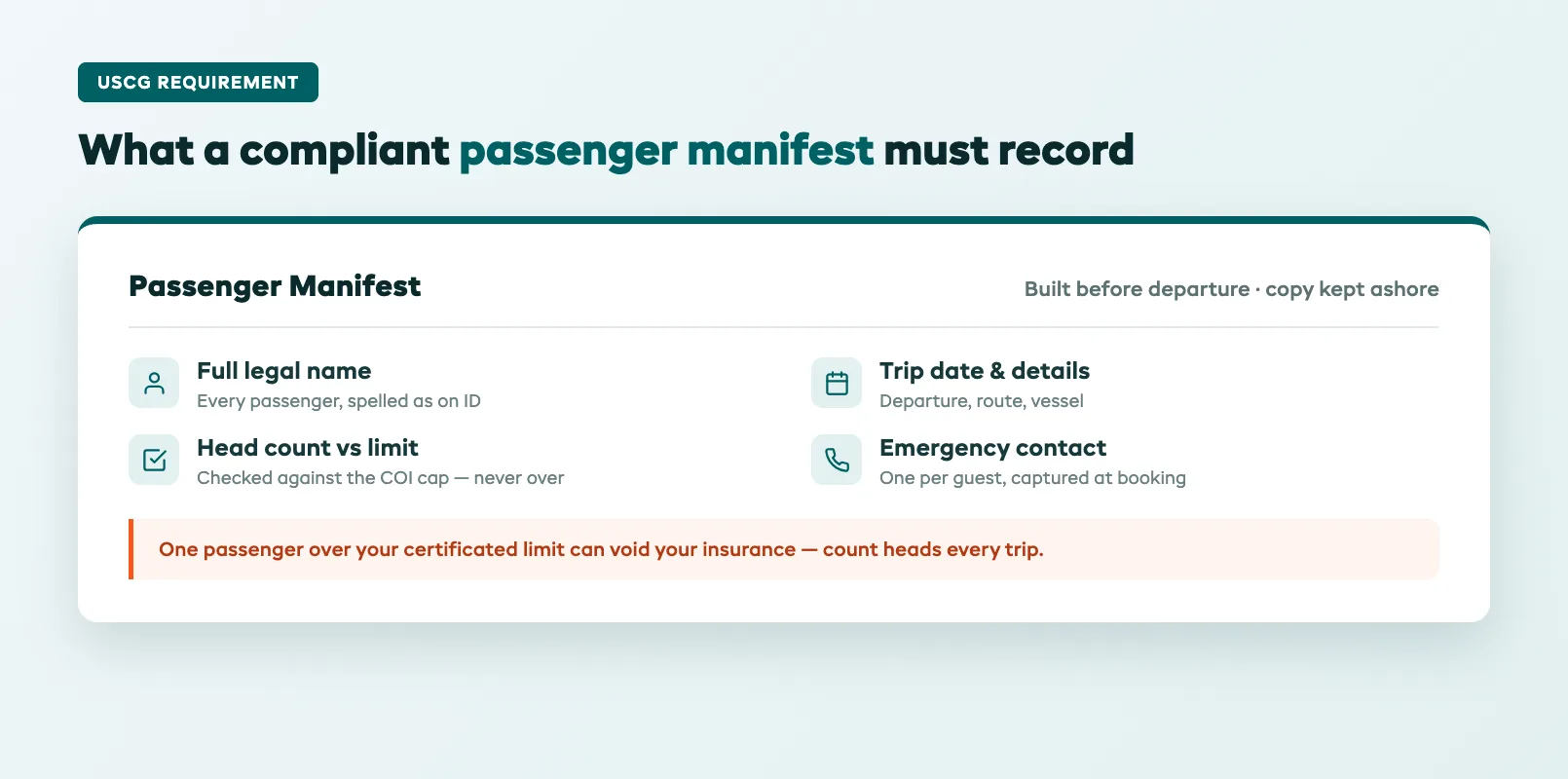
The practical discipline is simple: build the manifest before you leave the dock, not from memory afterward. Count heads against your Certificate of Inspection limit every single trip — going one passenger over is one of the fastest ways to void your insurance and draw a penalty. Capture an emergency contact for each guest while you are at it. It costs nothing at booking and matters enormously if you ever have to make a call no operator wants to make.
Waiver Essentials
A waiver is the passenger's written acknowledgement that they understand the risks of the activity and agree not to hold you liable for the ordinary ones. A good waiver will not protect you from gross negligence — no document does — but a properly written one stops a routine slip, a bout of seasickness, or a known risk of the activity from turning into a winnable lawsuit.
The clauses that actually carry weight are specific, not generic. An assumption-of-risk clause should name the real hazards of your trip — weather, wave motion, slippery decks, marine life, the use of equipment — in plain language, so a guest cannot later claim they had no idea. A release-of-liability clause should clearly state what the guest is giving up. You want acknowledgement that the guest is physically fit to participate, a consent clause if you photograph trips for marketing, and the guest's own confirmation that they have not been drinking before boarding.
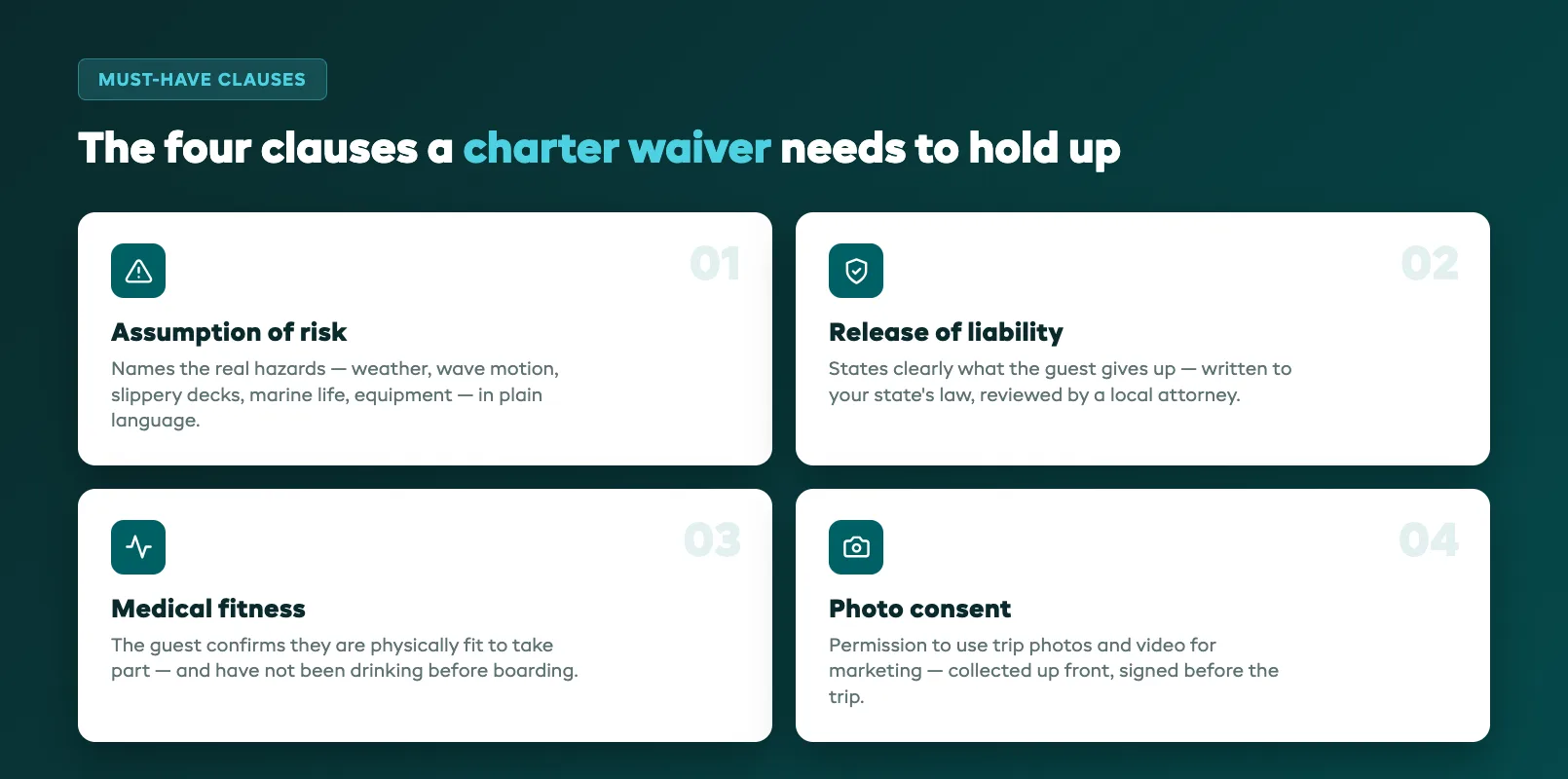
Two things matter as much as the wording. First, the waiver has to be signed before the trip, by the actual person taking it — not the friend who made the booking. Second, enforceability is set by the law of the state you operate in, and a handful of states are openly hostile to liability releases. This is the one section where a one-time review by a local maritime attorney pays for itself many times over. Write the waiver to your state, not to a template you found online.
Digital Waiver Systems
The clipboard-at-the-gate method fails in three predictable ways: people rush the signature without reading, pages get coffee-stained or lost, and you have no record of who has signed until you are standing on the dock counting. A digital waiver fixes all three by moving the signature to the booking flow, before anyone arrives.
The model that works is to send the waiver automatically the moment a booking is confirmed, then chase anyone who has not signed as the trip approaches. By the time guests reach the dock, the captain sees a clean list of who is cleared and who still needs to sign — and boarding is a head-count, not a paperwork scramble. This is exactly the job a waiver chaser agent is built for: it watches who has and has not signed and follows up on its own, so unsigned waivers stop being the captain's problem five minutes before departure.
Digital also solves storage. Every signed waiver is timestamped, tied to the booking and the trip date, and searchable in seconds — which is precisely the state you want your records in if you ever have to produce one. The harder part is operational discipline, and a smooth boarding process depends on the captain knowing the cleared list cold; our captain scheduling guide covers how that briefing fits into the run-up to departure.
Minor Handling
Minors are where good operators get caught out, because a minor cannot legally sign a waiver for themselves. A signature from a 16-year-old is worth nothing. The waiver has to be signed by a parent or legal guardian, and ideally that adult signs a clause that covers both the child's participation and the parent's agreement not to sue on the child's behalf.
The complication is that even a parent-signed waiver for a minor is weaker than one signed by an adult for themselves, and some states limit how much a parent can sign away on a child's behalf. You cannot fully waive a minor's own future right to sue. That does not make the waiver pointless — it documents informed consent and the parent's acknowledgement of risk — but it does mean minors deserve extra care, not less.
The clean operational rule: every guest under 18 must have a waiver signed by a parent or guardian, collected before the trip, and your booking process should flag a minor in the party so a guardian signature is required rather than optional. If an unaccompanied minor is booked, confirm guardian consent in writing before they board. A parent dropping a teenager at the dock without a signed form is a trip that should not leave.
Record Retention
A waiver only defends you if you can produce it, and a manifest only matters if it still exists when someone asks. That makes retention a legal question, not a filing-cabinet one. The trap is the statute of limitations: in many states an injured guest has two to three years to file a personal injury claim, and a minor's clock may not even start until they turn 18. Throw the paperwork out too early and you have effectively destroyed your own defense.
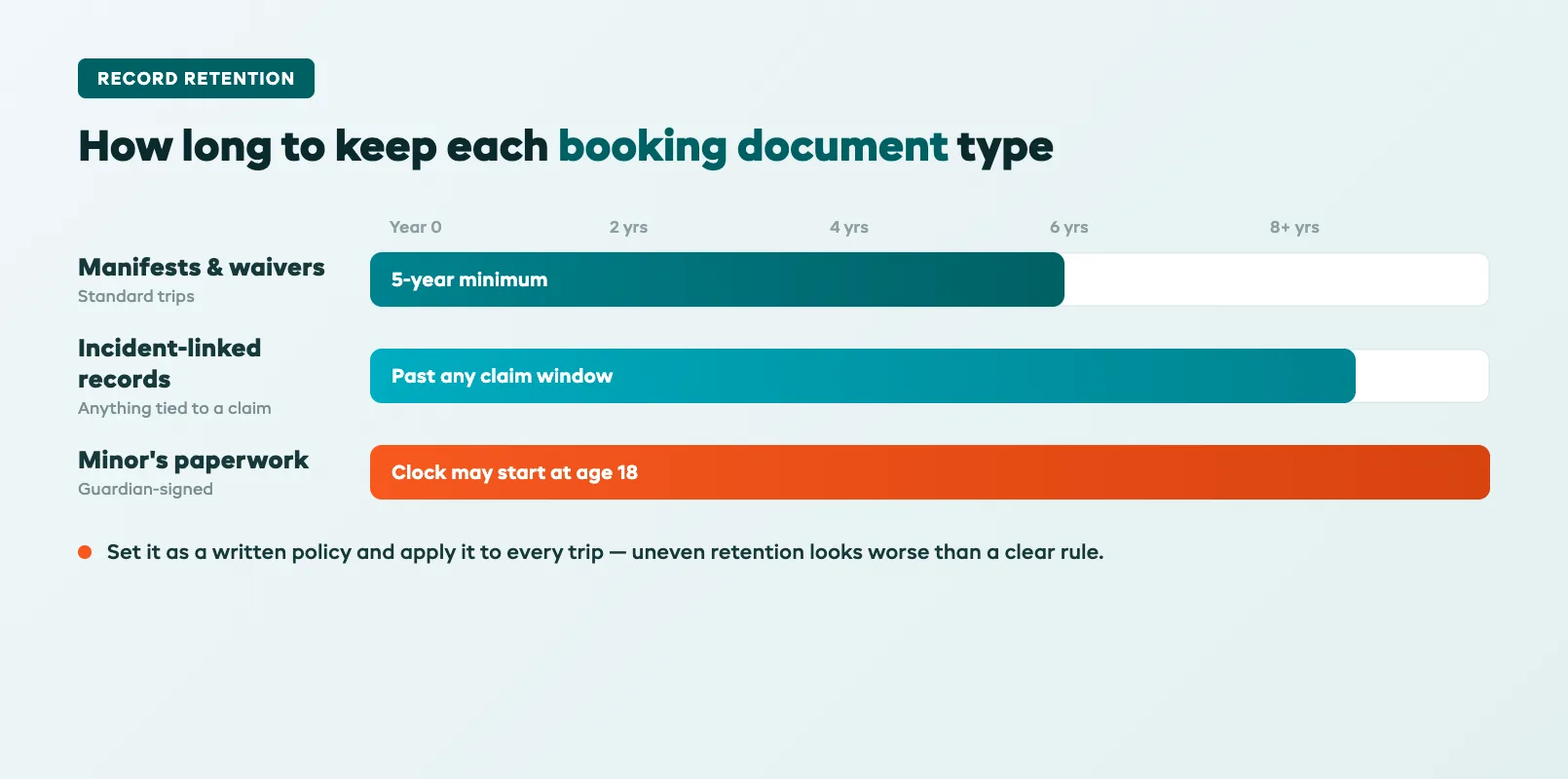
The safe default most operators land on is to keep manifests and signed waivers for a minimum of five years, and to keep anything connected to a minor or to an incident considerably longer — often until well past the point any claim could be filed. Digital storage makes this painless: there is no box to lose, no ink to fade, and retrieval is a search rather than an afternoon in a storage unit. The vocabulary around these obligations — manifest, certificate of inspection, statute of limitations — is laid out in plain terms in our charter operator glossary if any of it is unfamiliar.
Whatever window you choose, make it a written policy and apply it consistently. Keeping some trips and not others looks far worse in a dispute than a clear, evenly-applied retention rule.
Incident Defense
Everything above exists for one moment: the day a guest is hurt, a claim is filed, or an insurer asks what happened. When that day comes, your defense is only as strong as the evidence package you can assemble — and you assemble almost all of it before the incident, not after.
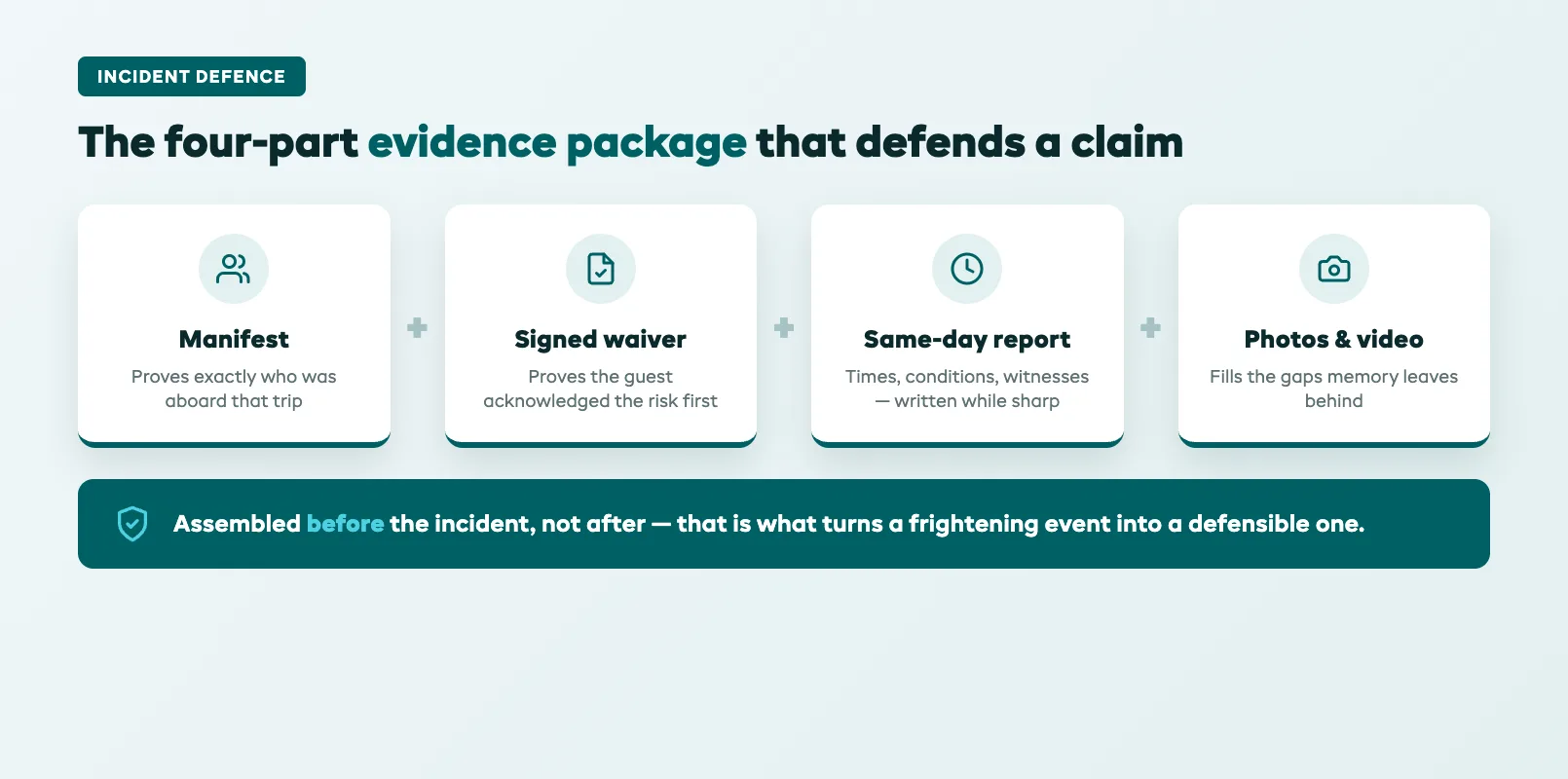
A strong package has four parts. The manifest proves exactly who was aboard. The signed, pre-trip waiver proves the guest acknowledged the risk. A contemporaneous incident report — written the same day, with times, conditions, witnesses, and what was done — proves you responded properly. And photos or video, where you have them, fill the gaps memory leaves. The single biggest mistake operators make is writing the incident report days later from a fuzzy recollection; the report written within hours, while details are sharp, is the one that holds up. A standard incident response checklist keeps the crew from forgetting a step in the chaos right after something goes wrong, and a documented response paired with a clean manifest and a valid waiver is what turns a frightening event into a defensible one.
Operators who run sailing trips alongside fishing trips should note the documentation load differs by trip type and risk profile — our sailing vs fishing operations breakdown covers where those differences bite, and the fishing charter startup guide walks through getting this paperwork right from your first season. Solid manifests and waivers also protect the pricing you have worked to defend; if you are still setting rates, the charter pricing strategy guide pairs naturally with locking down the legal side.
Get the paperwork right and it disappears into the background — a quiet system that runs itself until the rare day you need it, when it becomes the most valuable thing you own. If you are building out the rest of your operation, the charters resource hub collects the guides, checklists, and tools that go with it.
FAQ
What information has to be on a charter passenger manifest?
At a minimum, each passenger's full legal name, the trip date and details, and a total head count checked against your vessel's certificated passenger limit. Capturing an emergency contact for each guest is strongly recommended. Inspected vessels carrying larger groups must also keep a copy of the manifest ashore before departure, so a record exists off the boat.
Is a passenger manifest legally required for charters?
For most charter operations in US waters, yes — it is a Coast Guard requirement, and the rules get stricter as vessel size and passenger count increase. Beyond compliance, the manifest is your proof of exactly who was aboard if anything goes wrong, which is why you build it before leaving the dock rather than reconstructing it from memory afterward.
What clauses does a charter waiver actually need?
The ones that carry weight are specific: an assumption-of-risk clause that names the real hazards of your trip, a clear release-of-liability clause, a confirmation the guest is physically fit to participate, a photo consent clause if you market trips, and an acknowledgement the guest has not been drinking. Enforceability depends on your state's law, so have a local maritime attorney review it once.
Can a minor sign their own charter waiver?
No. A minor cannot legally sign a waiver for themselves — a parent or legal guardian must sign on their behalf, ideally including a clause covering both the child's participation and the parent's agreement not to sue. Even then, a parent-signed waiver for a minor is weaker than an adult's own, and some states limit how much can be waived for a child.
How long should I keep charter waivers and manifests?
A safe default is a minimum of five years for manifests and signed waivers, and considerably longer for anything tied to a minor or an incident — because a personal injury claim window can run two to three years, and a minor's clock may not start until they turn 18. Set it as a written policy and apply it consistently across every trip.
Are digital waivers as valid as paper ones?
Yes — a properly collected electronic signature is enforceable, and digital waivers are usually stronger evidence because each one is timestamped, tied to the booking and trip date, and instantly retrievable. Sending the waiver at booking confirmation and chasing unsigned ones before the trip also means more guests actually read it, which strengthens the assumption-of-risk record.
What documents defend a charter business after an incident?
Four things, assembled mostly before the incident: the manifest proving who was aboard, the signed pre-trip waiver proving acknowledged risk, a contemporaneous incident report written the same day with times and conditions, and any photos or video. The report written within hours holds up far better than one reconstructed days later from memory.
in one place