Charter Pricing: Half-Day, Full-Day, Multi-Day, and Premium Packages
Ask ten charter operators how they set their prices and most will give you some version of "it's about what everyone else charges, plus a bit." That's not a pricing strategy — it's a way to inherit your competitor's mistakes. Charter pricing done well is an architecture: a deliberate ladder of trip lengths, package tiers, and seasonal adjustments where every rate has a reason behind it and every step up the ladder is something a customer can understand and choose.
The operators who make real money aren't the ones with the lowest prices or the highest — they're the ones whose menu is built so the easy, obvious choice for the customer is also the profitable one for the boat. This guide is a spoke off our broader guide to running a charter business, focused entirely on the pricing layer: how to set half-day, full-day, and multi-day rates that make sense relative to each other, how to design premium packages people actually upgrade into, how to quote groups and corporate buyouts without giving away the boat, and how to move your prices with the season instead of holding one flat number all year.
Half-Day Pricing: Your Volume Workhorse
The half-day trip — typically four hours, often inshore or coastal — is the entry point to your whole menu. It's the price most customers compare first, the trip that fills your shoulder-season calendar, and the one that lets you run two departures in a single day. Price it as the volume workhorse it is: accessible enough to keep the boat moving, but never so cheap that two half-days earn less than one full-day with half the wear and fuel.
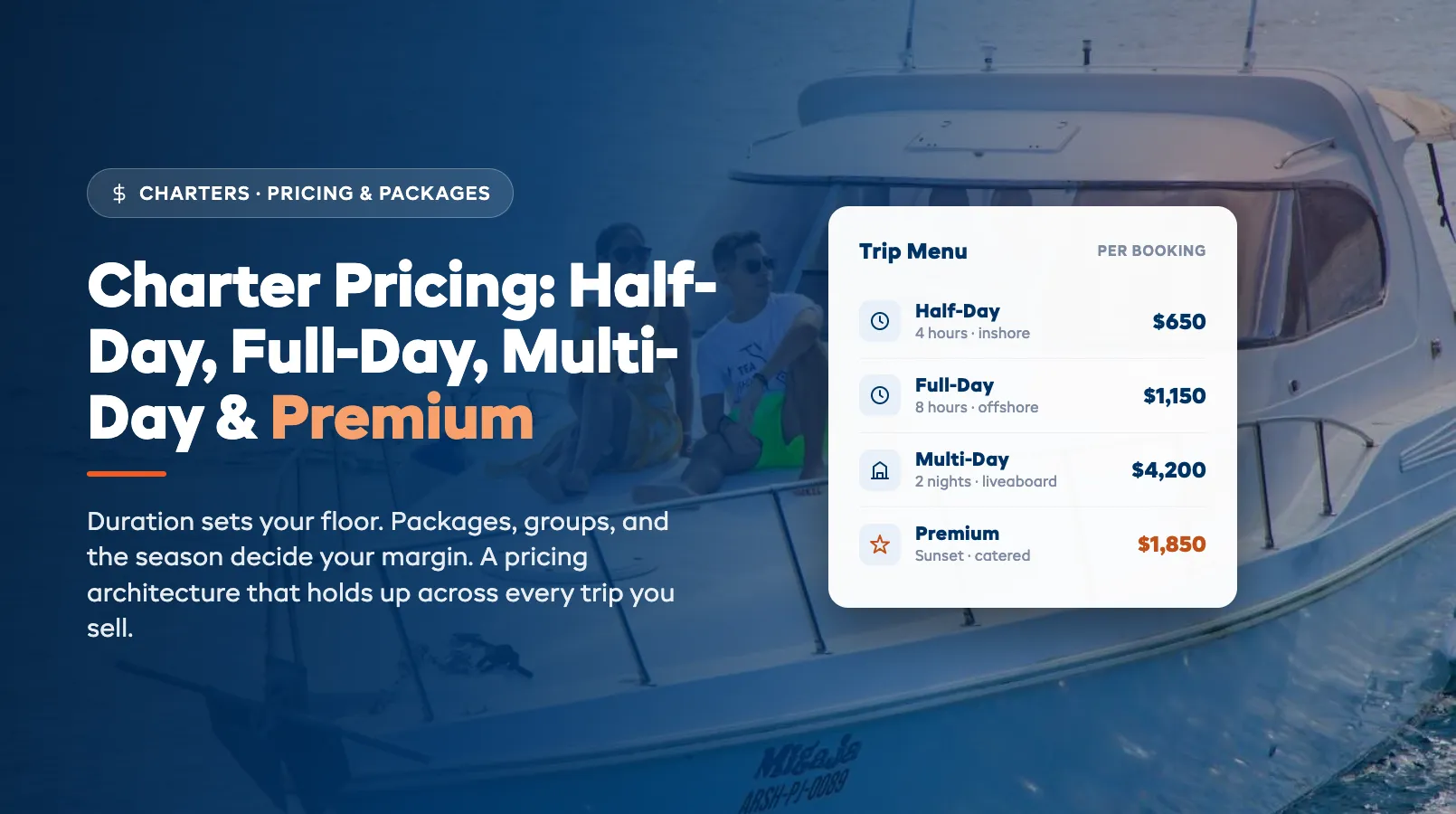
Start from your fully-loaded cost per trip — fuel, captain pay, bait or gear, insurance amortised per outing, and slip fees — then add the margin the trip needs to clear. A common mistake is pricing the half-day at exactly half the full-day; it shouldn't be. Your fixed costs (captain showing up, boat prepped, fuel to leave the dock and return) don't halve when the trip does, so the half-day should carry a higher effective hourly rate than the full-day. Customers accept this instinctively — a four-hour trip at $650 reads as fair next to an eight-hour trip at $1,150, even though the shorter trip earns more per hour on the water.
Full-Day Pricing: Where the Margin Lives
The full-day trip — eight hours or so, usually offshore or to the better grounds — is where your strongest margin usually lives. The incremental cost of the back half of the day is mostly fuel and a few more hours of captain time; everything else was already spent getting the boat off the dock. That means each additional hour of a full-day trip is cheaper to deliver than the first, and you can price the day as a premium experience rather than two half-days stapled together.
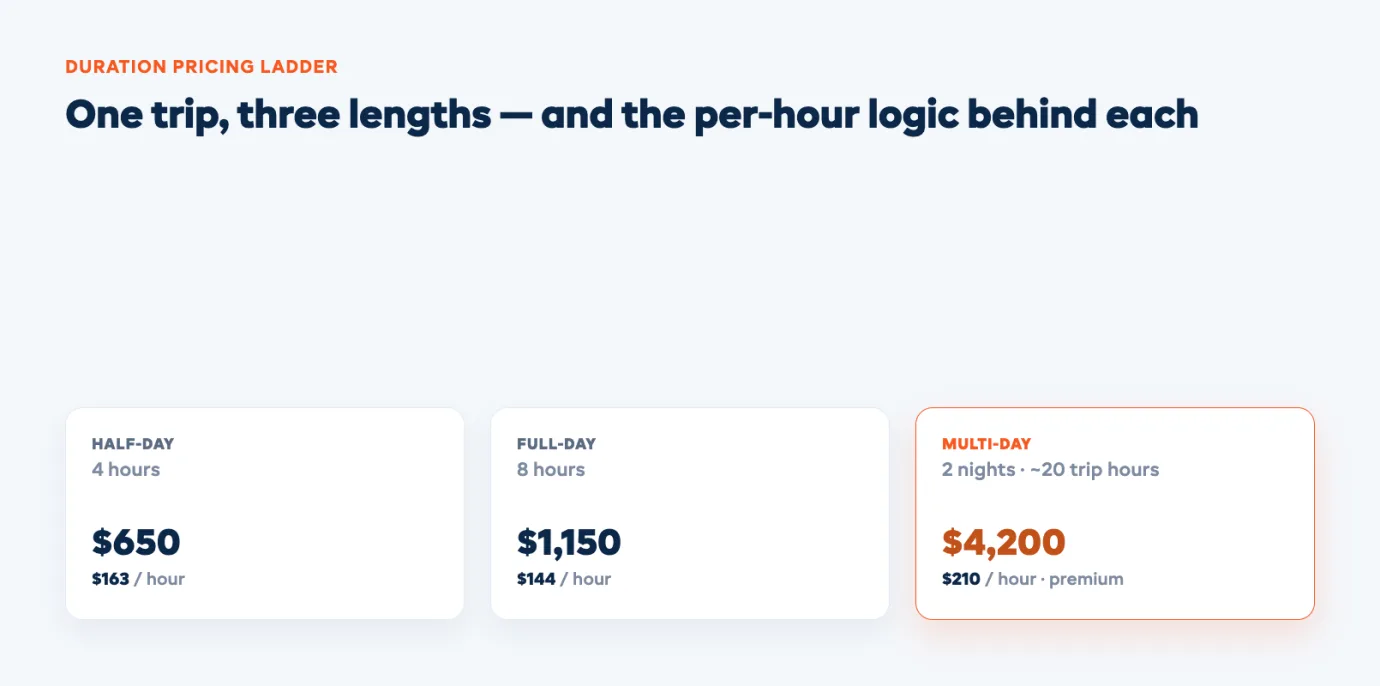
The discipline here is to make the full-day an obvious step up in value, not just in price. A full-day buyer is committing their whole day and usually their bigger budget, so load the trip with the things that make eight hours feel worth it — reaching the better water, a proper lunch, more target species, time to actually relax. Anchor the full-day against the half-day on your menu so the jump in price tracks a visible jump in what they get. Done right, a meaningful share of half-day enquiries trade up to the full-day on their own, because the value gap does the selling for you.
Multi-Day Charters: Pricing the Whole Experience
Multi-day and liveaboard charters are a different animal. You're no longer selling hours on the water — you're selling an experience that includes nights aboard, meals, fuel for longer runs, and a captain (and often crew) committed to you for days at a stretch. Pricing here is less about an hourly rate and more about packaging the whole trip at a number that reflects scarcity: while that boat is on a three-day charter, it can't run six half-days, so the multi-day price has to clear what those displaced trips would have earned, plus a premium for the exclusivity.
That's why the per-hour math on a multi-day trip looks high and should — customers buying a multi-day adventure aren't comparing hourly rates, they're comparing the trip against a vacation. Build the price from the cost of the days the boat is off the market, add provisioning and crew, then layer a premium for the once-in-a-lifetime nature of what you're offering. Require a meaningful deposit and a clear cancellation policy on these; a multi-day booking that falls through at the last minute is a hole in your calendar you can't easily refill. Your charter booking confirmation process is where those deposit terms, trip details, and expectations get locked in before the customer ever steps aboard.
Premium Package Design: Selling the Upgrade
The fastest way to lift your average booking value isn't raising your base price — it's giving customers a reason to spend more by choice. Premium packages do that. Take the same vessel and the same captain, and build a good-better-best menu where each tier bundles in extras that cost you a little and feel worth a lot: catered food, a photographer, sunset timing, a bar setup, a private host on deck. The trip is the same; the experience around it is what scales.
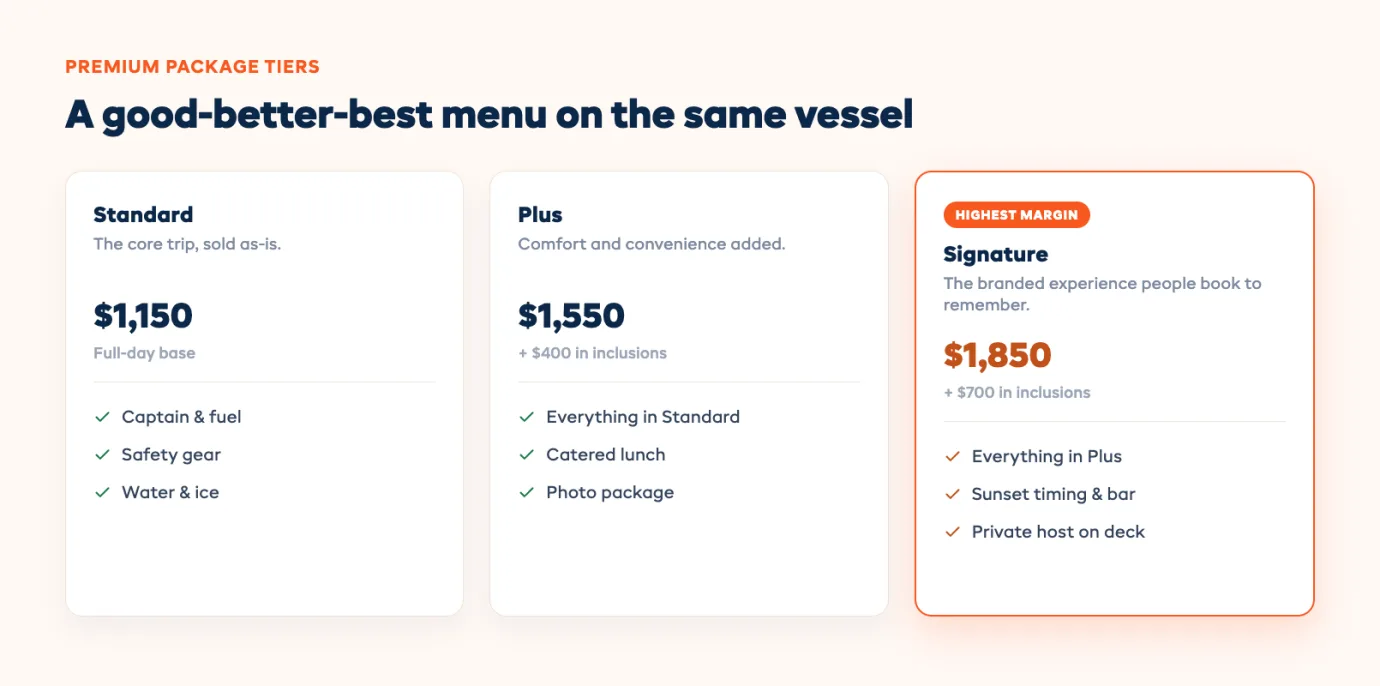
The design trick is to make the middle and top tiers the obvious value. When the jump from Standard to Plus adds $400 of price but visibly more than $400 of stuff, a big share of customers self-select up — and your highest tier exists partly to make the middle one look reasonable. Price the inclusions so the margin actually grows as customers climb the ladder, not just the revenue: a catering add-on you buy for $30 a head and sell as part of a $700 upgrade is doing real work — our charter add-on revenue guide covers the catering, photography, and gear menu in detail. Name the tiers like experiences ("Sunset Signature") rather than sizes, and let the premium package be the thing your marketing photos sell, because that's the trip people screenshot and remember.
Group and Corporate Charter Pricing
Groups and corporate clients are priced on a completely different logic from individual trips, and confusing the two is how operators leave the most money on the table. For a shared group trip sold by the seat, discount the head, not the boat — offer a per-person rate that improves with size, but protect a per-seat floor so a full boat of ten still clears well above your cost. The goal is to reward the group for filling seats you'd otherwise sell one at a time, not to hand them the vessel at a loss.
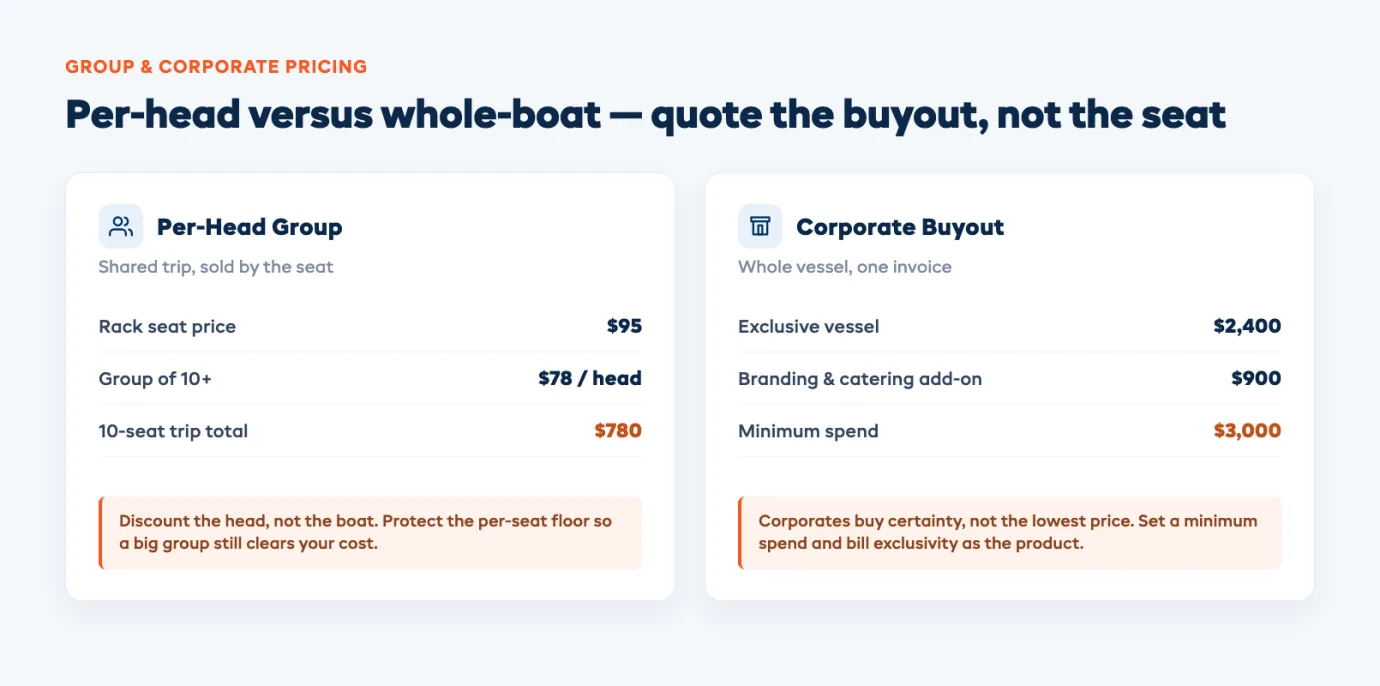
Corporate buyouts are the opposite: you're selling the whole vessel and exclusive use, so price the buyout as a product in its own right with a clear minimum spend. Corporate clients are buying certainty, branding, and a clean single invoice — not the lowest possible number — so bill exclusivity, catering, and any custom touches as line items rather than discounting your way into the booking. A no-show or last-minute cancellation on a buyout is expensive, so tie a firm deposit and cancellation window to every group and corporate quote, and let a no-show follow-up agent handle the chasing automatically so a missed deposit or a quiet cancellation doesn't slip through on your busiest weekend.
Seasonal Adjustments: Price the Calendar, Not the Trip
The single biggest pricing lever most charter operators never pull is the season. Demand for charters swings violently across the year — a Saturday in July is not the same product as a Tuesday in November, and charging the same for both means you're either leaving money on the table in peak or pricing yourself out of trips in the off-season. The fix is to set a price list per season before the year starts, so your rates move with demand on a schedule instead of in a panic.
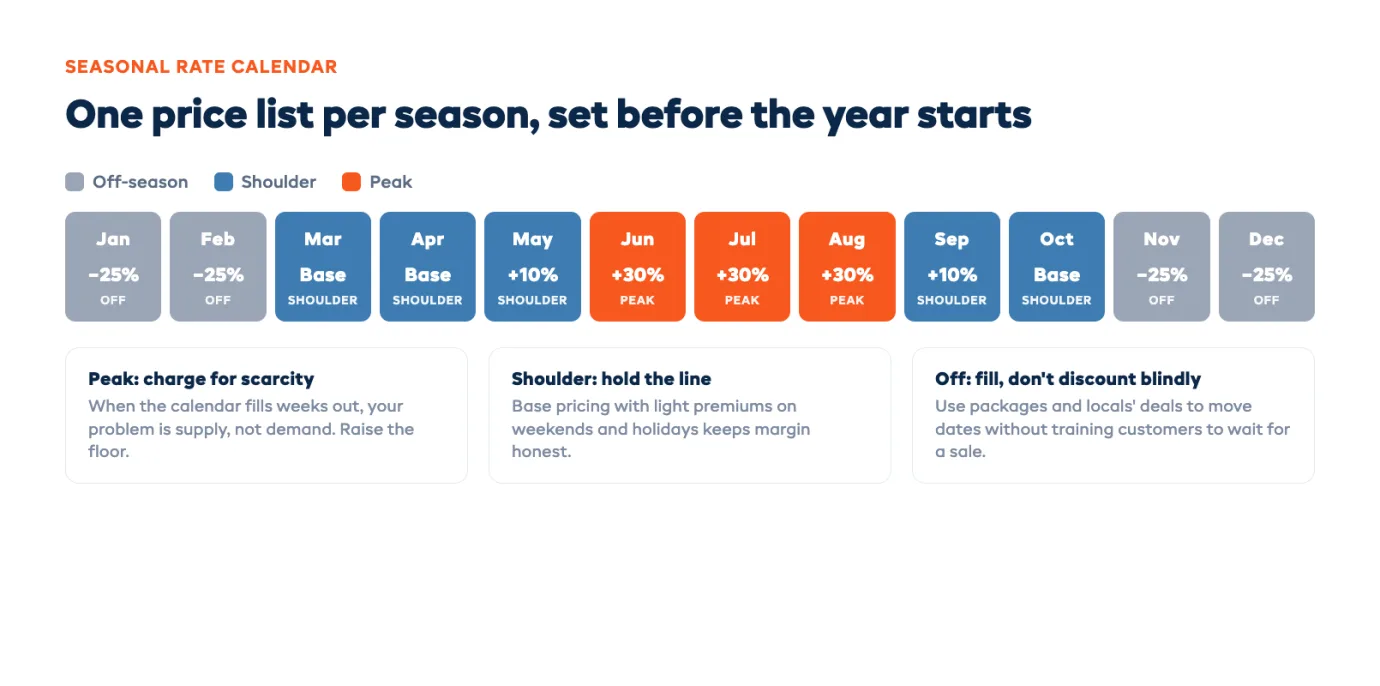
In peak season, when your calendar fills weeks out, your constraint is supply, not demand — so raise the floor and let scarcity work for you. In the shoulder months, hold base pricing with light premiums on weekends and holidays. In the off-season, the temptation is to slash prices, but blind discounting just trains customers to wait for a sale; instead, use packages, locals' deals, and off-peak experiences to fill dates while protecting the perception of your peak rates. Purpose-built charter booking software makes this practical — seasonal price rules apply themselves to the calendar so the right rate shows for the right date without you re-pricing every trip by hand. For the credentials and compliance side of running those trips, see the USCG compliance guide; for building the crew to staff a full peak calendar, the captain bench guide covers scheduling and pay, and the guide to starting a fishing charter business walks the first-season economics that your pricing has to clear. The full picture lives in the charters operator hub, and the charter operator glossary defines the pricing and compliance terms in plain language, and the guide to charter manifests, waivers, and legal records covers the per-trip paperwork that keeps every booked trip defensible.
FAQ
How much should I charge for a half-day charter?
There's no universal number — it depends on your boat, your market, your fuel and crew costs, and what the trip targets. The right way to set it is from the bottom up: total your fully-loaded cost per trip (fuel, captain pay, bait or gear, insurance per outing, slip fees), then add the margin the trip needs to clear. The key principle is that a half-day should carry a higher effective hourly rate than a full-day, because your fixed costs of getting the boat off the dock don't halve when the trip does. As a rough illustration, a four-hour inshore trip priced around $650 reads as fair next to an eight-hour offshore trip at $1,150 — but build from your own costs, not a competitor's sticker.
Why shouldn't a full-day charter cost exactly double a half-day?
Because your costs don't scale linearly with time. Most of the expense of any charter is incurred just getting the boat prepped, fueled, and off the dock with a captain aboard — that cost is the same whether the trip is four hours or eight. The back half of a full-day trip is mostly incremental fuel and a few more hours of captain time, which makes those later hours cheaper to deliver than the first ones. So the half-day carries a higher per-hour rate to cover the fixed costs, and the full-day earns its strongest margin on the back end. Pricing the full-day at exactly double the half-day usually means you're underpricing the full day.
How do I price multi-day and liveaboard charters?
Stop thinking in hourly rates and price the whole experience against scarcity. While the boat is on a multi-day charter, it can't run the half-days and full-days it would otherwise sell, so the multi-day price has to clear what those displaced trips would have earned, plus provisioning, crew, and a premium for the exclusivity of the trip. Multi-day customers are comparing your charter against a vacation, not against an hourly rate, so the per-hour math looking high is fine and expected. Always require a meaningful deposit and a clear cancellation policy, because a multi-day booking that collapses at the last minute leaves a hole in your calendar you can't easily refill.
How should I price group and corporate charters?
Use two different logics. For a shared group trip sold by the seat, discount the head, not the boat: offer a per-person rate that improves with group size while protecting a per-seat floor that keeps a full boat well above cost. For a corporate buyout, you're selling the whole vessel and exclusive use, so price it as a standalone product with a clear minimum spend and bill catering, branding, and custom touches as line items rather than discounting. Corporate clients are buying certainty and a clean invoice, not the lowest price. Tie a firm deposit and cancellation window to every group and corporate quote, since a no-show on a buyout is expensive to absorb.
Should charter prices change with the season?
Yes — seasonal pricing is the biggest lever most operators never pull. Demand swings hard across the year, so charging one flat rate means you either leave money on the table in peak or price yourself out of trips in the off-season. Set a price list per season before the year begins: raise the floor in peak when the calendar fills weeks out and scarcity is on your side, hold base pricing with light weekend premiums in the shoulder months, and in the off-season use packages and locals' deals to fill dates rather than blindly slashing rates, which only trains customers to wait for a sale. Booking software that applies seasonal price rules to the calendar automatically makes this practical to run without re-pricing every trip by hand.
in one place