Urban vs Tourist Bike Rental: Two Business Models, One Playbook
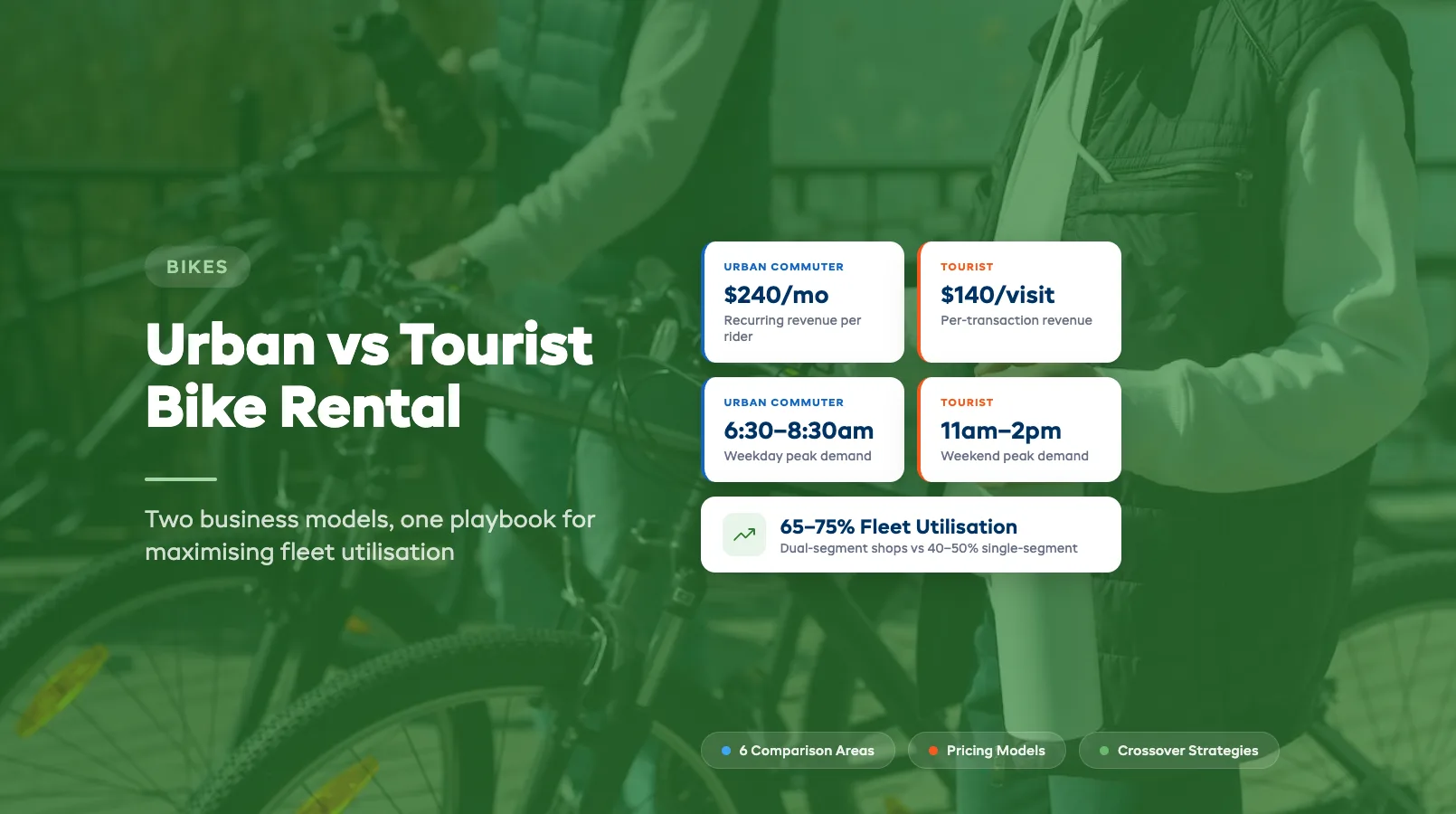
The person renting a bike at 7:15 a.m. on a Tuesday and the person renting one at 10:30 a.m. on a Saturday are running two completely different transactions. One needs to get to work. The other wants to see the harbor.
If you run a bike rental shop, you've probably noticed this split. The question is whether your pricing, fleet, and marketing actually reflect it — or whether you're serving both crowds with the same playbook and leaving money on the table. If you're setting up from scratch, start with our complete bike rental business guide for the full picture.
Customer Profile Differences
Urban commuter renters and tourist renters don't just want different bikes. They want different experiences, different levels of hand-holding, and different things from your checkout process.
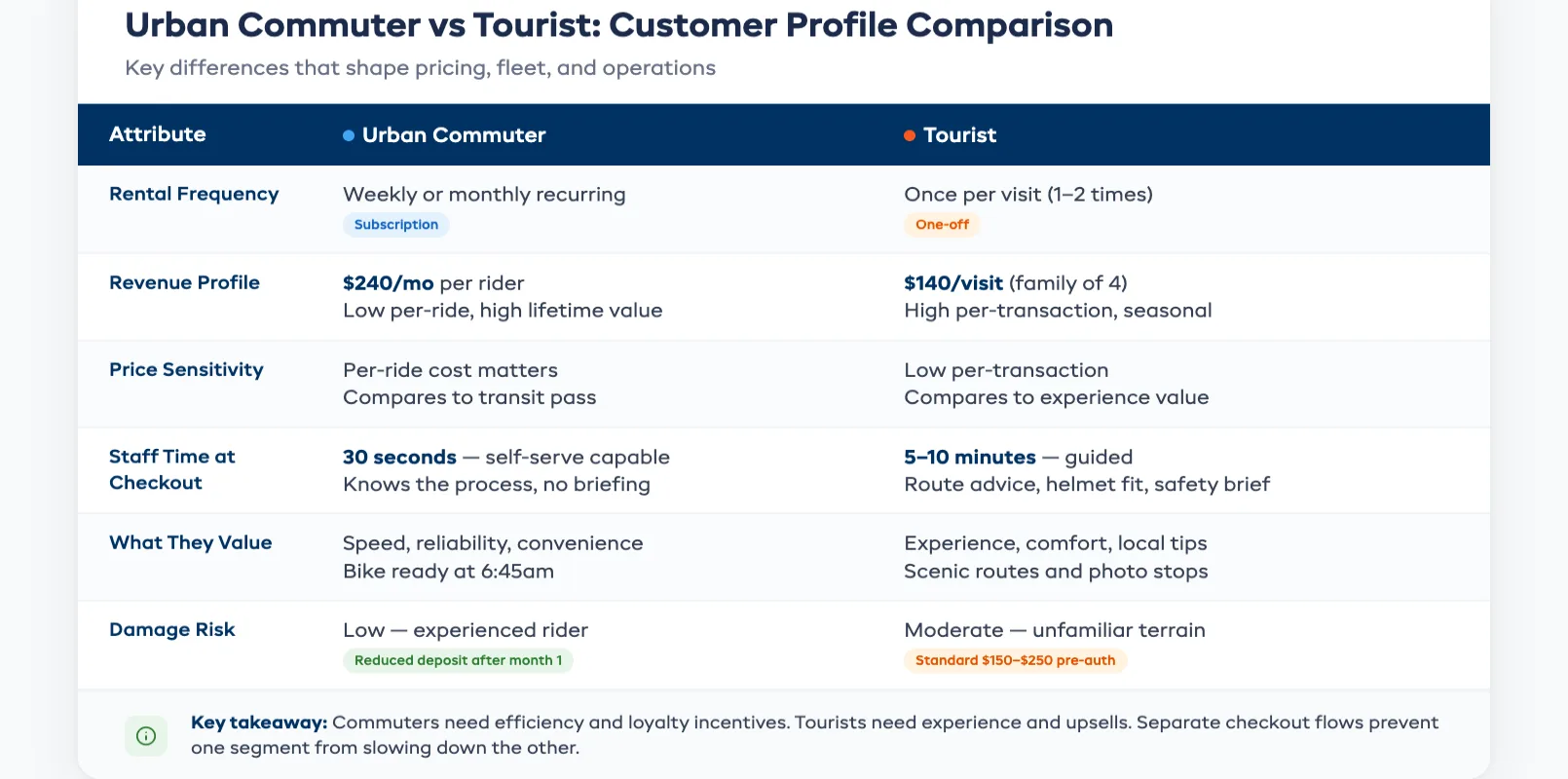
The urban commuter. Rents weekly or monthly. Knows exactly what they want — a functional bike that gets them from A to B. No map needed, no helmet tutorial, no route recommendations. They want fast checkout, predictable pricing, and a bike ready at 6:45 a.m. A commuter paying $12/day five days a week generates $240/month. Low-maintenance, high lifetime value.
The tourist. Rents once, maybe twice. On holiday. Wants an experience, not transportation. They'll ask about scenic routes, coffee stops, and whether the basket fits a camera bag. A family of four paying $35/bike for a half-day ride is a $140 ticket — but they won't come back next Tuesday. Revenue is transaction-heavy and season-dependent.
The implication: commuter renters need efficiency and loyalty incentives. Tourist renters need experience and upsells. Running the same checkout flow for both means your commuter waits behind a tourist getting a 10-minute route briefing.
Pricing Structure Differences
The pricing models for these two segments are almost opposite. Get this wrong, and you either undersell to tourists or overcharge commuters into leaving.
Urban commuter pricing: subscriptions and volume. Commuters want predictability. Monthly passes ($89-$149/month), weekly passes ($45-$65), or punch-card models (10 rides for $90). The per-ride cost drops as volume increases. A commuter paying $120/month is paying $5.45/ride — far below your tourist day rate, but they're filling bikes that would sit idle on weekdays.
Tourist pricing: day rates and time blocks. Tourists pay per hour ($12-$18), half-day ($25-$40), or full-day ($35-$60) depending on your market and bike type. E-bikes command a 40-60% premium. For more on pricing mechanics, see our bike tour operator revenue playbook.
Where shops lose money. Offering commuters your tourist day rate prices them out. Offering tourists your subscription rates leaves revenue on the table. The fix: separate rate cards in your booking system that present the right pricing based on booking type.
Deposits differ too. Commuters with monthly accounts get reduced deposits after the first month — 20 clean returns means lower risk. Tourists get the standard pre-auth ($150-$250). For deposit strategies, see our bike rental damage policy guide.
Location and Marketing
Where you put your shop — and how you attract each customer type — determines which segment you'll dominate.
Urban locations. Transit hubs, business districts, university campuses, and residential corridors near bike-lane networks. Commuters don't detour. If your shop isn't between their home and their office, they'll use a competitor or a dockless share service. Visibility matters less than convenience. A basement-level shop next to a train station will outperform a street-level shop three blocks away.
Tourist locations. Waterfronts, historic districts, hotel clusters, cruise terminal exits, and trailheads. Tourists are on foot, exploring, and impulse-renting. Street-level visibility, colorful signage, and bikes displayed outside all drive walk-in traffic. Partnership with hotels, Airbnbs, and concierge services fills your pipeline before the customer even arrives at your door.
Marketing channels diverge too. Commuters respond to Google search ("bike rental monthly pass [city]"), local SEO, and workplace partnerships. Tourists respond to TripAdvisor, Google Maps reviews, hotel lobby flyers, and Instagram-worthy route photos.
Dual-location strategy. Some shops run a stripped-down commuter hub near transit and a full-service tourist shop on the waterfront. Same fleet, same back-end systems, different front-of-house experience.
Fleet Composition
The bikes you stock for each segment are different animals.
Commuter fleet. Durability over comfort. Single-speed or internal-hub bikes with puncture-resistant tires, disc brakes, and fenders. Internal-hub gearing (Shimano Nexus 3 or 7-speed) eliminates derailleur damage — the single biggest maintenance item on rental bikes. Budget $400-$600 per unit; expect 18-24 months of service life at daily-use intensity.
Tourist fleet. Comfort over speed. Step-through frames, wide saddles, upright handlebars, front baskets, and phone mounts. E-bike options are worth the investment — tourists pay the premium willingly. Budget $500-$800 per standard bike, $1,200-$2,000 per e-bike.
Crossover bikes. If you can only stock one type, a hybrid with step-through frame, 7-speed internal hub, and puncture-resistant tires serves both adequately. You'll compromise on speed and comfort, but it reduces fleet complexity. For maintenance schedules across both types, see our bike fleet maintenance guide.
E-bikes. Both segments want them — commuters for hilly commutes, tourists for comfort and range. A mid-range city e-bike with 60+ km range covers both. The key difference is charging logistics: commuter e-bikes charge overnight, tourist e-bikes need midday top-ups. For e-bike operational details, see our e-bike operations guide.
Peak Demand Patterns
Urban and tourist demand curves barely overlap — which is either a scheduling nightmare or a fleet-utilization goldmine, depending on how you play it.
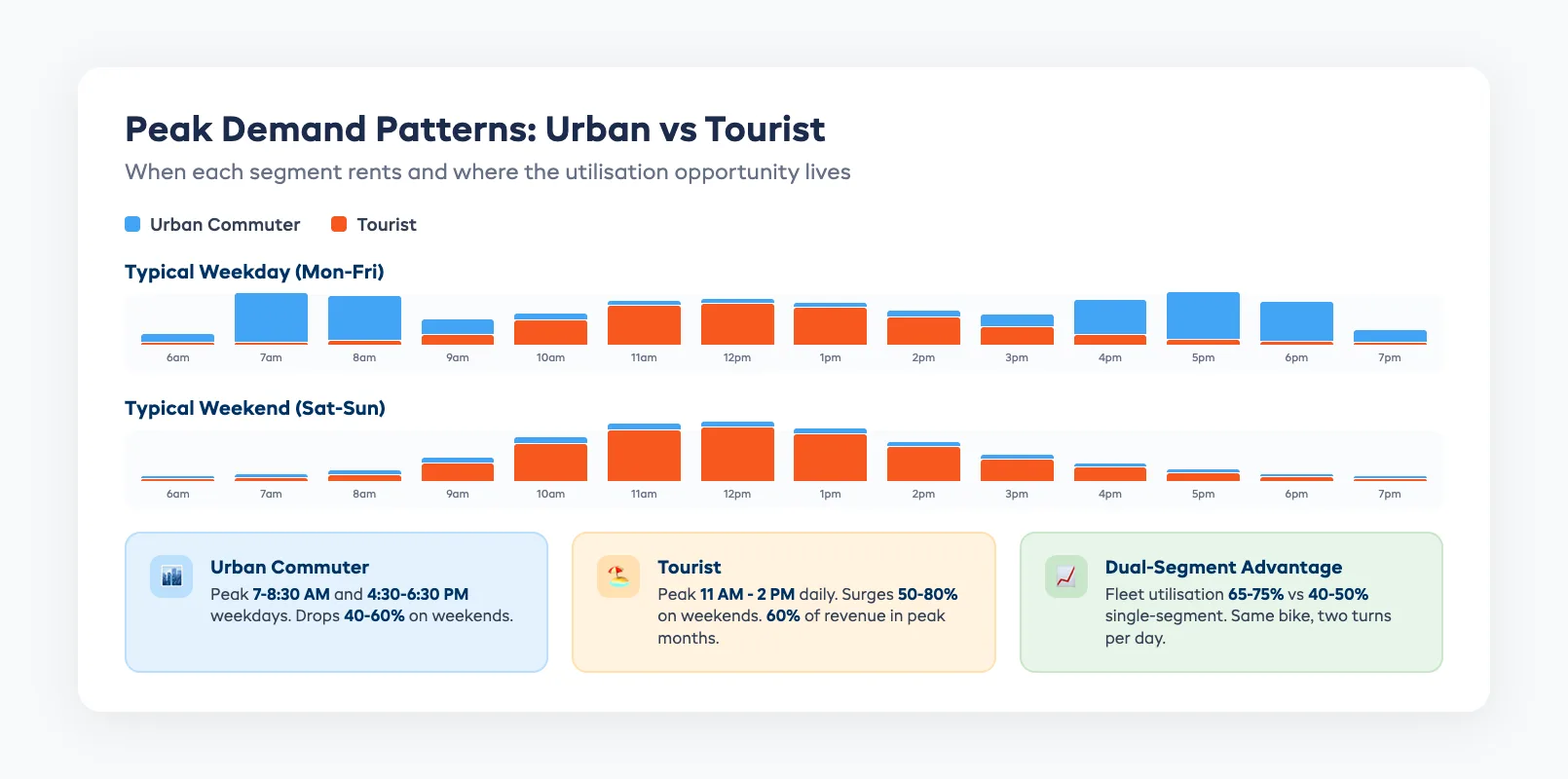
Commuter peaks. Monday to Friday, 6:30-8:30 a.m. and 4:30-6:30 p.m. Sharp spikes, predictable timing. Demand drops to near-zero on weekends. Seasonality is mild — wet-weather days dip 30-40%, but commuters ride year-round.
Tourist peaks. Weekends, school holidays, summer months. Peaks 11:00 a.m.-2:00 p.m. Heavy seasonality: a beach-town shop might do 60% of annual revenue in June-August. Rainy days are near-total write-offs.
The utilization opportunity. A dual-segment shop can push fleet utilization to 65-75% vs 40-50% for single-segment operations. That's the difference between a 14-month and a 9-month payback on each bike.
Staffing implications. Commuter-heavy shops need early-morning staff or self-serve infrastructure. Tourist-heavy shops need midday staff with people skills. Dual-segment shops need a tiered model: lean crew for weekday mornings, full crew for weekend midday rush.
Crossover Strategies
The shops making the most money serve both segments without compromise.
Separate rate cards, same system. Your booking platform should support subscriptions for commuters and day-rate bookings for tourists. The back-end inventory is shared; the front-end experience is different. A commuter logs in and grabs a bike in 30 seconds. A tourist gets a 5-minute guided checkout. Same fleet, different flow.
Convert between segments. A tourist who loved their rental is a potential commuter (or repeat visitor). Capture email at checkout. Send a monthly-pass offer 3 days later. Going the other way: offer commuters a guided weekend ride or bike-and-brunch package. Cross-selling turns a $120/month commuter into a $200/month customer.
Seasonal fleet rotation. In winter, shift tourist bikes to commuter inventory. In summer, move commuter overflow into the tourist pool. Review monthly based on booking patterns — your system should show utilization by bike type and customer segment.
Technology that supports both. Self-serve kiosks for commuters. Tablet-based guided checkout for tourists. Both feed into the same booking system, fleet tracker, and maintenance schedule.
FAQ
Can I run both urban commuter and tourist bike rentals from the same shop?
Yes. Many successful shops serve both segments from one location. The key is separate checkout flows (fast for commuters, guided for tourists), separate pricing (subscriptions vs day rates), and shared back-end systems. A location near both transit and tourist attractions works best.
What's more profitable — urban commuter or tourist bike rental?
Tourist rentals have higher per-transaction margins (day rates of $35-$60 vs commuter effective rates of $5-$8/ride). But commuter rentals generate more consistent year-round revenue. Shops serving both typically achieve 65-75% fleet utilization vs 40-50% for single-segment operations.
How should I price monthly bike rental passes for commuters?
Most urban markets support $89-$149/month for unlimited rides on standard bikes. E-bike monthly passes run $129-$199/month. Price below the cost of 15-16 daily rides at your tourist rate — that's the breakeven point where the subscription feels like a deal to the commuter.
What bikes work best for both commuters and tourists?
A hybrid with step-through frame, 7-speed internal hub gearing, puncture-resistant tires, front basket, and disc brakes covers both segments. You'll compromise on speed (commuters prefer lighter bikes) and comfort (tourists prefer wider saddles), but it reduces fleet complexity significantly.
How do I handle peak demand when commuter and tourist hours overlap?
Overlap is rare — commuter peaks are weekday mornings (6:30-8:30 a.m.) while tourist peaks are midday weekends (11 a.m.-2 p.m.). The real challenge is having enough bikes available for Saturday morning tourists after Friday commuter returns. Schedule Friday evening maintenance checks to ensure full fleet availability Saturday morning.
Should I offer e-bikes to both commuters and tourists?
Yes. Commuters use e-bikes for longer commutes and hilly routes. Tourists use them for comfort and range. A mid-range city e-bike with 60+ km range serves both segments. The main operational difference is charging logistics — commuter e-bikes charge overnight, tourist e-bikes need midday top-ups between half-day blocks.
Wrapping Up
Urban commuter and tourist bike rental look like the same business from the outside. But the customer motivations, pricing levers, and peak demand windows are fundamentally different.
The shops that thrive build systems flexible enough to serve both — separate rate cards, separate checkout flows, shared fleet and back-end. A commuter filling your weekday mornings and a tourist filling your weekend afternoons means higher utilization, steadier cash flow, and less seasonal vulnerability.
Start by identifying which segment drives your current revenue. Build out the weaker segment with targeted pricing and marketing. For tour-specific revenue strategies, see our bike tour operator revenue playbook. For fleet maintenance, check our bike fleet maintenance guide.
in one place