How to Run a Ticketed Attraction: The Complete Operator's Guide (2026)
Running a ticketed attraction looks simple from the outside: open the doors, sell admission, count the takings. Anyone who has actually done it knows better. You are juggling timed capacity, safety law, seasonal staff, weather, refunds, and a tech stack that has to hold up on your busiest Saturday of the year. Get one piece wrong and the whole day wobbles — overcrowded queues, a failed inspection, a payment outage at the gate.
This guide is the operator's view of running an attraction in 2026. It covers the main attraction types and what each one demands, the licensing and safety work you can't skip, how to plan capacity so you sell out without overcrowding, staffing and pricing that actually hold up, the revenue levers beyond the ticket, and the tech stack that ties it together. Whether you run a museum, an aerial park, an escape room, a zoo, or a haunted house, the operating fundamentals rhyme.
In this guide:
- Attraction Types and What Each One Demands
- Licensing, Insurance, and Compliance
- Capacity Planning and Time-Slot Ticketing
- Staffing the Operation
- Pricing and Ticketing
- Revenue Optimization Beyond the Ticket
- The Attraction Tech Stack
- A Practical Launch Sequence
- FAQ
Attraction Types and What Each One Demands
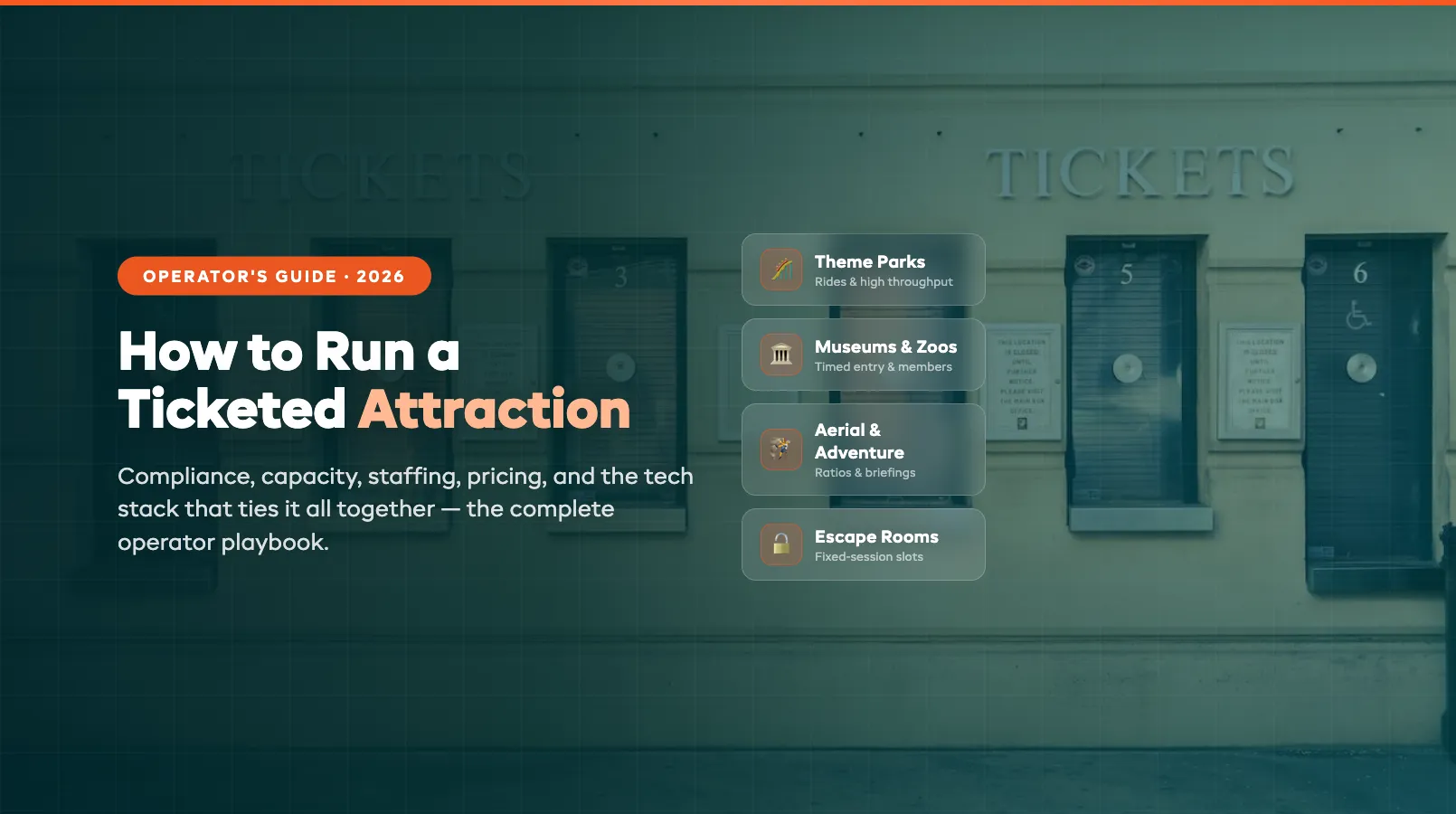
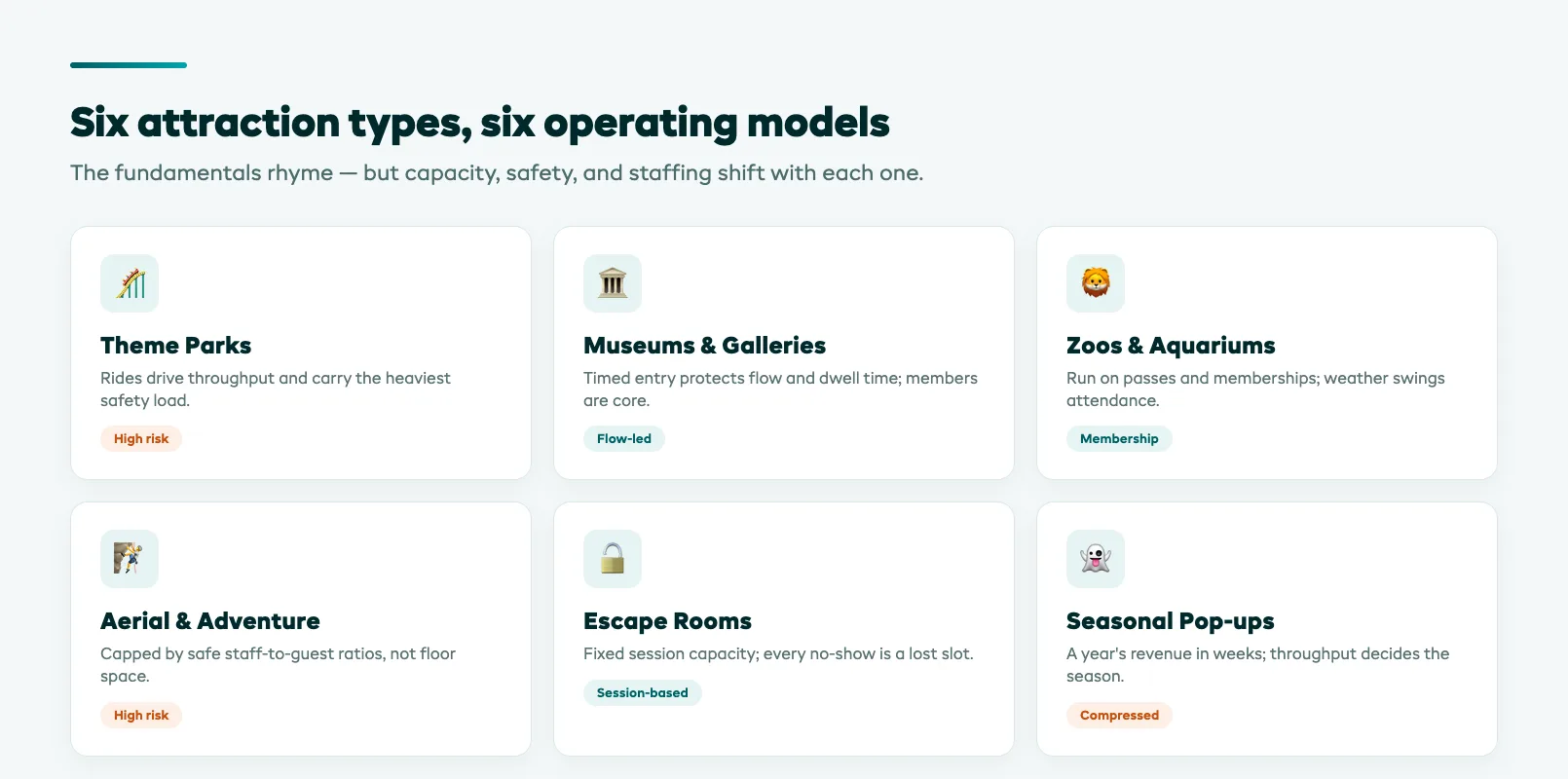
"Attraction" covers a wide range of businesses, and the operating model shifts with each one. Before you copy another operator's playbook, be clear about which kind of attraction you actually run — because capacity, safety, and staffing all flow from that.
Theme parks and amusement attractions. Rides are the draw and the risk. You carry the heaviest compliance load: daily ride inspections, lockout/tagout procedures, operator certification, and tight incident-reporting rules. Capacity is huge and uneven — throughput per ride drives the whole guest experience. Staffing is large and seasonal.
Museums, science centers, and galleries. Lower physical risk, higher emphasiz on flow and dwell time. Timed entry keeps galleries from clogging. Memberships and school groups are core revenue. The job is moving people through a space comfortably while protecting the exhibits.
Zoos, aquariums, and wildlife parks. Animal welfare and guest safety sit alongside ticketing. You run on memberships and season passes more than one-off visits, so renewal economics matter as much as gate sales. Weather swings attendance hard.
Aerial parks, climbing, and adventure attractions. High physical risk, mandatory safety briefings, harness checks, and strict staff-to-guest ratios. Capacity is gated by how many people your instructors can safely supervise at once, not by floor space.
Escape rooms and experience centers. Small, fixed capacity per session and a hard reset between groups. Revenue per square meter is high, but every no-show or late group costs you a slot you can't resell. Scheduling discipline is everything.
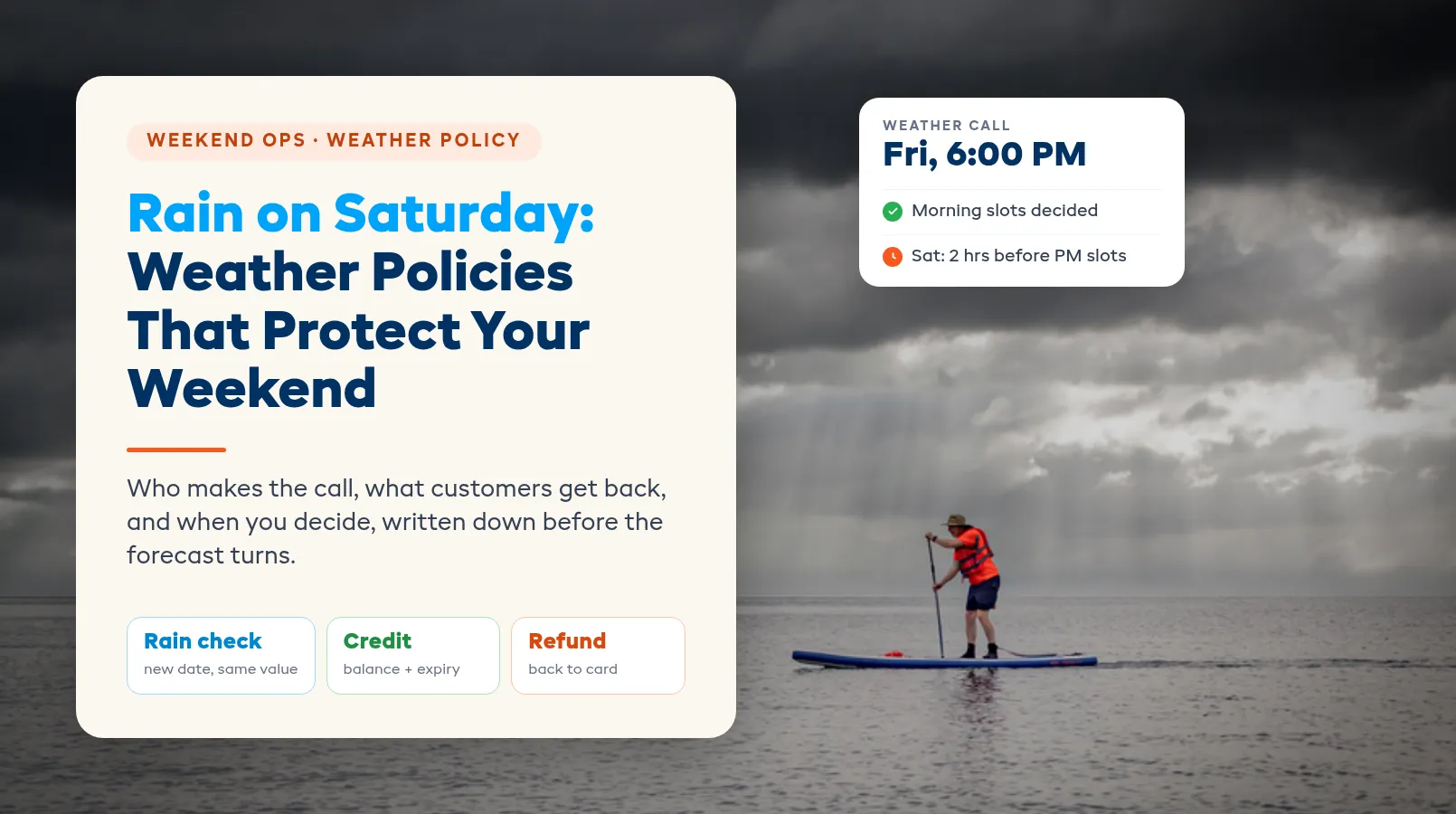
Haunted attractions and seasonal pop-ups. Compressed seasons mean you earn a year's revenue in weeks. Throughput, timed entry, and weather contingencies decide whether the season works. There's little room to recover a lost weekend.
Most of what follows applies across all of these. Where it matters, we'll flag where high-risk attractions need more. For shared definitions of the terms used throughout, keep our attractions glossary open in another tab.
Licensing, Insurance, and Compliance
Compliance is the part operators most want to skip and least can afford to. The exact requirements depend on your country, state, and attraction type, but the categories are consistent.
Business and operating permits. You'll need standard business registration plus any local operating permit for a public venue — occupancy certificates, fire safety approval, and food-service licensing if you sell food. Public-assembly venues usually have a posted maximum occupancy you are legally bound to respect.
Ride and equipment certification. If you operate rides, climbing structures, or mechanical equipment, expect mandatory inspection and certification, often annually by a licensed inspector plus daily checks by trained staff. Keep the paperwork. Insurers and regulators both ask for it, and "we did the check" without a signed record counts for little.
Safety programs and documentation. A written safety program is no longer optional for higher-risk attractions. That means lockout/tagout procedures for ride maintenance, documented daily inspections, staff training records, and an incident-response plan everyone knows. The point isn't the binder — it's that when something goes wrong, your team acts the same way every time and you can show you took reasonable care.
Insurance. General liability is the baseline. Higher-risk attractions add participant liability, and most carriers want to see your waivers, inspection logs, and training records before they'll quote a fair premium. Good documentation directly lowers your insurance cost.
Waivers and consent. For any attraction with physical risk, a clear digital waiver collected before entry protects you and speeds up the gate. Electronic signatures hold the same legal weight as ink under laws like the U.S. ESIGN Act and equivalents elsewhere, provided the waiver is clearly presented and the guest takes a deliberate action to agree.
Two checklists make this routine rather than stressful: a daily attraction safety inspection your team runs before the gates open, and an incident response protocol so a bad moment doesn't become a worse one. Run them every day, sign them off, and store them where you can find them in seconds.
Capacity Planning and Time-Slot Ticketing
Capacity is where attractions live or die. Sell too few tickets and you leave money on the table. Sell too many and you get overcrowding, long queues, safety risk, and reviews that mention "packed" and "not worth it." The goal is to run as close to your comfortable maximum as you can, all day, without tipping over.
Know your real numbers. Start with three figures: legal maximum occupancy, comfortable capacity (usually 70–85% of legal max, where the experience still feels good), and throughput — how many people clear each ride, room, or zone per hour. Comfortable capacity, not legal max, is your selling target.
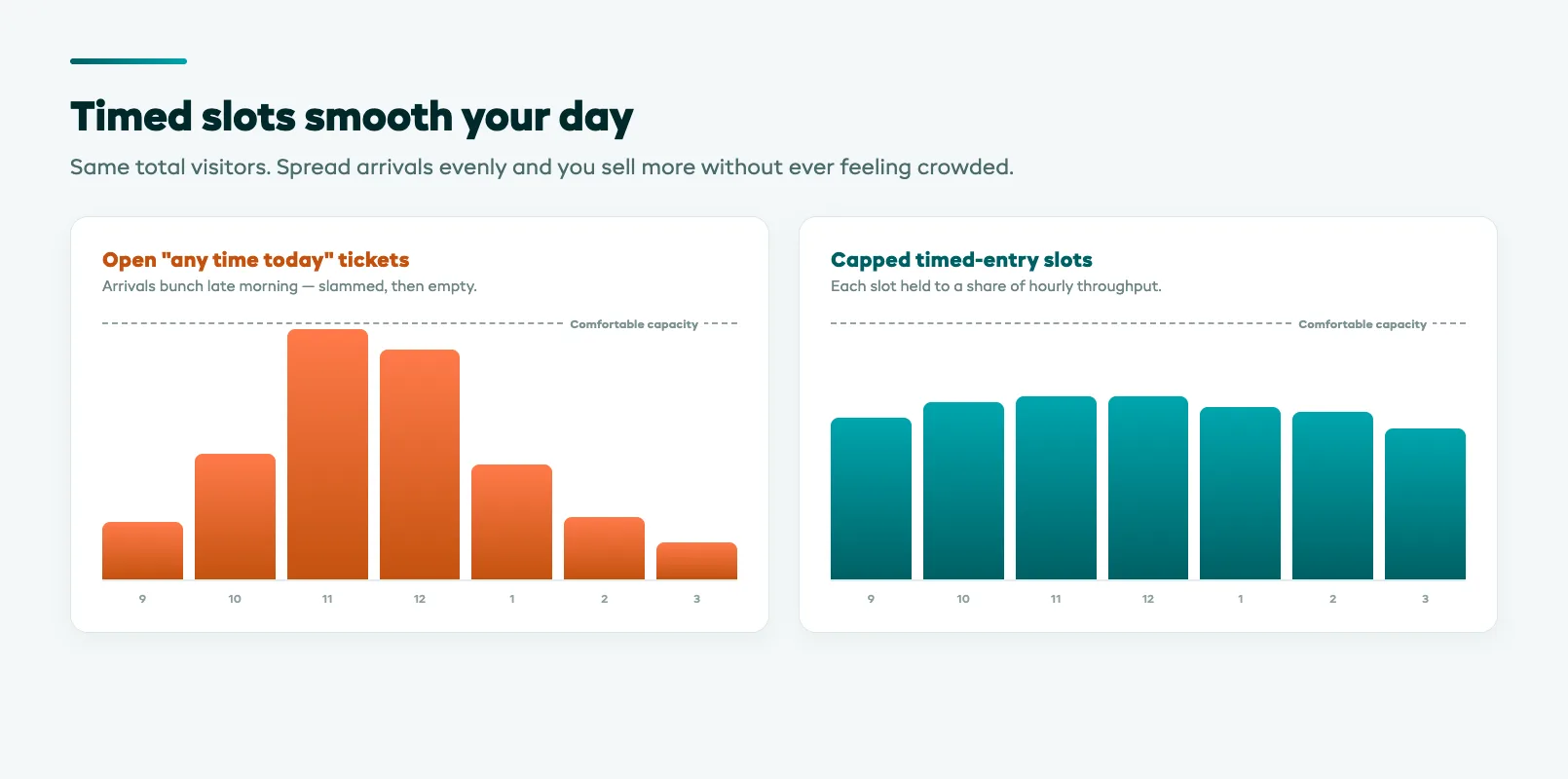
Use timed-entry slots. Selling unlimited "any time today" tickets concentrates arrivals at the gate when people feel like coming — usually late morning — and leaves you overwhelmed at 11am and empty at 3pm. Timed slots spread arrivals evenly. You cap each slot at a share of your hourly throughput and let guests choose a window. Done well, timed entry smooths the day, shortens queues, and lets you sell more total tickets without ever feeling crowded.
Watch utilization in real time. You want a live view of how full each slot and zone is, so a manager can react — open a second entry lane, redirect flow, or release held inventory. Walking the floor with a clipboard worked when you had one attraction. With several zones and online sales updating by the minute, you need the numbers on a screen.
Plan overflow and sell-outs. Decide in advance what happens when a slot sells out: waitlist, next-slot upsell, or a clear "sold out" message that still captures the lead. A sold-out sign that just turns people away wastes a warm customer who would happily have booked tomorrow.
This is a deep topic on its own. Our attraction capacity management checklist turns the steps above into a daily routine, and a capacity alert agent can watch your slots and warn you before a window overfills — so you're managing by exception, not refreshing a dashboard.
Staffing the Operation
Attractions are people businesses, and most run on a seasonal workforce that turns over every year. That makes training systems, not individual stars, the thing that keeps quality steady.
Map your roles. A typical attraction needs gate and ticketing staff, guest-services and floor staff, operations and safety roles (ride operators, lifeguards, instructors), retail and food staff, and a duty manager who owns the day. Write down what each role does before you hire, so training has something to point at.
Train for the booth first. The ticket booth is your first impression and your cash-handling front line. New staff should be confident with the ticketing system, refund and exchange rules, capacity messaging, and the most common guest questions before they ever face a queue. A slow, unsure booth backs up the whole entrance.
Build a repeatable curriculum. Because you re-hire every season, a documented training program — checklists, short videos, a shadow shift, a sign-off — lets you bring a new cohort up to standard fast and the same way every time. Safety-critical roles get formal certification on top.
Schedule to the demand curve, not the clock. Your visitor flow is uneven across the day and the week. Staff your peaks heavily and trim your quiet hours. Use last season's attendance by hour to build the roster, and keep a short on-call list for the days when weather or a school group blows past forecast.
Retain the good ones. Seasonal doesn't have to mean disposable. Returning staff are faster, safer, and cheaper to onboard. Small things — predictable schedules, a returning-staff bonus, a clear path to a lead role — lift your return rate and cut your training load next year.
Pricing and Ticketing
Your ticket price sets your revenue ceiling, but how you structure tickets decides how close you get to it. Flat single-price admission is simple and almost always leaves money on the table.
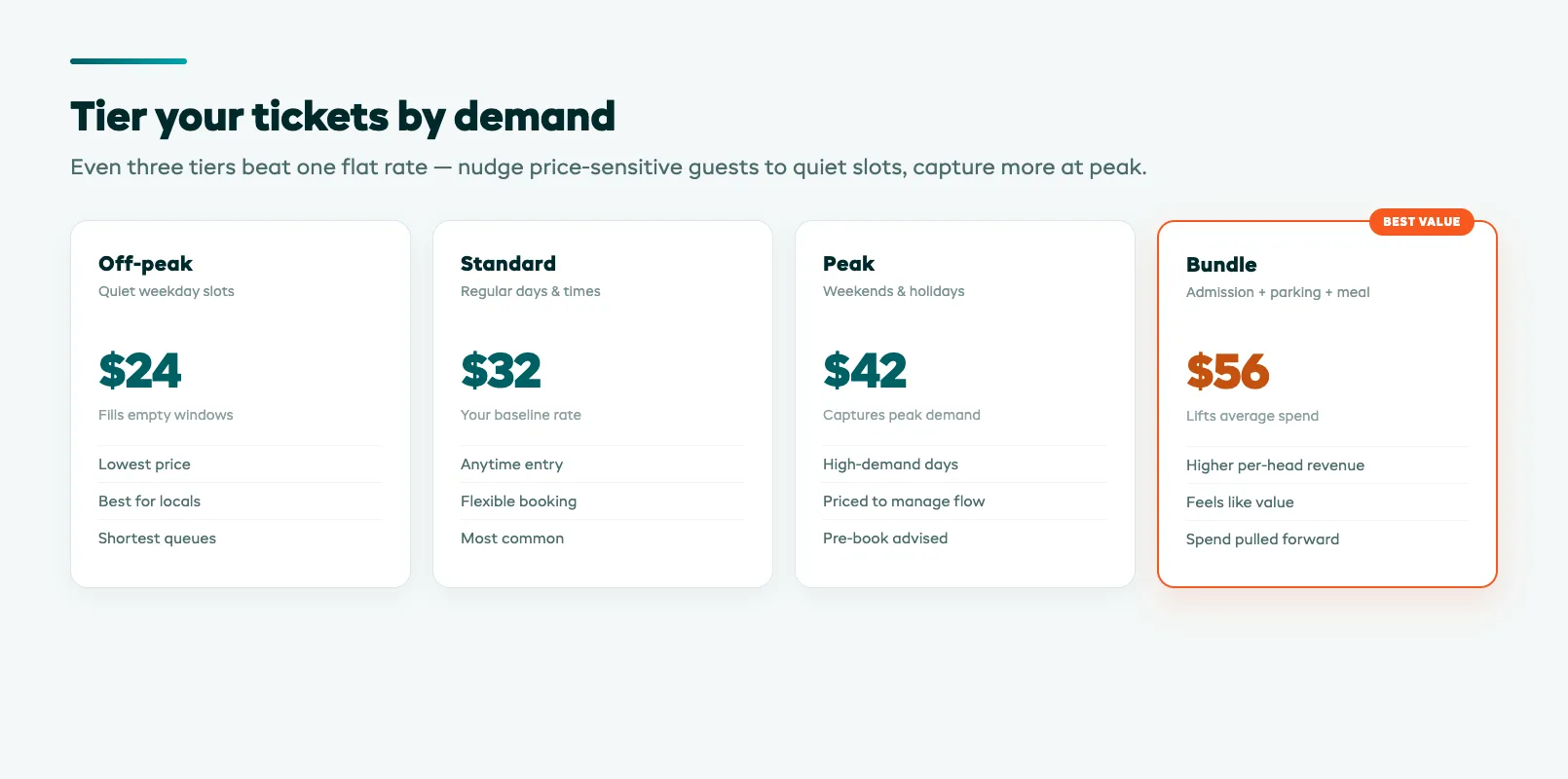
Tier by demand. Peak days (weekends, school holidays, the haunted-house season) should cost more than quiet Tuesdays. Demand-based pricing nudges price-sensitive guests toward your empty slots and captures more from peak visitors who'll pay regardless. Even two or three tiers — off-peak, standard, peak — beats one flat rate.
Sell the bundle. Admission plus parking, admission plus a meal, admission plus a souvenir — bundles raise the average transaction and feel like value to the guest. They also pull spending forward to the point of booking, before the guest is distracted on-site.
Reward booking ahead. A small online-advance discount does two valuable things: it pulls revenue forward and it gives you a demand signal for staffing and capacity. Guests who book ahead are also far less likely to no-show than walk-ups who change their mind.
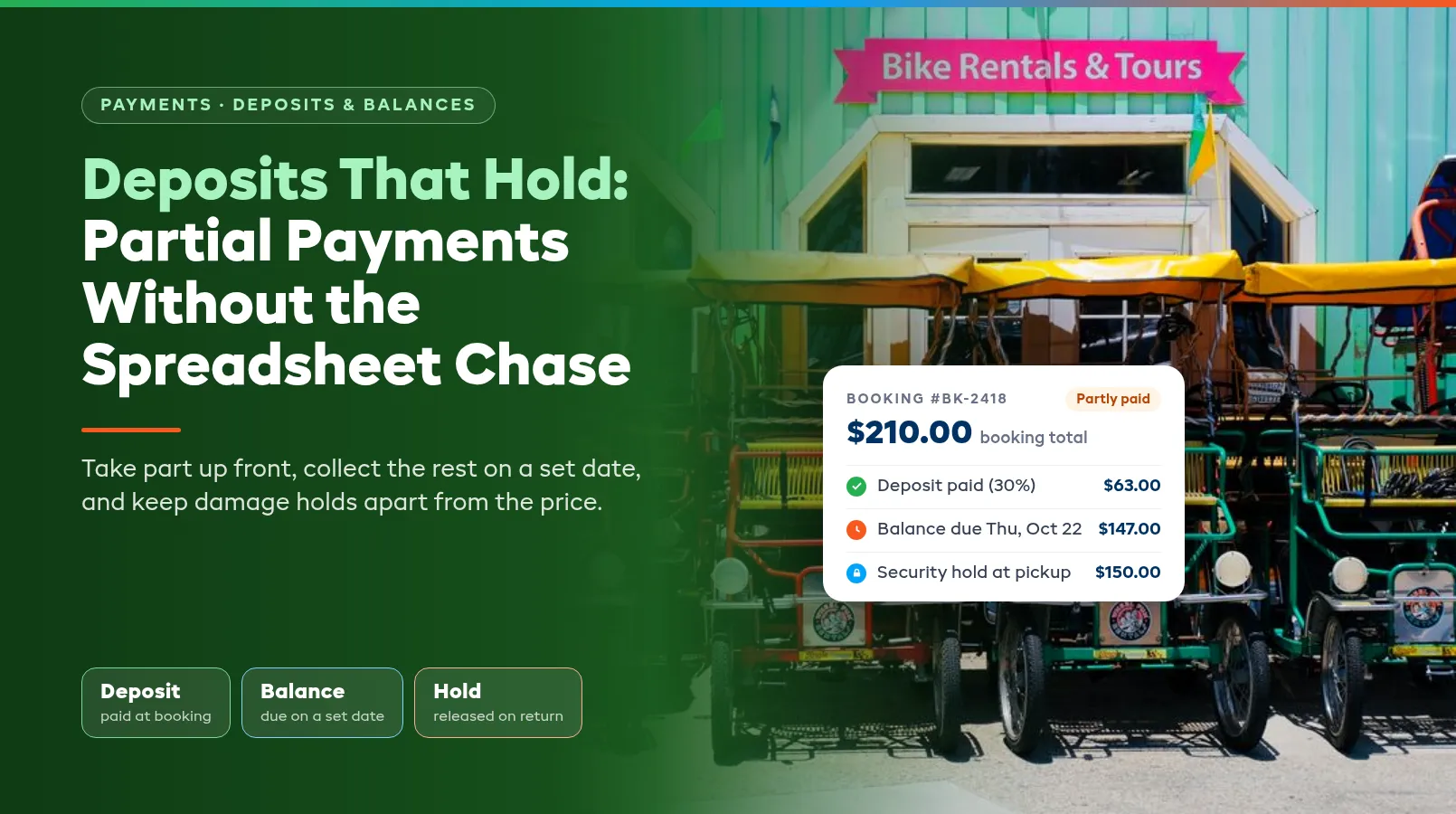
Make group and member pricing deliberate. Schools, tour groups, and corporate events fill your quiet midweek slots — price them to win that business without cannibalising peak weekends. Memberships and season passes trade a lower per-visit price for guaranteed cash up front and repeat visits. For attractions with strong repeat demand, that recurring revenue is the most stable money you have.
Keep checkout clean. However you price, the booking flow has to be fast on a phone, show real-time availability, and take payment without surprise fees at the end. Every extra step and every surprise charge costs you conversions — most of them after the guest has already decided to come.
Revenue Optimization Beyond the Ticket
The strongest attractions treat admission as the entry point, not the whole business. Two attractions with identical gate numbers can have very different bottom lines depending on what happens after the guest walks in.
Grow secondary spend. Food and beverage, retail, photos, lockers, premium experiences, and skip-the-line upgrades all add to per-guest revenue without adding a single visitor. A guest already inside and enjoying themselves is your easiest sale. Many mature attractions earn as much per head inside the gates as they do at them.
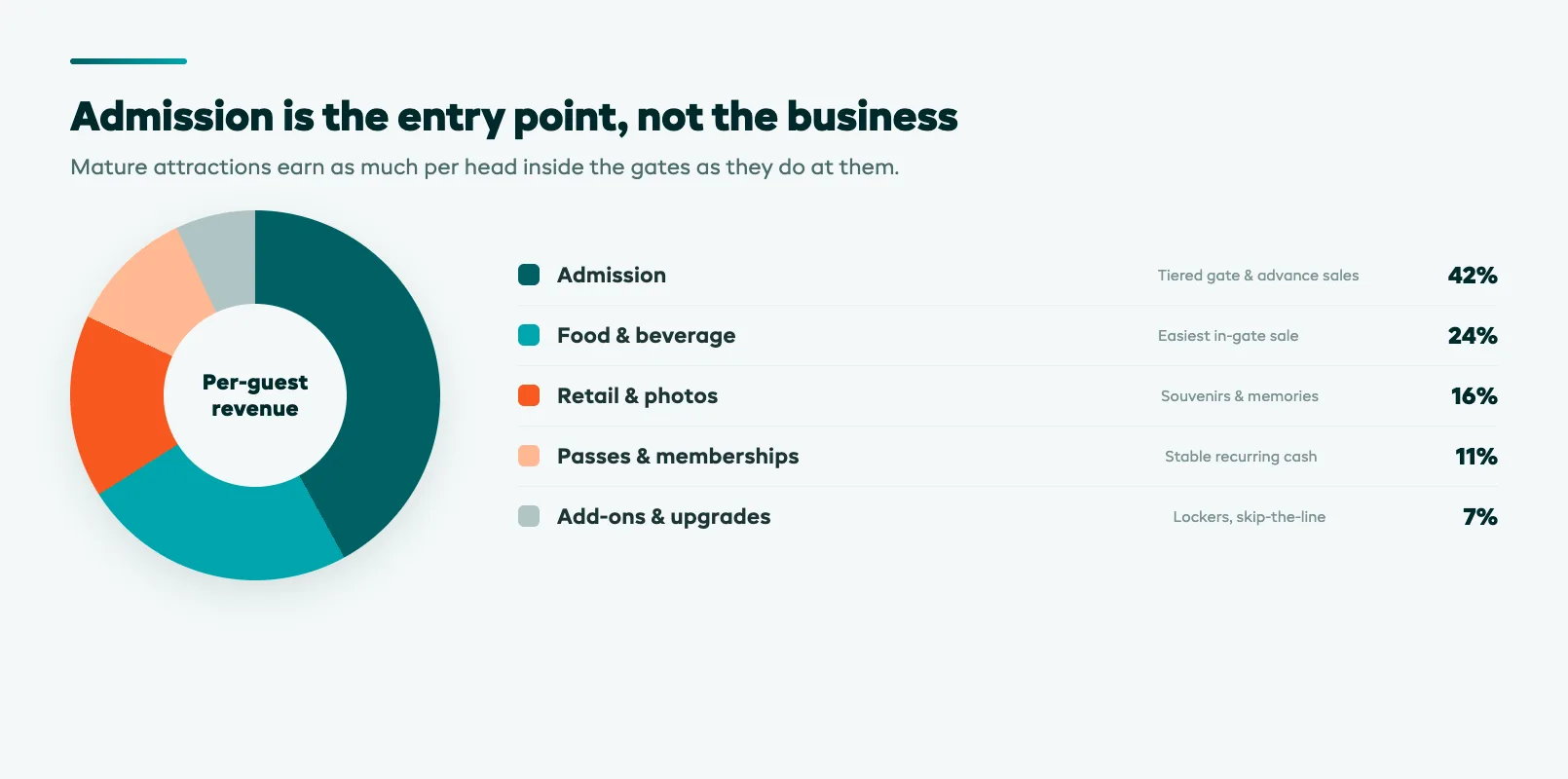
Build recurring revenue. Season passes and memberships smooth your cash flow and lift lifetime value. A pass holder visits more often, brings friends, and spends inside on each visit. Design the renewal from day one — the program only works if passes actually renew, which comes down to perks people use and timely reminders before expiry.
Distribute without losing the customer. Online travel agencies (OTAs) like Viator, GetYourGuide, and Klook put you in front of travelers you'd never reach, especially international ones. They also charge commission and own the customer relationship. The right move is a deliberate mix: use OTAs to fill capacity and reach new audiences, while steering repeat and local guests to your own direct channel where the margin and the data stay with you. Our guide to OTA distribution for attractions breaks down the commission math, the ranking factors, and how to protect that direct channel.
Recover lost bookings. Abandoned carts, no-shows, and lapsed members are revenue you've already half-earned. A simple, polite nudge — finish your booking, your pass is expiring, we missed you — recovers a meaningful slice with almost no cost. This is exactly the kind of repetitive follow-up that's easy to automate and easy to neglect.
The Attraction Tech Stack
The right tools turn all of the above from a daily scramble into a system. The wrong ones — or six disconnected ones — create the scramble. Most attractions stitch together a booking tool, a separate point of sale, a spreadsheet for capacity, another for staff, and a waiver app that doesn't talk to any of them. Every gap is a place for double-bookings, miscounts, and manual reconciliation.
What an attraction tech stack needs to cover:
- Online ticketing with timed slots and real-time availability, fast on mobile, with clean checkout.
- Capacity management that enforces your slot caps and shows live utilization across zones.
- Point of sale at the gate and on-site, sharing the same inventory and customer records as your online sales.
- Digital waivers collected before entry and stored against the booking.
- Staff scheduling built off your demand curve.
- Memberships and season passes with automated renewals.
- Reporting that shows attendance, revenue mix, and utilization without you building it by hand.
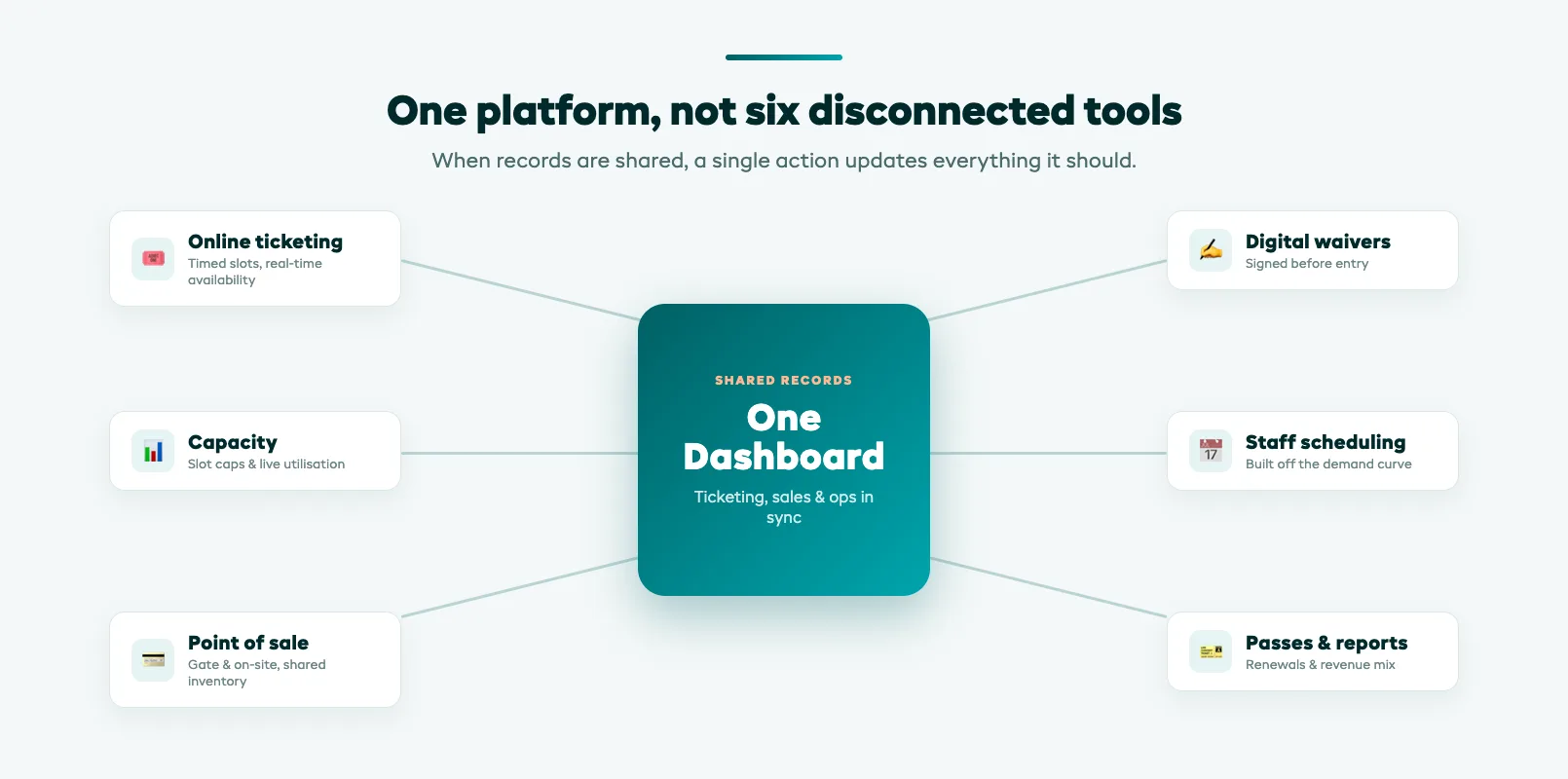
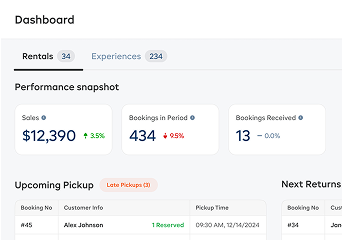
The case for consolidation is straightforward: when ticketing, POS, capacity, waivers, and reporting share one set of records, a sale at the gate updates capacity instantly, a waiver attaches itself to the right booking, and your end-of-day numbers are already done. EquipDash brings these into one dashboard built for attractions and tour operators, with a built-in AI assistant (Dash AI) that handles routine jobs like booking confirmations, waiver chasing, capacity alerts, and renewal reminders. Whatever platform you choose, the test is the same — does a single action update everything it should, or do you re-key it into the next tool?
A Practical Launch Sequence
If you're opening a new attraction or rebuilding your operation, work in this order rather than trying to do everything at once:
- Lock down compliance. Permits, occupancy limits, insurance, safety program, and waivers come before you sell a single ticket.
- Set your capacity model. Define legal max, comfortable capacity, and throughput, then design your timed slots around them.
- Choose your tech stack. Pick tools that share data — ideally one platform — so ticketing, POS, capacity, and waivers stay in sync from day one.
- Build pricing and ticketing. Set your tiers, bundles, advance discount, and group and member options.
- Hire and train. Document roles, train the booth first, and certify safety-critical staff.
- Run your opening-day checklist. Walk the opening day checklist before the gates open so nothing gets missed in the rush.
- Measure and adjust. After each week, review attendance by slot, revenue mix, and utilization, and tune pricing, staffing, and capacity for the next one.
Running an attraction well is a thousand small decisions made consistently, day after day, season after season. The operators who thrive aren't the ones with the flashiest ride — they're the ones whose compliance is tight, whose capacity is full but never crowded, whose staff know exactly what to do, and whose systems do the busywork so the team can focus on guests. Get the fundamentals in this guide right, and the rest gets a lot easier.
FAQ
What licenses do I need to run a ticketed attraction?
At minimum you need standard business registration plus a local operating permit for a public venue — usually an occupancy certificate and fire-safety approval, and a food-service license if you sell food. Attractions with rides, climbing structures, or mechanical equipment add mandatory inspection and certification on top, often annually by a licensed inspector plus daily checks by trained staff. Requirements vary by country and state, so confirm with your local authority before opening.
How do I stop my attraction from getting overcrowded?
Sell to your comfortable capacity (typically 70–85% of legal maximum), not your legal maximum, and use timed-entry slots so arrivals spread evenly across the day instead of bunching at late morning. Cap each slot at a share of your hourly throughput, watch utilization in real time, and have an overflow plan for sell-outs. Done well, timed entry actually lets you sell more total tickets while feeling less crowded.
Should I use timed-entry ticketing?
For almost every attraction, yes. Open "any time today" tickets concentrate arrivals when guests feel like coming, leaving you slammed at peak and empty later. Timed slots smooth the flow, shorten queues, improve the guest experience, and help you fill quiet windows. Escape rooms and aerial parks essentially require slot-based booking; museums, parks, and zoos all benefit from it.
How should I price attraction tickets?
Avoid a single flat rate. Tier by demand so peak days cost more than quiet ones, offer a small discount for booking online in advance, and bundle admission with parking, food, or retail to lift the average transaction. Add deliberate group and member pricing to fill midweek slots and build recurring revenue. Even moving from one flat price to three tiers usually raises total revenue.
How do attractions make money beyond admission?
The strongest attractions earn heavily on secondary spend — food and beverage, retail, photos, lockers, and premium upgrades — often as much per guest inside the gates as at them. Season passes and memberships add stable recurring revenue and repeat visits, while OTAs like Viator and Klook reach new audiences. Recovering abandoned carts, no-shows, and lapsed members captures revenue you've already half-earned.
What software does an attraction need?
You need online ticketing with timed slots and real-time availability, capacity management, a point of sale that shares records with online sales, digital waivers, staff scheduling, memberships and season passes, and reporting. The biggest gain comes from consolidating these into one platform so a single action — a gate sale, a waiver, a refund — updates everything at once, instead of re-keying data across six disconnected tools.
How much staff training does an attraction require?
Because attractions re-hire seasonally, the priority is a repeatable training program rather than relying on experienced individuals. Train ticket-booth staff first on the ticketing system, refund rules, and common questions, then move through guest services, operations, and safety roles. Safety-critical positions (ride operators, instructors, lifeguards) require formal certification. Documented checklists, short videos, a shadow shift, and a sign-off let you bring each new season's cohort up to standard quickly and consistently.
in one place