AI Demand Forecasting for Tour Operators: Plan Guides, Gear, and Marketing Before the Rush
Every tour operator knows the season has a shape. Spring is quiet, summer is chaos, the shoulder weeks are a coin toss. But knowing the shape and knowing next Thursday are two different things. Most operators plan the week ahead off how last week went, plus a gut feel for the calendar, and that gut feel is right often enough to be dangerous. It's wrong on exactly the days that hurt: the surprise sell-out where you were two guides short, and the dead Tuesday where you rostered four people for six guests.
AI demand forecasting closes that gap. Instead of guessing, it reads everything that predicts how busy you'll be (your own booking history, the day of week, the season, local events, school holidays, the weather forecast) and turns it into a number you can actually staff and stock against. This guide covers what it forecasts, how to use it for rostering and gear and marketing, and what a real first season looks like. For the wider picture of how these tools are reshaping tour operations, start with our AI for tour operators guide.
Why Tour Operators Get Caught Off Guard
The problem isn't that operators are careless. It's that the signals are scattered and the lead times are long. By the time the bookings make it obvious you're going to have a huge weekend, it's Wednesday, your best guide is already booked on a private charter, and the wetsuit sizes you actually need are at the dry cleaner. The information existed. It just arrived too late to act on.
Forecasting off last week is the core trap. Demand doesn't move in a straight line; it jumps on long weekends, dips when it rains, and spikes around an event you forgot was in town. A flat "next week looks like this week" assumption misses every one of those, and the misses are expensive in both directions. Understaffing a busy day means rushed trips, bad reviews, and money turned away. Overstaffing a quiet one means you paid four guides to stand around.
The cost of being wrong isn't symmetric, either, which makes the guessing worse. A no-show guide on a packed day can cost you a whole departure; an extra guide on a slow day costs you a few hours of wages. Operators tend to over-correct toward overstaffing to avoid the nightmare scenario, and quietly bleed margin all season doing it.
What AI Uses to Forecast Tour Demand
A forecast is only as good as the signals feeding it, and the useful thing is that you're already sitting on most of them. Your booking system holds years of history: which trips filled, how far ahead they booked, how weather and season moved the numbers. That history is the backbone. AI is simply much better than a human at spotting the patterns buried in it: the fact that your 7am sunrise paddle always books out 11 days ahead, or that a warm forecast lifts walk-up demand by a third.
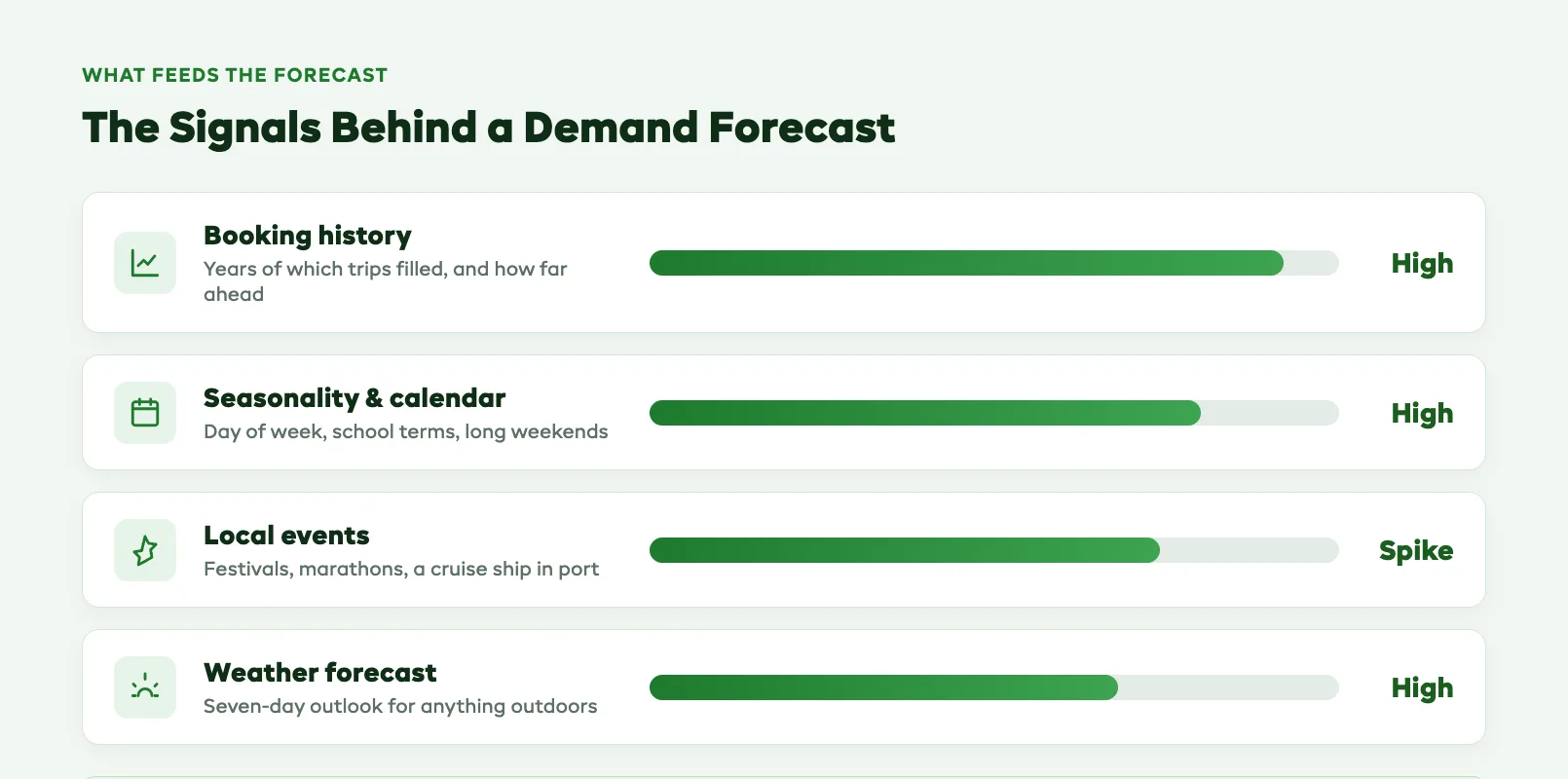
On top of your own data, a good forecast layers in the outside world. The calendar matters enormously: day of week, public holidays, school terms, and the long weekends that turn a normal Saturday into a three-day rush. Local events are the wildcard that catches operators out most: a festival, a marathon, or a cruise ship in port can double demand overnight, and a model that watches the events calendar sees it coming. Weather is the last big input. For anything outdoors, the seven-day forecast is one of the strongest predictors you have, and it's the one operators most often check too late.
None of this requires you to become a data scientist. The job of the software is to take those inputs and hand you a plain-language read: expect roughly this many bookings on this departure, with this much confidence. You stay in charge of what to do about it.
Guide Scheduling Based on Predictions
The first place a forecast pays for itself is the roster. Once you have a credible bookings number for two or three weeks out, guide scheduling stops being a guess and becomes arithmetic: predicted guests, divided by your guests-per-guide ratio, equals heads needed on each departure. You roster to the forecast instead of to your nerves.
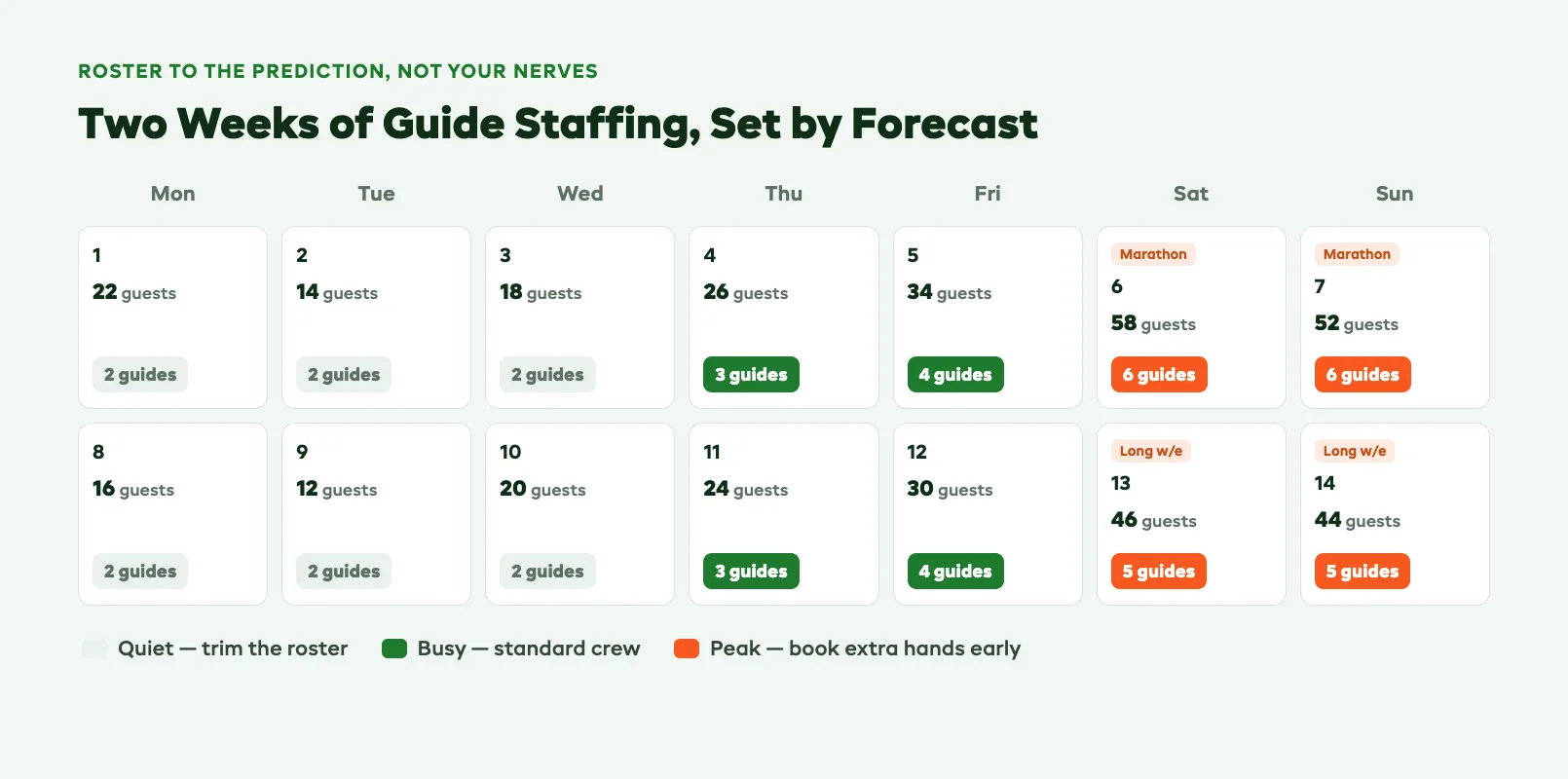
That lead time is the real prize. Knowing on the 1st that the 14th will be slammed means you can offer the shift to your best people while they're still free, line up a casual before the agency rates climb, and avoid the Wednesday-night scramble of texting everyone you know. It works the other side too: a forecast that flags a soft week lets you trim the roster early, give people the time off they wanted, and protect your wage line without anyone standing idle. Pair the forecast with an AI scheduling assistant and the first draft of the roster can build itself, leaving you to approve rather than assemble it.
Marketing Spend Allocation
Forecasting doesn't just tell you when you'll be busy. It tells you when you won't be, which is exactly when marketing earns its keep. There's no point spending to promote a departure that's already going to sell out; that budget is lit on fire. The departures worth promoting are the ones the forecast says will run half empty, and a demand model points your spend straight at them.
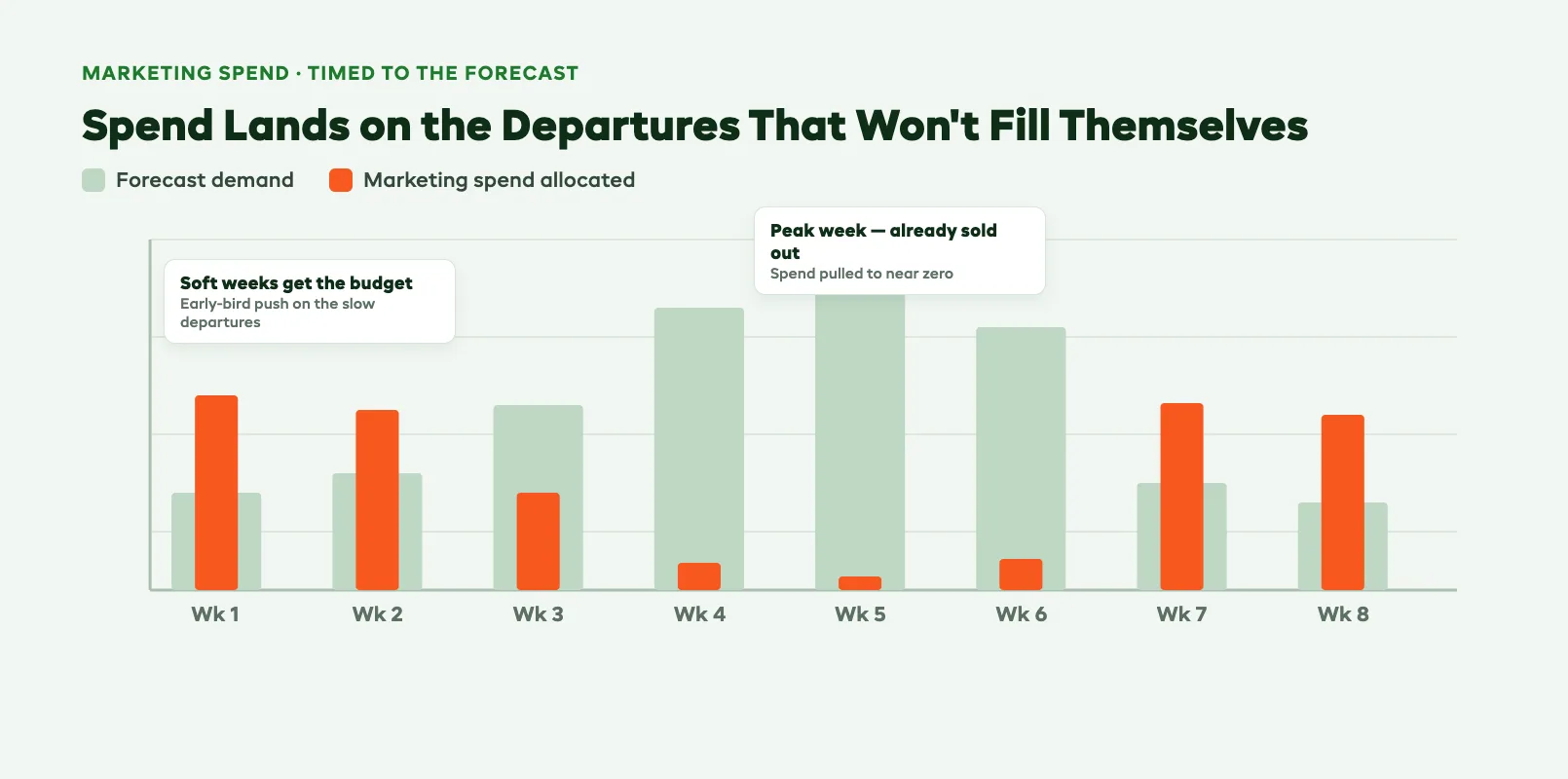
This flips the usual habit. Most operators market hardest in peak season because that's when they're thinking about it, which is precisely when they need it least. A forecast lets you pull spend forward into the soft weeks and the under-booked slots (early-bird pushes on the quiet Tuesdays, a last-minute offer on a departure the model says is lagging) so every marketing dollar lands on a seat that wasn't going to fill on its own. The same logic underpins our guide to AI booking optimization for tours, which covers how to convert that demand once you've created it.
Event and Holiday Forecasting
The single biggest forecasting win for most operators is getting the spikes right, and the spikes almost always trace back to the calendar. Public holidays, school breaks, and long weekends are predictable months out, yet they're the days operators most often under-prepare for, because "I know it's a long weekend" is not the same as "I've rostered for 40% more guests and ordered the extra gear."
Local events are the harder, higher-value half. A model watching the events calendar can warn you that the city marathon, the food festival, or a docked cruise ship is about to flood your booking page weeks before it happens: long enough to lift your guide count, extend your hours, and brief your team. The flip side counts too: a major event can pull your usual customers away from a normal activity, and a forecast that drops for an odd reason is a signal worth trusting rather than overriding. Demand modeling and AI dynamic pricing for tours and activities are natural partners here — the forecast tells you the surge is coming, and dynamic pricing makes sure you capture its full value.
Case Study: A Kayak Tour Company's First AI Season
Consider a small kayak outfit running guided harbor and sunrise tours: six guides in peak, a flat $65 seat, and a season planned entirely off last year's diary and the owner's instinct. Their two recurring pains were textbook: the surprise busy days where they turned guests away for lack of staff, and the over-rostered quiet ones where wages outran revenue.
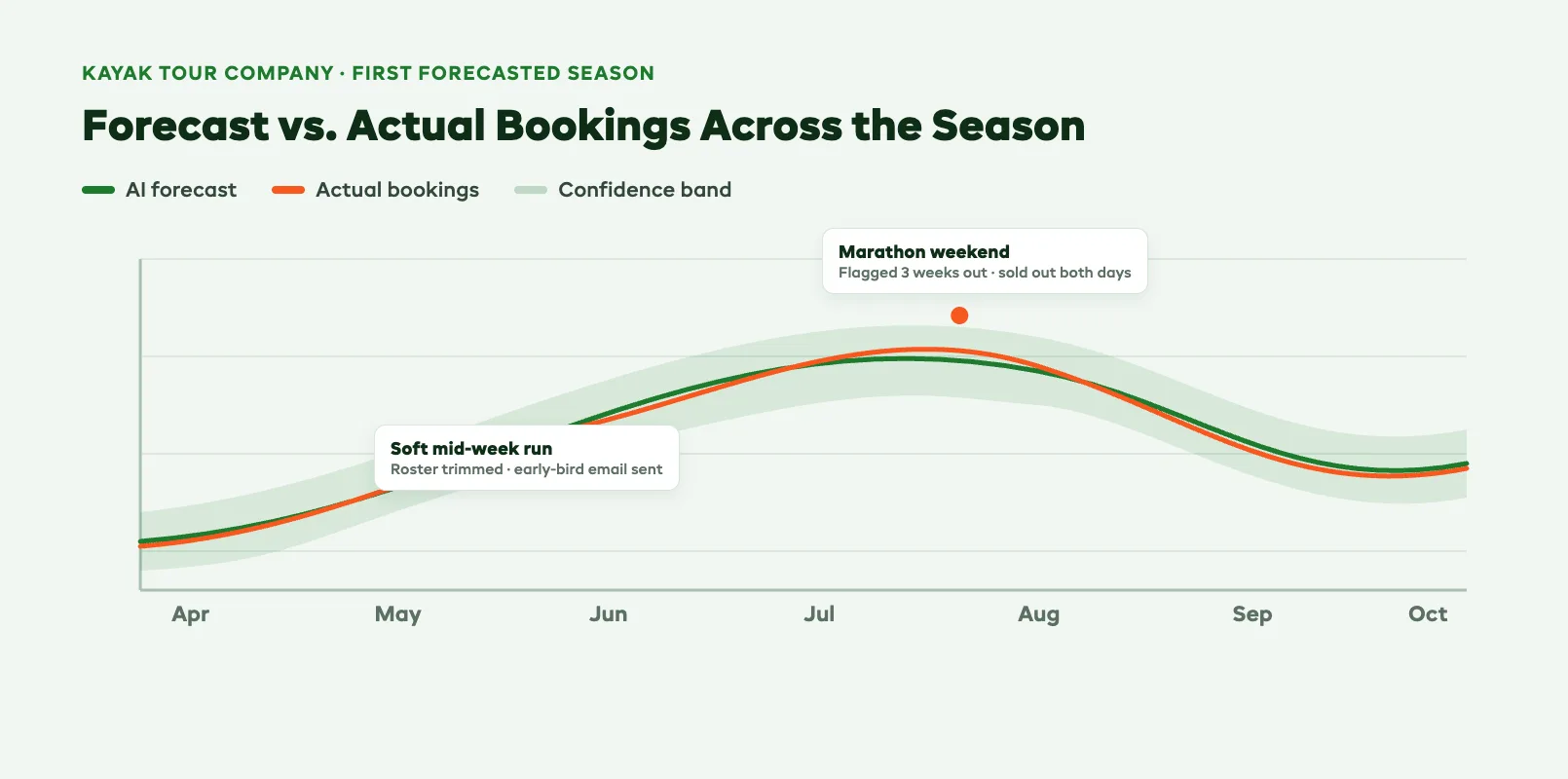
In their first forecasted season, the model fed on three years of their own booking history plus the local events and weather feeds. It flagged a marathon weekend three weeks out that the owner had forgotten. They rostered two extra guides and sold out both days instead of capping at half capacity. It also called a run of soft mid-week mornings, so they trimmed the roster and aimed an early-bird email at exactly those slots. The headline wasn't magic; it was fewer surprises. They stopped paying for idle guides on dead days and stopped leaving money on the dock on busy ones: same boats, same guides, planned three weeks ahead instead of three days.
The lesson generalises beyond kayaks. You don't need a huge operation or a data team to forecast; you need a couple of seasons of clean booking history and the discipline to plan off the prediction instead of the panic. The software does the watching. You do the deciding: earlier, and with better information.
FAQ
How much booking history do I need before AI demand forecasting is useful?
Roughly one to two full seasons of clean booking data is enough to start seeing useful patterns, and accuracy improves as more history accumulates. The model leans on seasonality, day-of-week trends, and lead times, so it needs to have "seen" at least one cycle of your year. If you're newer than that, forecasts still help by blending your limited history with calendar and weather signals. They're just less precise until a season or two builds up.
Can a forecast handle a brand-new tour with no history?
Partly. With no history of its own, a new tour can't be forecast from its own numbers, but a good model can borrow from comparable tours you already run (similar duration, season, and audience) and from the calendar and weather signals that apply to any outdoor activity. Treat those early forecasts as a starting estimate with wide error bars, and expect them to sharpen quickly once the new tour has a few dozen real bookings behind it.
How far ahead can it predict accurately?
Useful accuracy usually runs two to four weeks out: far enough to roster guides, order gear, and time a marketing push, which is the window that matters operationally. Beyond a month, seasonal and calendar-level forecasts are still reliable for big-picture planning (you'll know summer will be busy), but day-level precision fades. The closer a departure gets, the tighter the forecast becomes as real bookings and the weather forecast firm up.
Will a forecast account for the weather?
For anything outdoors it should, because weather is one of the strongest short-term predictors of demand. Most forecasting tools pull the seven-day forecast into the model so a rainy Saturday or an unseasonably warm Tuesday adjusts the predicted bookings automatically. Further out than a week, the model falls back on seasonal weather norms rather than a specific forecast, which is part of why precision improves as the date approaches.
Do I have to follow the forecast exactly?
No. A forecast is a decision aid, not an autopilot. It gives you a confident starting number for staffing, gear, and marketing, but you know things the model doesn't: a VIP group, a guide's availability, a one-off local situation. The right way to use it is to plan off the prediction by default and override deliberately when you have information it lacks, rather than guessing from scratch every week.
How is forecasting different from dynamic pricing?
Forecasting predicts how many people will book; dynamic pricing decides what to charge them. They're complementary: the forecast tells you a departure will be in high demand, and dynamic pricing uses that to lift the price and capture the extra value, or to discount a slot the forecast says will run empty. You can run forecasting on its own to plan operations, but pairing it with pricing is where the revenue upside compounds.
in one place