Capacity Management at Scale: Time Slots, Dynamic Pricing, and Anti-Overcrowding
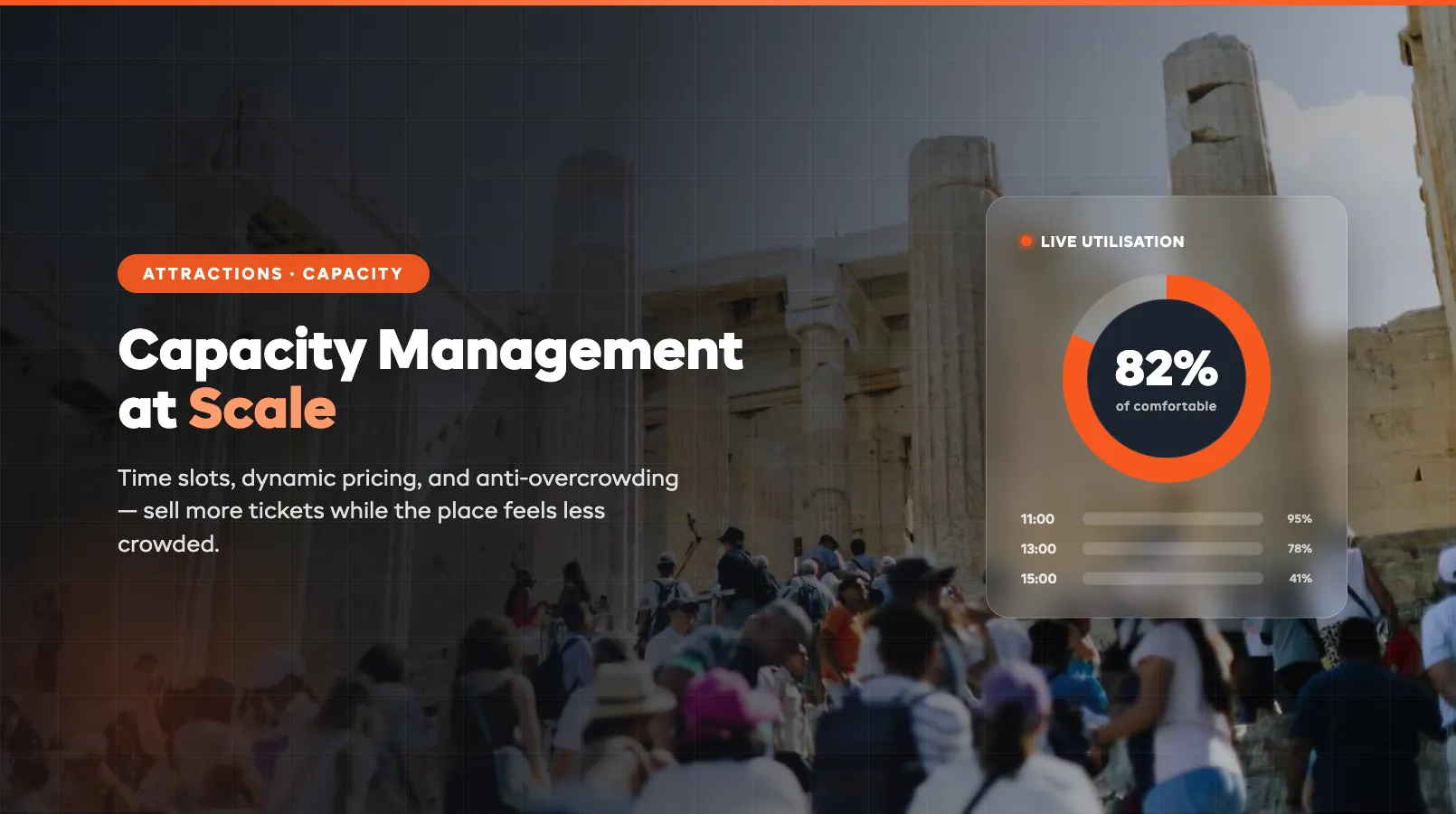
Every attraction operator lives between two bad outcomes. Sell too few tickets and you give away revenue you can never get back — an empty Tuesday is gone forever. Sell too many and you get jammed queues, frustrated guests, a safety risk, and reviews that use the word "packed." Capacity management is the discipline of running as close to your comfortable maximum as you can, all day, every day, without ever tipping over the edge.
The good news: this is one of the most solvable problems in the business. With the right capacity model, timed-entry slots, demand-based pricing, and a live view of how full you are, you can usually sell more total tickets while the place feels less crowded. This guide walks through how to build that system, step by step. It sits under our broader guide to running a ticketed attraction — if you're starting from scratch, read that first, then come back here for the capacity detail.
Start With Your Real Capacity Numbers
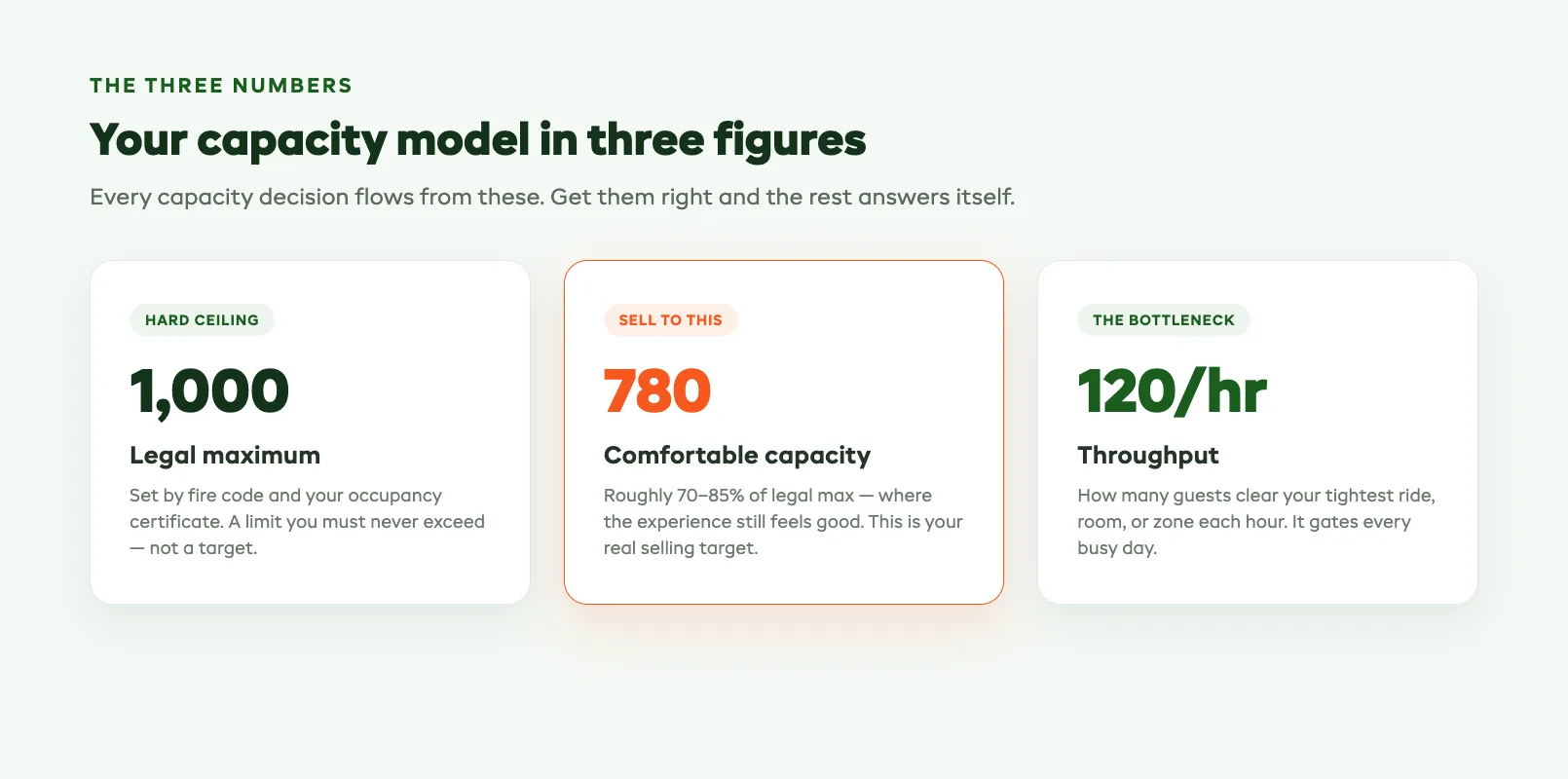
You can't manage capacity you haven't measured. Before you touch a ticketing setting, write down three numbers.
Legal maximum occupancy. The hard ceiling set by fire code, your occupancy certificate, or safety regulation. You are legally bound to respect it. This is a limit, not a target.
Comfortable capacity. The point where the experience still feels good — usually 70–85% of legal max. Past it, queues lengthen, toilets back up, and the day stops feeling fun even though you're technically "allowed" more people. Comfortable capacity, not legal max, is what you actually sell to.
Throughput. How many people clear each ride, room, gallery, or zone per hour. Throughput is what really gates a busy day. A museum with room for 800 people but a café that seats 40 has a café-shaped bottleneck, not a gallery-shaped one. Find your tightest throughput point and plan around it.
Get these three numbers right and most capacity decisions answer themselves. Get them wrong — sell to legal max, ignore throughput — and no clever pricing will save the day. For the shared definitions behind these terms, keep our attractions glossary open in another tab.
Build a Time-Slot Architecture
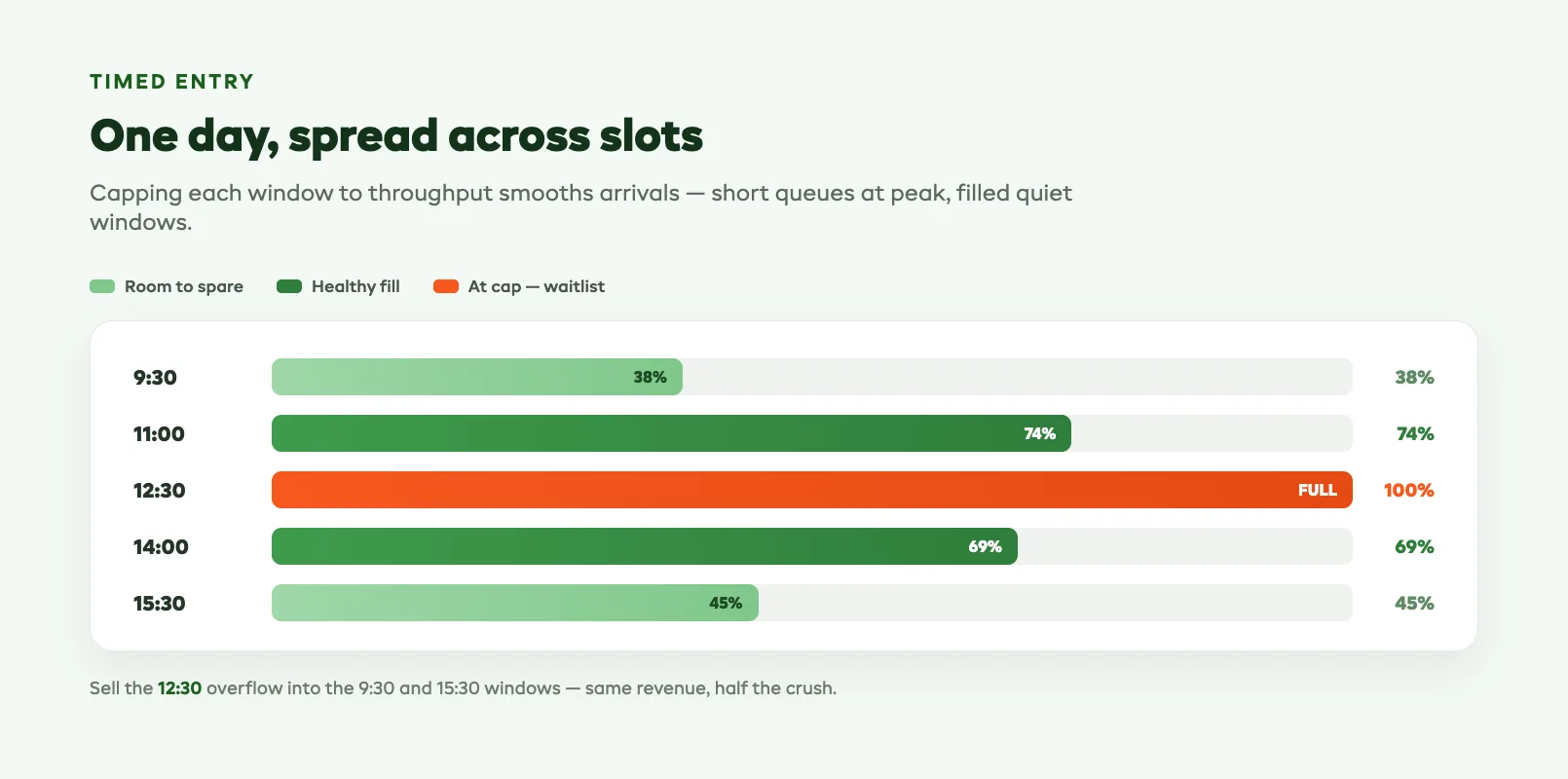
Open "any time today" tickets are the single biggest cause of overcrowding. Guests arrive when they feel like it, which means almost everyone shows up between 10:30 and 1:00. You're slammed at peak and empty by four — overcrowded and under-sold on the same day.
Timed-entry ticketing fixes this by spreading arrivals across the day. Instead of selling a flat day pass, you sell entry to a window — 10:00, 10:30, 11:00, and so on — and cap how many tickets each window holds.
Size each slot to your throughput, not your floor space. If your entrance and first zone can comfortably absorb 120 people every 30 minutes, that's your slot cap. Selling 300 into a single slot just rebuilds the bottleneck you were trying to avoid.
Match slot length to dwell time. Escape rooms and aerial parks need slot lengths tied to session duration and reset time. Museums and zoos, where people stay for hours, use rolling entry windows that control the arrival rate rather than the total inside.
Leave deliberate headroom. Don't sell every slot to 100%. Hold a small buffer for walk-ups, members, and group changes so a single coach turning up early doesn't break the morning.
Done well, timed entry feels generous to guests — short queues, room to move — while letting you safely sell more tickets across the full day than an open-door model ever could.
Use Dynamic Pricing as a Capacity Lever
Most operators think of pricing as a revenue tool. It's also one of your best capacity tools. When you price by demand, you nudge guests toward the slots and days you most want to fill — and away from the ones that overflow.
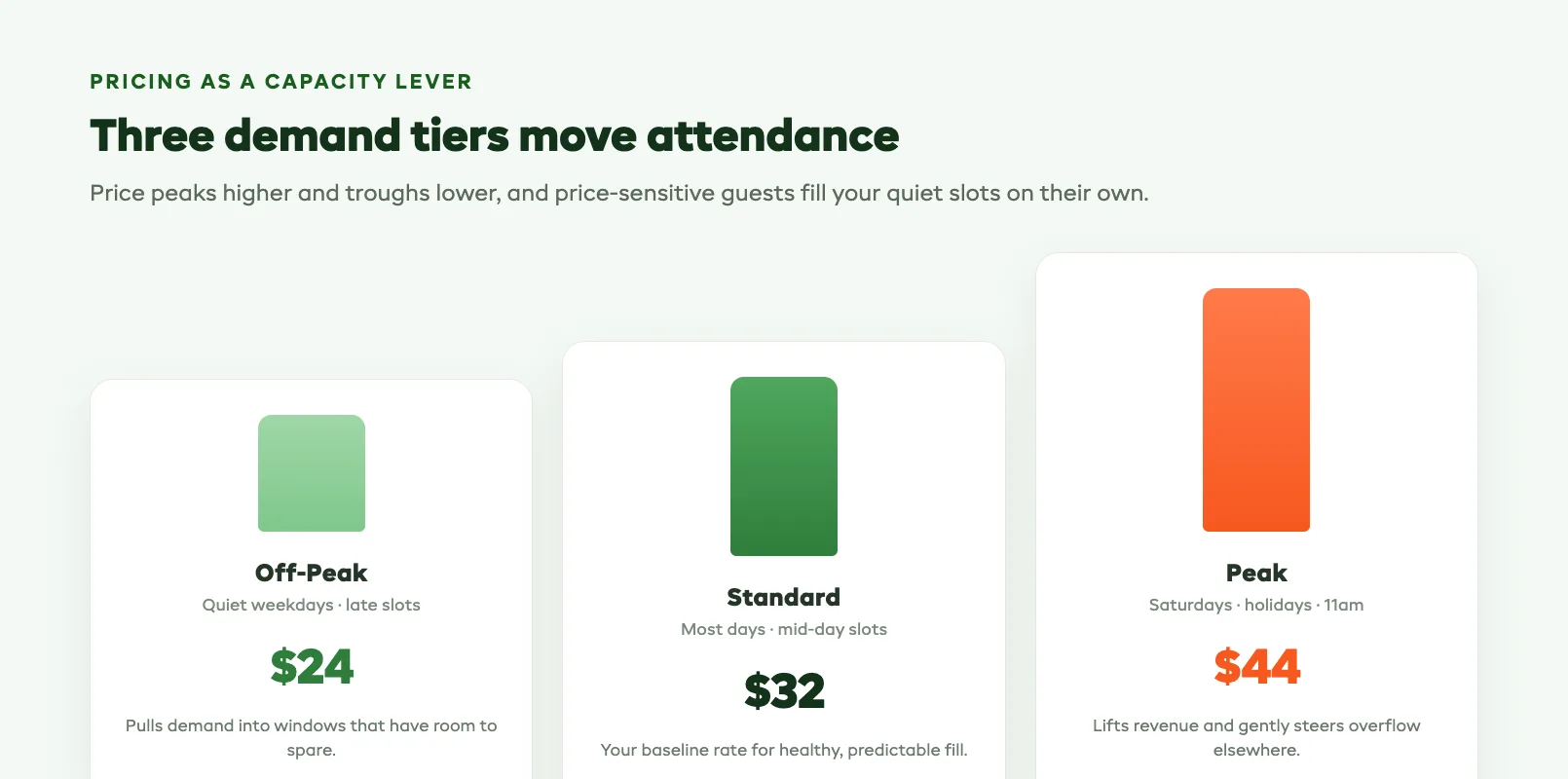
Price peaks higher, troughs lower. A Saturday in July should not cost the same as a wet Wednesday in March. Charging more at peak does two things at once: it lifts revenue on your busiest days and it gently pushes price-sensitive guests toward quieter slots that have room to spare. That's load-balancing your attendance with money instead of apology emails.
Reward advance booking. A small discount for booking online a few days ahead pulls demand out of the unpredictable walk-up pool and into slots you can see and plan for. Known demand is manageable demand.
Tier by slot, not just by day. The 11:00 window selling out while 3:00 sits half-empty is a pricing signal. Make the early peak slots cost a little more and the afternoon ones a little less, and attendance flattens on its own.
You don't need a complex algorithm to start. Even three tiers — off-peak, standard, peak — applied deliberately will move attendance and raise revenue at the same time. Refine from there once you can see how each slot fills.
Watch Utilization in Real Time
A capacity plan you set in the morning and forget is half a plan. Conditions move — a coach cancels, the weather turns, a slot sells out faster than expected — and you need to see it while you can still act.
The number that matters is live utilization: how full is each slot, each zone, and the site overall, right now, against comfortable capacity. When the 1:00 slot is at 95% and the 2:30 is at 40%, that's your cue to open a few more 2:30 tickets, redirect a group, or quietly hold the gate.
This only works if your ticketing, point of sale, and gate scans feed one live count. If online sales live in one system and walk-up sales in another, your "current occupancy" is a guess — and guesses are how attractions end up over legal max without realizing it. A single platform where every sale and scan updates the same number is what makes real-time capacity management possible.
You can also automate the watching. An attraction capacity-alert agent can ping a manager the moment a slot crosses a threshold, so nobody has to stare at a dashboard all day. Pair it with a documented capacity management checklist so the response is the same every time, whoever's on shift.
Have an Overflow Plan Before You Sell Out
Selling out is a good problem — but only if you've decided in advance what happens next. Without a plan, a sold-out morning turns into a crowd of disappointed walk-ups arguing at the gate.
Waitlist the sold-out slots. Capture interested guests and release tickets back to them automatically when a cancellation or no-show frees a spot. No-shows are real money: every empty slot you can resell is margin you'd otherwise lose.
Steer overflow to quieter windows. When a slot is full, your booking flow should immediately offer the next available one rather than just saying "sold out." Most guests are flexible by an hour if you ask at the right moment.
Define your hard stop. Decide ahead of time what you do when the whole day is genuinely full: stop online sales, post clear signage, and brief the gate team on exactly what to tell people. A calm, prepared "we're full today, here's how to book tomorrow" protects your brand far better than an overwhelmed staffer improvising.
Design Anti-Overcrowding Into the Guest Experience
Capacity isn't only a number — it's how the day feels. Two attractions can run at identical occupancy and one feels relaxed while the other feels like a crush, purely down to flow design.
Spread the draw. If everyone funnels to one headline exhibit at opening, stagger it — timed access to the marquee attraction, or a suggested route that loops people through quieter zones first.
Manage the pinch points. Cafés, toilets, gift shops, and photo ops are where crowds clot. More than the galleries themselves, these decide whether a busy day feels busy or feels broken. Watch them, staff them, and size your slots around their limits.
Communicate honestly. Show real-time availability at booking, tell guests which slots are quietest, and set expectations on the busy ones. Guests forgive a full house they chose with open eyes; they resent a crush they were sold as a quiet afternoon.
Handled well, anti-overcrowding work pays back twice — better reviews and higher capacity utilization, because guests who trust your flow book the slots you most need filled.
Capacity management rewards operators who treat it as a system, not a daily scramble. Set your real numbers, sell to comfortable capacity through timed slots, let pricing balance the load, watch utilization live, and plan your overflow before you need it. For the full operating picture around it — compliance, staffing, pricing, and tech — see the attractions operator hub and the complete ticketed-attraction guide. And when you open spare off-peak inventory to the marketplaces, our guide to OTA distribution for attractions covers how to do it without eroding direct margin.
FAQ
What is attraction capacity management?
Attraction capacity management is the practice of controlling how many guests are on site at any one time so you sell as many tickets as possible without overcrowding. It combines a clear capacity model (legal maximum, comfortable capacity, and throughput), timed-entry ticketing, demand-based pricing, and a live view of how full each slot is. Done well, it lets you run close to your comfortable maximum all day instead of being slammed at peak and empty by mid-afternoon.
What's the difference between legal maximum and comfortable capacity?
Legal maximum occupancy is the hard ceiling set by fire code, your occupancy certificate, or safety regulation — you are legally bound never to exceed it. Comfortable capacity is the lower point where the guest experience still feels good, typically 70–85% of legal maximum. Past comfortable capacity, queues lengthen and the day stops feeling enjoyable even though you're technically allowed more people. Always sell to comfortable capacity, not legal max.
How do time-slot tickets reduce overcrowding?
Open "any time today" tickets let everyone arrive at once — usually late morning — so you're overcrowded at peak and empty later. Timed-entry tickets sell entry to a specific window and cap how many tickets each window holds, spreading arrivals evenly across the day. Size each slot to your throughput rather than your total floor space, and leave a small buffer for walk-ups and groups. The result is shorter queues and more total tickets sold across the full day.
Can dynamic pricing actually control attendance?
Yes. Pricing peak days and peak slots higher than quiet ones nudges price-sensitive guests toward windows that have room to spare, flattening your attendance curve while lifting revenue on busy days. A small advance-booking discount also pulls demand out of the unpredictable walk-up pool into slots you can plan around. You don't need a complex algorithm — even three deliberate tiers (off-peak, standard, peak) will move attendance.
How do I track attraction capacity in real time?
You need a single live count that combines online sales, walk-up point-of-sale sales, and gate scans against your comfortable capacity for each slot and zone. If online and walk-up sales sit in separate systems, your current occupancy is only a guess. A platform where every sale and scan updates the same number gives you an accurate live figure, and a capacity-alert agent can notify a manager automatically the moment a slot crosses a threshold.
What should happen when a time slot sells out?
Decide your overflow plan before you sell out. Offer a waitlist that automatically releases tickets back to guests when cancellations or no-shows free a spot, steer overflow demand to the next available slot inside your booking flow rather than just showing "sold out," and define a hard stop for genuinely full days — stop online sales, post clear signage, and brief the gate team on exactly what to tell people. A calm, prepared response protects your brand better than improvising at the gate.
in one place