Captain Scheduling and Endorsements: Building a Bench
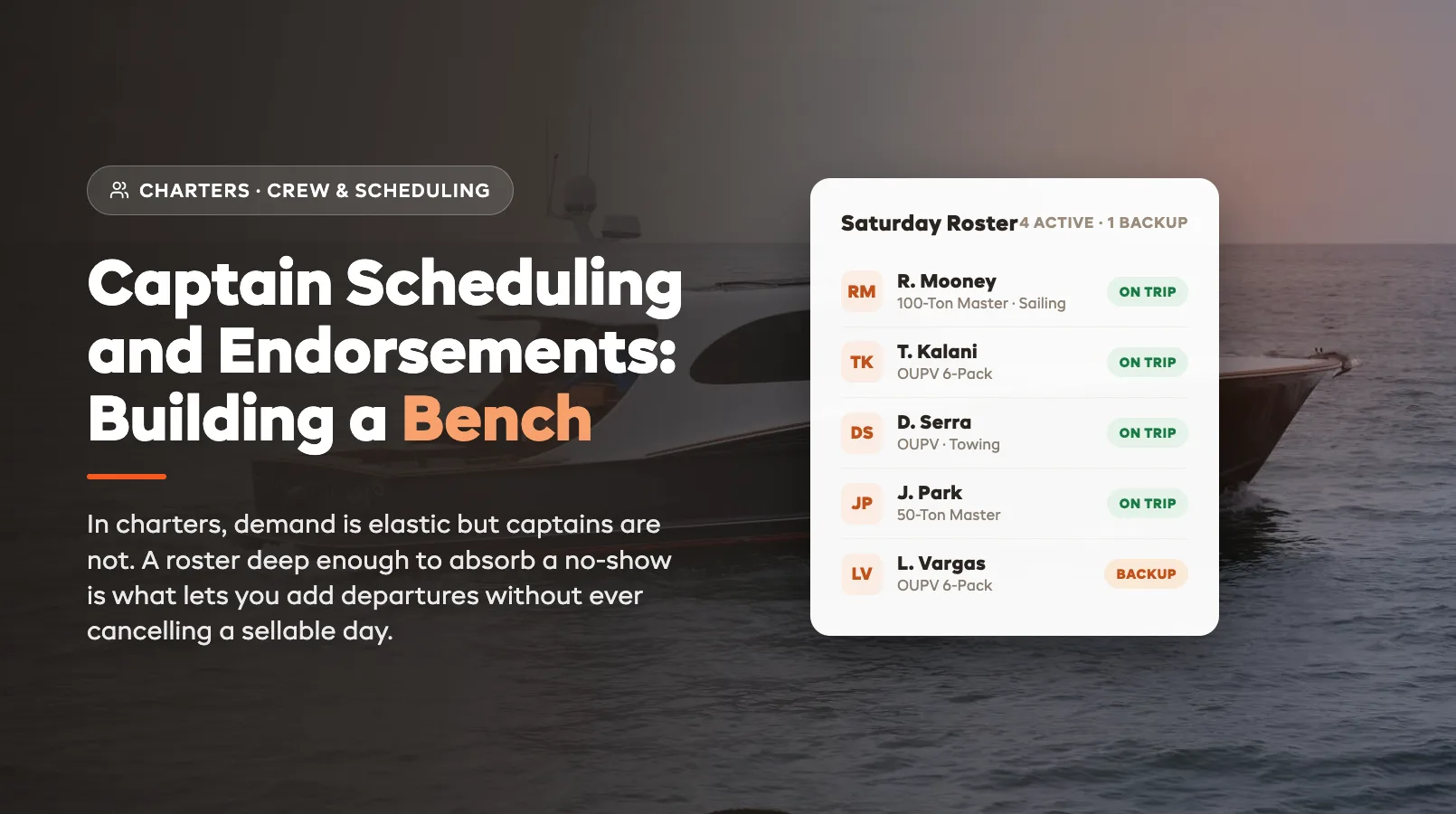
Ask a charter operator what stops them adding a second boat or a third daily departure, and the honest answer is almost never "not enough customers." It's "I don't have the captains." Demand in a good market is elastic — you can fill more trips with marketing and reviews. Captains are not. A licensed, insurable, reliable captain who shows up at 5am and represents your brand on the water is the single scarcest input in the business, and the operators who scale are the ones who treat captain supply as a system to build rather than a fire to fight every Friday night.
That system is what people in sports call a bench: a roster deep enough that losing a starter to illness, weather, or a competing offer doesn't cost you a sellable day. This guide is a spoke off our broader guide to running a charter business, focused entirely on the captain layer — how to hire, what endorsements actually matter, how to schedule without double-booking, how to pay so good people stay, and how to keep a backup ready for the day a starter goes down.
Captain Hiring: Build the Pipeline Before You Need It
The first mistake new operators make is hiring reactively — scrambling for a captain the week a booking lands instead of the season before. By the time you need someone, the good captains in your market are already committed. Building a bench starts with treating recruitment as a year-round pipeline, not an emergency.
Your best channel is the same one tour operators rely on: referrals from captains you already trust. Good captains know other good captains and won't recommend someone who will embarrass them in front of your customers. Beyond referrals, recruit from where licensed mariners already gather — local USCG-approved captain schools, marina docks, fishing tournaments, sailing clubs, and the delivery-captain networks that move boats up and down the coast in shoulder season. Retired commercial mariners and Coast Guard veterans are an underrated pool: credentialed, calm under pressure, and often looking for part-time work that keeps them on the water.
When you screen, you're verifying two separate things: the paperwork and the person. The paperwork is binary — valid credential, current medical certificate, TWIC card, clean drug-program enrolment, and an insurance carrier willing to cover them on your policy. The person is the harder read: customers remember the captain, not the boat, so you're hiring for the ability to make six strangers feel safe and entertained on a rolling deck as much as for seamanship. Run a paid trial trip before you commit to anyone for the season. You learn more from one real charter than from three interviews. If you're still building your first roster, the guide to starting a fishing charter business walks the first-season path from licensing to break-even that your founding captains will run on.
Endorsement Types: Match the Credential to the Trip
A captain's license is not one thing — it's a base credential plus a stack of endorsements that decide which trips that captain can legally run for you. Getting this wrong is how operators end up non-compliant without realizing it, because a captain who's perfectly licensed for one trip may be illegal on the next boat in your fleet.
The base credential most of your bench will hold is the OUPV — the "6-pack" — authorizing up to six paying passengers on an uninspected vessel. Above it sits the Master license, rated by tonnage (25, 50, or 100 gross tons), which a captain needs to run an inspected vessel carrying more than six guests. On top of the base sit the endorsements that unlock specific work: a sailing endorsement to command auxiliary-sail charters, a commercial towing endorsement, and the assistance-towing route some operations need. We cover the credential ladder in depth in the USCG compliance guide — for bench-building, the point is to know exactly which endorsement each trip requires before you assign anyone to it.
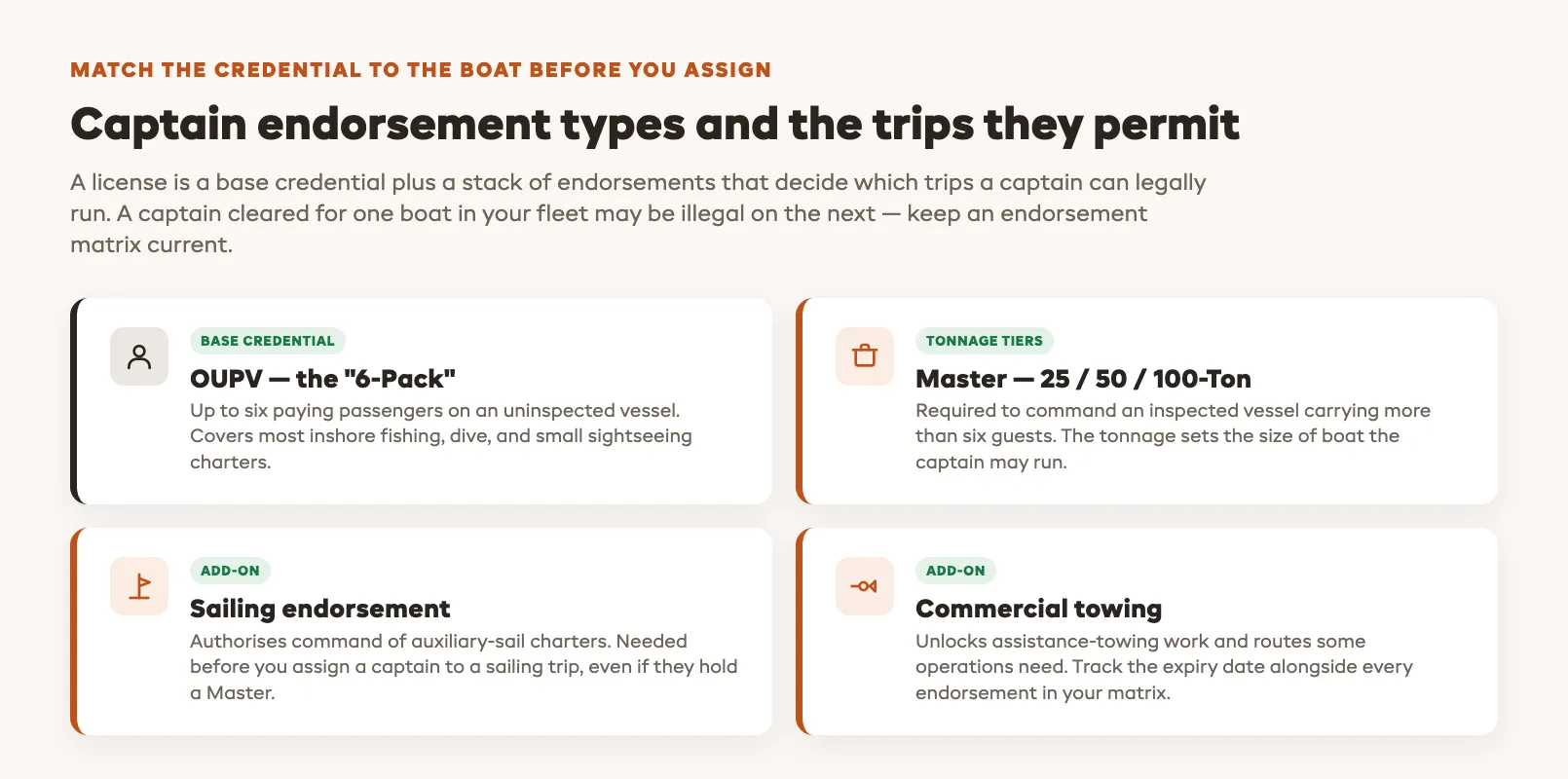
The practical discipline is a simple matrix: every captain on one axis, every trip type and vessel on the other, and a clear mark showing who is endorsed for what. A captain endorsed for your inshore 6-pack center console is not automatically cleared to run your 12-passenger inspected sightseeing boat. Keep the matrix current, store the expiry date of every credential alongside it, and never let scheduling assign a captain to a trip their endorsement doesn't cover. The matrix is the difference between a bench and a liability. The same documentation discipline extends to every trip your bench runs — see our guide to charter manifests, waivers, and legal records for the passenger paperwork that has to be right before any captain leaves the dock.
A Scheduling System That Won't Double-Book
Two or three captains, and a group chat plus a wall calendar holds together. Past that, manual scheduling starts dropping trips — the same captain promised to two charters, a backup who was never actually confirmed, a credential that lapsed three weeks ago but stayed on the board. Every one of those is a canceled trip or a compliance breach waiting to happen, and they cluster exactly when you're busiest and least able to catch them.
The fix is to tie captain scheduling directly to your live booking calendar so the two can never drift apart. When a charter is booked, the system should surface only the captains who are both available that day and endorsed for that specific vessel and trip — then hold the assignment against the booking so the same captain can't be promised elsewhere. The moment a captain marks themselves unavailable, they disappear from the assignable pool. The moment a credential expires, they're flagged off trips that require it. That's scheduling that defends itself rather than relying on you to remember everything at 9pm on a Saturday.
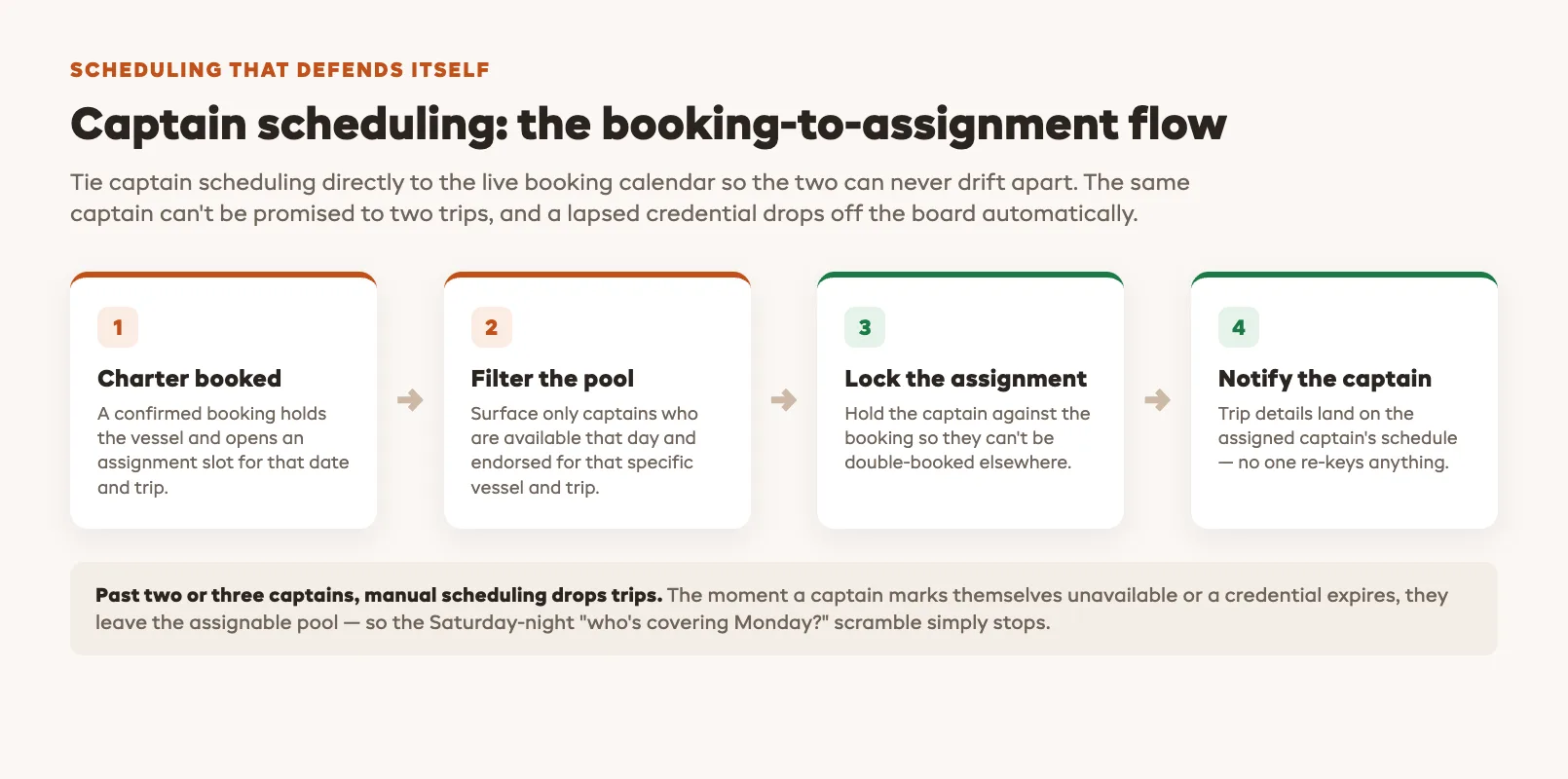
This is precisely where purpose-built charter booking software earns its keep over a spreadsheet: it knows each captain's endorsements and availability, assigns the right person to the right boat automatically, and updates instantly when a trip fills or a booking moves. EquipDash ties captain assignment to the booking itself, so a confirmed charter holds the vessel, requests the waiver, and lands on the assigned captain's schedule in one motion — and the captain gets the trip details without anyone re-keying them. The Sunday-night scramble to work out who's covering Monday simply stops happening.
Pay Structures: How You Pay Decides Who Stays
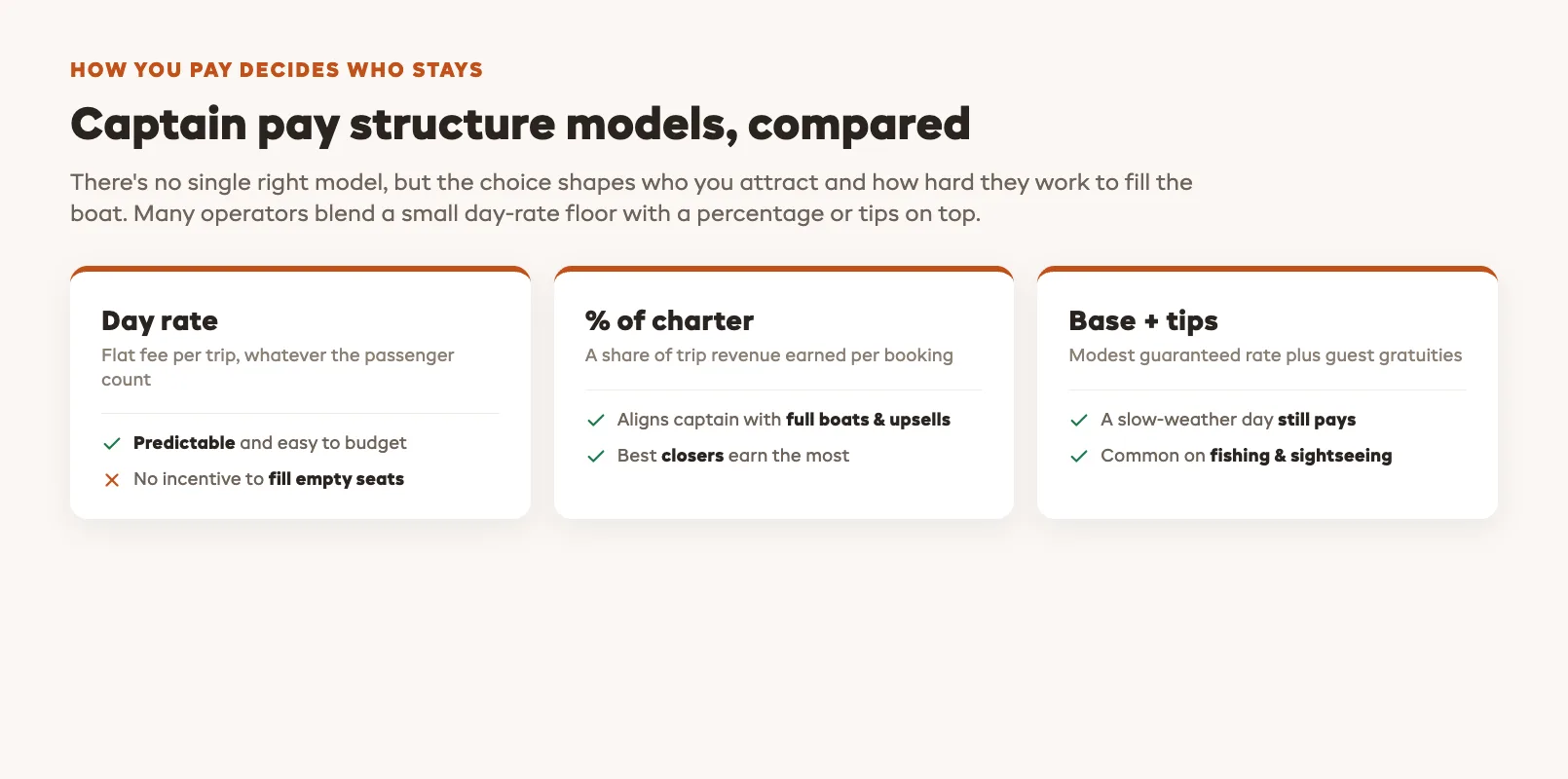
Captains talk to each other, and the operators with the deepest benches are usually the ones with pay structures that captains consider fair and transparent. There's no single right model, but there are three common ones, and the choice shapes who you attract and how hard they work to fill your boat.
A day rate is the simplest: a flat fee per trip regardless of how many passengers book. It's predictable for the captain and easy for you to budget, but it gives no incentive to upsell or fill empty seats. A percentage of the charter — typically a share of the trip revenue — aligns the captain with your goal of full boats and premium upsells, and the best closers love it because their effort shows up in their pay (how you set those trip prices in the first place is covered in our charter pricing strategy guide). A base-plus-tips structure, common on fishing and sightseeing charters, pairs a modest guaranteed rate with the gratuities that good captains earn naturally from happy guests. Many operations blend these: a small day-rate floor so a slow-weather day still pays, plus a percentage or tips on top.
Whatever you choose, write it down and pay on time. Captains are independent operators with options, and the fastest way to lose your bench to a competitor is a confusing payout or a late one. Be explicit about who covers fuel, who keeps the tips, what happens on a weather cancellation, and how multi-day trips are paid. Clarity is itself a retention tool — a captain who never has to chase you for money or argue about a split is a captain who picks up your phone first.
Backup Captain Coverage: The Bench Behind the Bench
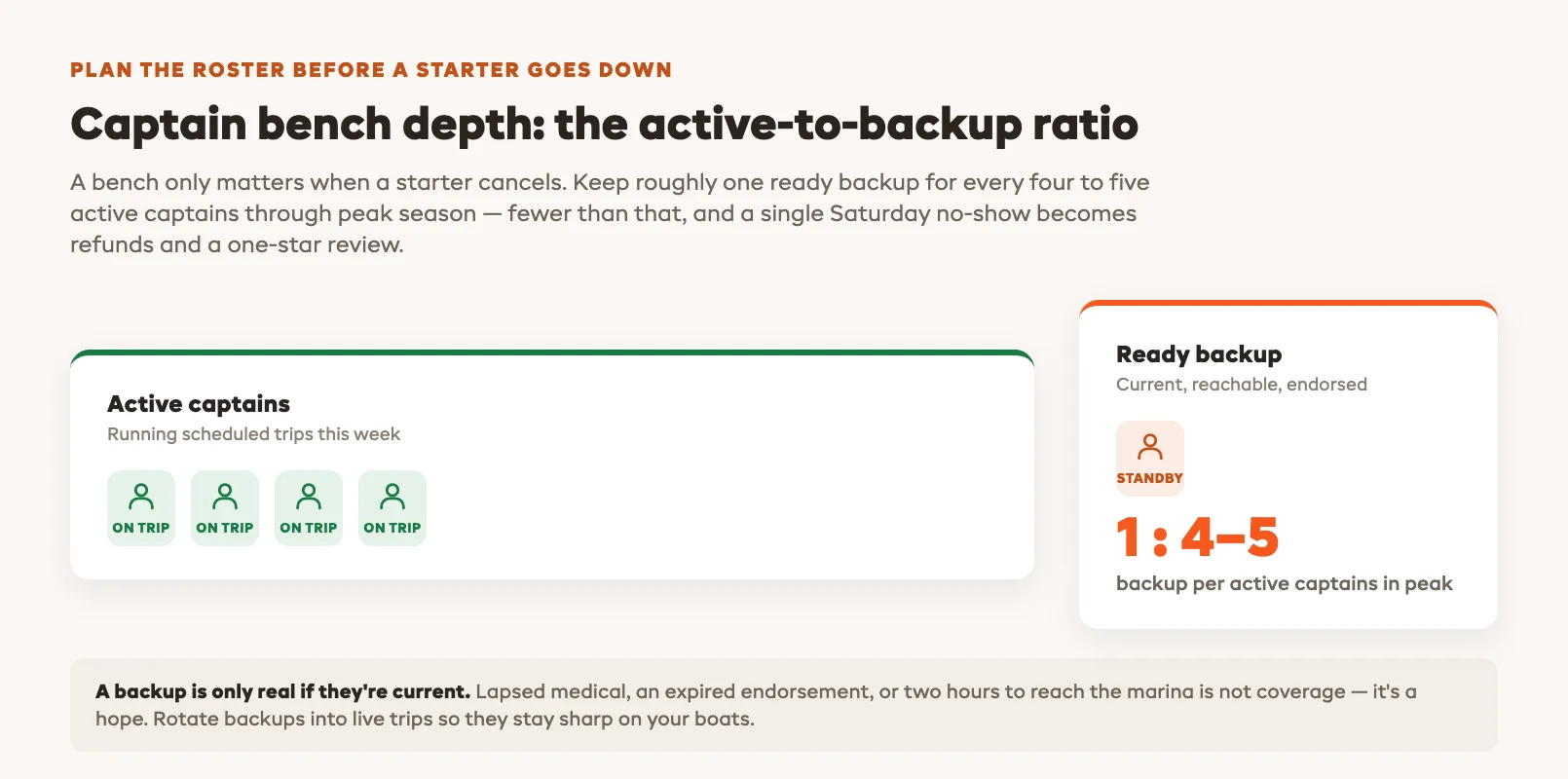
A bench only matters when a starter goes down, and in charter operations starters go down constantly — illness, a family emergency, a better-paying offer, or a captain who simply doesn't show. The operations that never cancel are the ones that planned for this before it happened. As a rough rule, keep roughly one ready backup for every four to five active captains through peak season. Fewer than that, and a single no-show on a fully booked Saturday turns into refunds and a one-star review.
A backup is only real if they're genuinely reachable and genuinely current. A captain who's "available in theory" but hasn't run your boat in a year, whose medical certificate lapsed, or who needs two hours' notice to get to the marina is not coverage — they're a hope. Keep backups warm by rotating them into real trips through the season so they stay sharp on your vessels and your procedures, confirm their credentials stay current, and make sure your scheduling system can surface an endorsed, available substitute in minutes rather than sending you down your contacts list one text at a time. A pre-departure routine like the charter pre-departure check keeps a swapped-in backup running to the same standard as your starter, so the customer never notices the change. When a starter cancels at 4am, the question isn't whether you have a backup — it's whether you can deploy one before the guests reach the dock.
Retention: Keep the Bench You Built
Every captain who leaves takes their training, their credentials, and their relationship with your repeat customers with them — and replacing them costs you a season of trust-building. Retention is cheaper than recruitment, and in a market where captains are the scarce resource, it's the real competitive advantage.
The levers are straightforward and mostly non-financial once pay is fair. Captains stay where they're scheduled predictably and well in advance, where the boats are maintained so they're not fighting equipment all day, where they're treated as professionals rather than interchangeable labor, and where the booking and admin systems make their job easier instead of harder. Give your best captains first pick of the premium trips. Loop them into the off-season — early schedule commitments, returning-captain check-ins before competitors call, a stake in how the operation runs. A reactivation routine such as the pre-season charter reactivation agent keeps both customers and crew warm through the quiet months so you ramp into peak season with your bench intact. For the full picture of how captains fit alongside boats, pricing, and seasonality, the charters operator hub maps the whole operation, and the charter operator glossary defines the credential and compliance terms in plain language. Build the bench once, treat it well, and you stop running the business around captain availability — and start running it around customer demand, which is exactly where a growing charter operation wants to be.
FAQ
How many backup captains does a charter business need?
A useful rule of thumb is roughly one ready backup for every four to five active captains during peak season. The exact ratio depends on how reliable your core captains are and how many sellable days you'd lose to a single no-show. The critical point is that a backup only counts if they're genuinely current and reachable — endorsed for the vessel, holding a valid medical certificate and drug-program enrolment, and able to reach the marina on short notice. Rotate backups into real trips through the season so they stay sharp on your boats and procedures rather than being a name on a list you've never actually deployed.
What endorsements do charter captains need?
It depends entirely on the trip and the boat. The base credential most charter captains hold is the USCG OUPV or "6-pack," which covers up to six paying passengers on an uninspected vessel. Carrying more than six requires a Master license rated by tonnage (25, 50, or 100 gross tons) on an inspected vessel. On top of the base, captains add endorsements for specific work — a sailing endorsement to run auxiliary-sail charters, or a commercial towing endorsement. The rule that keeps you compliant is simple: match the captain's endorsement to the specific vessel and trip before assigning them, because a captain cleared for one boat in your fleet may be illegal on the next.
How should I pay charter captains?
Three models dominate. A day rate pays a flat fee per trip — predictable and easy to budget, but with no incentive to fill seats. A percentage of the charter revenue aligns the captain with full boats and upsells, which the best closers prefer. A base-plus-tips structure pairs a modest guaranteed rate with gratuities, common on fishing and sightseeing charters. Many operators blend a small day-rate floor with a percentage or tips on top. Whichever you choose, write it down, pay on time, and be explicit about fuel, tips, weather cancellations, and multi-day trips. Clarity and reliability of payment are themselves retention tools.
How do I stop double-booking captains across multiple trips?
Once you're past two or three captains, a spreadsheet and a group chat start dropping trips. The fix is to tie captain scheduling directly to your live booking calendar so the two can't drift apart. When a charter is booked, the system should surface only captains who are both available that day and endorsed for that specific vessel, then lock the assignment against the booking so the same captain can't be promised elsewhere. Captains who mark themselves unavailable or whose credentials lapse drop out of the assignable pool automatically. Purpose-built tour operator software handles this, which is why operations outgrow manual scheduling quickly.
How do I retain good charter captains season to season?
Once pay is fair and on time, retention is mostly about respect and predictability. Captains stay where they're scheduled well in advance, where the boats are maintained so they're not fighting equipment all day, where they get first pick of premium trips, and where the admin systems make their job easier rather than harder. Stay in touch through the off-season — commit to early schedule slots and check in with returning captains before competitors do. Replacing a captain costs you a season of rebuilt customer trust, so in a market where captains are the scarce resource, keeping the bench you've built is a bigger competitive advantage than almost anything else you can do.
in one place