How to Run a Charter Business: The Complete Operator's Guide (2026)
A charter business looks simple from the dock. You own a boat, people pay to come aboard, and you take them fishing, sailing, or sightseeing for a few hours. The reality is that a charter operation is three businesses stacked on top of each other: you own and maintain expensive marine assets, you run a licensed passenger-carrying operation under real regulatory scrutiny, and you sell a hospitality experience that lives or dies on reviews. Get any one of those three wrong and the other two can't save you.
This guide is for operators who are either starting a charter business or trying to run their existing one more like a business and less like an expensive hobby. We'll cover the main charter types and how their economics differ, the licensing you genuinely need (and the myths around it), insurance, hiring and keeping captains, how to think about acquiring boats, pricing across trip lengths, and the seasonal rhythm that quietly decides whether you finish the year ahead. For where charters sit alongside the rest of the on-water world, the charters operator hub is a good map of the territory.
The Main Types of Charter Business
"Charter" covers a wide spread of operations, and they don't run the same way. Before you spend money, be clear about which one you're actually building, because the boat, the license, the customer, and the season all change with it.
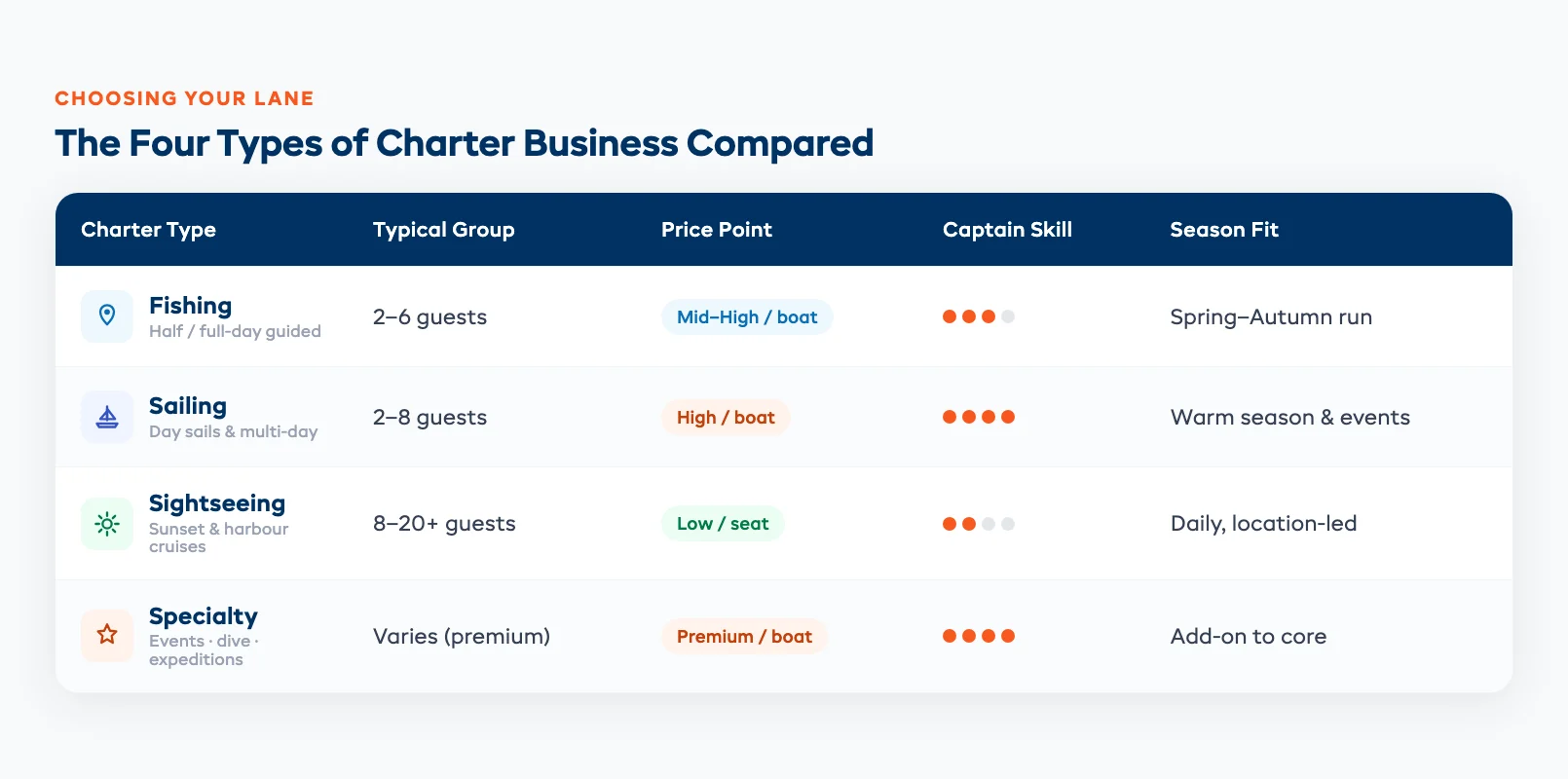
Fishing charters are the most common entry point. A licensed captain takes anywhere from two to six guests offshore or inshore to fish, usually on a half-day or full-day trip. The product is partly the fish and partly the captain — guests are buying local knowledge and a guided day on the water. Repeat business and referrals are strong if you put people on fish, which makes consistency and reputation everything.
Sailing charters sell the experience of being under sail. Some are skippered day sails and sunset cruises; others are multi-day or even bareboat charters where qualified guests take the boat themselves. The customer skews toward couples, special occasions, and travelers who want a slower, scenic trip rather than an activity with a scoreboard. Boats are more expensive to buy and maintain, and the skill bar for crew is higher.
Sightseeing and sunset charters are the volume play. Short, scenic, low-skill-barrier trips — harbor cruises, wildlife watching, sunset sails — that fill a boat with eight, twelve, or more guests at a lower price per head. They lean on location and marketing more than on specialist skill, and they're the easiest charter type to scale across multiple departures a day.
Specialty and event charters — corporate days, weddings, dive trips, whale watching, multi-day expeditions — sit on top of the others. They command premium prices but demand more coordination, catering, and often specific endorsements or partnerships. Most operators add these once the core business is steady rather than starting there.
The trap is trying to be all four at once on day one. Pick the type that fits your boat, your waters, and your own credentials, get it running profitably, and add adjacent products from a position of strength.
Licensing: What You Actually Need to Carry Passengers
This is where new operators get the most confused, and where cutting corners ends a business fastest. The moment you carry paying passengers, you're a commercial operator, and the rules are not optional.
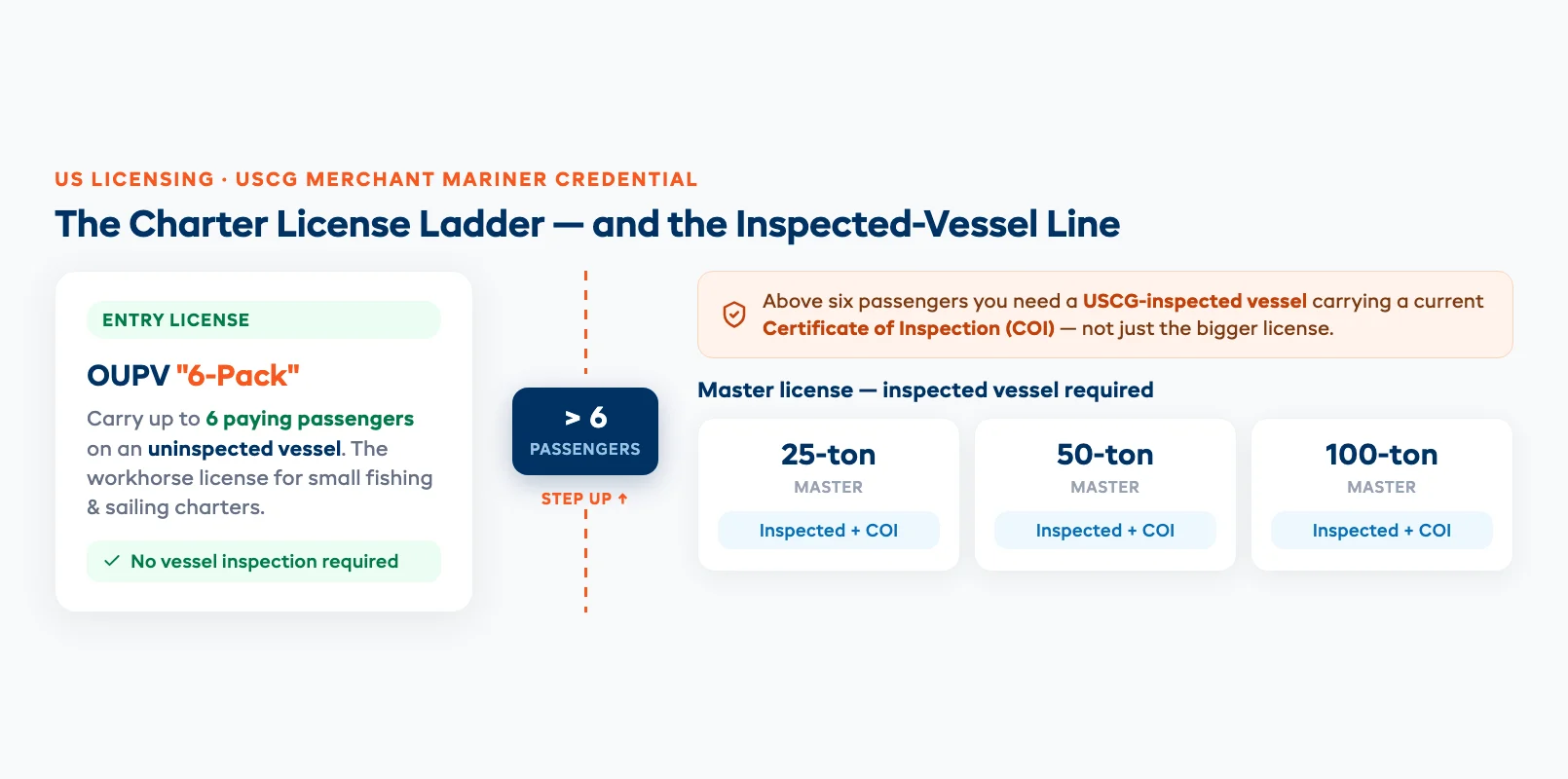
In the United States, the key threshold is the US Coast Guard (USCG) merchant mariner credential. For most small charters the entry license is the OUPV, universally called the "6-pack." It lets you carry up to six paying passengers on an uninspected vessel and is the workhorse license for fishing and small sailing charters. If you want to carry more than six passengers, you step up to a Master license (commonly the 25, 50, or 100-ton Master), and crucially the boat itself must be a USCG-inspected vessel carrying a Certificate of Inspection (COI). That inspected-vessel requirement, not just the captain's license, is what trips up operators who assume a bigger license alone lets them load more guests.
Getting a 6-pack means documented sea time, a captain's course, a written exam, a TWIC card, a medical certificate, and enrolment in a random drug-testing program. None of it is exotic, but it takes months, so start early. The tiers, what each unlocks, and the sea-time and testing requirements are worth understanding in detail before you commit to a boat size — a 12-passenger sightseeing plan you can't legally crew is an expensive mistake.
In the United Kingdom, commercial charter work falls under the Maritime and Coastguard Agency (MCA), with the Boatmaster's License and various Commercially Endorsed RYA qualifications (Day Skipper, Yachtmaster) depending on the vessel and area of operation, plus coding of the vessel itself to a category that matches how far offshore you run. In Australia, the Australian Maritime Safety Authority (AMSA) governs commercial vessels under the National Law, requiring an appropriate Certificate of Competency for the skipper and a Certificate of Survey and a Certificate of Operation for the vessel. The specifics differ, but the shape is the same everywhere: the person needs a license, the boat needs a certificate, and carrying more people raises both bars.
Two practical rules. First, verify your local requirements with the regulator directly, not a forum post — the details vary by waters, passenger count, and distance offshore. Second, build your compliance calendar into your operating system so license renewals, medicals, drug-test enrolment, and vessel inspections never lapse. A lapsed COI on a peak Saturday is a canceled trip and a refunded deposit.
Insurance: The Coverage That Keeps You in Business
Charter insurance is more expensive and more specific than recreational boat insurance, and the gap between the two is where uninsured operators get wiped out. You are carrying paying passengers on the water, and the liability that comes with that is the real exposure — not just the hull.
The core policies most charter operators carry are: protection and indemnity (P&I) or marine liability covering injury to passengers and crew and damage you cause to others; hull and machinery covering physical damage to your own boat; and where you have employees or hired captains, the relevant crew/workers' coverage (in the US, this often means Jones Act and longshore exposure, which standard policies exclude). Many operators also carry coverage for passenger personal effects and, if they run a dock or shop, general business liability.
The figure that matters most is your liability limit. A single serious passenger injury offshore can generate a claim far beyond what a thin policy covers, and the difference is paid out of your business and personal assets. Don't shop on premium alone — shop on the limit, the exclusions, and whether the policy actually covers commercial passenger-carrying for your specific operation. A recreational policy will not, and discovering that after an incident is catastrophic. Insurers also reward a documented paper trail on every trip — a clean passenger manifest, signed waivers, and proper records retention — which is exactly the discipline our guide to charter manifests, waivers, and legal records lays out.
Insurers will also want to see your operation is run tightly: documented safety briefings, signed passenger waivers, captain credentials on file, and maintenance logs. The same discipline that keeps you compliant lowers your risk profile and, over time, your premiums. Tying waivers to each booking so no guest boards unsigned is the kind of control underwriters reward — and it's far easier when the charter passenger safety briefing and waiver collection live in the same system as the booking.
Hiring and Managing Captains
Unless you're a single owner-operator running every trip yourself, captains are your business. They're the product the customer experiences, the person legally responsible on the water, and the constraint on how many trips you can run. Most charter businesses hit a ceiling not because demand runs out but because they can't crew the boats.
When you hire, you're checking three things: the right license and endorsements for the vessel and trip, a clean record and current medical and drug-test status, and the softer stuff — does this person represent your business well to a boat full of paying guests? A brilliant fisherman who's surly with families will quietly cost you reviews and rebookings. Verify credentials on file and keep copies; an expired captain's license is your problem, not just theirs.
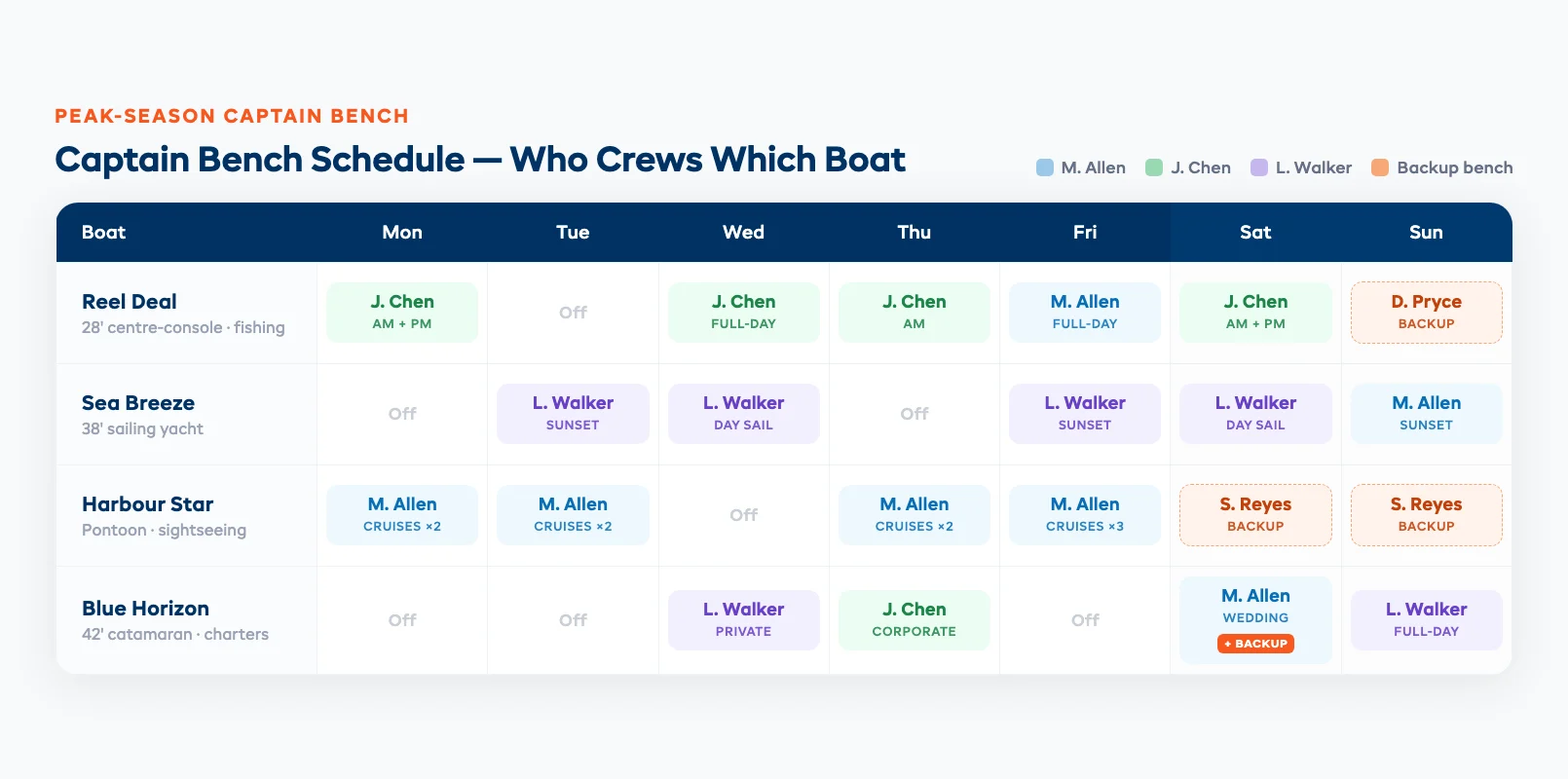
The operators who scale build a bench — a roster of reliable part-time and backup captains — rather than depending on one or two people. A bench means you can add a Saturday departure when demand spikes, cover a sick captain without canceling, and run multiple boats in peak season. Building that roster takes time and is worth starting before you need it. Pay structures vary: a day rate, a percentage of the charter, or a base plus tips, with the right mix depending on your margins and local norms. Whatever you choose, make it predictable, because captains talk and a reputation for fair, on-time pay is how you keep a good bench together.
Scheduling that bench across overlapping departures, days off, and endorsement limits is its own discipline. A shared calendar that shows who's qualified for which boat and who's already booked prevents the classic peak-season mistake — promising a charter you have no captain to run. A captain daily briefing checklist standardizes the handoff so every captain, regular or backup, starts the day with the same trip details, weather call, and guest notes. For the full playbook on hiring, endorsing, paying, and scheduling a bench deep enough to survive peak season, see our guide to building a captain bench.
Acquiring Boats: Buy, Finance, or Manage
The boat is your biggest capital decision and your biggest ongoing cost, so resist the urge to over-buy at the start. The right first boat is the smallest, simplest vessel that credibly delivers the trip you're selling — not the boat you'd love to own.
There are three common paths. Buying outright gives you full control and no financing cost, but ties up capital and concentrates risk in one asset. Financing spreads the cost and keeps cash free for marketing and working capital, at the price of monthly payments you owe whether or not the season cooperates — which makes your break-even load factor the number to model before you sign. Charter management or boat-share arrangements, where you operate a boat owned by someone else in exchange for a revenue split, let you start or expand without the full purchase, trading a slice of revenue for lower capital risk. Many operators use management deals to test a second boat or a new location before committing.
Whatever you choose, the cost that surprises new operators isn't the purchase — it's the upkeep. Engines, haul-outs, antifouling, electronics, safety gear, dockage, and fuel add up to a serious annual figure, and a commercial boat running hundreds of trips a season wears faster than a weekend cruiser. Budget maintenance as a fixed cost of doing business, log every service, and run a charter vessel maintenance log so problems are caught at the dock instead of two miles offshore with six guests aboard. Reliability is a revenue feature: a boat that's down on a Saturday in peak season isn't just a repair bill, it's a day of charters you can never sell again.
Pricing Your Charters
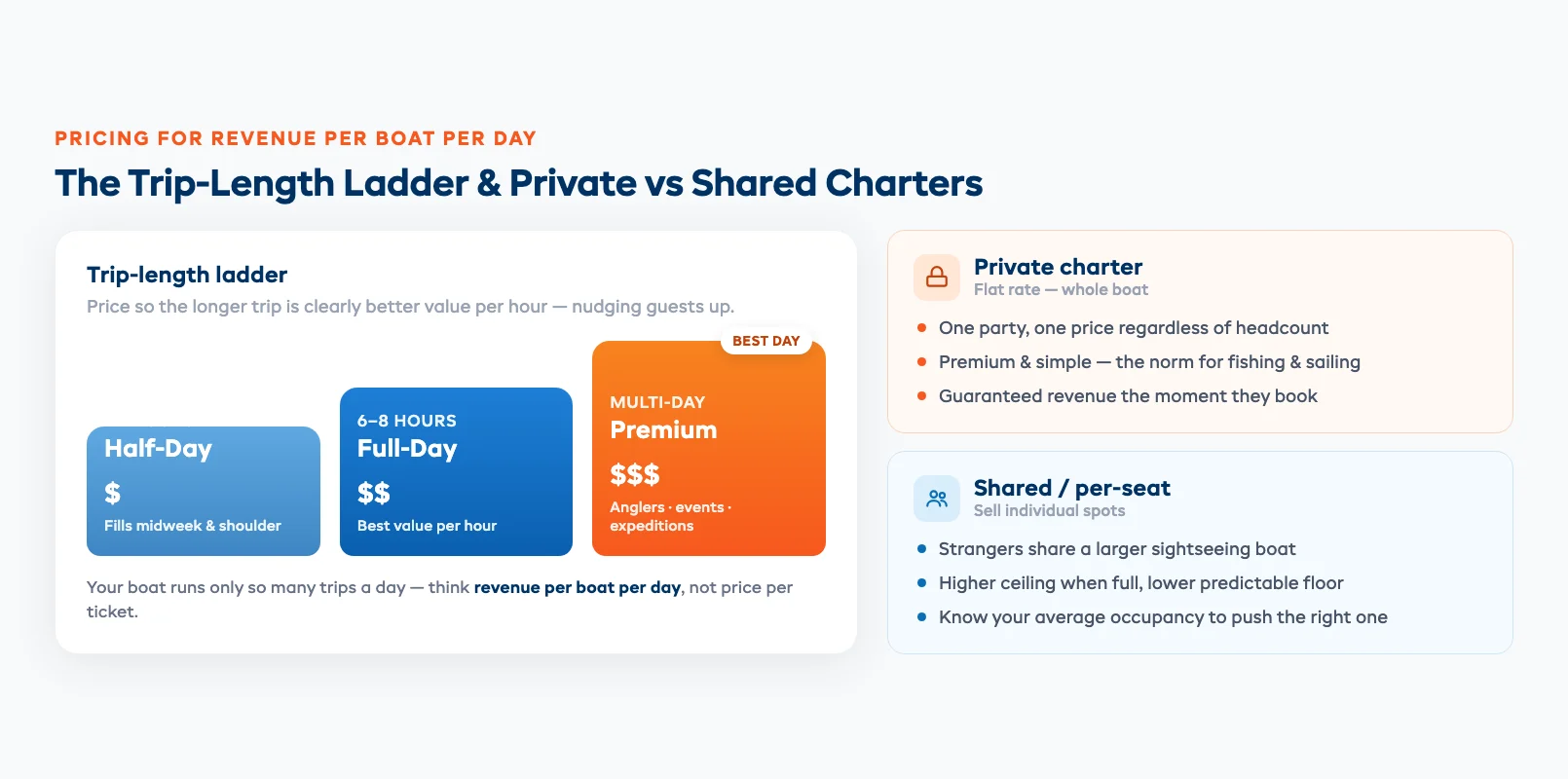
Charter pricing is built around trip length and exclusivity, and the operators who get it right think in revenue per boat per day rather than price per ticket. Your boat can only run so many trips in a day, so the real question is how to fill those slots at the best blend of price and occupancy.
Most operators offer a ladder: a half-day trip (often 4 hours) as the accessible entry point, a full-day (6–8 hours) at a higher absolute price but better value per hour for the customer, and multi-day or premium packages for serious anglers, special occasions, or expeditions. The half-day fills midweek and shoulder seasons; the full-day and premium trips drive your best revenue days. Pricing them so the full-day is clearly better value per hour nudges customers up the ladder without you discounting. Our charter pricing strategy guide breaks the whole ladder down — half-day, full-day, multi-day, premium packages, groups, and seasonal adjustments — with the per-hour logic behind each step.
Then there's the private-versus-shared decision. A private charter sells the whole boat to one party at a flat rate regardless of headcount — simpler, premium, and the norm for fishing and sailing. A shared or per-seat charter sells individual spots to fill a larger boat, which suits sightseeing and sunset cruises where strangers happily share. Shared trips have a higher ceiling when the boat fills but a lower, less predictable floor; private trips give you a guaranteed number the moment they book. Knowing your average occupancy on shared trips is what tells you which to push on any given day.
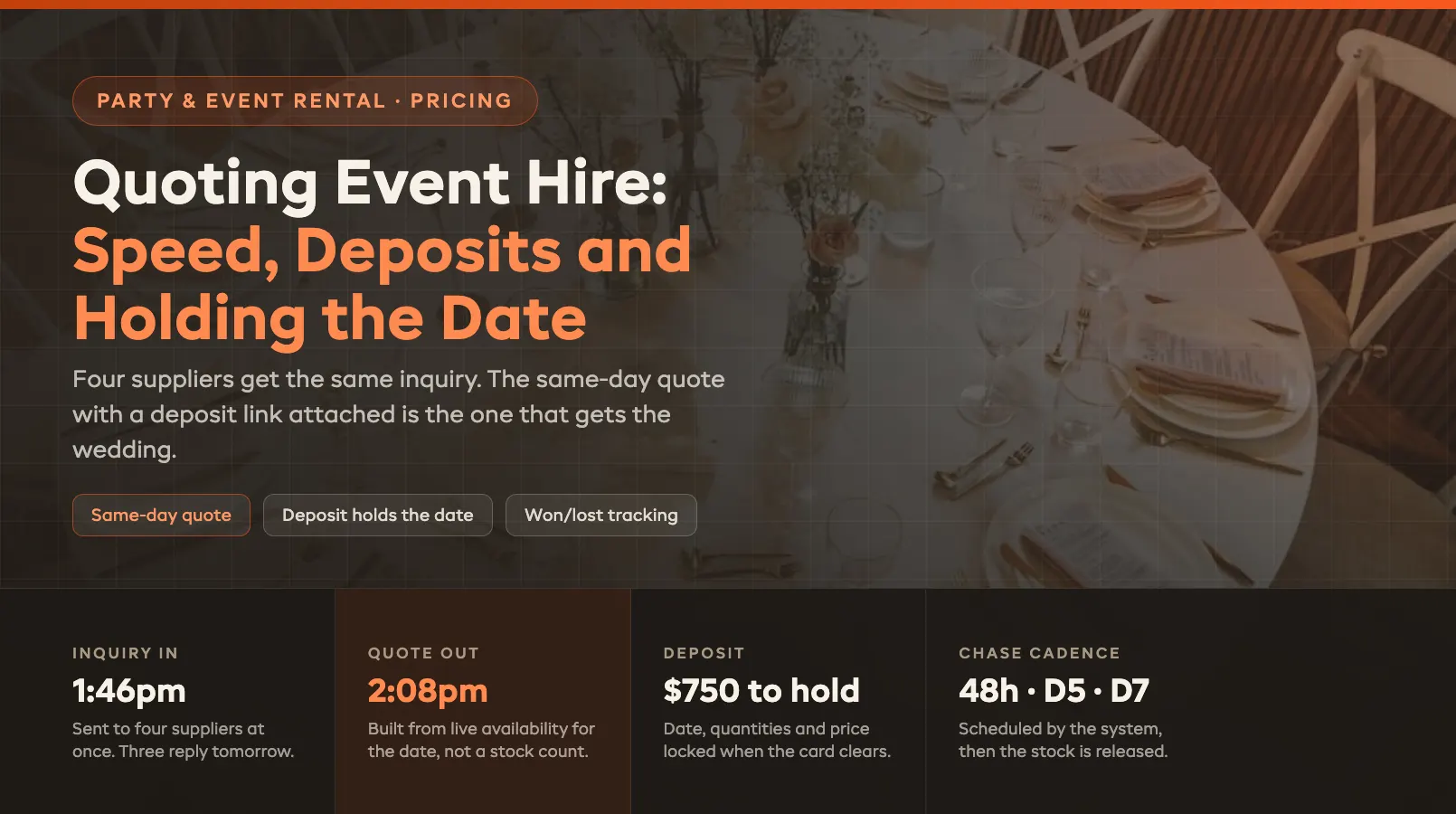
Layer in the obvious adjustments — peak-season and weekend premiums, group and corporate rates, and add-ons like catering, gear, or photos — and require a deposit at booking. A deposit does two jobs: it filters out tire-kickers and it protects you against the late cancellation that leaves a fueled boat and a paid captain with no guests. Charging the balance automatically and capturing the deposit up front is the kind of thing your booking system should handle so you're not chasing payments the morning of a trip.
Seasonal Operations: The Rhythm That Decides Your Year
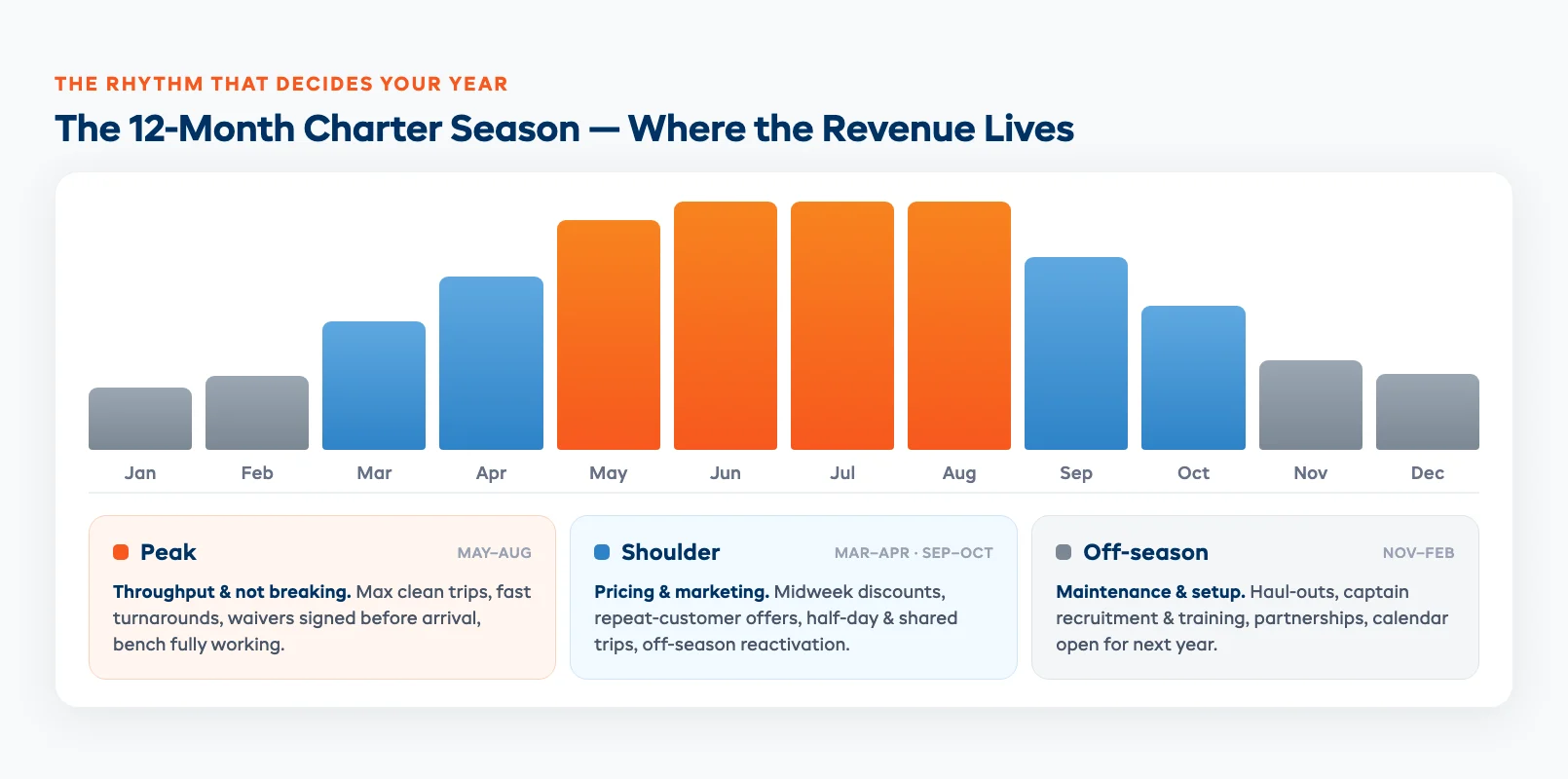
Almost every charter business is seasonal, and the operators who thrive treat the off-season as part of the job rather than a dead stretch to survive. Your year has a shape, and planning around it is the difference between a profitable season and a scramble.
Peak season is about throughput and not breaking. Boats run hard, the bench works, and small operational frictions — a slow check-in, an unsigned waiver, a double-booked captain — cost you real money because every slot is sellable. This is the time to be ruthless about systems: automated confirmations and reminders, waivers signed before arrival, a clear captain schedule, and fast turnarounds between trips. The goal is to run the maximum number of clean trips with the fewest mistakes.
Shoulder seasons are where pricing and marketing earn their keep. Demand is softer, so you fill the calendar with midweek discounts, local promotions, repeat-customer offers, and the shared or half-day trips that lower the barrier to booking. A strong off-season reactivation effort — reaching back out to last year's guests before the season opens — fills early dates that would otherwise sit empty.
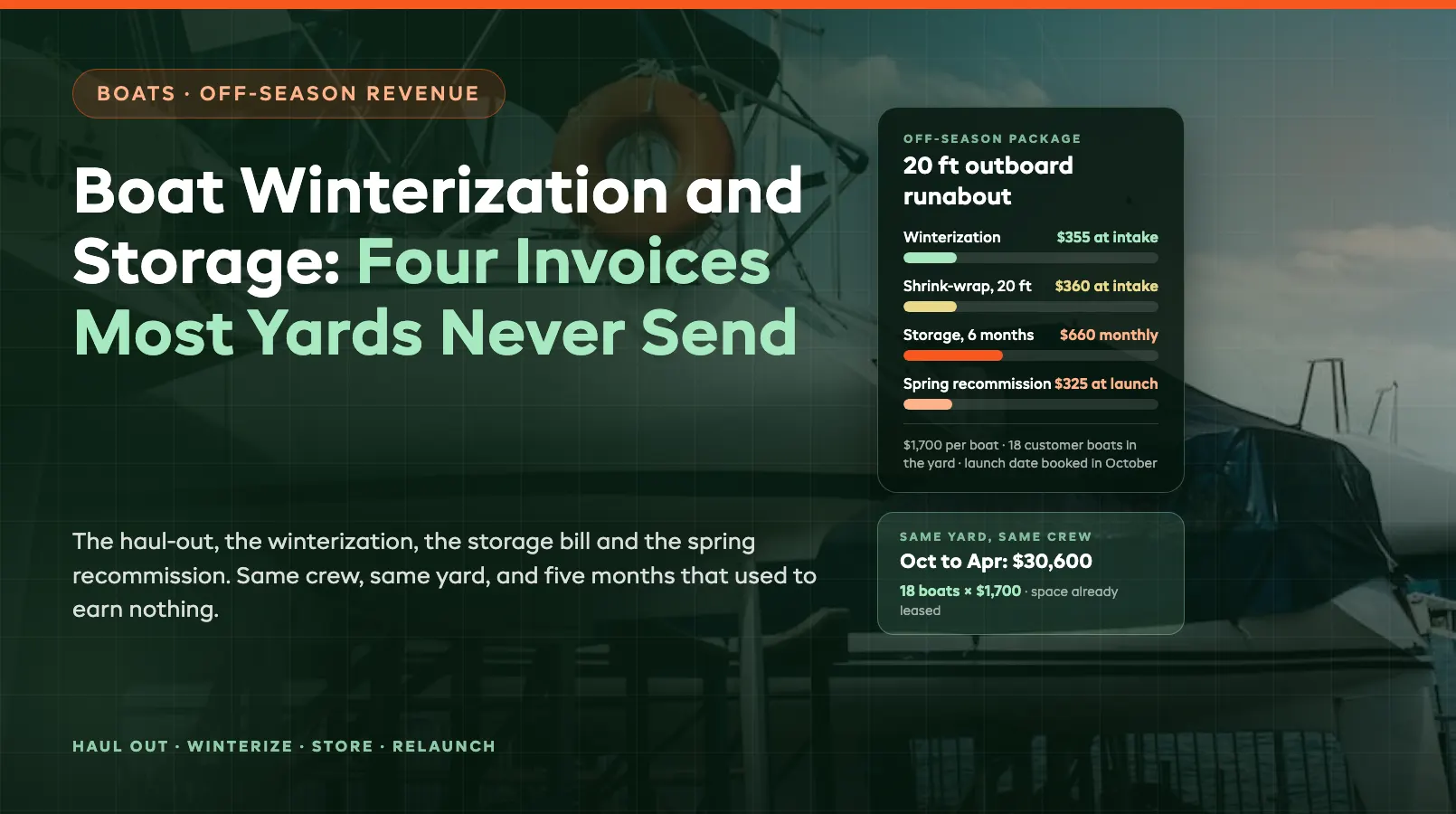
Off-season is for the work you can't do when boats are running: haul-outs and major maintenance, captain recruitment and training for next year, reviewing what worked, locking in partnerships with hotels and concierges, and getting your booking calendar open and marketed for the season ahead. A boat that's recommissioned and a calendar that's already taking bookings on opening day is worth far more than a frantic scramble in the first warm week. Running a pre-season charter operator audit before you open turns that scramble into a checklist.
The Technology That Holds It Together
A charter business runs on coordination — bookings, deposits, waivers, captain schedules, maintenance, and weather calls all have to line up, often on the same busy morning. Trying to hold that together across a paper diary, a phone, a spreadsheet, and a separate waiver app is where revenue leaks and trips fall through the cracks. The point of a real operating system is that those pieces talk to each other.
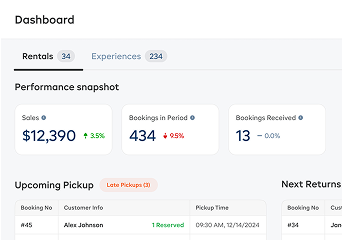
A booking platform built for charters lets guests book and pay a deposit online around the clock, blocks out boats and captains so you can't double-book a slot, sends automated confirmations and reminders that cut no-shows, collects signed waivers tied to each booking before anyone reaches the dock, and gives you a clear view of who's going out, on which boat, with which captain, every day. That's the operational backbone. EquipDash brings these pieces into one system so a confirmed booking automatically holds the boat, requests the waiver, and lands on the captain's schedule without anyone re-keying it.
On top of that backbone, automation handles the repetitive coordination that otherwise eats your mornings. Dash Agents can chase an outstanding waiver before a trip, follow up on a no-show to rebook it, draft a damage report after an incident, or send a weather-alert message to today's guests when a forecast turns — the same routine work a charter generates every single day. The value isn't novelty; it's that the boat, the captain, the waiver, and the customer stay in sync without you holding all of it in your head. The charters operator hub lays out how these pieces fit a passenger-carrying operation end to end.
Run the boats well, stay compliant, keep a bench of good captains, price for revenue per day, and let a real system carry the coordination — that's a charter business that makes money instead of just staying afloat. Start with the charter pre-departure check and the charter weather alert agent, and build the rest of your operation around the same discipline.
FAQ
Do I need a captain's license to run a charter business?
Yes. The moment you carry paying passengers you're a commercial operator. In the US, the entry license is the USCG OUPV ("6-pack"), which allows up to six paying passengers on an uninspected vessel; carrying more requires a Master license and a USCG-inspected vessel with a Certificate of Inspection. The UK (MCA) and Australia (AMSA) have equivalent requirements where both the skipper and the vessel must be certified. Verify the exact rules with your local regulator before buying a boat.
How much does it cost to start a charter business?
It varies enormously with the boat. The largest cost is the vessel — anywhere from a modest used center-console for inshore fishing to a large sailing yacht — followed by commercial insurance, licensing and certification, dockage, safety equipment, and working capital for marketing and fuel before bookings ramp. Many operators reduce the upfront figure by financing the boat or starting under a charter-management or boat-share arrangement rather than buying outright, then reinvesting first-season profit into a second boat.
What's the difference between a 6-pack and a Master license?
The OUPV or "6-pack" lets you carry up to six paying passengers on an uninspected vessel and is the standard entry license for small fishing and sailing charters. A Master license (25, 50, or 100-ton) is required to carry more than six passengers — but only on a USCG-inspected vessel that holds a current Certificate of Inspection. So scaling past six guests means upgrading both the captain's license and the boat's certification, not just the license alone.
How do I make a charter business profitable beyond one boat?
The constraint on growth is usually captains, not demand. Build a bench of reliable part-time and backup captains so you can add departures and run multiple boats in peak season without canceling. Price for revenue per boat per day rather than per ticket, fill shoulder seasons with discounting and repeat-customer offers, and keep boats reliable so you never lose a sellable peak-season day to a breakdown. Tight systems — online booking, deposits, waivers, and captain scheduling in one place — let you add trips without adding chaos.
What insurance does a charter business need?
At minimum, commercial marine liability or protection and indemnity (P&I) covering injury to passengers and crew, plus hull and machinery coverage for your own boat. If you hire captains or crew you'll likely need crew coverage (in the US, Jones Act and longshore exposure that standard policies exclude). A recreational boat policy does not cover paying passengers, so confirm any policy explicitly covers commercial passenger-carrying for your operation, and shop on the liability limit and exclusions rather than premium alone.
How do I handle weather cancellations without losing money?
Set clear go/no-go criteria in advance, make the call early enough to warn guests, and default to rescheduling rather than refunding wherever you can — a rebooked trip keeps the revenue, a refund loses it. Communicate proactively the moment a forecast turns, require a deposit at booking so a cancellation isn't a total loss, and automate the alert and reschedule offer so a bad-weather morning doesn't become an hour of phone calls. A reschedule-first policy, clearly stated up front, preserves both revenue and the customer relationship.
in one place