USCG Compliance for Charter Operators: COI, 6-Pack, 100-Ton Master
Every charter business in US waters runs on one foundation that customers never see and inspectors always check: USCG compliance. The credential in the captain's wallet and the certificate on the boat decide exactly what trips you can legally sell, how many passengers you can carry, and whether a routine dockside check ends in a friendly wave or a shut-down operation. Get the compliance map wrong and you don't just risk a fine — you risk an uninsured incident that ends the business.
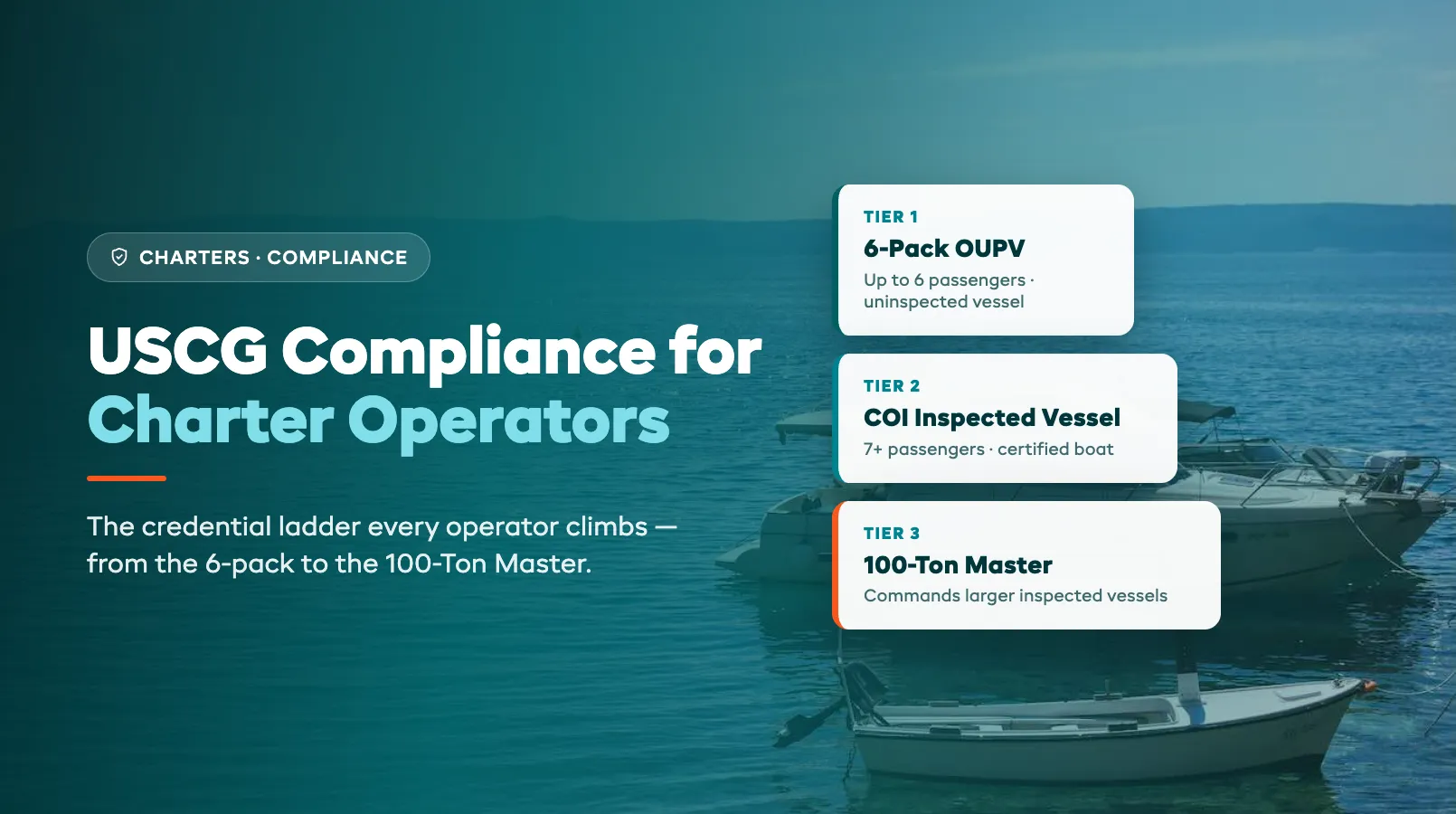
The frustrating part for new operators is that the rules are tiered, and the tier you need depends on how many passengers you carry, how far offshore you go, and the size of your vessel. This guide lays out the credential ladder in plain language — the 6-pack OUPV, the inspected-vessel COI, and the 100-Ton Master — then covers the ongoing obligations that catch people out: random drug testing, safety-equipment compliance, and inspections. It's a spoke to our broader guide to running a charter business, focused specifically on the federal compliance layer that sits under everything else. The credential and the COI are only half the compliance picture, though — the per-trip paper trail of passenger manifests and signed waivers is the other half, and our guide to charter manifests, waivers, and legal records covers what to capture and how long to keep it.
The 6-Pack License (OUPV): Your Entry Credential
For the great majority of charter operators, the journey starts and often ends with the OUPV — the Operator of Uninspected Passenger Vessels credential, universally called the "6-pack." The name is the rule: it authorizes you to carry up to six paying passengers on an uninspected vessel. That single tier covers most fishing charters, small sightseeing trips, and dive boats, because six paying guests is a healthy private-charter load for a boat under 100 gross tons.
Earning the OUPV is a stack of paperwork rather than a single hard exam. You document sea time, pass an approved captain's course and a written test, hold a TWIC (Transportation Worker Identification Credential), carry a current medical certificate, and enroll in a random drug-testing program. None of it is exotic, but the sea-time and processing timelines run into months, so the credential is the long pole in any startup plan — begin it the day you're serious about the business.
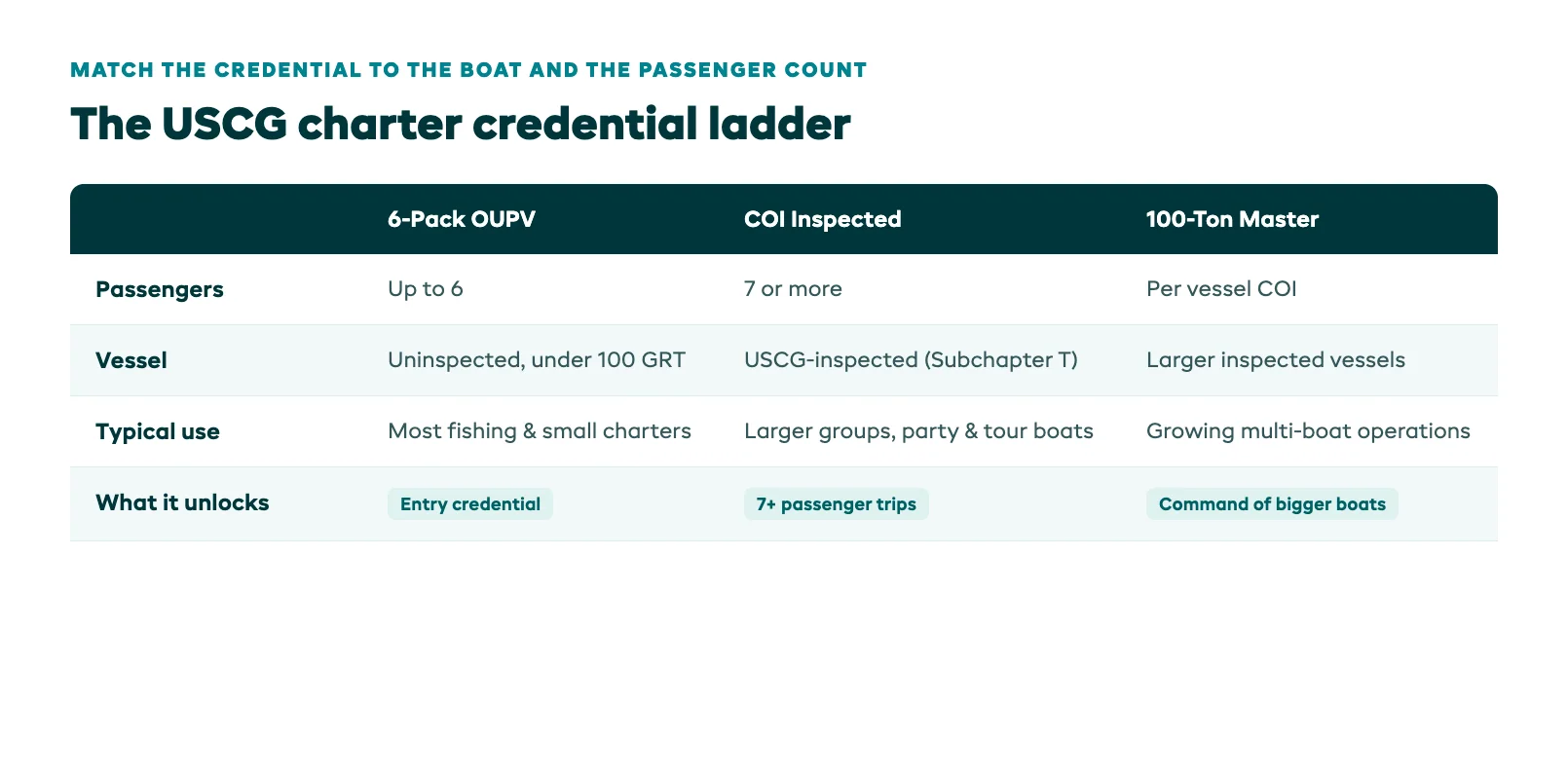
The thing to internalise is the boundary the 6-pack sits behind: six passengers, uninspected vessel. The moment your business plan needs a seventh paying passenger, you cross into a different and far more involved compliance world — and that's where the COI comes in.
When You Need a COI (Inspected Vessel)
A Certificate of Inspection (COI) is the document the Coast Guard issues to an inspected vessel, and you need one the instant you carry more than six paying passengers. This is the single most misunderstood line in charter compliance: the jump from six to seven passengers isn't a small upgrade, it's a move into a regulated class of vessel with its own construction, stability, equipment, and crewing standards.
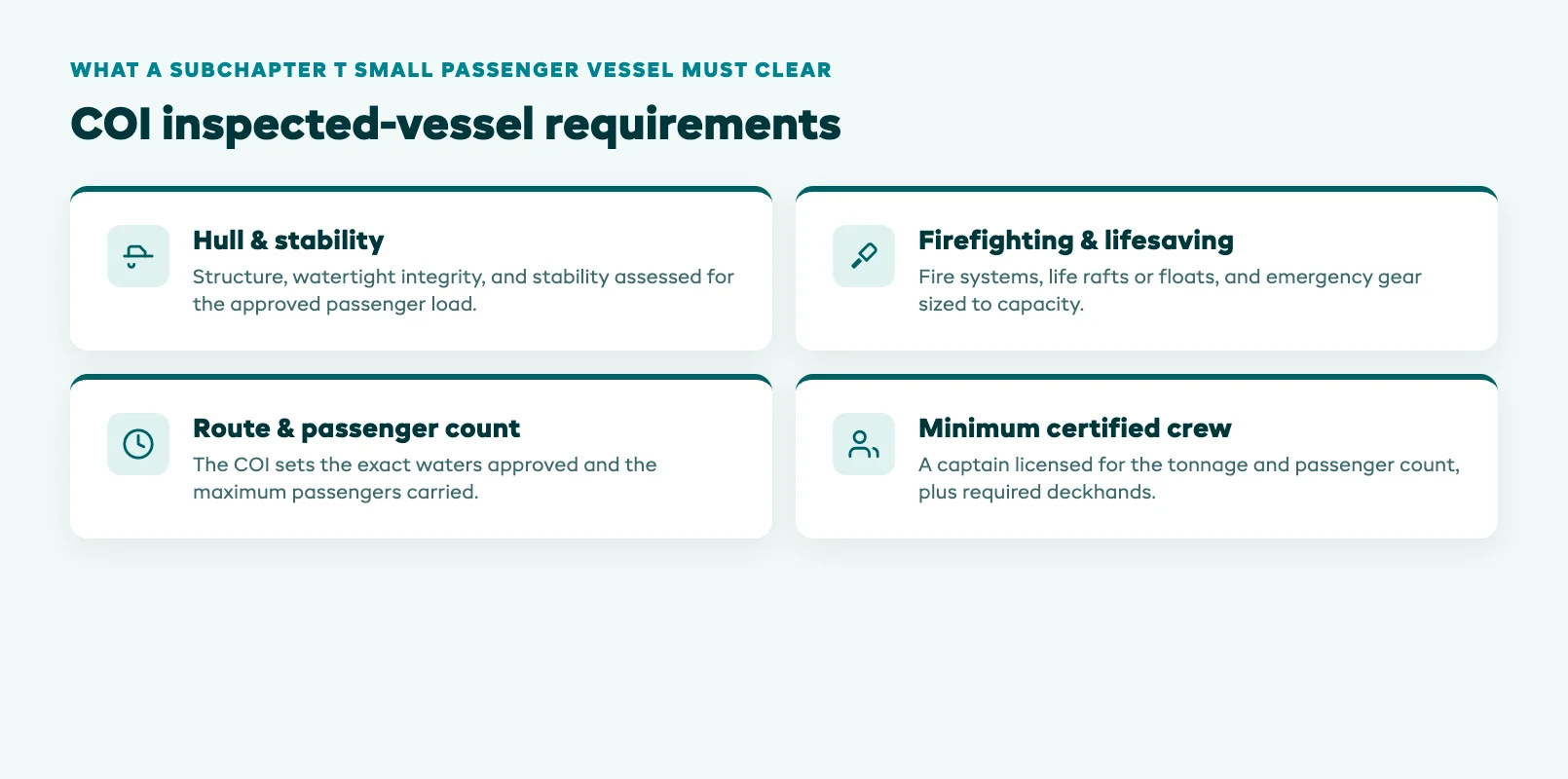
An inspected "small passenger vessel" — the Subchapter T class most charter operators encounter — has to pass a formal USCG inspection covering hull integrity, stability, firefighting and lifesaving equipment, and the qualifications of the crew running it. The COI itself spells out exactly how many passengers the boat may carry, the waters it's approved for, the minimum crew, and the safety gear required on board. You operate to that certificate, not to your own judgment.
For a first-year operator this is usually a deliberate fork in the road, not a surprise. Plenty of successful charters stay firmly inside the six-passenger 6-pack world for years precisely because it avoids the cost and complexity of an inspected boat. If your market genuinely needs larger groups — corporate trips, big sightseeing loads, party charters — budget for the COI vessel and the higher-tier captain it demands from the start, because retrofitting an uninspected boat to inspected standards after the fact is rarely worth it. Those larger trips also need their own pricing logic; our charter pricing strategy guide covers group rates and corporate buyouts alongside the standard half-day and full-day ladder.
The 100-Ton Master and Higher Tiers
Above the OUPV sits the Master license, and the tonnage on it — 25, 50, or 100 gross registered tons — sets the size of vessel you're authorized to command. The 100-Ton Master is the credential most growing charter operators aim for, because it lets you captain an inspected passenger vessel carrying more than six guests, which is exactly the boat a COI covers.
The Master is a step up from the 6-pack in sea time, examination depth, and endorsements rather than a different kind of credential. Operators frequently add endorsements that unlock specific work: a sailing endorsement to run auxiliary-sail charters, a commercial assistance towing endorsement, or a master-of-towing route. Match the credential to the boat and the trip you actually intend to sell — there's no value in a 100-Ton Master if your business is a single six-passenger center console, and no point running a 12-passenger inspected boat on an OUPV you're not licensed to command.
The practical rule across all of it: the captain's credential and the vessel's certificate have to agree. An inspected boat with a COI for 20 passengers still needs a captain licensed for that tonnage and passenger count standing behind the wheel. Mismatch the two and you're non-compliant even if each piece individually looks valid.
Drug Testing: The Program You Must Join
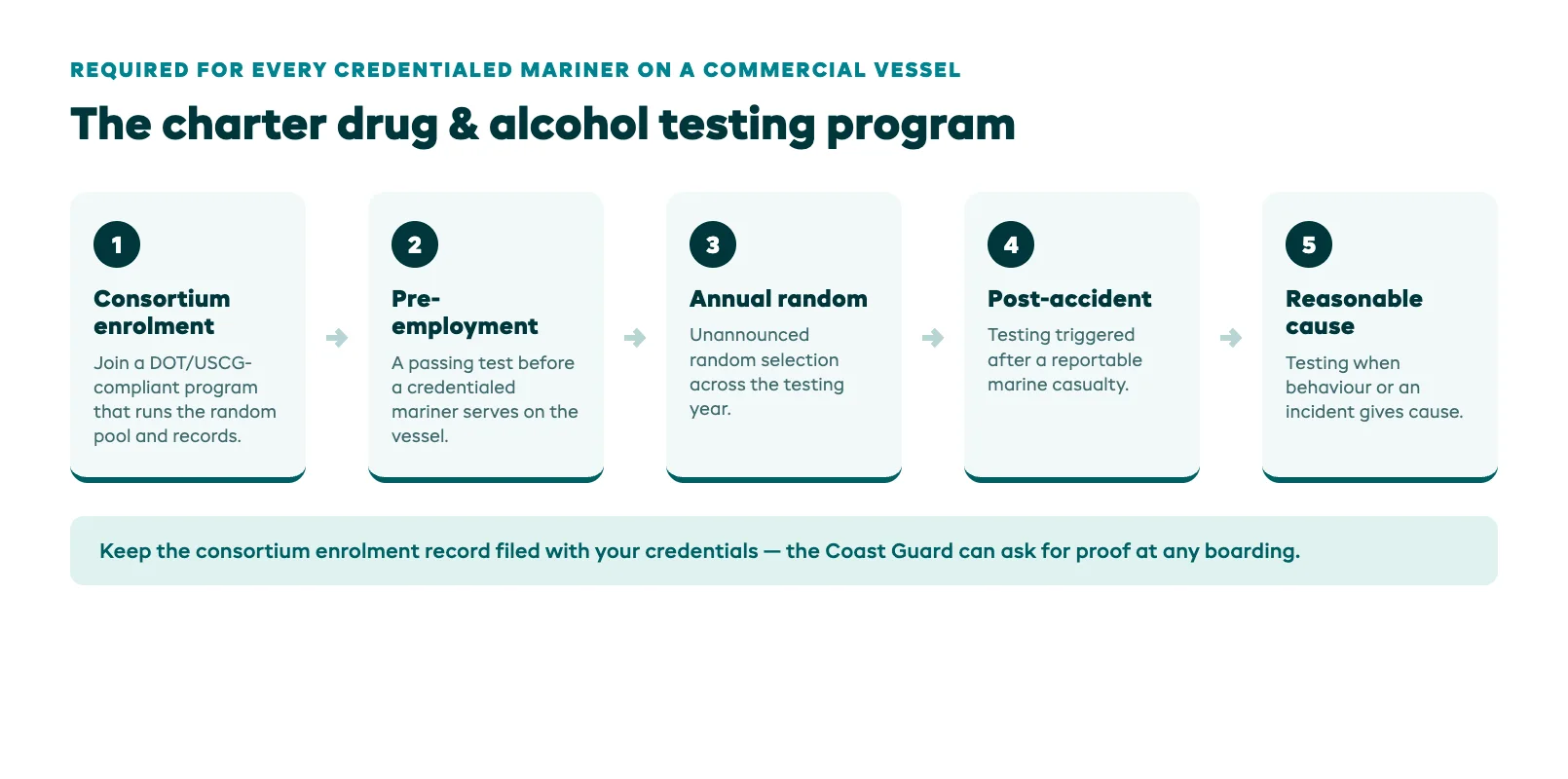
Federal drug and alcohol testing isn't optional for credentialed mariners, and it's one of the most commonly under-managed parts of charter compliance. Anyone holding a USCG credential and serving on a commercial vessel must be enrolled in a DOT/USCG-compliant random drug-testing program, typically through a third-party consortium that handles the random selection pool and record-keeping for small operators who can't run a program alone.
The program is more than the pre-employment test most people picture. It includes random testing across the year, post-accident testing after a reportable marine casualty, reasonable-cause testing, and the alcohol rules that prohibit operating within set hours of drinking and above defined limits. The Coast Guard can and does ask for proof of program enrolment, so the consortium paperwork belongs in the same file as your credentials.
For a solo operator this feels like bureaucracy, but it's cheap insurance: enrolment costs little, and being able to produce a clean program record after an incident is exactly the kind of documentation that protects your license, your insurance claim, and your defense if anything ever goes wrong on the water.
Safety Equipment Compliance
Carriage requirements — the safety gear the law says must be aboard — scale with your vessel and your passenger count, and they're checked both at COI inspection and at any dockside boarding. Even an uninspected 6-pack boat has a baseline: a properly sized, accessible life jacket for every person aboard, throwable flotation, fire extinguishers rated and mounted for the vessel, visual distress signals, sound-producing devices, and current navigation lights.
Inspected vessels carry far more, specified on the COI itself — life rafts or floats sized to capacity, additional firefighting systems, first-aid and emergency equipment, and placarded safety information. The detail varies with the boat and route, which is exactly why you operate to the certificate rather than a generic checklist you found online.
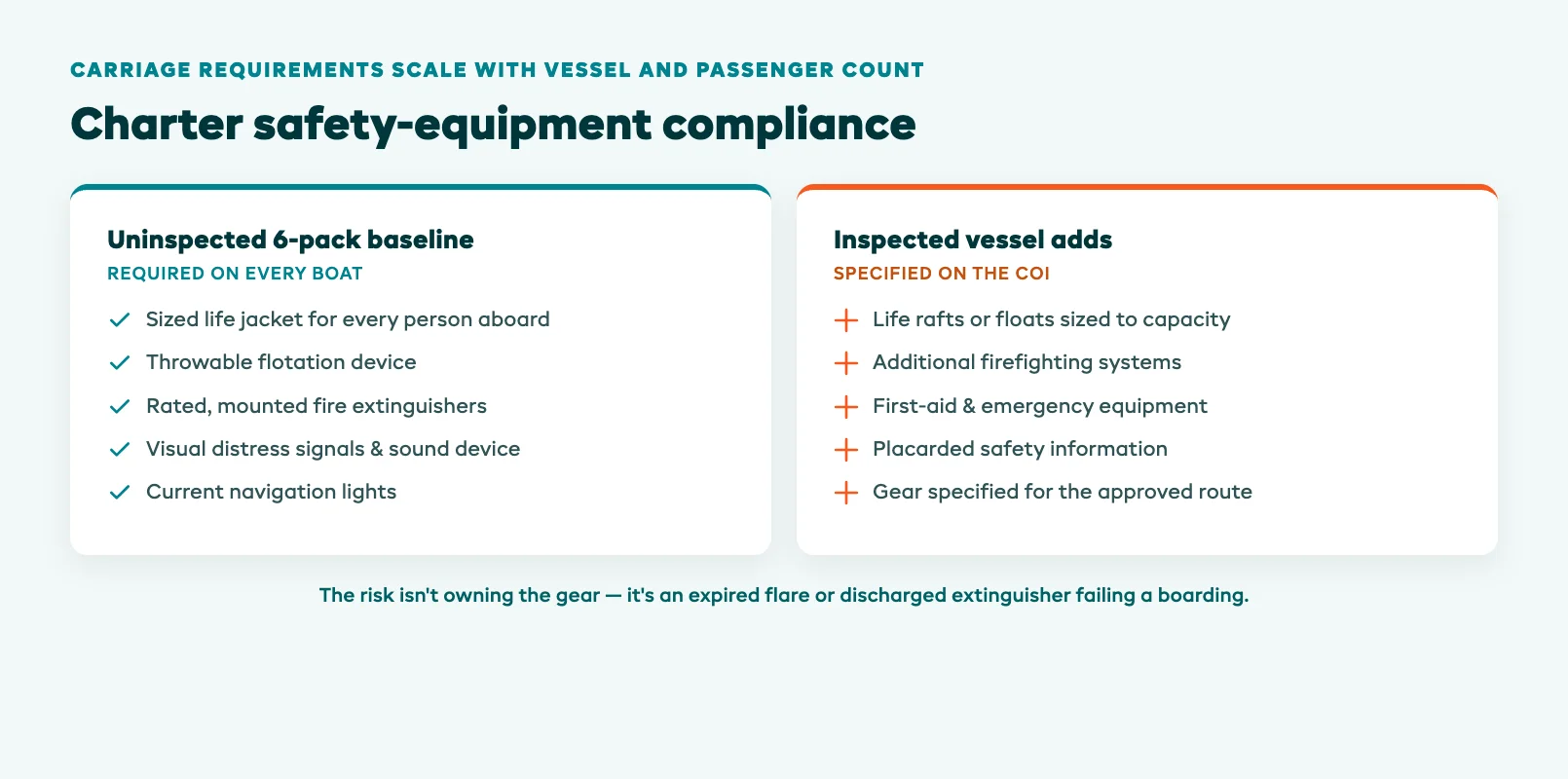
The operational risk isn't usually owning the gear — it's the gear quietly going out of date. Flares expire, extinguishers lose charge, life jackets wear out, and a single expired item can fail a boarding or, worse, an inspection. Treat safety-equipment status as a recurring maintenance task rather than a one-time purchase, and fold it into the same routine that keeps the boat itself ready — a pre-season charter audit and a running charter vessel maintenance log are the simplest way to make sure nothing expires unnoticed.
Inspections and Staying Compliant
There are two kinds of inspection to plan for. The scheduled COI inspection that an inspected vessel passes to earn and renew its certificate, and the unannounced dockside boarding or examination that any commercial vessel — inspected or not — can face from the Coast Guard. The Coast Guard Auxiliary also offers free voluntary vessel exams that are a smart, no-stakes way to confirm you'd pass the real thing.
Passing either comes down to the same thing: current paperwork and current equipment, both retrievable on demand. That means the captain's credential and medical certificate, the drug-program enrolment record, the COI if you carry one, vessel documentation or state registration, and in-date safety gear. Operators who keep this organized treat a boarding as a non-event; operators who scramble for an expired flare and a missing certificate turn a routine check into a day off the water.
Compliance isn't a single milestone you clear and forget — it's a calendar. Credentials renew, medical certificates expire, the COI comes up for renewal, drug-program records roll over, and safety gear ages out on its own schedule. The operators who never get caught out are the ones who track every expiry date in one place instead of discovering a lapse the morning of a peak-season charter.
Building Compliance Into Your Operation
The federal rules are fixed, but how you stay on top of them is up to you — and for most operators the failure mode isn't ignorance, it's a missed renewal or a waiver that never got signed. A charter generates the same compliance touchpoints on every single trip: a passenger count that has to stay inside your authorized limit, a waiver collected before anyone boards, and a captain whose credential matches the boat that day. Trying to hold all of that across a paper diary, a phone, and a separate waiver app is exactly where compliant operators slip into non-compliance without noticing.
A booking system built for passenger-carrying operations keeps the compliance layer attached to the booking itself: it caps each trip at your legal passenger limit so you can't over-sell a 6-pack boat, collects the signed waiver before the guest reaches the dock, and assigns the right captain to the right vessel. EquipDash brings those pieces together so a confirmed booking automatically holds the boat, requests the waiver, and lands on the assigned captain's schedule — and a waiver-chaser agent follows up the stragglers before departure so nobody boards unsigned. When you're ready to go deeper on captains, scaling, and seasonality, the charters operator hub maps the whole operation, and our guide to starting a fishing charter business walks the first-year path from licensing to break-even. Because the captain credential and the vessel certificate have to agree on every trip, our guide to building a captain bench covers how to match endorsements to boats across a roster without ever assigning an under-licensed captain.
Compliance done well is invisible to your customers and decisive for your business. Get the credential ladder right, keep the paperwork and gear current, and a USCG boarding becomes one more routine part of a well-run operation instead of the thing that ends it.
FAQ
What is a USCG 6-pack license?
The "6-pack" is the informal name for the USCG OUPV (Operator of Uninspected Passenger Vessels) credential. It authorizes a captain to carry up to six paying passengers on an uninspected vessel under 100 gross tons, which covers most small fishing, dive, and sightseeing charters. To earn it you document sea time, pass an approved captain's course and written exam, hold a TWIC card and medical certificate, and enroll in a random drug-testing program. Carrying a seventh paying passenger requires both an inspected vessel with a COI and a higher-tier Master license.
When does a charter boat need a Certificate of Inspection (COI)?
A charter vessel needs a USCG Certificate of Inspection the moment it carries more than six paying passengers. The COI certifies that the boat has passed a formal inspection of its hull, stability, firefighting and lifesaving equipment, and crewing, and it specifies exactly how many passengers the vessel may carry, the waters it's approved for, the minimum crew, and the required safety gear. Operating an uninspected boat with seven or more paying passengers is a serious compliance violation, so any business planning larger groups should budget for an inspected vessel from the start.
What is the difference between a 6-pack and a 100-Ton Master license?
The 6-pack (OUPV) caps you at six paying passengers on an uninspected vessel, while a Master license authorizes you to command an inspected passenger vessel carrying more than six guests. The tonnage on the Master — 25, 50, or 100 gross tons — sets the size of vessel you can run, with the 100-Ton Master being the common target for growing charter operations. The Master requires more sea time and a deeper examination than the OUPV. The key rule is that the captain's credential must match the vessel's COI for both tonnage and passenger count.
Do charter captains need to be in a drug-testing program?
Yes. Any mariner holding a USCG credential and serving on a commercial vessel must be enrolled in a DOT/USCG-compliant random drug-testing program, usually through a third-party consortium that manages the random pool and record-keeping for small operators. The program covers pre-employment, random, post-accident, and reasonable-cause testing, plus alcohol limits on operation. The Coast Guard can request proof of enrolment during a boarding, so keep the consortium records with your credentials.
What safety equipment does a charter boat legally need?
Carriage requirements scale with the vessel and passenger count. Even an uninspected 6-pack boat must carry a properly sized life jacket for every person aboard, throwable flotation, mounted fire extinguishers, visual distress signals, a sound-producing device, and current navigation lights. Inspected vessels carry more — life rafts, additional firefighting systems, and emergency equipment — all specified on the COI. The biggest practical risk is gear expiring unnoticed, so treat flares, extinguishers, and life jackets as recurring maintenance items rather than one-time purchases.
What happens during a USCG dockside boarding?
The Coast Guard can board any commercial vessel, inspected or not, to verify compliance. They'll typically check the captain's credential and medical certificate, drug-program enrolment, vessel documentation or registration, the COI if the boat carries one, and that all required safety equipment is aboard and in date. Operators who keep current paperwork and gear retrievable on demand treat a boarding as a non-event. The Coast Guard Auxiliary also offers free voluntary vessel exams, which are a low-stakes way to confirm you'd pass a real boarding before it happens.
in one place