Experiences vs Rentals — What's the Difference?
EquipDash has two core product types: Experiences and Rentals. They handle very different business models, and understanding the difference helps you set things up correctly. Many businesses use both — for example, a kayak shop that rents out kayaks (rental) and also runs guided kayak tours (experience).
Side-by-Side Comparison
| Feature | Experiences | Rentals |
|---|---|---|
| What it is | A scheduled activity, tour, or event | An on-demand equipment hire |
| Scheduling | Fixed time slots (sessions) | Flexible date and time ranges |
| How customers book | Pick a session from available slots | Pick a start date/time and end date/time |
| Pricing model | Per person or per group | Per product, per time period |
| Capacity | Limited participant spots per session | Limited by number of inventory units |
| Staff involvement | Guides can be assigned to sessions | No staff assignment |
| Inventory tracking | Not applicable | Track individual units, condition, and maintenance |
| Workshop | Not applicable | Send items for repair/maintenance |
| Barcodes | Not applicable | Scan barcodes for quick check-in/out |
| Examples | Guided hike, sunset tour, cooking class, snorkelling trip | Bike hire, ski rental, surfboard hire, camping gear |
When to Use an Experience
Use an experience when the offering:
- Runs at a set time — There is a specific start time (and usually end time) that everyone attends together.
- Has a participant limit — Only a certain number of people can join each session.
- May need a guide — A staff member leads or facilitates the activity.
- Is priced per person or per group — You charge based on how many people attend, not on equipment.
Examples:
- A 2-hour guided kayak tour at 9:00 AM with space for 12 people
- A sunset sailing trip every evening with a captain and 8 passenger spots
- A cooking class on Saturday mornings for groups of up to 6
When to Use a Rental
Use a rental when the offering:
- Has flexible timing — The customer picks when they want to start and finish.
- Involves physical equipment — You are lending out items that need to be tracked and returned.
- Is priced by duration — You charge by the hour, day, or other time period.
- Requires inventory management — You need to know how many units are available, which ones are out, and when they are coming back.
Examples:
- Renting a mountain bike for the weekend
- Hiring a stand-up paddleboard for 2 hours
- A weekly camping gear rental
Can I Use Both?
Absolutely. Many EquipDash customers use both product types. For example:
- A surf school might rent out surfboards (rental) and run surf lessons (experience).
- A bike touring company might rent bikes (rental) and offer guided rides (experience).
- A watersports centre might rent kayaks and paddleboards (rentals) while running snorkelling tours and diving courses (experiences).
Each product type has its own section in the sidebar, its own booking flow, and its own settings. Bookings can include rental items, experience sessions, or both.
You can also sell physical products through the Store module -- think accessories, merchandise, and maintenance kits. Store products can be sold standalone through the store widget or offered as add-ons alongside rentals and experiences.
How They Appear in the Booking Widget
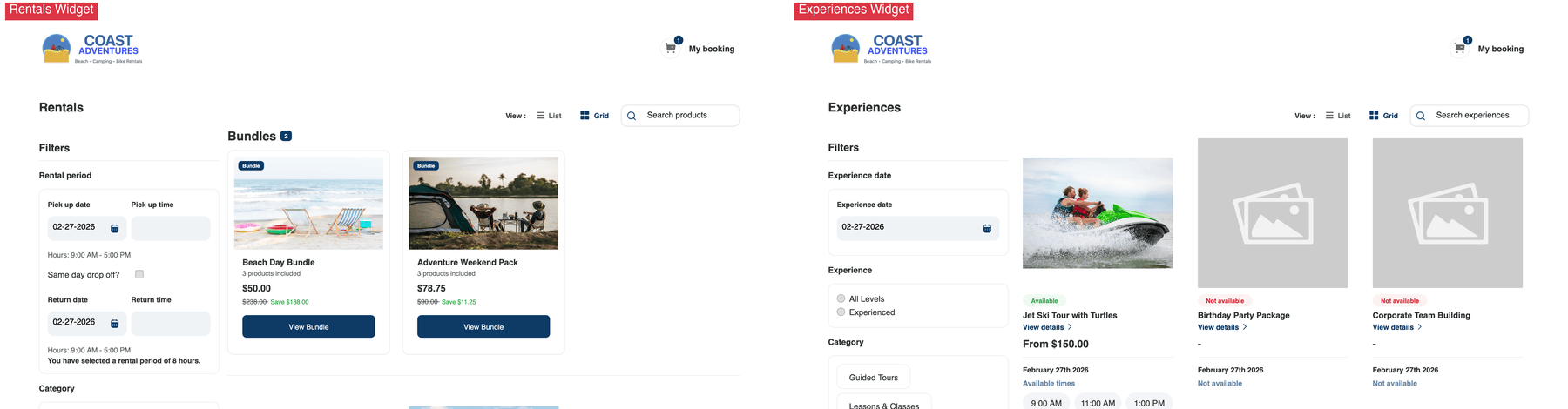
In the Booking Widget, rentals and experiences are presented separately:
- Rentals — Customers browse products, select dates and quantities, and see real-time availability based on inventory.
- Experiences — Customers browse activities, select a session from the available time slots, and choose how many participants of each rate category are attending.
How They Appear on the Calendar
The Calendar has separate views for rentals and experiences:
- The Rental Calendar shows products booked across date ranges.
- The Experience Calendar shows sessions as time-slot entries with participant counts and guide assignments.
Key Differences in Setup
| Setup Area | Experiences | Rentals |
|---|---|---|
| Pricing | Per person (rate categories) or per group | Per product, based on pricing templates and duration |
| Availability | Manual sessions or recurring schedule | Automatic based on inventory count |
| Categories | Experience categories | Product categories |
| Inventory | Not applicable | Inventory units per product |
| Bundles | Not applicable | Bundle multiple products together |
Still Not Sure?
A simple test: Does the customer come to an event at a specific time, or are they borrowing something for a period they choose?
- Specific time with other people = Experience
- Borrowing for a chosen period = Rental
If your offering has elements of both (e.g. a guided bike tour where the customer also hires a bike), you can set up the tour as an experience and the bike as a rental. EquipDash handles mixed bookings.