Guide Scheduling and Trail Group Sizes for Off-Road Tours
Guide Scheduling and Trail Group Sizes for Off-Road Tours
Every off-road tour lives or dies on two numbers: how many riders sit behind one guide, and how you space those groups on the trail. Get them right and a tour flows — riders stay together, stops are quick, the trail clears cleanly for the next group. Get them wrong and you get a strung-out line of lost riders, a viewpoint jammed with three groups at once, and a guide radioing back to find the straggler who missed a turn.
None of that is bad luck. It is scheduling. This guide covers how experienced off-road operators set their ratios, run lead and sweep, cap group sizes, stagger departures, and build a roster that survives a busy Saturday and the occasional sick call. If you are still building the wider operation, start with the complete guide to running an off-road tour business and use this as the deep dive on staffing the trail.
Start with your guide-to-rider ratio
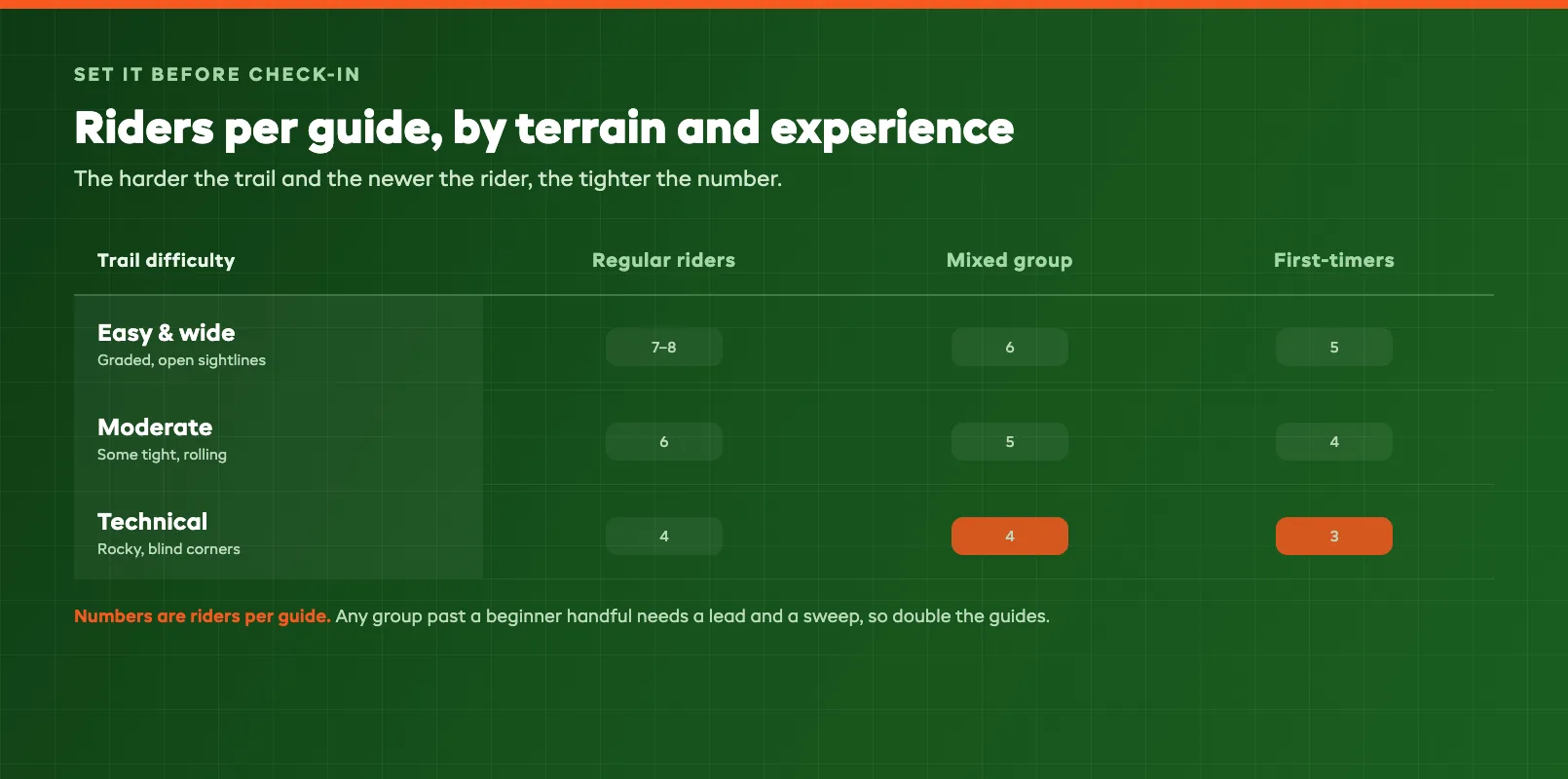
The ratio is the foundation, so set it honestly. One guide can only watch so many machines before the group outruns their eyes. The right number depends on three things: your terrain, your machines, and who is riding.
On wide, graded trails with confident riders, a single guide backed by a sweep can shepherd six to eight riders without much drama. Put those same riders on a tight, rocky, blind-cornered trail and that number has to drop — four riders, sometimes fewer. First-timers on a 400-pound quad need more eyes than a group of regulars who ride every weekend. UTVs with two or three people aboard change the math again, because you are managing fewer machines but more bodies.
Write your ratios down by trail and by rider type instead of eyeballing it at check-in. When a booking comes in for eight beginners on your hardest loop, the schedule should already tell you that is a two-guide job, not a hopeful one-guide gamble.
Lead and sweep: the two roles every group needs
For anything past a tiny beginner group on flat ground, one guide is not enough — not because of the count, but because of the geometry. A single guide can be at the front or the back, never both. The moment someone drops a machine or misses a turn, the guide either abandons the front of the group to help or leaves the rider stranded.
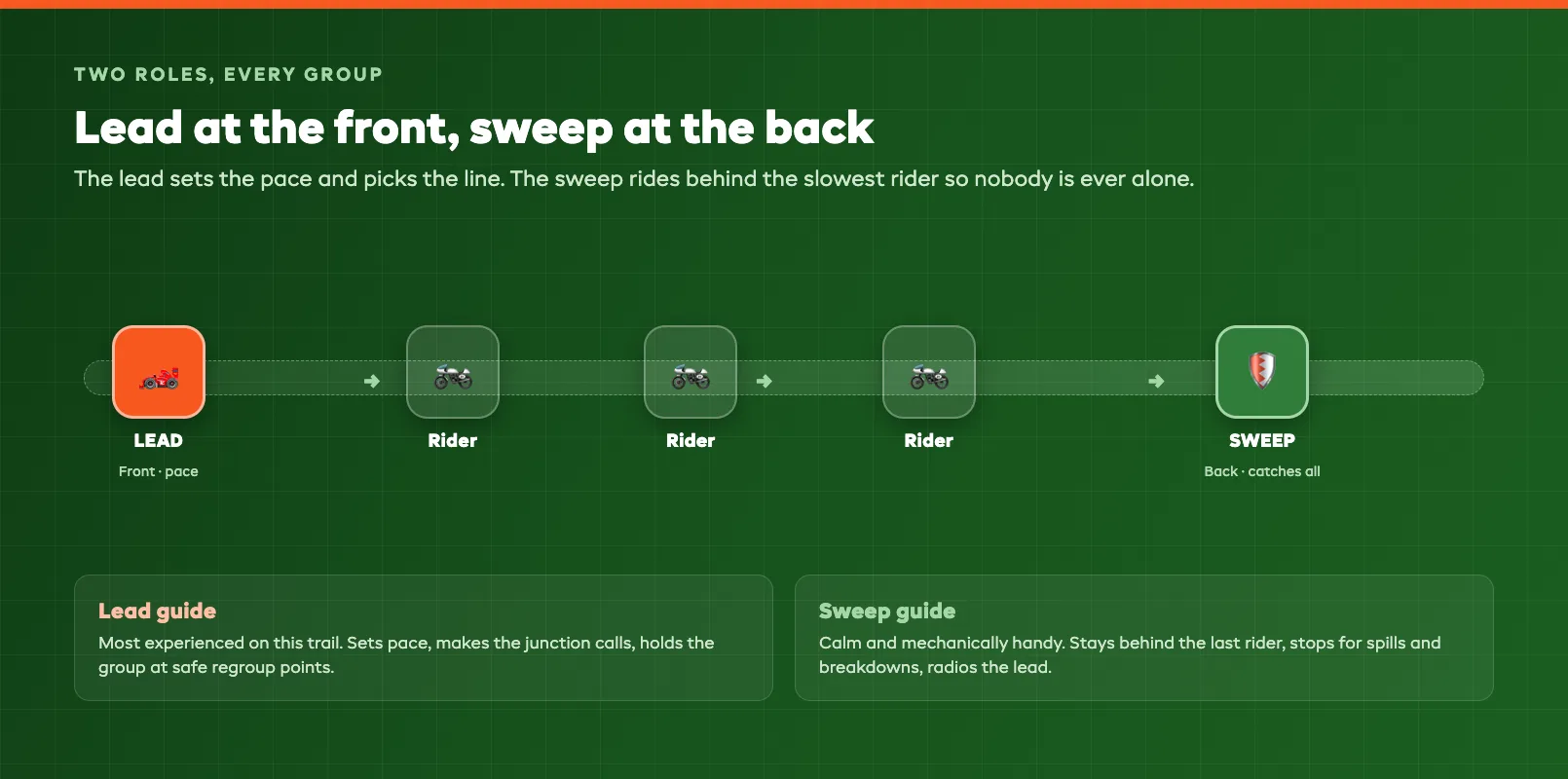
That is why the lead-and-sweep setup is standard. The lead guide rides up front, sets a sensible pace, picks the line, and makes the calls at junctions. The sweep rides at the very back, behind the slowest rider, so nobody is ever unsupervised. If a machine breaks down or a rider tips over, the sweep stops with them while the lead holds the rest of the group at the next safe point.
Both guides need radios and a shared plan for the ride: where the regroup points are, how they signal a stop, and who makes the call to turn a group back. The lead is usually your most experienced guide for that trail. The sweep needs to be calm, mechanically handy, and good with a nervous rider, because that is who they will spend the day next to — and a sweep who can diagnose a stalled machine on the trail saves the whole group. That is easier when your fleet maintenance is tight enough that breakdowns are rare in the first place.
Cap the group size before you sell the seats
Group size is a limit you set once and enforce at booking, not a number you negotiate on the trailhead. Left uncapped, a group grows until it stops working. Ten riders behind two guides is manageable. Eighteen is a parade — the front reaches the viewpoint while the back is still climbing, stops stretch to twenty minutes, and every other trail user has to wait for your convoy to pass.
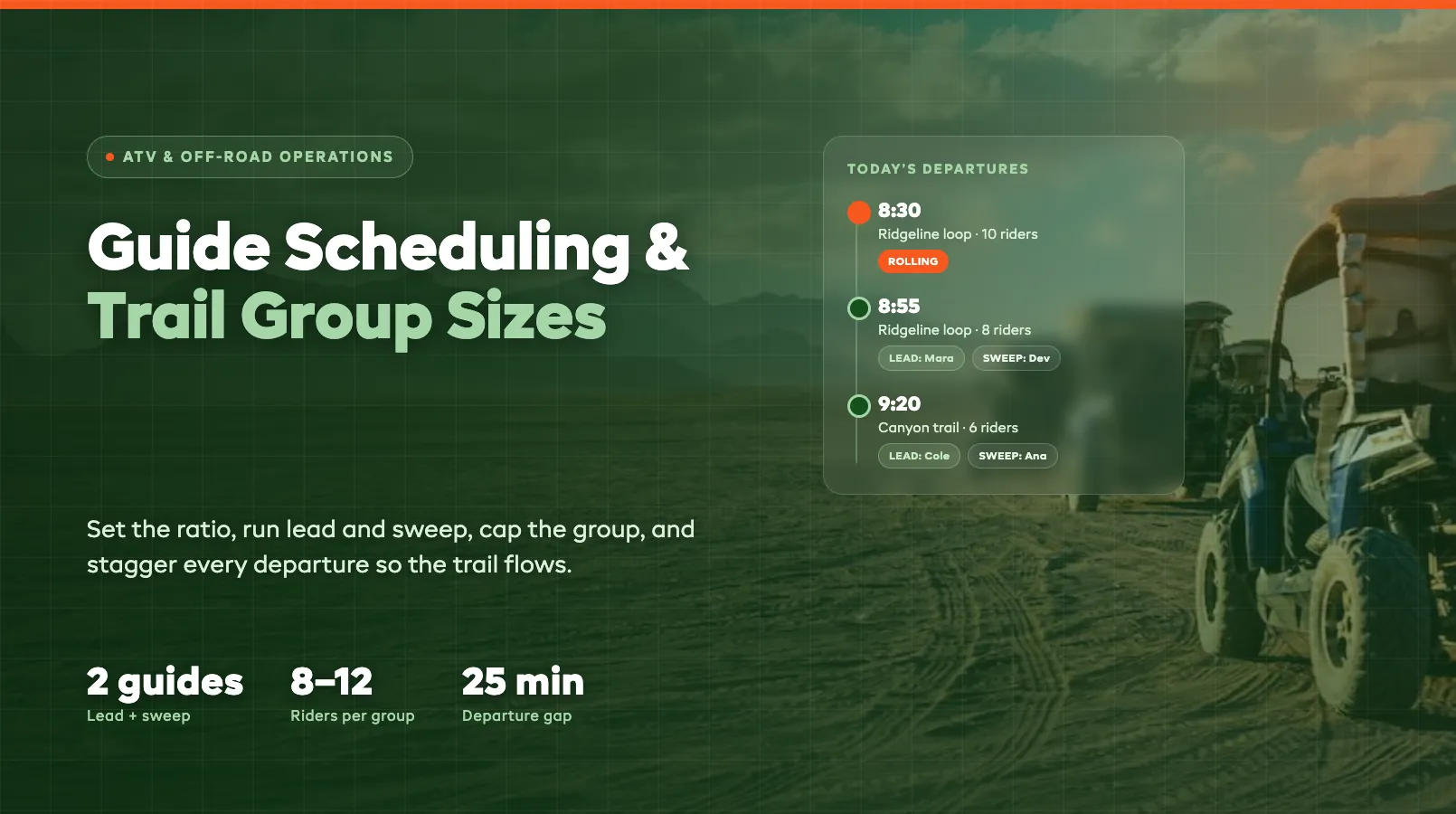
Most off-road operators land somewhere between eight and twelve riders per departure with two guides, then adjust for terrain. Harder trails pull the cap down. Wider, flowing trails let it drift up. The cap should live in your booking software so a departure simply sells out and pushes the next customer to the following slot, rather than a staff member trying to remember the ceiling while the phone rings.
Capping also protects the experience you are selling. People pay for a ride through the backcountry, not for standing around waiting for a group of sixteen to sort itself out. A tight, well-sized group moves better, feels more personal, and gets better reviews.
Stagger departures so the trail flows
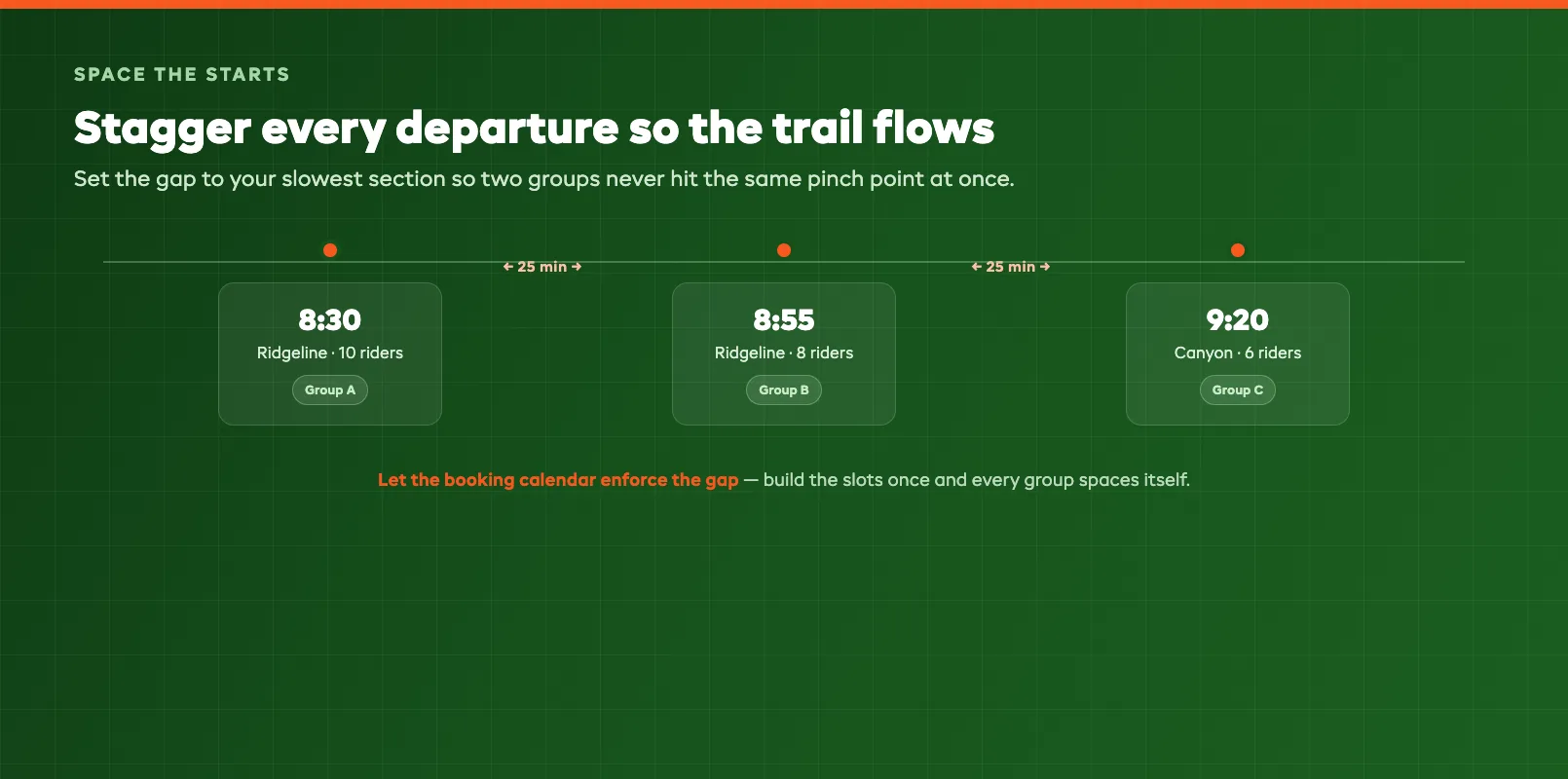
Even with capped groups, running them back to back creates a jam. If three groups roll out ten minutes apart onto the same loop, they will stack up at the first narrow section and spend the day leapfrogging each other. Staggering fixes it.
The idea is simple: space each departure far enough apart that no two groups reach the same pinch point at the same time. On a shared loop that often means twenty to thirty minutes between starts, but the right gap depends on your slowest section. Time how long a group takes to clear your tightest bottleneck, then make the departure gap at least that long.
Staggering also smooths your operation on the ground. Check-ins, waivers and safety briefings, and machine hand-offs spread across the morning instead of forty riders arriving at once. Your booking software should enforce the gap automatically — build departure slots at the right interval and the calendar does the spacing for you, instead of a dispatcher guessing.
Build a roster that survives peak season
Once ratios, roles, and departures are set, scheduling becomes a matching problem: put the right guides on the right departures without burning anyone out. That is the roster.
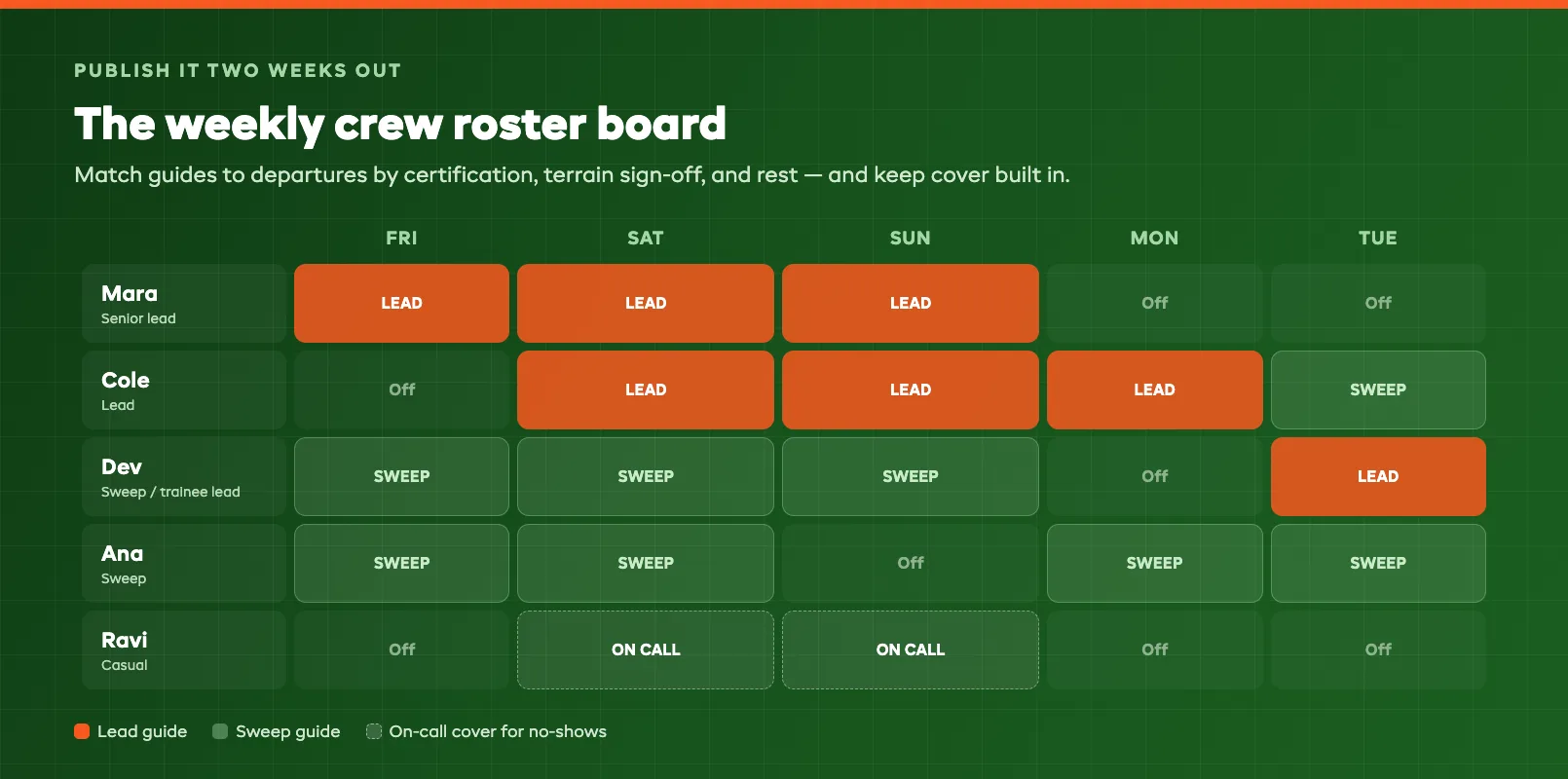
Match guides to departures on more than availability. A technical morning loop needs a lead who knows that trail cold, not whoever happened to be free. Track each guide's certifications, terrain sign-offs, and machine familiarity so the schedule respects them. Watch rest too — a guide who led three back-to-back tours yesterday should not open the hardest trail at dawn.
Publish the roster early. In peak season, guides plan their lives around your schedule, and a roster that appears the night before guarantees gaps and grumbling. Lock the coming week by mid-week and give guides a way to see it from their phones. Good booking and scheduling software puts the departures, assignments, and open slots in one view, which is where a Dash Agent can quietly flag an unstaffed departure before it becomes a Saturday problem.
Plan for no-shows and last-minute cover
Guides get sick, machines break, and a group of ten books the same slot a guide just called out of. The operators who stay calm are the ones who planned for it before it happened.
Keep an on-call guide on your busiest days — someone rostered to be reachable and ready, paid for the standby. Cross-train so more of your team can lead a trail, not just sweep it, which widens the pool you can pull from when someone drops. And set clear swap rules so guides can trade shifts without every change routing through you.
When a gap does open, speed matters. A schedule you can see at a glance — who is working, which departures are covered, where the hole is — turns a panic into a two-minute reshuffle. If cover truly is not there, it is better to cap a departure smaller or merge two small groups within your ratio than to send a group out short-staffed. The ratio is a safety line, not a suggestion.
Ramp your crew up and down with the season
Off-road demand rarely holds steady. Most operators have a shoulder, a peak, and a quiet stretch, and the guide roster has to breathe with it. Staffing for peak all year bleeds money; staffing for the average leaves you scrambling every busy weekend.
Map your season before it starts. Look at last year's booking curve, mark the weeks where departures double, and hire and train ahead of them — not during them. New guides need weeks of shadowing as sweep before they lead, so a guide you recruit in peak week is useless for that peak. Bring them on in the shoulder so they are trail-ready when it counts.
On the way down, protect your best people. Give your strongest guides the steadier hours through the quiet stretch so they are still around next season, and lean on casual or part-time crew for the swings. A roster that ramps with the calendar keeps you covered on the big weekends without carrying a full crew through the slow ones.
Putting it together
Guide scheduling is not one decision — it is a chain. Your ratio sets the group size. The group size and your trail set the departure gap. The departures set the roster. The roster needs cover built in, and the whole thing scales with the season. Break one link and the rest wobbles: a ratio nobody enforces means oversized groups, which means jammed trails, which means bad reviews.
Get the chain right and the payoff is a tour that runs itself on a busy day. Groups leave on time, stay together, clear the trail cleanly, and come back happy — while you spend the morning running the business instead of chasing a lost rider up a fire road. Set your numbers, put them in a system that enforces them, and let the schedule do the heavy lifting.
For more on running the operation end to end, see our ATV and off-road tour hub, and check the off-road glossary if any of the terms here are new.
FAQ
How many riders can one guide safely handle off-road?
On easy, wide trails with a lead and a sweep, many operators run up to about six to eight riders per guide. On technical terrain or with first-timers, tighten that to four or fewer. Your terrain, machine type, and rider experience set the real number.
Do I always need two guides on a tour?
For anything beyond a tiny group on flat ground, yes. A lead sets the pace at the front and a sweep stays at the back, so nobody rides unsupervised or gets left behind after a spill or breakdown.
What is a good maximum group size for an off-road tour?
Most operators cap a single departure between eight and twelve riders with two guides. Bigger than that and the group strings out, stops take forever, and the trail clogs for other users. Harder terrain pulls the cap lower.
How far apart should I stagger departures?
Enough that two groups never reach the same pinch point at once — often twenty to thirty minutes on a shared loop. Time how long a group takes to clear your slowest section and make the gap at least that long.
How do I cover a guide who calls in sick?
Keep an on-call guide during peak days, cross-train so more staff can lead a trail, and set clear swap rules. Booking software that shows the roster and open departures at a glance makes the reshuffle fast instead of frantic.
How early should I publish the guide roster?
At least two weeks out in season so guides can plan around it and you spot gaps early. Lock the coming week by mid-week, and only adjust after that for genuine changes rather than constant tinkering.
in one place