Running Multi-Guide Tour Operations: Training, Scheduling, Consistency
You ran every tour yourself for the first year. You knew the script, the timing, the jokes that land at stop three. Then you hired a second guide. Reviews dropped from 4.9 to 4.4 within a month. Guests started writing "the tour was fine but our guide seemed new."
That is what happens when a tour operator scales without building the systems that make consistency possible. When you have three, five, or twelve guides running the same product, the gap between your best and worst experience becomes your biggest business risk.
This guide covers seven operational patterns that separate multi-guide tour operations that scale from those that collapse. For the full tour business playbook, see How to Run a Tour Operator Business. For pricing structures across your guide team, see Tour Pricing Strategy.
Guide Hiring: Screen for What You Cannot Train
Most tour operators hire for subject knowledge and hope the rest follows. It rarely does. You can teach someone the history of your city in two weeks. You cannot teach them to project their voice or read when a group is losing interest.
Where to find candidates. Local theater and improv communities. University tourism programs. Retired professionals with deep local knowledge. Other tour companies — guides move around. Hospitality workers who are already good at reading rooms and managing groups.
Run a 15-minute audition. Give candidates a one-page script on a random topic and ask them to present it. Watch for energy, eye contact, pacing, and how they handle a planted question from someone pretending to be confused. Screen for the unteachable: presence, charisma, and the ability to recover when things go sideways.
Red flags. Candidates who talk about themselves more than the audience. Anyone who cannot give a specific example of handling an unhappy customer. Guides who show up late to the interview. Arrogance kills guide quality faster than inexperience.
Hiring pace. One new guide at a time. Each requires 2-4 weeks of training and shadowing. If peak season starts in June, your new guide should be solo-certified by May.
Training Curriculum: Build the System, Not the Dependency
A training curriculum turns your personal knowledge into a repeatable system. Without it, every new guide reinvents the tour from scratch.
Build a training manual. Not a word-for-word script: a structured reference covering: talking points for each stop, timing benchmarks, transitions between stops, rain plans, safety protocols, emergency procedures, and customer service escalation paths.
Record your best guide. Film your top performer running the full tour. This video captures pacing, voice modulation, crowd positioning, and the small decisions that are impossible to write down. New guides watch it before their first shadow tour.
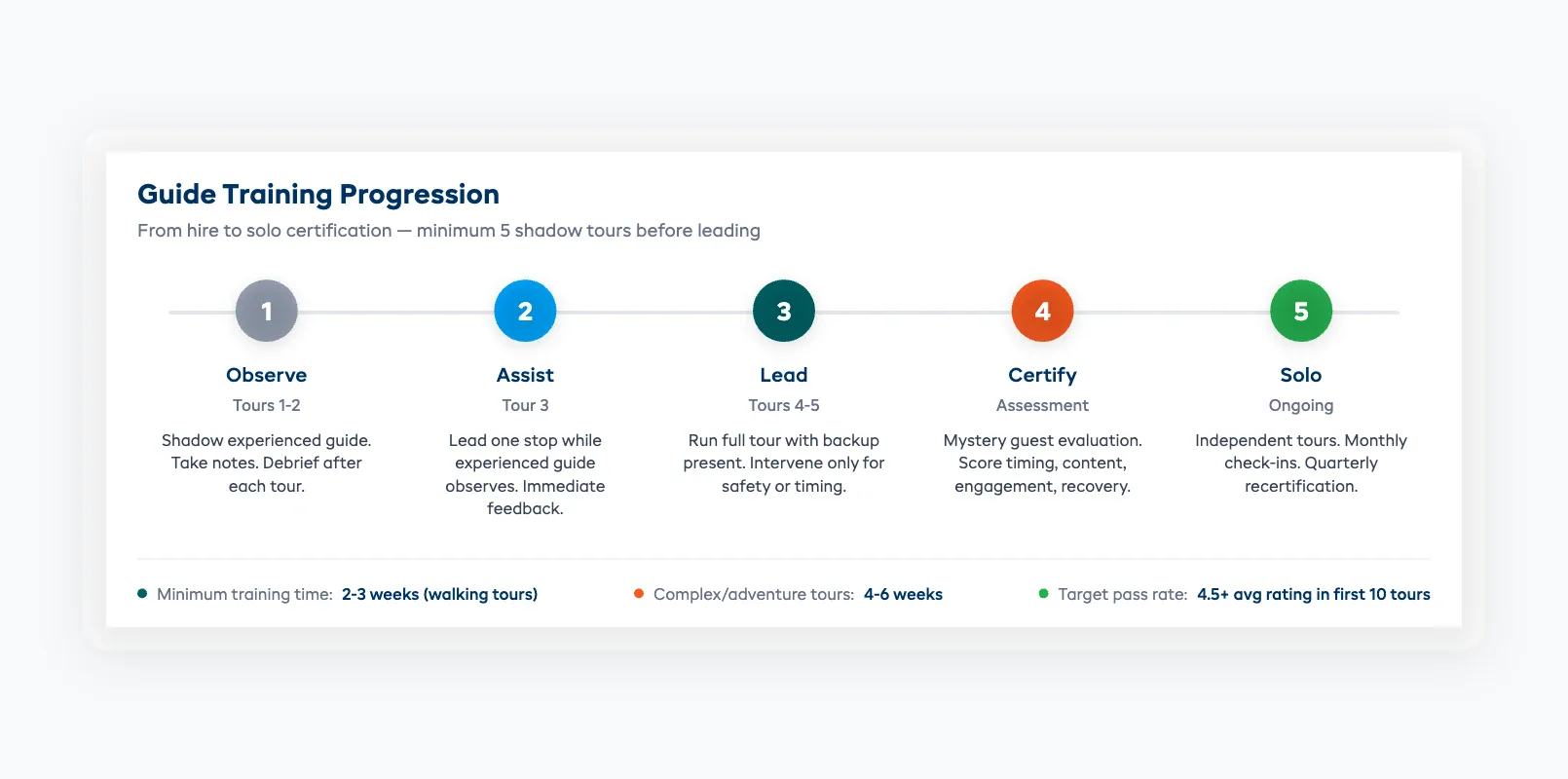
Shadow tour structure. New guides shadow an experienced guide for a minimum of 5 tours:
- Tours 1-2: Observe only. Take notes. Debrief after each tour.
- Tour 3: Lead one stop while the experienced guide observes.
- Tours 4-5: Lead the full tour with backup present. Intervene only for safety or timing.
Certification check. After shadowing, the new guide runs a certification tour scored on: timing accuracy, content accuracy, group engagement, safety protocol adherence, and recovery from a planted disruption. Use the Tour Guide Certification & Training Review template to standardize this.
Ongoing training. Monthly team meetings. Quarterly route walks for seasonal updates. Annual safety recertification. Training never stops.
Quality Consistency: Same Tour, Every Guide, Every Time
Delivering a great tour once is easy. Delivering the same great tour fifty times a week across five guides is what earns a 4.8 rating at scale instead of a 4.3.
Define non-negotiables. The welcome script. The safety briefing. The specific stories at your top three stops. The closing review request. Everything else (ad-libs, personal anecdotes) is guide discretion. Non-negotiables keep the floor high. Discretion keeps tours from feeling robotic.
Mystery guest program. Monthly, have someone book as a regular guest and score the experience. This catches drift — the slow erosion of standards that happens when nobody is watching. Share results privately. Celebrate strengths. Coach gaps.
Review monitoring by guide. Tag each booking to its guide. Track average rating over rolling 30-day windows. A guide dropping below 4.5 needs a ride-along within the week — a support conversation, not a disciplinary meeting.
Standardize the controllables. Uniforms or branded gear. Identical equipment kits (speaker, first aid, wet weather gear). Same meeting point setup: arrive 15 minutes early, exact spot, branded sign.
Scheduling: Fill Guides Without Burning Them Out
Too few guides and you cancel tours. Too many and you pay guides who stand around. The sweet spot requires data.
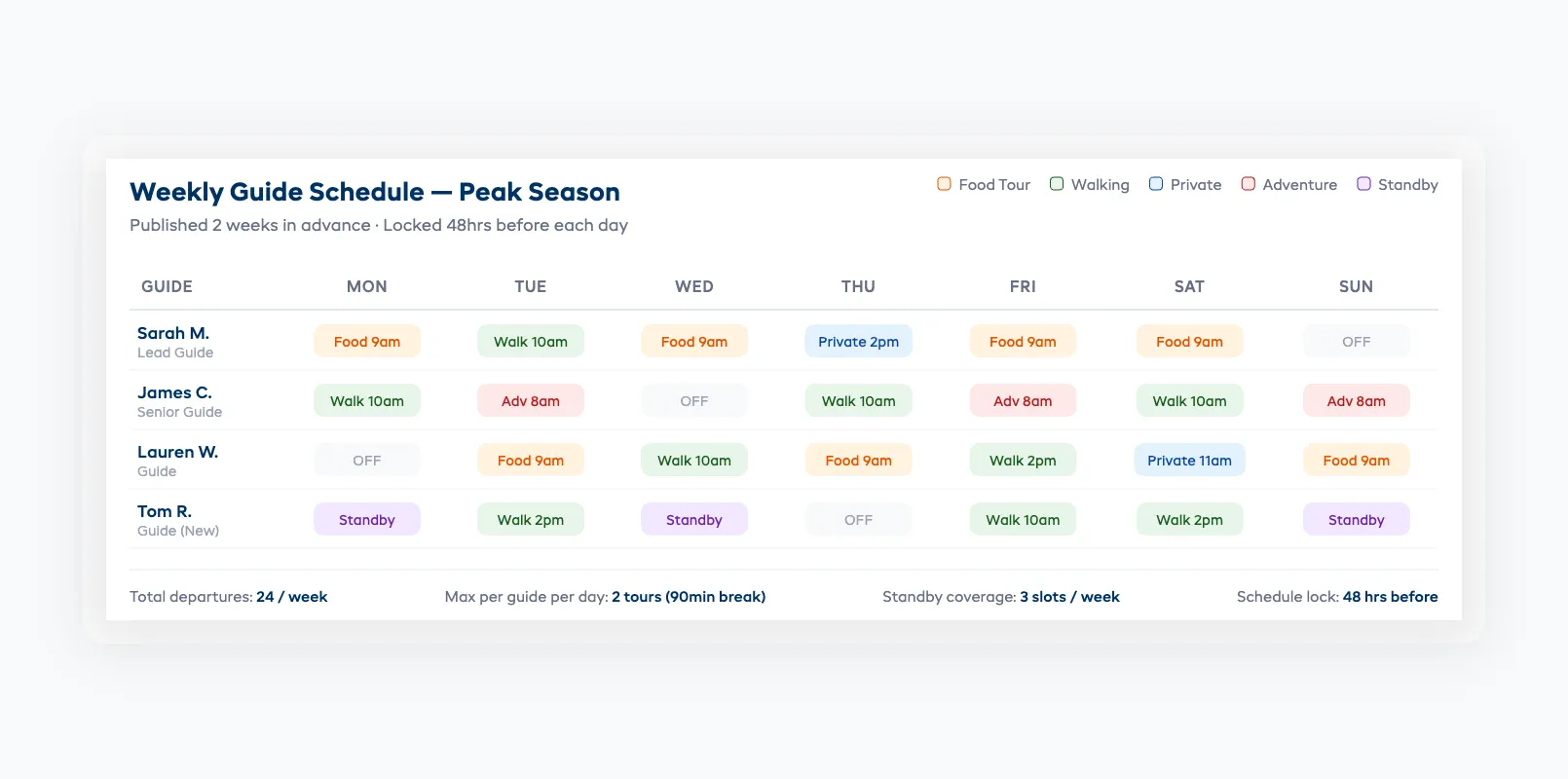
Publish schedules 2-4 weeks in advance. This is the single biggest driver of guide satisfaction. Guides who get called at 7 AM for a 9 AM tour will leave. Lock schedules 48 hours before each day. Changes after lock require guide consent.
Match guides to tour types. Your high-energy guide crushes the pub crawl but struggles with the historical walk. Assign guides to best-fit products. Rotate occasionally to build versatility.
Staff to 80% of expected demand. Use booking data to predict demand by day and slot. You can always add a departure if demand spikes; you cannot un-hire a guide for the day.
Maximum two tours per guide per day with a 90-minute break between. Tired guides give bad tours. Bad tours generate bad reviews. Bad reviews cost more than hiring an extra guide.
Dash AI can automate the matching: feed it booking patterns, guide availability, and certifications. It builds the weekly schedule and flags under-coverage before it becomes a problem.
Guide-Swap and Backup Protocols
A guide calls in sick at 6 AM. The tour departs at 9 AM. Twelve guests have paid. What happens next determines whether you lose $800 in refunds or guests never notice the change.
Maintain a backup roster. Two guides on standby per operating day. Pay a $25-$50 standby fee for on-call availability. It costs less than refunding a full tour.
Cross-train every guide on at least two products. If your food tour guide is the only person who knows the food tour, you have a single point of failure. Schedule cross-training during slow periods.
Swap protocol. (1) Notify the replacement with tour details, guest count, and special requests. (2) Notify guests only if the experience materially changes. (3) Brief the replacement on guest-specific notes. Use the Tour Pre-Departure Check to ensure nothing is missed.
Log every swap. Why it happened, how it was resolved, whether guests were affected. A guide who calls in sick every other Friday is a reliability problem, not a health problem.
Performance Reviews: Measure What Matters
Most tour operators skip formal reviews because they "know" how their guides are doing. They don't. They know how their favorite guide is doing.
Quarterly reviews. 30-minute one-on-ones. Structure: review metrics (average rating, on-time percentage, cancellation rate), discuss 2-3 specific reviews, set one improvement goal, ask the guide what they need from you.
Metrics that matter. Average guest rating by guide (rolling 30 days). On-time start percentage (target: 95%+). Tour completion within time window. Chronic over-runners cost you the next departure.
Tie pay to performance. Guides rating 4.7+ with 95%+ on-time earn rate increases. Training leads earn a premium. Make the path from $100 to $150 per tour visible and achievable.
Handle underperformance quickly. A guide below 4.3 for two months gets a structured improvement plan: ride-along, coaching, 30-day check-in. If no improvement, reduce their schedule before letting them go.
Retention: Keep Your Best Guides From Leaving
Tour guide turnover averages 40-60% annually. Every guide who leaves costs $2,000-$5,000 in recruiting, training, and lost productivity. Retention is one of the biggest cost levers in multi-guide operations.
Predictable scheduling wins loyalty. Ask any guide who left a company why. Most say scheduling, not pay. Publish schedules early. Honour them. Pay a premium for short-notice changes.
Create advancement paths. Guide to Lead Guide to Training Guide to Operations Coordinator. Each level brings higher per-tour rates and genuine input into tour development. A guide with no path forward sees the job as temporary.
Invest in development. Pay for certifications (first aid, wilderness first responder, sommelier for food tours). Fund a quarterly "guide development day" to explore new routes and venues.
Respect their expertise. Guides who run your tours daily know things you don't — a stop under construction, a restaurant that changed its menu, a shortcut that avoids noise. Build a system for feedback. Act on it visibly. Nothing kills engagement faster than being asked for input and then ignored.
For operational checklists, explore the tours hub. For industry terms, see the tour operator glossary. And for the scheduling and booking tools that tie multi-guide operations together, start a free trial.
FAQ
How many guides do I need before building formal systems?
Two. The moment you have a second guide, you need a training manual, a scheduling system, and a quality consistency framework. One guide is a solo operation. Two guides is a business, and businesses need systems.
How long should guide training take before they lead solo?
Minimum 2-3 weeks for a simple walking tour (5 shadow tours, 2 assisted leads, 1 certification tour). Complex or high-risk tours should take 4-6 weeks. Rushing training to fill a schedule gap always costs more in bad reviews than the revenue from one extra departure.
Should I pay guides per tour or hourly?
Per-tour flat rates work best for most small tour operators. They are simple, predictable, and align guide compensation with output. Hourly works for training days and standby time. A hybrid (flat rate per tour + tips) is the most common structure for operators with 3-10 guides.
How do I handle a guide who gets consistently lower ratings?
Start with data. Pull their rating trend over 30-60 days and compare to team average. Schedule a ride-along. Identify the specific gap (pacing, engagement, content accuracy, energy). Set one clear improvement goal with a 30-day check-in. Most underperformance is coachable. If ratings do not improve after two coaching cycles, reduce their schedule.
What is the biggest mistake operators make when scaling to multiple guides?
Assuming their guides will deliver the tour the same way they do without formal systems. The founder's institutional knowledge lives in their head, not in a document. The fix is building a training manual, recording a reference tour on video, and running a structured shadow program before any guide leads solo.
How do I prevent guides from freelancing for competitors?
Non-compete clauses are hard to enforce for hourly workers. Instead, make your operation the best place to work: predictable scheduling, fair pay, advancement opportunities, and genuine respect. Guides who feel valued do not moonlight. Guides who feel replaceable do.
in one place