Tour Pricing: Small Group, Private, and Seasonal Dynamic Rates
You run a food tour. You charge $69 per person. A couple pays $138 for a 3-hour experience. A private group of 8 would happily pay $800 for the same tour with no strangers, but you never offered the option, so they booked your group departure at $552 instead. A corporate team of 20 wanted a team-building outing and would have paid $2,400 for a custom package, but they saw only a per-person price and went with a competitor who quoted a flat group rate.
That is what happens when a tour operator runs one price for every customer. Different groups have different willingness to pay, different expectations, and different booking patterns. A tiered pricing strategy captures those differences without adding capacity, guides, or equipment.
This guide covers the six pricing layers that separate operators who struggle from operators who thrive: base tour pricing, small-group premiums, private tour rates, seasonal adjustments, corporate and group tiers, and dynamic pricing rules. For the full business playbook, see How to Run a Tour Operator Business. For operational checklists and templates, visit the tours hub and the tour operator glossary.
Base Tour Pricing: Know Your Floor Before You Build Tiers
Every pricing decision starts with knowing what a tour actually costs to run. Most operators guess, and they guess low.
Calculate your true cost per departure. Add up: guide pay (including travel time), insurance allocation per tour (divide your annual premium by expected tour count), permit fees per departure, transport costs (fuel, tolls, parking, vehicle depreciation), any inclusions (food, drink, entry tickets, equipment), booking platform fees, credit card processing (2.5-3.5%), and overhead allocation (rent, phone, software, admin time). Divide the total by your minimum viable group size — the smallest group you will run without canceling. That is your price floor.
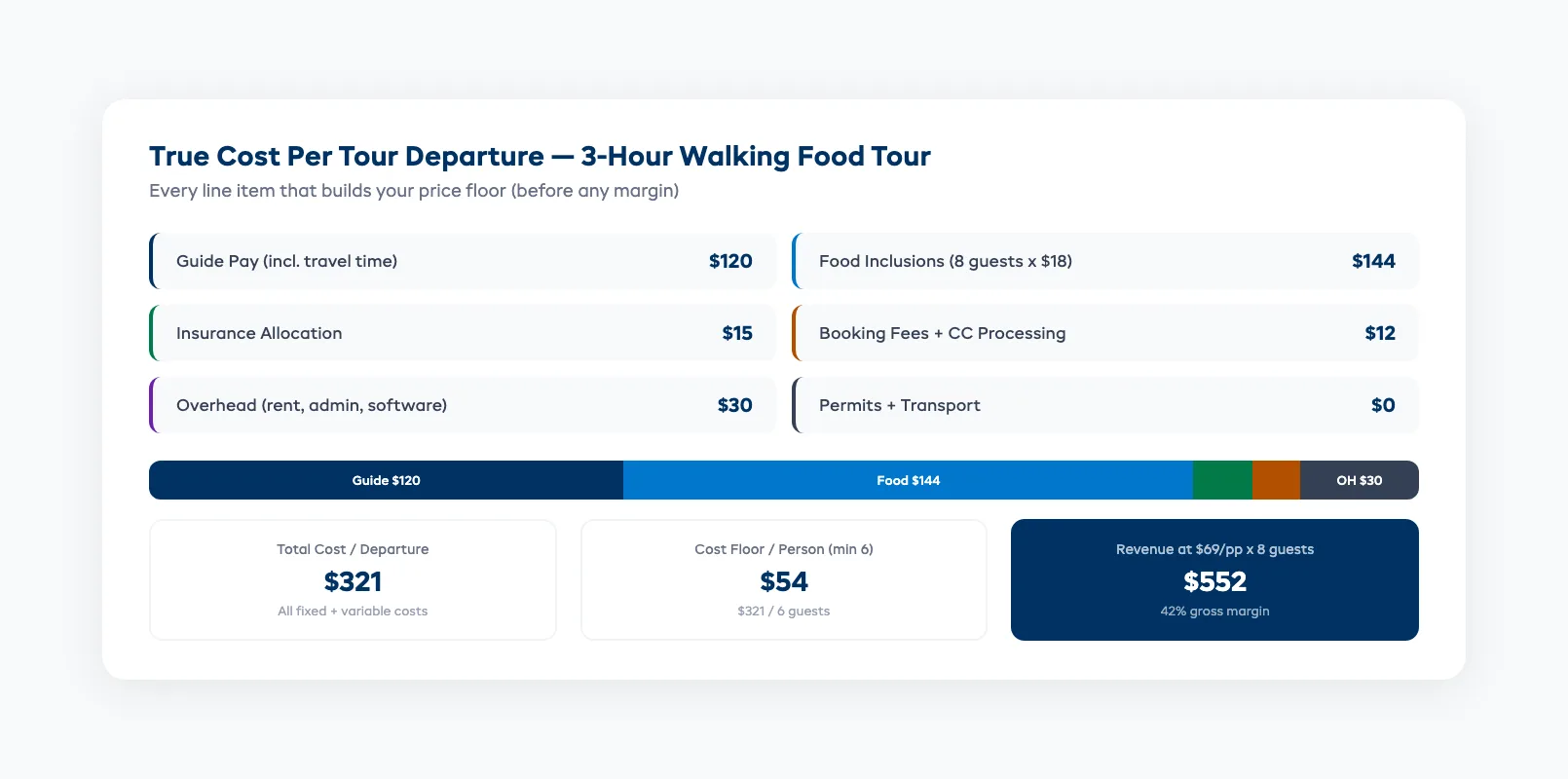
Example. A 3-hour walking food tour costs: guide pay $120, food inclusions $18 per person (for 8 guests = $144), insurance allocation $15, booking fees $12, overhead allocation $30. Total: $321. Minimum group size: 6. Cost floor per person: $54. At a $69 per-person price with 8 guests ($552 revenue), your gross margin is 42%. That is healthy. At 6 guests ($414 revenue), margin drops to 22% — survivable but tight.
Margin target: 35-55% gross margin on your base rate. Below 35% means one bad-weather cancellation or a short-booking day wipes out your margin for the week. Above 55% means you have room for seasonal discounts and group pricing without dipping below your floor.
Benchmark, but compare apples to apples. Pull competitor pricing for similar tours in your area. Check what is included at each price point. A $55 competitor tour that excludes food tastings is not cheaper than your $69 tour that includes them. It is just priced differently. Customers compare what they get, not just what they pay.
Small-Group Premiums: Fewer Strangers, Higher Price
Small-group departures are the easiest margin upgrade in tour operations. The product is nearly identical (same route, same guide, same duration) but the customer experience feels premium because there are fewer people.
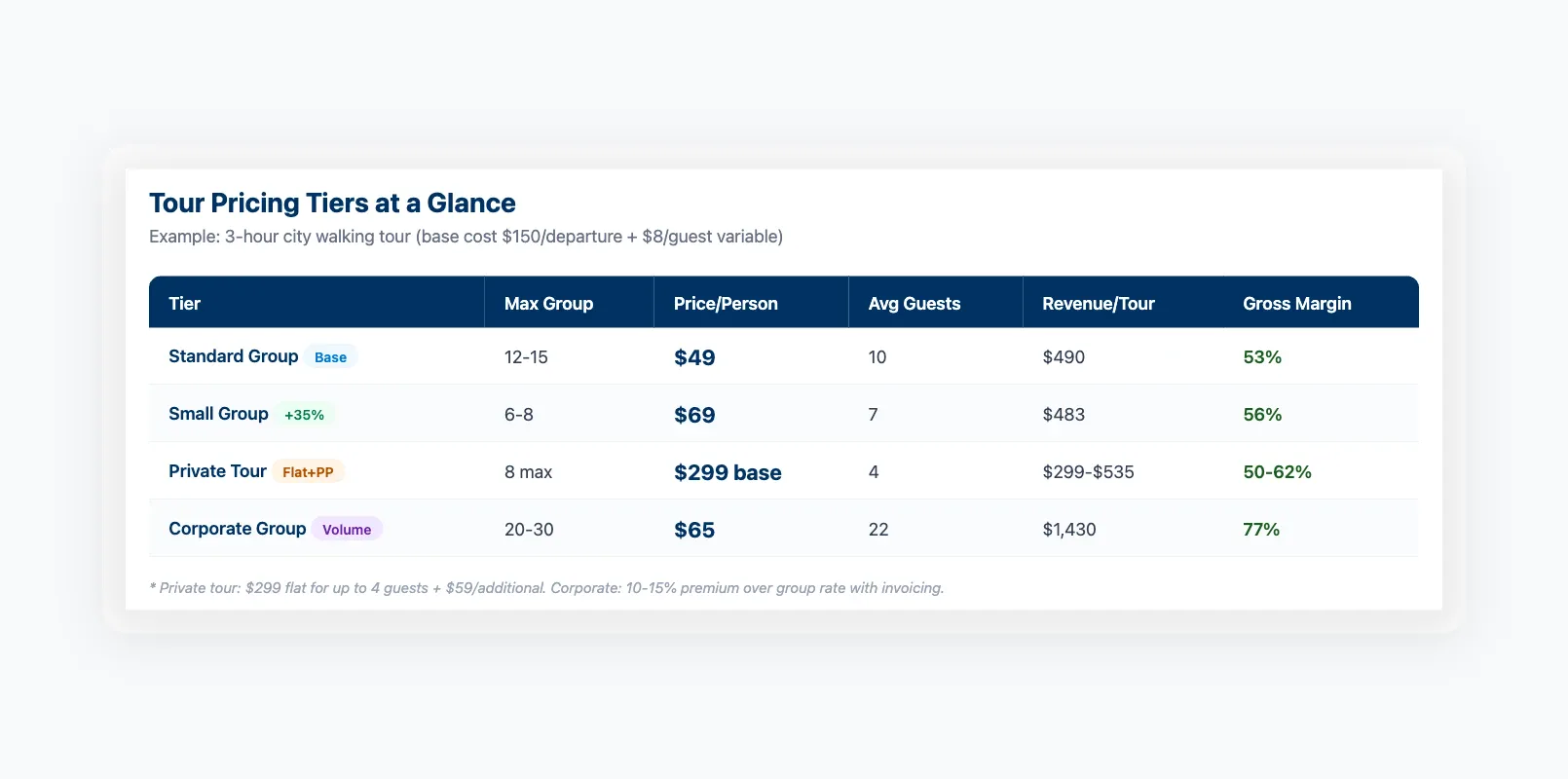
Standard group vs. small group. A standard departure might cap at 12-16 guests. A small-group departure caps at 6-8. The per-person price increases 20-35% for the smaller group because the customer gets more guide attention, less waiting at stops, and a more intimate experience.
The math works even with fewer seats. Standard tour: 12 guests at $69 = $828. Small-group tour: 8 guests at $89 = $712. Revenue is lower per departure, but guide cost is identical. If you can run both a standard and a small-group departure in the same time slot (two guides), you gross $1,540 vs. $1,656 from two standard departures. The difference is $116, but the small-group tour generates higher review scores, more repeat bookings, and premium positioning on OTAs.
Positioning matters more than the price gap. Do not call it a "smaller tour." Call it "intimate," "exclusive," or "VIP." Use language that frames the smaller group as the upgrade, not a downsized version. Listing titles on Viator and GetYourGuide that include "Small Group" consistently outperform identical tours without the modifier, both in click-through and conversion rate.
When to offer small-group departures. Mid-week slots that struggle to fill at standard pricing often sell out at small-group premium pricing because the target customer (couples, mature travelers, repeat visitors) prefers paying more for a better experience over waiting for a weekend slot. Run small-group on Tuesday-Thursday; standard group on Friday-Sunday.
Private Tour Rates: Pricing Exclusivity
Private tours are the highest per-booking revenue line for most tour operators. A family, couple, or friend group pays for an entire departure rather than individual seats.
Flat rate, not per-person. Price private tours as a flat rate for the group (up to a guest cap) rather than per-person. A private walking tour priced at $450 for up to 6 guests feels like a deal for a family of 5 ($90 per person) but earns you more than 6 individual bookings at $69 ($414). The customer perceives value. You capture premium.
Set a private rate at 1.5-2.5x your standard full-departure revenue. If a standard tour at full capacity (12 guests at $69) grosses $828, your private rate should be $450-600 for up to 6-8 guests. The guide cost is identical. The customer gets exclusivity. You fill a departure that might have run at 60% capacity anyway.
Additional guests above the cap. Charge $50-75 per additional guest above your included cap. This handles corporate groups or large families without underpricing the base package. A private tour at $500 for up to 8, plus $60 per extra guest, prices a corporate group of 14 at $860 — premium for you, reasonable for them.
Private tours fill dead spots. Offer private tours at any departure time, including slots you would not run scheduled tours. A private tour at 7 AM or 4 PM fills guide time that would otherwise sit empty. The customer gets flexible scheduling (a major selling point for travelers with tight itineraries) and you get incremental revenue at near-zero marginal cost.
Seasonal Pricing: Match Price to Demand
Tourism demand is cyclical. Pricing should follow the same cycle — higher when demand is strong, adjusted when demand softens.
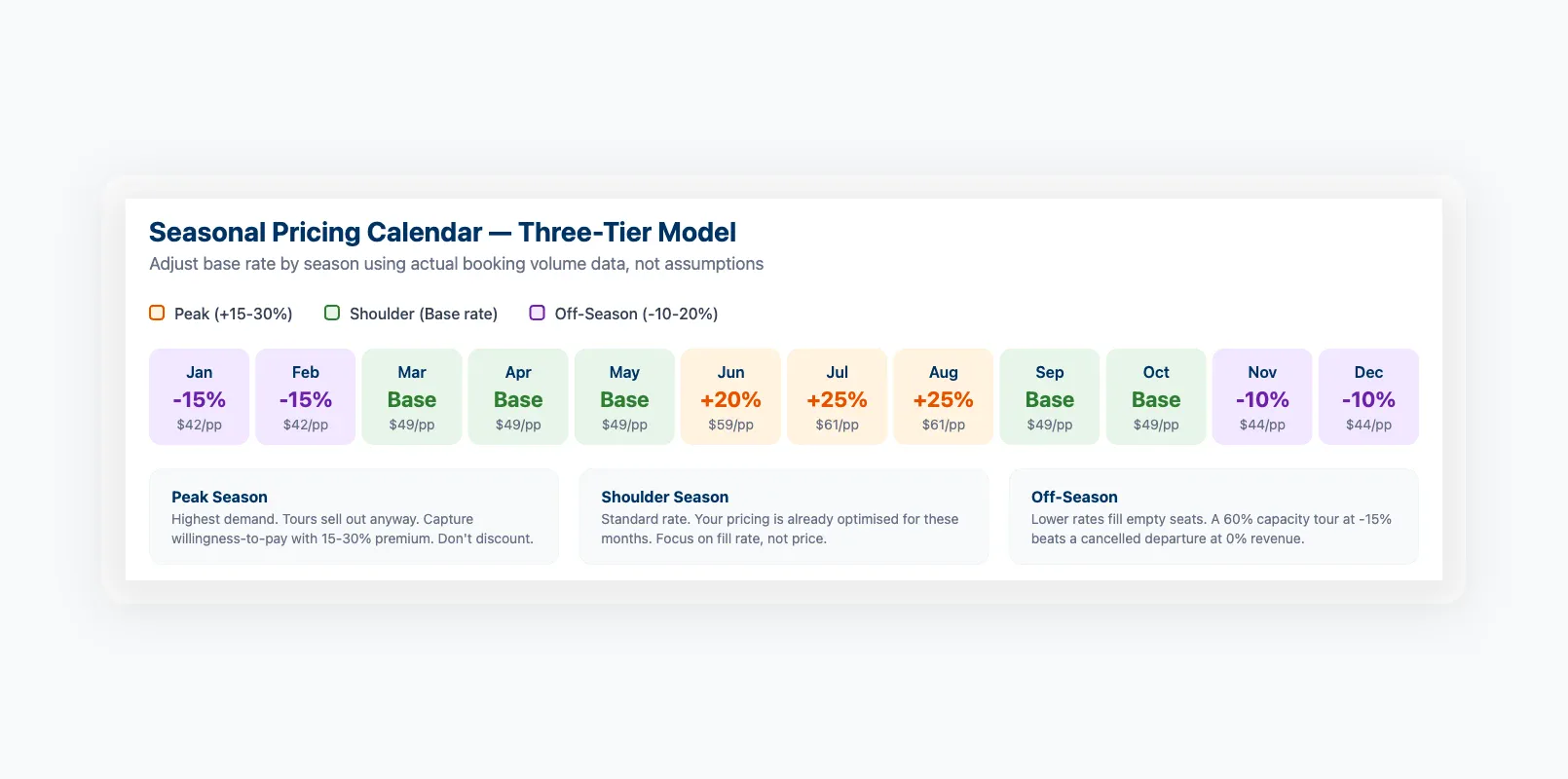
Define your seasons. Most tour markets have three pricing bands:
| Season | Typical Months | Price Adjustment |
|---|---|---|
| Peak | Jun-Aug (Northern Hemisphere), Dec-Feb (Southern) | Base rate (or +10-20%) |
| Shoulder | Apr-May, Sep-Oct | -5% to -10% from peak |
| Off-season | Nov-Mar (Northern), Jun-Aug (Southern) | -10% to -20% from peak |
Never discount more than 20% off peak. Deeper discounts train customers to wait for deals and devalue your product permanently. If off-season demand is weak, add value instead of cutting price: include a hot drink, a bonus stop, an extended route, or a small souvenir at the same price point. The perceived value increases without eroding your rate card.
Shoulder season is where you make or lose the year. Peak season sells itself. Off-season is about survival. Shoulder season (the 2-3 months on each side of peak) determines whether you end the year profitable or breaking even. Small discounts (5-10%), targeted marketing to locals, and partnerships with hotels running shoulder-season promotions fill the gap. Our guide to filling tours in the fall shoulder season works through the foliage calendar, harvest variants, and midweek locals' pricing in detail.
Holiday and event surcharges. New Years Eve, Valentines Day, local festivals, and long weekends command premium pricing. A sunset tour on Valentines Day at $99 per person (vs. $69 standard) sells out because the occasion justifies the spend. Build a holiday pricing calendar at the start of each year and load rates into your booking system in advance.
Weekend vs. weekday pricing. Saturday and Sunday tours fill faster and attract more price-insensitive tourists. A $5-10 per-person weekend surcharge (or equivalently, a weekday discount) shifts some demand to quieter days without leaving weekend money on the table.
Group and Corporate Tiers: Volume Without Margin Erosion
Group bookings and corporate events are high-volume, high-effort, high-value. The pricing needs to reflect all three. For the full breakdown of tiered discounts, private versus join-in rates, and handling group size changes, see our tour operator group pricing guide.
Group discount structure. Offer tiered discounts that scale with group size:
- 10-14 guests: 10% off per-person rate
- 15-24 guests: 15% off per-person rate
- 25+ guests: custom quote (you need to scope logistics before pricing)
Never exceed 20% off your standard rate for any group size. Below that floor, you are subsidising their outing with your margin.
Corporate packages are priced differently than group discounts. Corporate customers pay for logistics, not just the tour. They need: one invoice, a dedicated account contact, insurance certificates, custom itinerary options, branded materials, and post-event photos. Package your corporate offering at 20-30% above your per-person rate multiplied by headcount. The client pays more because the service level is higher and the procurement hassle is lower.
Example. Standard tour: $69 per person. Group of 20 at 15% discount: $69 x 0.85 x 20 = $1,173. Corporate package for 20: $69 x 1.25 x 20 = $1,725. Same tour, same guide, same route. The corporate client gets invoicing, insurance certs, branded name tags, a group photo package, and a dedicated coordinator. They happily pay the premium because their procurement department values simplicity over savings.
Require deposits for group and corporate bookings. 50% non-refundable deposit at booking, balance due 14 days before the event. Groups cancel more often than individual bookings, and a canceled 20-person corporate event leaves a $1,000+ hole in your week. The deposit protects your revenue and signals commitment. Use the Tour Pre-Departure Check to ensure nothing falls through on event day.
Dynamic Pricing Rules: Automate Price-to-Demand Matching
Dynamic pricing matches your rates to real-time demand signals. Instead of setting a price once and hoping, you adjust based on how bookings are flowing.
Rule 1: Last-seat premium. When a departure is 75%+ full with 48+ hours to go, increase the price by 10-15% for remaining seats. High demand justifies higher price. A 12-person tour with 9 booked and 3 days to departure should price those last 3 seats at $79, not $69.
Rule 2: Low-fill discount. When a departure is below 40% capacity within 72 hours, drop the price 10-15% and push a flash deal via email or social. The goal is not to race to the bottom. It is to fill seats that would otherwise run empty.
Rule 3: Advance-booking incentive. Bookings made 14+ days in advance get a 5-10% early-bird rate. Bookings within 48 hours pay standard or premium rate. This smooths your booking curve, gives you forecasting visibility, and rewards planners without penalising spontaneous travelers.
Rule 4: Day-of-week adjustment. If Tuesday departures consistently run at 50% capacity while Saturday runs at 95%, price accordingly. Tuesday at $59 (15% off), Saturday at $75 (10% premium). Automate this so it does not require manual intervention every week.
Automation beats manual adjustments. You cannot monitor booking velocity across every departure and manually adjust prices. Dash AI can apply these rules automatically — watching fill rates, days-to-departure, and historical patterns to nudge prices up or down within the guardrails you set. You define the floor and ceiling; the system handles the real-time math.
For building the right tech stack to support automated pricing, see How to Run a Tour Operator Business. For broader booking operations, explore the tours hub and tour operator glossary. For checklists that keep your operation tight, use the Tour Guide Certification and Training Review.
FAQ
How much more should I charge for a private tour vs. a group tour?
Price private tours at 1.5-2.5x your standard full-departure revenue, structured as a flat rate for the group (up to a guest cap) rather than per-person. A standard tour grossing $828 at full capacity should price privately at $450-600 for up to 6-8 guests. The guide cost is identical, but the customer pays for exclusivity and flexible scheduling.
Should I offer different prices for weekdays vs. weekends?
Yes. Weekend tours typically fill faster and attract more price-insensitive tourists. A $5-10 per-person weekend surcharge (or equivalent weekday discount) shifts some demand to quieter days. Saturday departures at $75 and Tuesday departures at $59 can both be profitable — the key is matching price to demand rather than running one rate that underprices high-demand slots.
How do I avoid a race to the bottom with seasonal discounts?
Never discount more than 20% off your peak rate. Deeper discounts train customers to wait for deals and permanently devalue your product. Instead, add value during slower periods: include a complimentary drink, a bonus stop, or a small souvenir at the same price point. The perceived value increases without eroding your rate card.
What is the difference between group pricing and corporate pricing?
Group pricing is a volume discount — 10-15% off per-person rates for parties of 10+. Corporate pricing is a premium package (20-30% above your per-person rate multiplied by headcount) because it includes logistics that corporate procurement values: single invoicing, insurance certificates, a dedicated coordinator, branded materials, and post-event deliverables. Same tour, different service level, different price.
Can I automate dynamic pricing for my tours?
Yes. Define your pricing rules (last-seat premium, low-fill discount, advance-booking incentive, day-of-week adjustment) with floor and ceiling guardrails. An all-in-one booking platform can apply these rules automatically based on fill rates, days-to-departure, and historical booking patterns — adjusting prices in real time without manual intervention.
How do I handle OTA pricing when I have dynamic rates?
Maintain pricing parity between your OTA listings and your website for the base rate. OTAs like Viator and GetYourGuide penalise operators whose direct site undercuts their listed price. Offer a book-direct incentive (a free add-on, priority time slot, or small discount code) rather than a lower headline price. Your dynamic pricing rules apply to your direct booking channel; OTA rates update on a daily or weekly schedule.
in one place