How to Run an RV and Campervan Rental Business: The Complete Guide (2026)
An RV rental business hands a guest a $90,000 vehicle, a full water tank, and the keys to two weeks on the road — then waits to see what comes back. That is the whole business in one sentence. Compared with renting kayaks or e-bikes, the ticket is bigger, the asset is bigger, and the ways a rental can go sideways are bigger too: a misjudged fuel policy, an uninsured driver, a black tank nobody explained. The operators who sleep at night are not the lucky ones. They are the ones who chose the right business model, wrote the walkthrough down, and priced the mileage before the first booking went live.
This is the complete playbook for running an RV rental business in 2026, whether you are listing one campervan on a peer-to-peer platform or running fifteen motorhomes off your own yard. It covers the choice between platform and owned fleet, what to buy and in what mix, the insurance layer that decides whether a bad week ends the company, the handover and return routines that prevent 90% of disputes, pricing that actually covers depreciation, and the seasonal rhythm that makes or breaks year one. If a term trips you up along the way, the RV rental glossary covers the vocabulary from black tank to walkaround.
Peer-to-Peer, Owned Fleet, or Hybrid: Choose Your Model
Every RV rental business starts with the same fork in the road, and the answer shapes everything downstream: margins, insurance, marketing, even what vehicles you buy.
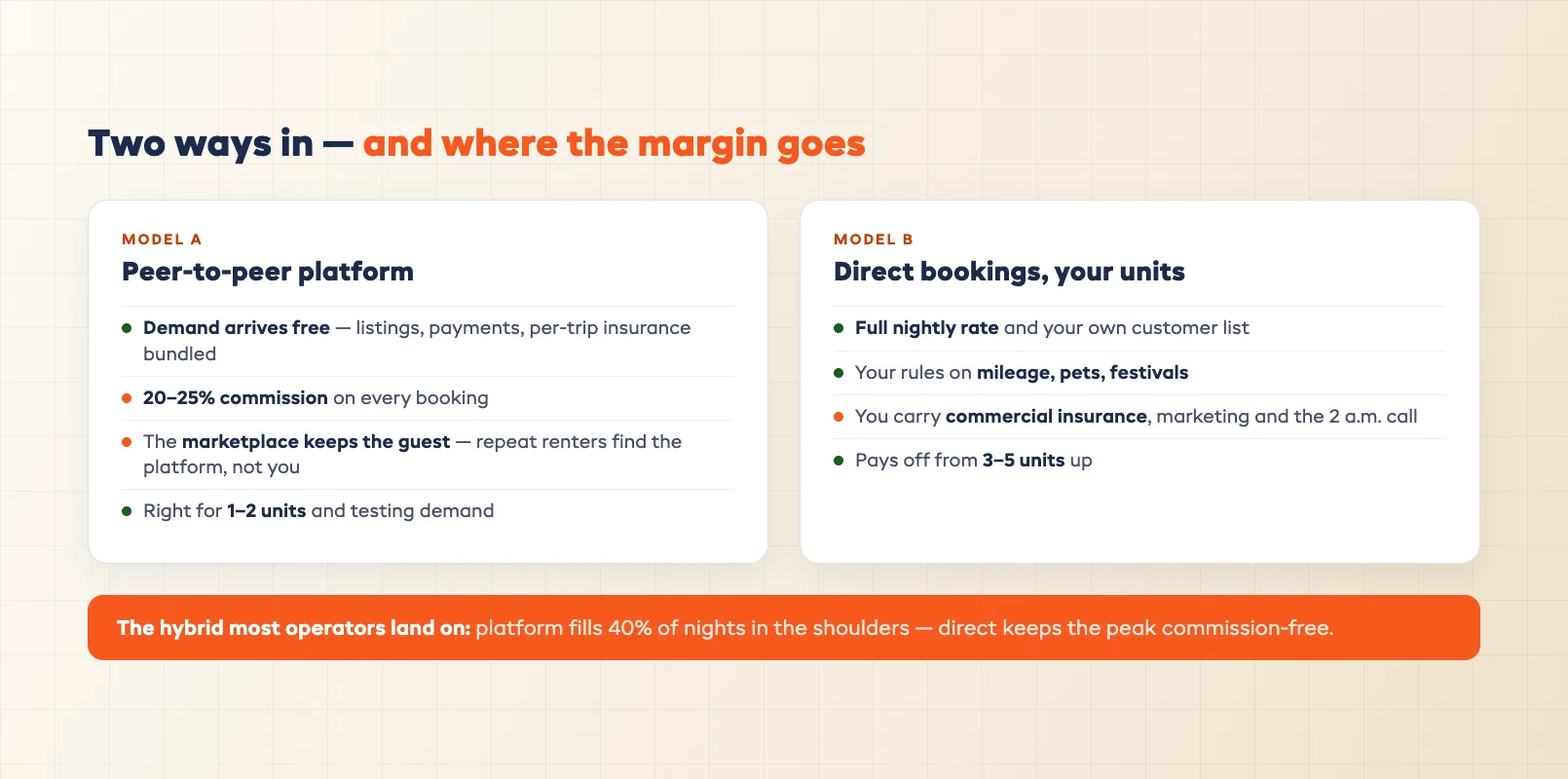
Peer-to-peer platforms (Outdoorsy, RVshare, and their regional equivalents) are the low-friction entry. You list a vehicle, the platform brings demand, processes payment, and wraps each trip in its episodic insurance. The cost is real: platform commissions typically run 20–25% of every booking, you compete on a crowded results page, and the guest relationship belongs to the marketplace, not to you. A repeat renter finds the platform again, not your phone number.
An owned fleet with direct bookings flips all of that. You keep the full nightly rate, you own the customer list, and you set your own rules on mileage, pets, and festivals. In exchange, you carry the hard parts yourself: commercial insurance, your own booking site, marketing spend, and every 2 a.m. breakdown call. Direct operators generally need three to five units before overheads stop eating the margin advantage.
The hybrid is where most serious operators land. Start on a platform to validate demand and fill the calendar, then build a direct channel and migrate your best guests to it. A common year-two pattern: platforms fill 40% of nights at a 25% commission, direct bookings fill the rest at full rate, and every platform guest gets a card in the glovebox with your own booking address on it.
There is a third variant worth naming: consignment. Private owners place their RVs in your fleet; you manage bookings, cleaning, and handovers for a 30–40% management share. It scales your fleet without capital, but only works once your operations are tight enough to defend someone else's asset.
Pick based on capital and appetite: one unit and a day job points to peer-to-peer; savings, a yard, and a plan to grow points to owned-plus-direct with a platform topping up the shoulder season.
Building the Fleet: Class A, Class B, Class C, and Campervans
The class mix decides who books you, what you charge, and how much you spend keeping vehicles on the road. Buying what you would personally love to drive is the classic first mistake.
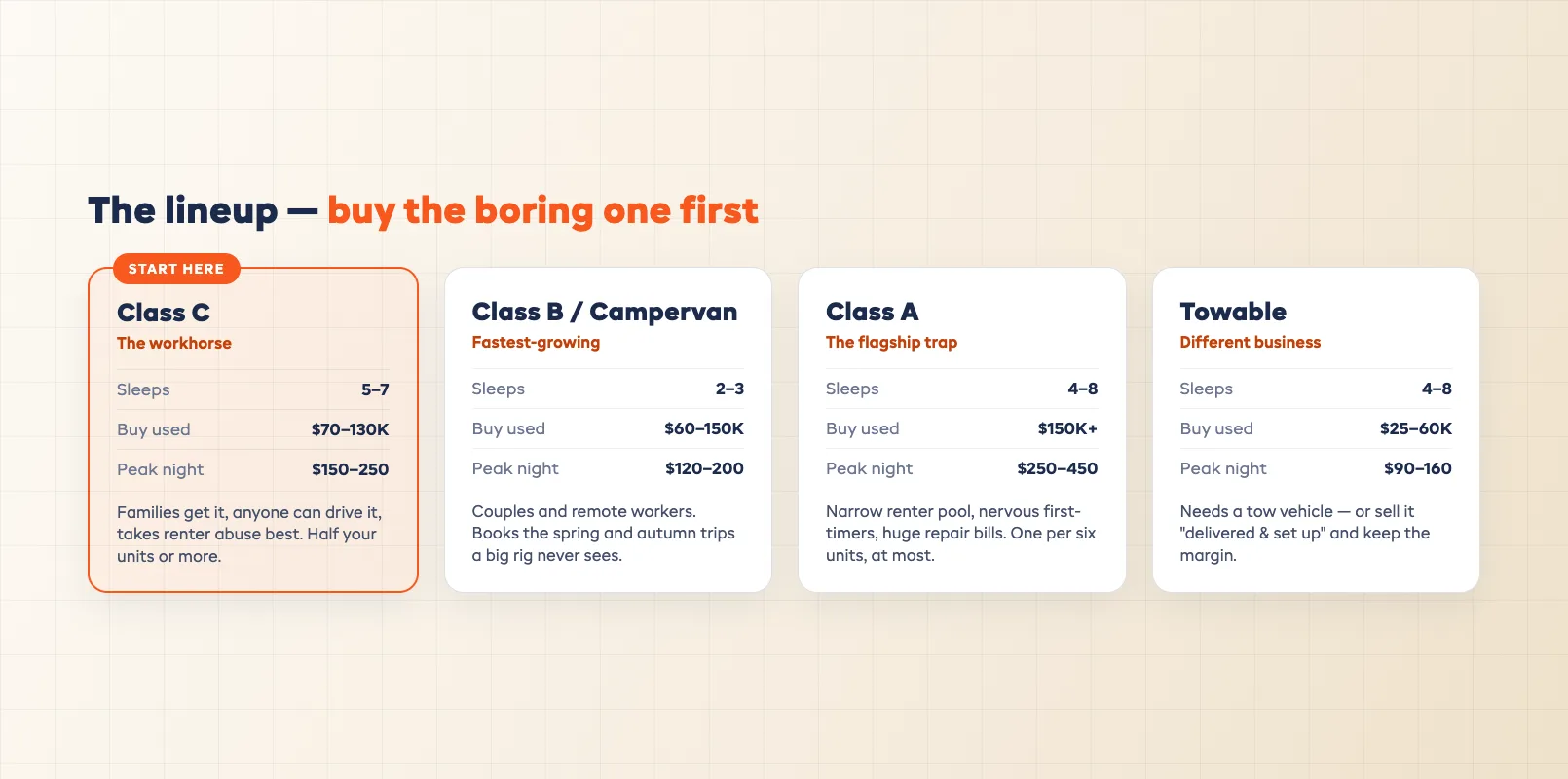
- Class C motorhomes are the workhorse of the industry — the cab-over-bunk units sleeping five to seven. Families understand them, anyone with a standard license can drive one, and they tolerate renter abuse better than anything else on the lot. Typical purchase: $70,000–$130,000. Most fleets should be half Class C or more.
- Class B campervans (and their van-conversion cousins) are the fastest-growing segment: couples, remote workers, festival-goers. Easier to drive, cheaper to run, bookable for city-plus-coast trips a big rig can't do. Purchase from $60,000 used to $150,000+ for a new premium conversion. They book younger guests and longer shoulders — spring and autumn trips a family unit never sees.
- Class A motorhomes are the bus-style flagships. Premium nightly rates, but a narrow renter pool, nervous first-timers behind the wheel, eye-watering repair bills, and in some regions licensing complications. Most operators should own zero until there is proven demand; one Class A in a six-unit fleet is plenty.
- Towables (travel trailers, caravans) are a separate business model — cheaper to buy and maintain, but they filter for guests who own a tow vehicle and know how to use it. Some operators solve this with "delivered and set up" rentals: you tow the trailer to the campground, the guest never hitches a thing. Margins on delivery packages are excellent.
A sensible first fleet of four: two Class C units, one campervan, one more of whichever books out first. Buy two-to-four-year-old units with service history rather than new: the first owner has already eaten the steepest depreciation, and renters are no gentler on a new vehicle than on a clean used one.
Insurance, Agreements, and Who Pays When Things Go Wrong
Insurance is the part of an RV rental business that decides whether one bad week is an expensive story or the end of the company. Get it settled before the first booking, not after.
If you rent through a peer-to-peer platform, episodic coverage is bundled per trip. Read the exclusions anyway, because interior damage, awnings, and roof strikes are routinely carved out. If you rent direct, you need a commercial rental-fleet policy: personal RV insurance is void the moment money changes hands, and a standard business auto policy will not cover renters as drivers. Expect the commercial layer to be one of your three biggest operating costs, and expect the underwriter to ask about renter age limits (most policies want 25+), driver-license verification, and your inspection routine.
The rental agreement is the second layer (the dedicated guide to RV rental agreements, insurance, and damage protection covers the full document) and it earns its keep in four clauses:
- Named drivers only: every driver license-checked and listed. An unnamed driver in an accident can void the claim entirely.
- Responsibility and excess: the guest's deposit is on the line for damage up to the excess; state the number plainly rather than burying it.
- Prohibited use: festivals-without-declaration, off-road tracks, towing, smoking, and unapproved borders. Not because you will enforce every line, but because the claim depends on them being written down.
- Roof and awning liability: the two most common damage sites on any rented motorhome, and the two most commonly excluded from platform coverage. Many operators make guests initial a separate line for overhead damage; it changes how people drive under petrol-station canopies.
Add roadside assistance to every rental — bundled into the rate, not sold as an extra. A guest broken down without cover becomes your logistics crisis either way; the only question is whether it was funded.
The Handover: Walkthroughs, Photos, and Paperwork
Nothing in this business predicts guest satisfaction, and dispute rate, like the quality of the handover. An RV is a vehicle, an apartment, and a plumbing system in one, and most renters have operated exactly none of those on wheels.
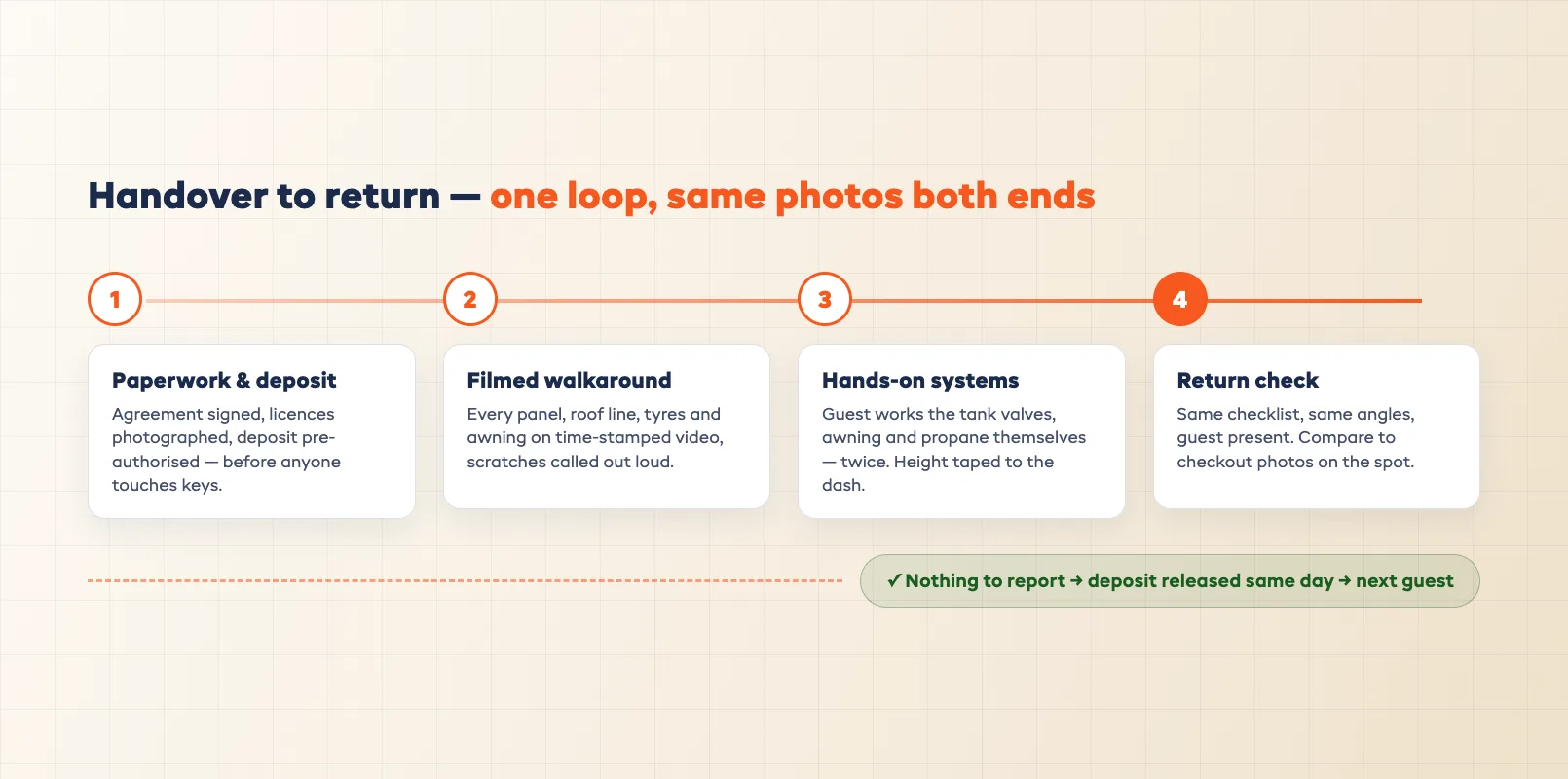
Script it and run the same sequence every time:
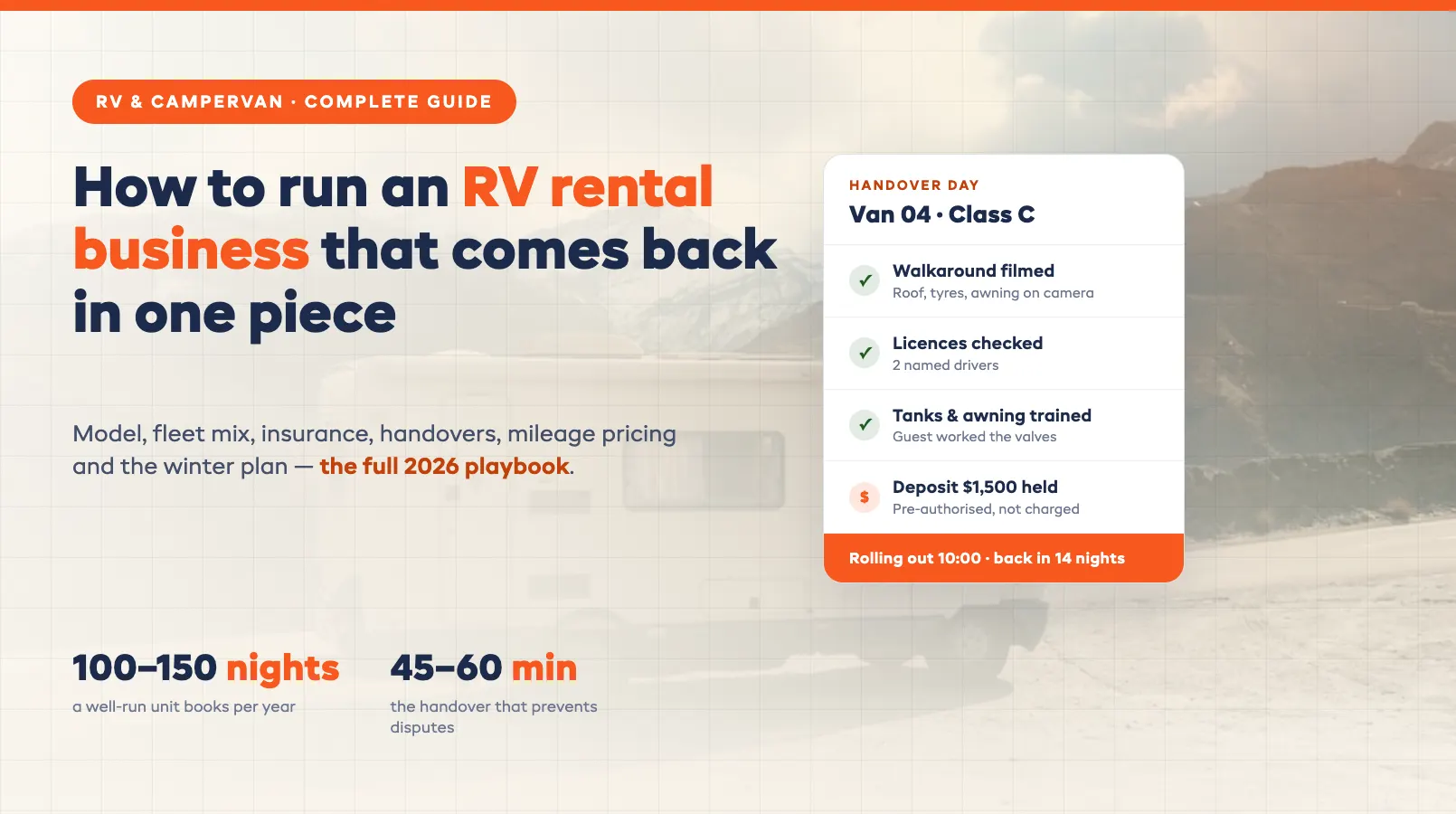
- Paperwork first: agreement signed, driver licenses photographed against the named-driver list, deposit pre-authorized. Doing this before the walkthrough means nobody is signing documents with one foot in the driver's seat.
- The recorded walkaround — you and the guest circle the vehicle together while you film it: every panel, the roof line from a step-ladder, tires, awning arms, existing scratches called out loud on camera. Time-stamped photos or video are what settle the "that scratch was already there" conversation in October.
- Systems training, in order: fresh water fill, gray and black tank dump (make them work the valves themselves, not just watch), propane, fridge modes, heating, the awning (out and in, twice), and the height of the vehicle taped to the dashboard. Guests forget verbal instructions by the first roundabout; the ones who did it with their own hands remember.
- The leave-behind: a one-page laminated cheat sheet plus a QR code to short how-to videos. Every question answered by the sheet is a phone call you don't take on Saturday night.
Budget 45–60 minutes for a first-time renter and refuse to compress it. Operators who cut the handover to fifteen minutes buy themselves burnt clutches, flooded bathrooms, and deposit fights. The full routine (the departure shot list, systems training, return comparison, and how to charge fairly for what you find) is covered step by step in the handover and return inspection guide.
Return Day: Inspections, Fuel, and Deposit Decisions
The return inspection closes the loop the handover opened: same checklist, same photo angles, ideally the same staff member.
Walk the vehicle with the guest present whenever schedules allow. Compare against the checkout photos on the spot: agreeing on a scraped bumper face-to-face takes three minutes; arguing about it by email takes three weeks. Check fuel and propane against the agreement (full-to-full is the cleanest policy: anything else invites arithmetic disputes), confirm the tanks were dumped if your terms require it, and run the interior sniff-and-scan for smoking and pets.
Then make the deposit call fast. Nothing to report? Release the hold same day and tell the guest you have. It is the single cheapest goodwill move in the industry. Damage found? Document it in photos beside the checkout photos, quote the repair from your published charge list, take it from the deposit, and send the evidence with the invoice. Charge what the damage costs, never what the hold allows: a $1,500 deposit is not a $1,500 fee menu. Fair, evidenced charges get paid without drama; padded ones become chargebacks and one-star reviews that cost more than the repair.
Between return and the next handover sits the turnaround: dump and flush tanks, sanitise the kitchen and bathroom, launder linens, top propane, safety-check tires and lights, and stage the unit for the next walkthrough. A full turnaround on a motorhome takes four to six staff-hours, which is why back-to-back same-day changeovers are where standards quietly collapse. Build a buffer night into the calendar between bookings until your crew proves they don't need it. The full reset workflow (tank service, sanitising, safety checks, and staging) is broken down step by step in the RV fleet maintenance and turnaround guide.
Pricing: Nightly Rates, Mileage, and Extras
RV pricing has more moving parts than almost any other rental vertical: a nightly rate, a mileage allowance, generator hours, cleaning, extras, and a seasonal curve steep enough to double rates between May and July.
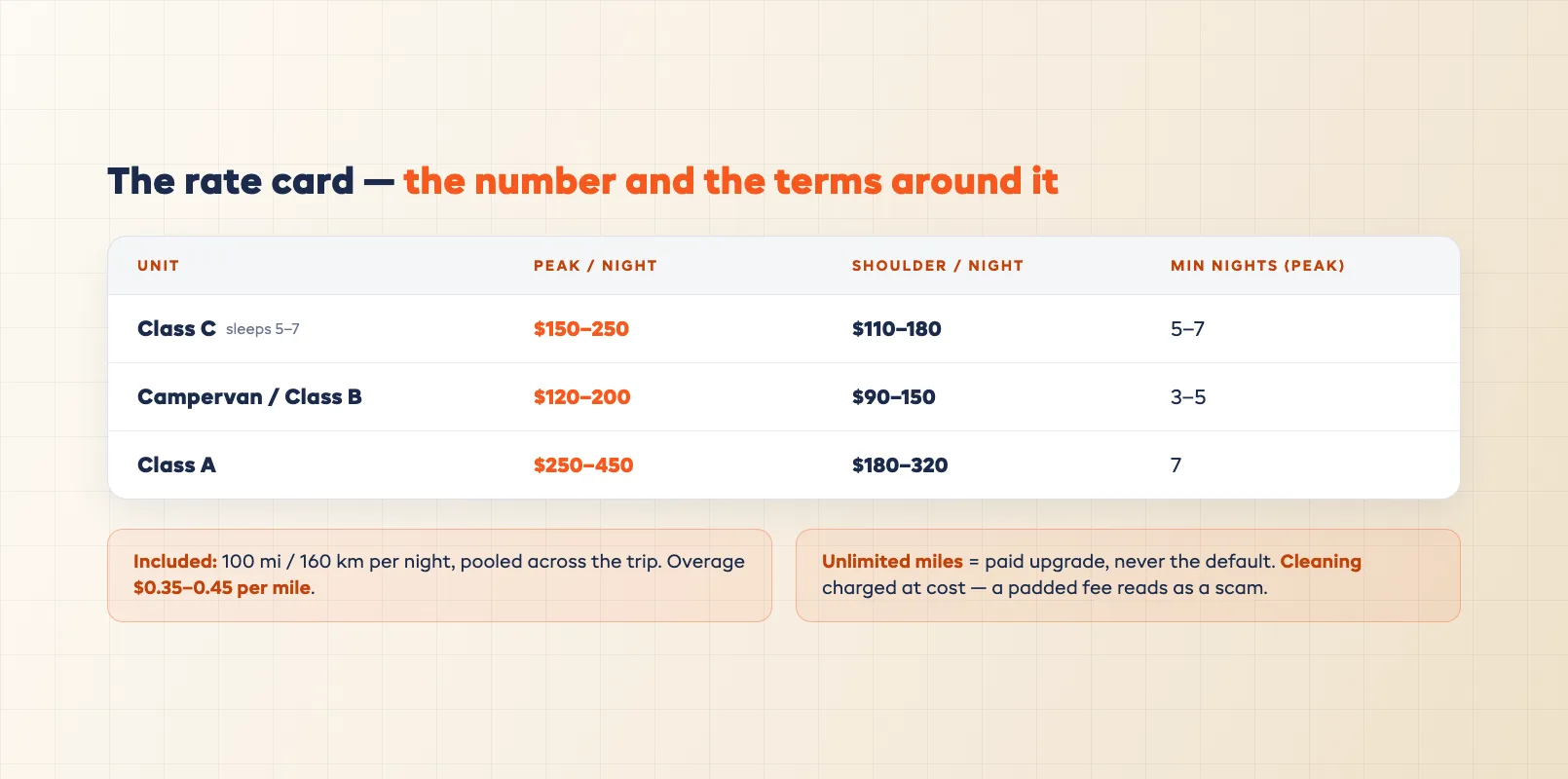
Anchor the nightly rate to what the unit must earn, not what the platform average shows. A quick floor: annual costs per unit (finance or depreciation, insurance, maintenance, storage, cleaning labor) divided by realistic booked nights (most operators net 100–150 nights a year per unit) then margin on top. In practice that lands a mid-age Class C at roughly $150–$250 a night in peak season, campervans at $120–$200, and a Class A at $250–$450. If the arithmetic says your rate can't compete, the problem is the vehicle's cost base, not the market.
The terms around the rate matter as much as the rate:
- Mileage: the standard structure is an included allowance (commonly 100 miles / 160 km per night, pooled across the trip) with a per-mile overage of $0.35–$0.45. Unlimited-mileage pricing sounds guest-friendly and quietly hands your engine life to the 4,000-mile road-tripper. Offer unlimited only as a paid upgrade.
- Minimum nights: three nights standard, five to seven in peak weeks. Every changeover costs those four to six turnaround hours; short bookings in July are how you go broke while fully booked.
- Generator hours — meter them if your units have one: a few hours a day included, then an hourly charge.
- Extras that earn: bedding kits, camp chairs and table, portable BBQ, bike racks, unlimited-mileage upgrades, and "arrive-and-drive" packages (pre-filled water, stocked essentials). Extras routinely add 10–15% to booking value at near-pure margin.
- One fee that shouldn't profit: cleaning. Charge it at cost and say so; guests read a padded cleaning fee as a scam even when the nightly rate is fair.
Then let the calendar move the number: peak-summer weeks at your ceiling, shoulder months 20–30% below, long-hire winter discounts, and event weekends (festivals, eclipses, big games) priced like the second peak season they are.
Seasonality: Peak Summer, Shoulder Deals, and the Winter Question
An RV rental business in most climates earns 70% of its revenue in five months. That is not a flaw in your marketing; it is the shape of the industry, and the whole year has a job to do.
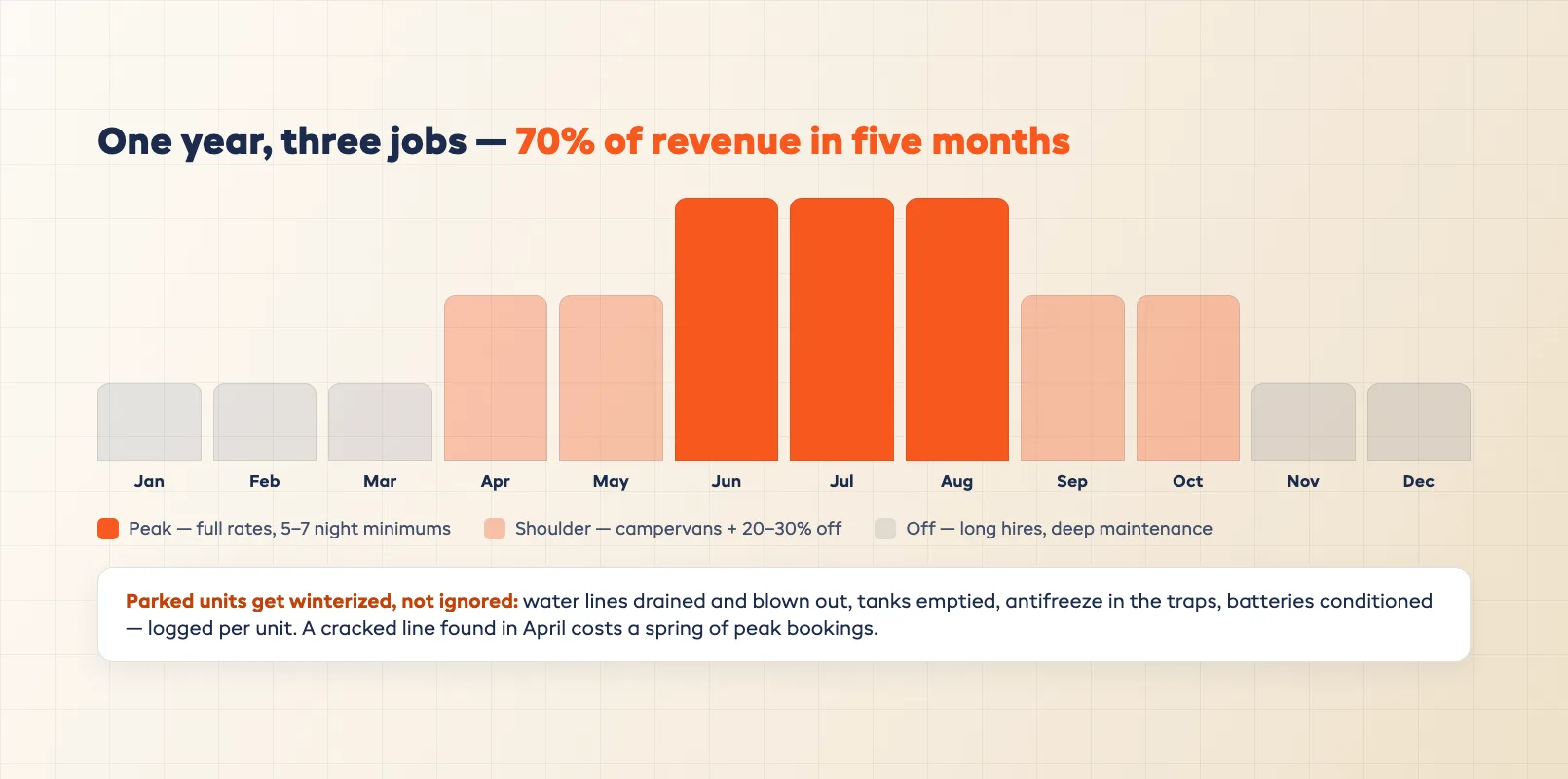
- Peak (June–August, plus Easter and local holidays): full rates, long minimum stays, and a calendar managed for revenue, not occupancy. The expensive mistake of peak season is the three-night gap between two bookings that nothing can fill.
- Shoulders (April–May, September–October): the growth frontier. Couples in campervans, retirees chasing quiet campgrounds, autumn-color road-trippers. This is where the Class B section of your fleet pays for itself, and where 20–30% discounts convert browsers who would never pay July rates.
- Winter — pick a strategy per unit rather than letting the season happen to you: long-hire monthly rentals (film crews, relocations, homeowners mid-renovation), snowbird one-way logistics if your geography supports it, or full winterization and storage. A unit that earns nothing from November to March but avoids one freeze-damage claim has had a decent winter.
Use the quiet months deliberately: deep maintenance, interior refits, photography, and next season's price list. Fleets that treat winter as an off switch start peak season with the same wear they parked in November.
Storage, Parking, and Winterization
Nobody starts an RV rental business dreaming about parking, and then parking becomes a monthly line item with opinions. A growing fleet needs space that is secure, insurable, and workable.
The options ladder up: your own land (free but rarely scales past three units and often collides with zoning), leased yard space at commercial storage ($50–$200 per unit per month depending on market and whether it's covered), or a dedicated depot once the fleet justifies it. Whatever you choose, insurers increasingly ask about fencing, cameras, and GPS trackers, and catalytic-converter theft from parked motorhomes is common enough that secure storage effectively pays part of its own rent.
The depot layer of the business is also where handovers live. A gravel corner with a tap is workable at two units; at eight you want a dump point, fresh-water fill, power hookups for pre-cooling fridges, and an undercover bay so returns and walkthroughs happen in the rain without cutting corners.
In freezing climates, winterization is non-negotiable for any unit sitting out the cold months: drain and blow out the water lines, add antifreeze to the traps, empty and clean the tanks, condition the batteries, and record it all on a per-unit checklist. A cracked water line discovered in April costs a spring of peak bookings; the winterization that prevented it costs an afternoon.
The Booking System That Holds It Together
Run the model, fleet, insurance, handover, pricing, and seasonal calendar through one more filter: can your systems keep up when three units check out on the same Saturday morning?
Spreadsheets survive one RV. They do not survive five, because this vertical stacks requirements most booking tools ignore: per-unit calendars with turnaround buffers between trips, security-deposit pre-authorization and release, signed agreements and license capture before handover, mileage and fuel recorded at both ends, and inspection photos attached to the booking they belong to. Purpose-built rental software like EquipDash handles that stack in one place (calendar, deposits, digital paperwork, and inspection records per booking) so the Saturday with three departures runs on process instead of memory. Whatever platform you choose, the test is the same: fewer tabs open on changeover day, not more.
For a deeper look at how the software layer fits the rest of the operation, the RV and campervan operator hub breaks down the tooling vertical by vertical.
Putting It Together
The RV rental operators who last share a pattern: they choose a model deliberately instead of drifting between platform and direct, they buy the boring Class C before the glamorous Class A, they treat insurance and agreements as the foundation rather than paperwork, and they run the same recorded handover and return inspection every single time. Price the mileage, protect the turnaround buffer, plan the winter before it arrives, and the $90,000 vehicle you hand over on Friday comes back as a five-star review instead of a claim. Start with one unit run properly. The second one is easier, and by the fourth you are not renting an RV; you are running an RV rental business.
FAQ
How much does it cost to start an RV rental business?
Entry depends on the model. Listing one used campervan on a peer-to-peer platform can start around $60,000–$80,000 for the vehicle plus a few thousand for detailing, extras, and photography. An owned fleet of three to four units with commercial insurance, a booking site, and yard space typically needs $250,000–$450,000, most operators finance the vehicles rather than buying outright.
Is an RV rental business profitable?
It can be, with realistic expectations. A well-run unit books 100–150 nights a year; after finance, insurance, maintenance, cleaning, and storage, operators commonly net $8,000–$20,000 per unit annually — more on delivered trailers and premium campervans, less on heavily financed new stock. Profit concentrates in units bought used, priced with proper mileage terms, and kept booked through the shoulder seasons.
Should I start on a peer-to-peer platform or take direct bookings?
Most operators should start on a platform and build direct alongside it. Platforms bring demand and per-trip insurance while you learn the operation, at the cost of 20–25% commission and the guest relationship. Once the calendar fills and your handover routine is solid, add a direct booking channel and move repeat guests to it — the hybrid keeps platform demand for the shoulders while your best weeks book commission-free.
What insurance do I need to rent out my RV?
Personal RV insurance never covers paid rentals. On a peer-to-peer platform, the marketplace bundles episodic per-trip coverage. Check the exclusions for roofs, awnings, and interiors. For direct rentals you need a commercial rental-fleet policy that covers renters as drivers, usually with a minimum renter age of 25 and license verification. Add roadside assistance to every booking and put roof and awning responsibility in writing in the agreement.
How do mileage limits work in RV rentals?
The standard structure is an included daily allowance — commonly 100 miles (160 km) per night, pooled across the whole trip — with overage billed at $0.35–$0.45 per mile, recorded from odometer photos at checkout and check-in. Unlimited mileage is best sold as a paid upgrade rather than given away, because engine hours and service intervals are the real cost of a high-mileage trip.
What is the biggest mistake new RV rental operators make?
Rushing the walkthrough. Most damage, disputes, and desperate phone calls trace back to a guest who was never properly shown the tanks, the awning, or the vehicle height. A scripted 45–60 minute recorded walkaround with hands-on systems training prevents more losses than any clause in the contract, and it is also the moment guests decide you are professionals worth booking again.
in one place